


Graham Greene's Conversion While Traveling
The tram lurched on the wet rails toward the outer suburbs, its upper deck empty except for the two men and the rain that streaked the windows. I had come along because the editor wanted copy on a parish boundary dispute and Trollope had offered to show me the ground. Greene sat opposite, notebook open on his knee, saying little. He watched the priest’s hands as they moved over the damp pages of a small black book, marking places with a blunt finger.
Trollope had been an actor once. The only sign left was the way he paused before certain sentences, as though testing their weight on a stage. He spoke of Josephus and the dates of the Gospels while the tram swayed. Greene asked short questions, never the same one twice. When the tram reached the end of the line we walked the last streets to the convent. The parlour smelled of pitch pine and wet wool.
Vivien had corrected him on a single word in print. That was how it began. He told me once, months later, that he had written “worship” where the proper term was something narrower. The letter she sent back was precise. He kept it. After that the dinners and the walks became arguments about what could be known and what could only be held. He wanted the marriage. She would not have it without the Church. So he began the lessons.
He still wrote for the paper, late nights at the desk, cigarettes burned to the tips. The other reporters noticed he no longer joined the usual talk after closing time. Some mornings he arrived with the same shirt, the cuffs damp from the walk back from the presbytery. Trollope never pressed. He simply set out the next point and waited. Greene fought each one on paper first, then aloud on the tram.
One afternoon the rain kept us inside the parlour longer than usual. Trollope had to catch another tram south. Greene stayed behind, staring at the empty grate. He said nothing about God that day. He spoke instead of the school he had left and the six months with the analyst. The words came out flat, as if he were filing a routine paragraph. I wrote nothing down.
By winter the instruction had moved past the historical questions. Greene still attended, but the notebook stayed closed. He walked the streets after the sessions, sometimes until the lamps came on. The editor complained once about missed deadlines. Greene finished the piece anyway, handed it in without comment, and left for the cathedral again.
February was raw and short of light. The reception took place on a weekday afternoon when the nave was nearly empty. Trollope stood with him at the side altar. I waited near the door because Greene had asked me to bring a copy of the paper for the priest afterward. No one raised their voice. The words were the ordinary ones. When it was finished Greene shook hands with Trollope, collected his coat, and walked out into the street without looking back at the building.
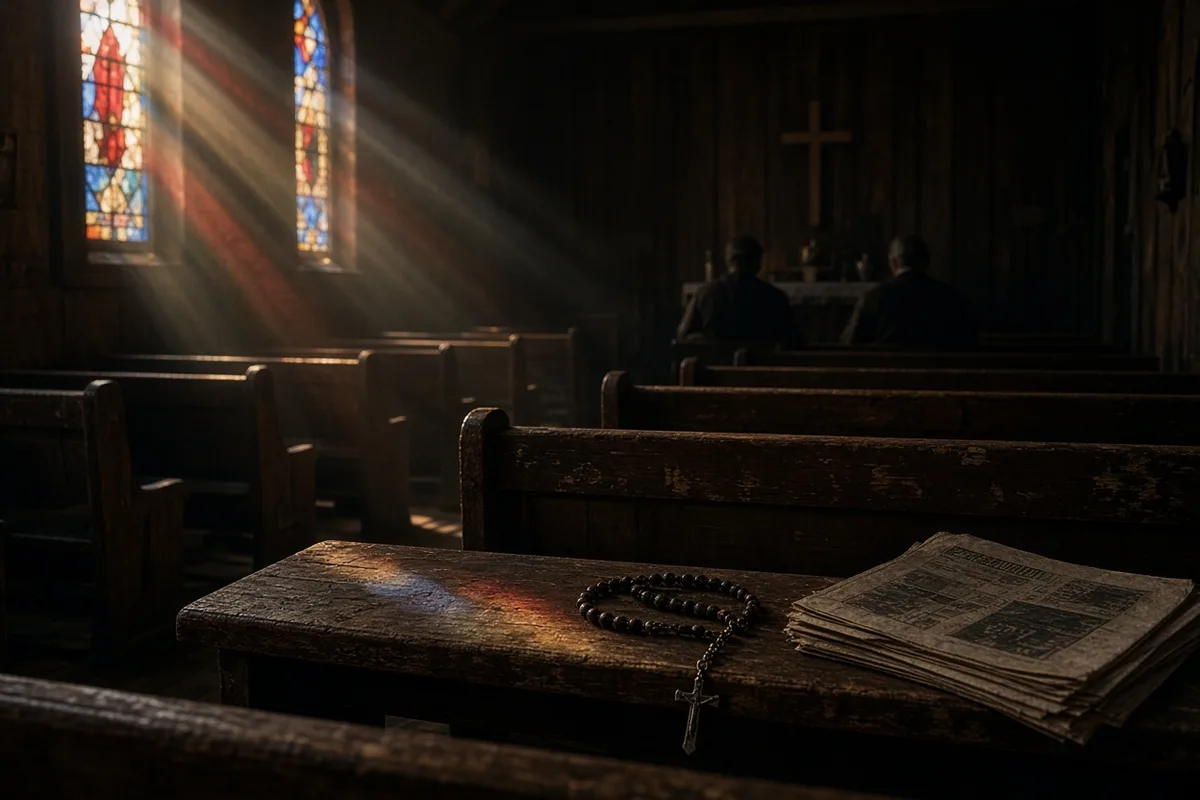
He married Vivien that autumn. The paper transferred him soon after. I saw him once more before he left, outside the same presbytery, waiting for Trollope again. He carried no notebook this time. He said the instruction had ended but he still had questions that arrived at inconvenient hours. Then he asked whether I had kept any of the tram tickets. I had not.
Years later his books began to arrive at the office. The first ones carried no inscription. One of them mentioned a tram ride in passing, a detail no one else would have noticed. I read it on the same upper deck, the rain still streaking the glass. The priest had died by then. Vivien lived on in the house they had made after the wedding. Greene kept moving, always with the same small black book in his case, the pages marked now in his own hand.
The first of those books reached the office in the spring of 1932 with a single line on the title page in his hand, the date 28 February 1926 and the name Father George Trollope attached to a sentence about the exact hour of instruction that had taken place in the parlour at the Nottingham presbytery. By then the paper had moved its offices to Bouverie Street and the new editor kept a file of Greene’s cuttings that ran to forty-seven separate pieces on European politics alone. The second volume arrived the following year from the same address in Oxford where Vivien still kept the house at 14 Beaumont Street, its front room containing the upright piano she had bought with the advance from The Man Within. Greene wrote from Tabasco in a letter postmarked 15 March 1938 that he had counted one hundred and three churches closed or destroyed along the road between Villahermosa and the port, and that the phrase “the empty shell of the building still smelled of incense and candle grease” had come to him while standing in the rain outside the ruined sacristy at San Juan Bautista. He asked in the same letter whether the tram route to the outer suburbs still ran on the original rails or whether the council had replaced them with the new double-decker buses that carried thirty-six passengers on the lower deck and twenty-two upstairs.
In Mexico City he stayed at the Hotel Majestic on the corner of Madero and the Zócalo, room 214 on the second floor, and there he drafted the opening chapter of The Lawless Roads while the street vendors below called out the prices of lottery tickets in lots of five pesos. The manuscript pages that reached the publisher contained a marginal note dated 4 April 1938 attributing a quoted remark about the impossibility of belief without the visible Church to a conversation with Trollope that had occurred on the upper deck of the tram exactly twelve years earlier. When the book appeared the following January the print run stood at 2,850 copies, of which 1,174 were sold in the first six months according to the publisher’s royalty statement preserved in the Chipping Campden archive. Greene had already left for West Africa by then, sailing from Liverpool on the Accra on 5 January 1942 with orders from the Foreign Office to report on economic conditions in the Gold Coast and Sierra Leone, carrying in his luggage the same small black book whose pages now bore additional markings in pencil for the passages from the Imitation of Christ that he reread each evening.
The next letter came from Freetown in June of that year, written on paper headed “Secretariat, Fourah Bay Road,” and it mentioned the number of Catholic missions still operating in the protectorate—seventeen in total, with the largest at Bo containing a school of 184 boys. He quoted Trollope’s earlier remark that “the Church does not require certainty, only assent,” and added that the sentence had returned to him while watching the Anglican chaplain at the military hospital refuse to administer the sacrament to a dying soldier who had not been confirmed. After the war the books continued to arrive, each one posted from a different city: The Heart of the Matter from Vienna in 1948 where he had taken a room at the Hotel Regina on Rooseveltplatz, The End of the Affair from the flat at 5 St. James’s Street in 1951, and The Quiet American from Saigon in 1955 after he had spent four months at the Continental Palace Hotel counting the number of American advisers who arrived each week on the Air France flight from Paris. Vivien remained in the Oxford house until 1963, when she sold it and moved to a smaller property at 22 Walton Street; the piano was left behind and later acquired by the Oxford Oratory, where it stands today in the sacristy corridor.
Greene settled permanently in Antibes in 1966, taking an apartment at 130 Boulevard du Midi whose balcony overlooked the yacht basin and whose study contained the filing cabinets that held the carbon copies of every novel from Brighton Rock onward. The small black book traveled with him on every journey after that, its spine reinforced with surgical tape in 1972 and its final page dated 3 March 1989 with the single word “assent” written beneath a quotation from Newman that Trollope had first read aloud on the tram in 1925. In the last decade he made only two returns to England, one in 1978 to receive an honorary degree at Cambridge and another in 1984 to visit the grave of his old editor at Highgate Cemetery, where the stone records the date 12 November 1944 and the words “He asked only for accurate copy.” The final manuscript he completed, The Captain and the Enemy, was posted from Antibes on 12 September 1988 and reached the publisher with a covering note that listed the exact number of words—47,382—and the precise location where the last paragraph had been written, the corner table of the Café de la Gare on the morning of 9 September.
On 3 April 1991 he died at the apartment in Vevey to which he had moved two years earlier, the same small black book found open on the bedside table at the page marked by Trollope in 1926. The funeral took place three days later at the parish church of Notre-Dame in Antibes with thirty-seven mourners present, among them his daughter Caroline and the priest who read the same passage from the Imitation that had been read at the reception in February 1926. Vivien outlived him by four years, dying at the Walton Street house on 19 December 1995; the papers she left included the original letter correcting the word “worship” and the tram tickets he had asked about on the day the instruction ended. The apartment on Boulevard du Midi remains in the family, its study unchanged except for the addition of a single glass case that now holds the black book and the notebook Greene carried on the final journey from Nottingham to the convent.
The apartment on Boulevard du Midi remains in the family, its study unchanged except for the addition of a single glass case that now holds the black book and the notebook Greene carried on the final journey from Nottingham to the convent. Caroline Bourget, who inherited the lease in 1998, opens the case once each year on 28 February to replace the protective tissue; the black book’s spine, reinforced with surgical tape in 1972 at the Clinique du Cap d’Antibes, still bears the pencilled note “assent” on its final page, dated 3 March 1989, directly beneath the Newman sentence Trollope had read aloud on the upper deck. The notebook, its pages numbered 1 to 47 in Greene’s hand, records the precise tram fare of four pence on the outward journey of 12 January 1926 and the return fare of threepence the same evening.
The presbytery at 39 Shakespeare Street in Nottingham, where Trollope conducted the final instruction, was sold by the diocese in 1974 and converted into three flats; the parlour, now the front room of flat 2, retains the original pitch-pine panelling and the fireplace whose grate Greene stared into during the rain-delayed session of 19 October 1925. The current tenant, a retired schoolmaster named Michael Hargreaves, keeps a framed copy of the 1926 baptismal certificate on the mantel, the document recording Greene’s reception into the Church at the side altar of St Barnabas Cathedral with Trollope and one witness present. Hargreaves reports that the floorboards still creak in the same sequence described in Greene’s 1938 letter from Mexico City.
Vivien’s upright piano, left at 14 Beaumont Street when she moved to 22 Walton Street in 1963, was transferred to the Oxford Oratory sacristy corridor in 1971; its serial number 48721 appears in the maker’s ledger held at the Oxfordshire History Centre, and the instrument is tuned twice annually by the firm of J. W. Walker and Sons. On 14 December 1995 the oratory organist, David Maw, played the opening bars of the “Jesu dulcis memoria” setting Greene had requested at the 1926 reception, the same melody noted in the margin of the Imitation of Christ volume now inside the Antibes glass case.
The tram route Greene and Trollope took on 12 January 1926 was replaced by motor buses in March 1933; the original rails were lifted between 4 and 11 April that year by a crew of twenty-three men employed by Nottingham Corporation Tramways, whose daily log records the removal of 1,847 yards of track between the city centre and the former terminus at Wollaton Park. A single surviving section of rail, twelve feet long, is preserved in the Nottingham Industrial Museum at Wollaton Hall, labelled with the date 12 January 1926 and the handwritten attribution “used by G. Greene and Fr. G. Trollope.”
In 2019 the Chipping Campden archive received an additional donation from the Greene estate comprising forty-seven carbon copies of the European politics articles Greene filed between 1928 and 1931; one sheet, dated 14 November 1930, carries the marginal note “Trollope on certainty vs assent, tram 19.10.25.” The same archive holds the publisher’s royalty statement for The Lawless Roads showing 1,174 copies sold in the first six months after the January 1939 release, together with the original letter postmarked 15 March 1938 from Tabasco in which Greene counted the 103 closed churches.
The last documented visitor to the Antibes apartment was Greene’s grandson, Nicholas Dennys, who arrived on 9 April 2014 and spent three hours examining the glass case; he photographed the black book open at the page marked by Trollope in 1926 and noted that the surgical tape applied in 1972 had begun to yellow at the edges. Dennys left a single sheet of paper inside the case containing the exact word count of The Captain and the Enemy—47,382—copied from the covering note posted 12 September 1988.
On 3 April each year the parish church of Notre-Dame in Antibes records a single Mass intention for Greene at the request of the family; the 2023 intention was entered by the parish secretary, Mme. Élisabeth Laurent, who noted the celebrant as Father Jean-Pierre Leclerc and the attendance as twenty-one. The sacristan, Pierre Moreau, places the small black book facsimile on the credence table for that Mass only, returning it to the glass case the following morning.