



Eyal argues habits, not features, decide which apps survive

In 60 seconds
- Eyal argues that when apps are endlessly substitutable and ads keep getting costlier, the only durable moat is habit—users returning with little or no conscious choice.
- His Hook Model cycles trigger, action, variable reward, and investment in order; each pass stores something that fuels the next and slowly replaces external nudges with internal ones.
- Products become habitual by attaching to existing negative emotions such as boredom, loneliness, or FOMO rather than inventing new desires.
- Making the wanted action trivially easy beats trying to raise motivation; designers should shrink time, effort, mental load, and social friction first.
- Unpredictable rewards keep the check compulsive; fixed payoffs lose their pull once the outcome is known.
- Work users put in—follows, playlists, reviews—raises switching costs and becomes the raw material for the next trigger.
The big idea
Eyal argues that habitual use, not superior features or ad spend, now decides which digital products survive, and that habits can be engineered through a repeatable four-phase loop. Attach the product to an itch users already feel, make the action effortless, keep the reward uncertain, and persuade users to invest effort that both locks them in and cues the next visit.
The book in brief
Eyal starts from a market problem: acquiring users through advertising keeps getting more expensive while switching costs between rival apps keep falling. A user can abandon one photo app for another in seconds. The only durable advantage left, he claims, is psychological—wiring the product so deeply into daily routine that trying an alternative never occurs. Instagram did not win on better filters; it won by attaching faster to existing itches like boredom and waiting. That claim sets the stakes for everything that follows: habit design as the primary survival skill in software.
He then introduces the Hook Model as a four-phase loop that must run in order, repeatedly. A trigger cues action; the action is the simplest behavior done in hope of reward; a variable reward delivers something uncertain enough to keep curiosity alive; investment asks the user to put in effort, data, or content that raises the product’s value to them and loads the next trigger. Early users still need external nudges; the design goal is to graduate them to internal triggers—feelings that fire without any company prompt—so the product becomes self-sustaining.
The middle of the book unpacks each phase. Triggers work best when they hitch to negative emotions already seeking relief. Action succeeds more reliably by cutting friction than by stoking desire, following the idea that behavior needs motivation, ability, and a trigger at once. Variable rewards—social validation, informational ‘hunt’ payoffs, or feelings of mastery—keep users pulling because they cannot predict the outcome. Investment closes the loop: follows, playlists, profiles, and reviews create sunk cost, endowed progress, and stored cues that make leaving costly and returning automatic.
Eyal then narrows when the model applies. Only high-frequency, high-perceived-utility behaviors repeat often enough for internal triggers to form; low-frequency products need other strategies. Teams with live products should identify their most retained users, reverse-engineer the early action sequence those users took, and redesign onboarding to reach that sequence faster. He closes with a self-administered ethics grid that asks whether builders would use their own product and whether it truly improves lives, framing habit design as morally neutral mechanics whose weight rests on intent and effect. The book lands as a practical toolkit for embedding the loop from day one, while leaving the harder accountability questions largely to the builder’s own judgment.
Context
Nir Eyal published Hooked in 2014 as a hands-on guide for product managers, startup founders, and marketers who needed retention without large ad budgets. It quickly became a shared vocabulary for why some apps feel compulsive. Later industry criticism of attention-maximizing design, and Eyal’s own 2019 follow-up Indistractable, reframed the same mechanics as something users might also need to defend against.
The key ideas

1
Habits as the real moat
In markets with near-infinite substitutes, Eyal argues the deciding advantage is becoming an unthought-of default users reach for without choosing, which he ranks above features and most marketing spend.
Old moat
Better features, lower price, heavier ad spend
Eyal’s moat
Unthinking default wired into routine so alternatives never occur
Eyal opens by noting that paid acquisition is growing more expensive while the cost of switching apps keeps collapsing. A user can drop one photo tool for another in seconds, so feature lead and price cuts no longer hold. The durable moat he proposes is psychological: wire the behavior into routine so deeply that an alternative never comes to mind.
He frames this as a shift from products people choose to products people use without choosing—brushing teeth, checking a feed, reaching for a phone at a red light. Habit, in this view, is not a nice-to-have retention metric; it is the primary determinant of which software companies survive once utility is table stakes.
The practical consequence is that teams should treat habit formation as something to design deliberately from day one rather than hope emerges after launch. Everything later in the book is a mechanism for manufacturing that automatic return.
In practice: Instagram, launched in 2010, beat dozens of photo-filter apps not by superior filters but by attaching more reliably to daily itches such as boredom, waiting, and social comparison.
2
The four-phase hook
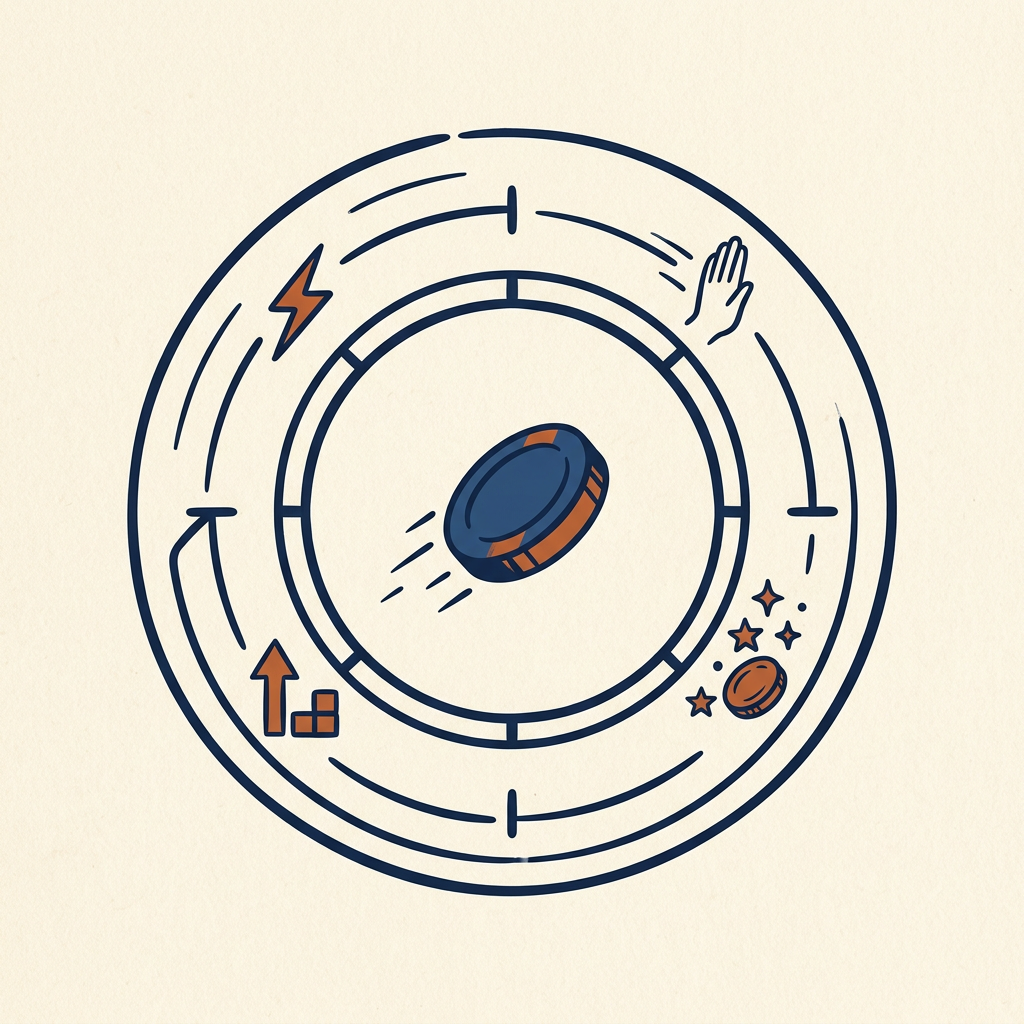
Habitual use is not one event but a self-reinforcing loop of Trigger, Action, Variable Reward, and Investment, each cycle depositing fuel that makes the next pass need less outside prompting.
Eyal names the phases in fixed order and insists the loop must repeat. A trigger cues the user; the action is the simplest behavior done in anticipation of reward; variable reward delivers uncertainty that sustains curiosity; investment asks the user to put something in—effort, data, content, reputation—that improves the product for them and raises the odds they return.
The decisive move is that investment does not only benefit the company. It loads the next trigger. A playlist built today becomes tomorrow’s reason to open the app; a new follower becomes a reason to check notifications again. Over cycles, external prompts such as emails and push alerts give way to internal cues the user generates alone.
Eyal uses this to explain a business split: products that never graduate users past external triggers need continuous ad spend forever, while products that cross the habit threshold become self-sustaining. Strategy, in his framing, is the deliberate design of that graduation.
In practice: A Spotify playlist a user builds becomes the internal reason to reopen the app the next day without any promotional email.

3
Hitch to existing itches
A product becomes truly habitual only when it attaches to a negative emotion the user already wants relief from, not when it tries to manufacture a novel need.
External trigger
Push, email, icon, or friend’s tip—costly and ignorable
Internal trigger
Boredom, loneliness, FOMO, or uncertainty firing alone
Eyal splits triggers into external and internal. External triggers live in the environment—notifications, icons, emails, recommendations—and are necessary for first use yet costly and easy to dismiss. Internal triggers are emotional or situational states that summon the action with no outside prompt: boredom, loneliness, uncertainty, fear of missing out, the urge to feel productive.
His contestable claim is that negative emotions outperform positive ones as internal triggers because relief from discomfort is a stronger, more consistent motivator than the chase for extra pleasure. Designers should therefore stop inventing new desires and instead locate an emotion that already drives repetitive behavior, then position the product as the fastest relief.
He recommends a five-whys style interview to dig past the rational reasons users recite and down to the root feeling. That reframing also marks the first ethical pressure point later critics would seize: the product is routing an existing itch through itself.
In practice: Eyal links Instagram to boredom, Pinterest and Yelp to indecision, and Slack to the anxiety of missing a work update.

4
Ease beats motivation
Making a behavior easier to perform is a more reliable lever than trying to increase how much the user wants to do it; behavior needs motivation, ability, and a trigger together.
Drawing on BJ Fogg’s model, Eyal states that a behavior happens when motivation, ability, and a trigger converge—B equals MAT. Motivation is hard to manipulate because it rides unpredictable drives such as hope, fear, or social acceptance. Ability, by contrast, can be engineered by shrinking the effort the action demands.
Fogg’s six ability levers give designers concrete dials: time, money, physical effort, brain cycles, social deviance, and non-routineness. Successful habit products, Eyal argues, win less by making users want something more and more by making the wanted action trivially easy. The required action should be the simplest behavior that still counts as progress toward reward—open, swipe, tap—even if it is not the most meaningful act.
The builder implication is ruthless friction audits. Small increases in required effort compound into large drops in habit formation, a pattern he treats as a design constant across categories.
In practice: Twitter’s early growth was helped by account creation and posting in a handful of clicks; the Like button replaced effortful comments and dropped the cost of social feedback near zero.

5
Uncertainty sustains the check
Unpredictability in what the user will receive, not the average size or quality of the reward, is what turns a one-off action into a compulsive pull-to-refresh.
Fixed reward
Known payoff after a set number of actions—curiosity dies once the pattern is learned
Variable reward
Unpredictable payoff after an unknown number of actions—anticipation stays switched on
Eyal leans on variable-ratio reinforcement—the schedule that delivers reward after an unpredictable number of actions and produces behavior harder to extinguish than fixed payoffs. He maps the same principle onto digital products and sorts rewards into three kinds.
Rewards of the tribe are social: likes, comments, belonging. Rewards of the hunt are material or informational: deals, the next post in an infinite scroll, search results. Rewards of the self are internal: mastery, completion, inbox zero. Variability itself, he claims, keeps the anticipation system engaged; users return because they do not know whether something good is waiting.
This is the chapter with the thinnest direct evidence inside the book: the conditioning work comes from animal and slot-machine settings, extended to apps by analogy. Within Eyal’s frame, though, the design rule is clear—keep the payoff uncertain rather than guaranteed.
In practice: Facebook’s algorithmically shuffled infinite feed and Pinterest’s uneven grid of differently sized images keep the next item unknowable.

6
Users build their own cage
A product deepens its hold less through rewards handed out than through work users are persuaded to put in, because invested effort raises perceived value and stores the next trigger.
The investment phase asks users to act before the next reward: rate, follow, enter preferences, build a profile, invite friends. Eyal draws on endowed progress—the finding that people given a head start on a loyalty card finish faster even when total required effort is identical—plus sunk cost, cognitive dissonance, and the tendency to value what one helped build.
Concretely, a user who has followed hundreds of accounts, curated playlists, or written dozens of reviews has made switching costly in a way that has nothing to do with raw feature quality. The stored value lives inside the platform. Each piece of investment also becomes raw material for a future trigger: a tagged photo today becomes a notification tomorrow when someone comments.
That is the mechanism that closes the loop introduced earlier. One pass through the Hook becomes a self-perpetuating cycle that needs progressively less external marketing to sustain.
In practice: Car-wash customers given a loyalty card already stamped with two of eight required stamps completed the card faster than customers starting from zero, even though total washes needed were the same.

7
Frequency first, then reverse-engineer
The Hook Model is only a fit for behaviors done often enough and valued highly enough; teams should discover the sequence already used by devoted users before designing hooks.
Eyal offers a simple diagnostic: plot a behavior by how often it occurs against how much utility users perceive. High-frequency, high-value actions—checking messages, browsing feeds—are candidates because enough repetitions exist for an internal trigger to form. Low-frequency behaviors, even valuable ones such as buying life insurance or booking a rare vacation, do not repeat often enough for a habit loop; those products need strong external triggers and word of mouth instead.
For teams with a live product he lays out habit testing: identify the highest-frequency retained users, work backward through logs to the specific early actions that preceded habitual use, then redesign onboarding so new users hit that same sequence faster and with less friction. The Hook is meant to be reverse-engineered from retention data, not invented in a vacuum and bolted on.
This is the operational payoff of the book—the model becomes a build-measure loop tied to a company’s own users rather than a universal recipe.
In practice: Facebook’s early growth team found that new users who reached a threshold number of friends in their first days were far more likely to stay active, so onboarding shifted toward pushing users to that number quickly.

8
Two questions, no outside referee
Eyal locates a builder’s moral position on whether they would use the product themselves and whether it materially improves users’ lives, yet the test is entirely self-administered.
Improves users’ lives ↑ · Creator uses it →
Facilitator
Uses it and believes it helps—framed as the ideal
Dealer
Does not use it yet claims it helps others—suspect
Entertainer
Uses it for enjoyment without claiming deeper benefit
Peddler
Neither uses it nor believes it helps—exploitative
He closes with a two-axis grid. One axis: does the creator use the product. The other: does the product genuinely improve the user’s life. Crossing them yields four types. The facilitator uses it and believes it helps—the ideal. The dealer does not use it but claims it helps others—treated as suspect. The entertainer uses it for enjoyment without deeper benefit claims. The peddler neither uses it nor believes it helps—called exploitative.
Eyal asks builders to place their own product honestly and argues that habit-forming design is not inherently good or bad; the same mechanics can support flossing or compulsive gambling. Moral weight, in his account, rests on intent and real effect on users’ lives. He offers the personal-use-plus-benefit test as the practical checkpoint before shipping habit features.
The chapter is shorter and less rigorous than the technical sections. It proposes no regulatory, organizational, or incentive mechanism to enforce the self-assessment, leaving accountability with the people most financially rewarded for judging generously.
In practice: Eyal contrasts a habit-tracking app the founder personally relies on with free-to-play games that monetize compulsive spending as exploitative design.
Key terms
- Hook Model Eyal’s four-phase loop—Trigger, Action, Variable Reward, Investment—run repeatedly to form habits.
- External trigger A cue in the environment (notification, icon, email, tip) that tells the user what to do next.
- Internal trigger An emotional or situational state—boredom, loneliness, FOMO—that summons the action with no outside prompt.
- B=MAT Fogg’s rule that behavior happens when motivation, ability, and a trigger converge at once.
- Variable reward An uncertain payoff—social, informational, or mastery-based—that keeps anticipation alive because the outcome is unknown.
- Investment Work the user puts into the product (data, content, follows, reputation) that raises its value to them and loads future triggers.
- Rewards of the tribe, hunt, self Eyal’s three buckets of variable payoff: social validation, material or informational gains, and internal feelings of competence.
- Manipulation Matrix Eyal’s ethics grid crossing ‘would I use it’ with ‘does it improve lives’ to sort facilitators, dealers, entertainers, and peddlers.
- Endowed progress effect The tendency to finish a goal faster when given artificial head-start credit toward it.
What to do
- Map your core loop on one page: name the trigger, the minimum action, the variable reward, the user investment, and the emotion the trigger actually relieves.
- Audit onboarding against Fogg’s six ability factors—time, money, physical effort, mental effort, social awkwardness, unfamiliarity—and cut at least one step before adding any feature.
- Pull logs for your most retained users, trace the early action sequence they completed that churned users skipped, and redesign new-user flow to reach that sequence faster.
- Before shipping any habit-forming feature, write whether you would want your own child using it as designed and treat hesitation as a design problem, not a deferral.
- Plot your core behavior on frequency versus perceived utility and drop habit engineering if the behavior is low-frequency.
Questions to think with
- What negative emotion does your product actually relieve, and how do you know it is not just the rational story users tell?
- Which single step in your current flow most inflates time, mental effort, or unfamiliarity—and what happens if you remove it this week?
- If every external notification disappeared tomorrow, what stored user investment would still pull people back?
- Where does your product sit on Eyal’s matrix when you answer the two questions without marketing spin?
- Is the behavior you want to hook frequent enough for an internal trigger to form, or are you forcing a habit strategy onto a low-frequency job?
The other side
The central weakness is evidentiary and ethical thinness. Eyal reverse-engineers the Hook from already-successful cases—Instagram, Twitter, Pinterest, Facebook—without systematically studying products that used the same mechanics and failed, so survivorship bias clouds whether the model predicts success or only redescribes it. The behavioral science is real but applied by analogy: Skinner’s variable-ratio work used animals and levers; Fogg’s model was general persuasive design, not smartphone software; the book offers no controlled studies showing the four-stage Hook itself outperforms simpler accounts such as network effects or genuine utility. The ethics chapter is short, self-administered, and silent on business incentives; later critics including Tristan Harris and the Center for Humane Technology argued that advertising-funded models structurally reward maximizing time-on-device, making a personal ‘would I use this’ test insufficient. Work by Adam Alter and later adolescent-mental-health research raised costs the 2014 founder-facing book never weighed, and Eyal’s own later Indistractable shifted toward defending users against the techniques Hooked teaches. The book also treats users as psychologically uniform, underplaying differences in vulnerability by age, mental health, or circumstance.
Who it's for
Product managers and startup founders who need retention without a large marketing budget, plus designers and marketers who want a shared vocabulary for compulsive use, will get the most from the full book. Readers mainly seeking a rigorous ethics or public-health treatment of attention design will find the closing framework too light and should treat the mechanics as descriptive rather than licensed.