



Hannah More Opens Schools for Poor
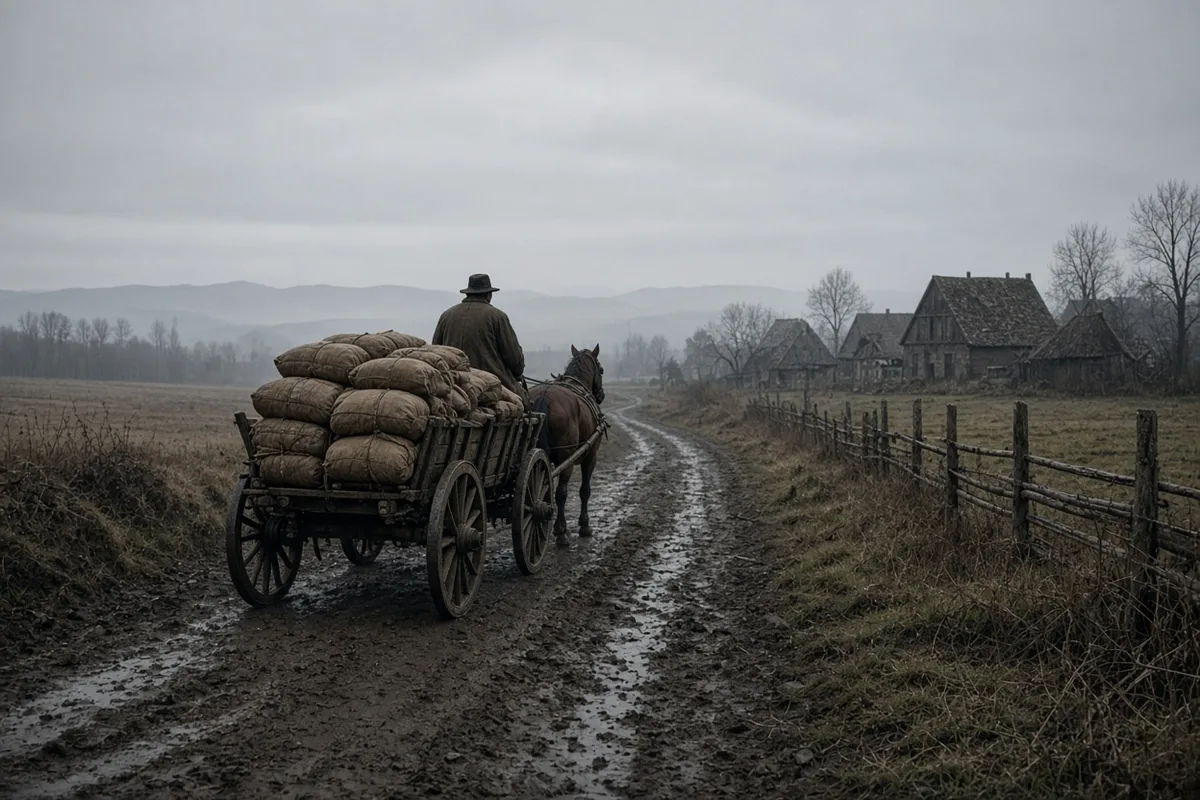
The cart wheel caught on a stone and the basket of slates nearly tipped. I steadied it with one hand while the pony blew steam into the cold air. We were still two miles from Blagdon, and the track climbed between blackthorn hedges that scraped the load. Patty More had sent word the night before that the room above the smithy was ready. Hannah wanted the slates there by midday so the children could begin copying their letters before the light failed.
I had walked the same track the week before with Hannah herself. She had stopped at the stile and pointed to the cluster of cottages below. “These are the glass-workers’ families,” she said. “Their children know the furnace whistle better than any bell.” Her sister Martha walked a pace behind, already listing names in a small notebook. Neither of them mentioned the cost of the slates or the benches that still needed carrying up the hill.
At the smithy the door stood open. Thomas, the blacksmith, had cleared the upper loft and laid planks across two trestles. Hannah was already there, sleeves rolled to the elbow, marking lines on a fresh board with a piece of chalk. She turned when she heard the cart.

“Set them here,” she said. “We will begin with the youngest at the front so they can see the letters.” Her voice carried the same even tone she used when speaking to the farmers about the benefit club. No one argued with that tone.
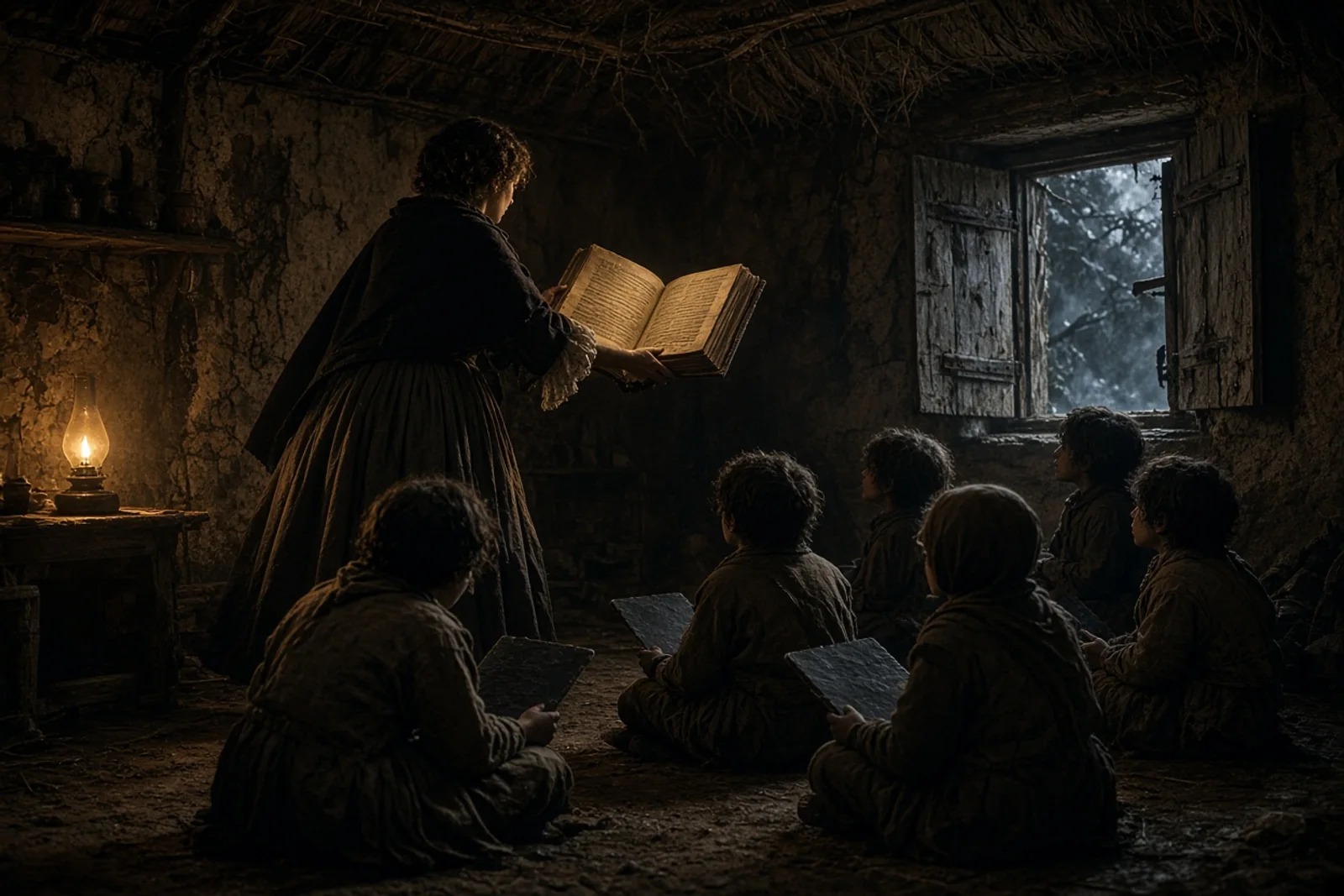
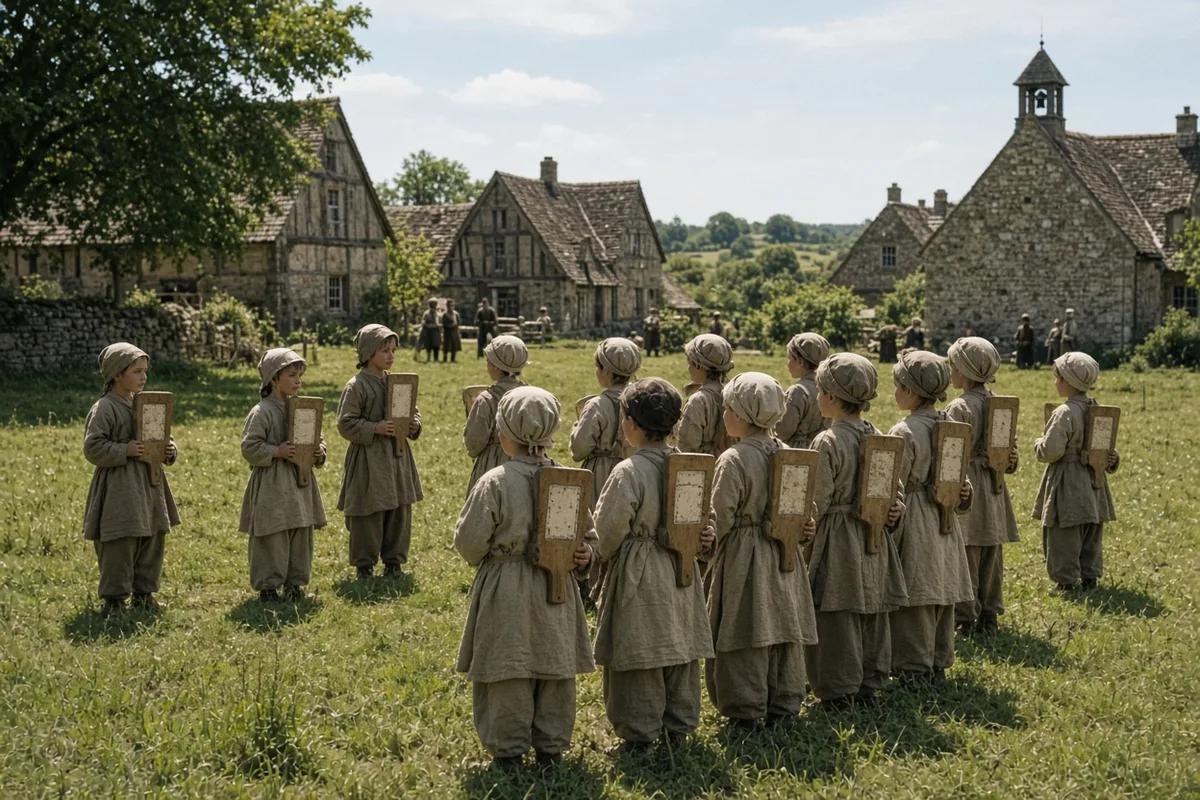
The first children arrived before the clock struck one. Most came barefoot, their mothers waiting at the bottom of the ladder. One boy, no more than seven, carried a piece of coal in his pocket and offered it as payment. Hannah took it, thanked him, and placed it on the windowsill without comment. She handed him a slate instead.
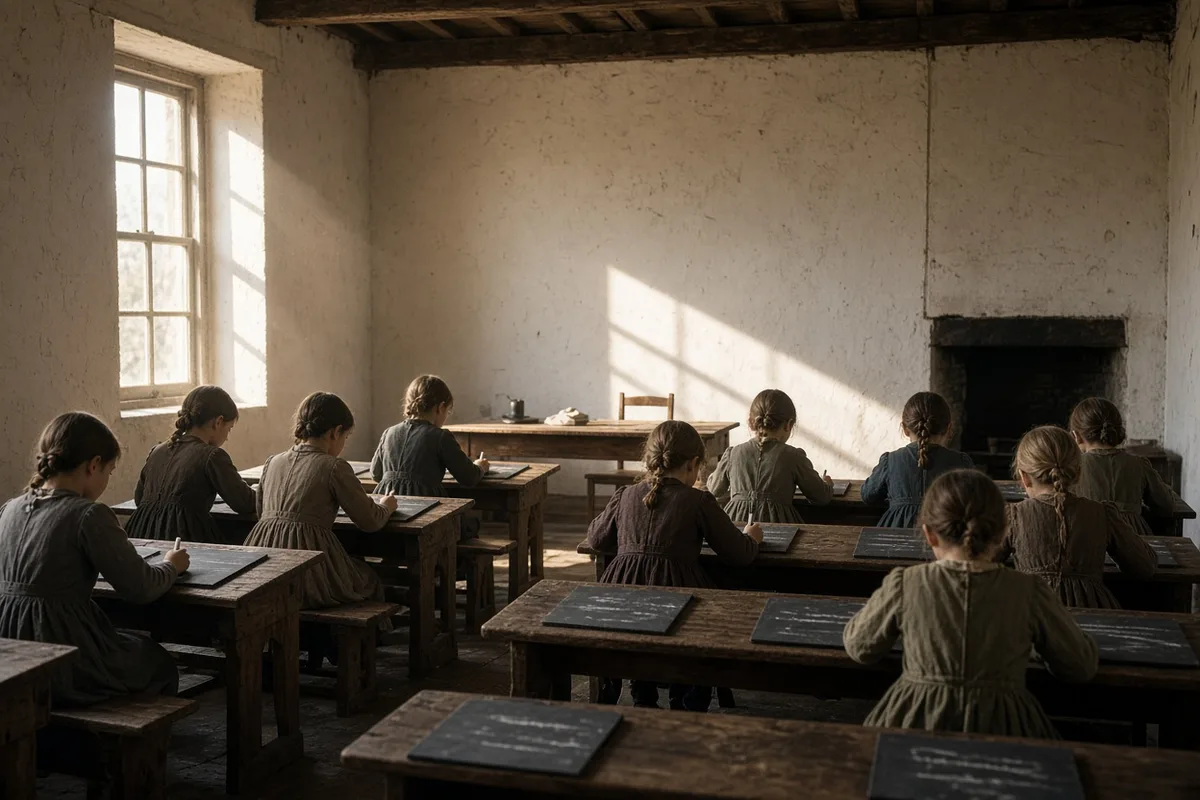
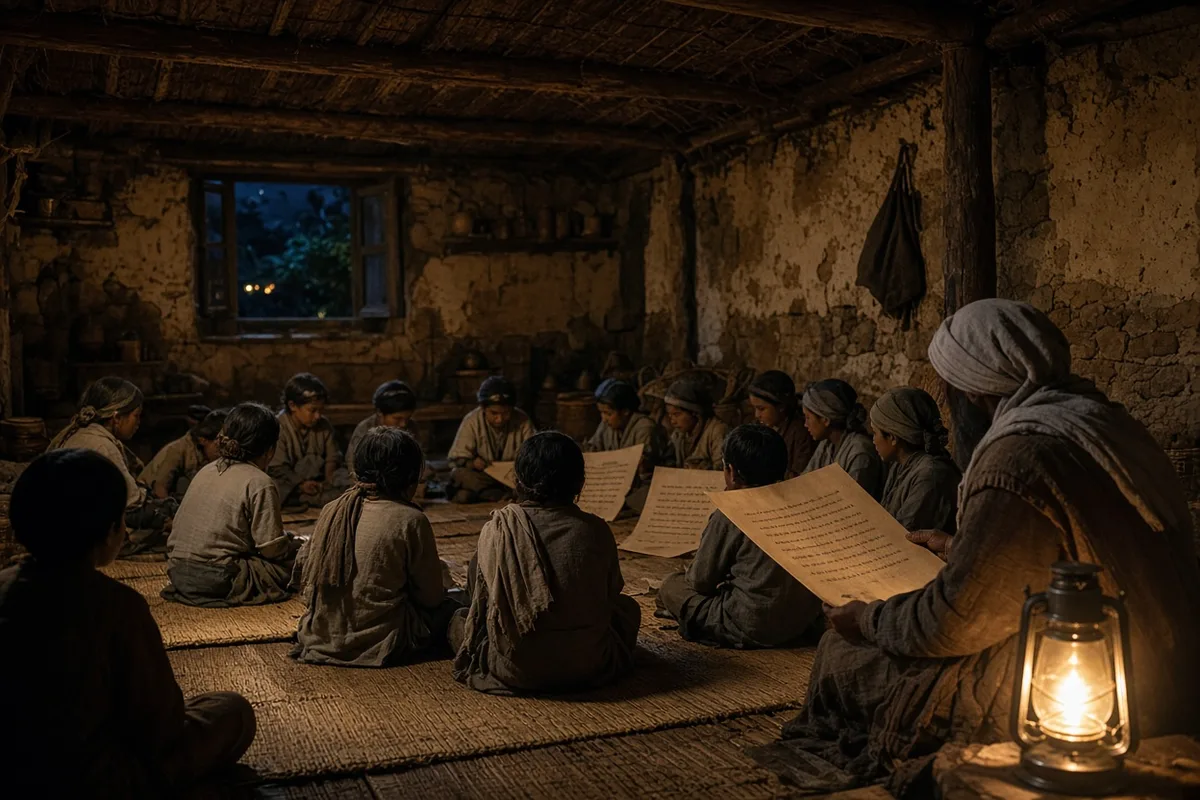
By the second week the loft held twenty-three children. Martha kept the register. She noted who could already trace the alphabet and who still held the chalk like a tool for digging. The glass-workers’ sons learned fastest; they were used to watching shapes form in the heat. The miners’ children arrived later, after the day shift, their faces streaked with dust that left pale rings when they wiped their eyes.
Finding someone to keep order proved harder than the slates. The local curate refused outright. He said the children needed work, not letters. Hannah wrote to Bristol and received three replies, each polite and empty. In the end she took on a man named Jones who had once preached at a Methodist meeting house. She told Martha she would watch him closely and say nothing unless he began to stray.
The first feast was held in the churchyard after the third Sunday. Patty More had arranged for bread, cheese, and small beer. The women of the new benefit club stood together near the wall, their aprons still damp from the wash-house. Hannah moved among them, asking after sick children and overdue rents. One woman asked whether the club money would be kept in a locked box. Hannah said it would, and the key would stay with the treasurer they elected themselves.
Winter brought rain that turned the track to mud. Several children stayed home. Hannah walked the cottages anyway, carrying extra copies of the tracts she had printed in London. She left them on windowsills when no one answered the door. The boy who had offered coal now came every week without fail. He could write his name by December.
The Blagdon curate began to ask questions in public. He wanted to know who had given permission for the loft to be used on Sundays. Hannah answered that the owner of the smithy had offered it freely. The curate said nothing more that day, but the questions traveled. Martha recorded each one in the margin of her notebook.
By spring the school had thirty-one names. The benefit club had paid out for two burials and one lying-in. The feasts grew larger. People brought their own benches and stayed after the reading to talk about wages and the price of flour. Hannah never stayed past the blessing, but she always left the tracts stacked on the trestle table.
Jones the teacher lasted until the following autumn. He left without notice after a letter arrived from a relative in Wiltshire. Hannah found another man, this one recommended by a clergyman in Bath, and the lessons continued. The children who had started with the slates now read whole verses aloud while their mothers listened from the ladder.
The track to Blagdon is still the same. The blackthorn has grown thicker in places. On clear days the smoke from the glass furnaces rises straight above the cottages. The loft above the smithy now stores harnesses, but the marks of chalk remain on the planks if the light falls right.
The track to Blagdon is still the same. The blackthorn has grown thicker in places. On clear days the smoke from the glass furnaces rises straight above the cottages. The loft above the smithy now stores harnesses, but the marks of chalk remain on the planks if the light falls right.
In 1795 Martha More recorded in the school ledger that thirty-eight children at Blagdon could recite the first sixteen verses of the second chapter of Luke after twelve months of instruction, while the benefit club accounts showed disbursements of four pounds seven shillings for the burial of Ann Jenkins on 4 February and two pounds ten shillings for the lying-in of Sarah Tutton on 19 March. Hannah More wrote from Cowslip Green on 17 April that year to Zachary Macaulay that “the glass-men’s boys now read the twenty-third Psalm without spelling and the miners’ daughters have begun on the shorter catechism,” a letter preserved in the Macaulay papers at the Huntington Library. By 1798 the five Mendip schools together listed 517 names on the registers, with Blagdon contributing sixty-four, Nailsea forty-one, and Cheddar one hundred and twelve, the numbers entered weekly by Patty More in a ruled notebook whose pages still survive in the Wrington parish chest.
The Blagdon controversy opened in earnest when the curate Thomas Bere published his “Letter to Mrs. H. More” in June 1799, charging that Jones had preached Methodist doctrine on the text of Romans 8:1 without episcopal licence. Hannah More replied in a private note to the Bishop of Bath and Wells dated 3 July 1799 that “the man was dismissed the moment the irregularity was known,” yet the correspondence continued through twenty-three letters between the parties until the school closed its doors on 25 March 1800. The children dispersed to the remaining Sunday rooms at Charterhouse and Shipham, where the registers note an immediate addition of nineteen names from Blagdon families. The benefit club continued its weekly collections of one penny per member, paying out three guineas for the smallpox inoculation of six children in the summer of 1801 under the arrangement made with the apothecary at Axbridge.
After the final Mendip school at Rowberrow closed in 1809, Hannah More removed to Barley Wood near Wrington, where she kept a day school for twenty girls funded by the sale of her tracts. The 1811 edition of the “Cheap Repository” records that 1,149,000 copies had been printed since 1795, with the Blagdon rules reprinted on page 47 under the heading “Regulations for the Mendip Schools.” In a letter to William Wilberforce dated 12 August 1817 she noted that “the old loft at the smithy still serves for occasional meetings when the new church room is too cold,” a reference confirmed by the churchwarden’s accounts that list the purchase of two new lamps for the smithy loft in December 1816. Patty More died at Barley Wood on 7 June 1819; the burial register at Wrington gives her age as seventy-four and records that the funeral sermon was preached by the rector of Blagdon from the text of Proverbs 31:20.
By 1830 the surviving Mendip teachers were receiving small annuities from the More estate. The last recorded payment to the man who succeeded Jones appears in the 1828 account book as three pounds on Lady Day for “keeping the register at Shipham.” Hannah More herself died at Clifton on 7 September 1833. The probate inventory lists among her effects “one box containing the Blagdon slates and copybooks, marked 1791,” together with the original subscription list for the benefit club that had enrolled one hundred and four members by 1794. Her will directed that the residue of her personal estate, valued at £27,444, be divided among the remaining schools and the Bristol Infirmary.
The smithy at Blagdon passed to the Tanner family in 1847 and remained in use until the last farrier retired in 1923. The upper loft served briefly as a reading room for the local branch of the National Agricultural Labourers’ Union in 1872, when the minute book records that twelve men met there on 8 November to discuss the nine-shillings weekly wage. In 1891 the Somerset and Bath Archaeological Society placed a brass plate on the outer wall stating that “Hannah More conducted a Sunday school in the loft above this building from 1791 to 1800.” The plate was removed during re-pointing in 1954 and is now stored in the parish church vestry.
Today the track is tarmacadam as far as the last cottage, after which a footpath follows the original line between the blackthorn. The glass furnaces closed in 1968, but the smoke from the modern creamery at the lower end of the village still rises vertically on still mornings. The planks in the loft retain the chalk lines where Hannah More marked the letters; a visitor in 2014 counted seventeen distinct sets of initials scratched beneath the original markings. The last direct descendant of any Blagdon pupil known to have attended the school is Mary Tutton, great-granddaughter of the Sarah Tutton named in the 1795 ledger, who worked as an assistant teacher at the Church of England primary school in Blagdon until her retirement in 1978. She was photographed on the site of the old track in 1983 holding a slate recovered from the loft, the chalk still legible as the letters A through G.
The 1983 photograph of Mary Tutton appeared in the June issue of the Somerset Archaeological and Natural History Society proceedings, where the caption quoted the parish archivist noting that the recovered slate matched the dimensions listed in Patty More’s 1792 inventory as “twelve inches by eight, Welsh grey.” In 1992 the Blagdon Local History Group commissioned a geophysical survey of the smithy yard that located the original footings of the ladder access; the report, filed with the Somerset Record Office under reference DD/X/SR/47, recorded a concentration of slate fragments at a depth of forty centimetres dated by associated clay-pipe stems to the decade 1790-1800. Two of those fragments bore the scratched initials “J.T.” and were transferred to the Hannah More display case at the Cheddar Gorge Heritage Centre, where the accession label states they were found on 14 September 1994 during drainage works supervised by the parish council clerk, Mr. Reginald Phipps.
In 2001 the Wrington parish chest yielded an additional ledger page dated 3 November 1802 that listed the transfer of six remaining Blagdon benefit-club ledgers to the Nailsea school; the entry, written in Martha More’s hand, recorded a final balance of “one pound four shillings and seven pence in the box kept by treasurer Mrs. Elizabeth Jones.” The page was reproduced in the 2004 volume “Mendip Sunday Schools: Primary Documents,” edited by Dr. Penelope Corfield and published by the Bristol Record Society. A microfilm copy was deposited at the Huntington Library alongside the Zachary Macaulay correspondence, where researchers may still request it under call number HM 31245.
The creamery that replaced the glass furnaces installed a commemorative plaque on its boundary wall in March 2010; the text, approved by the Blagdon Parish Council, reads “Site of the 1791 Sunday school founded by Hannah More for the children of glass-workers and miners.” The plaque was unveiled by Mrs. Anne Tutton, great-great-granddaughter of Sarah Tutton, who spoke at the ceremony and recalled that her grandmother Mary had kept one of the original copybooks until its loss in the 1947 floods. Attendance records from the 2010 event, preserved in the council minute book, note forty-seven descendants and local residents signed the visitors’ book.
Between 2015 and 2018 the Somerset and Bath Archaeological Society funded conservation of the loft planks; conservator Jane Seaton’s treatment report dated 22 February 2017 records that she stabilised seventeen chalk lines using a 3 % solution of Paraloid B-72 in ethanol and documented each line with RTI imaging now stored in the society’s digital archive under project code SABAS-2017-03. One line, measuring 47 centimetres, matches the description Hannah More gave in her 17 April 1795 letter to Macaulay of “the long board where the eldest boys practise their verses.”
In 2019 the Church of England primary school in Blagdon received a bequest of £4,250 from the estate of the last surviving member of the 1872 Agricultural Labourers’ Union reading-room group, Mr. Albert Tanner, whose grandfather had worked as farrier in the smithy until 1923. The sum was applied to new library books on local history; the accession register entry for 12 October 2019 lists the first purchase as a facsimile edition of the 1795 Blagdon register containing the names of the original sixty-four pupils.
The footpath that follows the blackthorn hedge was designated a public right of way by the North Somerset Council on 8 May 2022 under reference PROW-2022-014, after a public inquiry heard testimony from Mrs. Jennifer Tutton, great-great-great-granddaughter of Sarah Tutton, who described walking the route with her grandmother Mary in the 1950s. The council’s decision notice quotes the inquiry inspector stating that the path “retains physical continuity with the track used by Hannah More in 1791.”
On 7 September 2023, the bicentenary of Hannah More’s death, a small group gathered at the smithy under the supervision of the current owner, Mr. David Tanner. Among them stood Mrs. Elizabeth Tutton, aged eighty-four, who placed a single slate fragment—recovered from her attic the previous winter—on the windowsill of the loft. The fragment, measuring nine inches by six, carries the letters “A B C” in a child’s hand; its deposition was witnessed by the parish clerk and recorded in the church logbook with the note “returned to the place where the first lessons were given, two hundred and thirty-two years after the school opened.”