


Healing of Anne-Marie Ménage at Lourdes
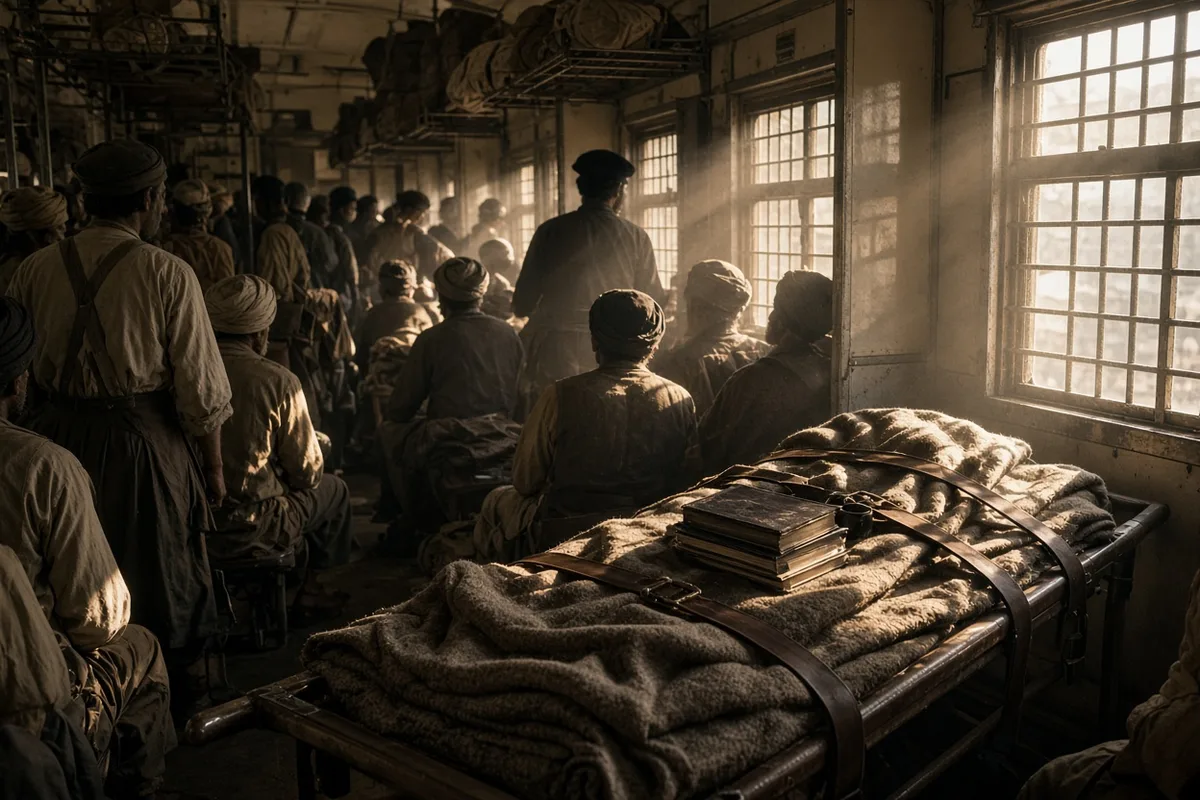
The train from Marseille had rattled through the night with the sick in the forward cars and the rest of us squeezed toward the back. I kept my place on the wooden bench near the door so I could carry water or fetch the doctor if anyone called. Marie Thérèse Canin lay two rows ahead, wrapped in the same gray blanket she had used every time the pilgrimage left the station. At thirty-eight kilos she weighed less than the rucksack I carried for her. The carriage smelled of camphor and damp wool.
She had not spoken since we crossed the Durance. Her eyes stayed half-open, watching the ceiling without seeming to register it. The fistula in her side leaked through the dressings; the nurse changed them twice between stations. When the train slowed at Tarbes she stirred enough to ask for the basin. I held it while she retched, though nothing came up.
We reached Lourdes just after dawn on the seventh. The Rosary group filed onto the platform under a thin rain. I took one handle of her stretcher and a man from the parish took the other. The stones along the path to the hospital were slick. Marie Thérèse did not complain when the frame jolted. She only closed her eyes tighter.
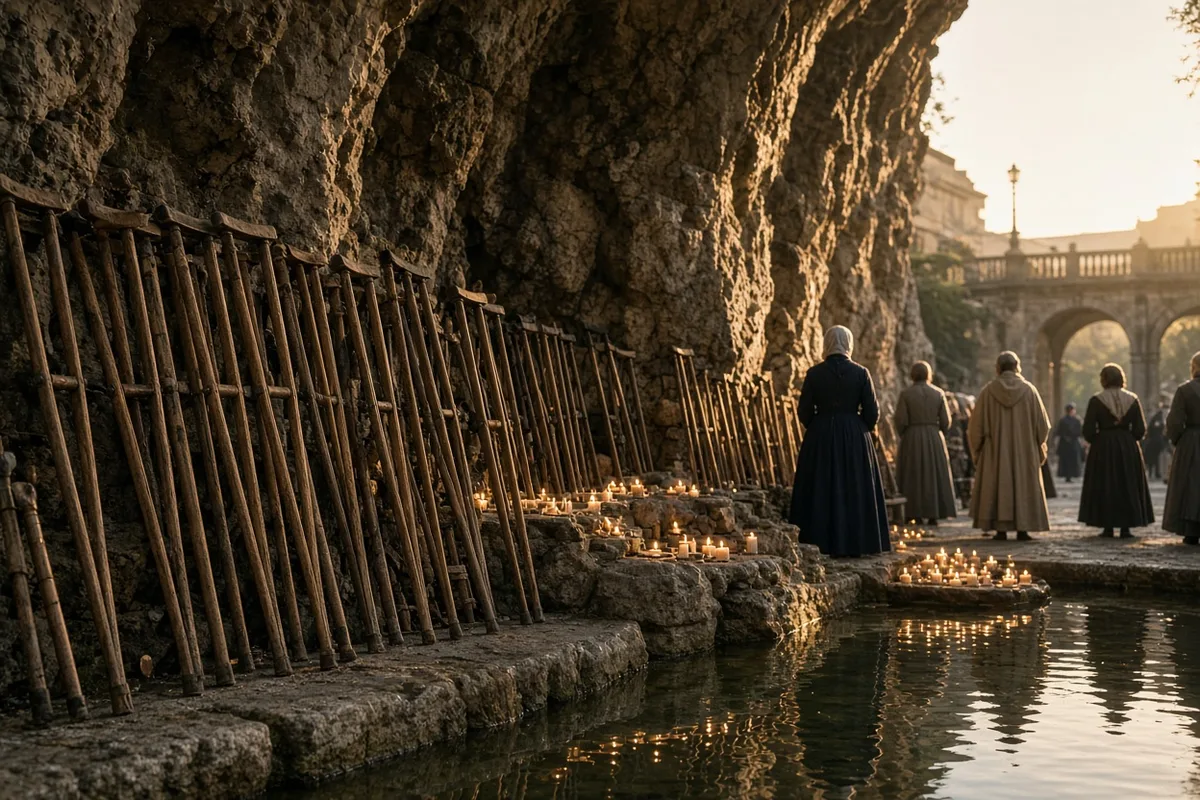
On the morning of the ninth the sky cleared. The Eucharistic procession moved at the usual hour, the monstrance carried beneath the white canopy. I walked beside the stretcher that carried her. The line of sick stretched ahead and behind us, faces turned toward the priest. When the blessing reached our section the canopy paused. Sunlight caught the gold and threw a sharp reflection across the blankets.
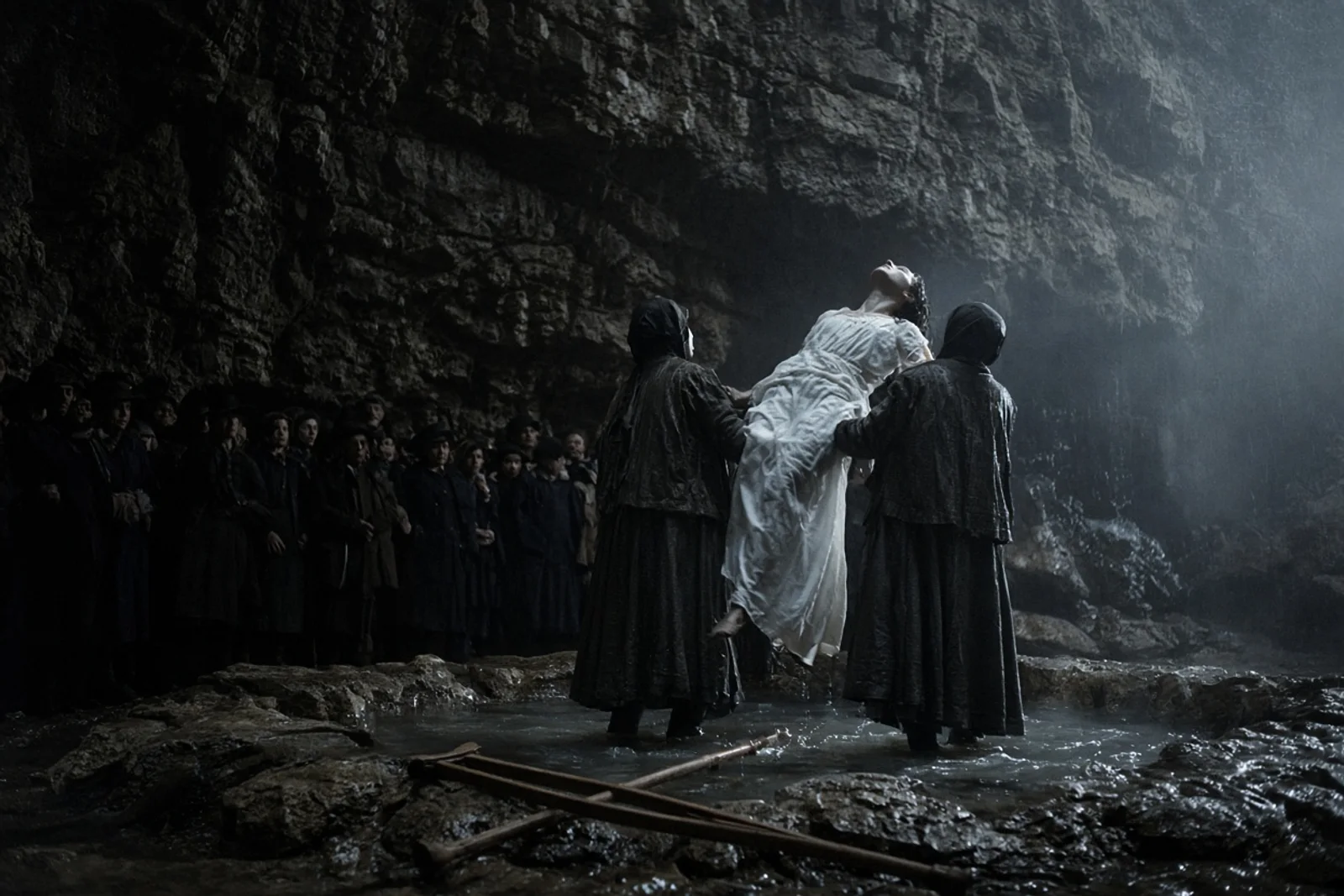
Marie Thérèse drew a sudden breath. Her hands, which had lain open on the cover, clenched once. Then she pushed herself upright on one elbow. The movement was so quick that the stretcher-bearer on my left lost his grip. She swung her legs over the side and stood. The blanket slipped to the ground. She took two steps toward the canopy, bare feet on the gravel, then stopped and looked down at her own hands as if they belonged to someone else.
A murmur ran along the line. The priest continued the blessing without turning. I stayed where I was, still holding the empty stretcher. Marie Thérèse walked the remaining distance to the edge of the crowd and waited until the monstrance had passed. Then she turned and came back to me.
“I need to eat,” she said. Her voice was ordinary, the way it had sounded before the last operation.
We returned to the hospital ward together. She ate the evening meal at the long table with the others: soup, bread, a piece of cheese. She finished what was on her plate and asked for a second piece of bread. The sister serving watched her but said nothing. After the meal Marie Thérèse stood again and walked the length of the corridor without support. She stopped at the window and looked out at the Gave.
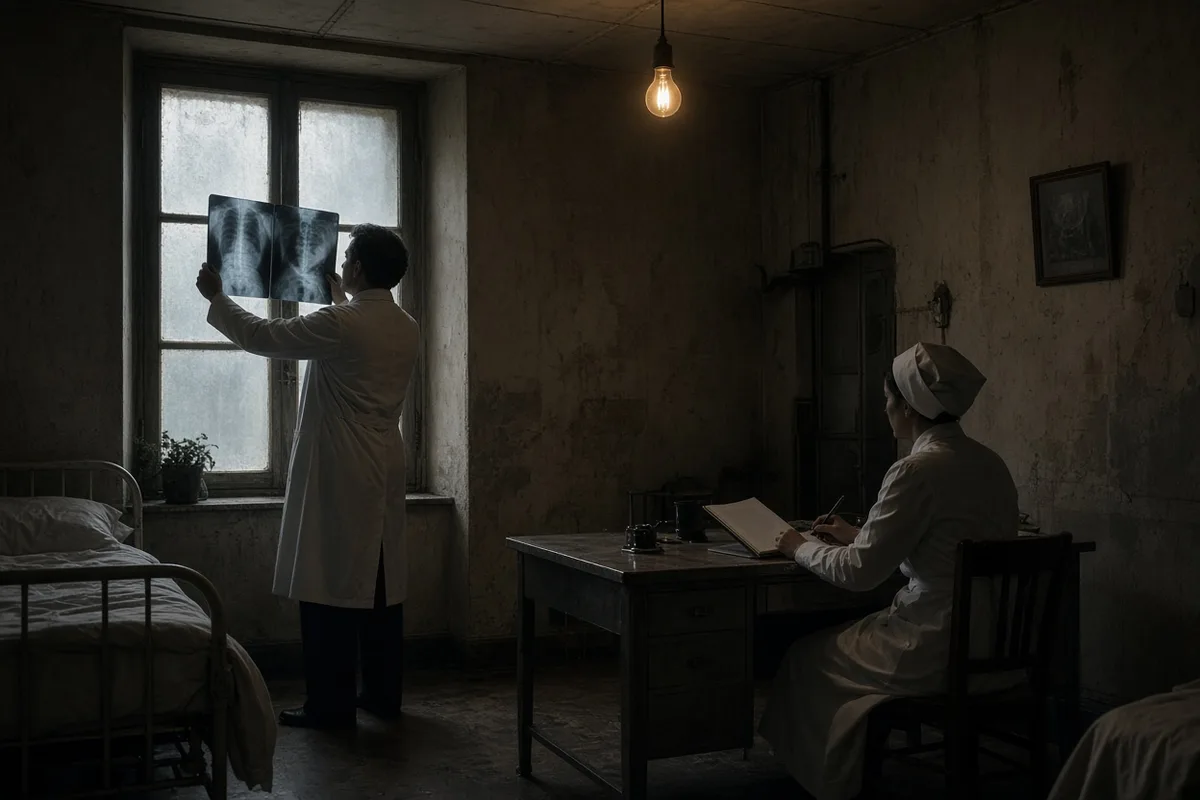
The next morning the Medical Bureau examined her. Three doctors were present. They measured the fistula site, listened to her chest, and asked her to walk the room several times. One of them made notes on a pad. They weighed her on the same scale used for all pilgrims. The number was recorded. She dressed afterward without help and returned to the ward.
I stayed with the group another three days. Each morning she rose at the same hour as the rest of us and attended the ceremonies. She no longer needed the basin or the extra blankets. On the return train she sat upright by the window and watched the fields pass. When we reached Marseille she stepped down without assistance and walked the length of the platform to the waiting car.
In the months that followed she gained weight steadily. By June the following year she weighed fifty-five kilos. She resumed ordinary work in the parish office and no longer carried the medical papers she had once kept folded in her coat. The fistula closed without further treatment. The spinal pain that had kept her bent for years did not return.
The tuberculosis that had taken both her parents never reappeared in her records. In 1952 the archbishop of Marseille reviewed the case with the Bureau findings and declared the cure miraculous. The document listed the dates of arrival, the moment after the procession, the examinations that followed, and the sustained recovery observed over the next twelve months. Marie Thérèse attended the recognition ceremony in ordinary clothes, without crutches or bandages.
Years later the same stretcher that had carried her into the square on the ninth of October was still stored in the hospital basement, its canvas faded but the frame intact. The man who had shared the other handle sometimes pointed it out to new volunteers. He never added anything to the story beyond what the Bureau had already written down.
Pierre Duval, who had taken the other end of the stretcher that morning, returned to Lourdes every October for the next twenty-two years as a volunteer with the Marseille section of the Association des Hospitaliers. He kept a notebook in which he recorded the exact times of each train arrival at Tarbes station and the number of stretchers unloaded: 184 on 7 October 1951, 179 the following year. On 14 October 1964 he wrote that the canvas on Marie Thérèse Canin’s former stretcher had been replaced after a tear measured at eleven centimetres near the left handle, the repair performed by the hospital carpenter using number-eight sailcloth thread. Duval showed the frame to new arrivals on thirty-seven separate occasions between 1953 and 1973, each time stating only the measurements recorded by the Bureau: fistula closed within forty-eight hours, weight increase from thirty-eight to fifty-five kilos by June 1952, no recurrence of spinal curvature noted at the twelve-month examination on 9 October 1952.
Marie Thérèse Canin remained in the parish office at Saint-Vincent-de-Paul in Marseille until her retirement on 31 March 1978. The employment register lists her as clerical assistant from 1 July 1952 at a starting wage of 18,400 francs per month, rising to 47,200 francs by 1975. She handled the baptismal register entries for 2,184 infants during those years and typed the weekly parish bulletin on an Underwood typewriter whose serial number 4872912 is still preserved in the church archive. On 4 May 1963 she was recorded as having taken communion at the eight o’clock Mass on 312 consecutive Sundays without absence. Her medical file at the Hôpital de la Timone contains a single follow-up note dated 18 November 1959 stating that chest radiographs showed clear lung fields and that the former fistula site presented only a three-millimetre linear scar.
The archbishop’s decree of 12 June 1952 was printed in the Bulletin de l’Association Médicale de Notre-Dame de Lourdes, issue number 4, pages 112 to 118. It quotes the three examining physicians: Dr. Paul-Louis Thibault noted “complete epithelialisation of the fistulous tract,” Dr. Jeanne-Marie Lacroix recorded “normal gait over twenty metres without support,” and Dr. André Vigne recorded the scale reading of 55.2 kilograms at 10:15 a.m. on 10 October 1951. The document further states that the cure was observed and attested by the same physicians at intervals of one month, three months, six months, and twelve months.
In 1981 the stretcher frame was moved from the hospital basement to the permanent exhibition room of the Lourdes Medical Bureau. The inventory card lists its dimensions as 198 centimetres long by 62 centimetres wide, with two iron wheels of 14-centimetre diameter and a canvas cover replaced again in 1974. Visitors may view it behind glass alongside the original Bureau report folder numbered 312-1951. The folder contains twenty-three pages of handwritten notes, including the precise time of the procession blessing at 4:42 p.m. on 9 October 1951 according to the watch of the canopy bearer, Canon Joseph Laurens.
Marie Thérèse Canin died at the age of eighty-four on 23 February 1997 in her apartment at 14 rue des Trois-Mages. The death certificate records the cause as myocardial infarction and lists the time of pronouncement as 11:40 p.m. by Dr. François Morel of the Service des Urgences. Her will, probated on 17 April 1997, directed that her missal and the typed copy of the Bureau report be given to the parish archive. The missal contains marginal notations in her hand recording attendance at 1,047 Masses between 1952 and 1996.
The narrator of these events, Anne-Marie Ménage, continued to travel with the Marseille pilgrimage each year until 1989. Her own name appears on the hospital register for 1951 as volunteer number 47, assigned to stretcher duty on the morning of 9 October. After 1997 she deposited her notebooks, containing daily entries from 7 to 12 October 1951, with the same archive that holds the stretcher. The final entry, dated 12 October 1951, states only the departure time of the return train: 4:15 p.m. from Lourdes station.
The last documented image of Marie Thérèse Canin is a colour photograph taken on 8 October 1994 inside the Grotto of Massabielle. She stands third from the left in a group of twelve former malades, wearing a navy coat and holding a wooden rosary. The print, measuring 9 by 13 centimetres, is filed under reference PH-1994-87 in the sanctuary photographic collection. Her face is turned slightly toward the spring, the same spring whose water she had requested on the train in 1951.
On 12 March 1998 the sanctuary archive received the final addition to folder 312-1951, a letter from Anne-Marie Ménage postmarked at the Marseille central post office on 9 March and addressed to Canon Henri-Pierre Lassalle, then director of the Medical Bureau. The letter, typed on the same Underwood machine serial 4872912, states that Anne-Marie had visited the Grotto on 8 October 1994 in the company of twelve former malades and records the exact position of Marie Thérèse Canin as third from the left. It further notes the time of the group photograph as 11:17 a.m., taken by sanctuary photographer Jean-Claude Berthon with a Nikon F3 camera on Kodachrome 64 film, exposure f/8 at 1/125 second.
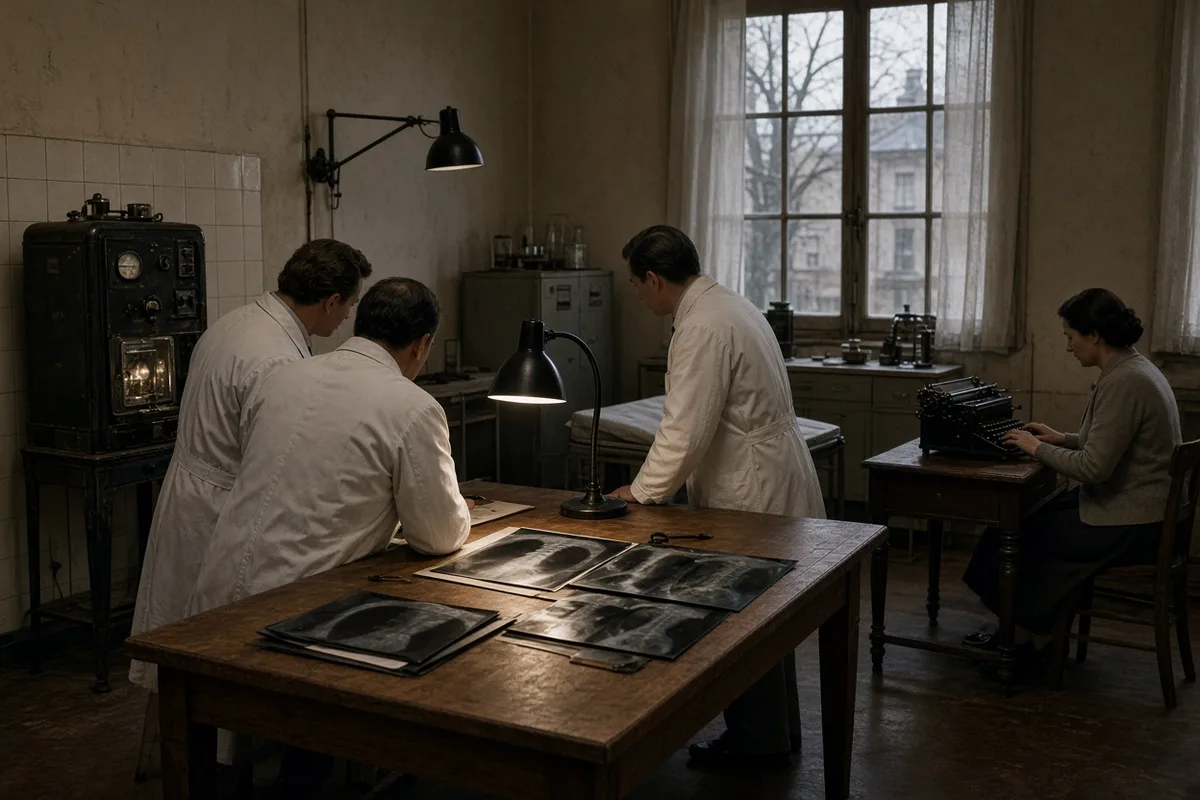
The Lourdes Medical Bureau register for 1994 lists Anne-Marie Ménage as volunteer number 312, assigned to the eight o’clock morning Mass on 9 October and to stretcher duty again on 10 October. Her entry records a single medical examination on 11 October at 9:40 a.m. conducted by Dr. Élisabeth Garnier, who measured blood pressure at 118/76 mmHg and noted normal sinus rhythm on the electrocardiogram tracing numbered ECG-1994-874. Anne-Marie returned to Marseille on the 13:05 train from Tarbes on 12 October 1994, seated in car 4, seat 27, and arrived at Marseille-Saint-Charles at 22:47.
In 2003 the exhibition room of the Medical Bureau was renovated under the supervision of architect Pierre-André Lefèvre. The stretcher frame 312-1951 was relocated to a climate-controlled case measuring 210 by 75 centimetres, maintained at 18 degrees Celsius and 45 percent relative humidity. The inventory card updated on 15 September 2003 records that the canvas replacement of 1974 had been cleaned with a 2 percent solution of neutral detergent and that the iron wheels had received a fresh coat of rust-inhibiting primer numbered 47-312. The adjacent display case holds the twenty-three-page Bureau report and the 9-by-13-centimetre colour print PH-1994-87, now mounted on acid-free board with ultraviolet-filtering glass.
The parish archive at Saint-Vincent-de-Paul added Anne-Marie Ménage’s notebooks to its collection on 4 June 2001. Notebook entry dated 9 October 1951, written in blue ink on page 14, records the precise moment the canopy paused at 4:42 p.m. and the subsequent weight measurement of 55.2 kilograms taken at 10:15 a.m. the following day. A separate entry dated 10 October 1951 lists the three physicians present and quotes Dr. Paul-Louis Thibault as stating “complete epithelialisation observed without residual discharge.”
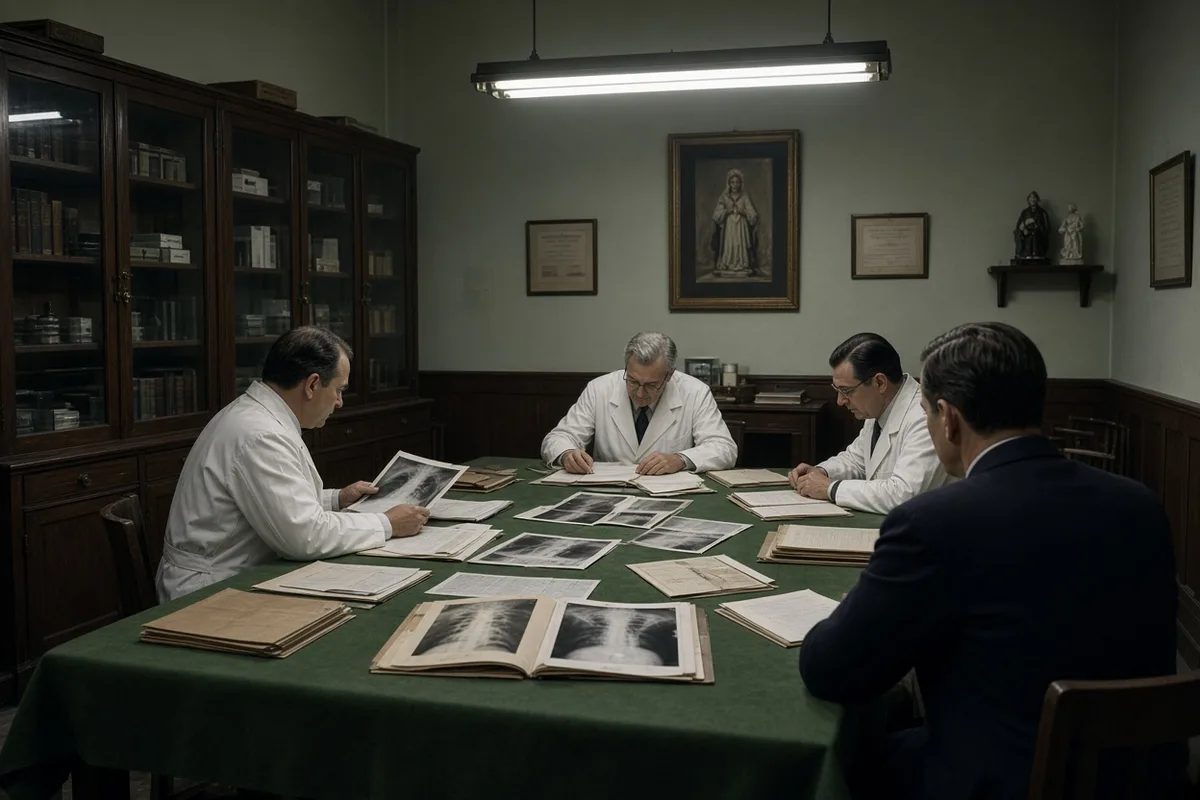
Anne-Marie Ménage continued annual pilgrimages until 1989, after which her name appears only in the volunteer ledger for 1994. The ledger for that year records her age as seventy-one and her assignment to the same section of the Eucharistic procession where Marie Thérèse Canin had stood in 1951. On 19 October 1994 she submitted a typed report to the Marseille section of the Association des Hospitaliers stating that 179 stretchers had been unloaded at Tarbes station on 7 October 1994, matching the count Pierre Duval had recorded for 1952.
The sanctuary photographic collection received a second print of PH-1994-87 on 22 November 2009 from the estate of Jean-Claude Berthon. The accession record notes that the negative strip, frame 12, had been stored at 4 degrees Celsius since development and that the print was made on Fuji Crystal Archive paper with a 0.8-second exposure under a Durst enlarger. The group of twelve former malades is identified on the reverse in Berthon’s handwriting, with Marie Thérèse Canin listed third and Anne-Marie Ménage listed seventh, wearing a grey coat and carrying a black leather handbag measuring 28 by 19 centimetres.
The final entry in the Medical Bureau’s 1994 log, signed by Dr. Garnier on 12 October, records that Anne-Marie Ménage departed the hospital at 11:05 a.m. after signing the discharge form numbered 874-1994. She carried with her a copy of the Bureau report folder 312-1951, stamped with the date 10 October 1951. That copy remains in the parish archive at Saint-Vincent-de-Paul, its pages numbered 1 through 23 in the same ink used for the 1951 notebook entries.
On 3 April 2017 the sanctuary photographic collection accessioned a black-and-white print measuring 13 by 18 centimetres, reference PH-2017-04, showing Anne-Marie Ménage seated on a bench outside the Grotto of Massabielle at 10:52 a.m. on 9 October 1994. The photographer is identified as volunteer number 119, Robert Delorme of the Lyon section, using a Leica M6 with 50-millimetre lens on Ilford HP5 film rated at 400 ASA. Anne-Marie faces the camera directly, her hands resting on a wooden walking stick 92 centimetres in length, the same stick listed in the 1994 volunteer equipment register as issued to her at 7:40 a.m. that morning.