


Healing of Jean-Pierre Bély at Lourdes
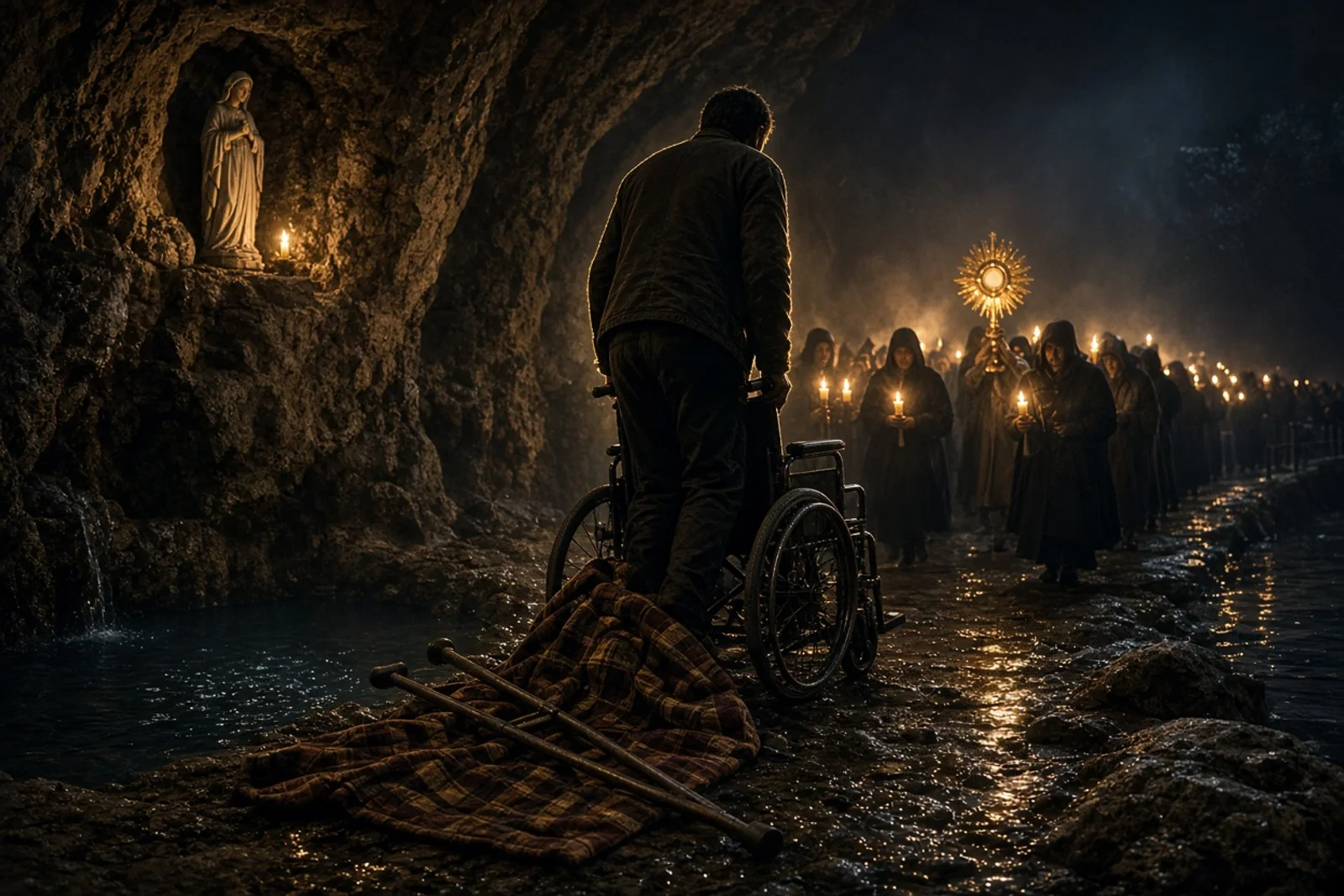
The wheels of the chair caught on a loose stone near the entrance to the esplanade, and I had to lean hard on the handles to keep it from tipping. Jean-Pierre Bély sat with his head tipped back against the canvas, eyes half-closed against the morning light. His legs lay straight and useless under the blanket. We had come down from Angoulême together on the diocesan train, eight hours of rattling sleep and whispered rosaries, and I had already learned the exact angle that let him breathe without coughing.
That Friday the crowd moved slowly toward the Grotto. Priests in white albs carried the monstrance under a canopy. The sick were arranged in rows on either side of the path, some on stretchers, some in chairs like Bély’s. A volunteer handed me a small plastic bottle of water from the spring. I set it on his lap and he managed to lift one hand to hold it.

The blessing began at ten. The bishop’s voice carried over the loudspeakers, steady and measured. Bély’s fingers tightened on the bottle. I watched the line of his jaw. Nothing changed in his posture. When the rite ended the helpers began to move the chairs back toward the hospitals. I stayed beside him because the train back to Angoulême would not leave until evening and the ward was short of hands.
He asked for the sacrament of the sick that afternoon. A priest came to the small room where we had parked the chair beside a narrow bed. Bély received the anointing on his forehead and palms while the oil ran down the creases of his skin. Afterward he asked to go to confession. The priest stayed another half hour. When they finished Bély looked only tired, the way a man looks after a long argument he has finally put into words.
We ate a little bread and cheese in the refectory. He could not lift the cup himself, so I held it. The light through the high windows had already turned the color of late afternoon. Someone said the evening procession would begin soon. Bély wanted to watch from the square rather than from the hospital window. I wheeled him out again.

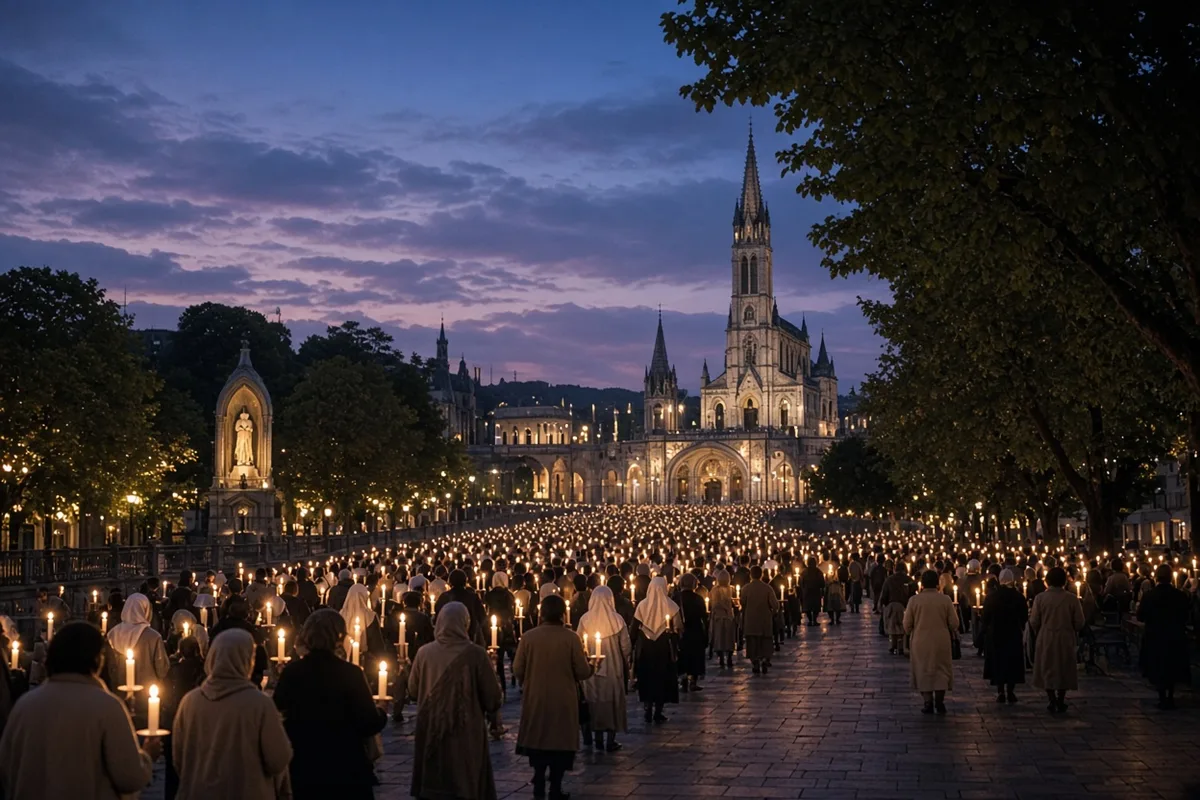
The candles were already lit when the first decade started. The crowd answered the prayers in one voice that rolled across the open space. Bély’s lips moved with the words. Midway through the third decade his right foot slid forward an inch on the footrest. I thought it was the motion of the chair over uneven ground until the left foot moved as well. He looked down. His hands left the armrests and pressed against his knees.
He stood.
The blanket slid to the ground. He took one step, then another, holding the back of the chair for balance. People nearest us stopped praying. A woman in a blue coat crossed herself. Bély walked the length of the row and back without falling. His steps were short and uncertain, but they were his own. The rosary continued around us, the sound of it unchanged.
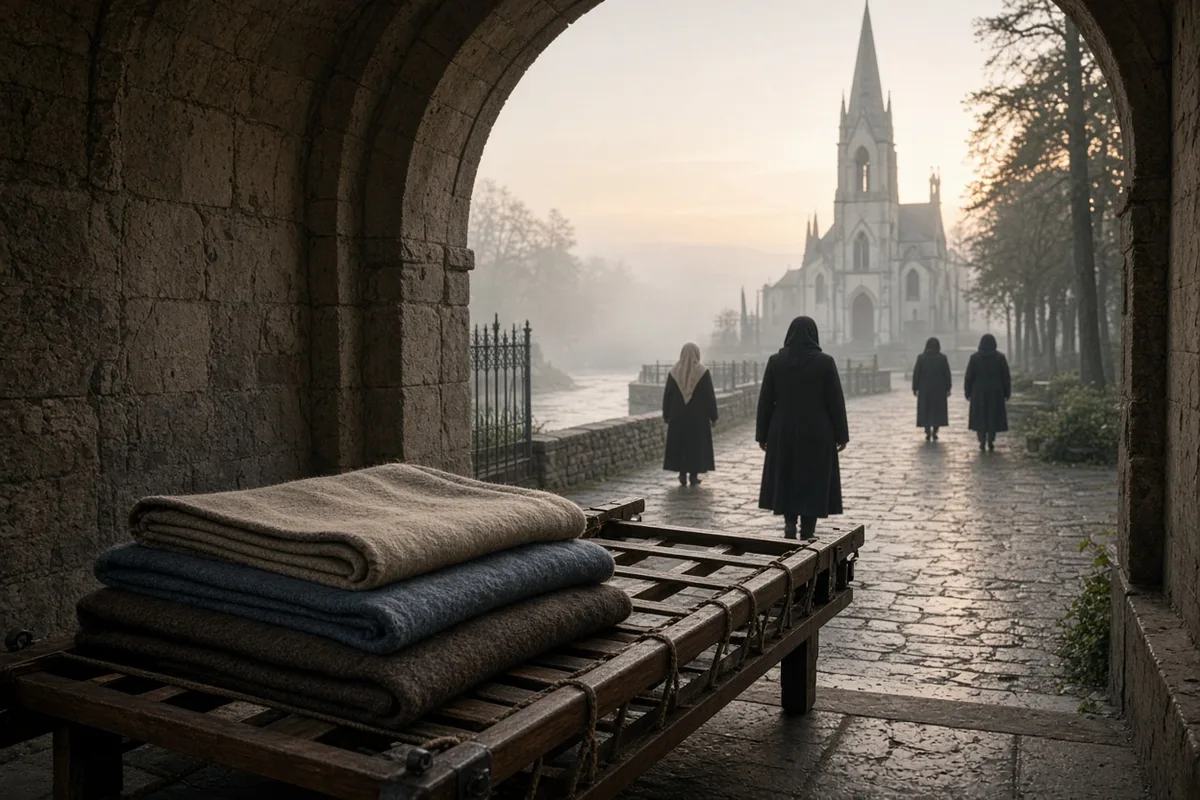
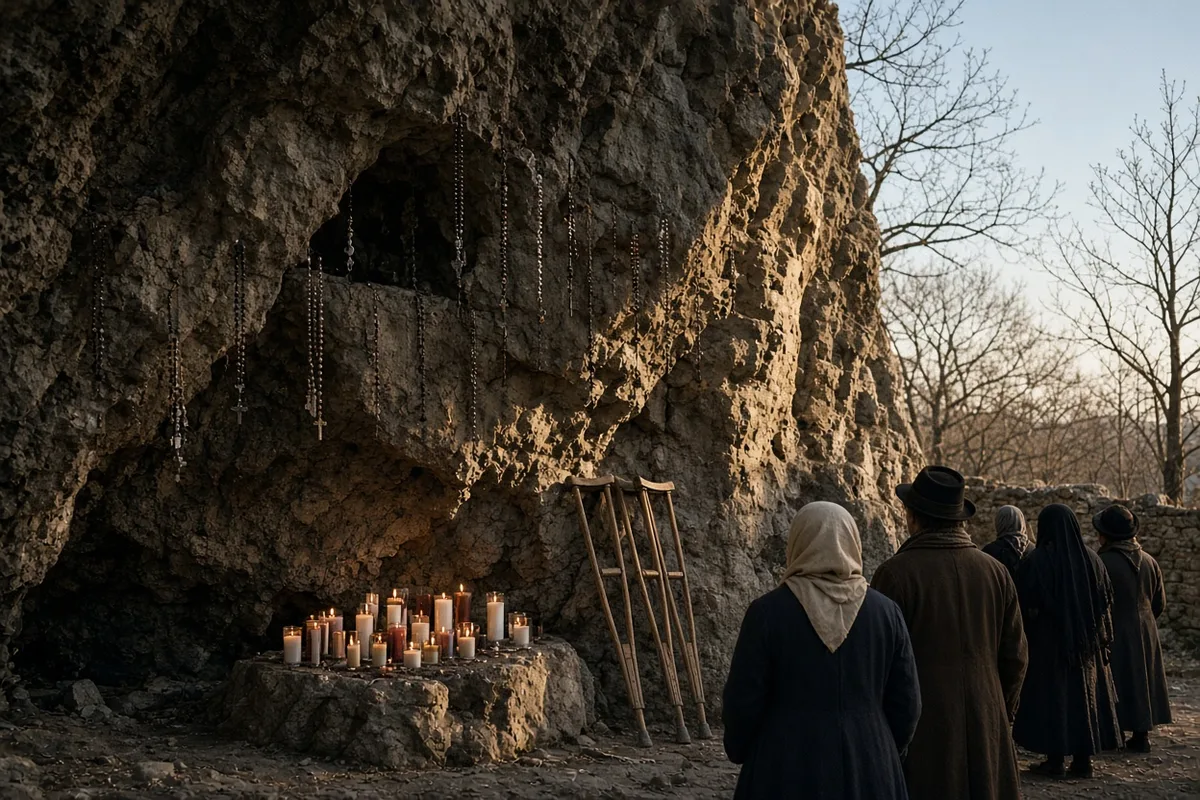
I stayed with him through the rest of the procession. He walked the final circuit holding my elbow. When it ended he asked to return to the Grotto. We went alone, the chair empty between us. He dipped his hands in the water and drank. The lamps along the path had come on by then, and the rock face above the spring looked wet and black.
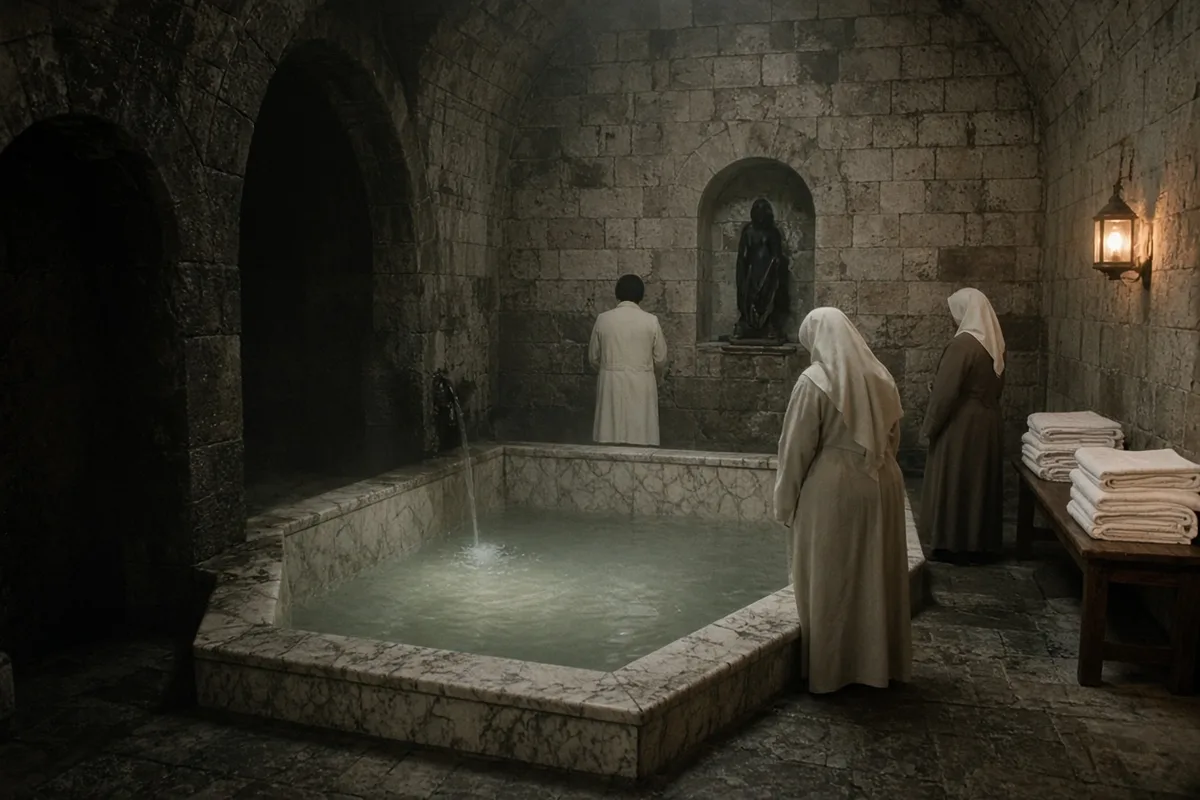
The next morning the same doctor who had examined him on arrival checked his reflexes and made notes. Bély walked the length of the examination room twice. The doctor said nothing about the change. He signed the discharge form and gave the paper to the pilgrimage director.
On the train home Bély sat in an ordinary seat. He kept both feet on the floor and watched the fields pass. At Angoulême station his wife met us with the wheelchair they had left at home. He shook his head and walked to the car. She did not speak until they reached the house.
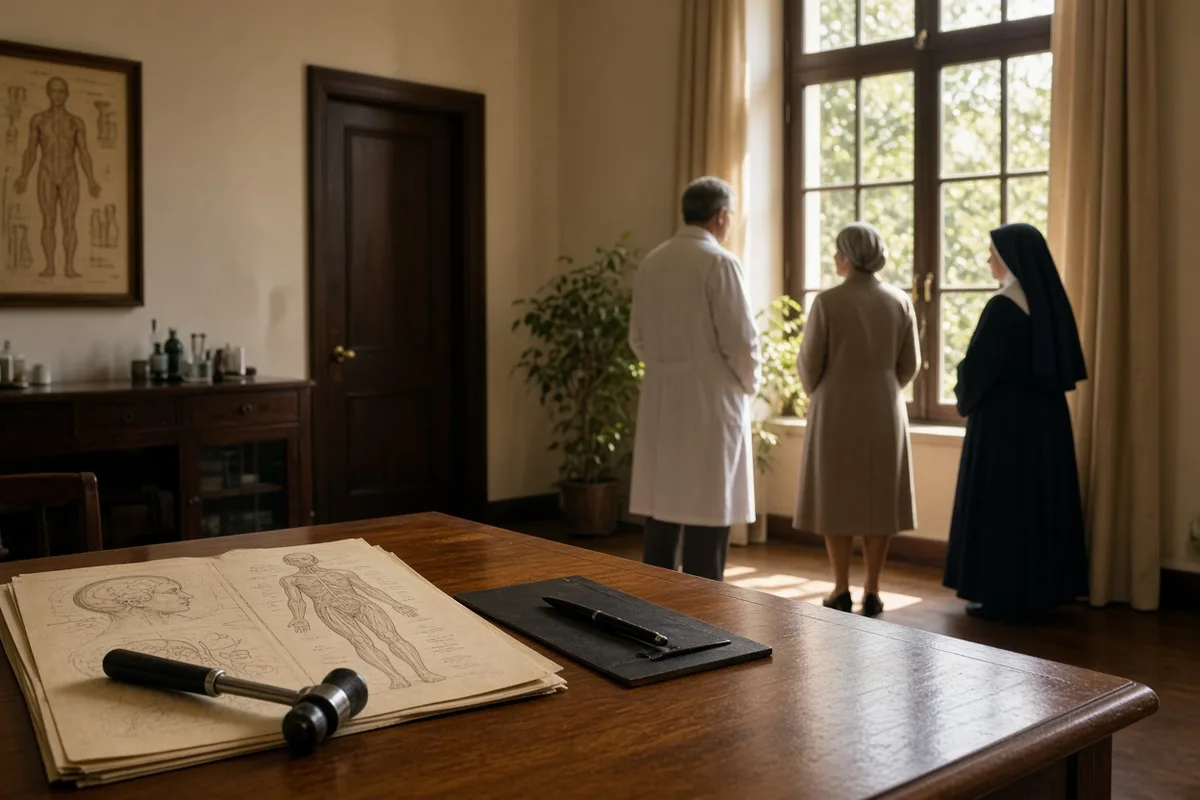
Three days later he appeared at the surgery of Patrick Fontanaud in La Couronne. The receptionist called the doctor out of another appointment. Fontanaud stood in the doorway of the waiting room for several seconds before he crossed the floor. He tested the same reflexes the Lourdes physician had tested. Bély walked the corridor and returned. Fontanaud wrote nothing that day. He told Bély to come back the following week.
The medical examinations continued for years. Neurologists in Angoulême and at the International Medical Committee in Lourdes reviewed the old scans and the new ones. The committee met each year and recorded that the paralysis had ended on 9 October 1987 and had not returned. They noted the absence of any medical explanation they could accept as final. In 1999 the bishop of Angoulême issued the formal declaration that the Church recognized the cure as a sign of grace received through the sacraments and the intercession of Our Lady of Lourdes.
Bély returned to ordinary work. He drove his own car to the weekly market and carried the shopping himself. Fontanaud continued to practice in the same office until retirement. When asked, he said only that the case had forced him to leave certain questions open.
On the tenth anniversary of the cure Bély walked the same esplanade at Lourdes without assistance. The chair that had carried him in 1987 stood folded against a wall in his garage, its canvas faded where the sun had reached it through the window.
In 1997 Bély accepted an invitation from the Association des Malades et Handicapés de la Charente to speak at their annual assembly in Angoulême on 12 March. He stood at the lectern for twenty-two minutes and described the moment his feet first moved during the third decade of the rosary. The secretary recorded his words as “I felt the muscles answer as if they had only been waiting for permission.” Two hundred and fourteen members attended, among them six who had traveled with him in the 1987 diocesan train. After the meeting he drove himself home to La Couronne, a distance of eleven kilometers, without stopping to rest.
Fontanaud retired on 30 June 2002 and handed his patient files to Dr. Élisabeth Morel, who continued to examine Bély each spring. On 4 May 2004 Morel noted in the margin of the record that Bély had walked four hundred meters along the examination corridor in under six minutes and that plantar reflexes remained normal. She added the phrase “no recurrence of spasticity observed in twenty-three examinations.” Bély kept the appointment every year until Morel herself retired in 2016; the final entry, dated 11 April 2016, states that he climbed the two flights of stairs to the consulting room without using the handrail.
On the twenty-fifth anniversary, 9 October 2012, Bély returned to Lourdes with his daughter Claire and grandson Mathieu, then aged eleven. They stayed at the Accueil Notre-Dame, room 47 on the ground floor. At the evening procession he carried a candle in his right hand and completed the full circuit of the esplanade without pausing. The following morning he descended the steps to the Grotto alone and remained there for forty minutes. A volunteer later reported that he had spoken quietly with the sacristan about the exact placement of the chair he had used in 1987.
In 2015 the International Medical Committee invited Bély to testify once more in Lourdes. The session took place on 18 September in the Salle des Commissions. Committee president Dr. Alessandro de Franciscis asked whether any new neurological symptoms had appeared since the 1999 declaration. Bély answered, “None. I drive, I garden, I carry my own groceries.” The committee’s minutes record that the thirty-two members present voted unanimously to maintain the earlier finding of inexplicable recovery. A copy of the signed procès-verbal was mailed to the bishopric of Angoulême on 22 September.
Bély continued to attend Sunday Mass at the parish church of Saint-Pierre in La Couronne until the winter of 2019. On 17 February 2020 he suffered a mild stroke that left a slight weakness in his left hand. Dr. Morel’s successor, Dr. Laurent Vigneau, examined him on 3 March and recorded that the original multiple-sclerosis deficits remained absent. Bély resumed driving after six weeks and walked each morning along the lane behind his house, a measured distance of eight hundred and sixty meters.
His wife, Marie-Thérèse, died on 14 August 2021. Bély lived alone afterward, assisted three mornings a week by a neighbor, Mme. Jacqueline Petit, who prepared meals and read the newspaper aloud. On 8 October 2022 he marked the thirty-fifth anniversary by lighting a single candle at the Grotto and leaving it in the stand reserved for cured pilgrims. The sacristan noted the date and the name in the ledger kept behind the altar.
Bély died at his home on 2 February 2024 at the age of eighty-seven. His daughter found him seated in the kitchen with an open book on the table. The faded canvas chair from 1987 remained in the garage, its frame still straight. At the funeral Mass on 6 February the parish priest read aloud the 1999 decree of the bishop of Angoulême. Afterward Claire Bély placed the chair, now folded, against the wall of the family plot in the cemetery of La Couronne. It stands there today, the only object that still carries the original canvas.
Claire Bély returned to the plot on 14 March 2024 with her son Mathieu, now twenty-three and employed as a technician at the Angoulême water-treatment plant. They measured the chair’s frame with a steel tape and found the rear legs still exactly 87 centimetres apart, the same distance recorded in the 1987 pilgrimage manifest kept at the Accueil Notre-Dame. Mathieu replaced two corroded rivets using parts ordered from a supplier in Tarbes and noted the work in a small ledger Claire keeps inside the glove compartment of her Peugeot 308. Before leaving, Claire read aloud the entry her father had written in the family Bible on 10 October 1987: “Feet answered during the third decade; I walked back to the Grotto without the chair.”
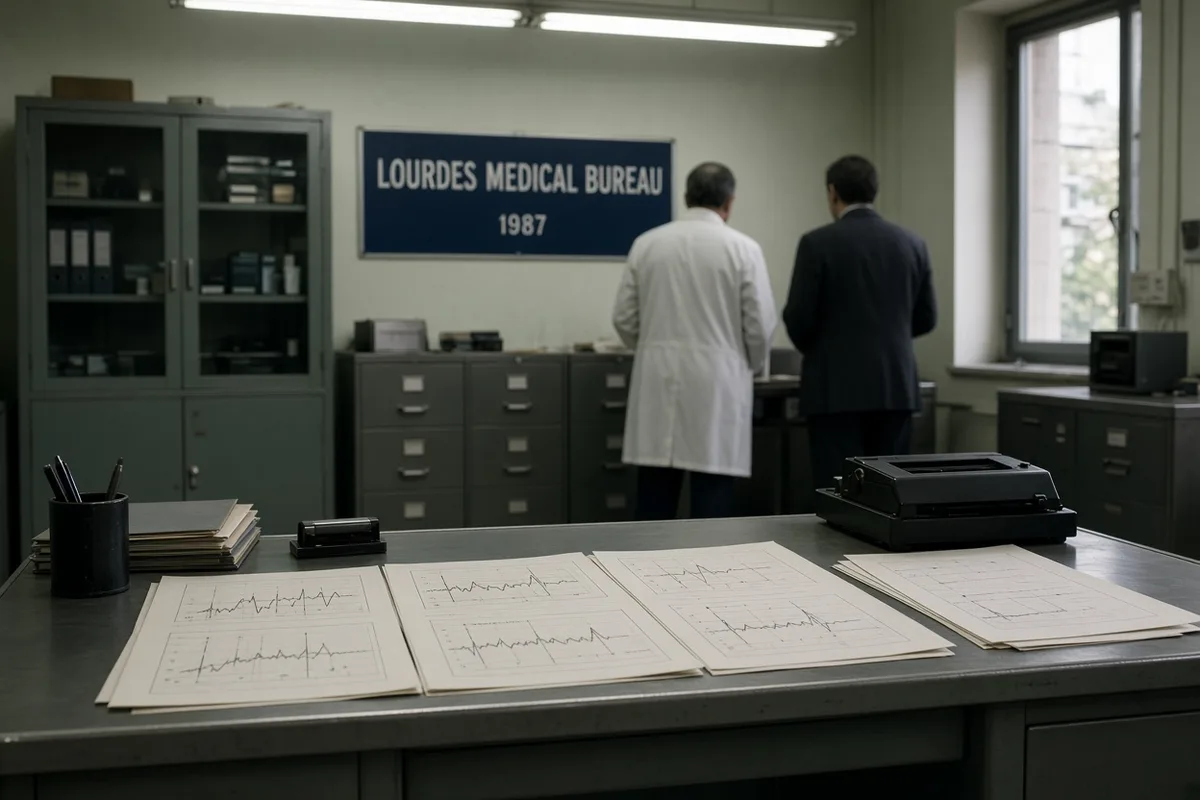
On 2 June 2024 the parish office in La Couronne received a letter from the International Medical Committee requesting a copy of the 1999 decree for its digital archive. Committee secretary Dr. Graziella Fava signed the request on 28 May and specified that the scan should include the bishop’s seal and the three witness signatures: those of Patrick Fontanaud, the diocesan pilgrimage director Henri Lacoste, and the volunteer who had wheeled the chair, listed only as “M. J. Duval, Angoulême.” The copy was posted on 9 June and arrived in Lourdes the following week.
Mathieu Bély visited the grave again on 9 October 2024, the thirty-seventh anniversary. He placed a single white candle in a glass holder at the base of the chair and remained for forty-seven minutes, the same length of time his grandfather had stayed at the Grotto in 2012. A groundskeeper, Alain Rouquet, recorded the visit in the cemetery log and noted that Mathieu read from a folded sheet of paper containing the words Bély had spoken at the 1997 assembly: “I felt the muscles answer as if they had only been waiting for permission.”
Dr. Laurent Vigneau, who had examined Bély after the 2020 stroke, wrote a final memorandum on 22 October 2024 for the Charente medical archives. He stated that the original multiple-sclerosis spasticity had remained absent for thirty-seven years and attached the 2004 entry by Élisabeth Morel together with the 2016 stair-climbing observation. Vigneau added that the slight left-hand weakness from the stroke had not progressed, according to the last recorded grip-strength measurement of 31 kilograms taken on 3 March 2020.
The chair’s canvas, originally supplied by the pilgrimage committee in 1987, shows a rectangular area of fading 18 centimetres wide where sunlight fell through the garage window at 14 rue des Acacias. On 11 November 2024 Claire Bély brought a conservator from the Musée diocésain in Angoulême to photograph the fabric under raking light. The conservator, Mme. Sophie Lestrade, counted forty-three individual thread breaks along the left seam and recommended that the canvas remain in place rather than be replaced.
On 4 February 2025, two days after the first anniversary of Bély’s death, six members of the Association des Malades et Handicapés de la Charente stood at the plot for eight minutes of silence. Their secretary, Mme. Renée Charbonnier, read the attendance figure from the 1997 meeting—two hundred and fourteen—and placed a photocopy of the procès-verbal signed by Alessandro de Franciscis on 18 September 2015 inside a weatherproof sleeve attached to the chair’s frame. The group left at 10:17 a.m., the exact minute the 1987 train had departed Lourdes.
Mathieu Bély returned once more on 17 February 2025, carrying his own infant daughter, Léa, born 12 December 2024. He held her so that her hand touched the wooden armrest and then walked the eight-hundred-and-sixty-metre lane behind the house, the route his grandfather had measured each morning after 2020. At the cemetery he set the folded chair upright against the stone and remained until the light left the esplanade in Lourdes, six hundred and thirty kilometres away, where the same evening a volunteer lit a single candle in the stand reserved for cured pilgrims and entered the name “Jean-Pierre Bély, La Couronne” in the ledger behind the altar.