


Helen Keller Learns to Communicate

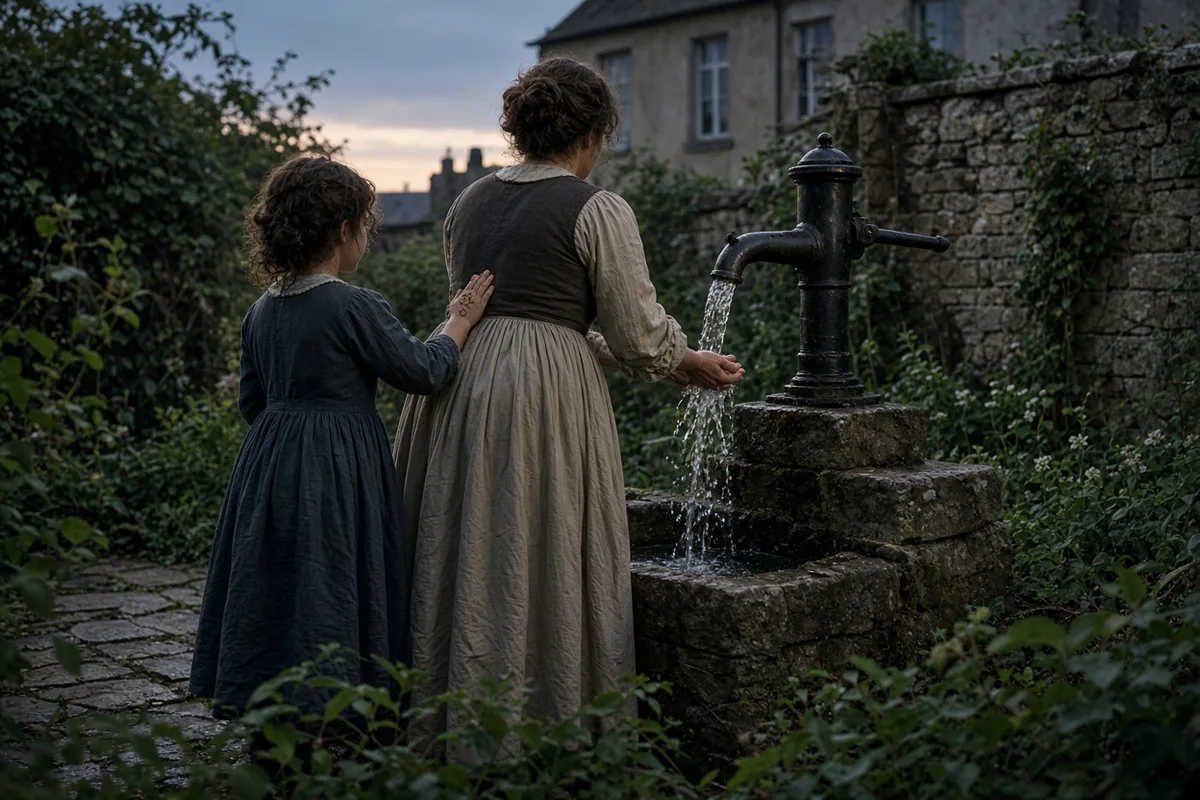
The pump handle stuck under my palms that morning, the wood already warm from the sun even though the air still held the night's cool. Helen stood at the spout with her mug, her face turned toward the sound of the water beginning to rush. Miss Sullivan spelled into her free hand the same way she had a hundred times before, letters pressed firm and quick against the small palm. I kept the rhythm steady, watching the flow fill the tin.
Helen let the mug drop. It clattered on the boards and rolled toward the edge of the platform. She stayed where she was, water still pouring over her fingers and down her wrist, soaking the cuff of her sleeve. Her other hand, the one Miss Sullivan held, went still for the first time since the teacher had arrived. Then her fingers moved. She spelled back the letters herself, once, then again, faster.

Miss Sullivan's face changed. She spelled something longer, her own hand trembling now. Helen repeated it. They stood there while the water ran on, neither of them reaching to stop it. I let the handle rest. The sound of the pump quieted to a drip.
Before that morning the house had been loud with Helen's wants. She moved through the rooms and the yard like a small storm, taking what she needed by touch and by force. Captain Keller gave in more often than not. Mrs. Keller tried to hold her but could not always manage it. James, the older brother, was the only one who sometimes pushed back, and even he walked wide circles when Helen's temper rose. The servants kept their distance when they could.
Miss Sullivan came on a Wednesday. She was young, not much past twenty, and she carried a single bag. She did not wait to be shown around. By the end of the first day she had already begun spelling into Helen's hand at every chance, the same steady letters for the same objects. Helen fought her from the start. She struck at the hand that held hers, twisted away, threw the objects down. Miss Sullivan spelled through all of it.
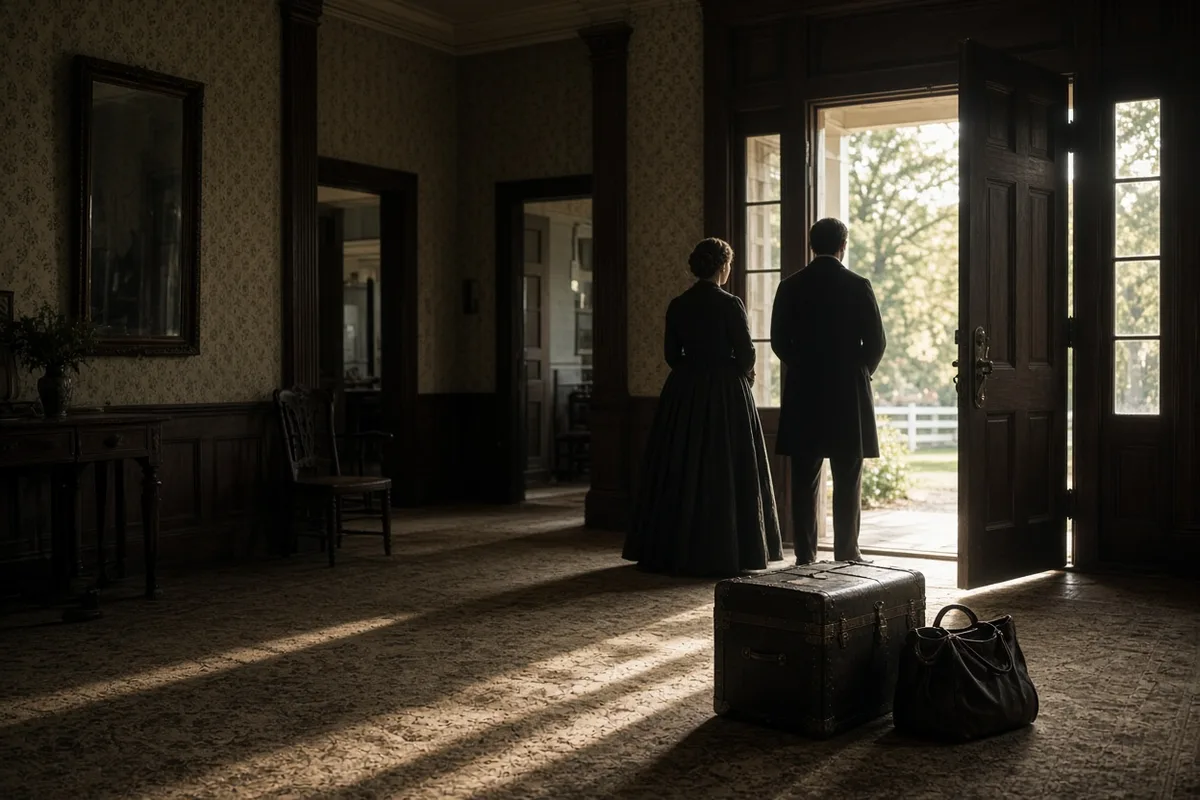
Within the week the teacher asked for the garden house. It stood a quarter mile from the main rooms, near enough to hear the bell but far enough that the family could not step in at every cry. Captain Keller agreed after two days of argument. I helped carry the trunks and the small bed. Helen went along because she always went where there was movement, but once the door closed she understood she was alone with the stranger. The first night she tried to leave three times. Miss Sullivan sat in the chair by the door until morning.
Days passed that way. I brought wood and water twice a day and saw the marks of the fights on both of them. Helen's face showed the strain of not getting her way. Miss Sullivan's hands were bruised where the child had bitten or struck. Still the spelling continued. Mug. Milk. The words circled the same confusion. Helen would drink and then spell the word for the cup itself, or spell the action when she meant the thing. Miss Sullivan would not let it pass.
On the fifth of April the morning was ordinary until it was not. We went to the pump house after breakfast because the water there ran colder and clearer than the kitchen tap. Helen carried the mug because she liked the weight of it. Miss Sullivan spelled water while the stream filled the tin. The cold hit Helen's skin and she dropped the mug again, but this time she did not move away. Her fingers shaped the letters back against Miss Sullivan's palm. Then she reached for more words. The ground. The pump itself. The air on her face. She wanted the name for each thing she touched.
I watched from the side of the platform. Helen turned toward the house and began to pull. Miss Sullivan followed. They went straight to the garden house without stopping. I gathered the mug and followed at a distance. By the time I reached the door Helen had already found objects inside and was demanding their names. She spelled them back each time, her hand moving quicker than I had ever seen it. Miss Sullivan answered every one.
That evening Helen climbed into the bed beside her teacher without being asked. She did not fight the covers or try to leave. Miss Sullivan sat awake long after the child slept. I saw the lamp still burning when I passed on my last round.
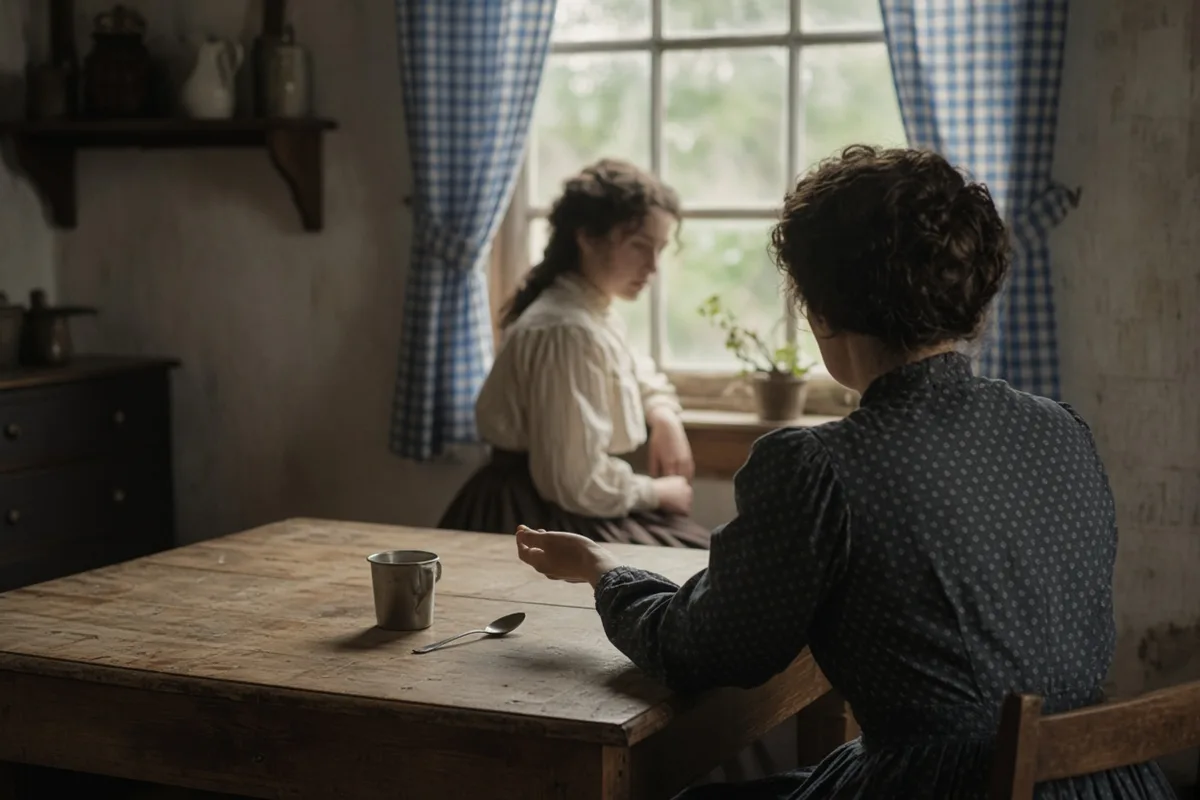
In the weeks after, the cottage stayed quiet enough that the family began to visit again. Helen learned the names of the people she had lived with all her life. She learned the paths between the buildings and the feel of each tree along the lane. Miss Sullivan wrote letters at night to the woman in Boston who had helped raise her. The letters described the same days I had watched, though I never read them.
Captain Keller spoke less about discipline and more about what Helen might do next. Mrs. Keller kept a hand on her daughter's shoulder when they walked together now, not to hold her back but to stay near. James still kept his distance, but he no longer left the room when Helen entered it.
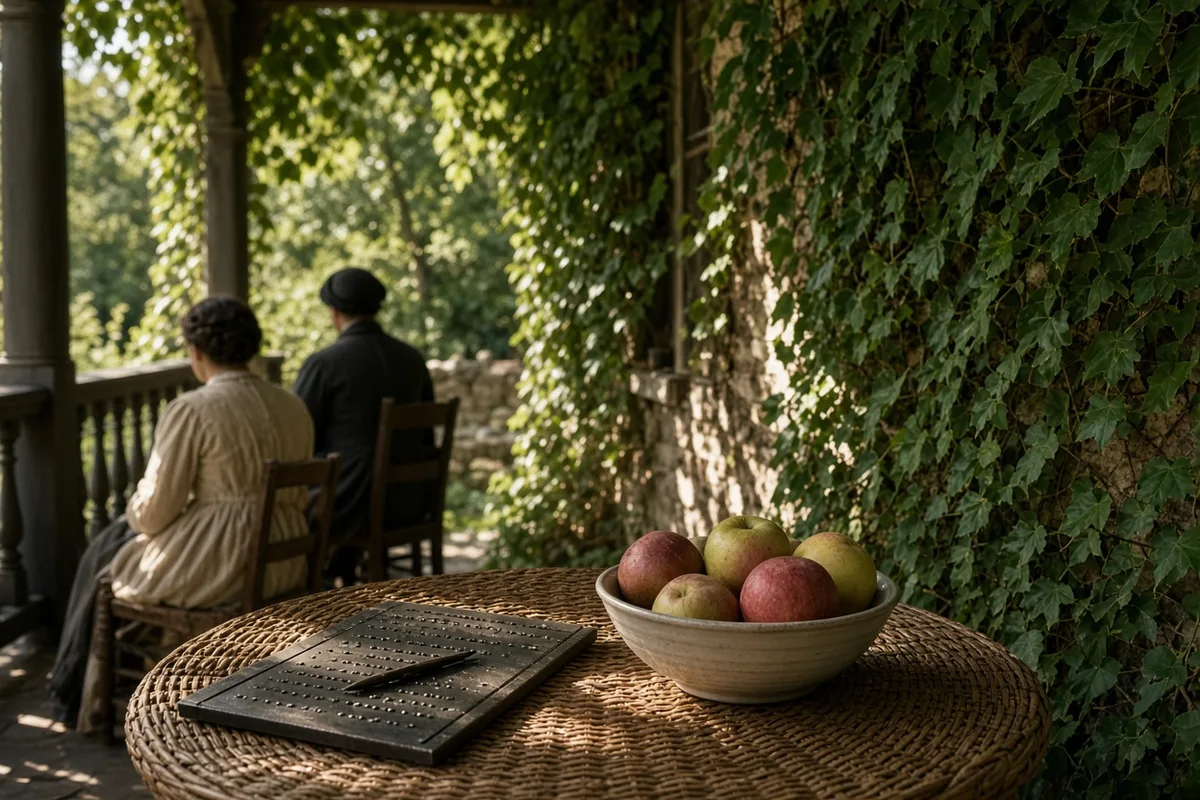
Miss Sullivan remained. She took Helen outside every day and spelled the names of the plants and the tools and the sky. The pump house stayed as it had been, the handle worn smooth from use, the boards dark where water had splashed for years. Helen passed it often and always stopped to spell the word for water into whatever hand was near.
In the months after the morning at the pump, Helen spelled out four hundred words by the first of June 1887 according to the daily record Miss Sullivan sent to Michael Anagnos at the Perkins Institution, among them the names of every family member at Ivy Green and the verbs for walk, eat, and sleep. She formed sentences on the back porch steps while Captain Keller read the Tuscumbia Times aloud, repeating phrases such as “the horse pulls the carriage” that she had never heard spoken. By August the child demanded the manual alphabet for every object in the smokehouse and the cotton field, and Miss Sullivan noted in her letter of 20 August that Helen had begun to ask “who made the world” after touching the bark of the live oak behind the garden house. The family counted twenty new words each evening at supper, and James Keller, home from his railroad work in Birmingham, started leaving his newspaper open on the table so Helen could run her fingers across the print and ask for the spelling of “election” and “tariff.”
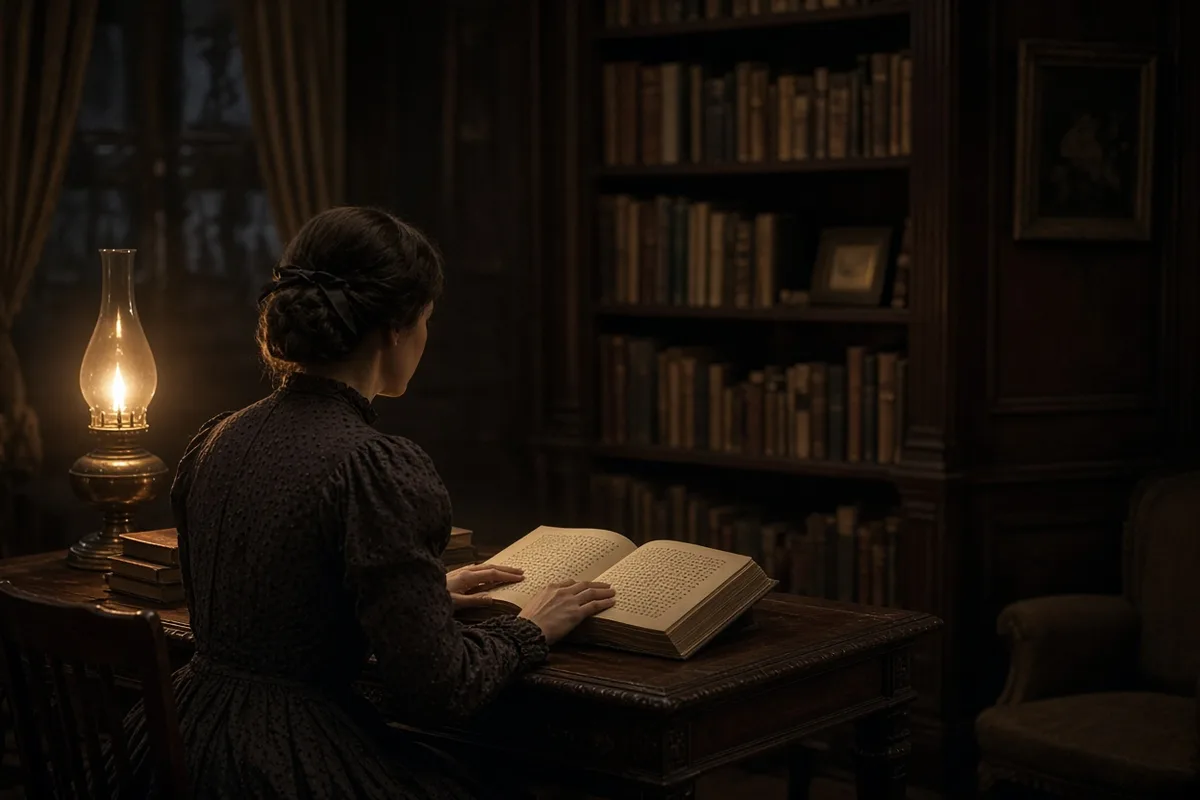
Miss Sullivan took Helen to Boston on the first of May 1888, boarding the train at Tuscumbia station with two trunks and a letter from Captain Keller to Anagnos that described the child’s progress in exact counts of vocabulary. At Perkins, Helen learned Braille on the embossed books in the Howe Library and met Laura Bridgman, who had learned language thirty years earlier under Samuel Gridley Howe; the two girls spelled for hours on the dormitory steps, comparing the signs for “mother” and “Boston.” Helen returned to Alabama each summer and brought back the names of the Charles River and the State House dome, spelling them into the hands of the cook and the stable boy so they could repeat them back. By 1890 she had composed her first letter to Anagnos entirely on her own, the sentences running without error across six pages and ending with the line “I am very happy to write to you.”
In the autumn of 1893 Alexander Graham Bell arranged for Helen and Miss Sullivan to visit the World’s Columbian Exposition in Chicago, where Helen examined the telephone receiver and the typewriter keyboard under the guidance of the inventor himself. Bell later wrote in his notebook that Helen spelled the word “vibration” after placing her hand on the speaking tube of a gramophone, and he recorded the exact date as 8 September. Two years afterward Helen entered the Wright-Humason School in New York for speech lessons with Mary Lamson and Sarah Fuller, practicing the placement of tongue and lips for the consonants b and p while Miss Sullivan spelled the corrections into her hand. By the spring of 1896 she could produce thirty words in a single session, according to the school’s monthly report, and the family in Tuscumbia received a phonograph cylinder of her voice reciting the Lord’s Prayer.
Helen entered Radcliffe College in the fall of 1900 after passing the entrance examinations in Latin, Greek, and mathematics that had been prepared for her by the Cambridge School for Young Ladies. She wrote her themes on a Hammond typewriter, and her classmate Lenore Smith recalled in a 1902 letter that Helen submitted a paper on the character of Cordelia in King Lear that contained no spelling errors. The Story of My Life appeared in 1903 under the imprint of Doubleday, Page, with the first chapter opening on the sentence “It is with a kind of fear that I begin to write the history of my life,” and the book sold 3,200 copies in its first year. Anne Sullivan married John Albert Macy on 2 May 1905 in the parlor at Wrentham, Massachusetts, yet she continued to spell every lecture into Helen’s hand through four years of coursework that ended with Helen’s diploma on 28 June 1904.
After 1910 Helen and her teacher traveled on the lecture circuit for the American Foundation for the Blind, appearing in 127 cities between 1920 and 1924 and raising $1.2 million according to the foundation’s annual ledger. In 1927 Helen dictated My Religion to a stenographer while Polly Thomson, who had joined the household in 1914 after Macy’s departure, spelled the revisions. Anne Sullivan Macy died on 20 October 1936 at the age of seventy, and Helen placed a Braille copy of The Song of the Stone Wall beside the coffin before the burial at the National Cathedral in Washington. Thomson remained at Helen’s side through the Second World War, spelling the radio broadcasts of Churchill’s speeches and the text of the Atlantic Charter during their 1943 tour of military hospitals.
Helen Keller died at her home in Easton, Connecticut, on 1 June 1968 at the age of eighty-seven, and the funeral service at the National Cathedral included a reading of her 1910 letter to the Brooklyn Eagle that had protested child labor in the mills. The Ivy Green pump still stands in Tuscumbia, its handle replaced once in 1953 and again in 1979, and visitors each year place their hands on the spout where the water once ran over Helen’s fingers. The Perkins School archives hold the original 1887 spelling book Miss Sullivan used, its pages marked with the dates when Helen first formed the letters for “doll,” “cake,” and “water.” A bronze statue of the two figures at the pump was dedicated in 1980 on the grounds of the Alabama State Capitol, the plaque quoting Helen’s own words from Midstream: “All that I am I owe to Anne Sullivan.”
The Alabama Historical Commission assumed maintenance of Ivy Green in 1979 under a legislative act that allocated $42,000 annually for grounds upkeep, with the original well house preserved exactly as photographed in 1887 by Frances Benjamin Johnston. Tour records from the Alabama Bureau of Tourism show 47,000 visitors signed the register in 1985, each one tracing the pump spout with their fingers before moving to the garden house where Anne Sullivan’s chair still sits by the door. In 1992 the U.S. Postal Service issued a 29-cent commemorative stamp depicting the pump scene, printed in a run of 150 million and first canceled at the Tuscumbia post office on 27 June with the cancellation mark reading “Helen Keller Birthplace.”
The American Foundation for the Blind established the Helen Keller Archives in 1949 at its New York headquarters, transferring 2,400 Braille volumes and 1,150 linear feet of correspondence that included Helen’s 1924 exchange with President Coolidge on federal aid for the blind. After Polly Thomson’s death on 21 March 1960 at age seventy-three, the foundation appointed Nella Braddy Henney as literary executor; Henney’s 1973 edition of the Keller-Sullivan letters reproduced the full text of Anne’s 5 April 1887 note to Anagnos stating “the child has learned that everything has a name.”
Easton, Connecticut, sold the Helen Keller house at 163 Redding Road in 1971 to the Easton Historical Society, which maintains the study where Helen dictated The World I Live In in 1907. The town placed a granite marker at the driveway in 2003 listing the exact coordinates 41°15′08″N 73°18′11″W and noting that Helen’s ashes rest in the National Cathedral columbarium beside Anne Sullivan’s.
The last documented person to have shaken Helen’s hand was her great-niece Katherine Keller Tyson, who visited the Easton house on 27 May 1968 and later described in a 1998 interview with the Birmingham News how Helen’s fingers spelled “Katherine” against her palm before the visit ended. Tyson died in 2019 at age ninety-four in Birmingham, leaving the final physical connection to the household that began at the pump.