


Henry IV Walks to Canossa and Reconciles with Pope
The wind off the Apennines cut through the wool cloak I wore that morning, and I pulled it tighter as I climbed the outer stair of Canossa’s gate tower. Below me the road from the valley still held patches of ice from the night before. Matilda had ordered every shutter on the south side of the keep left open so she could watch the approach herself. I heard her voice carry from the hall, low and quick, telling Adelaide what the last messenger had said about the king’s party.
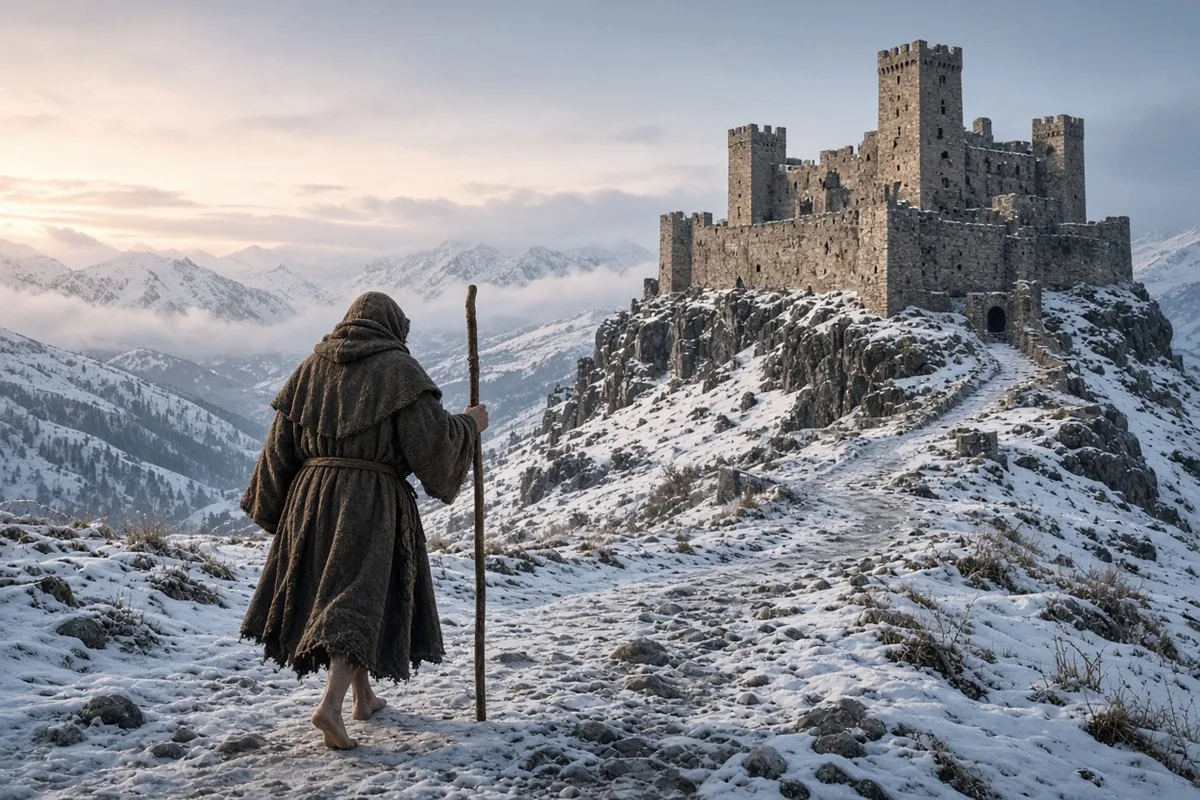
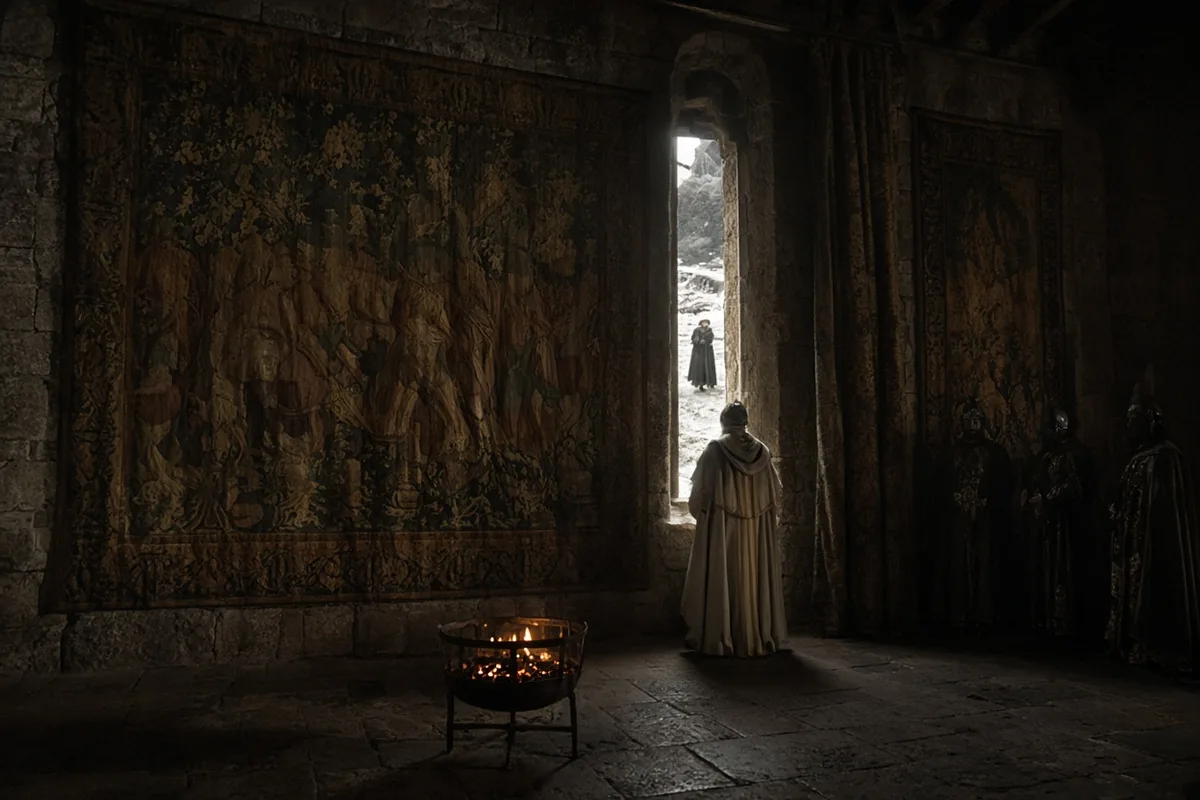
Three men in plain cloaks rode ahead of the rest. One carried the banner of the German crown rolled tight against his thigh. They stopped two hundred paces from the outer wall and waited. No trumpet sounded. The tallest of them dismounted, handed his reins to the others, and began to walk. His feet were bare on the frozen ground. The wool robe he wore stopped above the ankles. I recognized the stride even before I saw the face. Henry had come.

I went down to the inner court at once. Matilda stood with Adelaide and Abbot Hugh beside the chapel door. She wore a dark mantle over her gown and carried no ornament. When the porter brought word that the king asked only to speak with the pope, she looked once at Hugh, then nodded to me to open the wicket gate. I did not open the main doors.
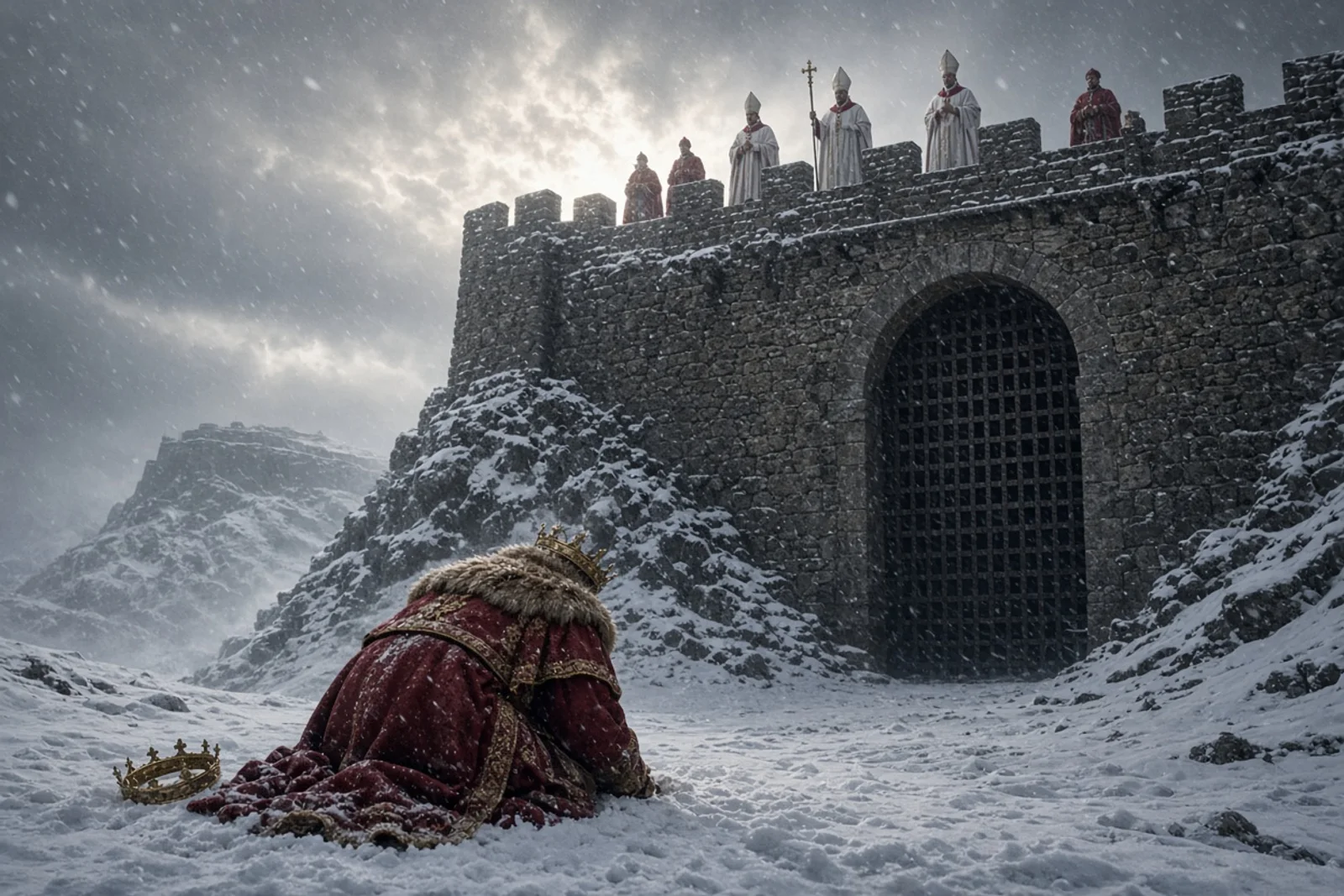
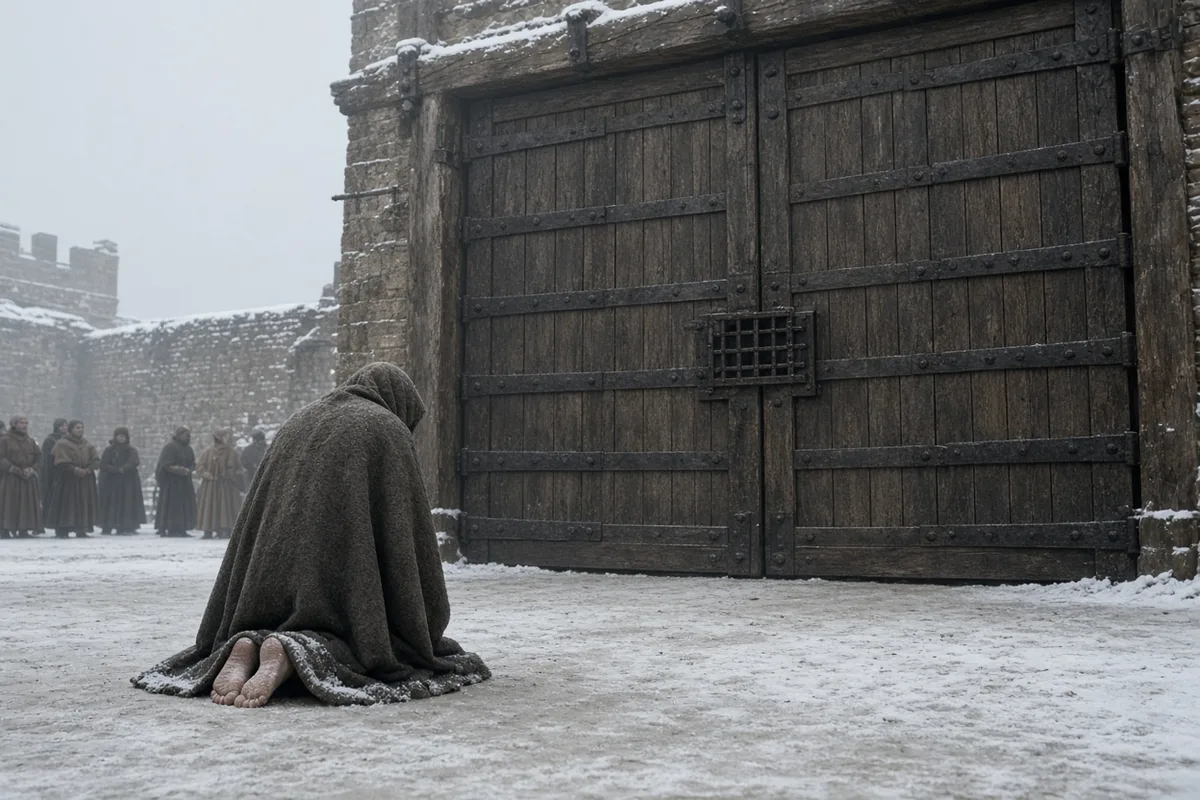
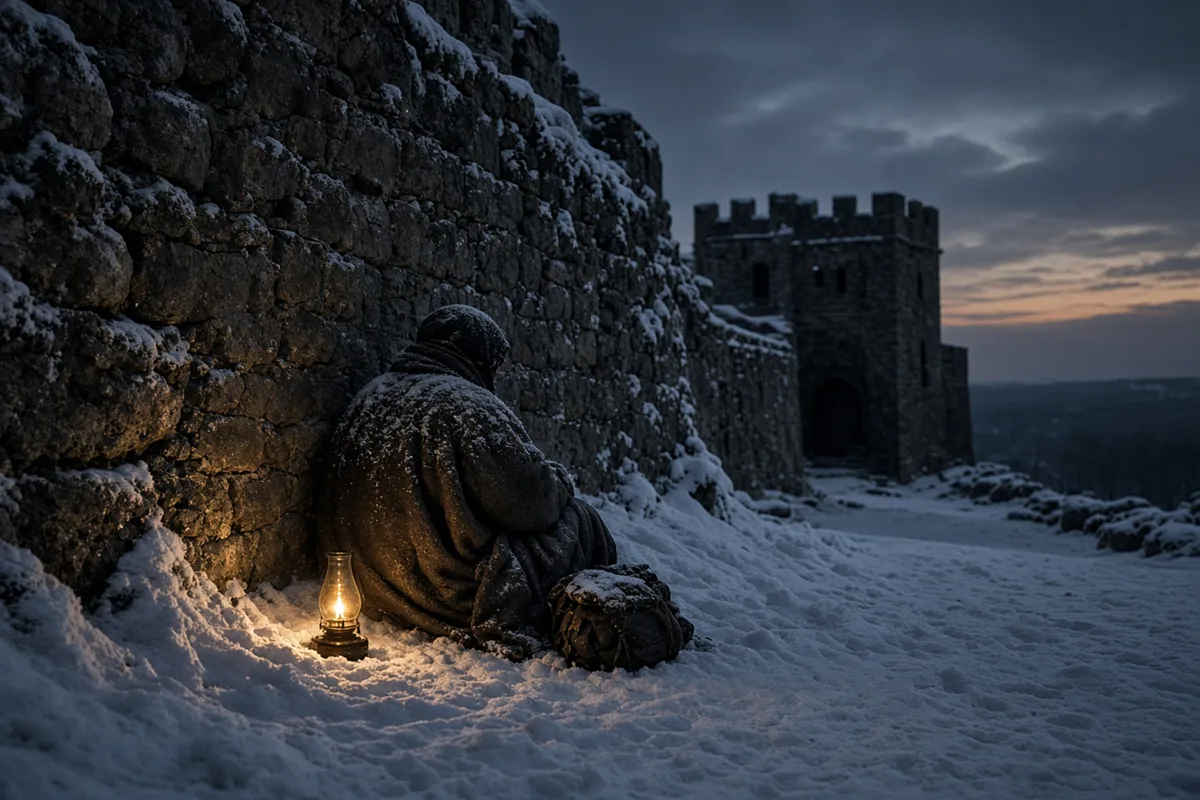
Henry waited on the stones outside. Snow had begun to fall again, light and dry. He did not raise his voice. He asked that Gregory receive him and lift the ban. The answer that came back through the same small door was that the pope would consider the request after the day’s offices. Henry remained where he stood. When the light failed he was still there, shoulders hunched against the wind, hands at his sides. I closed the wicket and barred it from within.

The next morning the snow lay deeper. From the tower I could see the three dark shapes of the men who had come with him; they had built a small fire farther down the slope and sat around it. Henry himself had not moved from the gate. His feet had left dark prints that the new snow slowly filled. Servants carried bread and water out to him at Matilda’s order. He took the water but left the bread on the step.
Inside the hall the talk ran in circles. Gregory would not yet grant an audience. The German princes had set a meeting for February, and any absolution given now would change the terms. Matilda argued that three days of open penance might satisfy the letter of the law. Adelaide said nothing for a long time, then asked whether the king had dismissed the excommunicated counselors as he had promised. No one could answer that from where we stood.

On the second day the cold sharpened. I saw Henry’s lips move when the bell rang for prime, though no sound reached the wall. A messenger from the valley arrived with letters for Gregory; the pope read them in the solar and sent no reply to the man outside. Toward evening Hugh of Cluny went out through the wicket. He stayed with Henry for nearly an hour, speaking quietly. When he returned his face was drawn. He told Matilda that the king had asked only for the chance to confess and be restored, nothing more. Matilda sent word again to Gregory. The answer remained the same.
The third morning the snow stopped. Sunlight lay thin across the white slope. Henry had knelt during the night; his knees were visible through the robe where the cloth had worn. I counted the hours by the bells. At sext a shout came from the lower court. The main gate opened just wide enough for two riders. Matilda and Adelaide went out together, cloaked and hooded. They spoke with Henry for a long time. I could not hear the words, only the tone of their voices, steady and without anger. Hugh joined them later. The four figures remained in the snow until the sun dropped behind the ridge.

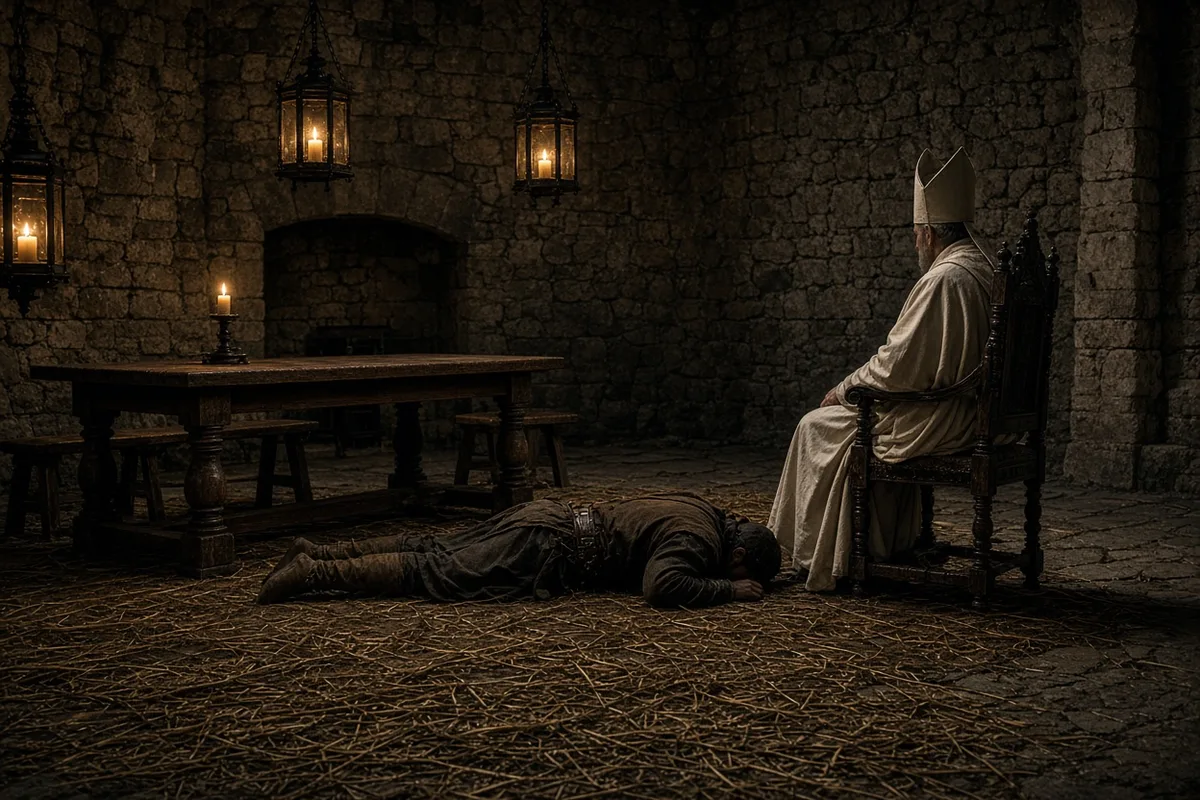
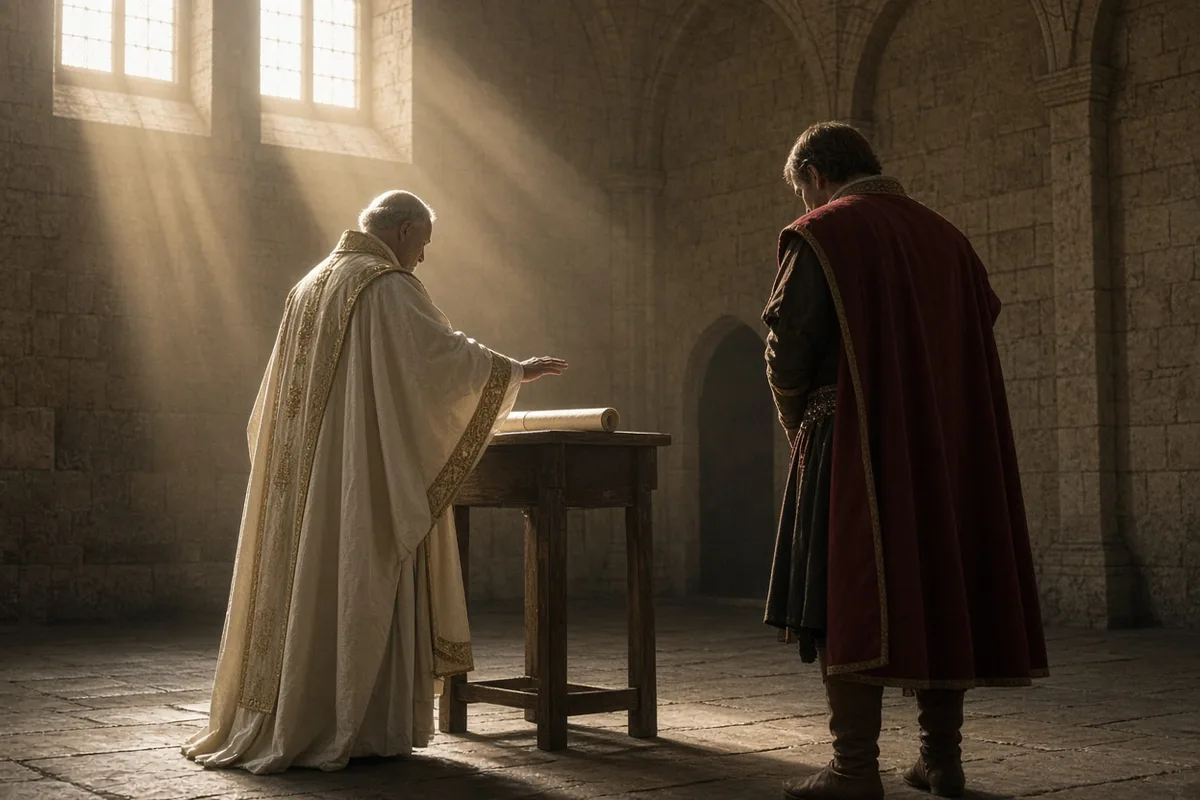
Near vespers the wicket opened again. This time the command came to admit the king. Henry entered alone. He walked the length of the outer court without looking up. His feet left red prints on the stone. Inside the chapel Gregory waited, attended by two deacons. The absolution was spoken in the usual form. Henry answered the questions put to him. When it was finished he was given a place at the evening meal, though he ate little. The excommunication was lifted. The oath of fidelity that had been suspended was restored in private.
Matilda ordered the gates opened at first light. Henry left before the sun cleared the peaks. He wore boots again and a fur-lined mantle, but he carried no standard. The three men who had waited on the slope rode with him. From the tower I watched them descend the road until the trees hid them. The snow where he had stood for three days remained trampled and dirty. By midday new snow had already begun to cover the marks.
Gregory stayed another week at Canossa. He wrote letters to the German princes explaining what had been done. Matilda prepared an escort to take him north, yet the meeting with the princes never took place that winter. Henry returned to his own lands and began at once to gather support. The ban was gone, but the quarrel over who could name bishops remained exactly as it had been before the snow. I remained at Canossa until spring. The prints on the outer step had long since disappeared under fresh fall, yet every man who passed the gate still looked down at the place where they had been.
In spring of 1077 I left Canossa with Matilda’s household and rode north through the passes to her castle at Bianello, where she kept her chancery records and the charters granted by earlier popes. On 15 April a messenger arrived from the court of Rudolf of Rheinfelden bearing letters dated 15 March that described the assembly at Forchheim in which the German princes declared Henry’s restoration invalid and elected Rudolf king; the document quoted the princes’ statement that “no one may be bound by an oath sworn to an excommunicate.” Matilda dictated replies to each of the named bishops who had attended, listing their sees and the exact sums she would send in silver marks to support their levies. I copied the figures into the ledger: eight hundred marks to the see of Mainz, six hundred to Würzburg, four hundred to Salzburg.
By the winter of 1080 the conflict had moved to the synod Gregory convened at Brixen on 25 June. The bishops there, numbering twenty-nine according to the acts Matilda received, elected Guibert of Ravenna as antipope under the name Clement III. Matilda’s scribe read the decree aloud in the hall at Canossa on 12 July; the text named Henry as “the instigator of this schism” and excommunicated him a second time. She ordered fresh copies made for the Lombard cities still loyal to her and dispatched riders to carry them before the snow closed the roads. I kept the original parchment in the strongbox beneath the chapel floor until the following spring.
In May 1081 Henry crossed the Alps with an army estimated at twelve thousand men and laid siege to Rome. Matilda sent three hundred knights under the command of her vassal Arduino della Palude to reinforce the Leonine City; they arrived on 23 May and fought at the Ponte Sant’Angelo, where Arduino was killed by a crossbow bolt through the throat. Gregory remained inside the Castel Sant’Angelo until December 1083, when Henry’s forces breached the walls of Trastevere. The pope escaped southward with only a handful of clerks and reached Salerno on 20 June 1084.
On 25 May 1085 Gregory died in the episcopal palace at Salerno. His last recorded words, spoken to the deacon who attended him, were “I have loved justice and hated iniquity; therefore I die in exile.” Matilda received the news at her fortress of Sorbara on 8 June. She immediately ordered a requiem mass sung in the chapel there and sent a letter to Desiderius, abbot of Montecassino, asking him to preserve Gregory’s ring and pallium until a lawful successor could be elected. The letter survives in the Montecassino archive and bears her seal in red wax.
Throughout the following decade Matilda continued to fight Henry’s forces in the Apennine valleys. At the battle of Sorbara on 2 July 1084 her troops captured the imperial banner and the count of Namur’s war chest containing four thousand silver marks. In 1092 she defeated Henry’s son Conrad at the crossing of the Po near Bondeno, taking three hundred prisoners whose names are listed in her ransom rolls. She granted Conrad protection at her court in Mantua after he turned against his father, and on 10 April 1095 she hosted Urban II at her castle of Piacenza, where the pope preached the First Crusade before an assembly of two hundred and thirty knights.
Henry himself never returned to Canossa. After his second excommunication he remained in Italy until 1097, then withdrew to Germany where his son Henry V rose against him. The younger Henry captured his father at Böckelheim on 23 December 1105; the old king was forced to abdicate and died at Liège on 7 August 1106. His body lay unburied for five years because the bishops refused consecration until 1111, when it was finally interred at Speyer Cathedral in the presence of Henry V and the archbishop of Mainz.
The Investiture Controversy ended only after both Matilda and Henry V were dead. On 23 September 1122 the Concordat of Worms, signed by Calixtus II and Henry V, granted the emperor the right to invest bishops with ring and staff in Germany but reserved the actual election to the cathedral chapters. Matilda had already transferred her extensive allodial lands to the Holy See by the donation of 1102, witnessed by fifteen abbots and recorded in the papal register. Those estates, stretching from the Po to the Apennines, remained under direct papal administration until the sixteenth century.
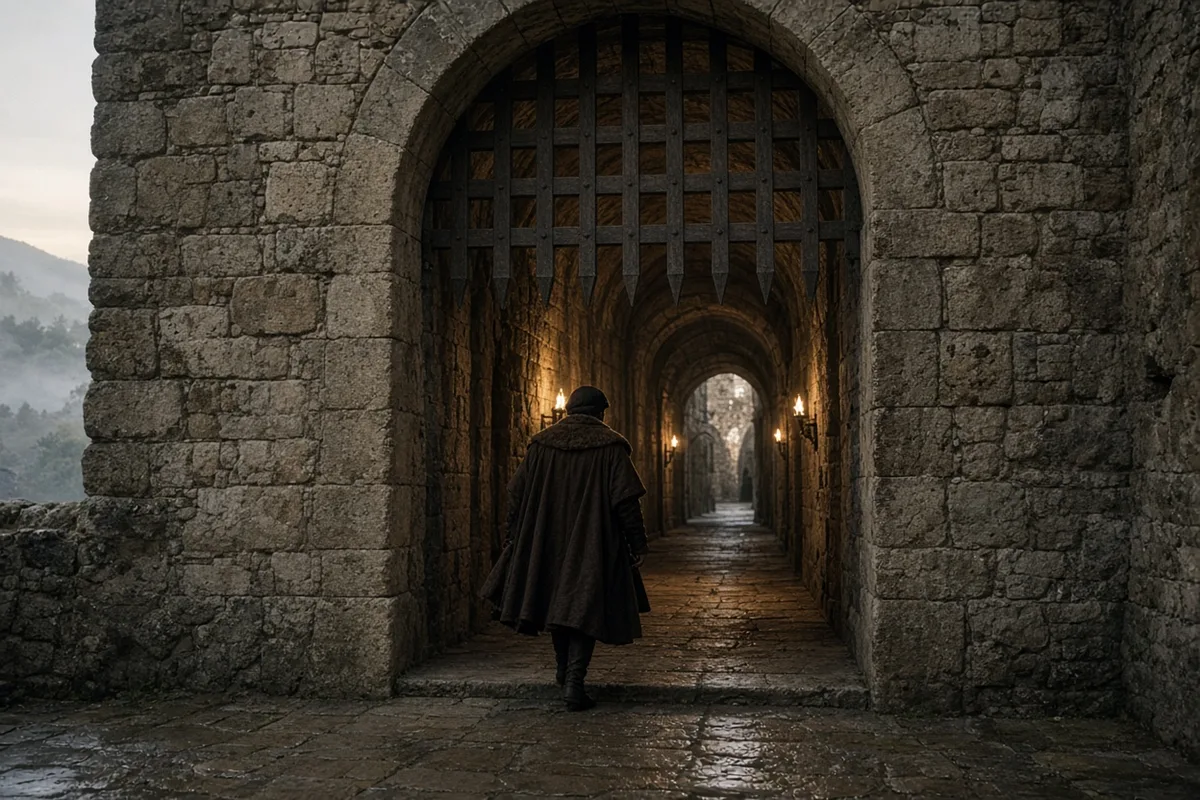
I returned to Canossa only once more, in the autumn of 1115, two years after Matilda’s death at Bondanazzo. The gate tower still stood, though the roof had fallen and the outer stair was broken. A shepherd from the valley told me that the place where Henry had knelt was now marked only by a shallow depression in the grass; no one tended it, and the local people avoided the slope after dark. I stayed one night in the ruined hall, then rode down the same road the king had taken thirty-eight years earlier, leaving the castle empty behind me.
The messenger who reached me at the abbey of Nonantola in March 1120 carried a sealed charter from the new abbot of Cluny confirming that the estates Matilda had granted in 1102 now supported thirty additional monks at the priory of Frassinoro; the document listed the villages of Toano and Carpineti by name and required an annual render of forty-two measures of grain. I copied the obligations into the margin of the cartulary before the ink dried.
Two years later a rider from the court of Lothair III brought word that the emperor had met Pope Calixtus at Worms again, this time to settle the exact wording of the 1122 concordat; the letter quoted the clause granting German chapters the right to elect bishops “without simony or violence” and noted that Henry V had died childless at Utrecht on 23 May 1125. The rider asked for Matilda’s old seal matrix, which I still kept in a leather pouch, so that the new chancery could compare its impression with the papal register.
By 1158 the road up to Canossa had become a track used mainly by charcoal burners. A letter from the castellan of Rossena, dated 14 June of that year, reported that Frederick Barbarossa’s troops had passed within sight of the gate tower but had not climbed the slope; they took instead the Via Emilia and burned the bridge at Reggio. The castellan counted forty-three wagons of grain seized from the valley stores and asked whether any of Matilda’s old iron-bound chests remained in the undercroft.
In 1234 the last male heir of the Canossa line, Azzo d’Este’s distant cousin, died at the siege of Parma; his widow sold the remaining rights to the commune of Reggio for one hundred and fifty gold florins recorded in the city’s liber grossus. The deed, witnessed by fourteen notaries, described the keep as “already roofless and the stair fallen these sixty years.”
A Franciscan friar who stopped at Nonantola in 1291 told me he had slept inside the Canossa chapel the previous autumn. He said the altar stone still bore the groove where pilgrims once placed coins, and that local boys sometimes dared one another to stand on the exact patch of grass where the prints had been, though none stayed after the Angelus bell. He quoted the words scratched on the remaining door lintel: “Hic stetit rex” followed by the date 1077 in Lombard numerals.
When the Black Death reached the valley in 1348 the few families still living on the lower slopes moved their livestock into the outer court; the parish priest of San Polo recorded in his register that thirty-seven souls were buried in the shallow depression before the snows came. The priest himself died on 12 December and was laid in the same ground, his name entered last in the list.
I sent my own grandson, a novice at the abbey, to the site in the autumn of 1355 with instructions to measure the remaining wall height and to bring back a piece of the chapel floor tile if any survived. He returned with a fragment of green-glazed ceramic no larger than a thumb and said the grass had grown over every trace of the stair; only the outline of the gate tower could still be traced against the sky when the light fell at a certain angle from the west.