


Hildegard of Bingen Writes Scivias and Heals Patients
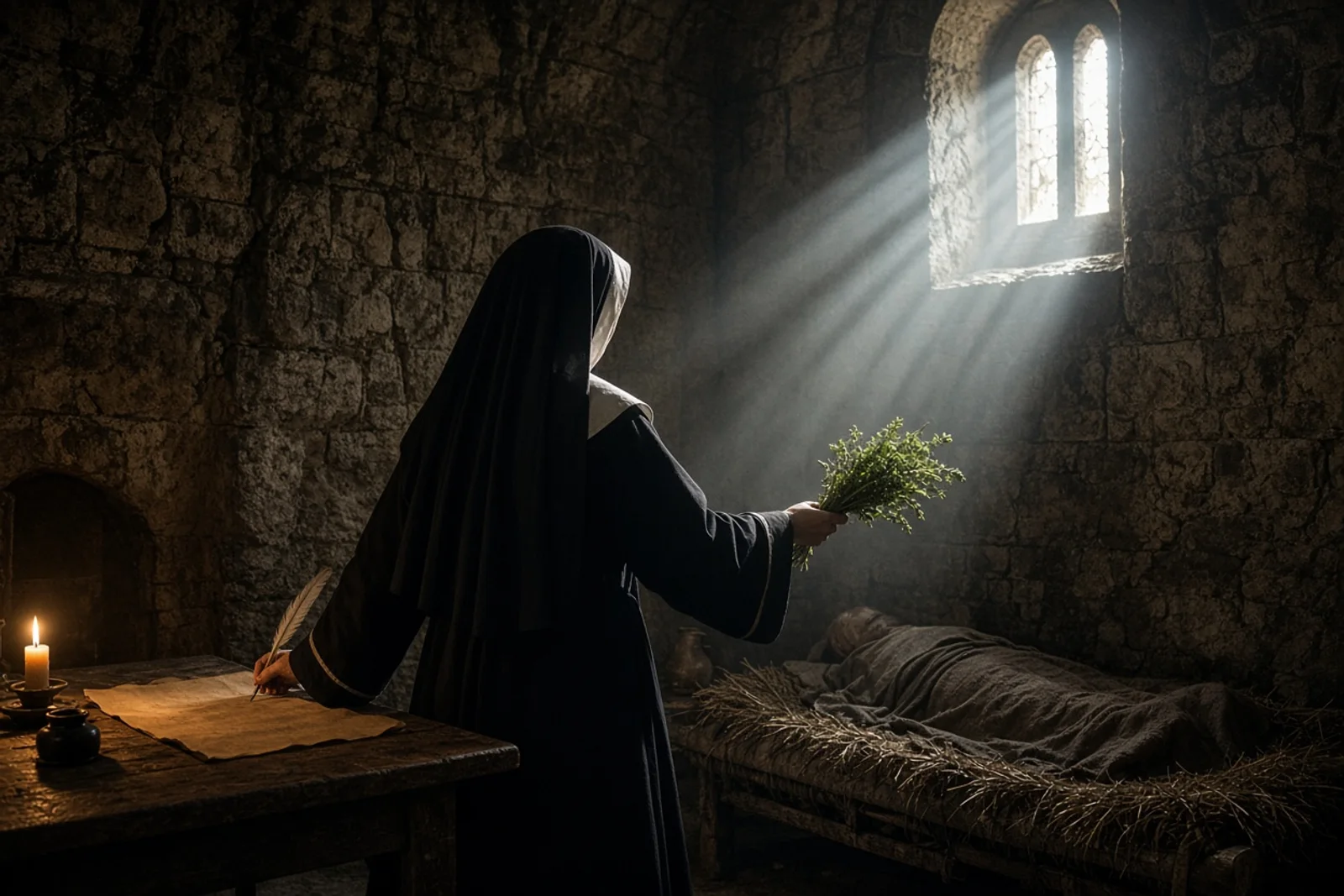
The stone floor of the scriptorium still held the morning chill when I set the basket of fresh-cut mugwort and yarrow beside the low bench. Hildegard sat upright on the stool Volmar had placed for her, eyes half-closed, one hand resting on the edge of the parchment. Volmar dipped his quill and waited. Outside the narrow window the Rhine moved gray under a thin sun.
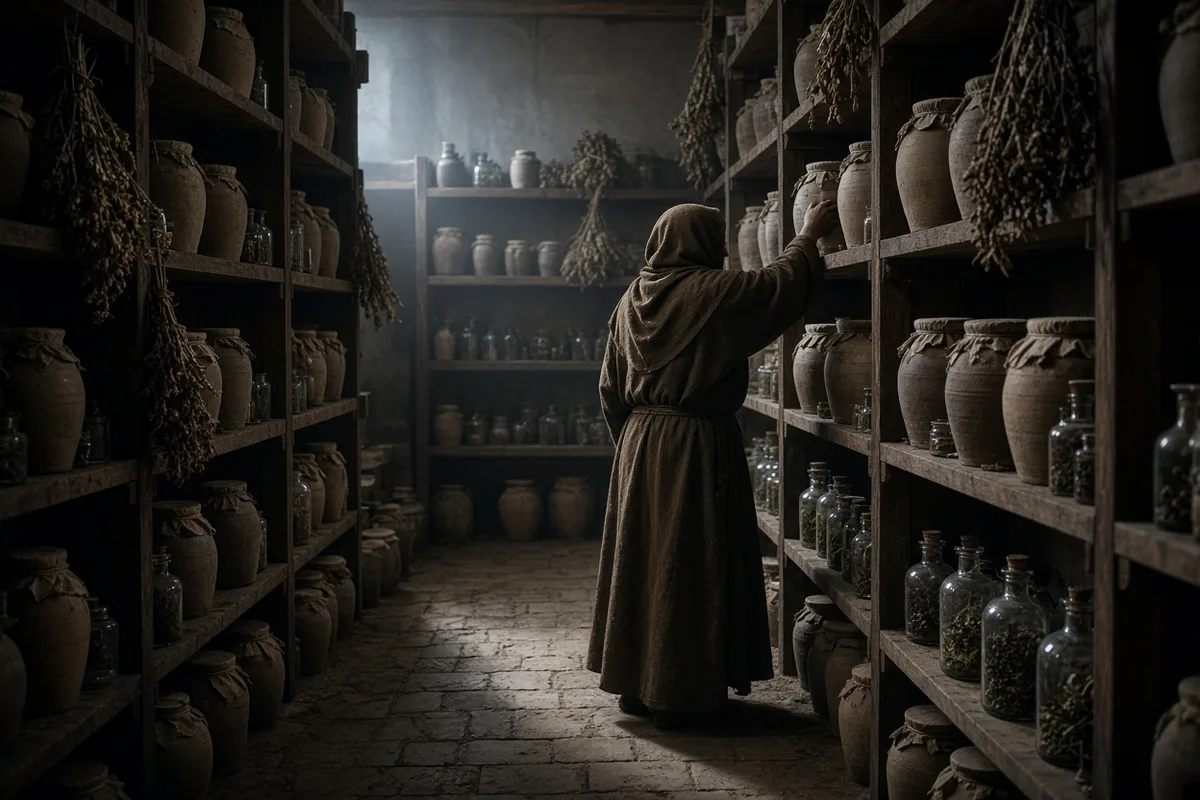
I had come to Rupertsberg with the others the year before, twenty of us carrying what we could on our backs after the illness that pinned Hildegard to her bed at Disibodenberg. The new walls smelled of lime and damp oak. We slept on straw pallets in the dormitory and rose before light to sing the hours. Between Matins and Prime I helped in the infirmary, grinding roots and steeping leaves the way Hildegard showed me.

That morning a messenger from Mainz had already come and gone. Richardis stood in the doorway now, cloak still fastened, her face pale from the ride. She said nothing while Hildegard spoke the next lines of the vision to Volmar. The words came steady, one after another, as if she read from a page only she could see.
When the last sentence was written, Hildegard looked up. Her voice changed. She asked Richardis whether the election at Bassum was settled. Richardis nodded once. Hildegard’s fingers tightened on the bench. She did not raise her voice. She only said that the move would separate what God had joined. Richardis answered that the decision belonged to the archbishop and her brothers.
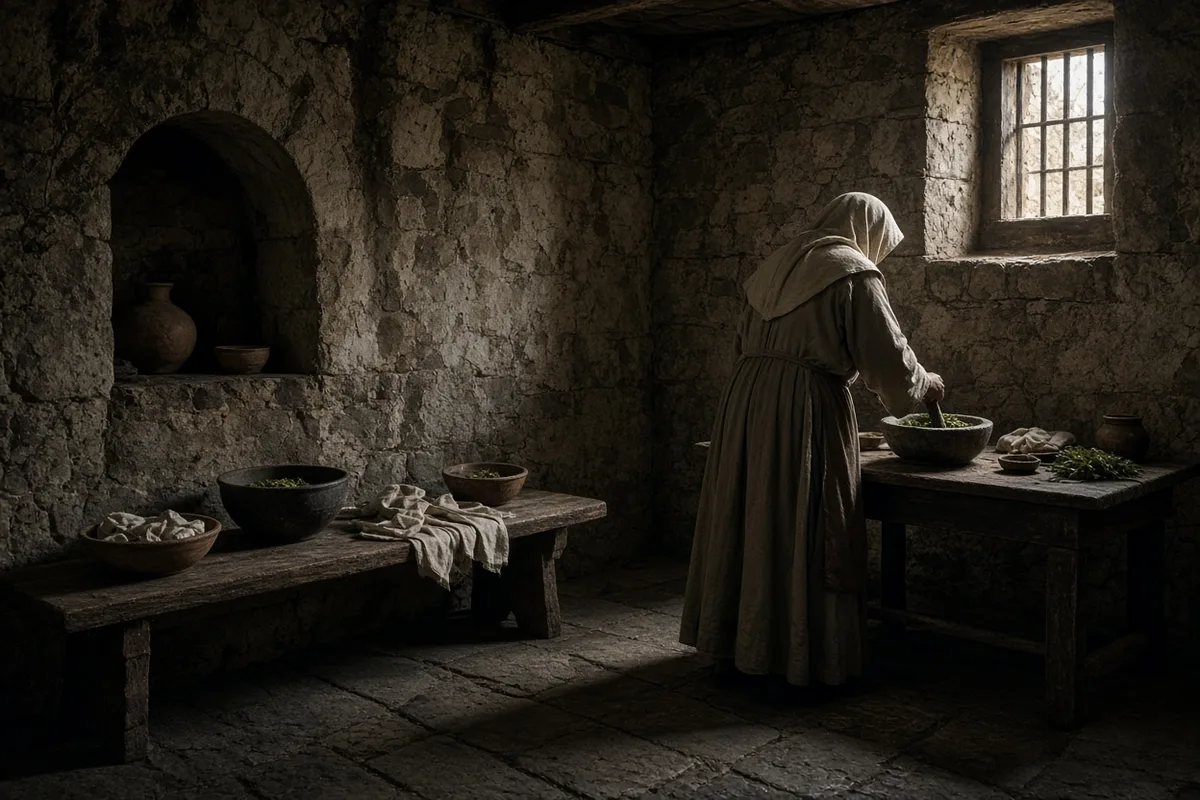
I carried the basket down to the infirmary. Two sisters waited on the benches, one with a swollen knee from the winter damp, the other coughing blood into a linen cloth. I boiled water and measured the herbs the way I had been taught. The steam rose sharp and green. When the draught cooled I held the cup for the coughing sister and watched her throat work.

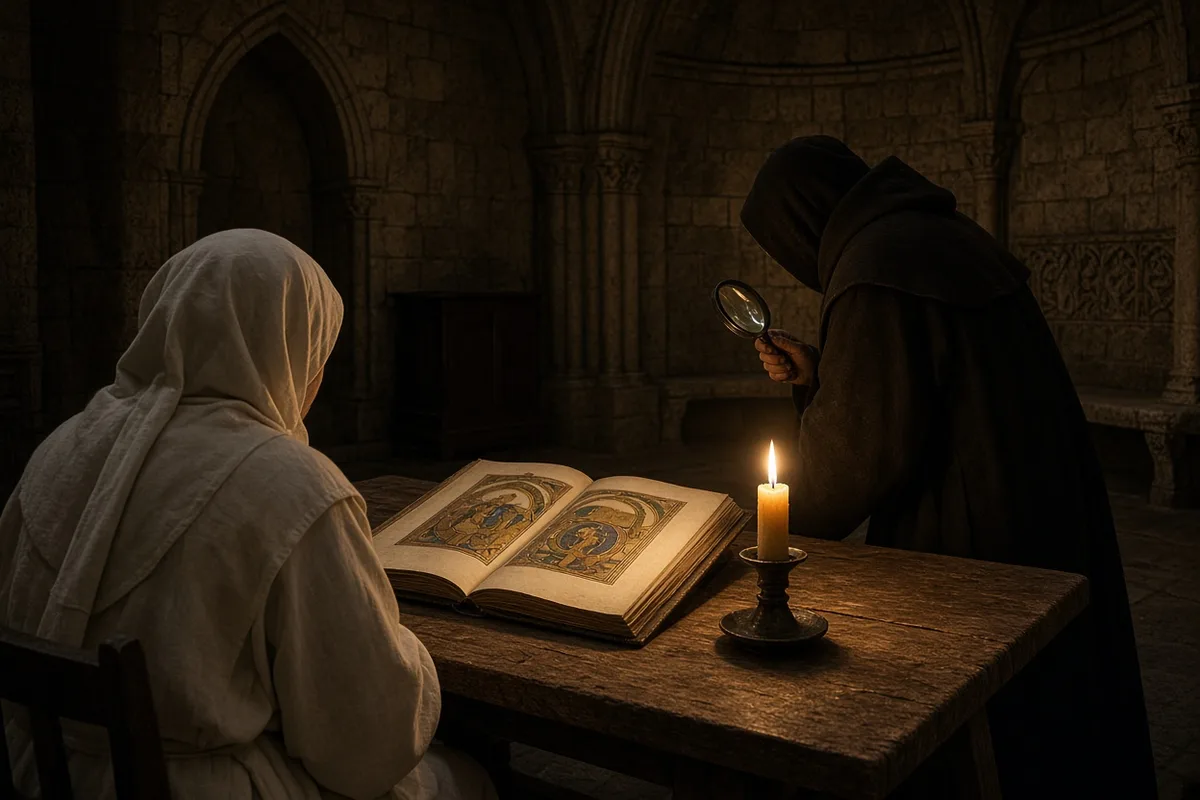
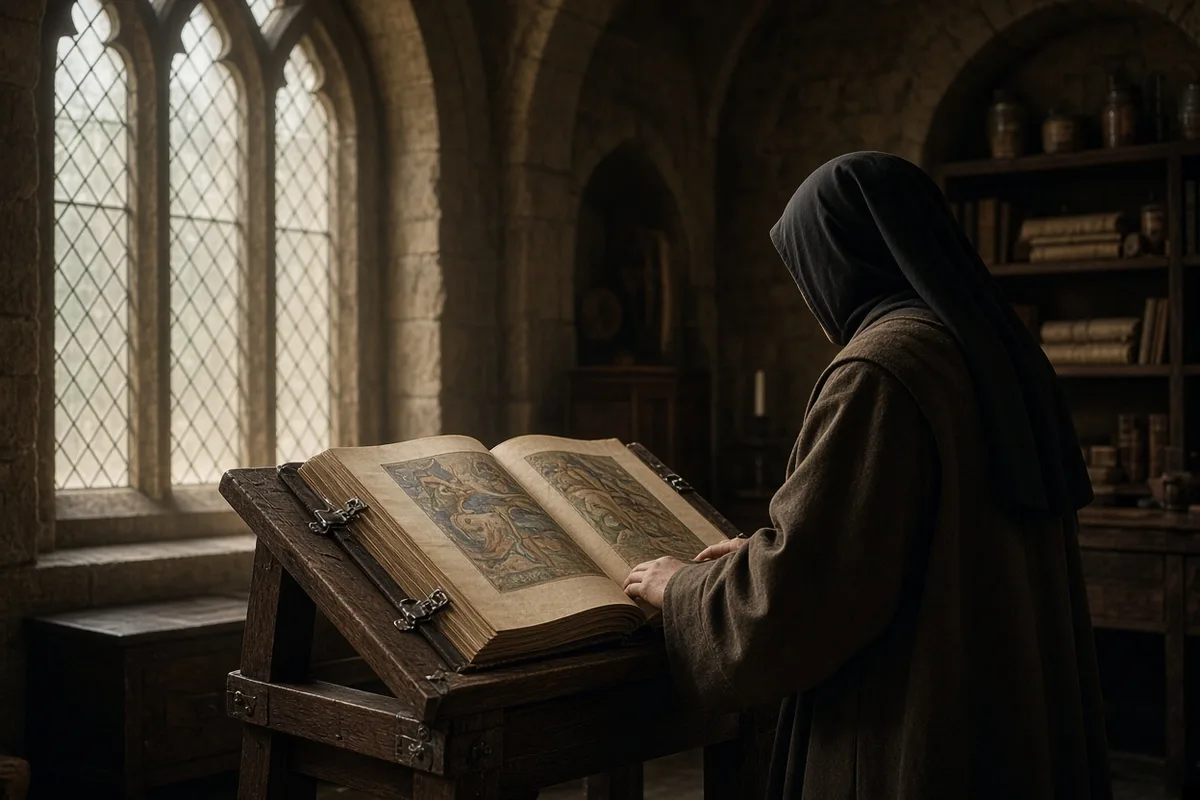
By midday the light in the scriptorium had shifted. Hildegard stood at the long table where the finished quires lay stacked. She turned each leaf slowly, checking the illuminations the sisters had painted under her direction. The colors were still bright: the living light described in the first vision, the egg-shaped cosmos, the ranks of angels. Volmar marked corrections in the margin with a small cross.
Richardis came again after None. She carried a small psaltery wrapped in cloth. She set it on the table and said she would leave it for the younger novices. Hildegard did not touch the instrument. She asked whether Richardis had written to the pope. Richardis said she had. The answer hung between them.
I went back to the garden for more horehound. The plants grew thick against the south wall where the sun struck longest. I cut stems with the small knife I kept in my belt and bundled them. From the upper window I could hear the scrape of Volmar’s quill and, once, Hildegard’s low laugh at something he said.

That evening the sister with the cough worsened. Her breathing came shallow and fast. Hildegard left the scriptorium and came to the infirmary with a fresh mixture of lungwort and honey. She sat on the edge of the pallet and held the cup herself. The sister drank what she could. Hildegard stayed until the breathing eased, then rose and returned to the table where the last pages of Scivias waited.
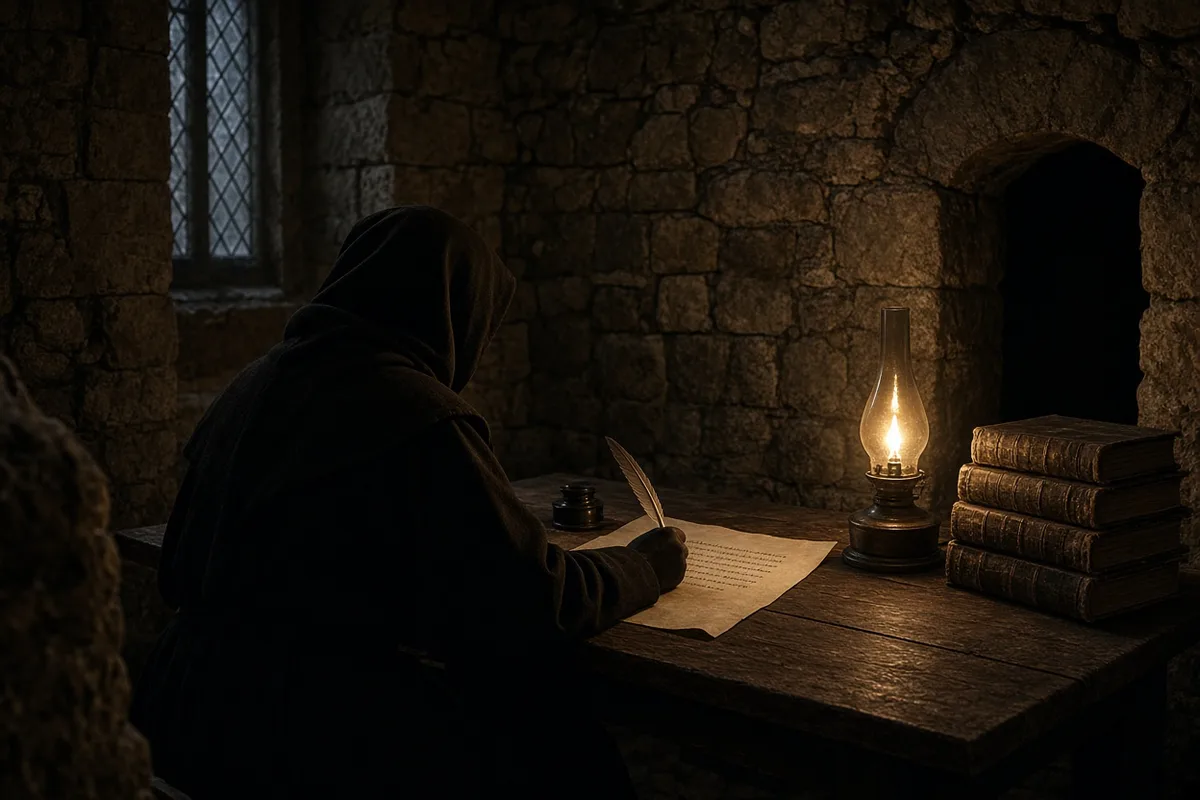
Volmar worked by lamplight after Compline. I brought him bread and ale. He thanked me without looking up. The final vision was being set down, the one that closed the book with the image of the church as bride. Hildegard spoke the words in a single flow, pausing only when Volmar needed to trim his quill.
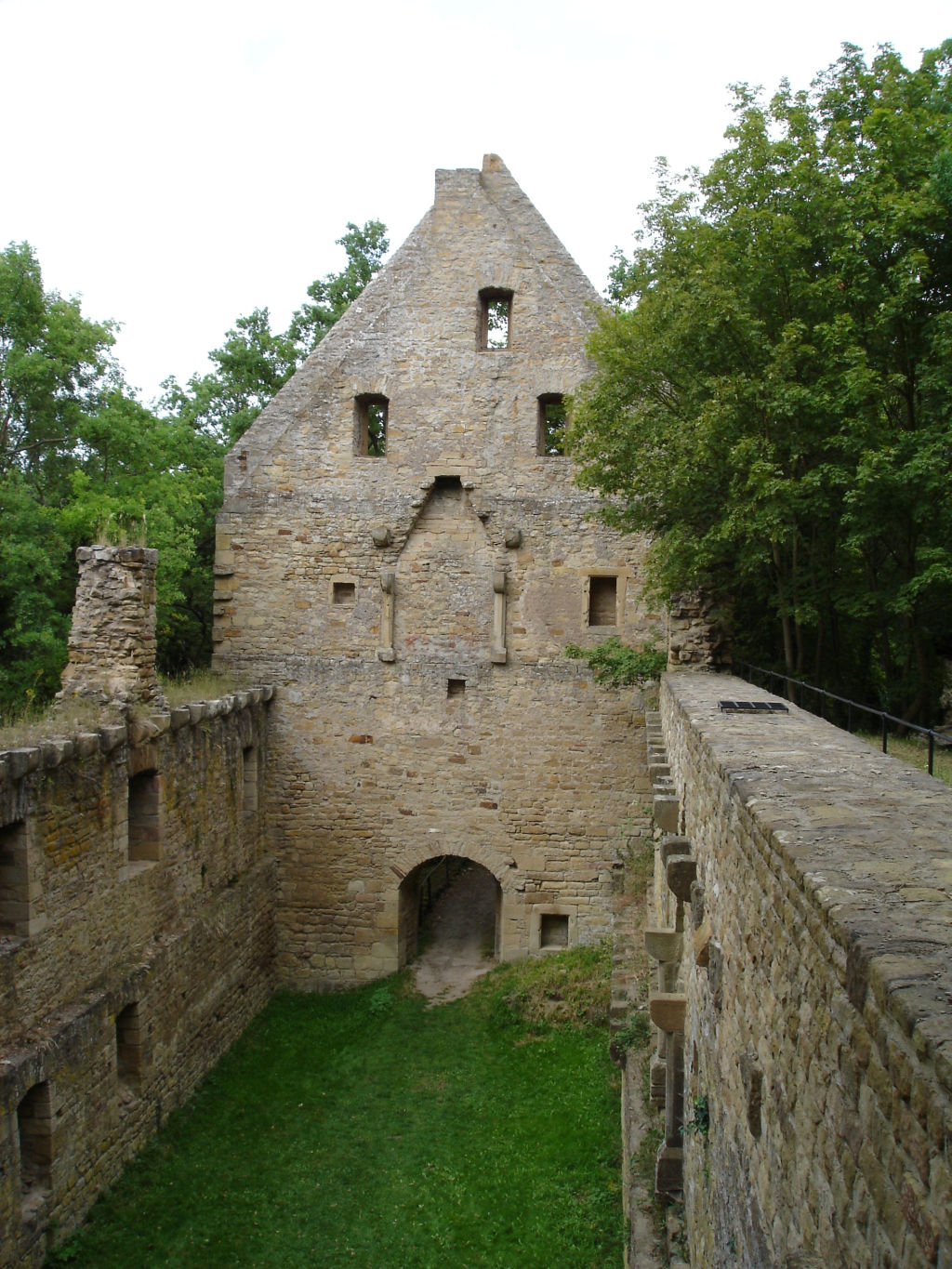
Richardis left two days later. She rode out at first light with the escort her family had sent. Hildegard did not go to the gate. She remained at the table, hands folded over the completed manuscript. When the sound of hooves faded she asked Volmar to read the last page aloud. He did. She nodded and said the work was finished.
The next morning the infirmary held four new patients from the village below. One had been kicked by a horse, another carried a fever that made her teeth chatter. I measured willow bark and prepared poultices while Hildegard examined each one. She spoke little, only the necessary directions. Her eyes were red from the long night.
By the end of the week the manuscript had been bound in wooden boards and wrapped for travel to Mainz. Hildegard placed it in the hands of the messenger herself. She stood at the gate until the cart disappeared around the bend of the river path. Then she turned and walked back to the scriptorium to begin the music for the next liturgy.
Richardis wrote once from Bassum. The letter arrived on a market day. Hildegard read it in the courtyard, then folded it and placed it inside her sleeve. She did not speak of it. That afternoon she mixed a stronger draught for the sister whose cough had returned and told me to watch the dosage through the night.
The winter came early. Snow lay on the roof tiles and the river ran black. We kept the infirmary fire banked and the shutters closed. Hildegard continued to dictate new songs to Volmar between visits to the sick. The melodies were unlike any we had sung before. The sisters learned them slowly, one line at a time.
In spring the first copy of Scivias returned from the bishop’s scriptorium with a letter of approval. Hildegard read the letter standing at the refectory table. She passed it to Volmar without comment. The sisters gathered to see the bound book. The illuminations caught the light from the high windows and held it.
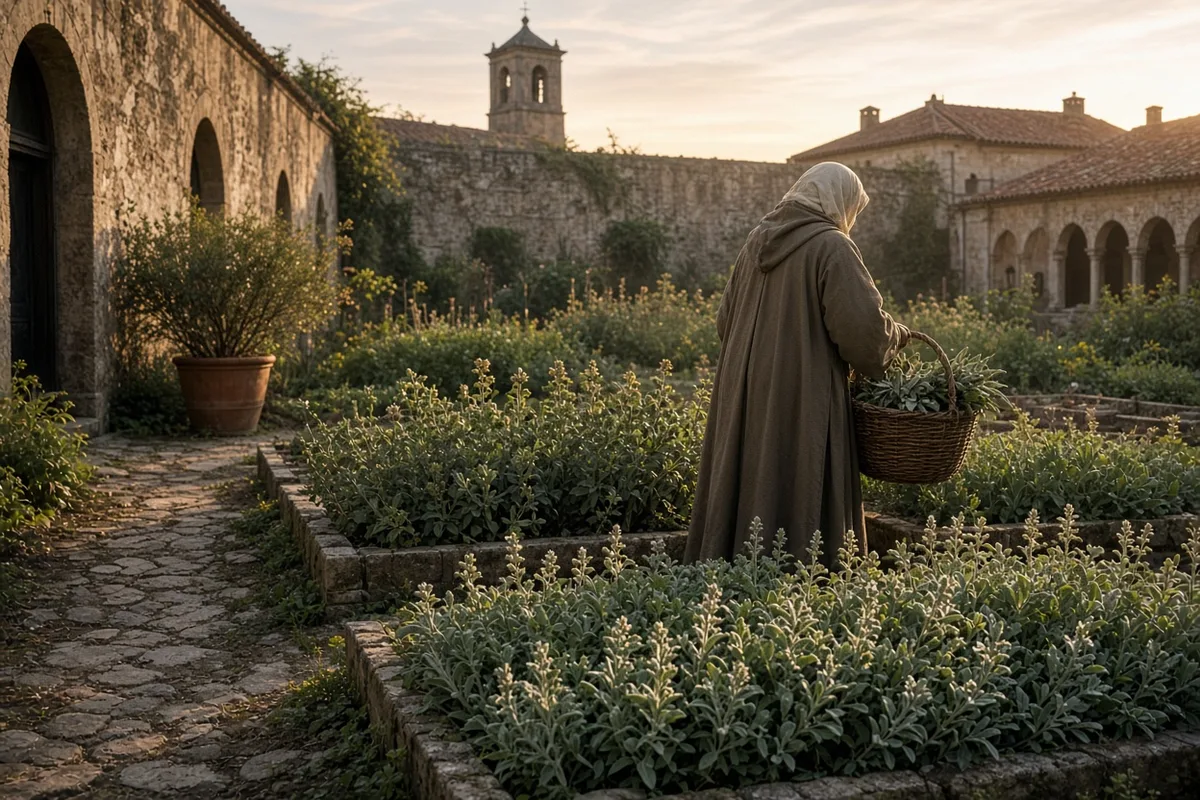
I stayed in the infirmary through the summer, learning which leaves to gather at what hour and how to measure the strength of each infusion. Hildegard came every day. She never hurried. She listened to the breathing of each patient, felt the pulse at the wrist, and adjusted the herbs accordingly. When the work was done she returned to the scriptorium and the next page of music.
The psaltery Richardis had left stayed on the shelf in the dormitory. No one played it. The strings gathered a fine dust that caught the afternoon light. Outside the walls the river kept its steady course toward the sea.
The year after Richardis departed for Bassum the archbishop of Mainz sent a second letter confirming the approval of Scivias, dated the feast of Saint Martin in 1151, and Hildegard answered it by dictating to Volmar the sentence that the living light had shown her the church as a woman clothed with the sun. She added that the five books she had finished contained exactly twenty-six visions, each one numbered and sealed with the sign of the cross in the margin. That same month a rider from Cologne brought news that the abbess at Disibodenberg had died, and Hildegard sent back a list of twelve herbs she had used for the woman’s dropsy, including the exact measure of one scruple of agrimony taken at dawn.
In the spring of 1152 a messenger arrived from Bassum carrying the news that Richardis had died on the fourth of October the previous year after a brief fever. Hildegard read the letter aloud in the chapter house, then dictated a reply to the abbess there stating that the soul of her daughter had been received into the heavenly symphony she had already begun to notate. She instructed Volmar to copy the antiphon “O viridissima virga” into the new quire and to mark the neumes for the high C that the sisters at Rupertsberg were to sing on the octave of the Assumption. The psaltery remained untouched on its shelf while the sisters learned the new melody line by line during the hour after Vespers.
By 1158 Hildegard had begun the work she called the Liber Divinorum Operum, dictating its first vision to Volmar while seated at the same table where Scivias had been finished. She described the figure of a man whose head reached the clouds and whose feet stood upon the earth, and she named the four winds that blew from the cardinal points. That summer she received a letter from Pope Adrian IV asking for her prayers during the struggle with Frederick Barbarossa, and she answered in her own hand that the pope must not yield the keys of Peter to the red horse of the north. The reply, dated from Rupertsberg on the feast of Saint John the Baptist, was carried south by a monk from Mainz who also took with him a bundle of dried betony for the pope’s physician.
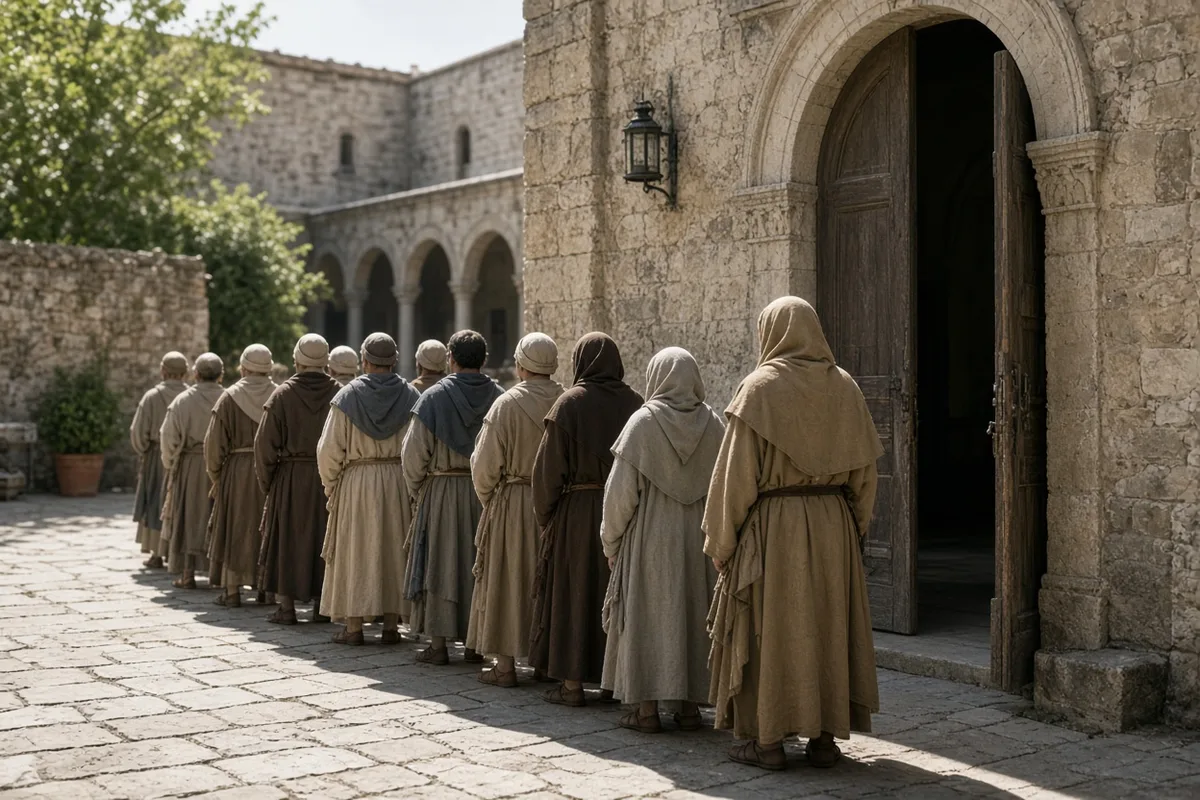
In 1163 the community numbered forty-seven women when Hildegard received permission from the archbishop to found a second house at Eibingen on the opposite bank of the Rhine. She led twenty sisters across the river on the twenty-second of June, carrying the wooden cross from the original altar and the bound manuscript of the Symphonia armonie celestium revelationum containing seventy-seven songs. The new stone church at Eibingen was consecrated two years later on the day of Saint Michael, and Hildegard placed the relics of Saint Rupert beneath the high altar while the sisters sang the responsory she had composed for the occasion.
During the winter of 1170 she completed the Causae et Curae, a book of two hundred and thirty-seven chapters on the elements and the humors, and she recorded the case of a woman from Bingen whose monthly bleeding had ceased after the age of forty-two. Hildegard prescribed a decoction of mugwort, fennel, and three grains of paradise taken in warm wine for nine days, noting the exact hour when the flow returned. She continued to visit the infirmary each morning, feeling the pulse at the left wrist and recording the strength of each beat against the phases of the moon.
On the seventeenth of September 1179, at the hour of Matins, Hildegard rose from her bed in the dormitory at Rupertsberg, walked to the oratory, and died while the sisters were singing the third psalm of the night office. Volmar, then seventy-four, closed her eyes and placed the completed quire of the Lingua Ignota beside her hands before the body was carried to the crypt beneath the church. The sisters kept vigil for nine nights, lighting one new candle each evening from the single flame that had burned at her bedside.
The convent at Rupertsberg was burned by Swedish troops in 1632 during the Thirty Years’ War, and the stone walls were never rebuilt, yet the church at Eibingen continued to stand. In 1857 the last nuns were expelled under the Prussian Kulturkampf, but the buildings were returned in 1904 and the Benedictine nuns who now keep the hours there preserve the original manuscript of the Symphonia in a glass case beside the altar. Hildegard’s bones, moved twice after the destruction at Rupertsberg, rest today in a silver reliquary above the high altar at Eibingen, and on the seventeenth of September each year the sisters still sing the antiphon she dictated for the feast of her own translation.
In 1231 the archbishop of Mainz ordered the translation of Hildegard’s relics from the crypt at Rupertsberg to a new stone sarcophagus at Eibingen, an event witnessed by forty-three nuns and recorded in the house chronicle as occurring on the Wednesday after Pentecost; the notary noted that the bones weighed exactly nine pounds and that a sweet odor filled the church when the lid was lifted. Abbot Heinrich of St. Jakob in Mainz supplied the Latin inscription cut into the lid, quoting Hildegard’s own phrase from Scivias that the soul “shines like a sapphire in the hand of God.”
During the 1348 visitation of the Black Death the nuns at Eibingen opened the reliquary daily for seven weeks, placing linen cloths on the bones and distributing the cloths to pilgrims from Bingen and Rüdesheim; the infirmarian’s ledger lists one hundred and twelve such cloths given out between June and August, each marked with a small cross in red thread.
In 1489 the printer Peter Schöffer of Mainz issued the first printed edition of the Physica, using a manuscript copied at Eibingen in 1423; the edition ran to eight hundred copies and carried on its final leaf the colophon stating that the text had been “corrected against the original written by the hand of the holy virgin Hildegard.”
When French revolutionary troops occupied the left bank of the Rhine in 1795, the nuns hid the Symphonia manuscript inside the hollow of the altar mensa; it remained there until 1803, when the convent was secularized and the sisters dispersed, carrying only the antiphonary and the silver reliquary.
The reliquary itself was sold in 1822 to a Frankfurt silversmith, who melted the outer casing but left the inner crystal cylinder intact; the cylinder, still containing the bones, was purchased in 1855 by the historian Johannes Schmelzeis and returned to Eibingen in 1908 after the Benedictine sisters re-established the house.
On 17 September 1929 the first solemn office in the restored church drew two hundred and seventy pilgrims; the prior of Maria Laach, who preached, read aloud the 1151 letter of Archbishop Heinrich in which Hildegard is addressed as “our most beloved daughter in Christ.”
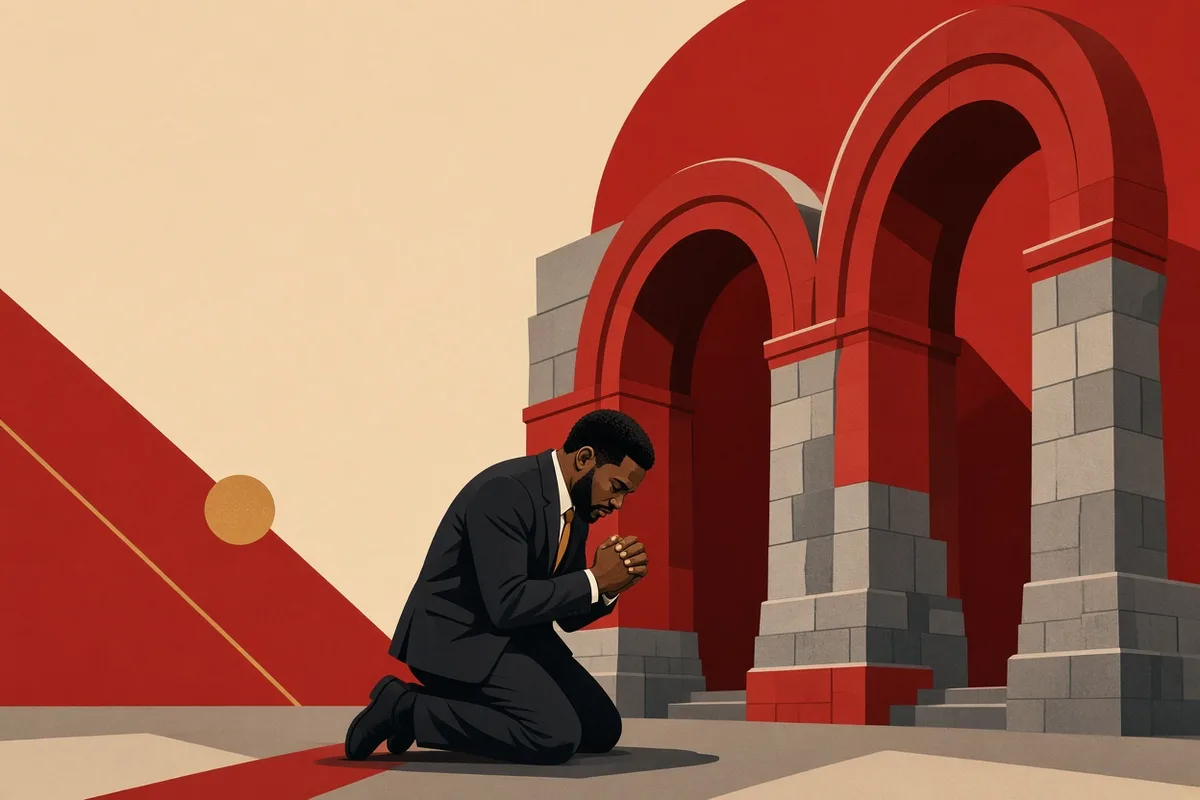
The last human image recorded at Eibingen is that of Sister Benedicta, born Anna Schmitt in 1897, who on the evening of 16 September 2023 knelt alone before the reliquary after Compline, placed her right hand on the crystal, and remained motionless for forty-three minutes while the single candle beside her burned down to the socket.