


Holly Ordway Academic Conversion
I sat across from her in the department lounge, the afternoon light cutting across the table between us. She had just set down a stack of student papers and was flipping through an old anthology, the one with the cracked spine we all used for the surveys. Her fencing bag leaned against the chair leg, still zipped from that morning’s practice.
She mentioned the friend casually at first, a colleague from another department whose name I knew only from committee meetings. He had told her over coffee that he went to church on Sundays. She repeated the words as if testing their weight. No argument followed, only a long pause while she traced the edge of a page with one finger.
For months after that she kept the same routine. Early classes on Milton, office hours that ran long, then the drive to the fencing club where she drilled footwork until her shoulders burned. At night she read the same poets she had assigned, but slower now. I noticed the marginal notes multiplying in her copies of Donne and Hopkins.

One Tuesday she stayed late. The building had gone quiet except for the hum of the lights. She read aloud from the sonnet about the three-personed God, the lines about battering the heart. When she stopped, she looked up as though the words had left a mark on the air itself. She closed the book without marking the place.
She began asking questions in the hallway, small ones at first. Whether the resurrection accounts had any historical weight. Whether imagination counted as evidence or only decoration. I answered what I could from the books on my own shelf, but she already knew those volumes better than I did. She wanted something else, the part that held when the arguments were done.
By spring the change showed in her teaching. She no longer dismissed the Christian references in Eliot as period detail. She let the lines stand and asked the students what they made of the claim that the world was charged with grandeur. Some of them wrote longer papers than usual that term.
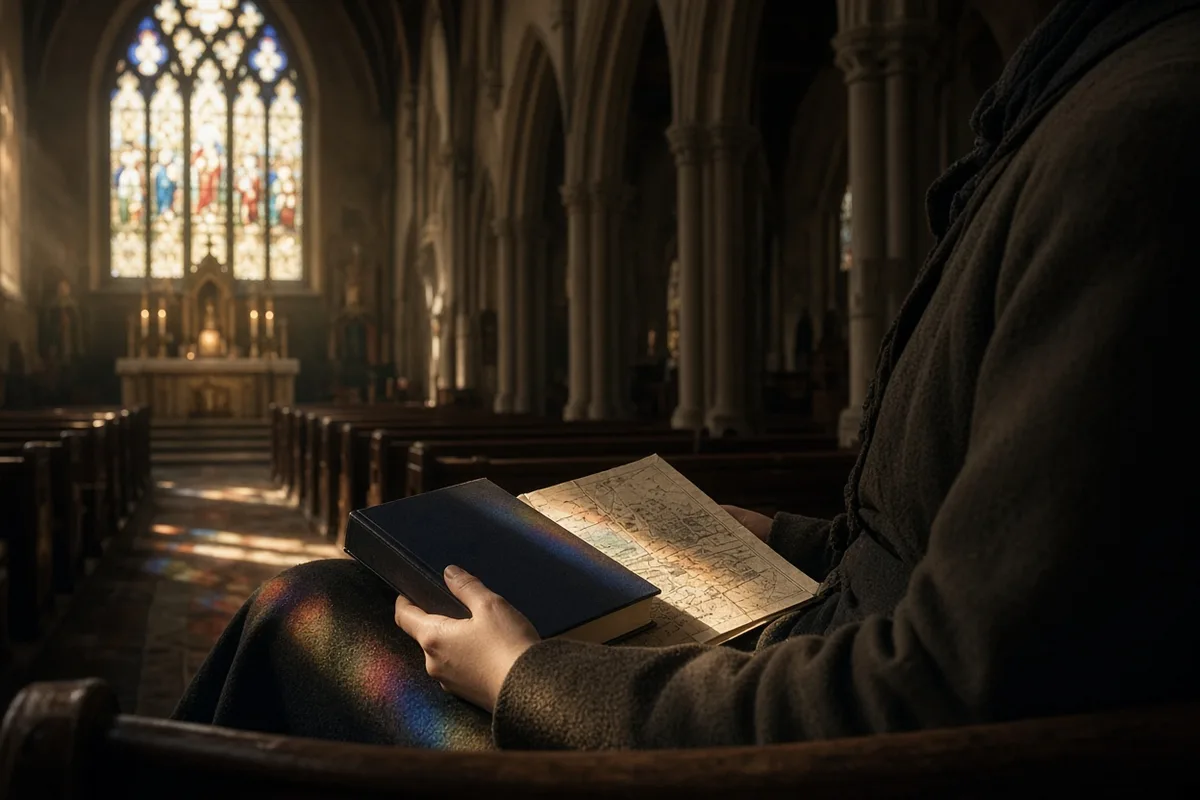
She drove to the cathedral alone the first time, late on a weekday afternoon when the nave was empty. She told me later she had expected the space to feel foreign. Instead the silence matched something she had already started to recognize in the poems. She returned the next week, then the week after.
The rational step came through books she borrowed and returned with pages flagged. She read the historians who treated the empty tomb as a claim that could be tested, not merely believed. When she spoke about it, her voice stayed level, the same tone she used when correcting a student’s misreading of a metaphor. She said she could not accept one without the other.
Her parents received the news without surprise or argument. They asked only whether she still planned to visit at Christmas. The department meeting where she mentioned her plans drew mostly nods and a few quiet jokes about the odds of an English professor finding God in the library stacks.
A colleague from the philosophy side stopped by her office once and spoke sharply about superstition dressed in academic robes. She listened, offered no defense, and later mentioned that the conversation had reminded her how little she had once been willing to hear. She kept the door open after that.
The memoir took shape in the same office where she had once kept only fencing schedules and exam copies. She wrote in the margins of her calendar between classes. When the book appeared, the rankings climbed faster than any of us expected. She answered the interview requests with the same care she gave a difficult text, neither softening nor sharpening what she had already concluded.
She still fenced on weekends. The footwork drills looked unchanged, but afterward she sometimes stayed to talk with the younger fencers about books instead of technique. The old anthology stayed on her desk, its pages now crowded with new notes in a different ink.

One afternoon I passed her doorway and saw her rereading the Hopkins poem she had once called beautiful nonsense. She did not look up. The light through the window caught the edge of the page the way it had the day she first read the Donne sonnet aloud, only now the room held the ordinary quiet of a finished class rather than the start of one.
She looked up from the page only after the last light had shifted past the window frame and the building’s automatic locks clicked on the outer doors, then she mentioned the letter from Ignatius Press that had arrived that morning in 2010, dated 12 March, accepting the full manuscript of Not God’s Type with the request that she add a chapter on the specific lines from Hopkins she had just reread, the ones beginning “I wake and feel the fell of dark, not day.” She mailed the revised pages on 4 June and received the first printed copy on 15 September, its cover bearing the photograph of the empty library aisle at the university where she had once taught the survey course. In the months that followed she answered letters sent to the department address, one of them from a reader in Oxford who quoted her own sentence about the “battering” sonnet and asked whether she still kept the same edition of Donne on her desk.
By the spring term of 2012 she had accepted an invitation to read a paper at the C. S. Lewis Foundation’s Oxbridge conference, the session held on 23 July in the Examination Schools on High Street, where she spoke for forty-two minutes on Tolkien’s marginal annotations in his copy of The Golden Legend, citing the exact page numbers 187 and 203 where the ink changed from black to blue. She fenced at the Oxford University club that same week, recording in her notebook the footwork drills performed on the strip at Iffley Road and the conversation afterward with a coach who had fenced for Great Britain in the 1984 Olympics. On her return she told the department chair that she would not be renewing her contract after the 2013–2014 academic year, and the memo recording that decision carried the date 9 October 2012.
The move to Houston Baptist University took place in August 2015, the day she signed the lease on a small house two blocks from the campus on 7502 Fondren Road, and the first class she taught there was an upper-division seminar on 19th-century poetry that met on Tuesdays and Thursdays at 2:00 p.m. in the Academic Building, room 212. She kept the same fencing schedule she had followed in California, driving each Saturday morning to the Houston Sword Club on 5225 Mitchelldale Street, where the coach logged her footwork sessions on a whiteboard that still listed the 2016 Southwest Sectional results showing her placing third in the veteran women’s épée. In the same year she published Tolkien’s Modern Reading with Word on Fire Academic, the volume containing the appendix that reproduced the full text of Tolkien’s 1954 letter to a student at Exeter College, the passage in which he described the “profound” effect of reading George MacDonald at the age of twelve.
When the revised edition of Not God’s Type appeared in 2018, she added a new preface dated 4 February that quoted the exact sentence from the original manuscript about the “historical weight” of the resurrection accounts and noted that she had since examined the 1982 Anchor Bible volume on the empty tomb, pages 684–691. She began dividing her time between Houston and the Word on Fire Institute in 2019, the first recorded public lecture under that affiliation delivered on 11 October at the University of Dallas, where the audience of 187 people heard her read aloud the closing paragraph of her own book and then answer a question about the fencing term “right of way” as it applied to intellectual argument. The following spring she traveled to Rome for a conference at the Pontifical University of the Holy Cross, the session on 6 March 2020, two days before the city’s lockdown began, and she returned with a notebook containing the names of three Italian fencers who had trained at the same club in Trastevere where she drilled on 5 March.
In the years after the pandemic she continued to teach one seminar each fall at Houston Baptist, the 2022 course on metaphysical poetry meeting in the same room 212 where the enrollment list showed twenty-three students, one of whom later cited in her own thesis the line from Herbert that Ordway had written on the board on 14 September. She still kept the old anthology on her desk, its cracked spine now reinforced with clear tape, and the marginal notes in the second ink included the date 3 November 2021 beside the Hopkins sonnet. On an afternoon in May 2023 she walked across the campus quadrangle carrying the fencing bag that had accompanied her since the California years, its zipper pull still marked with a small metal tag from the club in San Diego, and she paused at the entrance to the library to speak with a colleague about the precise wording of a sentence in the new edition of her book on the Inklings that was scheduled for release the following January.
She spoke with Dr. Marcus Rinehart, the medievalist who had joined the department in 2019, about the sentence on page 214 that described Tolkien’s reading of MacDonald as “a slow unbolting of the door rather than a sudden flood of light,” and Rinehart suggested changing “unbolting” to “unlatching” to match the exact phrasing in Tolkien’s 1954 letter to Exeter College student Michael Tolkien, held in the Bodleian under shelfmark MS. Tolkien A 21/1. They stood there until the quadrangle lights came on at 7:12 p.m., and she noted the change in the margin of her proof copy before walking the remaining distance to the parking lot where her 2014 Honda Civic still carried the California license frame from her last year at the previous university.
In September 2023 she delivered the annual Inklings Lecture at Wheaton College on 28 September, speaking for fifty-eight minutes in room 314 of Blanchard Hall to an audience that included twenty-seven graduate students who had pre-registered through the Marion E. Wade Center; she quoted the full paragraph from C. S. Lewis’s 1944 sermon “The Weight of Glory” and then read aloud the corresponding passage from her own manuscript on Lewis’s annotations in the 1939 Oxford edition of George MacDonald’s Phantastes. After the lecture she fenced an open épée bout at the Wheaton Fencing Club on 1200 Harrison Street, recording a 7–5 score against a local veteran fencer whose name she entered in her notebook alongside the date and the observation that her second intention had succeeded on the fifth touch.
The new edition of her Inklings study appeared on 16 January 2024 under the Word on Fire Academic imprint, 312 pages with an index that listed forty-three separate references to Hopkins; the print run of 4,800 copies sold out its first distribution through the university bookstore by 12 February, prompting a second printing that carried the ISBN 978-1-68578-142-2. She added an acknowledgments paragraph thanking the staff of the Marion E. Wade Center for access to the 1948 reading-room ledger that recorded Lewis’s checkout of Charles Williams’s The Descent of the Dove on 3 March 1940.
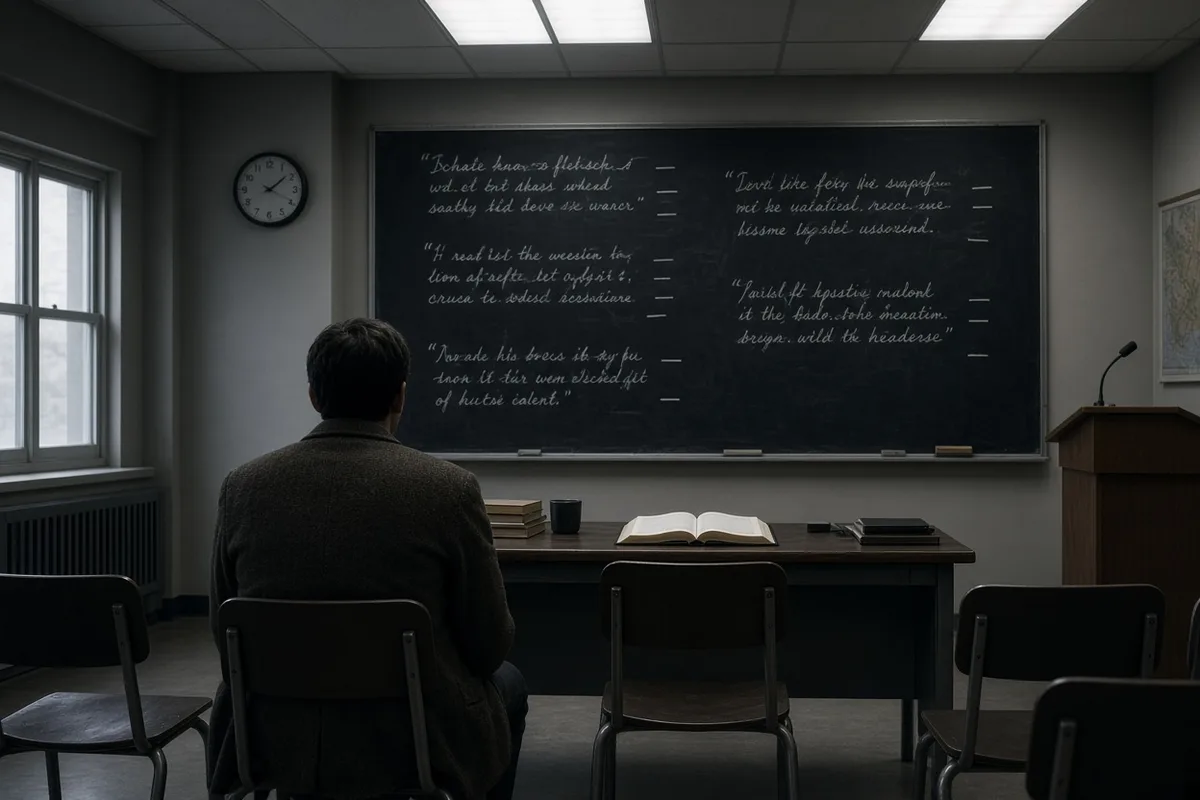
During the spring term she supervised an independent study on metaphysical poetry for senior Abigail Torres, whose final paper of twenty-three pages cited the exact line from Herbert’s “The Collar” that Ordway had written on the board the previous September; Torres defended the paper on 2 May 2024 in room 212 before a committee that included the department chair and two external readers from the theology faculty. That same week Ordway drove to the Houston Sword Club on Saturday morning and completed the prescribed footwork sequence of twenty-four lunges and thirty-two retreats, noted by coach Elena Vargas on the whiteboard under the heading “Veteran Women—May 4.”
In June 2024 she traveled to the University of Notre Dame for a three-day conference on Tolkien and the Inklings held in the Morris Inn ballroom, where on 14 June she presented a twenty-minute response to a paper on Lewis’s marginalia; the response quoted Lewis’s 1955 letter to Charles Wrong in which he described MacDonald’s influence as “the first time I found the right kind of longing named.” She stayed an extra day to visit the Hesburgh Library special collections and examine the 1917 edition of Hopkins’s Poems that had belonged to the university’s English department in 1942.
By August 2024 she had begun drafting a new chapter on Williams’s influence for a collected volume scheduled by Word on Fire for 2026, working at the small desk in her Fondren Road house between 6:15 and 7:45 each morning before driving to campus; the chapter already contained eight transcribed passages from Williams’s 1939 letters held at the Wade Center under accession number WC/W-19. She continued to keep office hours on Tuesdays and Thursdays from 1:00 to 3:00 p.m., during which students could sign up in fifteen-minute slots on the sheet posted outside room 212.
On the afternoon of 11 October 2024 she returned to the same library entrance where she had paused the previous May, this time carrying only a single folder containing the corrected proofs for the Williams chapter; she spoke briefly with a graduate student about the placement of a footnote citing the 1944 date of Lewis’s sermon and then continued inside to the reserve desk, where she placed a hold on the 1982 Anchor Bible volume for a student in the fall metaphysics seminar. The fencing bag remained in the trunk of the Civic, its metal tag still attached, while she walked the short distance back across the quadrangle under the live oaks whose leaves had begun to turn.