



How charm and silence let one man loot a state fund
In 60 seconds
- Jho Low rose by making elites feel like insiders and selling access, not by managing money well.
- 1MDB was structured from the start so Low and allies could divert borrowed billions with almost no independent oversight.
- Goldman Sachs helped raise roughly 6.5 billion dollars in bonds and took fees exceeding 600 million while internal red flags about Low were sidelined.
- Stolen funds bankrolled The Wolf of Wall Street, art, real estate, and celebrity parties that made the wealth look legitimate.
- Najib Razak’s political power blocked Malaysian accountability until U.S., Swiss, and Singaporean enforcers and foreign reporters forced the case open.
- Hope and Wright’s lasting claim is that grand fraud thrives on willful blindness more than on technical genius.
The big idea
Hope and Wright argue that Jho Low extracted an estimated 4.5 billion dollars from Malaysia’s 1MDB fund by exploiting people and institutions willing to ignore red flags when the fees and flattery were large enough. The theft worked because bankers chased revenue, celebrities enjoyed the gifts, a captured Malaysian state suppressed scrutiny, and only cross-border enforcement finally imposed costs.
The book in brief
The story opens with Low as a connector, not a banker. Raised in a comfortable Penang family, he used Wharton to befriend sons of Middle Eastern royalty and positioned himself as the bridge between Gulf wealth and Asian political elites. He rehearsed the later playbook with a Terengganu-linked shell fund: befriend the people who control money, promise impossible deals, and let the aura of connections replace expertise or oversight.
When Najib Razak launched 1MDB in 2009 as a sovereign development vehicle, especially for energy, the fund’s design already handed Low and allies effective control of cash flows. Billions were borrowed; a PetroSaudi joint venture became the first major pipe. Money meant for an oil-and-gas investment was wired onward into offshore structures Low secretly controlled, while a board stocked with loyalists signed off without basic questions.
The fraud went global when a top-tier bank underwrote the next wave of borrowing. Huge fees and a senior partner deeply tied into Low’s social world overrode internal worries about opacity. Institutional investors trusted the bank’s name and poured in, turning a Malaysian diversion into a Wall Street–certified product.
Low then converted cash into culture and status. Hundreds of millions moved through shells into a production company linked to Najib’s stepson, financing a hit film about financial crime and a whirl of premieres, art, jets, and parties with A-list names. Being photographed with stars and owning trophy assets made the idea that he was a fraudster feel socially implausible.
At home, political power kept the lid on. Journalists and opposition figures met intimidation; large sums that reached Najib’s accounts were waved away as a royal donation; an investigating attorney general was replaced by one who cleared him. Domestic oversight bodies were sidelined. Only sustained foreign reporting and, later, coordinated action by the U.S. Justice Department, Swiss prosecutors, and Singaporean regulators began seizing assets, shuttering complicit bank branches, extracting a guilty plea from the key banker, and hitting the bank with massive global penalties. Low fled into jurisdictions hard to reach. The book closes on a simple diagnosis: the scheme endured because almost everyone who could have asked hard questions chose not to.
Context
Bradley Hope and Tom Wright’s 2018 reconstruction is investigative journalism built on leaked 1MDB files, Sarawak Report material, court records, and anonymous interviews with people around Low. It mattered on arrival because it traced how a Malaysian state fund’s looting ran through Goldman Sachs, Hollywood, and luxury markets, exposing concrete failures in bank compliance and the ease with which celebrity culture and weak oversight laundered both money and reputation. Low did not give the authors a full account, and the book stops before later convictions and recoveries.
The key ideas

1
Access over expertise
Low’s real skill was making powerful people feel like insiders; that social capital mattered more than any technical banking ability.
What he lacked
Deep banking skill or a formal role managing the money
What he sold
Insider access between Gulf royalty and Asian political elites
Hope and Wright present Low as a fixer who learned early he did not need to be the smartest person in the room. At Wharton he cultivated the sons of Middle Eastern royalty, especially ties linked to the Sultan of Terengganu, and sold himself as the man who could open doors between Gulf sovereign money and Asian political elites.
He offered access rather than capital. Lavish generosity came before he had large funds of his own, essentially borrowing against a reputation still under construction. A shell vehicle tied to Terengganu state money let him show Najib Razak’s circle that he could move big sums quickly and quietly.
By the time 1MDB existed, the pattern was set. He did not need to manage money well; he needed people who controlled money to believe he could unlock more of it. Connections substituted for oversight, and that substitution became the operating system for everything that followed.
In practice: The Terengganu-linked shell fund served as his proof-of-concept that he could shift state-tied money fast while looking like an indispensable bridge to Gulf wealth.

2
A front from day one
1MDB was built to look like a development fund while giving Low’s circle control of borrowed cash with minimal independent checks.
- 1Borrow1MDB raises billions through bonds for stated development aims
- 2Joint venturePetroSaudi deal creates a legitimate-looking investment channel
- 3DivertWires move a large share into Good Star, Low’s secret offshore vehicle
- 4Sign-offLoyal insiders approve without basic independent questions
Najib established the fund with a public mission of strategic investment, especially in energy. In the authors’ account the internal design did the opposite of what the mission implied: it concentrated power over money flows among insiders and left little room for truly independent scrutiny.
Borrowed billions became the raw material. The PetroSaudi joint venture supplied the first large channel. Funds wired for a supposed oil-and-gas investment were diverted, in significant part, into an offshore account tied to Good Star Limited, an entity Low secretly controlled. Shell companies in places such as the Seychelles and ordinary wire transfers did the work; nothing about the toolkit was exotic.
A small group of insiders signed off. The board was filled with people loyal to Najib rather than with overseers who would slow a deal. Hope and Wright treat this as governance capture at birth, not a healthy institution corrupted later. Fraud at this scale needed the founding structure to be hollow.
In practice: The PetroSaudi deal alone diverted an estimated 700 million dollars in 2009 into the Good Star structure Low controlled.

3
Fees that quieted alarms
Goldman helped 1MDB raise roughly 6.5 billion dollars and earned fees exceeding 600 million because revenue incentives beat compliance doubts.
>$600M
Goldman fees on the 1MDB bond deals
Between 2012 and 2013 the bank ran three bond offerings that pulled in institutional money. The fees, far above normal for the work, were themselves a signal that the relationship was unusual. Tim Leissner, a senior Southeast Asia partner, was central to winning the mandates and to easing internal worries.
Hope and Wright document that the bank’s own risk committees flagged 1MDB’s opacity and Low’s undisclosed role. The deals still went forward. Leissner’s social entanglement with Low’s world, including benefits prosecutors later called improper, gave him personal reasons to keep the pipeline open.
Goldman’s brand did more than earn a payday. It stamped the paper with credibility that pension funds and insurers trusted, so they leaned on the bank’s due diligence instead of doing their own. A Malaysian diversion became a global financing event. In the authors’ framing, anti-money-laundering systems at a top-tier firm failed through high fees, senior complicity, and a failure to imagine how brazen the underlying theft was.
In practice: Internal compliance concerns about Low and 1MDB’s opacity were raised and then overridden so the outsized bond fees could be booked.

4
Cinema as clean provenance
Routing stolen money into Red Granite and The Wolf of Wall Street turned illicit cash into a celebrated film with seemingly legitimate origins.
Source
Diverted 1MDB cash moving through shells and offshore accounts
Product
A hit Hollywood film that looked like ordinary, celebrated commerce
Low pushed hundreds of millions toward Red Granite Pictures, co-founded by his friend Riza Aziz, who was also Najib’s stepson. The company’s biggest title was the 2013 film about financial fraud—funded, the authors show, in substantial part by the proceeds of financial fraud.
The path ran through shells and offshore accounts before it reached the studio, so most people making the movie never saw the true source. Premieres, after-parties, and public proximity to stars such as Leonardo DiCaprio gave Low the look of a jet-setting patron rather than a thief.
Commercial and critical success added another layer of cover: the money appeared to have produced a real cultural artifact instead of simply vanishing. Later U.S. civil forfeiture actions targeted assets tied to the financing, and DiCaprio returned gifts from Low, including an Oscar once owned by Marlon Brando. Laundering had reached into the ordinary entertainment economy.
In practice: The Wolf of Wall Street’s financing chain obscured 1MDB origins from most cast and crew while the finished film supplied prestige and cover.

5
Generosity as armor
Parties, art, jets, and celebrity friendships were a deliberate legitimacy strategy, not random excess.
- 1SpendLavish parties, art, jets, and gifts funded with diverted cash
- 2AppearPhotographs and co-investment with celebrities create a public image
- 3TrustSocial proof makes the fortune look legitimate
- 4SilenceBeneficiaries have little incentive to ask where the money began
↻ and round again
Low spent staggering sums on birthday spectacles, private flights, and gifts—including a widely noted 2012 Las Vegas party with Britney Spears. He bought Basquiat, Monet, and Warhol works through intermediaries and picked up real estate in New York, Los Angeles, and London.
Hope and Wright treat the celebrity glow as its own laundering mechanism. Photos with famous people and the trust implied by co-investing or gifting made him read as an ultra-wealthy financier. People enjoying the largesse had little incentive to demand a clean source of funds.
Luxury markets helped. Auction houses, brokers, and jet firms historically had weak reasons to interrogate a client who paid fast and in full. Art and property were also harder to trace than simple bank wires. Receipts, court records, and interviews in the book portray the spending as architecture: purchase by purchase, party by party, building a social world in which the fraudster hypothesis felt implausible.
In practice: The 2012 Las Vegas birthday production featuring Britney Spears was one node in a wider pattern of buying proximity to stars who then had little reason to probe the money.
6
Politics as the lock
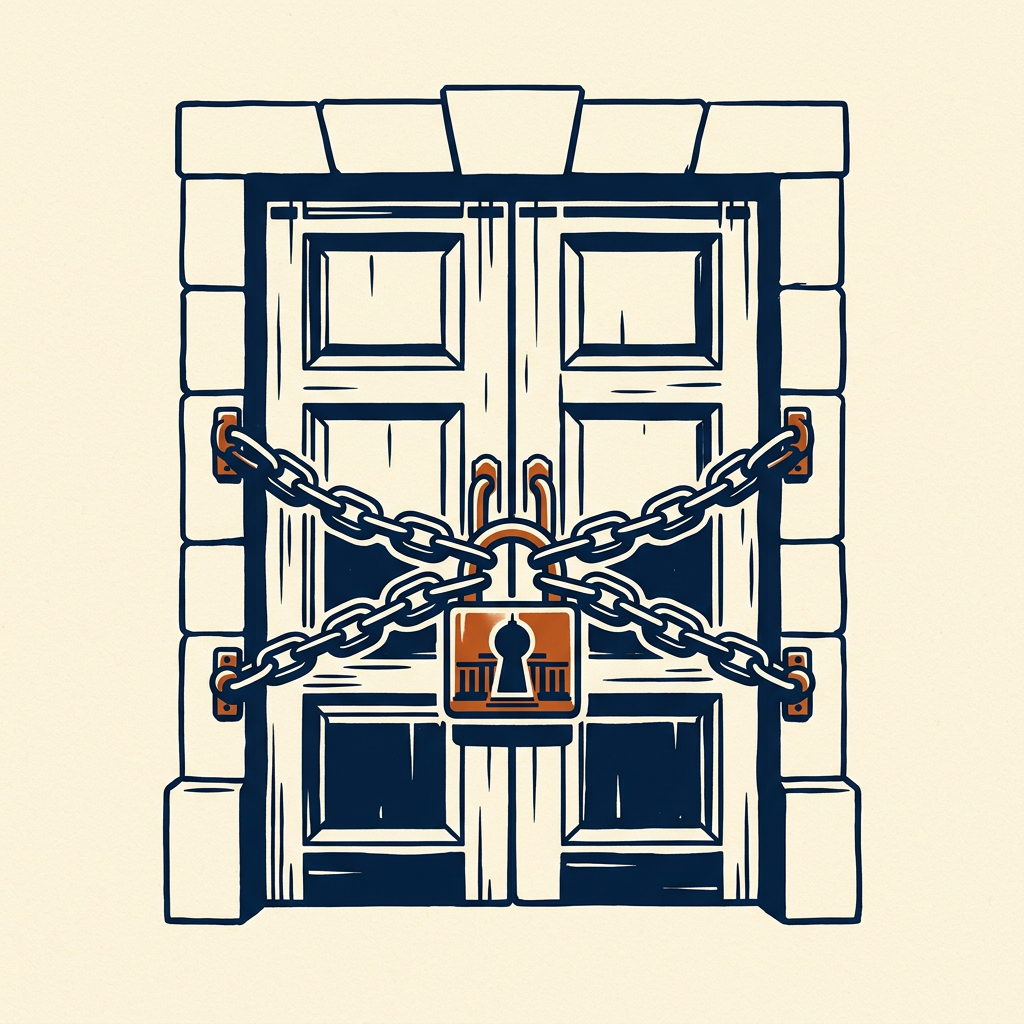
The scheme lasted because Najib’s power made real accountability inside Malaysia nearly impossible.
Inside Malaysia
Intimidation, a cleared prime minister, sidelined overseers, quiet state media
Outside pressure
Foreign newspapers and later cross-border prosecutors kept the facts alive
As diversions surfaced around 2015, journalists and opposition figures who dug faced intimidation; some were hit with sedition laws. Nearly 700 million dollars had moved into Najib’s personal accounts. He called it a legitimate Saudi royal donation.
The attorney general who first examined the transfers was replaced; the new appointee cleared Najib. Government-linked media stayed mostly quiet. The central bank and parliamentary committees that should have pressed were sidelined or ignored.
Hope and Wright treat Malaysia’s weak separation between ruling party and state institutions as a precondition, not a footnote. Low’s offshore machinery needed a captured apparatus at home that would not pull the plug. For years the fraud was survivable not because it was invisible, but because the people with formal power to stop it had strong personal reasons not to. Foreign reporting, especially by the Wall Street Journal and Sarawak outlets, kept oxygen on the story when domestic channels were closed.
In practice: After nearly 700 million dollars reached Najib’s accounts, the investigating attorney general was replaced and the successor cleared him.
7
Enforcement across borders
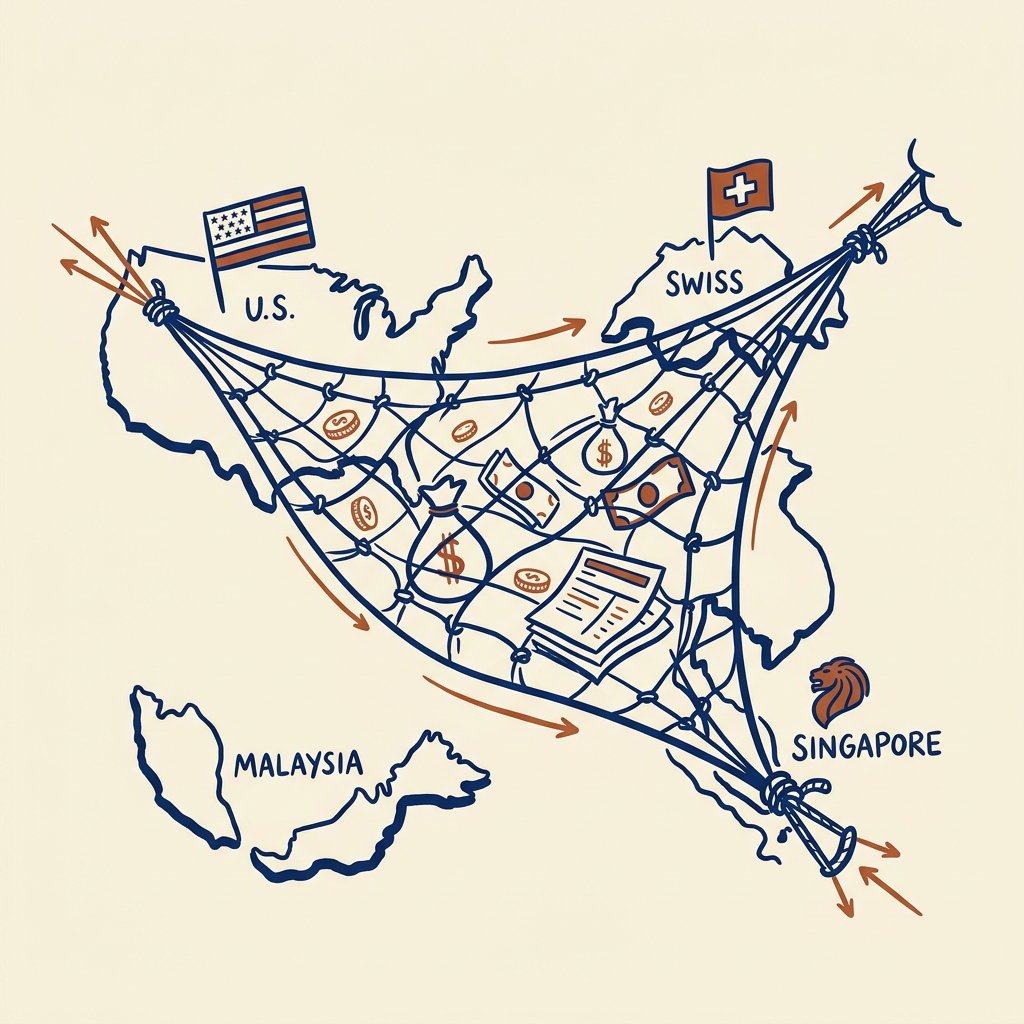
U.S., Swiss, and Singaporean authorities—not Malaysian institutions—finally made the case actionable by following money without waiting on local cooperation.
- 2015Evidence of diversions surfaces; Malaysian scrutiny is blocked
- 2016DOJ seeks over $1B in 1MDB-linked assets; Singapore and Switzerland act
- 2018Leissner pleads guilty; Goldman faces massive global penalties; Low still a fugitive
By 2016 the U.S. Justice Department had filed civil forfeiture complaints aimed at more than one billion dollars in assets tied to 1MDB, described then as the department’s largest kleptocracy action. Singapore shut branches of BSI Bank and Falcon Private Bank over compliance failures on related flows; Swiss prosecutors opened parallel money-laundering probes.
Separate threads—the bonds, the film financing, the celebrity spending, the political shield—became one map once investigators shared information across jurisdictions. Low left Malaysia and moved among places without easy extradition to the West.
In 2018 Leissner pleaded guilty to conspiracy charges involving money laundering and foreign-bribery law. Goldman later agreed to pay about 2.9 billion dollars in global fines and settlements. Hope and Wright read the ending as structural: money that crosses enough borders eventually hits oversight somewhere, even if it takes years and even if the central architect remains, at the time of writing, untried.
In practice: Leissner’s 2018 guilty plea and Goldman’s roughly 2.9 billion dollar global penalties landed only after multi-country probes connected the earlier Malaysian, Hollywood, and banking strands.
Key terms
- 1MDB Malaysian state investment fund created in 2009 that became the source of the diverted billions
- Good Star Limited Offshore entity Low secretly controlled that received a large share of the early PetroSaudi-linked diversion
- PetroSaudi joint venture First major channel that turned a supposed oil-and-gas investment into private offshore cash
- Red Granite Pictures Film company tied to Najib’s stepson that received hundreds of millions linked to 1MDB
- Social capital Low’s core currency: cultivated access and insider feeling that substituted for expertise and oversight
- Governance capture Stocking a fund’s controls with loyalists so diversion looks like ordinary approval
- Kleptocracy case How the DOJ framed its huge civil forfeiture push against 1MDB-linked assets
- Willful blindness Choosing not to ask obvious questions when fees, gifts, or political loyalty make curiosity costly
What to do
- Treat unusually high fees or unusually fast approvals on any deal as a warning sign, not a reason for excitement.
- Insist your compliance or diligence team document why originating funds are legitimate, not merely plausible.
- Review whether dissenting voices in past board or risk meetings were investigated or simply outvoted, and fix that process this week.
- When a new contact offers extraordinary travel, gifts, or high-status introductions, ask who benefits from your not probing the money’s source before accepting.
- Write down every internal red flag on opacity or undisclosed intermediaries even when senior sponsors want the mandate.
Questions to think with
- Where would an outsized fee quietly override basic questions about where the money started?
- What does a photograph with a celebrity actually prove about a financier’s legitimacy?
- How do you keep a board independent when political loyalty is the real hiring filter?
- Why do art, real estate, and private-jet markets still have weak reasons to stress-test a free-spending client’s wealth?
- What would make cross-border enforcers connect scattered transactions years faster next time?
The other side
The book is strongest as forensic narrative and weaker as psychology or policy: Low never fully cooperated or stood trial, so motives are reconstructed from leaks, the Sarawak Report, and anonymous insiders with their own agendas; Malaysian communal politics and the 2018 ouster of Najib are thin; it ends in 2018 before Najib’s later conviction and asset recoveries; and it diagnoses compliance and celebrity failure far more than it offers concrete reforms.
Who it's for
Finance professionals who want a hard case study in how compliance dies under fee pressure, plus readers tracking how celebrity culture and hollowed state institutions can launder both money and reputation. Anyone who needs to see the full arc from a connector’s social climb to multi-country forfeiture will get more from the book than from headlines alone.