



How to sharpen a kitchen knife
By How To (/journals/how-to)
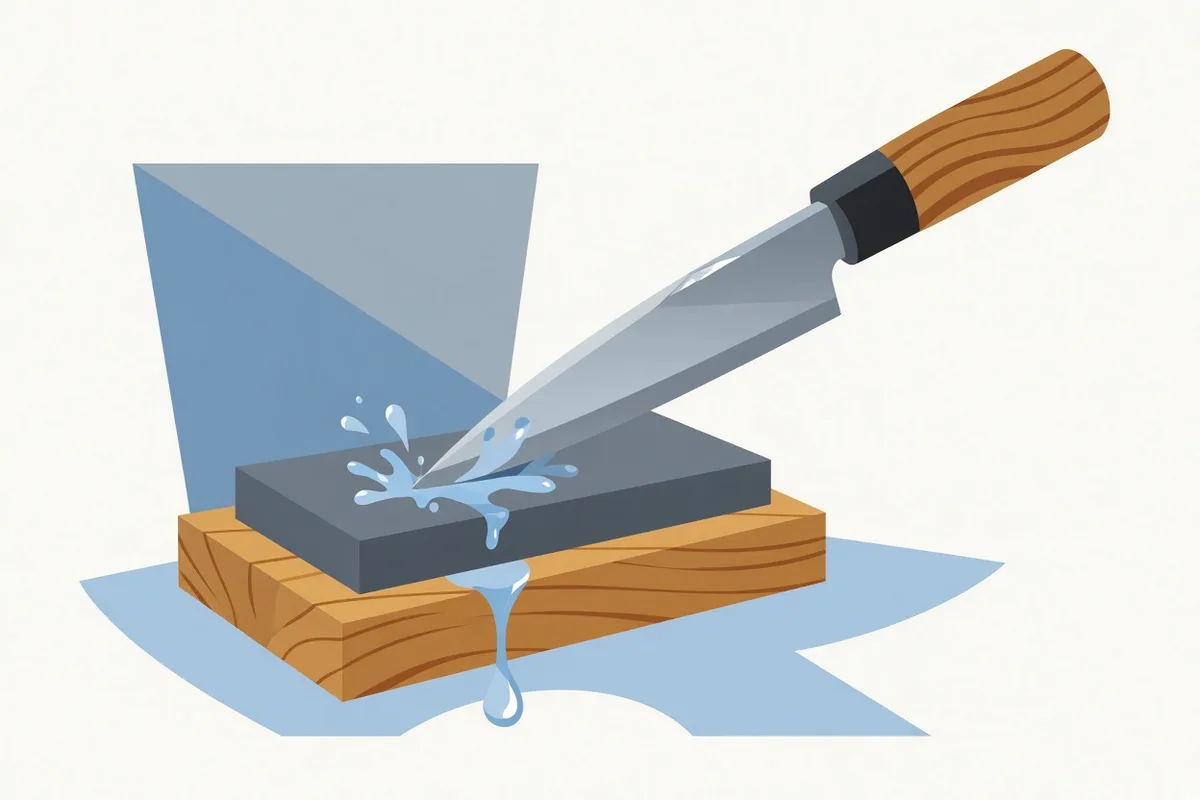
A sharp edge forms when you abrade both faces of the blade at one steady angle. Keep that angle and the knife bites food with less push and less chance of slipping.
Gather: a whetstone (medium grit near 1000 is common practice; finer grits vary by kit), water or the oil your stone needs, a towel for grip, and clear counter space.
1: SET the whetstone on a damp towel so it cannot skate: keep the blade pointed away from your body the whole time.
Press the stone lightly with your palm. If it stays put, the base is ready; if it creeps, fold the towel thicker under both ends.
2: HOLD the handle in your dominant hand at about fifteen to twenty degrees to the stone for most Western kitchen knives (some blades run thinner).
Raise the spine about half a finger above the stone at the heel. When that gap looks even from heel to tip, the angle is locked.
3: DRAW the edge across the stone from heel to tip as if slicing a thin layer off the top, guide fingers on the spine only.
Count eight to ten light passes on this face. A thin wire burr should start to catch when you wipe a fingertip away from the edge—never toward it.
4: FLIP the knife and match the same angle on the second face with the same heel-to-tip path.
Repeat the same eight to ten passes. The burr should now switch to the first side, proof both faces have met.
5: LIGHTEN the pressure for a few alternating strokes on each face to ease the burr off without rounding the edge.
Use two or three strokes per side with almost only the knife’s weight. When neither face catches a burr, stop.
6: RINSE the blade and stone under water, then dry the knife fully before any test cut.
Wipe from spine toward the edge with the towel, never the reverse. A dry blade that parts printer paper or ripe tomato skin without crushing has passed.
The most common mistake
Rolling the wrist mid-stroke changes the angle and leaves a rounded dull edge. Lock elbow height and keep the spine gap even the whole pass.
Pro tip
Color the bevel with a dark marker before the first stroke; when the ink vanishes evenly, your angle is tracking true.
Say it every time
set hold draw flip lighten rinse
Coverage
Comments (2)
The lighten and rinse parts make sense for avoiding grit in food, though I still prefer a whetstone over any gadget.
I tried the draw and flip steps on my chef knife and the edge stayed sharp through a whole week of meal prep.