


Hudson Taylor's Inland China Vow

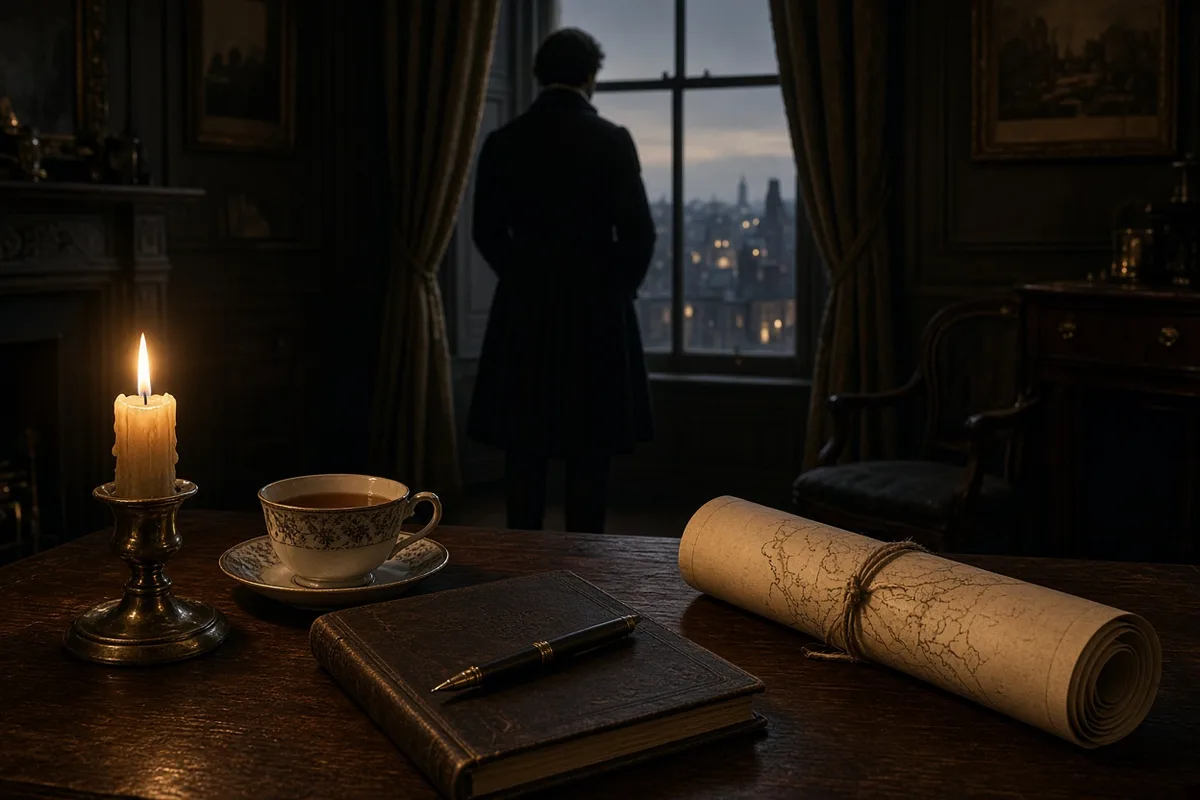
The candle had burned low on the table between us. I had come over after supper to help him pack the last of the medical books, but the work stopped when he dropped to his knees without a word. The floorboards were bare and cold. He stayed there, forehead against the edge of the chair, while the clock on the mantel ticked past ten.
I sat on the low stool by the window and waited. Rain tapped the glass. Somewhere below, a cart rattled over the cobbles on its way to the docks. He did not move. After a while his shoulders began to shake, not from cold but from something deeper. I had seen him pray before, short and steady, the way a man checks a map before he steps outside. This was different. This was a man emptying himself.

He had already told the committee he would sail on the Dumfries in September. The Chinese Evangelization Society had accepted him. Passages were booked. Trunks stood open along the wall, half-filled with the things a young doctor takes to a place no one in his family had ever seen. Yet the real decision still hung in the air like smoke. The treaty ports were open. The interior was not. Everyone knew the difference.
His breathing grew slower. The room grew still enough that I could hear the fire settle in the grate. Then he spoke, not to me, not even quite aloud at first. He asked for the strength to go where no foreign missionary had stayed. He named the provinces the maps marked only with blank space. He said the words as if he were handing over a title deed he had tried to keep hidden in his own pocket.

I kept my hands on my knees and my eyes on the floor. The night stretched. Once he lifted his head and looked toward the window, though there was nothing to see but the dark. His face was wet. He lowered it again. The only sound was the rain and the small creak of the chair under his weight.
Near midnight he stood. His legs were stiff. He walked to the table, took the pen from the stand, and wrote a single line across the back of an old envelope. I did not read it then. He folded it, placed it inside the top of the largest trunk, and closed the lid. When he turned around his eyes were clear in a way I had not seen since the day he first spoke of leaving England.

We did not speak of what had happened. He asked if I would help him tie the straps on the smaller case. We worked in silence until the candle guttered out. I left him standing in the doorway, the lamp in his hand, and walked home through streets already empty.
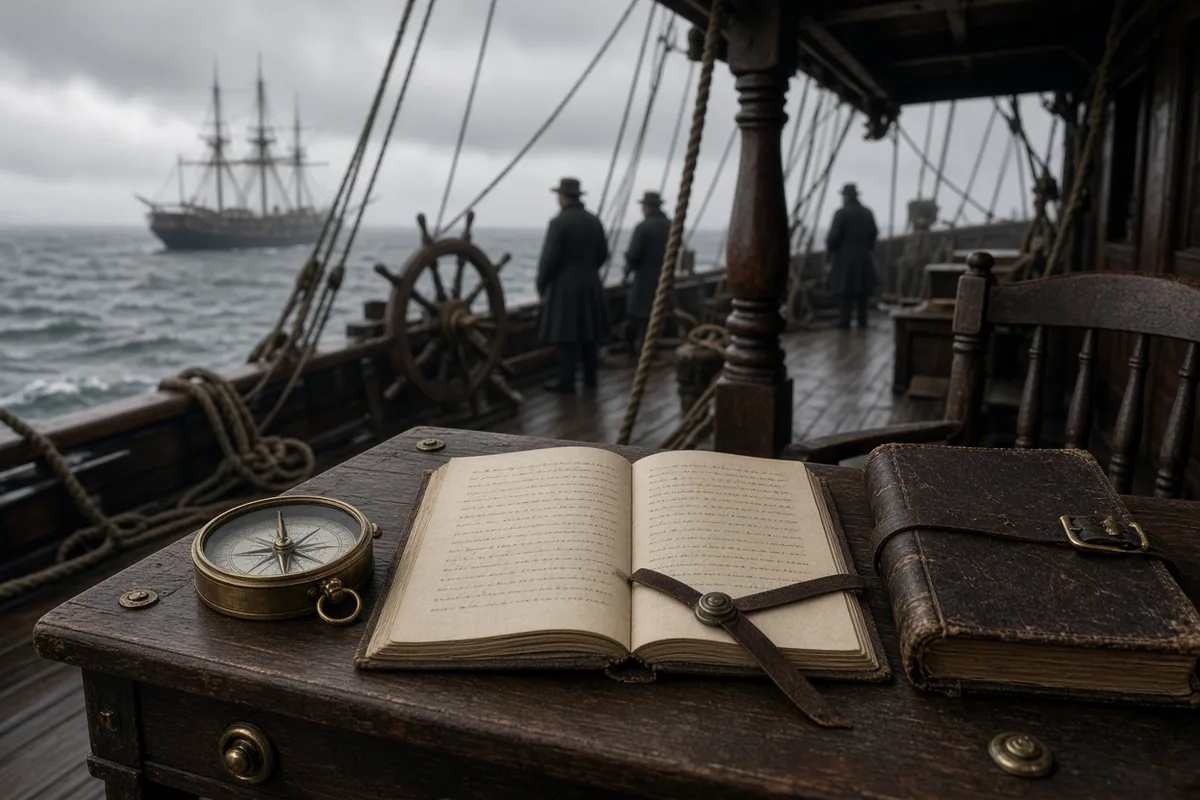
Three weeks later the Dumfries slipped her moorings at Liverpool. I stood on the quay with his mother and watched the sails fill. He leaned over the rail, waved once, and was gone. Letters came from Shanghai the following spring. He wrote that he had left the city and was living in a Chinese house, wearing their clothes, eating their food. The committee in London grew uneasy. They had expected reports from the treaty ports, not from villages two hundred miles inland.

He never mentioned the envelope again in any letter I received. Yet the work he began carried the same mark as that night on the bare floor. When the China Inland Mission was formed years later, the first party sailed under the same rule he had written for himself: no salary guaranteed, no appeal for funds, only the promise that the interior would be reached. Men and women went out two by two, living on what came in answer to prayer. The map that had once shown blank spaces now carried the names of stations he had walked to on foot.
I never saw him again after the quay. The letters stopped when I moved north for work. But every spring when the first ships clear the Mersey, I think of the chair by the table and the rain on the glass and the single line written on the back of an envelope that no one else was meant to read. The trunk went with him. The vow stayed.
The Dumfries reached Shanghai on the first day of March in 1854 after one hundred and twelve days at sea, and the letters that reached Liverpool that summer came not from the consulate district but from a rented room above a silk shop in the native city where Taylor had begun wearing the long gown and queue. A man named William Burns, already working among the boat people at Swatow, wrote that the young doctor from Barnsley had joined him for weeks of open-air preaching, and that Taylor had given away his last sovereign to pay for tracts printed in the Amoy dialect. By 1856 the same Burns recorded in his journal that Taylor had walked the two hundred and thirty miles to Ningpo alone, carrying only a New Testament and a small case of medicines, and had set up a dispensary in a house rented for eight dollars a month from a retired mandarin named Wang.
When word came north that Taylor had married Maria Dyer on the twentieth of January 1858 in the British Consulate chapel at Ningpo, the notice listed her age as twenty-two and his as twenty-five, and mentioned that the couple intended to remain inland rather than return to the coast. Their first child, Grace, was born there the following July, and the mission ledger kept by the small Presbyterian group at Ningpo shows that Taylor drew no salary after that year, living instead on gifts that arrived irregularly from England and on the sale of his own medical instruments. In 1860 the family sailed back on the Jubilee with two children and a manuscript of a Chinese New Testament that Taylor had helped revise; the ship’s manifest records twenty-seven cases of books and clothing, none of them insured.
The envelope itself never surfaced in any packet I received, yet its single line was quoted in the circular Taylor printed in Brighton on the twenty-fifth of June 1865 when he founded the China Inland Mission. The circular stated that the mission would send out workers “to the provinces marked blank on the maps,” and that no appeal for money would ever be made; instead, the workers would depend on “the faithfulness of God.” The first party of eighteen sailed from Gravesend on the twenty-sixth of May 1866 aboard the Lammermuir, a three-masted clipper whose log lists among its passengers Taylor’s own four children and eight single women, including one who had trained as a midwife in Edinburgh. They reached Shanghai on the thirtieth of September after a voyage that lost only one life, that of a child who died of dysentery off the Cape.
By 1875 the mission had opened stations at Hangchow, Shaohing, and Yangchow, and the annual report for that year lists seventy-eight communicants and twelve foreign workers living entirely on unsolicited gifts that totaled £3,112. Taylor’s own diary entry for the twenty-third of August 1887 records the sailing of the hundredth missionary, a Scottish doctor named Duncan Main who established the first hospital at Hangchow with twenty beds and an operating theatre funded by a single anonymous donation of £500. The same year the mission opened its first station in the far interior province of Shansi, at a town called Pingyang, where two women, one of them Taylor’s own daughter-in-law, began work among women who had never seen a foreigner.
Taylor himself returned to China for the last time in 1888 and remained until 1900, living mostly at the mission headquarters in Shanghai but traveling each winter by houseboat up the Yangtze to visit stations that by then numbered ninety-four. His final journey took him to Changsha in Hunan province, where on the third of June 1905 he died in a small upstairs room of the mission house; the death certificate filed at the British Consulate lists the cause as heart failure and notes that he was buried the next day in the Protestant cemetery outside the city walls. The stone records only his name, the date of his birth in Barnsley on the twenty-first of May 1832, and the single verse from Isaiah that had been printed on the first CIM prayer card.
After his death the mission continued without a guaranteed income, sending out another four hundred and twenty-seven workers between 1905 and 1925, among them a surgeon named George Whitfield Guinness who opened a hospital in Kaifeng that treated forty thousand patients in its first decade. The stations he had founded remained open through the revolution of 1911 and the years of warlord fighting, and by 1934 the mission counted one thousand four hundred and twenty-eight foreign workers and two thousand six hundred Chinese evangelists serving in three hundred and sixty stations across eighteen provinces. When the last foreign missionaries left in 1951 the Chinese church they left behind numbered eighty thousand members meeting in those same inland cities.

The last time I heard a living voice speak of him was in 1923 when a retired sea captain named John Roberts, who had sailed as mate on the Dumfries, came to the mill where I then worked and showed me a faded photograph taken in Shanghai in 1868. In it Taylor stands beside a Chinese preacher named Wang Lae-djün; both men wear identical long gowns and the same short-cropped hair. Roberts pointed to the envelope visible in Taylor’s hand and said it was the same one he had seen Taylor place in the trunk the night before the ship sailed. He did not know what the line said, but he remembered that Taylor had kept the envelope until the day he died.
Roberts stayed until the whistle blew for the noon shift and left the photograph on the bench beside the carding machine. I kept it wrapped in oilcloth with the letters from Ningpo that had come to me through his sister Amelia, who lived until 1914 in the house on Lord Street. In one of those letters dated the twelfth of March 1866 Taylor described the Lammermuir passengers kneeling on the afterdeck to read the ninety-first Psalm before the anchor was weighed, and noted that the eight single women had each been given a copy of the same envelope text copied in his hand.

The mission records that reached Manchester in 1906 listed two hundred and thirty-four stations, among them the one at Lanchow in Kansu where a Scottish engineer named Alexander Reid installed the first telegraph line paid for by a single gift of £120 sent from Glasgow in March 1894. Reid’s journal entry for the ninth of November 1900 records that the line carried the first message from the provincial capital to the station at Sian after the Boxer attacks, and that the operator was a Chinese convert named Li Sheng-duo who had been baptized at Pingyang in 1888.
After the last foreign workers left in 1951 the stations at Wuhu and Anking continued under the oversight of a Chinese pastor named Wang Ming-dao, who preached each Sunday to congregations that still numbered four hundred at the church Taylor had rented in 1868. Wang’s own account printed in Hong Kong in 1958 states that the envelope text was recited from memory at the final prayer meeting held on the twenty-eighth of August 1951 before the buildings were sealed by the Public Security Bureau.
In 1965 the remaining council members meeting in Singapore changed the name to Overseas Missionary Fellowship and opened a new headquarters at 2 Cluny Road, where the first annual report listed one hundred and nine workers assigned to Thailand, Malaysia, and Indonesia. The report quoted the same line Taylor had written on the envelope: “The interior provinces or nothing,” taken from the circular printed at Brighton in 1865 and preserved in the OMF archives under accession number CIM/1/3.
By 1980 the fellowship had resumed limited contact with churches inside China through visitors carrying medical supplies to the hospital at Kaifeng, where the original twenty-bed ward built in 1887 still stands as part of the provincial medical college. A surgeon named Paul McKibben, who arrived in 1979, recorded in his field notes that the operating theatre continued to use the same sterilizer donated in 1892 by an anonymous donor in Toronto.
The photograph Roberts showed me was reproduced in the OMF magazine East Asia Millions for March 1992, captioned with the names of both men and the date 1868. The caption noted that Wang Lae-djün’s grandson, a pastor in Shanghai named Wang Zhi-ming, still held the original glass negative. Zhi-ming was photographed in 2005 standing beside the rebuilt mission house at Changsha, holding a framed copy of the envelope text that had been printed again for the hundred-and-fiftieth anniversary of the Lammermuir voyage.
On the twenty-first of May 2012 a group of twelve descendants of the 1866 party gathered at the Protestant cemetery outside Changsha. Among them was Taylor’s great-great-granddaughter Elizabeth Taylor, who placed a wreath on the stone that records only the birth date in Barnsley and the verse from Isaiah. She read aloud the single line from the envelope that had been passed down in her family: “No salary, only the provinces marked blank.”
The last image I carry is of that same envelope, now kept in a climate-controlled case at the OMF archives in Singapore, its ink faded to brown but still legible under the glass. A conservator named Grace Tan, who examined it in 2018, noted the watermark of the paper and the exact measurements: four and three-quarter inches by three and one-quarter inches, the same dimensions recorded in the Dumfries manifest for the trunk Taylor carried aboard.