



Job openings jump to 7.52 million as demand holds
By The Conservative Desk (/journals/conservative-desk)
U.S. employers advertised 7.523 million open jobs at the end of September. That was a rise of 333,000 from August and a four-month high that cleared every estimate on the Street.
The Bureau of Labor Statistics released the Job Openings and Labor Turnover Survey on Tuesday, Nov. 3, 2026. Economists had forecast about 7.1 million to 7.16 million openings. The August total was revised up by roughly 110,000, from 7.079 million to 7.19 million. The job openings rate climbed to 4.5 percent from 4.3 percent.
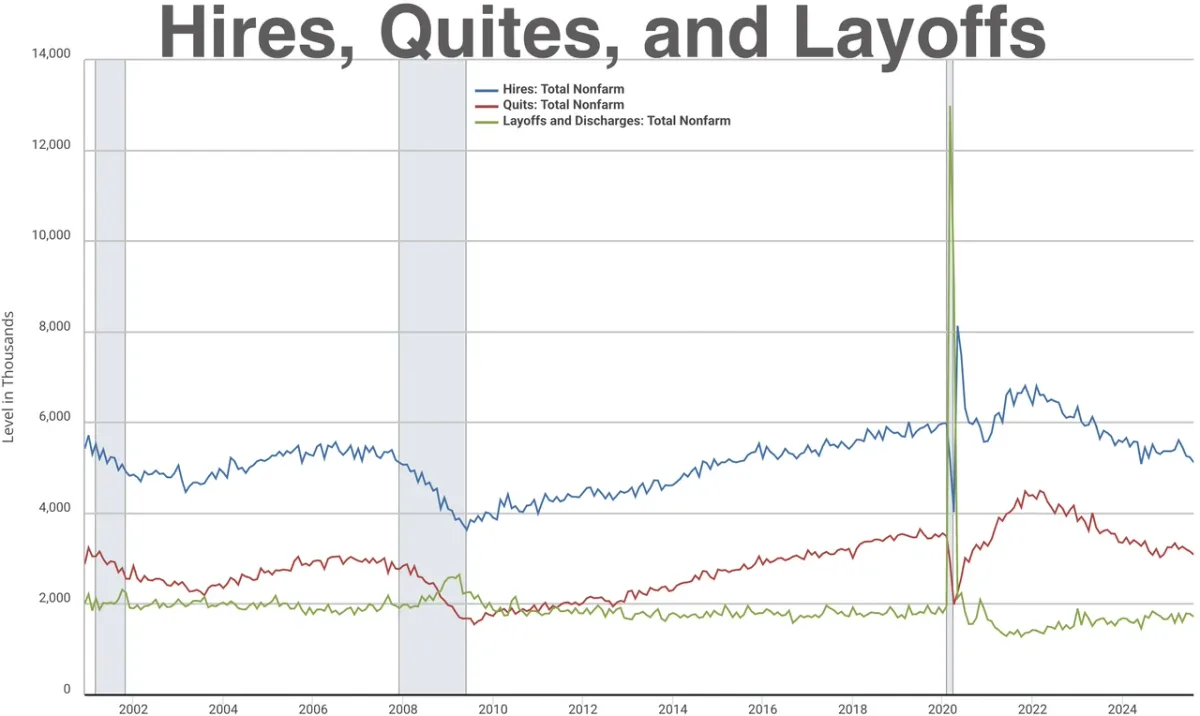
Layoffs and discharges fell 127,000 to 1.641 million, the lowest level since March 2025. The layoffs rate eased to 1.0 percent from 1.1 percent. Hires rose 131,000 to 5.402 million, and the hires rate moved to 3.4 percent from 3.3 percent. Workers who quit rose 321,000 to 3.365 million. The quits rate reached 2.1 percent, a more than one-year high.
The industry detail was not narrow. Professional and business services added 106,000 openings. State and local government excluding education added 104,000. Manufacturing added 54,000, construction 36,000, and wholesale trade 21,000. Real estate, rental and leasing openings rebounded to about 75,000 from a 12-year low of about 52,000 the month before. Openings declined in financial activities, private education and health services, and leisure and hospitality.
Accommodation and food services accounted for the largest single swings in turnover, with 158,000 more hires and 197,000 more quits. Layoffs in health care and social assistance fell by 70,000.
Jay Woods, chief market strategist at Freedom Capital Markets, told The Epoch Times in an emailed note that the pattern still looked cautious on the hiring side. "Employers seem content holding on to the workers they have, but aren't particularly eager to add more," Woods said. He added, "For now, this looks more like a labor market stuck in neutral than one headed off a cliff."
Cory Stahle, an economist at Indeed Hiring Lab, framed the same calm as a problem for anyone still looking for work. "Stability can have its advantages, but quiet isn't the same as healthy," Stahle said in a Nov. 3 note. "Job seekers are clearly losing out, but even workers who have jobs may not be coming out ahead. It's a good time to have a job, if only because it's hard to lose one."
That is the strongest case for restraint in the celebration, and it should be stated in its own terms. A market that neither hires nor fires at a normal pace can protect payrolls while leaving the unemployed outside the gate and giving employed workers little leverage to move. The September gains will need to persist before anyone can call the shift lasting. JOLTS figures are volatile, and several measures of labor-market turnover remain below their pre-pandemic norms.
The print itself, however, pushed the other way. The openings total topped all survey estimates. The advance was reasonably broad across private goods and services as well as state and local government. August was revised higher. Manufacturing, construction, and wholesale trade all added vacancies. Quits climbing to a more than one-year high is the signal when workers regain confidence they can find another job. Layoffs at the lowest mark since March 2025 mean firms are not shedding staff into a demand collapse.
For the worker the daily coverage often treats as a residual, those facts are the floor under a household. A job that is hard to lose is not a raise, but it is not a pink slip either. Openings rising in manufacturing, construction, professional services, and wholesale trade point to private employers still seeing work that needs doing. The 104,000 added openings in state and local government outside education are a separate ledger item.
Mark Mathews, chief economist at the National Retail Federation, put the household side in plain language. "We head into the holiday season with strong spending momentum, as consumers remain the bright spot in the economy," Mathews said in a statement. Retailers are staffing and stocking to that reality. That is the free-enterprise reading of the same numbers that others describe only as neutral.
Matthew Martin, senior U.S. economist at Oxford Economics, said in a note, "For now, all signs point to a solid labor market, even if it is difficult for pockets of workers – namely those who are unemployed." The September report was considerably stronger than expected and pushed back against signs that labor demand had weakened sharply. The gains were reasonably broad. August openings were revised higher as well.
Federal Reserve officials upgraded their assessment of economic activity to "strong" while holding rates steady. On this evidence they have room to keep inflation in view rather than treat the labor market as the emergency requiring the next intervention. The figures landed during the week of the midterm elections, with affordability cited as a voter concern. Openings at 7.523 million, layoffs at 1.641 million, and a quits rate at a more than one-year high are concrete inputs into that argument—whether private demand is deep enough to support working families without another cycle of easy money or expanded federal hiring, and whether the quiet that protects existing jobs can become the growth that creates new ones.
The October employment report is the next hard release on the calendar. Until it lands, the September openings number is the clearest recent measure of labor demand the government has published: 7.523 million jobs posted, more than every forecast, with the fewest layoffs since March 2025.