


Johannes Gutenberg Prints the Bible
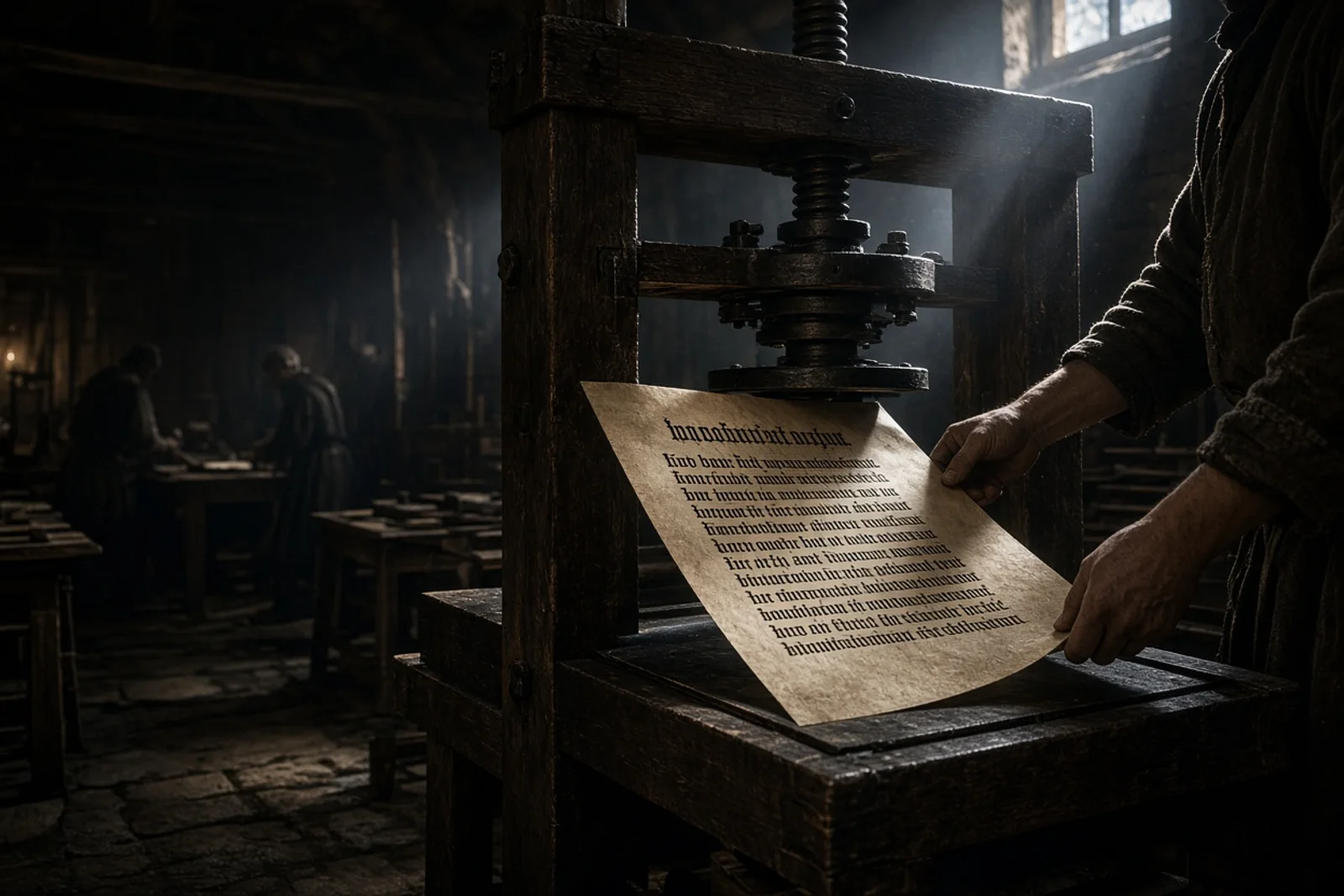
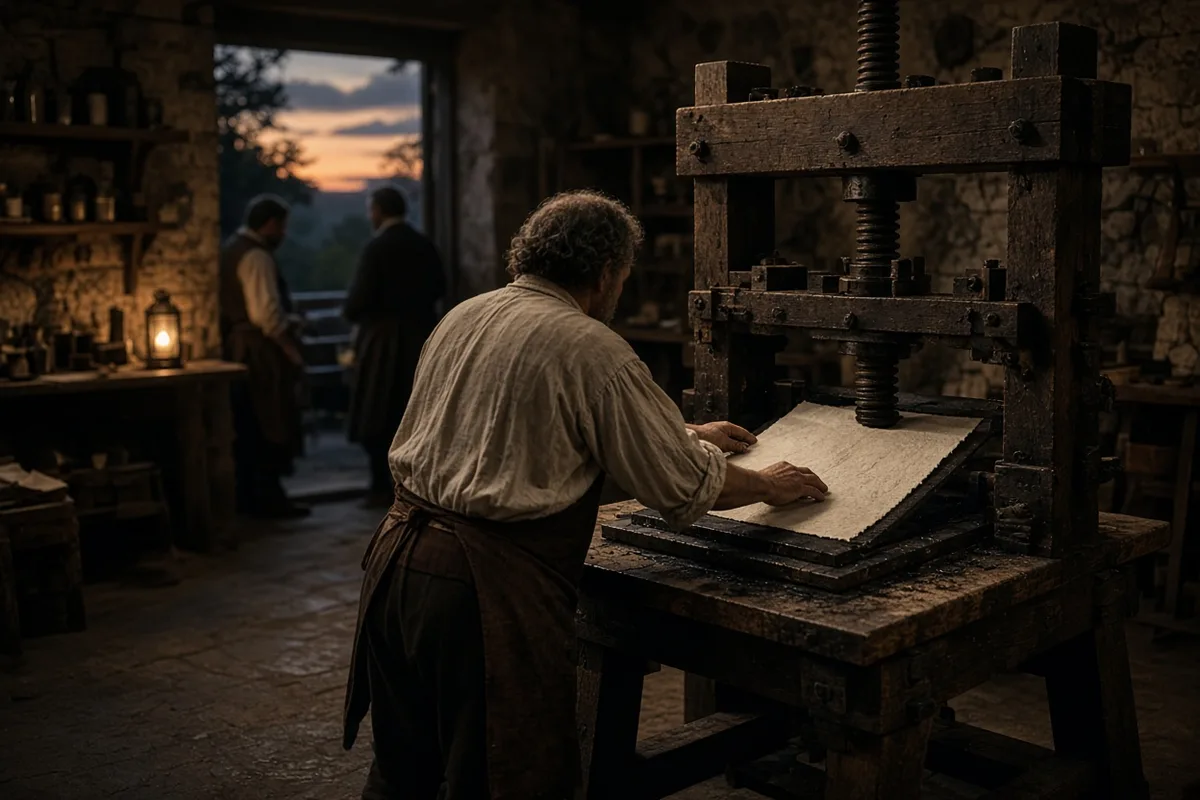
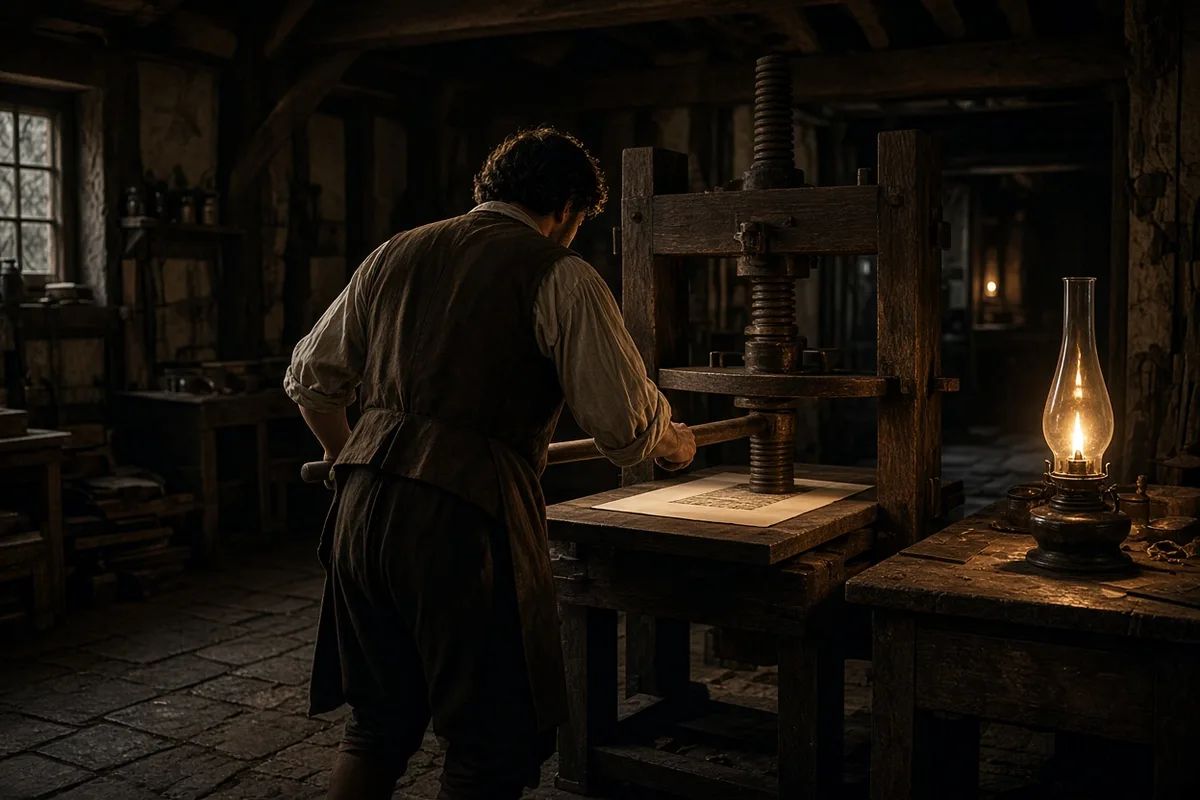
The press handle resisted at first, then gave with a crack that ran through the beams overhead. I leaned my weight into it again, feeling the oak bite into my palms, and the platen descended. Ink squeezed between the type and the vellum sheet, a dark bloom I could smell even through the open shutters. Schöffer stood at the composing table behind me, sorting the last line of the forty-second page. His fingers moved without looking, the same way a scribe finds the next letter on a ruled page. Gutenberg watched from the doorway, arms folded, saying nothing.
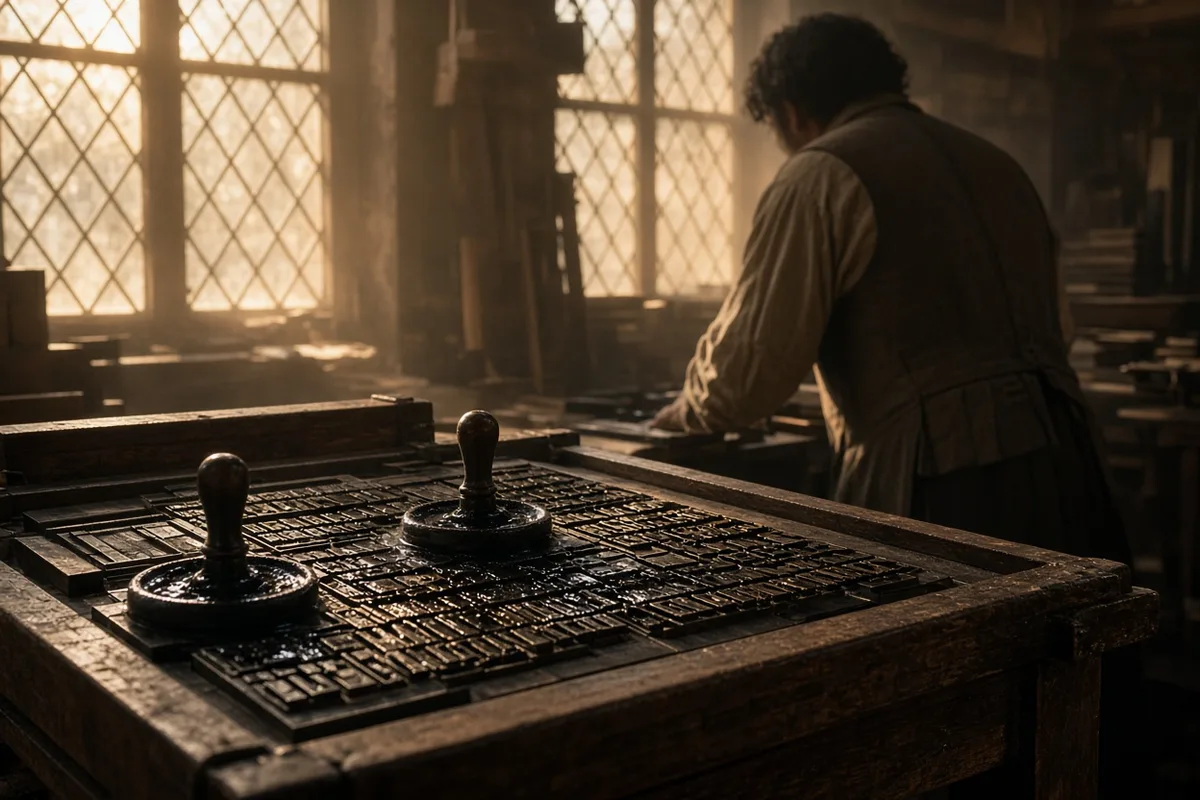
We had worked through the night again. The lamps were guttering, their smoke mixing with the sharp tang of boiled linseed and soot. Outside, rain tapped on the tiled roof of the Hof zum Humbrecht. Inside, the only sounds were the soft clack of type being lifted from the galley and the creak of the press screw turning back. Fust’s second loan had bought the vellum, enough for the three copies he insisted we keep perfect. The rest of the run would go on paper, but these sheets had to carry every line without a hair’s difference.

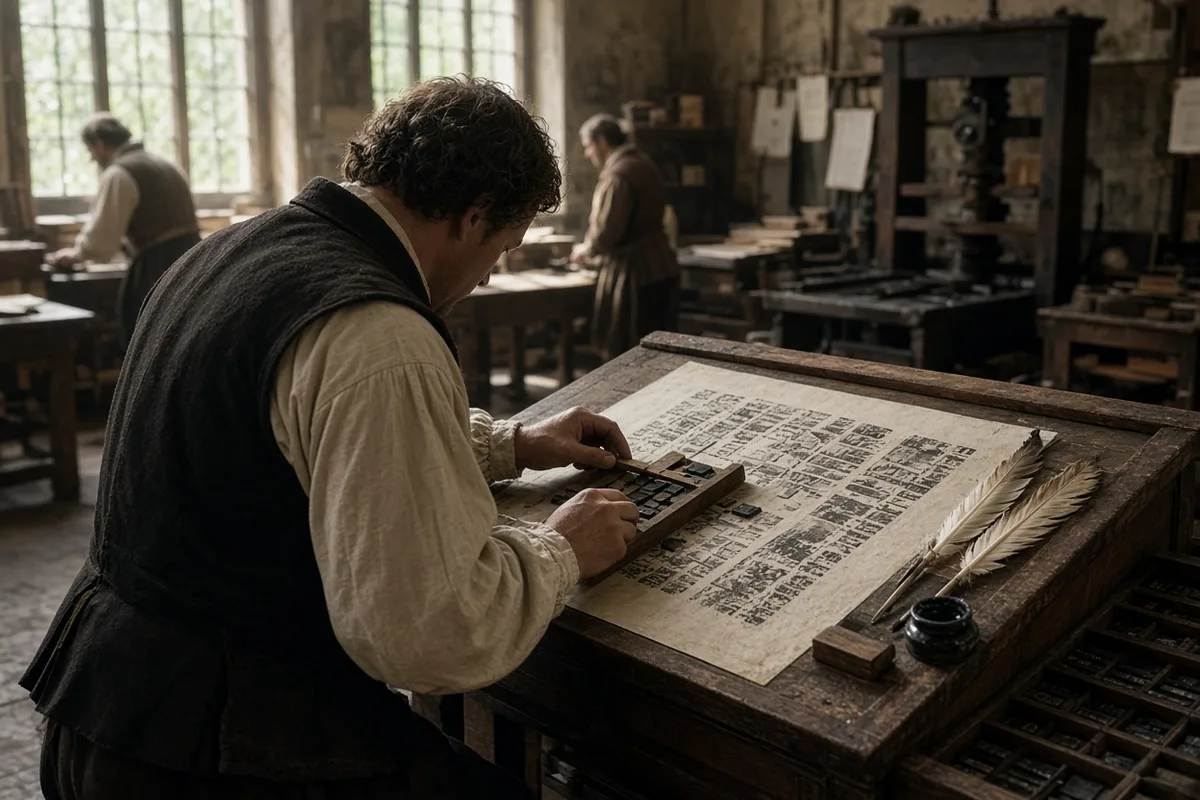
I pulled the printed sheet free and carried it to the drying rack. The letters stood slightly proud, still wet. Forty-two lines, two columns, the same measure we had used since the first gathering. My eyes had grown used to counting them at a glance. A single extra space would have meant resetting the whole page, and we could not afford the time. Schöffer had designed the type narrow enough to fit the columns yet wide enough that the eye did not tire. He tested each new punch on scraps before he let it near the forms.
Gutenberg crossed the room and lifted one corner of the sheet with a clean fingernail. He studied the impression the way a mason studies a joint. Then he nodded once and moved on. He rarely spoke during the run. The words he had spent years shaping were now locked in metal, and speech seemed unnecessary. I had seen him, months earlier, bent over the hand-casting mold for hours, adjusting the matrix until the letters dropped true every time. The same mold had produced every sort we now used.
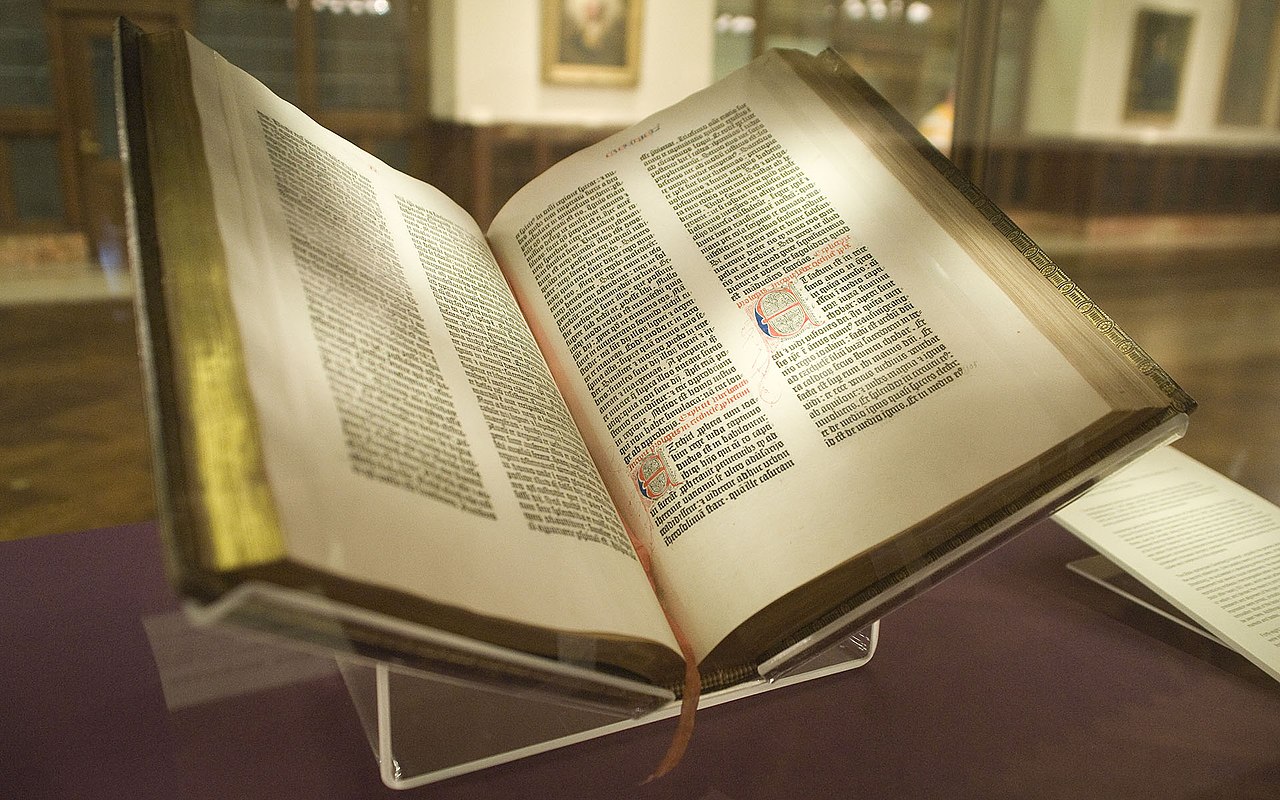
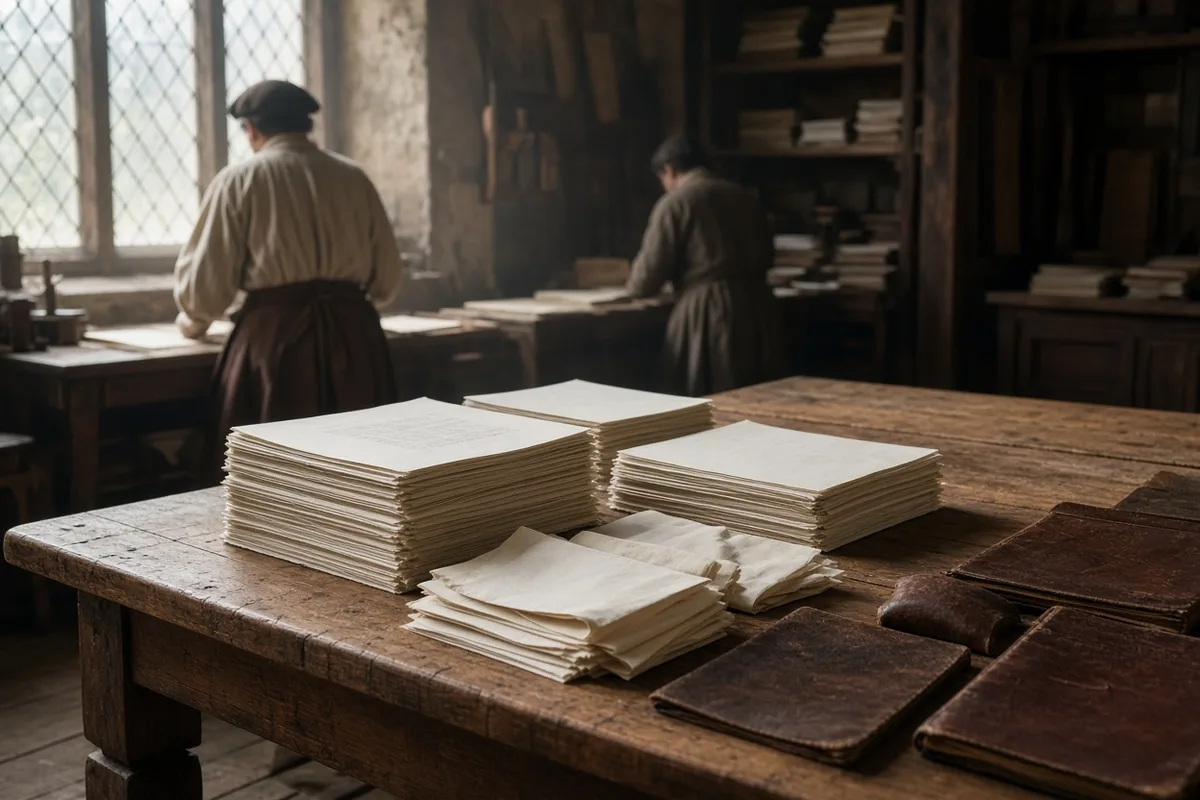
By mid-morning the rain stopped. We opened the larger shutters and let daylight fall across the finished pages laid out on the long table. The capitals still waited for the rubricator who would come later, adding red and blue by hand. For now the text stood plain, black on cream vellum. I walked the length of the table once, checking for smudges or offsets. None appeared. The press had held its register across every sheet of the gathering.
Fust arrived while we were eating bread and cheese at the bench outside. He wore the short cloak of a merchant who expected to be paid. He asked how many sheets remained and whether the ink would hold on the last quires. Gutenberg answered with numbers, nothing more. The two men stood apart while they spoke, voices low. I heard the word “account” and then the sound of coins counted onto wood. Fust left without looking at the printed pages.
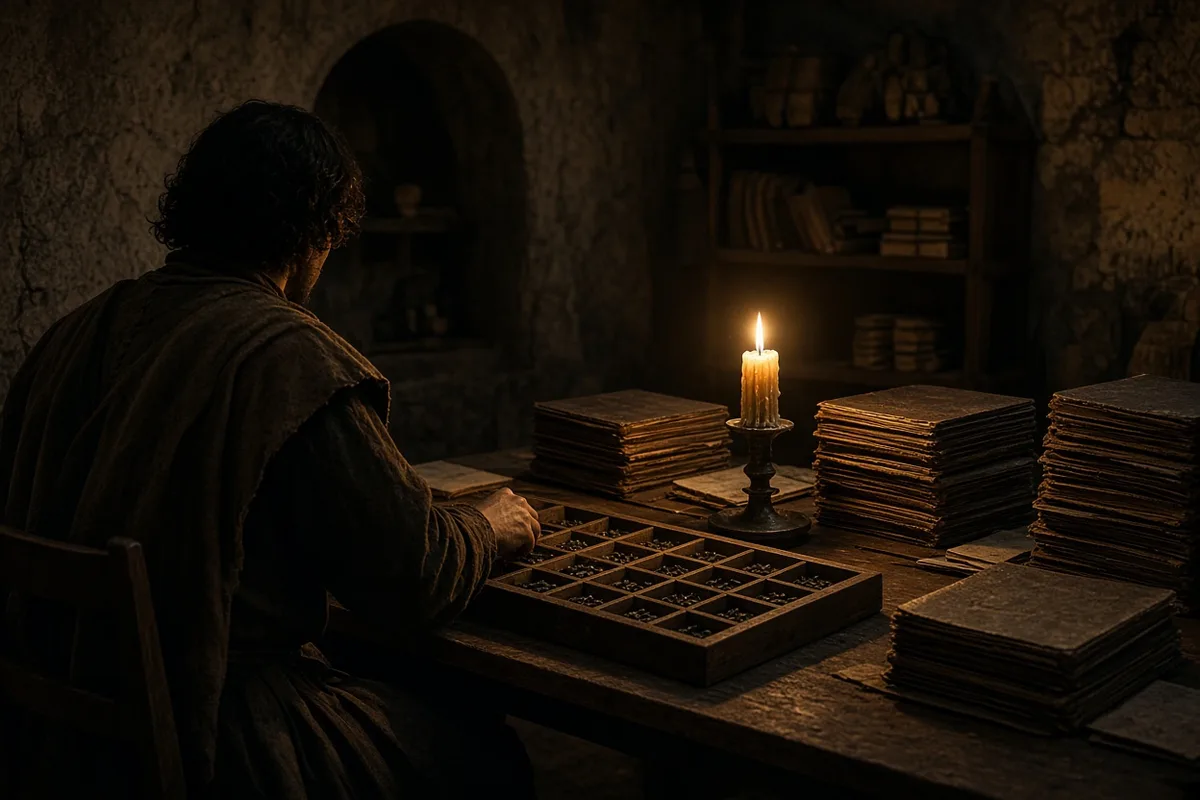
Schöffer returned to the type cases. He had begun as a scribe in Paris and still carried the habit of checking each letter against the light before he set it. When he placed a new sort into the composing stick, he tapped it once with the back of his thumbnail, listening for the fit. The rest of us followed his pace. If he worked quickly, the formes filled faster; if he slowed, the press waited. Today he moved steadily, the same rhythm he had kept since the first book of Genesis.

The workshop smelled of wet leather and hot metal by afternoon. We had cast fresh sorts the day before, and the cooling dross still lay in a pan near the furnace. I swept the floor between pulls so that stray type would not find its way underfoot. A single piece of metal under the press could ruin a forme and the sheet beneath it. We had learned that early.
Near dusk Gutenberg called us to the press again. The final sheet of the last volume lay ready. He took the bar himself and turned it with both hands, slow and even. When the platen rose, the page showed the complete colophon in its proper place. No one spoke. We carried the sheet to the rack and weighted its corners with clean stones so the vellum would dry flat. Then we cleaned the type with rags and oil while the light failed.

Fust returned two days later with a notary. They examined the finished sheets and the remaining quires still damp between boards. The notary recorded the number of pages and the quality of the vellum. Fust counted out the balance of the loan in front of us and placed the receipt on the composing table. Gutenberg signed it without reading the figures again. Schöffer watched from the shadows of the type cases.
After the men left, Gutenberg walked through the workshop once more, touching the edge of each rack. He stopped at the window and looked toward the river. The water moved gray under the afternoon sky. He stayed there until the bell for vespers rang, then went downstairs without speaking. We continued cleaning the press and sorting the sorts back into their compartments. The work did not stop because the Bible was finished.
In the weeks that followed, the three vellum copies were bound in white pigskin at the binder’s shop near the cathedral. The volumes stood on a low shelf while the glue dried. I carried one of them back to the workshop so Gutenberg could see the boards and the clasps. He opened the first volume at random and ran his finger down a column. The ink had not offset. The lines remained even. He closed the book and placed it on the table with both hands.

Schöffer began taking commissions for other texts soon after. He kept the type we had cast and the press we had adjusted. Fust supplied the paper and the buyers. Gutenberg stayed in the city but worked on smaller projects, letters of indulgence and calendars. The large formes for the Bible were broken up and the metal melted for new sorts. I helped carry the trays to the furnace and watched the letters soften and run together.
One afternoon I passed the cathedral square and saw a priest reading from one of the paper copies at a lectern. He turned the page with care, the way a man handles an object whose weight he has not yet measured. The crowd around him stood quietly. No one commented on how the letters had been made. They listened to the words as the priest spoke them.
Years later I heard that the copies had been divided among monasteries in Austria. The vellum set traveled together for a time, then one volume went to another house. The bindings grew darker with smoke and handling. The text inside remained unchanged. I never saw the volumes again after they left Mainz, but the measure of the columns and the weight of the press stayed in my hands whenever I set type for later work.
In 1457 Peter Schöffer and Johann Fust issued the Mainz Psalter from the same Hof zum Humbrecht workshop, its 143 leaves set in the twenty-six-line textura that Schöffer had cut after the Bible formes were melted. The colophon on the final page carried the explicit date “anno domini millesimo cccclvii” together with the names of both partners and the press mark of the double-shield escutcheon. That volume reached the Benedictine house at Saint Jakob in Mainz within the year, its rubricated initials supplied by the illuminator known only as the Master of the Housebook. Fust’s account books, preserved in fragments at the Stadtarchiv, record the sale of twelve further Psalters at twenty-five guilders each to buyers in Frankfurt and Cologne.
The notarial instrument drawn by Ulrich Helmasperger on 6 November 1455 still survives in the archives at Göttingen and lists the precise sums Fust advanced: eight hundred guilders for the first loan and an additional eight hundred for vellum and paper. Gutenberg’s testimony, recorded line by line, states that he had already spent the money on “the work of the books” and on wages for the six men who operated the presses. After judgment was given, Schöffer retained the Bible type and the two presses; Gutenberg kept only the small casting furnace and the set of matrices for the larger textura used in the thirty-six-line Bible that he later printed at Eltville with Heinrich Keffer.
On 17 January 1465 Archbishop Adolf von Nassau granted Gutenberg an annual pension of one hundred guilders together with an annual allowance of two hundred measures of grain and two fuders of wine, the grant recorded in the archiepiscopal register now held at Wiesbaden. The document names him “Johann Genszfleisch alias Gutenberg” and assigns the pension “for services rendered to the city and to the church.” By that date he no longer kept a press of his own and lived in the house called Zum Steinbrecher near the cathedral cloister.
Gutenberg died on or before 3 February 1468; the necrology of the Franciscan church at Mainz notes the burial of “Johannes Gutenberg, former citizen” in the cloister walk on that date. His brother’s widow, Else zu Gudenberg, received the final quarterly payment of the pension on 15 April 1468, the entry marked “pro Johanne defuncto.” No inventory of his personal effects survives, though the city tax rolls for 1469 list the house as empty and the furnace sold to the goldsmith Nikolaus von Hagenau.
Printing reached Italy when Conrad Sweynheym and Arnold Pannartz set up their press at the Benedictine abbey of Subiaco in 1465, using a type modeled on the textura of the forty-two-line Bible. Their first book, a Donatus grammar, was followed in 1465 by the De oratore of Cicero, its 146 leaves printed on paper supplied from Fabriano. Within four years the same partners had moved to Rome and issued Augustine’s City of God in an edition of 275 copies. By 1470 at least nine presses operated in Italy, each one using matrices struck from punches that descended, through one intermediary or another, from the original hand-mold Schöffer had adjusted in 1454.
Of the roughly 180 copies of the forty-two-line Bible that left the Mainz workshop, forty-nine complete or partial examples are recorded in institutional collections today. The copy on vellum once owned by Cardinal Mazarin, now in the Bibliothèque nationale de France, carries the rubricator’s date “1461” on the final leaf of the Old Testament. Another vellum set, divided in the sixteenth century, survives in three volumes at the Austrian National Library in Vienna, the British Library, and the Morgan Library in New York; each volume retains the original sewing stations and the sixteenth-century ownership inscription of the Benedictine abbey at Lambach.
In the winter of 1485 a man who had once turned the press bar at the Hof zum Humbrecht sat on a bench inside the Frankfurt book fair hall and watched a copy of the 1472 Nuremberg Chronicle being collated. He reached out, lifted the top sheet between thumb and forefinger, and held it to the light long enough to count the lines in each column. The sheet carried the same measure he remembered, forty-two lines, though the type was smaller and the paper thinner. He set the sheet down again without speaking and walked back toward the river gate before the fair closed for the evening.
The man reached the river gate as the last wagons rolled out, their axles groaning under crates marked for the Frankfurt merchants who had bought the remaining stock of the 1472 Chronicle at three guilders a quire. He passed the customs post where the clerk noted his name in the toll book as “Peter, once of Humbrecht,” the same entry he had seen recorded in 1454 when the Bible sheets first left the workshop. That night he slept in the loft above the ferryman’s house, the same room where he had lodged during the final collation of the vellum copies.
Two years later the same man stood at the door of the house Zum Steinbrecher when the new tenant, the goldsmith Nikolaus von Hagenau, sold the last of Gutenberg’s casting furnace for fourteen guilders and eight pfennigs, the transaction recorded in the city ledger for 1487. He watched the iron parts loaded onto a cart bound for Eltville, where Heinrich Keffer still operated the thirty-six-line press. The matrices, wrapped in oiled cloth, were carried separately and listed on the manifest as “twelve punches of the large textura.”
In 1492 he traveled once more to the fair and examined a copy of the Catholicon printed at Mainz in 1460, its 373 leaves set in the type Schöffer had retained after the lawsuit. The colophon read “presens hoc opusculum in alma urbe Maguntina,” the same phrasing Fust had insisted upon for the Bible. He turned to the final leaf and counted the lines again, finding the measure unchanged at forty-two.
The man returned to Mainz in the spring of 1499 and took work at the shop of Peter Schöffer the younger, now located on the Münsterplatz. There he helped set the 1503 edition of the Missale speciale, its 228 leaves printed on paper from the mill at Ettlingen. On the press day of 12 October he pulled the first sheet himself, noting that the new frisket reduced offsets by half compared with the method used on the Bible.
By 1511 his hands had stiffened enough that he could no longer hold the composing stick for more than an hour. He moved into a room above the Franciscan cloister where Gutenberg had been buried, paying three guilders yearly from the remainder of the pension still disbursed to Else zu Gudenberg’s heirs. The necrology entry for that year lists him as “Petrus, quondam impressor,” with the marginal note that he received the quarterly grain allowance on 15 March.
On the afternoon of 4 June 1515 he sat on the same bench in the cloister walk and opened a volume of the 1514 Complutensian Polyglot that had reached Mainz through the Frankfurt trade. He placed his finger on the column of the forty-second line of Genesis and traced the letters without lifting his hand until the bell rang for compline. The page measured exactly the width he remembered from the original forme.
The following morning the lay brother found him still seated, the book open on his lap, the vellum sheet of the Polyglot marked at the same passage with a single line drawn in the margin by a dry quill. The entry in the cloister register records the burial on 6 June beside the earlier grave of “Johannes Gutenberg, former citizen,” with the note that the deceased left no goods beyond the worn type rule he had carried since 1455.