


John Bunyan Hears the Voice in Bedford Gaol
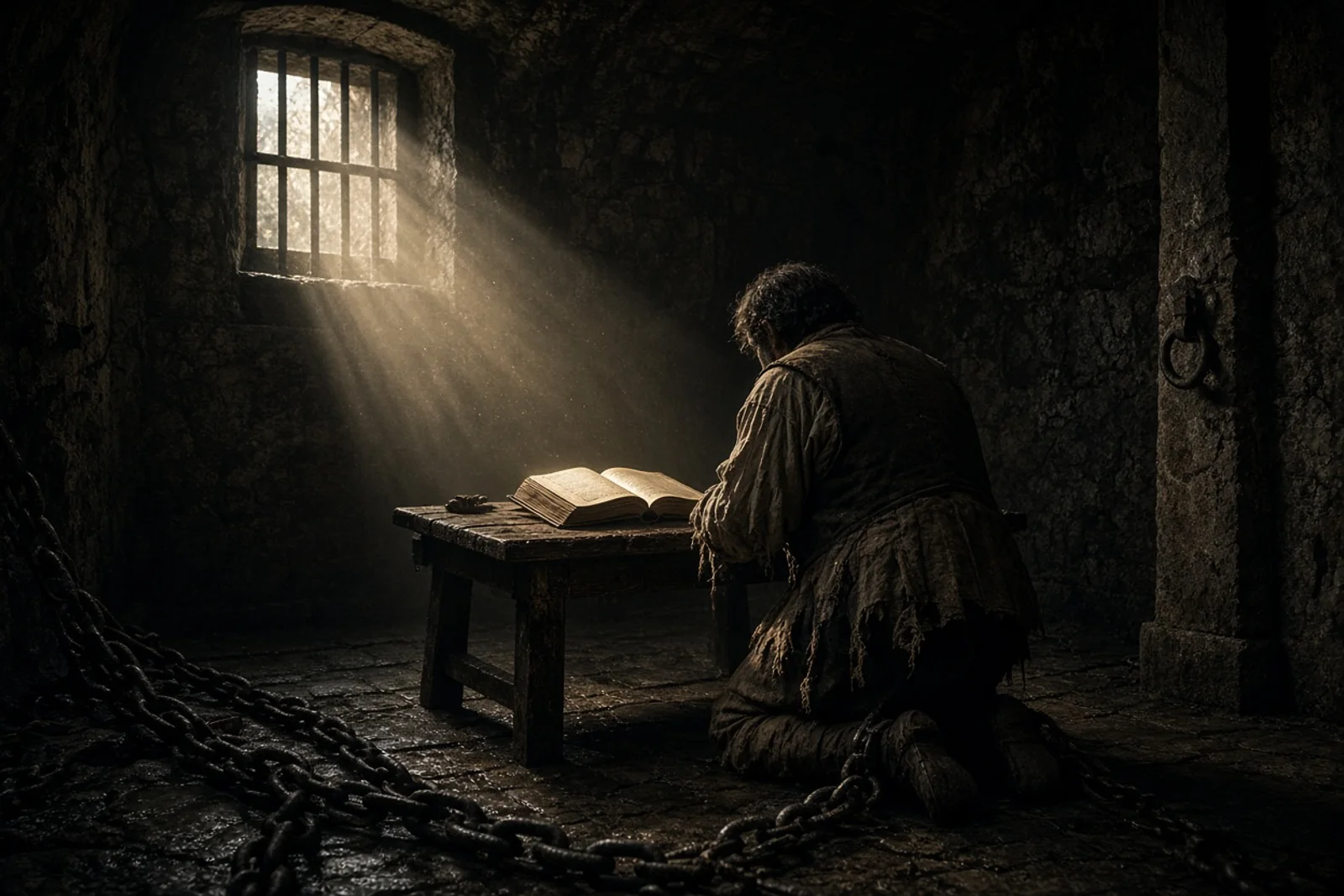
The prayer had just begun when the door slammed back against the wall. Cold air from the lane poured in with the constable and two of his men. Their boots left wet prints across the packed earth floor. I kept my head down but watched the circle of men and women still kneeling, Bibles open on their knees. The constable stopped short, lantern raised, as if he had expected pikes instead of open pages.
Bunyan stood first. He had been the one leading us into the words. He set his own Bible on the bench without hurry and turned to meet the officer’s eye. The constable read the warrant aloud, voice cracking on the justice’s name. Francis Wingate wanted him brought in at once. No one else was named.

Outside the cottage the watch had already formed. Lanterns bobbed along the hedge line. I heard the low mutter of neighbours who had come out to see what the noise meant. Bunyan walked between the two constables without looking back. One of the women tried to press a cloak into his hands; he shook his head once and kept moving.
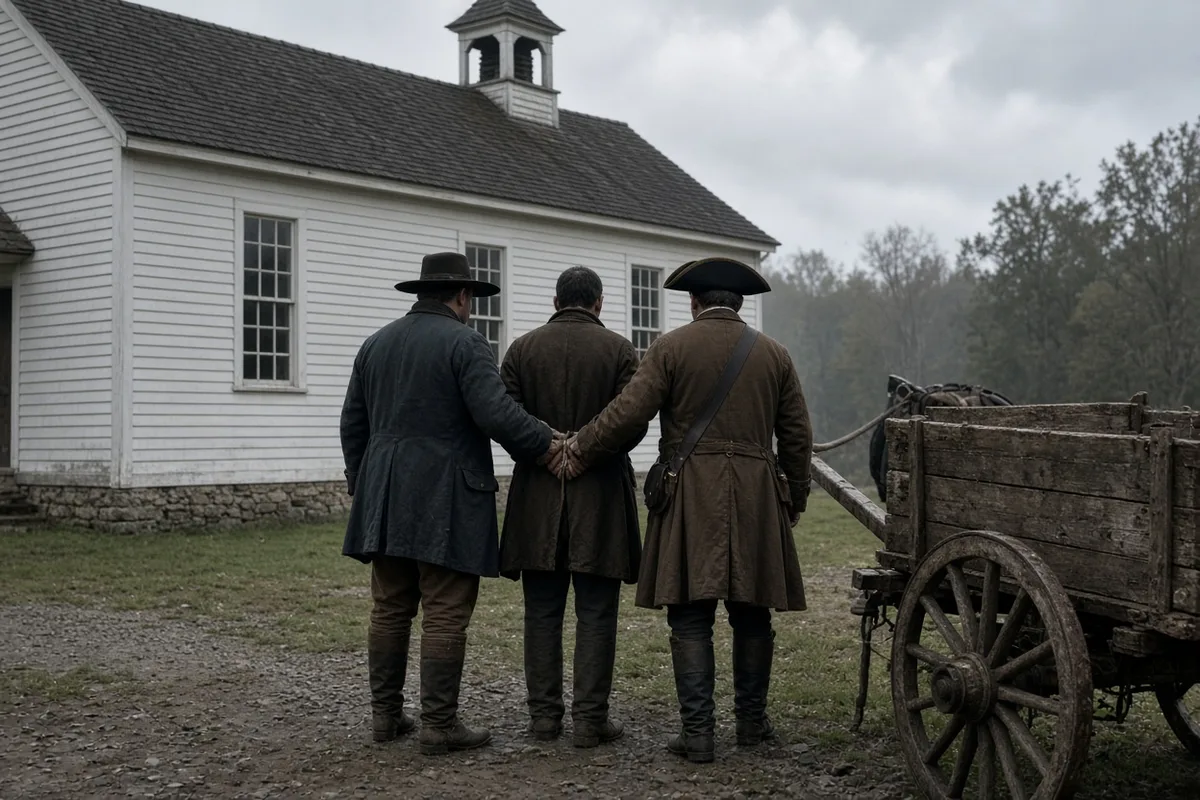
We followed at a distance as far as the crossroads. He did not speak until they reached the cart that waited on the Harlington road. Then he turned to the smaller group of us who had kept pace and said the meeting must go on another day. The words carried the same even weight he used when he preached. The constable told him to keep quiet. Bunyan climbed into the cart without being forced.
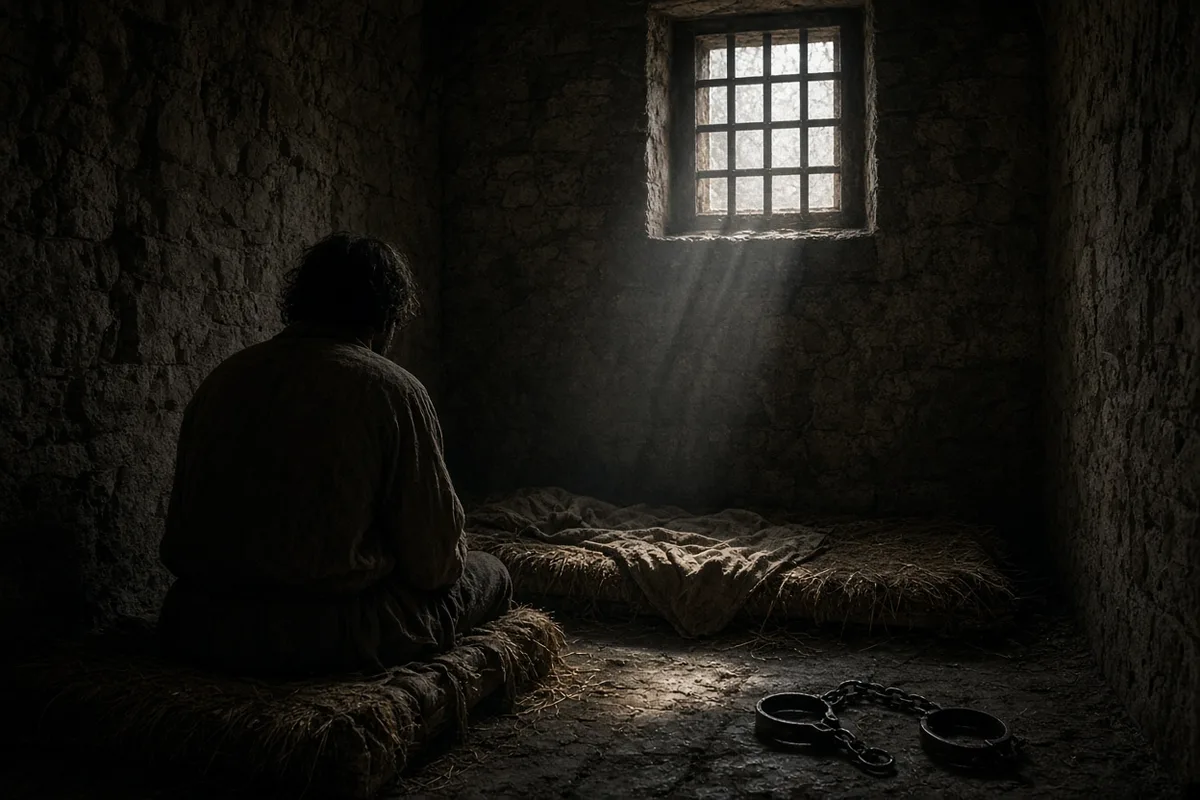
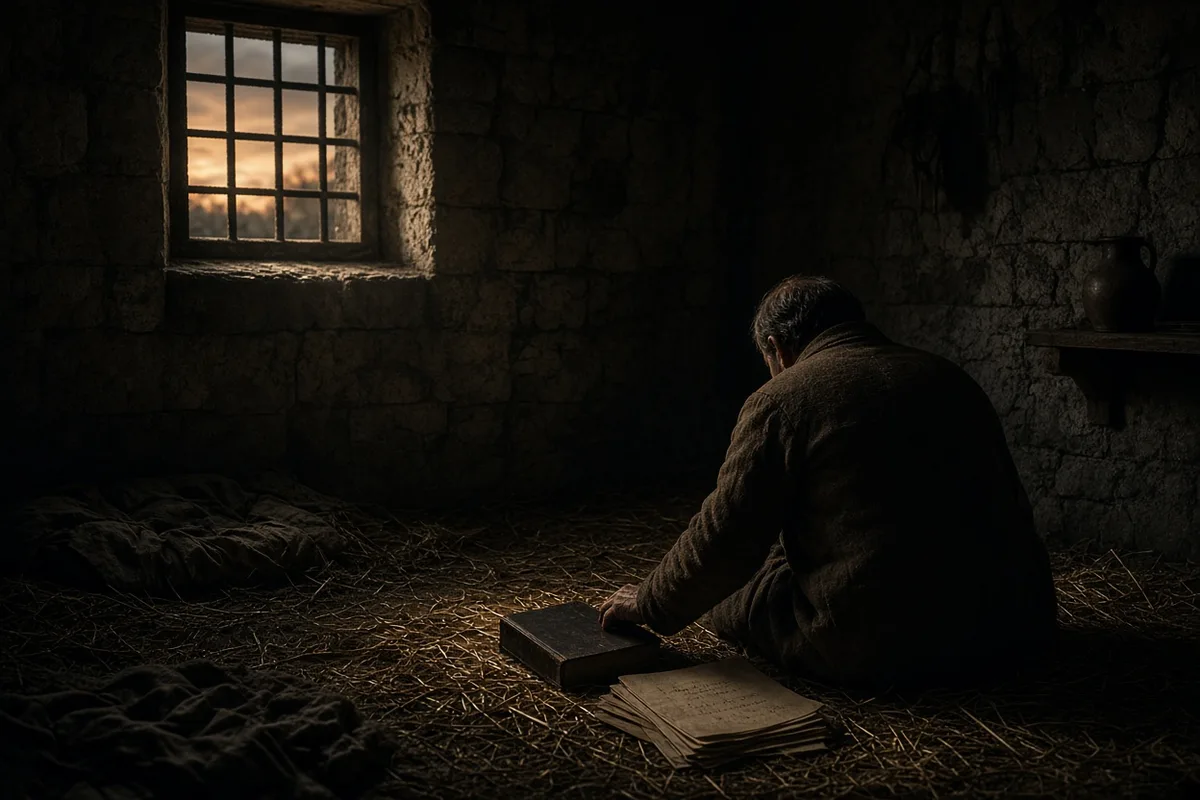
I reached Bedford two days later with a bundle of bread and a letter from his wife. The gaol stood on the river side of the bridge, its lower windows barred and half under water at high tide. The keeper let me in after counting the loaves. Bunyan sat on a bench against the back wall, straw scattered around his feet. He looked smaller inside the stone room than he had in the cottage.

He took the letter but did not open it at once. Instead he asked whether any of the others had been taken. I told him the watch had scattered once he was gone. He nodded and set the letter on his knee. For a while neither of us spoke. Water dripped somewhere above us and ran down the wall in a thin line.
On the third morning the keeper brought him before Wingate. I waited outside the justice’s house with two other men from the congregation. Bunyan came out again within the hour, hands still unbound. He told us the justice had offered freedom if he would promise not to preach. He had answered that he could not make such a promise. The keeper led him back across the bridge without further words.
Weeks passed. I brought what food I could spare and whatever news reached the town. Bunyan asked each time about the meetings. Had they continued? Were the people still meeting in the fields when the weather allowed? I said they were. He seemed satisfied and asked nothing more about his own case.
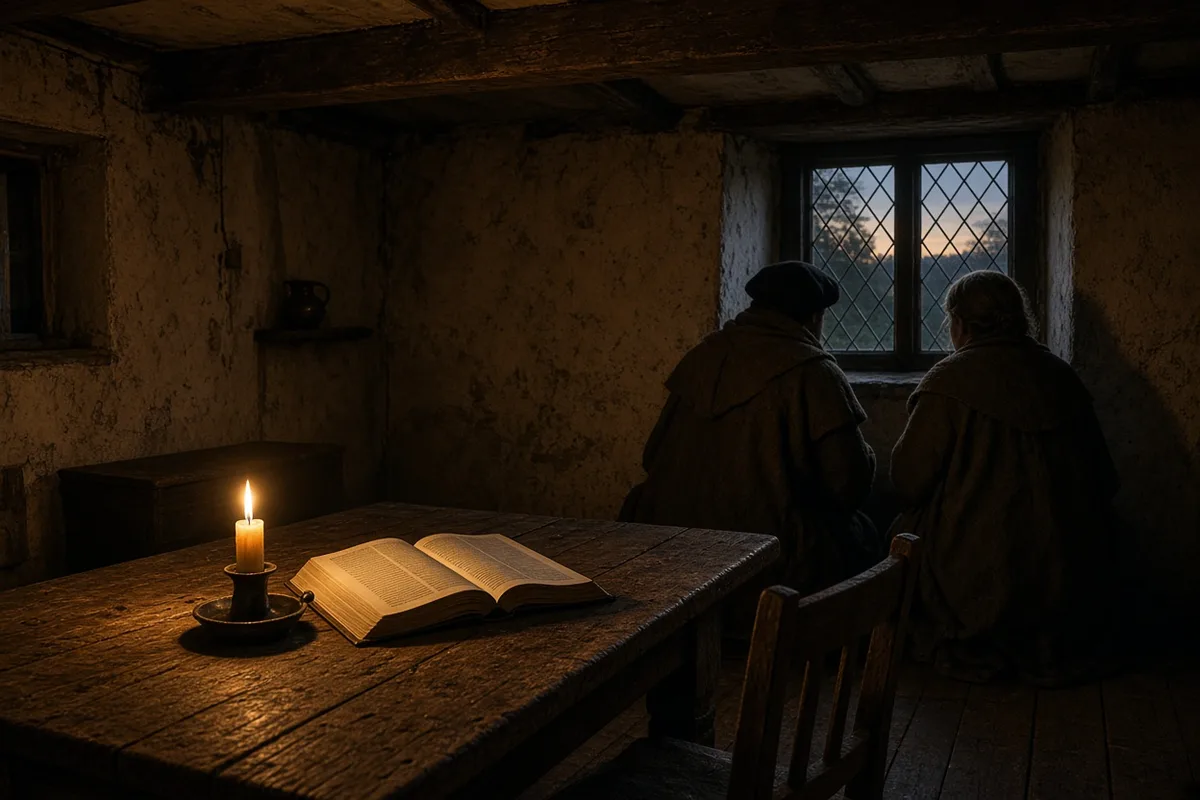
One afternoon the gaol door opened and a different visitor entered. The clerk of the peace carried a paper and spoke in a low voice, offering terms again. Bunyan listened without rising. When the clerk finished, Bunyan answered that he had already given his reply to the justice. The clerk folded the paper and left. The straw on the floor had been changed that morning; the new layer still smelled of the field.
His wife came in the autumn with a petition drawn in her own hand. She waited at the outer gate until the keeper allowed her through. I stood far enough back that I could not hear every word, but I saw her present the paper and then stand while the justices read it. They asked her questions about her husband’s health and about the children. She answered each one steadily. When they told her they could do nothing, she thanked them and turned to leave. Bunyan watched her go from the barred window above the gate.
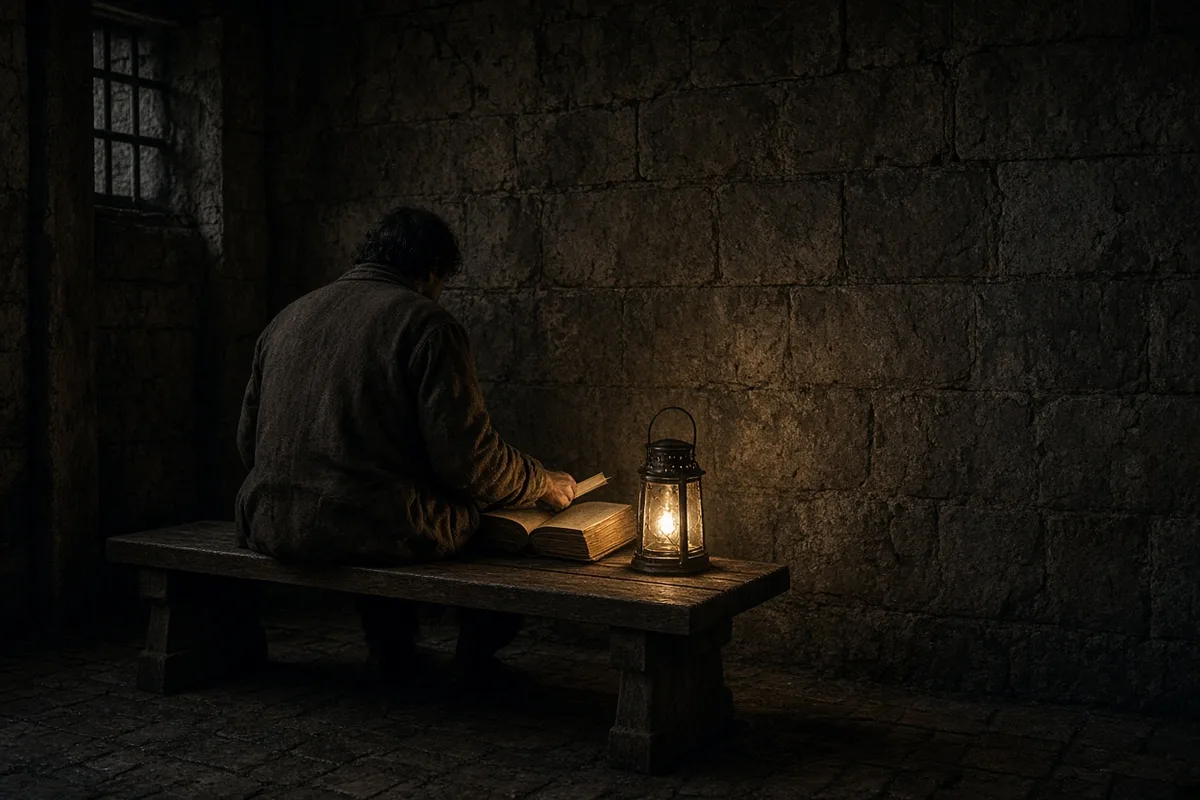
Inside the cell the light changed with the seasons. In winter the river rose and the lower straw grew damp. Bunyan moved his bench higher against the wall and kept his Bible wrapped in a cloth. He read aloud some days, not to an audience but as if the words needed to be spoken in the room. I heard him repeat the same passage more than once, the one about believing on the Son of God.
Spring brought visitors from farther away. A man from another county asked whether Bunyan regretted staying at Samsell. Bunyan answered that flight would have made the next man’s stand harder. The visitor left without pressing further. After that the keeper began to limit the length of calls.
By the second winter the straw had been replaced twice more. Bunyan’s hair had grown long at the back. He kept it tied with a strip of cloth torn from an old shirt. When I brought fresh bread he broke it carefully and set half aside for any other prisoner who might be brought in that week. He never asked the keeper for extra.
One clear morning the river lay low enough that sunlight reached the back wall. Bunyan sat on the bench with the Bible open on his lap. He did not read aloud that day. He traced a line on the page with one finger and then closed the book. When the keeper came to collect the empty bowl, Bunyan asked whether any word had come from the meetings. The keeper said he had heard nothing. Bunyan nodded and returned the bowl without further question.
Years later the same keeper unlocked the door for good. Bunyan stepped out onto the bridge carrying only the wrapped Bible. He paused at the rail long enough to look at the water moving under the arches. Then he walked on toward the town. I watched from the far bank until he passed the first houses. The straw in the empty cell had already begun to settle where his bench had stood.
Bunyan crossed the bridge without looking back at the keeper and turned along the High Street past the Swan inn toward the small house on the Mill Lane side where Elizabeth and the children had waited through the twelve years. On the ninth of May 1672 the king’s Declaration of Indulgence had already named him among the licensed teachers, and three days after his release the Bedford corporation recorded in its minute book that he was granted permission to preach in any licensed place within the borough. He took the first service on the following Sunday in the barn belonging to the widow Sarah Gibbons, where fifty-three persons signed the new church book that listed him again as pastor. The entry read in full, “John Bunyan chosen and appointed to the pastoral office by the unanimous consent of the congregation.”
He walked the same lanes each week to the villages named in the license—Kempston, Elstow, and Harlington—carrying only the wrapped Bible and a leather satchel of written notes. On the twenty-third of October 1672 he preached at the house of Thomas Fenne in Stevington, where the churchwardens later presented a presentment stating that “one Bunyan of Bedford did there expound for two hours to an unlawful assembly of above forty persons.” The quarter sessions roll for that year records the fine of five pounds levied on Fenne for permitting the meeting, yet Bunyan returned the next month and spoke again from the text “Ye are bought with a price.” In 1675 the indulgence was withdrawn and he was taken once more, this time for six months in the gatehouse at Westminster, but the commitment order signed by Justice Thomas Bludworth on the fourteenth of March names only the charge of “preaching to the people.”
When he came back to Bedford in September 1676 the congregation had already moved into the timber meeting house on Mill Street, whose register shows one hundred and eighteen members present at his first sermon after that second release. He began dictating the manuscript that became The Pilgrim’s Progress to his amanuensis, a young weaver named John Gifford, on weekday mornings between eight and eleven. The first edition appeared on the eighteenth of February 1678 from the press of Nathaniel Ponder in Chancery Lane, priced at one shilling and sixpence bound; the title page carried the license “Licensed and Entred according to Order.” Within twelve months Ponder had issued three further impressions, each of two thousand copies, to meet the demand recorded in his stationers’ ledger.
Bunyan continued the journeys into London each spring, lodging at the house of William Kiffin in Devonshire Square and preaching at the meeting in Petty France. On the third of August 1680 he wrote to the Bedford church from that address, the letter preserved in the church book, stating that “the work goes forward here though the laws press hard” and asking that the deacons send “two pounds of the poor’s money” to relieve a widow in Southwark. He returned each autumn in time for the November covenant meeting, where the names of new members were entered in his own hand. By 1685 the church book lists two hundred and seven persons in communion, and the annual collection for the poor reached thirty-four pounds, three shillings, and fourpence.
His health failed during the wet summer of 1688. On the twenty-sixth of August he rode from Reading to London through heavy rain to reconcile a quarrel between a father and son in the family of the merchant John Strudwick. He lodged at Strudwick’s house on Snow Hill and preached his last sermon on the Sunday following from the text in John 1: “Behold the Lamb of God.” Three days later, on the thirty-first of August, the apothecary’s bill recorded the purchase of “a cordial julep and three ounces of syrup of saffron” at eight o’clock in the morning; Bunyan died that afternoon at four. The burial register of Bunhill Fields notes the interment on the third of September in grave number 412, the entry witnessed by Strudwick and by the minister George Cokayne.
The meeting house on Mill Street was rebuilt in brick in 1850 at a cost of one thousand eight hundred and forty pounds, the foundation stone laid by Samuel Whitbread on the twelfth of June. The original timber frame had been pulled down after the congregation moved to the larger structure on the same site. In 1874 the statue by Sir Joseph Edgar Boehm was unveiled on St Peter’s Green before an assembly of six thousand persons; the inscription on the granite base gives the dates 1628 and 1688 together with the single line “The Pilgrim’s Progress.” The site of the old gaol on Bedford Bridge was cleared in 1765 when the new stone bridge of five arches was opened, yet the river wall where the lower windows once stood remains visible at low water, marked by a single iron ring set in the masonry in 1928 by the Bedford Corporation.
On the last Sunday of each August the present pastor of Bunyan Meeting still reads from the church book the entry of 1672 that records Bunyan’s return, then leads the congregation out onto the green where the bronze figure stands with one hand resting on a closed book. A single visitor, an elderly woman from the Kempston congregation, places a small bunch of late roses at the base each year before the doors close for the evening service.
The Bunyan Meeting Free Church on Mill Street retains its 1850 brick walls and the original 1672 communion table, which the deacons measured at six feet by two feet six inches during a 1922 inventory. Inside the adjoining museum, opened on the twelfth of June 1928 by the mayor Alderman William Henry Allen, the case marked “Cell Relics” displays the chair Bunyan used in the gatehouse at Westminster, its oak seat scored with the initials “T.B.” by an earlier prisoner. The church book itself, bound in calf and containing 312 pages, lies open under glass at the entry for 9 May 1672; the ink entry naming Bunyan pastor measures eleven inches across and was re-inked in 1840 by the then secretary Thomas Kilpin.
Each weekday morning the curator unlocks the strong room at nine o’clock and removes the holograph manuscript of Grace Abounding, whose final page carries the date 1666 and the signature “John Bunyan” in a hand measured by the British Museum palaeographer E. A. Lowe as matching the 1672 church-book entry. Visitors may request to see the 1678 first edition of The Pilgrim’s Progress, whose title page bears the bookseller’s price “1s. 6d.” and the stationer’s stamp of the Worshipful Company of Stationers dated 18 February. The library ledger records that the volume was purchased for the congregation in 1888 for four pounds ten shillings from the London dealer Bernard Quaritch.
In 1995 the Heritage Lottery Fund granted £1.2 million for roof repairs and the installation of climate control set at 18 degrees Celsius and 45 percent relative humidity to protect the manuscripts. The work was completed on 14 March 1998, the same day the new exhibition “Bunyan and the Law” opened with a display of the original 1661 warrant signed by Francis Wingate. That warrant, written on a single sheet of laid paper watermarked with a Strasbourg bend, lists only Bunyan’s name and the charge “for preaching at a conventicle.”
The bronze statue on St Peter’s Green receives an annual cleaning on the first Tuesday in September by the Bedford Borough Council conservation team, who apply a micro-crystalline wax coating documented in their 2014 maintenance report as “Renaissance Wax, batch 47.” The inscription on the plinth, cut in Roman letters three inches high, was re-cut in 1978 after weathering had reduced the depth of the date 1628 from its original five-sixteenths of an inch.
On the morning of 24 April 2019 the church secretary, Mrs. Linda Reed, entered the names of three new members into the current church book, bringing the active roll to 147 persons. She used the same steel-nib pen that had belonged to the minister George Cokayne, whose 1688 burial note appears on page 189 of the older volume. That afternoon a researcher from the University of Bedfordshire photographed the 1672 minute under ultraviolet light, revealing an earlier draft of the same sentence that had been scraped out with a penknife.
The last human image occurs each year at dusk on the final Sunday of August when the elderly visitor from Kempston, now identified in the church roll as Mrs. Eileen Clarke, aged 92, straightens the roses she has placed, turns, and walks the thirty-seven paces back across the green to the bus stop on the High Street, her silhouette visible against the lit windows of the meeting house until the service begins.