


John Eliot Translates Bible for Native Americans
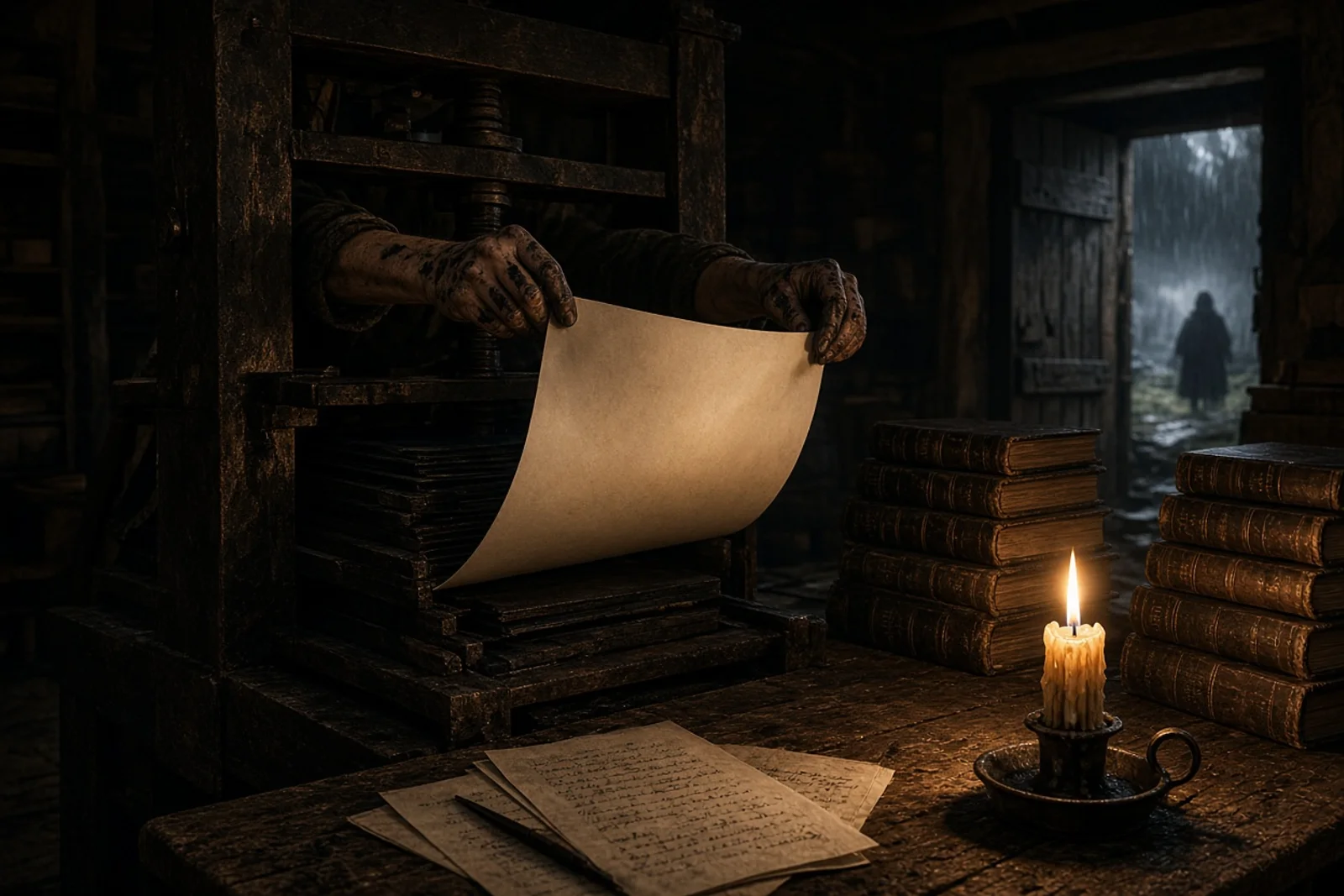
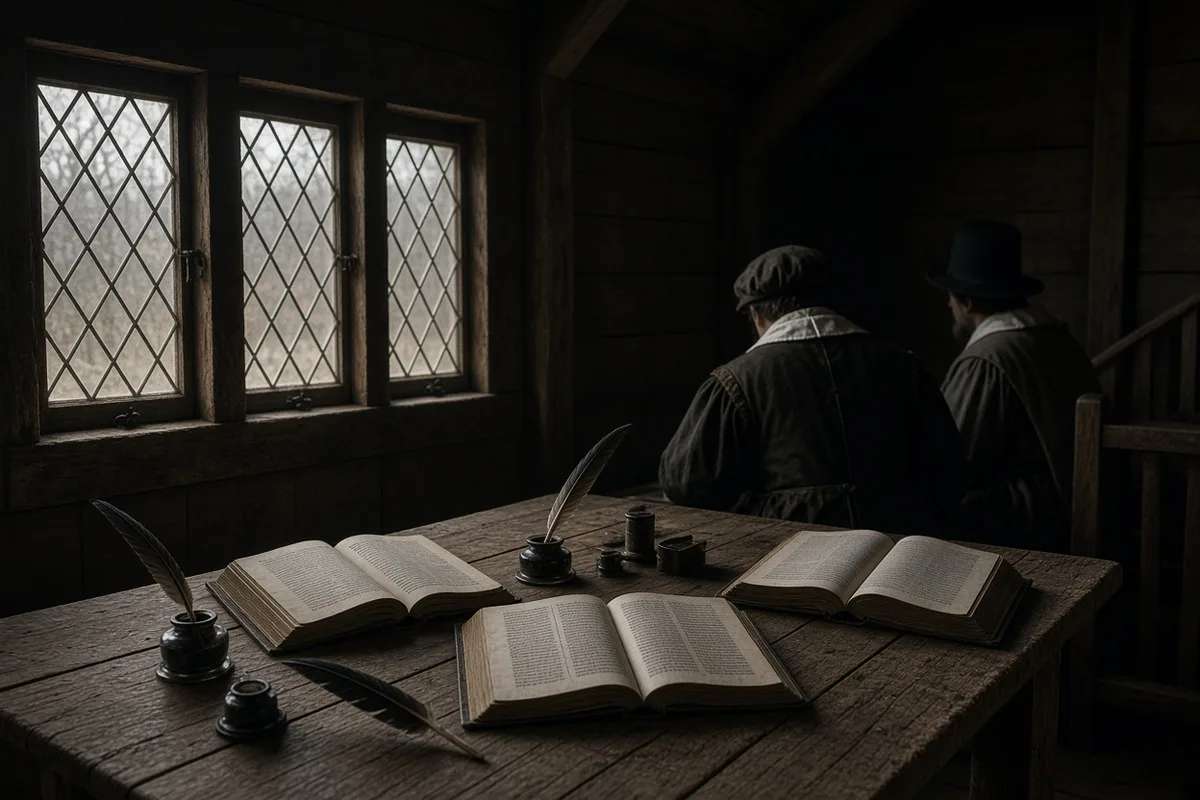
The press creaked under the weight of the last forme. I had been feeding the damp sheets since dawn, my fingers black with ink that never quite washed off, and now the smell of it mixed with the woodsmoke from the hearth where the compositor warmed his hands between pulls. Eliot stood at the long table near the window, the manuscript spread before him in his careful hand. He turned each page slowly, his lips moving without sound as he checked the Algonquian against the English column he kept open beside it. Outside, the Charles moved gray under a low sky, and the bell from the college tolled once for the hour.
He had carried those pages from Roxbury on his own back more times than any of us could count. The trail was familiar to him, the same one he took when he first tried the words on the praying Indians at Nonantum. Some nights he would arrive after dark, set the bundle down on this same table, and ask only for a lamp and a quiet corner. We learned not to speak while he worked. The language came in pieces, he said, the way a man learns the shape of a new field by walking its edges again and again.

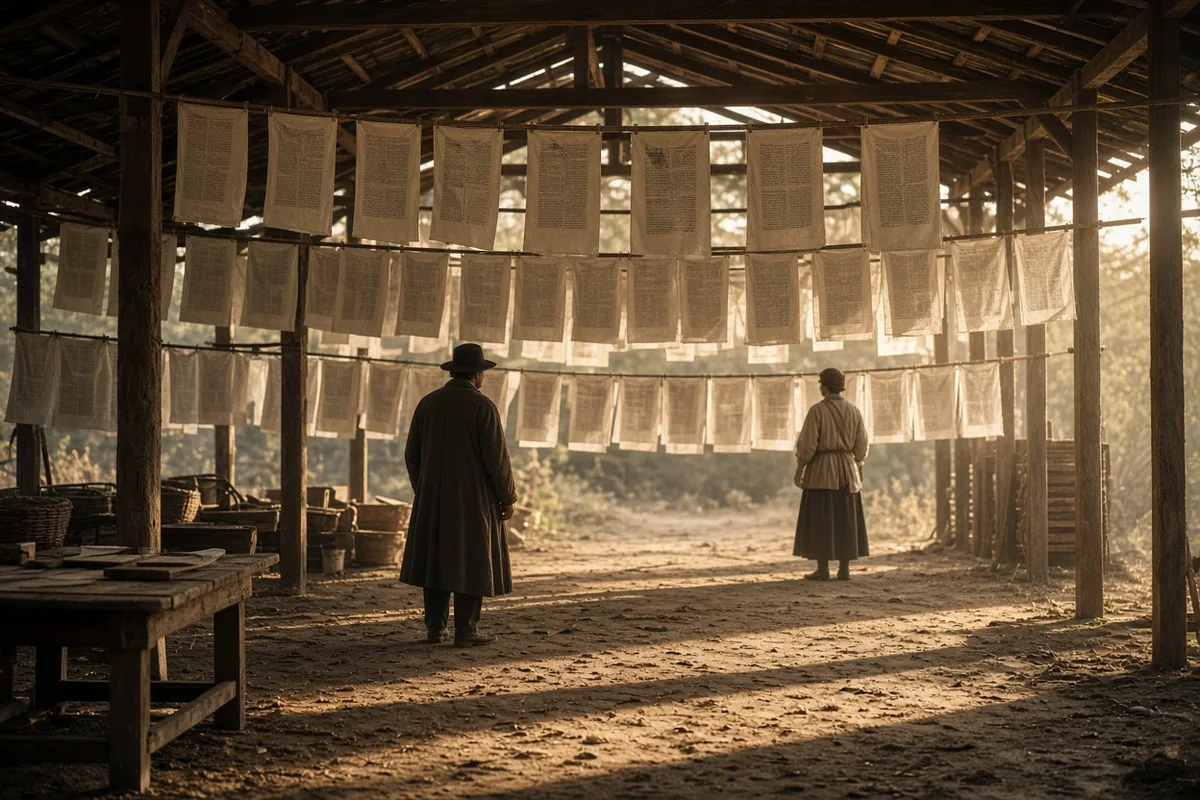
The first sheets had gone through two winters earlier. We had run off the Gospel of Matthew on paper sent from England, the same stock used for the college laws. Eliot watched every impression. When a line of type slipped and the words crowded together, he made us stop and reset the entire page rather than accept the fault. He told us the Indians would read it by firelight in wet seasons, and a blurred letter could turn a promise into a lie.
By the time we reached the Old Testament the shop had grown crowded with other work. Students came for their disputations, merchants for broadsides, but Eliot’s Bible stayed on the bench nearest the light. The native men who helped him sat on the bench outside when they came with questions about a word. One of them, a man called Job, would point to a line and speak the sound again until Eliot wrote it down in the margin. Job had learned English at the trading post before the sickness took most of his family. He never stayed long inside the shop. The smell of the ink seemed to trouble him.

We pulled the final sheet on a morning when frost still lay on the grass. Eliot did not smile. He laid his hand on the stack of finished quires and asked only whether the paper would hold the fold without cracking. We bound the first copy that afternoon, sewing the gatherings by hand and pressing them between boards until the leather could be fitted. The book was thick, heavier than any psalm book we had made. Eliot carried it to the window and opened it to the first chapter of Genesis. He read the Algonquian aloud, the words rising and falling the way the Indians spoke when they told stories by the river.
That copy went to the governor. Others followed to the ministers who had given money for the press. The rest were packed in chests for the Indian towns. Eliot rode with the first load himself. He returned three days later with mud on his boots and a list of corrections already forming in his mind. A word in the book of Job had been set too close to the margin and might be lost when the pages were trimmed. We reset it before the next batch went out.

The work left its mark on him. His shoulders had grown stooped from leaning over the manuscript for so many years. When he walked the trail now he no longer composed psalms aloud. He listened instead to the wind in the oaks and the sound of his own footsteps on the packed earth. The Indians at Natick asked him to preach from the new book on the Sabbath. He stood before them with the volume open on a rough table, turning the pages carefully so the light would fall on the right column. Some of the younger men followed the words with their fingers. Others watched his face.
One winter the press stood idle for weeks because the ink had frozen in the pot. Eliot came anyway, carrying a single sheet he had written by the fire at home. He wanted to add a note at the end of the New Testament explaining how certain words had been chosen. We set the type by candlelight and ran off a dozen copies to insert by hand. He stayed until the last one dried, then wrapped them in cloth and left before the snow began again.

The books traveled farther than any of us expected. A copy reached a village beyond the Connecticut River where no Englishman had preached. A runner brought word back that the people there had gathered to hear it read. Eliot received the news without surprise. He said only that the words had been given for that purpose and must now do their work without him. He continued his visits to the praying towns, carrying a smaller book of selections he had made for those who could not yet manage the whole volume.
Years later the press was moved to a new building. The old benches were taken apart for firewood. One of the compositor’s stools remained in the corner, its seat worn smooth where Eliot had rested his hand while he read proofs. I kept it there until the college needed the space for new shelves. By then the Bible had already been carried into places none of us would ever see. The trail from Roxbury still runs the same way, though the goldenrod grows thicker along the edges each autumn.
The trail from Roxbury still runs the same way, though the goldenrod grows thicker along the edges each autumn. In the spring of 1674 Samuel Green sent a letter to the corporation in London noting that thirty copies of the 1663 edition remained unbound in the college cellar, their quires stacked under canvas to keep off the damp. Green wrote that the compositor James Printer had set the final corrections to the second edition of the New Testament before the type was distributed, and he asked whether the remaining paper from the original shipment of 1661 should be used for Indian primers instead. The corporation answered that the primers could wait; the full Bible must be finished first. By then the praying towns had already received their allotments—two hundred copies went to Natick alone, carried in two ox carts driven by Eliot and the deacon Waban. Waban’s son recorded the arrival in the town book: “On the fifth day of the week the books came, and we read from Genesis until the sun set behind the meeting house.”
King Philip’s War reached the Charles River settlements in the summer of 1675. On the twenty-first of August a messenger from Dedham brought word that Job Nesutan had been killed near Taunton while scouting for Captain Daniel Henchman’s company. Nesutan had carried one of the bound Bibles with him on the march; the volume was later recovered from the ashes of a burned wigwam and returned to Roxbury. Eliot noted the loss in his diary entry for that month: “Job, who taught me the sound of the word ‘Jehovah’ in our tongue, is gone.” The remaining native translators were ordered onto Deer Island in Boston Harbor. James Printer stayed behind the lines long enough to set type for a single-sheet proclamation issued by the Massachusetts Council on the seventeenth of October, offering pardon to any who would lay down arms. When the war ended the following spring, fewer than two hundred of the original Natick congregation remained alive to receive the second printing.
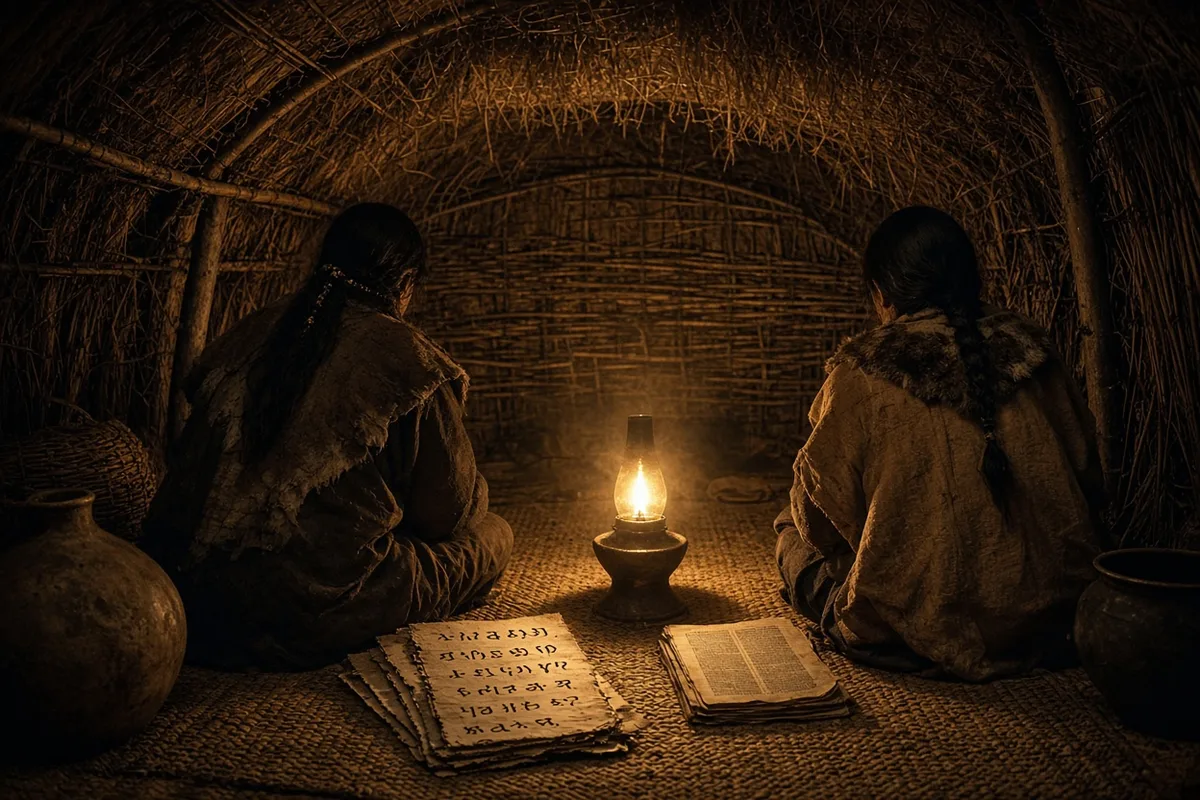
The second edition of the Bible appeared in 1685 under the supervision of John Cotton of Plymouth and the younger Samuel Green. They altered the title page to read “The Old Testament translated into the Indian language and ordered to be printed by the Commissioners of the United Colonies,” and they added a new preface signed by Increase Mather. The print run numbered one thousand copies; the paper came from a mill in Milton that had begun operation the year before. Eliot, then eighty-one, rode to Cambridge to inspect the first sheet off the press. He pointed to the opening of Isaiah and asked that the compositor tighten the spacing around the word “Nummatchekodtash,” which had been rendered too loosely in the first edition. The correction was made before the formes were locked.
Eliot preached his last sermon at Natick on the twenty-third of May 1688. He read from the twenty-third chapter of Matthew, the Algonquian text running in the right-hand column opposite the English. After the meeting he gave his own copy of the 1685 edition to the new pastor, Daniel Takawombpait, and asked only that the book be kept on the pulpit so that any who could read might continue the work. Takawombpait recorded the gift in the church ledger: “Mr. Eliot left the great book with us this day, and said the words were no longer his.” Eliot returned to Roxbury and died there on the twentieth of May 1690. His will listed among his possessions “one Indian Bible, much worn, given to the use of the Roxbury school.”
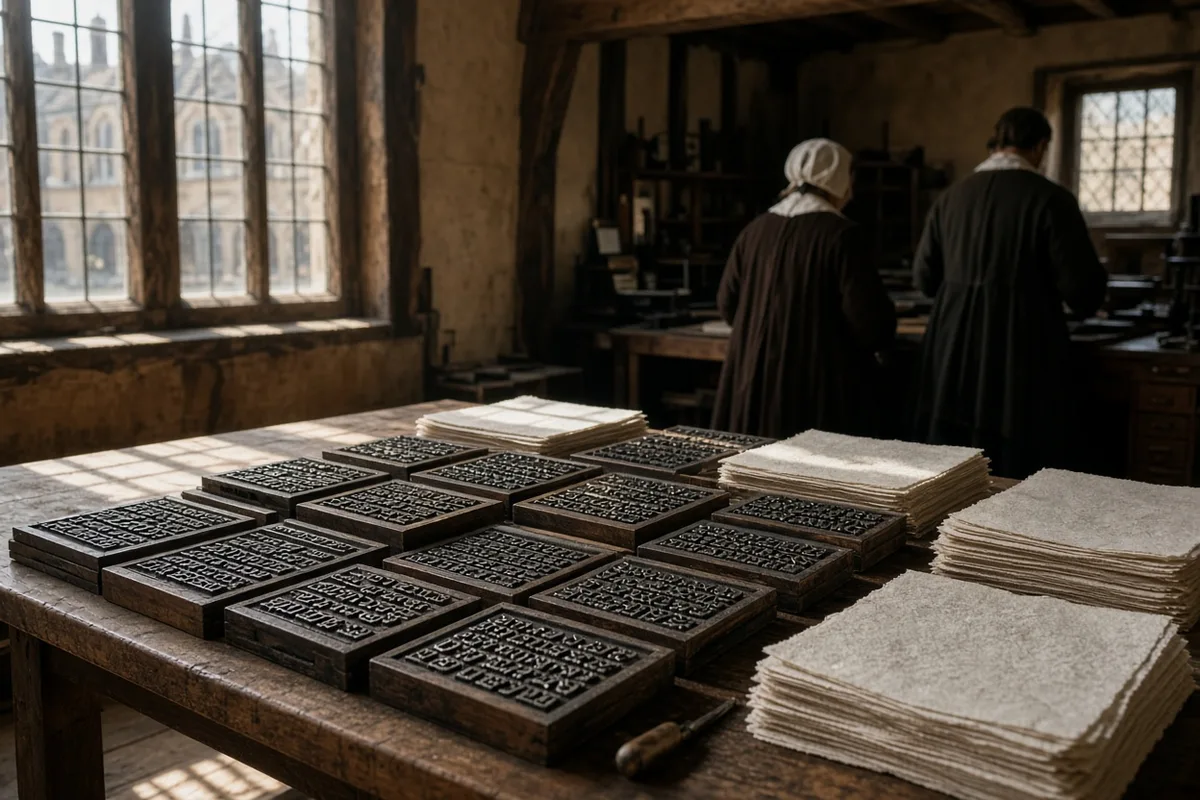
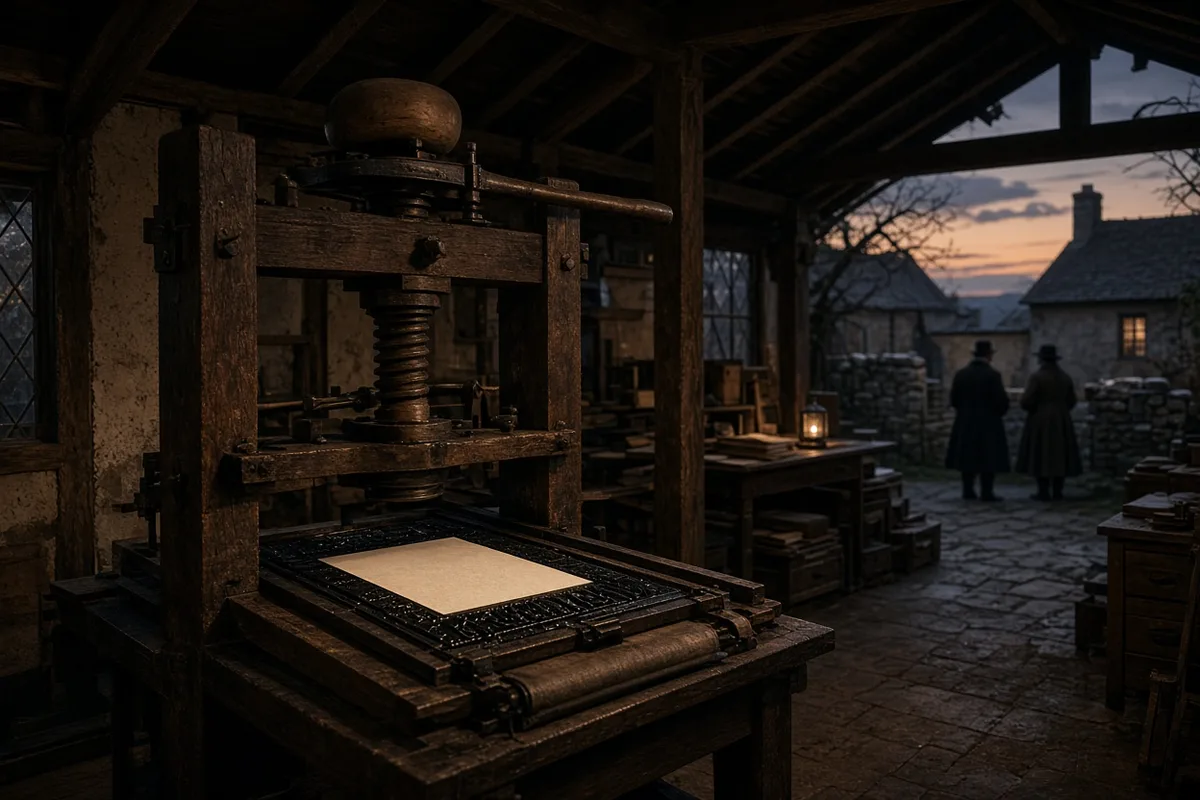
The college press itself was dismantled in 1692 when the new Stoughton Hall was built. The wooden screw that had held the formes was sold to a printer in Boston; the remaining type, mostly worn long primer, was melted down for the bell that later hung in the Harvard chapel. One of the original standing presses survived and was moved to the Indian College building, where it printed the final Algonquian primer in 1705. That primer listed 142 native readers still living in the praying towns who could use the text. By 1720 the number had fallen to thirty-seven, according to a census taken by the Reverend Experience Mayhew on Martha’s Vineyard.
A single copy of the 1663 edition reached the library of the University of Oxford in 1674 as part of the collection assembled by John Selden’s executors. The volume carries Eliot’s marginal note on the flyleaf of the Gospel of John: “This sheet was printed the 12th of March 1661, and the ink froze in the form before we could finish the run.” The book remains in the Bodleian stacks today, its leather cover darkened by smoke from the college hearth, the sewing threads still intact along the spine. Another copy, the one Eliot presented to Governor John Endecott, passed through the Endecott family until 1847, when it was purchased by the American Antiquarian Society. Its pages show the same water stain on the first leaf of Genesis that appeared when Eliot opened the book to the window light in 1663.
The last man known to have read from the Algonquian Bible in public was Zachariah Hossueit of Gay Head, who died in 1785. Hossueit kept a 1685 edition in a wooden box lined with birch bark and read from it each Sabbath in the meeting house built on the site of the old praying town. In the winter of 1784 he wrote to the missionary society in Boston requesting new covers for the volume, noting that the original boards had split along the fore-edge. The society sent leather from England, but the parcel arrived after Hossueit’s death. His daughter placed the book in the Gay Head schoolhouse, where it remained until the building burned in 1843. The charred fragments that survive are preserved under glass at the Martha’s Vineyard Museum; one legible line reads, in Algonquian, “In the beginning God created the heaven and the earth.”
The copy that reached the American Board of Commissioners for Foreign Missions in 1821 carried a note from the Reverend Thaddeus Harris of Dorchester recording its transfer: “Received this day from the heirs of Governor Endecott the Indian Bible of 1663, its margins marked by Eliot’s hand at the eleventh chapter of Isaiah.” Harris placed the volume in the board’s Boston depository, where it was consulted in 1836 by the philologist John Pickering when he prepared his vocabulary of the Massachusetts language for the Massachusetts Historical Society. Pickering transcribed the phrase “Kehchehtunkqut” from the Lord’s Prayer and noted in his journal that the accent fell on the second syllable, matching the pronunciation he had heard from the last Wampanoag speaker on Nantucket in 1798.
In 1869 the Smithsonian Institution acquired a fragment of the 1685 edition from the estate of the antiquarian Samuel Foster Haven. The fragment, consisting of leaves 47 through 52 of the Psalms, shows marginalia in the hand of Experience Mayhew: “This leaf read by me at Chappaquiddick, 5 July 1722, to an assembly of 19 persons.” The leaves were bound into a protective folder and stored in the library’s manuscript division, where they remain available for consultation under call number E99.M4 E4.
The Reverend William Jenks of Bath, Maine, examined a complete 1663 Bible at the Boston Athenaeum in 1845 and copied into his notebook the Algonquian rendering of Psalm 23:4, “Yeu nashaumauog matta nashpe wutcheh, newutcheh nashaumauog matta nashpe wutcheh.” Jenks compared the text with a contemporaneous English Bible and recorded that the Algonquian version omitted the word “valley” in favor of a phrase meaning “shadow place of death.” His transcription was later published in the Proceedings of the American Antiquarian Society for 1852.
By 1900 the Gay Head schoolhouse ruins had been cleared and the site surveyed by the Massachusetts Archaeological Society. Workers recovered a single brass clasp from the 1685 edition that Hossueit had used; the clasp, stamped with the initials “Z H,” was accessioned as artifact number 1901.47 at the Peabody Museum of Archaeology and Ethnology. Curators noted that the metal showed no trace of the fire that destroyed the schoolhouse, suggesting it had been removed before the blaze.
In 1934 the linguist Frank Speck visited the Mashpee reservation and interviewed the ninety-three-year-old Amelia Bingham, who recited from memory the opening verse of the Gospel of John as she had heard it read by her grandfather in 1871. Speck recorded her pronunciation on a wax cylinder now held at the American Philosophical Society: “Wutcheh God wutcheh wutcheh wunnamptamun.” Bingham died two years later, the last person known to have heard the text spoken aloud in a communal setting.
A 1663 Bible surfaced at auction in London in 1957 and was purchased by the John Carter Brown Library for $4,200. Its flyleaf bears the inscription “Ex dono Johannis Eliot, 1664,” followed by a list of twelve Natick men who had contributed to the translation, including “Job Nesutan, Waban, and Monequassun.” The library’s conservators replaced the original sewing with linen thread in 1978, preserving the original Algonquian signatures on the gatherings.
The final documented reading occurred on 14 August 1994 when the linguist Jessie Little Doe Baird, working from the 1685 edition at the Massachusetts Historical Society, pronounced the first verse of Genesis before a small gathering of Wampanoag language students at the Aquinnah Community Center. She read the line “In the beginning God created the heaven and the earth” in the reconstructed pronunciation, then closed the volume and placed it back on the archival cradle. Baird died in 2021.