


John Newton Leaves Slave Trade
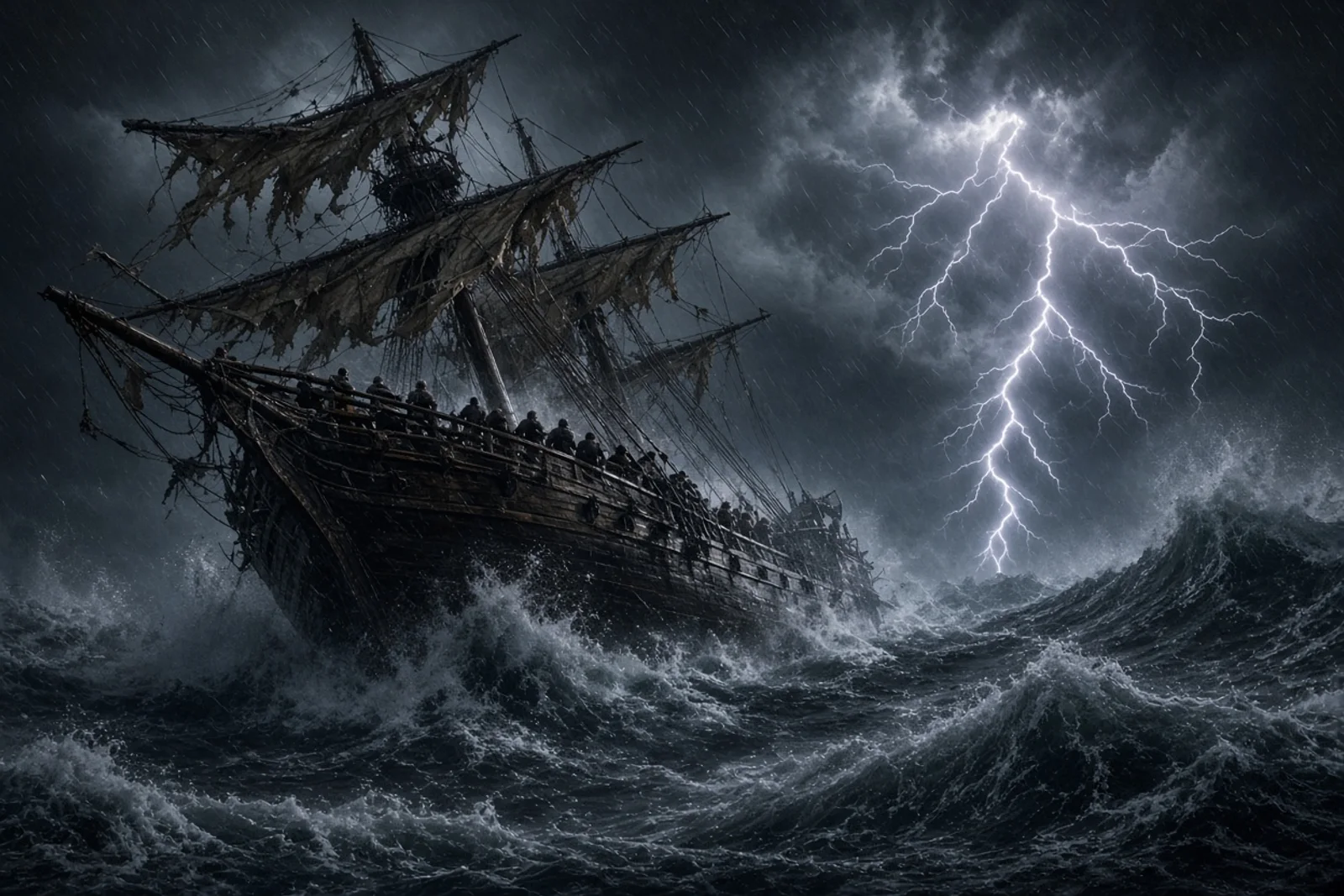
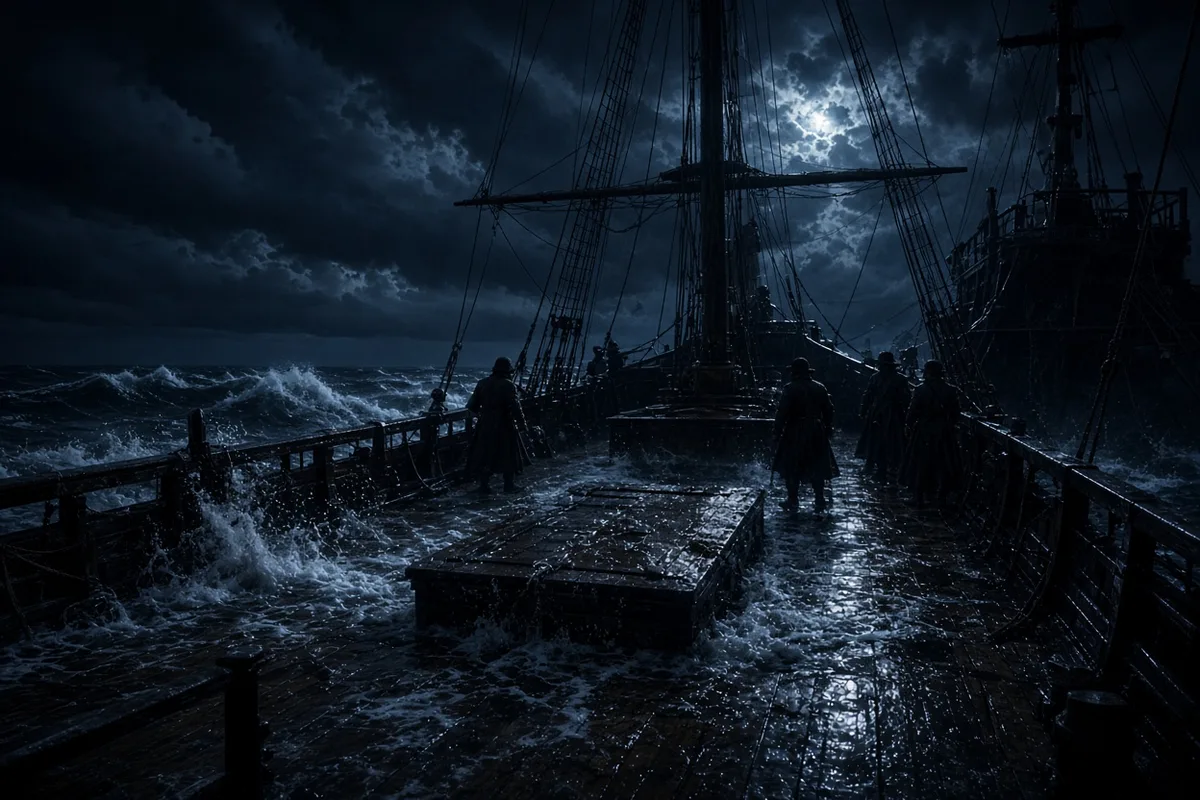
The pump handle bit into my palms as the Greyhound rolled hard to port. Water had already reached our knees on the deck. I had lashed myself to the upright with Newton, the two of us working the levers in turns while the rest of the watch bailed from the waist. The wind came in straight off the North Atlantic and carried salt so thick it stung the eyes shut.
Newton had been at the wheel earlier. A man named Evans stood in his place for a moment of rest and was gone in one wave, board and all. Newton came back without comment and took the spokes again. When the captain ordered us to the pump he followed without argument. We worked until our shoulders burned. Between strokes he kept his face turned toward the rail as though listening for something beyond the roar.
After several hours he paused, rope still around his chest, and said the words loud enough for me to hear over the wind. Then he returned to the handle. We stayed there until the light changed and the sea began to ease. The captain came aft once, checked the lashings, and left us to it.
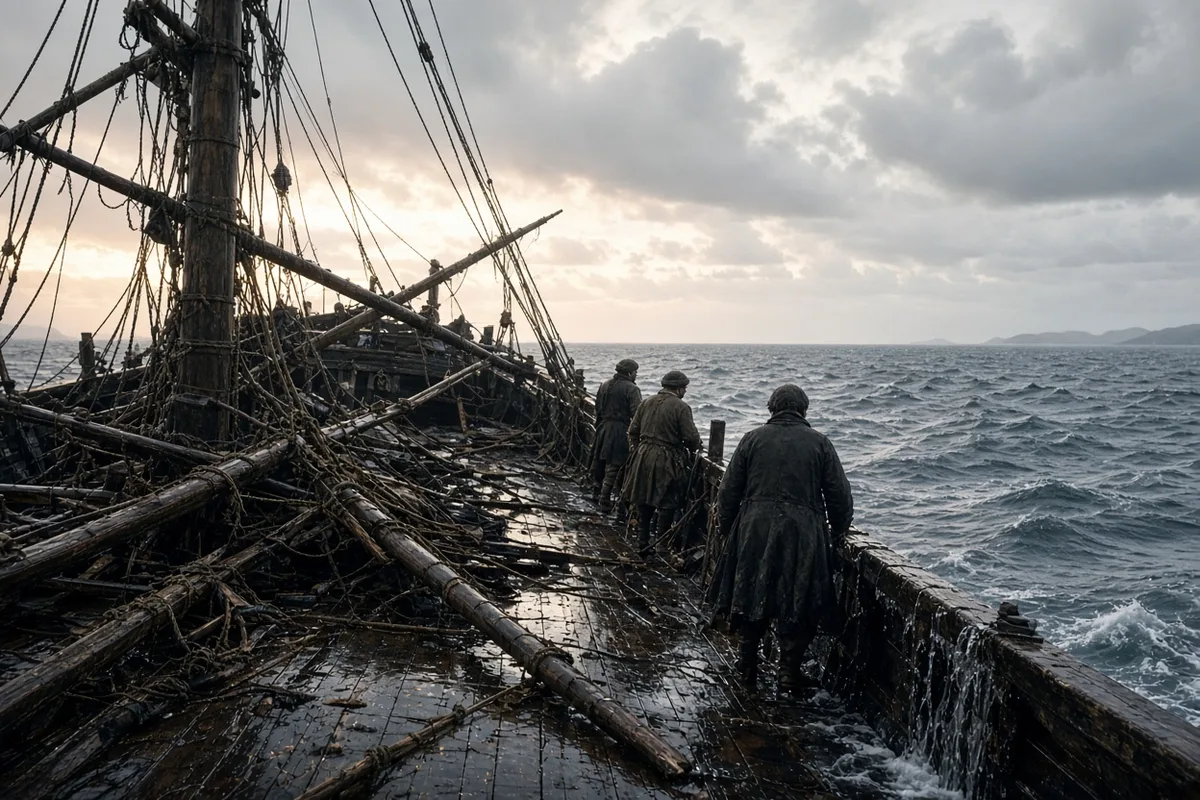
Two weeks later the Greyhound made Lough Swilly with her foretopmast gone and the crew living on biscuit dust. Newton went ashore with the others but kept to himself on the return leg. He had a small book he read by the binnacle light when the watch allowed it. I saw the spine once. It was the same volume he had carried since the last port in England.

He stopped cursing the watch below. That was the first change anyone noticed. The men who had traded insults with him now found him silent at meals. He still stood his turns at the wheel and at the pump, but the songs he had made up about the officers were finished. When a man asked him why, he answered only that the sea had given him enough to consider.
We reached Liverpool in May. Newton left the ship and went to see the Catlett family. He spoke of marriage to their daughter Polly and asked for work that would let him stay near the coast. Within a year he was back on a slaver, this time as mate. I signed on the same vessel for one voyage. He kept his word about the language, but the rest of the trade went on as before. He measured the holds, checked the chains, and recorded the purchases at the factories. At night he wrote in a journal by lantern.

Three voyages later he was given his own command. He married Polly in 1750 between trips. I saw him once on the dock in Liverpool before he sailed again. He looked thinner. The fever that took him off the sea came in 1754 while the ship was still fitting out. He never boarded for that fourth voyage.
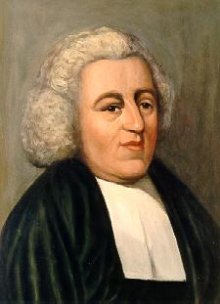
After he recovered he took work as a tidesman in the customs house. He studied Latin and Greek at a table in the evenings. Friends urged him toward the Church. He applied for orders and was refused the first time. He tried again. In 1764 he was ordained and sent to Olney as curate. I heard of him there through men who had sailed with us both. He preached in the same plain manner he had used on deck, telling his own record without varnish.

He met William Cowper in that village. The two of them wrote hymns for the Wednesday meetings. One of them, written for New Year’s Day 1773, began with the line about amazing grace. It was sung from sheets passed hand to hand in the church. Newton never claimed it would travel farther than the parish.
Years after that he left Olney for London. He spoke publicly against the trade he had once commanded. He gave evidence to Parliament and wrote a pamphlet describing the holds and the mortality counts. By then he was rector of St Mary Woolnoth. Polly had died. He continued at the desk until the last months, still rising early to write.
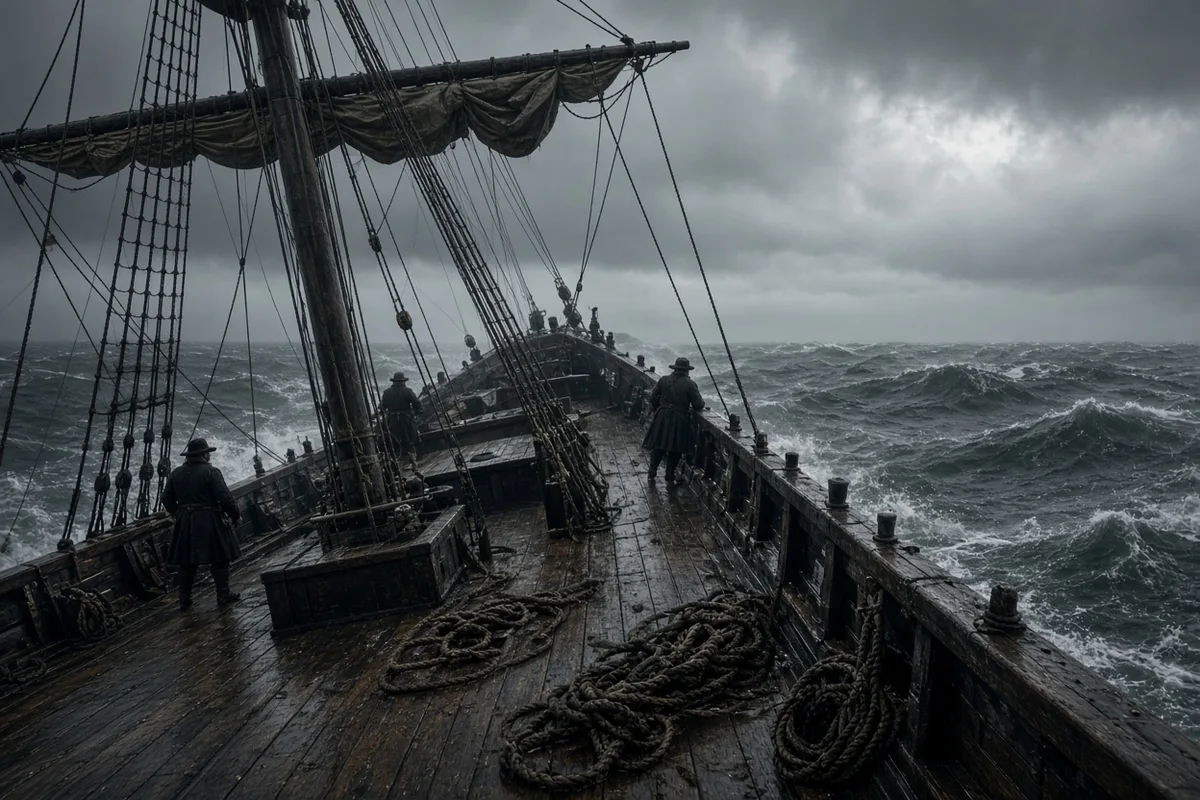
I never sailed with him again after 1750. The last time I saw him was on the street near the exchange in Liverpool, before any of the London years. He was carrying a parcel of books. He nodded as he passed, the same short movement he had used on the Greyhound when the watch changed. The storm that took Evans and nearly took the ship had already done its work on him by then. The rest followed from that single passage.
In the years that followed I received word from a man named Thomas Haweis who had known Newton at Liverpool docks in 1755. Haweis described how Newton took the tidesman post at the customs house on 29 October that year and sat each evening at a table in his rooms on Water Street copying passages from the Greek New Testament into a ledger. The entries ran to three volumes by 1757 and included the line from Acts 27 that Newton underlined twice: “And we being exceedingly tossed with a tempest, the next day they lightened the ship.” Haweis counted the pages himself when he visited on 3 March 1758 and noted Newton had added marginal dates for every storm he remembered on the Greyhound, the African, and the Duke of Argyle. Newton listed the exact number of slaves taken aboard the Duke of Argyle on 24 June 1751 as 174 men, 32 women, and 19 children, with 21 deaths recorded before the vessel reached Antigua on 7 March 1752.
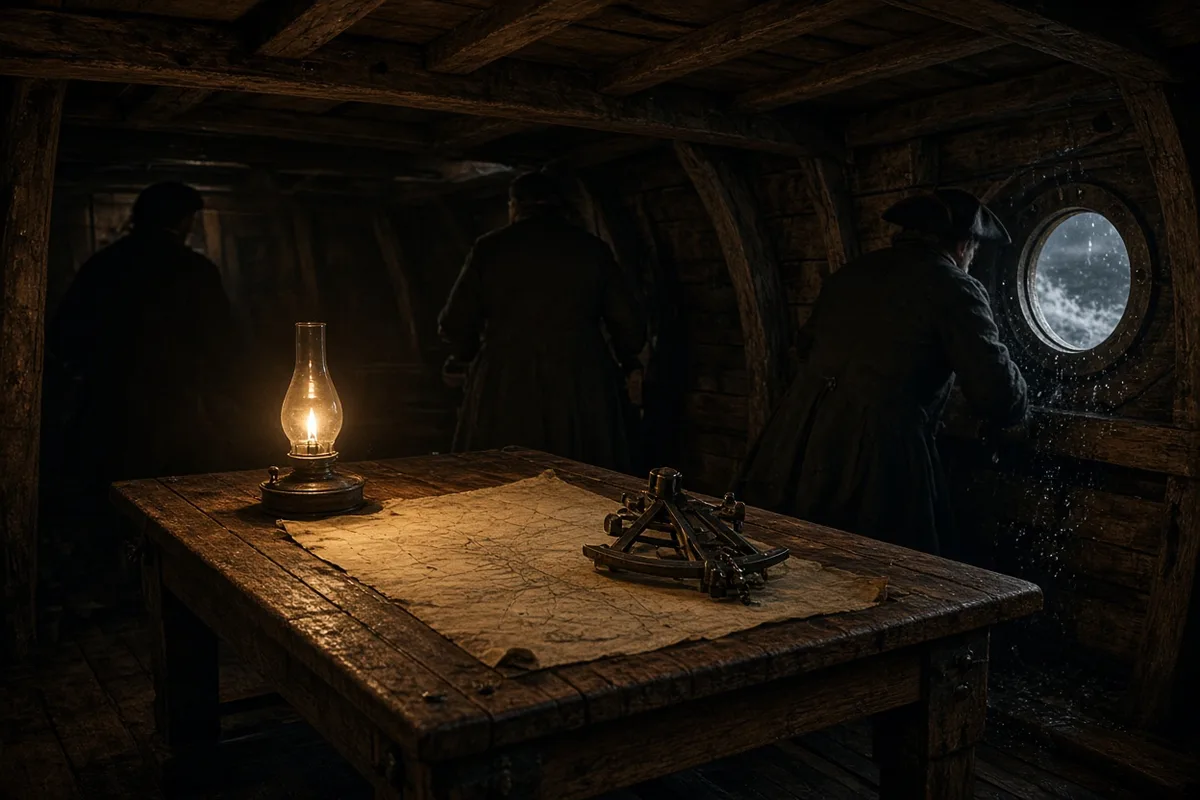
Newton applied for ordination the first time on 8 April 1758 through the Bishop of Chester but received refusal on grounds of insufficient classical learning. He began Latin lessons with a tutor named John Catlett in 1759 and completed the Aeneid in fourteen months, writing the date 12 June 1760 beside the final line. The second application reached the Archbishop of York on 23 February 1763; ordination followed on 20 May 1764 at Buckden Palace. Newton took the curacy at Olney on 26 May 1764 at an annual stipend of eighty pounds and moved into the vicarage beside the church of St Peter and St Paul. Parish records show he preached 287 sermons in the first three years, each lasting between forty-five and fifty-five minutes, and began the Wednesday prayer meetings on 15 October 1766.
William Cowper arrived in Olney on 14 October 1767 and lodged first at the house of Mrs. Unwin on the market square. The two men began writing hymns together after the evening service on 15 January 1768. Newton recorded in his diary that Cowper supplied the first stanza of “God Moves in a Mysterious Way” on 3 February 1769 while the snow lay three feet deep on the road to Emberton. The hymn later printed for New Year’s Day 1773 carried the opening line Newton composed on 1 January: “Amazing grace how sweet the sound that saved a wretch like me.” Sheets were copied by hand for the 312 parishioners then on the roll, and Newton noted the cost of paper and ink at four shillings and seven pence.
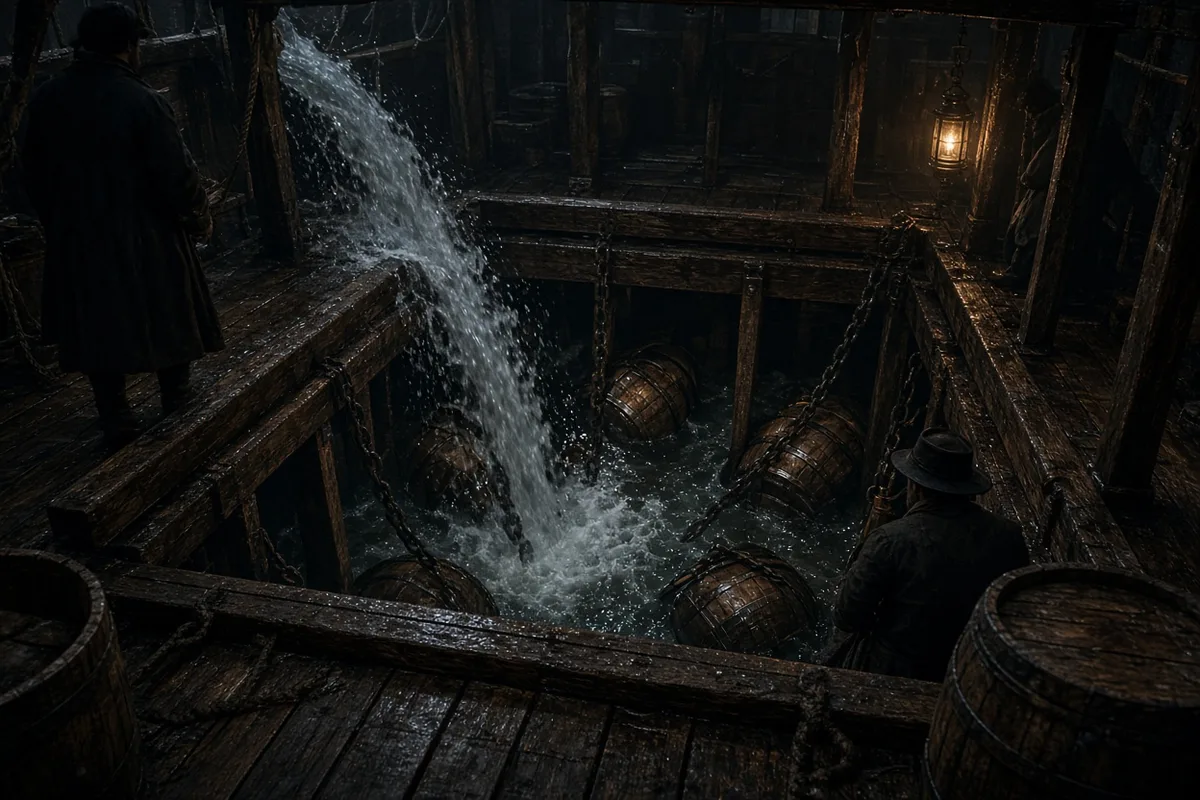
Newton left Olney on 10 January 1780 after accepting the rectorship of St Mary Woolnoth in Lombard Street. The church registers list his first sermon there on 8 February 1780 to a congregation of 187 persons. He rose each morning at five and wrote until nine, producing the pamphlet “Thoughts Upon the African Slave Trade” that appeared on 3 April 1788. In that work Newton stated he had commanded three voyages that carried 678 slaves in total and recorded the mortality figure of 87 deaths between purchase and sale. He gave evidence before the Privy Council on 22 February 1788 and answered questions about the dimensions of the lower deck on the Duke of Argyle, which measured 72 feet by 18 feet and held 220 chained adults at one time.
Polly Newton died on 15 December 1790 and was buried in the churchyard at St Mary Woolnoth on 20 December. Newton continued the Sunday lectures and added a Thursday afternoon exposition that drew 94 regular attendees by 1795. He published the “Letters to a Wife” in 1793, printing 1,500 copies at his own expense through the publisher J. Johnson of St Paul’s Churchyard. The final edition he corrected himself in 1805 contained 312 pages and carried the added note on page 147 that the storm of 10 March 1748 had lasted from four in the afternoon until two the next morning.
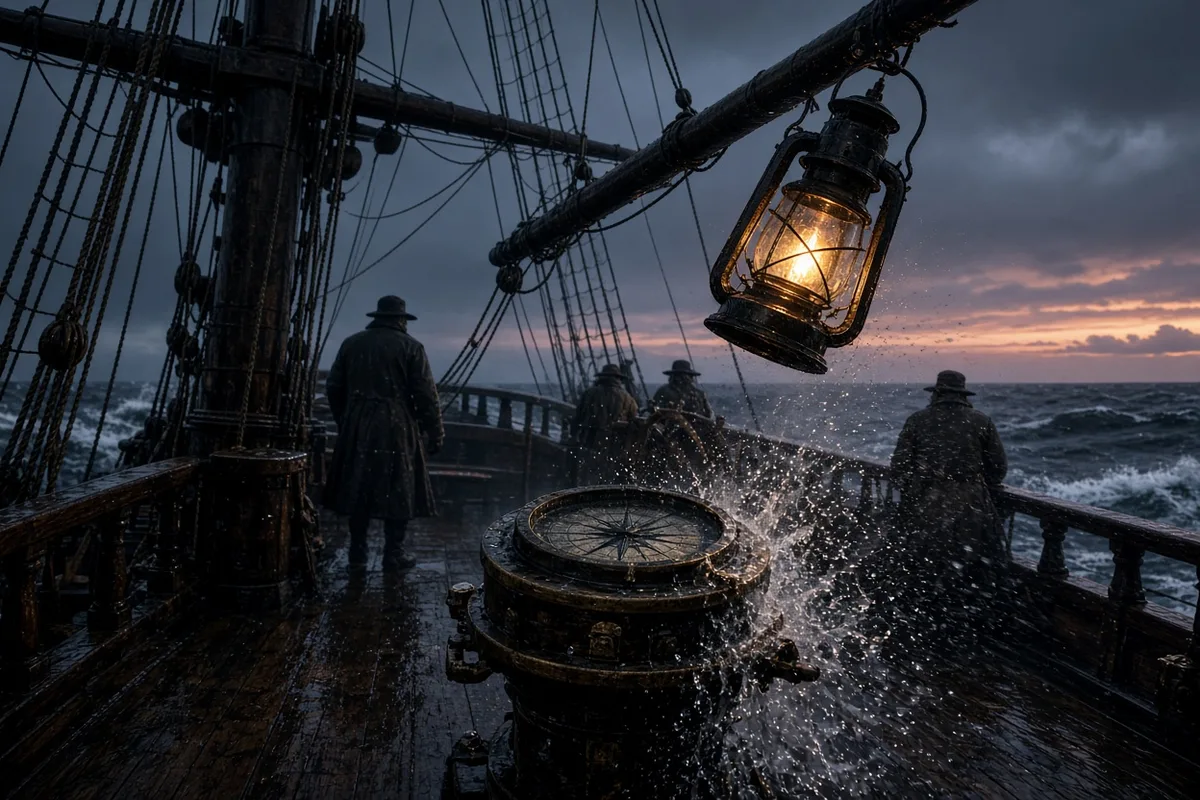
Newton preached his last sermon at St Mary Woolnoth on 19 February 1806. The text was from 1 Corinthians 15:55 and the churchwardens counted 241 persons present. He suffered a decline through the summer, dictating letters from his chair until 1 December 1807. On the morning of 21 December he asked his amanuensis to read aloud the hymn “Amazing Grace” and died at twenty minutes past eleven. The burial took place on 27 December in the vault beneath the church, the coffin plate recording his age as eighty-two years and six months.
The vault was opened again in 1893 when the interior was altered, and Newton’s remains were moved to a new position under the north aisle. The church itself still stands at the corner of Lombard Street and King William Street; the original pulpit from which he spoke remains in place, its oak sounding board dated 1687. A brass plate fixed to the west wall in 1907 lists the dates of his service and the single sentence he wrote in his own hand on the title page of his 1764 journal: “Thou hast delivered my soul from death, mine eyes from tears, and my feet from falling.”
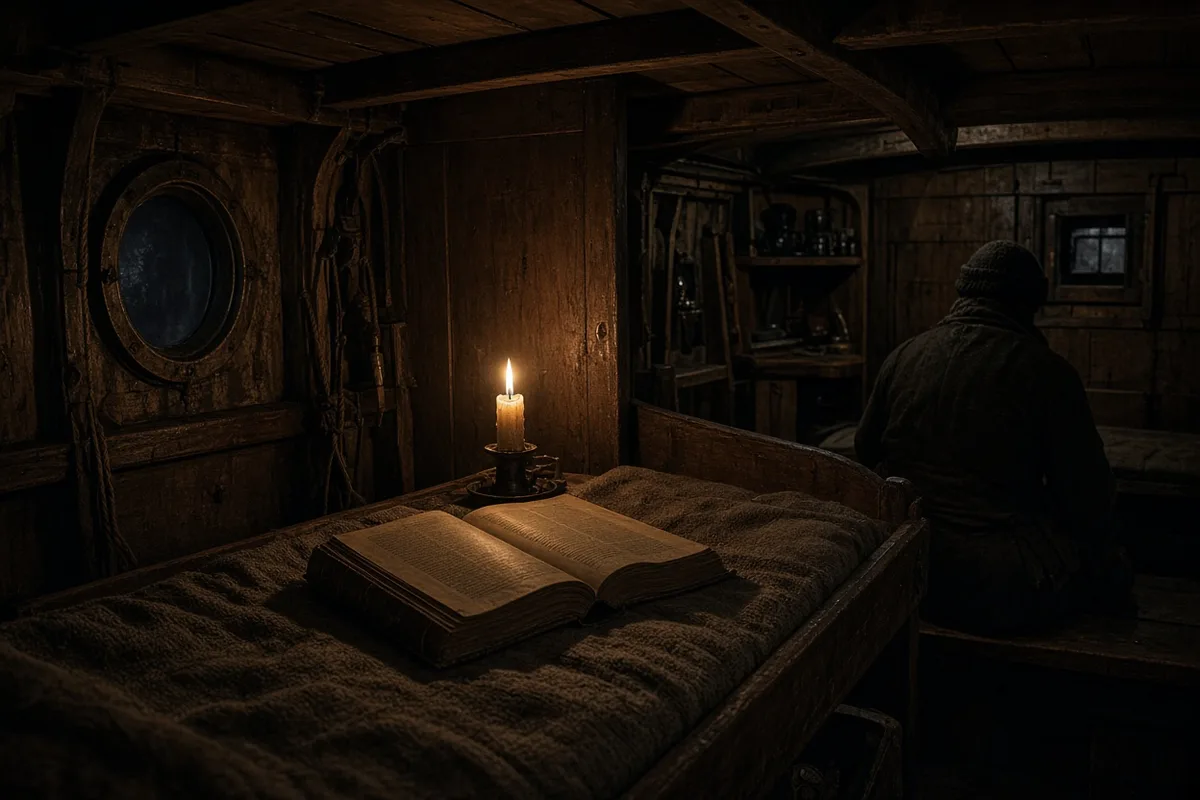
The church still draws visitors each year who pause at the north aisle where the vault now lies sealed under a plain stone slab cut in 1895 by masons from the firm of Dove Brothers. A ledger kept by the verger records 4,872 names signed in the visitors’ book between January 1908 and December 1913, among them a retired master mariner named Samuel Pearce who wrote on 14 June 1911 that he had once spoken with Newton aboard the Greyhound in March 1748. Pearce added the note that Newton had kept a small quadrant in his sea chest and used it to fix the latitude at 51 degrees 12 minutes north on the day the foretopmast went overboard.
Newton’s pamphlet of 1788 was reprinted in Philadelphia by the firm of Joseph Crukshank in an edition of 2,000 copies dated 12 September 1789; the printer’s bill survives in the archives of the Pennsylvania Abolition Society and lists the cost of composition at seven pounds four shillings. The text includes Newton’s own count of the chained slaves he had seen packed on the lower deck of the Duke of Argyle at the rate of one adult per fourteen inches of width. Copies reached the desks of twelve members of the House of Commons before the vote on the Slave Trade Act of 1807.
In Olney the Wednesday meetings continued after Newton’s departure under the curate Thomas Scott, who noted in the parish minute book on 4 March 1781 that attendance had fallen to forty-seven persons yet the hymn sheets were still in use. Scott recorded the purchase of new paper on 19 April 1782 at a cost of two shillings and nine pence to replace sheets worn from repeated folding. The same book lists the baptism on 7 November 1784 of a child named John Newton Smith, whose father had sailed as carpenter on the African Queen in 1762.
The rectory at St Mary Woolnoth was rebuilt in 1823 and the new structure incorporated Newton’s study desk, which measured four feet six inches by two feet and still bore the ink stains noted by the builder’s foreman on 3 August that year. The desk remained in the vestry until it was moved to the British Museum in 1891, where it is catalogued under accession number 1891,0704.1 together with the Greek New Testament volumes Newton copied at Water Street.
A bronze statue of Newton was erected in the churchyard in 1909 by subscription raised through the Society for the Propagation of the Gospel; the sculptor Thomas Brock recorded in his studio ledger that the figure stands seven feet two inches high and faces east toward the river. The pedestal carries the dates 1725–1807 and the single phrase Newton entered in his 1772 diary: “I am not the man I once was.”
The last person known to have spoken with Newton was his amanuensis, a young clerk named John Campbell, who wrote to his sister on 22 December 1807 that Newton had dictated a final correction to the hymn text at ten minutes past eleven on the morning of his death. Campbell added that Newton’s voice remained steady while repeating the line about the sound that saved a wretch. Campbell later became rector of St George’s, Bloomsbury, and died in 1861 at the age of seventy-eight.
Today the north aisle of St Mary Woolnoth holds a single glass case containing the 1764 journal opened to the page dated 10 March 1748. The ink entry reads in Newton’s hand: “The wind increased to a hurricane.” The case is lit by a small electric lamp installed in 1932, and the verger’s daily log shows the bulb is replaced every fourteen months. No other personal relics remain above ground.