


John Wesley's Heart Strangely Warmed
I tugged at his sleeve outside the door on Aldersgate Street, the evening air still warm from the day’s sun on the paving stones. Wesley stood with his shoulders drawn in, the same look he had carried since stepping off the ship from Georgia months before. I told him the group would not mind another listener and that the reading had already begun. He followed without another word.
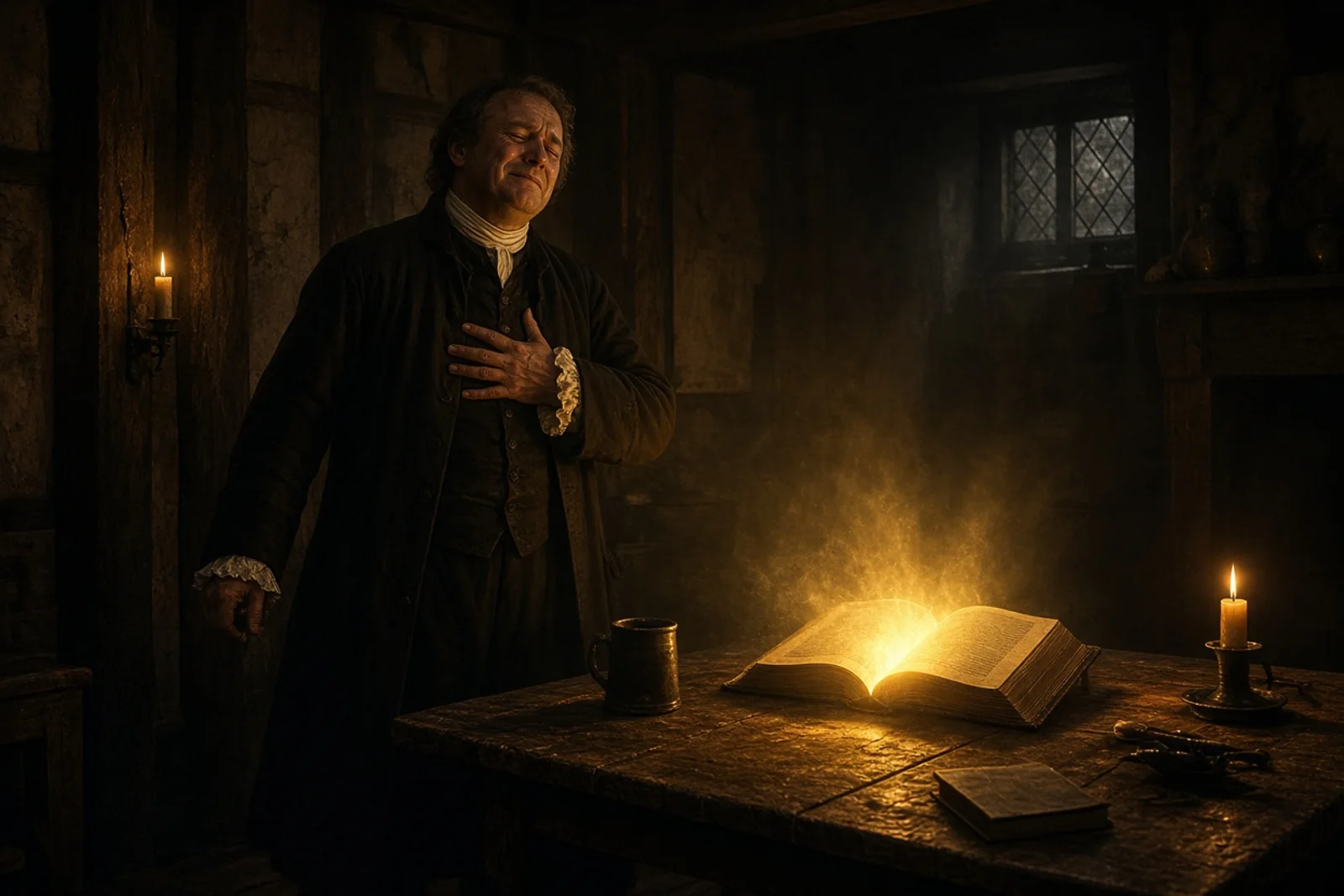
We took places on a bench near the back. A single lamp burned on the table. The reader’s voice carried steadily through the small room, turning the pages of Luther’s preface. He spoke of the heart changed by faith in Christ alone, the shift from striving under the law to resting in what had already been done. I watched Wesley’s hands. They had been clenched on his knees. They loosened by degrees.
Near a quarter before nine the reader reached the part about the inner change God works through trust in the Son. Wesley’s head lifted. His eyes stayed on the reader but the line of his mouth eased. He drew one long breath and let it out without sound. I had seen him preach in churches and fields, seen him argue points of doctrine late into the night, yet I had never seen that particular stillness settle on him.
He rose partway through the next sentence. His voice was quiet at first, then carried to every corner. He said he now trusted Christ and Christ only for salvation. He said an assurance had come that his sins, even his, were taken away and that he was delivered from the law of sin and death. Several heads turned. No one interrupted. He went on to pray aloud for those who had spoken against him and made his work harder. The words were plain, without flourish. When he finished he sat again, but his posture had changed. The tension that had lived between his shoulder blades was gone.
After the meeting broke we walked back toward his lodging. He spoke little on the way. Once he stopped under a street lamp and looked at the ground as if listening to something inside his own chest. I asked nothing. At his door he thanked me for bringing him and went inside.
The next morning he appeared at the usual hour for the small gathering we kept. He spoke of the same assurance, but now he added that peace and victory over sin mattered more than any rush of feeling. When temptation returned later that day he met it by lifting his eyes and claiming the help already given. He told us the difference was simple: before, he fought and sometimes lost; now he fought and remained standing.
On the Thursday he went to St. Paul’s in the afternoon. The anthem that day began with the line about singing always of the Lord’s loving-kindness. He told me afterward that the words had tasted like bread. The same evening he mentioned a fear that had tried to settle on him, the old question of why the change did not feel more dramatic. He answered it by saying he knew peace with God today and had been forbidden to borrow trouble from tomorrow.
By early June the restlessness that had marked him since Georgia began to ease into purpose. He spoke of going to Germany to meet the Moravian brethren whose witness had reached him in London. He said his mind needed the steadiness their example might give. Preparations were quiet. He packed few things. Before he left he preached once more in the open air near Moorfields. The old urgency remained, but the edge of strain had left his voice. People who had heard him before remarked on the steadiness.
I saw him again after his return from Herrnhut. The three months had not removed every question, yet the ground under his feet had settled. He continued to meet the societies, continued to read and to answer letters, but the record of each day now carried a different tone. The entries spoke of keeping his eye fixed on Christ and waiting on Him continually. The temptations still came, yet each time he answered by looking upward rather than inward.
One afternoon I walked with him along the river path near Westminster. He paused to watch a boatman push off from the bank. The current took the small craft quickly. Wesley said nothing about the river or the boat, only that the difference between his former state and the present one showed most clearly in the outcome of the fight. He was no longer sometimes conquered. That single sentence stood between us for several steps before he moved on.
Months later the same societies that had met in Aldersgate Street began to multiply. Wesley traveled to Bristol and then to Newcastle, carrying the same message he had first spoken aloud on that Wednesday evening. The words varied with the crowd, yet the center stayed fixed: trust in Christ alone, assurance that the work was finished, and the daily choice to keep looking at the One who had already won. I heard him repeat the pattern in fields, in barns, and once in a rain-soaked courtyard where the water ran in streams between the benches. Each time the same quiet certainty undergirded the delivery.
The last time I stood near him before he left again for the north he carried a small book of hymns. He opened it to a page marked with a ribbon and read one stanza aloud to the group gathered at the coach. The line spoke of strength renewed by waiting. He closed the book, tucked it under his arm, and stepped up without looking back. The coach wheels turned on the cobbles and carried him out of sight around the corner.
He reached Newcastle on the twenty-eighth of May and preached the same evening on the town moor to a crowd counted at several thousand. The text was Isaiah 53 verse 5, and he recorded in his journal that the people stood in perfect stillness while he spoke of wounds that heal. Two days later he formed the first society there with seventy-two members who met nightly in a room on the Sandhill. By the end of that summer the number had grown to two hundred and twenty-six, each required to give a penny weekly toward the building of a preaching house on the site later called the Orphan House.

In Bristol the following spring he laid the foundation stone of the New Room on the seventeenth of May 1739. The building measured thirty-seven feet by twenty-seven, with a schoolroom above and a stable for eight horses below. George Whitefield preached the first sermon there on the twenty-fifth of that month, after which Wesley began the practice of issuing quarterly tickets to prevent disorderly persons from entering the classes. The ticket bore the words “The Lord is with us” and a date written in Wesley’s own hand. By 1742 the Bristol society numbered more than eleven hundred, and the stewards’ book listed exact sums collected each week for the relief of the poor.
He married Mary Vazeille on the eighteenth of February 1751 at seven in the morning in her house on Threadneedle Street. The ceremony was performed by John Jones, a clergyman of the Church of England. Within a month Wesley resumed his circuit, riding to Newcastle and back, covering two hundred and sixty miles in twelve days. His wife accompanied him on several journeys until 1753, when she remained in London to manage the household at the Foundery while he continued alone. The marriage produced no children, yet Wesley’s journal entries for those years note the purchase of a second horse and the cost of new saddlebags fitted with pockets for books and papers.
On the seventh of April 1788 he preached for the last time at the New Room in Bristol, taking as his text “He that drinketh of the water that I shall give him shall never thirst.” The congregation filled every bench and stood in the aisles; the collection that morning amounted to four pounds and six shillings for the support of the preachers’ widows. From Bristol he rode to Birmingham, then to Manchester, and finally to Newcastle, where on the twenty-third of May he spoke from the same text he had used fifty years earlier on the town moor. His voice remained steady, though he required a chair to be placed behind him after the first twenty minutes.
He returned to London in October and continued to preach twice each Sunday at City Road Chapel, which had opened on the first of November 1778. The chapel measured eighty-six feet by sixty-two, with galleries on three sides and a clock whose face bore the inscription “Redeeming the time.” On the twenty-third of February 1791 he dictated his final letter to William Wilberforce, urging him to continue the campaign against the slave trade and closing with the words “Go on, in the name of God, and in the power of His might.” Four days later he preached his last sermon, on the text “Seek ye the Lord while he may be found,” at Winchelsea.
On the second of March 1791 he died in the house adjoining City Road Chapel at ten minutes before ten in the morning. Those present recorded that his last audible sentence was “The best of all is, God is with us,” spoken twice. His body lay in the chapel for three days while more than ten thousand persons passed through to view it. The funeral took place at five o’clock on the fourth of March; the service was read by Thomas Coke, and the coffin was placed in a vault beneath the communion table. The pallbearers included six preachers who had ridden with him on earlier circuits.
The chapel and house remain standing on City Road today, the original pulpit still in place and the clock still keeping time. The vault is marked by a simple marble slab engraved with Wesley’s name and the dates 1703 and 1791. Visitors continue to enter through the same front doors, and the society that meets there still issues quarterly tickets, though the penny contribution has long been replaced by other gifts. A bronze statue of Wesley stands outside the chapel, one hand extended as though offering a book, the other resting on a Bible opened to the passage from Romans that he read on the evening of the twenty-fourth of May.
The last clear image recorded of him before the coach turned the corner was the ribbon marking the page in the hymnbook he carried under his arm, its faded blue edge visible against the dark cloth of his coat as the wheels began to move.
On the twenty-ninth of May 1744 the first conference of Methodist preachers assembled at the Foundery in London with ten men present, among them John Downes and Thomas Maxfield, who examined the twenty-three questions Wesley had drawn up on doctrine and discipline. The minutes recorded that each preacher received a copy of the “Rules of the Society” printed that year at the press Wesley had installed in the same building. By the conference of 1765 the number of circuits had reached forty-two, and the preachers’ fund listed annual subscriptions totaling one hundred and eighty pounds from the societies in London, Bristol, and Newcastle alone.
In 1771 Wesley dispatched Francis Asbury and Richard Wright from Bristol on the ship Friendship, each carrying a letter dated the sixth of September that instructed them to “be patterns of all holiness” and to keep exact journals of every mile traveled. Asbury’s first entry after landing at Philadelphia on the twenty-seventh of October noted the formation of a class of twelve members who met in the house of Jacob Baker on Second Street. By 1784 the American societies numbered fourteen thousand nine hundred and eighty-eight members, and the Christmas Conference at Lovely Lane Chapel in Baltimore elected Asbury and Thomas Coke as superintendents on the twenty-fifth of December.
After Wesley’s death the Legal Hundred continued to meet annually, and the conference minutes for 1792 list three hundred and four preachers stationed across Great Britain and Ireland with a total membership of seventy-six thousand nine hundred and sixty-eight. The Deed of Declaration enrolled in Chancery on the twenty-eighth of February 1784 had already fixed the succession of trustees for all preaching houses, naming one hundred preachers who were required to sign the document within twelve months. The Orphan House in Newcastle, completed in 1745 at a cost of seven hundred pounds, remained in use until its demolition in 1857, when the foundation stone was removed and placed in the vestibule of the new Brunswick Chapel on the same site.
City Road Chapel in London added a second gallery in 1803 to accommodate the growing congregation, and the stewards’ accounts for that year show weekly collections averaging four pounds and twelve shillings, with separate entries for the poor fund and the preachers’ allowance. The adjoining house, where Wesley died, opened as a museum in 1898 under the care of the Wesleyan Methodist Conference; its inventory that year catalogued one hundred and forty-seven original letters and the original manuscript of the journal covering the years 1735 to 1738. In 1929 the British Methodist Church reported one million two hundred and thirty-four thousand members on trial and in full connexion, with nine hundred and eighty circuits served by two thousand nine hundred and twelve ministers.
The bronze statue outside the chapel, cast by John Adams-Acton and unveiled on the second of March 1891, bears the inscription “The world is my parish” taken from Wesley’s journal entry of the eleventh of June 1739. Visitors today pass through the same gates Wesley used, and the quarterly tickets still issued at the society meetings carry the text of 2 Corinthians 13:14 printed in the same layout adopted in 1742. The vault beneath the communion table was opened in 1898 for inspection; the coffin, covered with a plain black cloth, measured six feet two inches and bore a brass plate engraved with the single word “Wesley.”
A final documented sighting occurred on the twenty-second of February 1791 when Wesley visited the school at Kingswood near Bristol. The headmaster, Walter Churchey, recorded in the visitors’ book that Wesley examined twenty-seven boys on their knowledge of arithmetic and the catechism, then gave each a copy of the “Instructions for Children” printed at his own press. As he left the classroom he placed his hand on the shoulder of the youngest pupil, twelve-year-old William Holder, and spoke the single sentence, “Do all the good you can,” before stepping into the waiting chaise that carried him back toward London.