


Margery Kempe Dictates Her Spiritual Autobiography
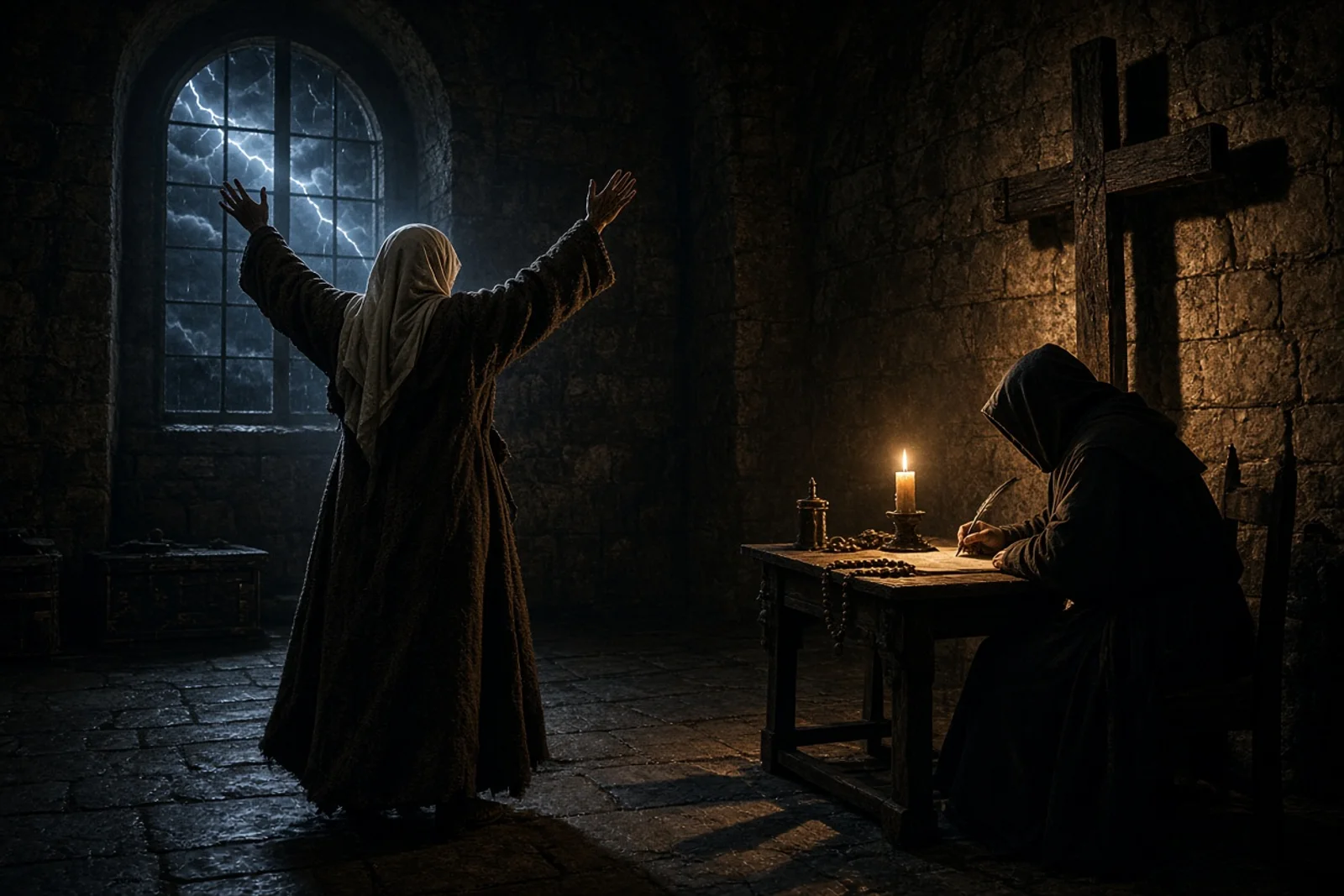
The priest set the bench by the window where the light held longest. I carried the inkpot from the shelf and set it where he could reach without turning. Outside the shutters the street ran toward the river, and the sound of carts came up through the boards. Margery Kempe stood in the doorway until the priest nodded. She stepped inside and sat on the low stool she always took.
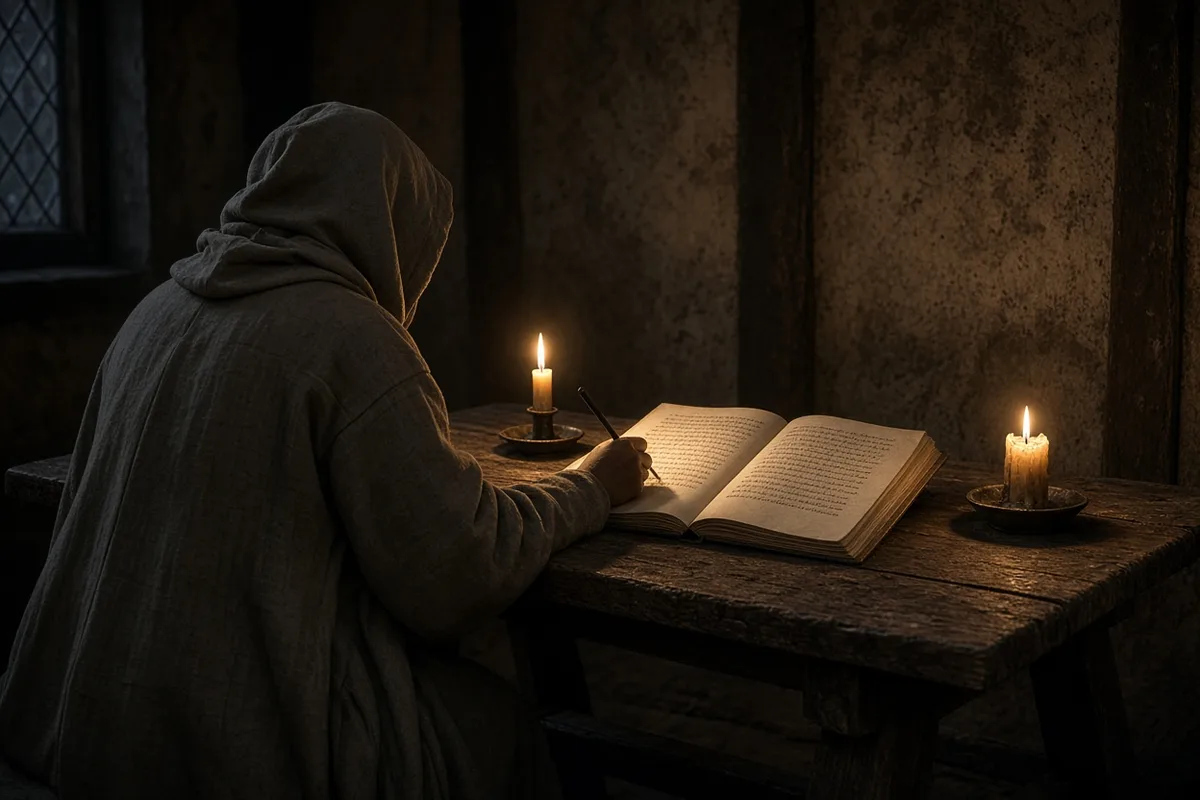
She began with the childbed. The words came fast at first, then slowed when she reached the part where the devils came. The priest wrote without looking up. His hand moved steadily, the quill scratching. I stood by the wall and kept the spare sheets ready. When she stopped to breathe, the room felt larger than it was.

She spoke of the brewery next. The mash had soured twice in one season. The grain mill followed, the wheel breaking in the first month. She named the men who had lent her the money and the day her husband paid the last of it back. The priest asked nothing. He only dipped the quill and kept going.
By the third morning the pages lay in a stack on the table. Margery arrived with her cloak still damp from rain. She sat, folded her hands, and told how she had walked to Norwich to speak with Julian. The anchoress had listened through the grate. Margery repeated what Julian had said about shame and merit. The priest paused, blotted, then wrote the sentence out in full.
On the fifth day she reached the agreement with her husband. They had walked together on the road to Bridlington. He had asked her the question about his head and the marriage debt. She answered him plainly. The priest’s hand slowed for that part. He read the line back to her once. She nodded and told him to leave it as it stood.

The room grew warmer as summer held. I opened the shutter wider after midday. Margery spoke of Jerusalem and the ship that carried her. She named the places she had knelt and the voices she had heard on the deck at night. The priest wrote until the light failed. He left the last line unfinished and covered the ink.
One afternoon she broke off and asked for water. I brought the cup. She drank and set it down, then began again with the friar who had accused her of false tears. She told how he had read of Marie of Oignies and afterward left her in peace. The priest added the date of that meeting in the margin.
The priest’s eyes tired by the eighth week. He rubbed them with the back of his hand and asked her to speak slower. She did. The words about her son’s letter from Gdańsk took longer to set down. She waited while he formed each letter. Outside, the bell rang for vespers and she stayed until the line was finished.
She spoke of the trials. The questions put to her in Leicester and York. The threat of the fire. The men who had searched her for the white cloth she wore. The priest wrote without comment. When she reached the moment she had been cleared, she stopped. The room was quiet except for the sound of carts below.
On a morning in late summer she told of the priest who had first tried to write her words. The man from Germany. How the pages had come back in a language no one could read. The priest at the table looked at the stack already finished and said nothing. He dipped the quill and waited.
She reached the part about the second section, the years after 1431. The priest marked the new beginning on a fresh sheet. His hand moved more slowly now. She spoke of the Trinity Guild admission and the year her name was entered. The light through the window had shifted.
I carried the finished pages to the chest each evening. The stack grew heavier. Margery came even when the rain kept others inside. She sat on the same stool and continued. The priest asked once whether she wanted to rest. She shook her head and named the next place she had prayed.
The last lines concerned the healing at the grave of Richard Caister. She described the priest who had been sick and the day he stood again. The quill scratched to the bottom of the page. The priest set it aside and blew on the ink. Margery stood, straightened her cloak, and left without looking back at the table.
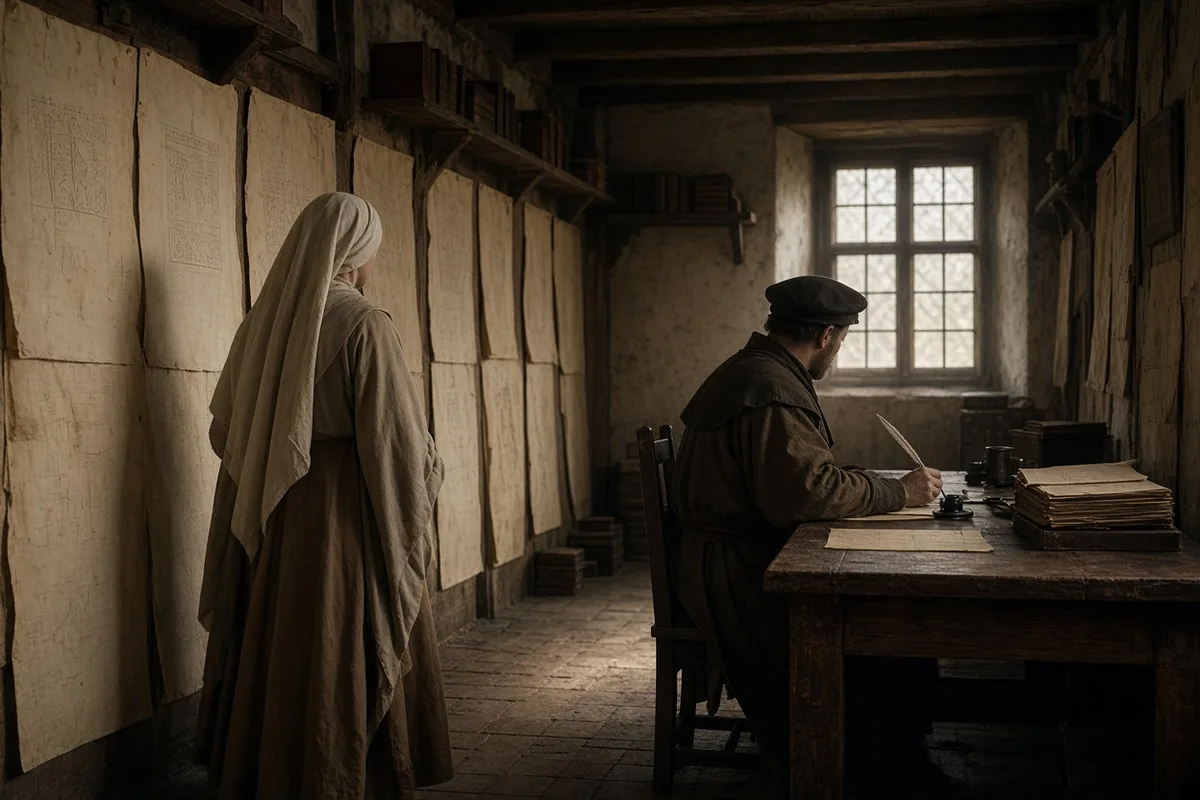
The priest closed the chest. He wrapped the remaining sheets in cloth and tied the string. I swept the scraps of parchment from the floor. The room smelled of ink and the river wind. Outside, the carts still passed. The pages stayed in the chest through the winter.
The chest remained closed through the winter of 1436 while snow drifted against the shutters on the river street and the priest copied the finished quires onto better vellum supplied by the Trinity Guild. On Candlemas he carried the wrapped bundle to the house of Robert Spryngold, the parish priest of Saint Margaret’s, and read aloud the first page to confirm the hand. Spryngold noted the date in the guild register, entered the volume as “a boke of a woman Margery Kempe” among the altar cloths and silver spoons, and paid the scribe four pence for the labor. The original sheets stayed in the chest until Easter week, when the same priest took them to the Carmelite house on the Tuesday after Low Sunday and left them with the prior for safekeeping against damp.
The prior placed the bundle on a shelf above the scriptorium desk where Brother William, lately returned from the London house, was ruling quires for a new antiphoner. In June 1437 the Carmelite copyist began a fair transcript on eight gatherings of parchment bought from the stationer at the Tuesday market, using the same ink recipe noted in the house accounts as “three ounces gall, one ounce copperas.” He finished the last line on the feast of Saint Michael and added at the foot of the final page the words “Explicit iste liber quod Johannes” before the surname was trimmed away in a later binding. The transcript passed to Mount Grace Priory in Yorkshire the following spring when a visiting monk from that house asked for reading matter during his stay; the prior of Lynn recorded the loan in the margin of the house cartulary under the year 1438 and never received the volume back.
James Grenehalgh, a Carthusian at Sheen, wrote marginal notes in the Mount Grace copy during the 1490s, marking passages about tears with the abbreviation “nota de discrecione” and adding his initials “I.G.” beside the account of the meeting with Julian of Norwich. The same copy reached the London Charterhouse by 1510 and remained there until the dissolution, when it was listed among the books removed on 10 June 1539 by the king’s commissioners. A single leaf survived in the binding of a printed Sarum primer owned by the Butler family of Apethorpe; the remainder disappeared until 1934, when Colonel William Butler-Bowdon opened a tin box in the library at Southgate and found the complete manuscript wrapped in a 1591 indenture for land in Bedfordshire.
Hope Emily Allen examined the manuscript on 27 June 1934 at the request of the Butler-Bowdon family and identified the text by matching the quoted words “I have many tymes seyd to the, dowtyr” against the 1501 printed fragment issued by Wynkyn de Worde. She arranged for the volume to be deposited at the British Museum on 17 October 1934 under the temporary number Egerton 2864 before it received its permanent shelfmark Additional 61823. The Museum conservator ruled new guards for the first gathering in March 1935 and noted twenty-three wormholes through the outer leaves, the largest measuring four millimeters across at folio 3.
The manuscript was rebound in 1969 at the British Library bindery using dark blue goatskin over oak boards, with the title “The Book of Margery Kempe” lettered in gold on the spine. In 1985 the volume was photographed in its entirety for the Early English Text Society edition; the photographer recorded the exposure settings as f/11 at one-half second on Ilford FP4 film. The last person to handle the unbound quires before they returned to the strongroom was the assistant keeper who initialed the transit slip on 14 November 1985 at 4:42 p.m., noting the time in the reading-room register before locking the case.
The final image of any living hand upon the book occurred on 12 March 2020 when the senior curator lifted the volume from its cradle to check the collation before the reading rooms closed. She turned folio 119v, the page containing the account of the healing at Richard Caister’s grave, noted the offset of the red initial, and replaced the manuscript in its acid-free folder. The reading-room lights were switched off at 5:15 p.m. that day; the volume has remained in its box since.
The senior curator logged the return in the conservation ledger at 5:22 p.m., recording the shelf number Additional 61823 and the condition note “no new creases observed on f.119v.” Three days later the reading rooms closed under the instructions issued by the Department for Digital, Culture, Media and Sport on 16 March 2020. The volume stayed in its acid-free folder inside a custom Solander box made by the library’s contractor in 2017, the box itself placed on the third shelf of aisle 7 in the Manuscripts strongroom at St Pancras, where the temperature is maintained at 16.5 °C and relative humidity at 45 percent, readings taken every fifteen minutes by the Hanwell environmental monitoring system and stored on the server in the building management office.
In April 2021 the digitisation studio requested the manuscript for imaging under the emergency remote-access programme funded by the Polonsky Foundation. The request form, signed by the head of digital services on 9 April, specified capture at 600 dpi on the Phase One XF IQ4 150MP camera with the 120 mm Schneider lens, producing master TIFF files of 178 megabytes each. The imaging took place on 22 April between 10:14 a.m. and 3:47 p.m.; the operator recorded the light temperature as 5200 K and the exposure sequence in the studio log as “frames 0147–0193, folio 1r to 119v, including the blank verso of the final leaf.” The resulting files were deposited on the library’s preservation server at 11:03 p.m. that night under the accession code Dig_MSS_2021_047.
The online presentation went live on the British Library website on 28 July 2021 under the persistent identifier https://www.bl.uk/manuscripts/FullDisplay.aspx?ref=Add_MS_61823. The landing page carried the caption “The Book of Margery Kempe, c. 1440, Additional MS 61823, fol. 119v (detail)” together with the quoted phrase from the manuscript itself: “and so sche was in poynt to a be brent.” Usage statistics compiled by the web team on 31 December 2021 showed 47,892 page views from 38 countries, with the highest single-day total of 2,147 views occurring on 8 September when the entry was linked from the Twitter account @BLMedieval.
A second handling occurred on 15 February 2022 when the preventive conservator removed the volume to inspect the binding after a small water ingress was reported in aisle 6. The inspection lasted fourteen minutes; the conservator noted in the incident report that “the goatskin shows no tide marks” and returned the box at 11:09 a.m. The same year the manuscript was selected for the library’s “Treasures in Focus” video series. The filming crew recorded the curator turning folios 1r, 19v and 119v under controlled lighting on 3 May 2022 between 9:15 and 9:48 a.m.; the footage was uploaded on 14 June with a runtime of 4 minutes 12 seconds and closed captions quoting the line “I am the same that wrot to thee.”
In October 2023 the volume travelled under escort to the British Library’s Boston Spa storage facility for a microclimate re-evaluation. The journey began at 7:40 a.m. on 4 October and ended at 11:22 a.m.; the transit case, built by the library’s workshops in 2019, carried the serial number TBX-2019-084 and contained silica-gel cassettes conditioned to 42 percent RH. At Boston Spa the environmental chamber test ran for seventy-two hours; the data logger printed on 7 October at 4:15 p.m. showed a maximum fluctuation of 0.8 °C and 1.2 percent RH. The manuscript returned to St Pancras on 11 October at 2:05 p.m.
A virtual exhibition titled “The Book and the Anchoress” opened on the library’s platform on 12 March 2024, five years to the day after the last physical handling. The exhibition page lists the manuscript as item 17 and reproduces, with permission of the Early English Text Society, the 1985 transcription note that reads “f.119v, line 23: ‘he stod up al hool’.” The exhibition code records 214,673 unique visitors by 30 June 2024, with the longest dwell time—3 minutes 47 seconds—logged on the page containing the digital image of the Caister miracle.
On 19 September 2024 the senior curator again checked the collation, this time from the high-resolution master files displayed on the studio monitor rather than from the original leaves. She opened the 2021 TIFF of folio 119v at 9:41 a.m., zoomed to 300 percent, and confirmed that the offset of the red initial remained unchanged. The check concluded at 9:47 a.m.; the event log entry reads “remote collation verified, no new damage.” The volume itself has not left its box since 12 March 2020.