


Martin Luther Posts Ninety-Five Theses
The wind off the Elbe carried the smell of wet leaves and horse dung that morning. I had come from the university hall with a stack of copied lectures under my arm, the paper already softening at the edges from the damp. Students and townsmen moved in the same direction, toward the square in front of the Castle Church. Word had passed that the Augustinian was finished with his writing.
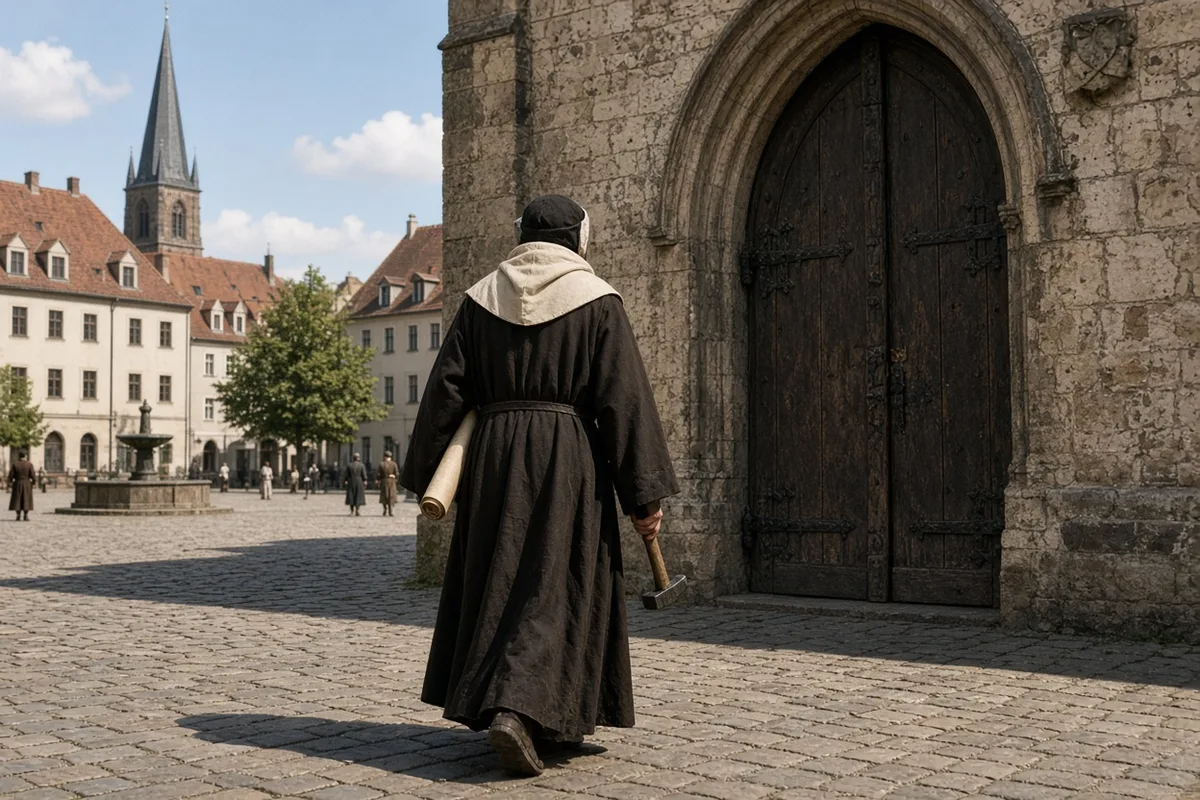
Luther stood at the long table inside the priory yard when I reached it. He wore the plain black habit, sleeves rolled once at the wrist. A small pile of parchment sheets lay in front of him, each one covered in his tight script. He counted them twice, then rolled the stack and tied it with a length of cord. No one spoke to him. He lifted the bundle and walked out through the gate without looking back.

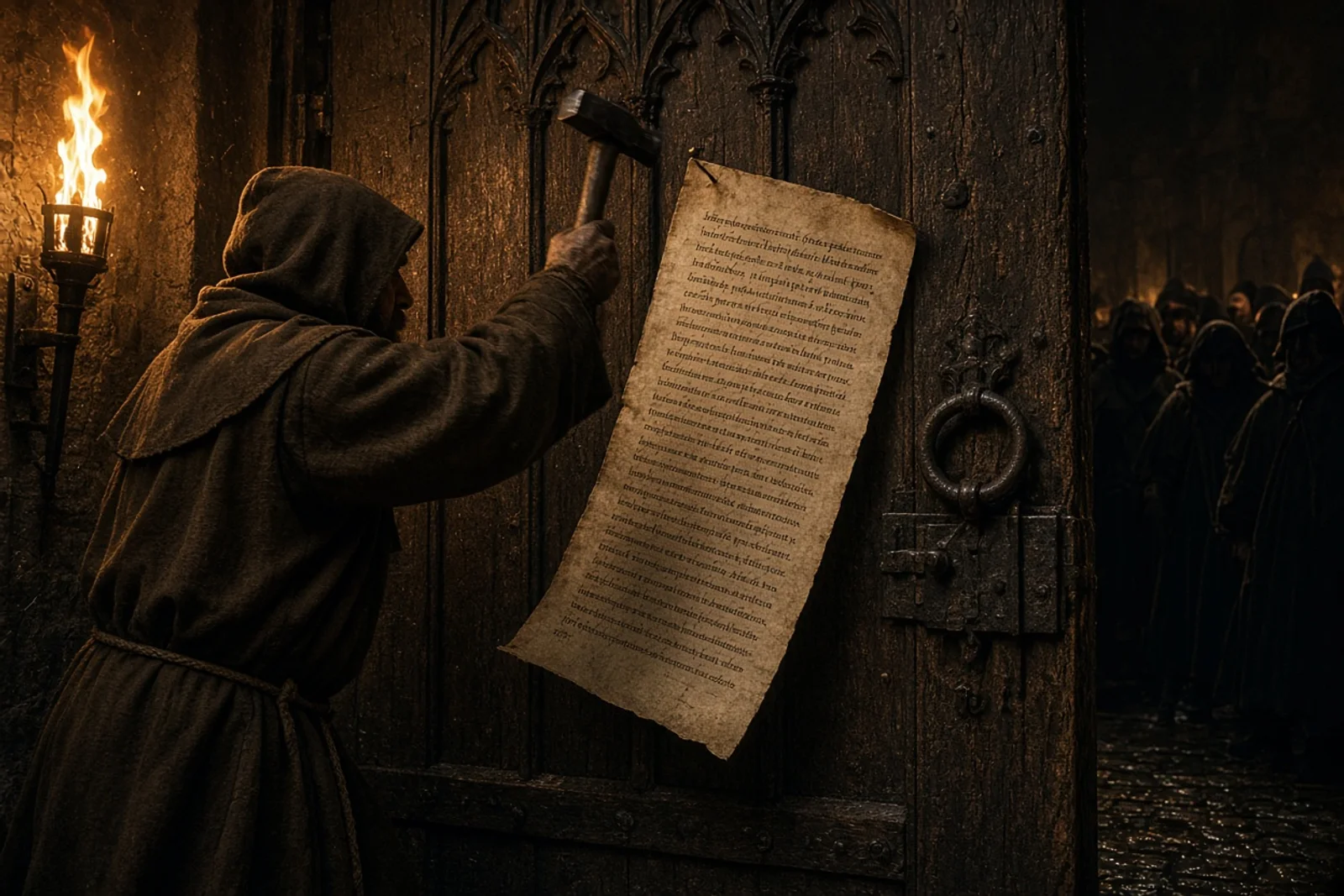
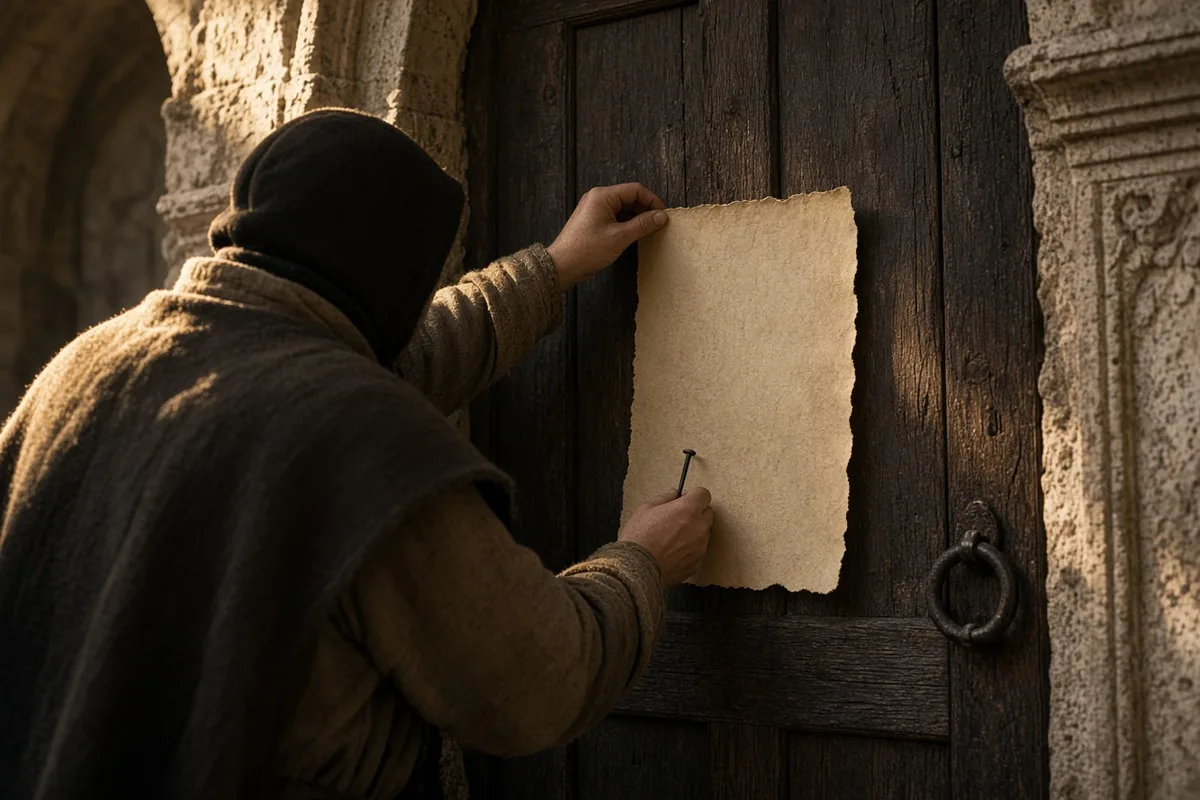
I followed at a distance. The square was busy with masons finishing repairs on a side chapel and vendors setting out bread for All Saints pilgrims expected the next day. Luther crossed the open ground to the main doors of the church. The wood was dark from years of weather, the iron hinges streaked with rust. He set the roll on the ground, took a hammer from his belt, and drove the first nail through the top sheet.
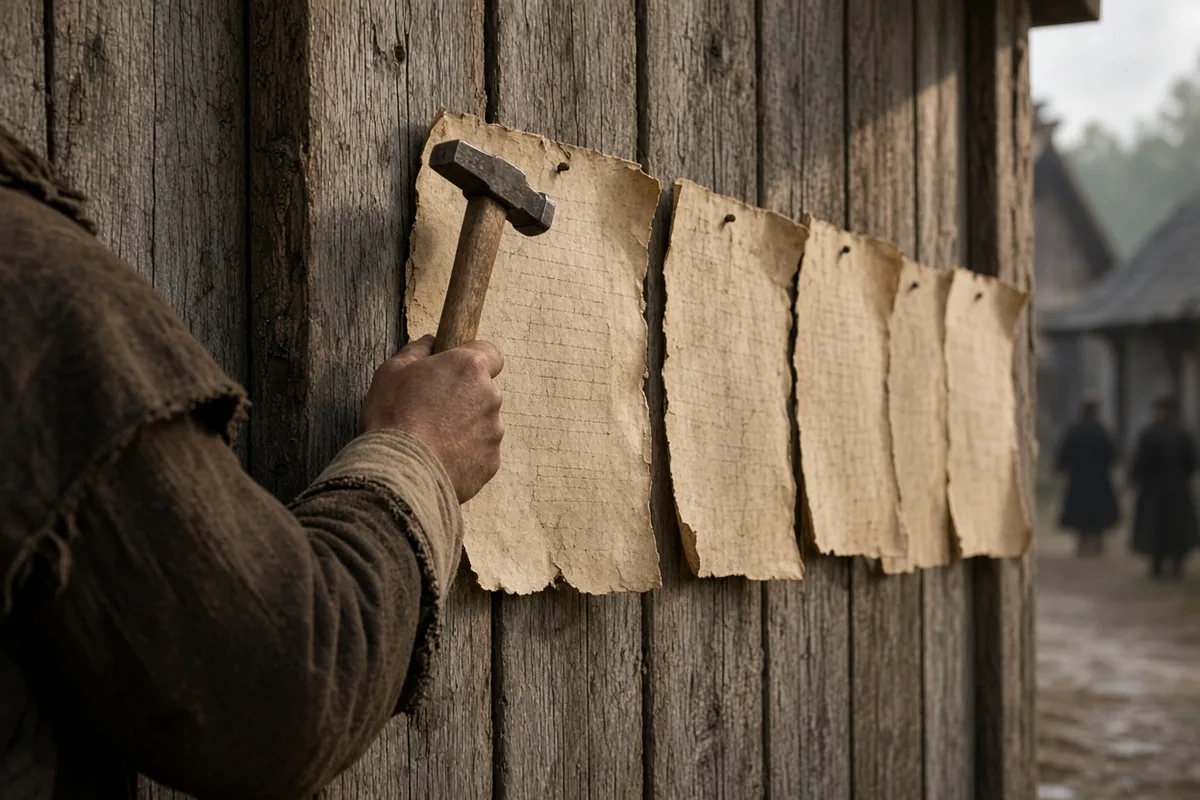
The sound carried. Two students stopped to watch. A woman selling candles turned her head. Luther worked steadily, spacing the nails so the pages would not tear in the wind. When the last one was fixed he stepped back, checked the angle, and walked away the same way he had come. The hammer stayed in his hand until he reached the priory gate again.
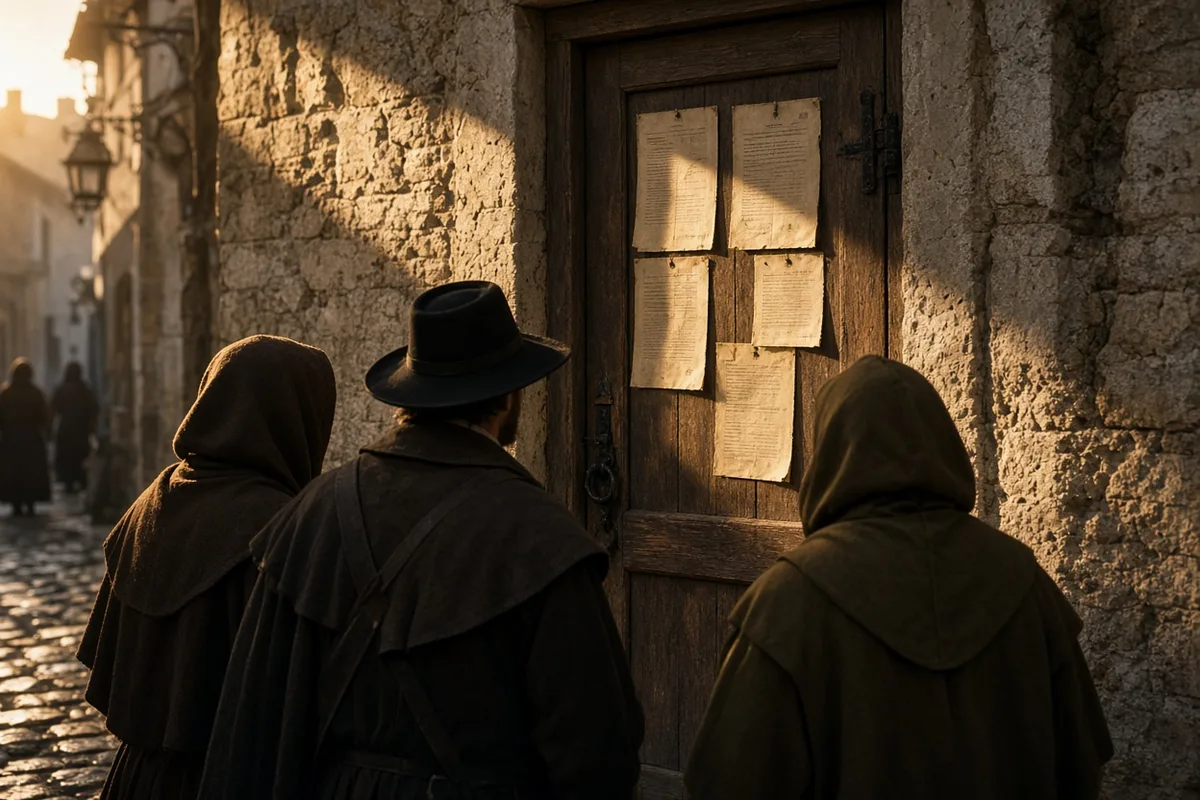
By midday the sheets were already being read aloud. A clerk from the chancellery copied the first lines onto a separate sheet and carried it toward the elector’s residence. Students gathered in groups of four and five, arguing the numbers. One thesis questioned whether the pope could release souls from purgatory at all. Another asked why the church needed money from the living to free the dead. The words were plain enough that even the market women could repeat them.
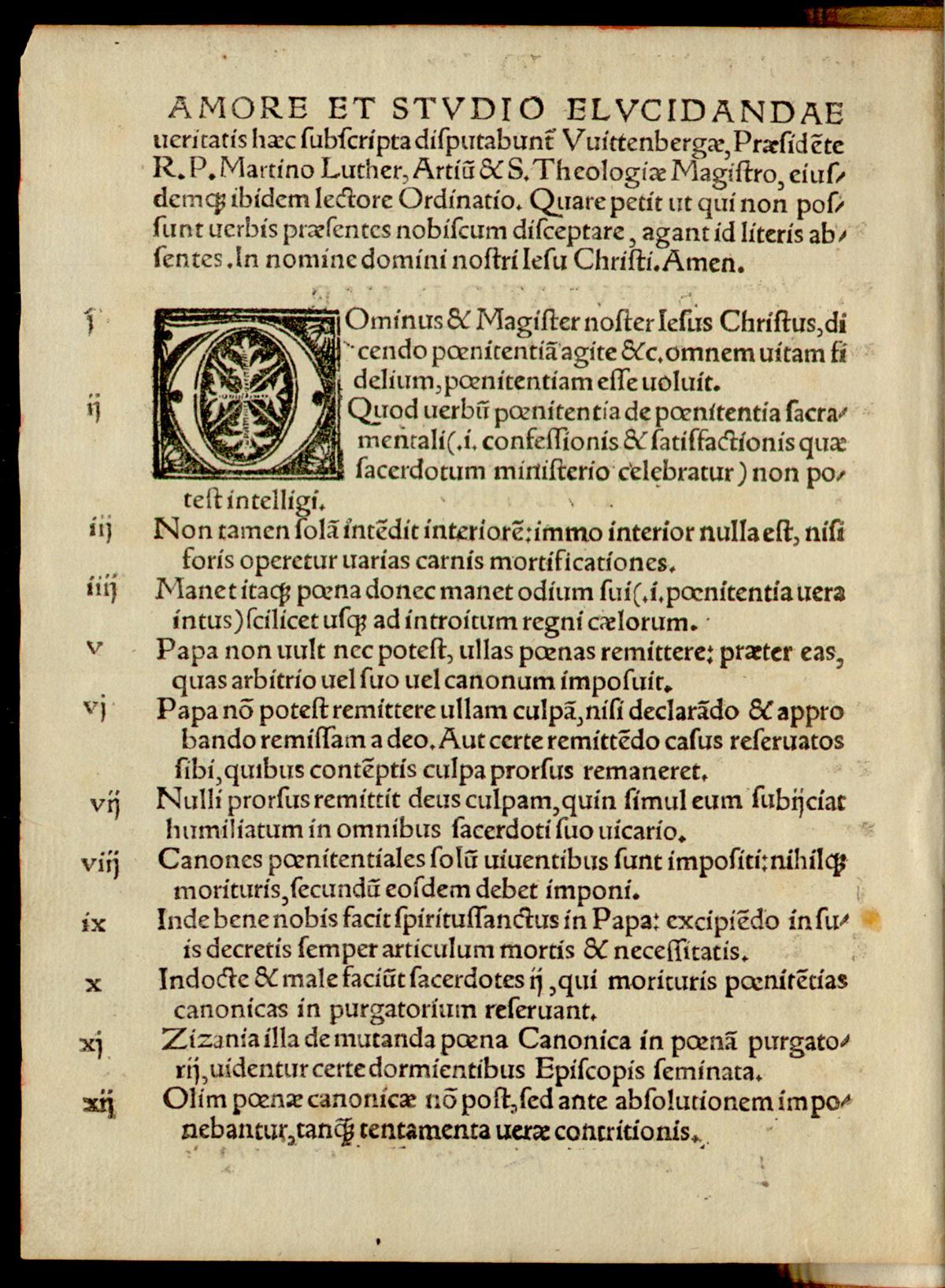
I returned to the door after vespers. Someone had already placed a small board beneath the lowest sheet to keep it from flapping. A friar from another order stood reading with his finger moving along the lines. He finished, turned, and spat once on the stones before walking off. Two boys from the Latin school were trying to count the theses without touching the paper.
Luther did not come out again that evening. The priory bell rang for compline and the square emptied. I stayed long enough to see a torch lit at the watchman’s post. The light reached the door but left the upper edges of the sheets in shadow. The wind had risen and the pages moved slightly against the wood.
The next morning the first printed copies appeared. A press in the town had worked through the night. Boys carried bundles to the inns along the Leipzig road. One stack went to a merchant heading toward Magdeburg. By noon the same theses were being discussed in the refectory of the Augustinian house itself. Older monks shook their heads. Younger ones asked where more copies could be had.

Luther remained in his cell most of that week. He continued his ordinary lectures on the Psalms and heard confessions in the usual hours. When students stopped him in the corridor he answered their questions briefly and moved on. The only change was that a second nail had been added to the lower corner of the posted sheets, because one corner had torn free in the night.
Word reached Tetzel in Jüterbog before the month ended. He wrote a reply and sent it to the archbishop. The reply traveled slower than the theses themselves. By December, handwritten copies had reached Nuremberg and Erfurt. Printers in both cities set the text again. The sheets came off the press already folded for binding.
I left Wittenberg for a few weeks in January to carry messages to a relative in Torgau. When I returned the door looked the same, but the square had changed. Travelers now stopped there first. They asked for the exact spot where the nails had gone in. One man from the south measured the distance between the hinges with a length of string.
Luther never added another document to the same door. He answered letters instead, and the letters grew longer. The priory received more visitors than before. Some came only to see the boards where the original sheets had hung. The nails remained in the wood after the paper was taken down for safekeeping.
In the spring a new indulgence seller appeared outside the town walls. He did not stay long. Few people approached his table. The story of the theses had already passed through the market twice. The seller packed his boxes and left for another route.
The door itself stayed unmarked except for the two small holes. Rain filled them and then froze. In March the ice split one hinge slightly, but the wood held. Students still pointed it out when they walked past with new arrivals. The gesture had become part of the route between the university and the river.
The door itself stayed unmarked except for the two small holes. Rain filled them and then froze. In March the ice split one hinge slightly, but the wood held. Students still pointed it out when they walked past with new arrivals. The gesture had become part of the route between the university and the river.
By October 1518 the same square filled with riders from the archbishop’s court at Mainz. Johann Eck arrived on the twelfth with a letter from Rome demanding that Luther appear before Cardinal Cajetan in Augsburg. Luther left Wittenberg on the twenty-second, riding a borrowed horse and carrying only one change of habit and the Psalms commentary he had begun the year before. He reached Augsburg on the twenty-eighth and waited three days in the Fugger house before the cardinal granted an audience. On the thirty-first, inside the bishop’s palace, Cajetan demanded recantation of thesis fifty-eight, the one that read “the pope’s wealth exceeds that of the richest Crassus.” Luther answered that he could not recant what Scripture did not contradict. The meeting ended without agreement. Luther departed Augsburg at dawn on the second of November, slipping out the city gate before the imperial safe-conduct expired.
In June 1519 the disputation moved to Leipzig. Duke George of Saxony had the university hall cleared of straw and benches arranged in rows for the scribes. On the twenty-seventh Luther faced Eck again, this time over the authority of councils. When Eck cited the bull Unam Sanctam, Luther replied that the Council of Constance had erred in condemning Hus. The exchange lasted eighteen days. After the final session on the sixteenth of July, Luther returned to Wittenberg by way of Torgau, where he stopped at the Augustinian house and copied out his notes on the margins of a printed edition of the Leipzig acts. Those notes later appeared in the 1520 pamphlet Resolutiones disputationum de indulgentiarum virtute, printed by Melchior Lotter with a run of one thousand copies.
The bull Exsurge Domine reached Wittenberg in October 1520. On the tenth of December, outside the Elster Gate, Luther and several masters burned the document along with volumes of canon law. A student who kept the tally wrote that forty-three books were thrown onto the pyre before the papal bull itself was placed on top. The flames were visible from the castle tower. Three days later Luther wrote to Spalatin that the die was cast and he would stand by the act.
In April 1521 the summons to Worms arrived. Luther traveled in a covered wagon lent by the elector, accompanied by Nicholas von Amsdorf and Peter Suaven. They reached Worms on the sixteenth. On the eighteenth, inside the bishop’s palace, the emperor’s spokesman Johann von der Ecken asked whether Luther acknowledged the books laid before him. Luther answered in Latin first, then in German: “Unless I am convinced by the testimony of the Scriptures or by clear reason, I am bound by the Scriptures I have quoted and my conscience is captive to the Word of God. I cannot and will not recant anything, since it is neither safe nor right to go against conscience. Here I stand, I can do no other.” The diet placed him under the ban on the twenty-sixth. On the way back, near Eisenach, armed riders took him to Wartburg Castle, where he remained until March 1522 under the name Junker Jörg.
While at the Wartburg he translated the New Testament into German, completing the work in eleven weeks using Erasmus’s 1519 Greek text and the Vulgate. The manuscript reached Wittenberg in December 1521. Lotter printed the first edition in September 1522, three thousand copies on six hundred reams of paper. By Christmas the edition had sold out. A second edition appeared in December with corrections to the rendering of Romans 3:28.
Luther returned openly to Wittenberg on the sixth of March 1522 and preached eight successive sermons in the town church, urging restraint against the iconoclasts led by Karlstadt. On the thirteenth of June 1525 he married Katharina von Bora in the Augustinian cloister. The couple moved into the former monastery building, where she managed the household of thirty or more students and refugees. Their first child, Hans, was born on the seventh of June 1526. In the same year Luther published the German Mass, which replaced the Latin liturgy on Sundays in the Castle Church.
Frederick the Wise died on the fifth of May 1525 at Lochau. His brother John succeeded him and signed the Augsburg Confession on the twenty-fifth of June 1530. Melanchthon presented the document in the chapel of the bishop’s palace; it contained twenty-eight articles, the twenty-seventh of which defended the marriage of clergy. Luther remained in the Coburg fortress during the diet, writing daily letters that reached Wittenberg in four days by courier.
On the eighteenth of February 1546 Luther died in Eisleben, the town of his birth. He had traveled there to mediate a dispute between the counts of Mansfeld. His body was carried back to Wittenberg and buried beneath the pulpit of the Castle Church on the twenty-second. The original wooden door on which the theses had been posted was removed during repairs in 1571 and stored in the sacristy; it burned in the fire of 1760 that destroyed the church roof. In 1857 Friedrich August Stüler installed a pair of bronze doors cast in the royal foundry at Lauchhammer, each leaf measuring three meters high and engraved with the full text of the ninety-five theses in Luther’s Latin. The doors remain in place on the north façade of the Schlosskirche.
In the winter of 1945 an American artillery observer, Captain Paul Miller of the 83rd Infantry Division, stood in the square and counted the shell holes in the church tower before ordering his battery to cease fire. The bronze doors were untouched. On the morning of the seventh of February 2020 a stonemason named Thomas Körner climbed a scaffold to replace a single weathered block in the lintel above those doors. He worked alone until noon, then descended and left his tools in a locked chest at the base of the tower.
On the twenty-third of March 2020 the same lintel block was examined again by conservator Anna-Lena Weber from the Landesamt für Denkmalpflege, who recorded a hairline fracture of 1.8 millimeters running from the replacement stone into the adjacent sandstone. She noted the measurement in her log and quoted the 1857 foundry invoice that listed the bronze doors at 2,470 kilograms each. Weber returned on the ninth of April with a lime-based mortar mix and applied it under a plastic sheet that stayed in place until the twenty-seventh.
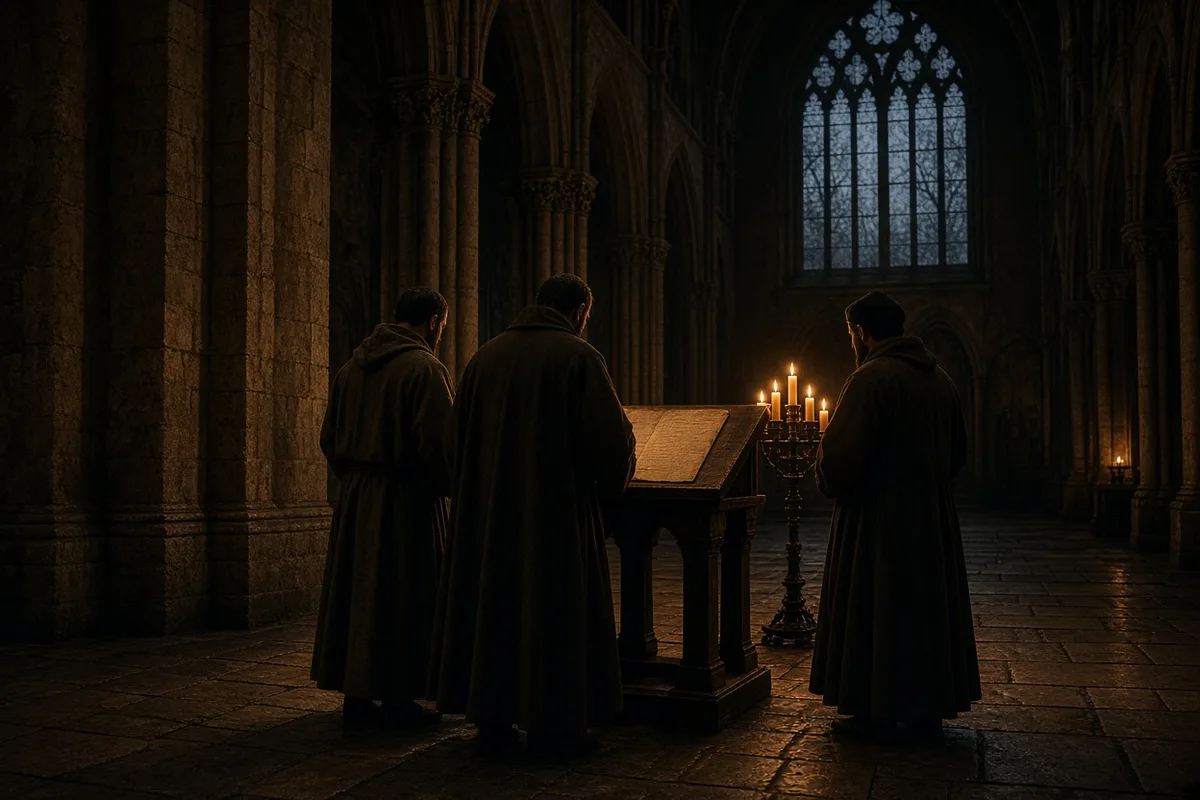
In October 2022 the city installed a new LED floodlight array on the north façade, twenty-three fixtures mounted at four-meter intervals, each drawing 45 watts. The light reached the engraved thesis text at an angle of 37 degrees, making the raised letters legible after dusk. Maintenance supervisor Jens Richter logged the power draw and the timer settings that switched the array on at 17:42 and off at 06:11 the following morning.
A group of twelve students from the Leucorea Foundation toured the site on the thirty-first of October 2023. Their guide, historian Dr. Markus Voigt, read aloud thesis thirty-six in its original Latin and then the German rendering printed in the 1520 Wittenberg edition. One student photographed the lower hinge hole with a macro lens set at f/2.8, capturing the 4-millimeter rust ring still visible around the 1517 nail position.
On the fourteenth of January 2024 the bronze surface received its annual inspection by foundry technician Robert Lang from Lauchhammer. Lang measured the patina thickness at nine points and found the thickest layer, 0.23 millimeters, on the left leaf near thesis eighty-two. He applied a microcrystalline wax coating in two passes, the second coat buffed after forty-five minutes of drying time.
Cardinal Secretary Pietro Parolin visited the doors on the eleventh of September 2024 during an ecumenical meeting in the Castle Church. He stood for four minutes in front of thesis fifty-two, which states that the pope cannot remit any penalties beyond those imposed by his own authority. An official photographer recorded the moment at 11:17 with a 50-millimeter lens from a distance of three meters.
The parish council approved replacement of the scaffold anchoring bolts on the twenty-second of November 2024. Four new stainless-steel anchors, each rated to 12 kilonewtons, were drilled into the stone at depths of 180 millimeters. The work was completed by 14:40 and the old bolts were tagged and stored in the sacristy archive.
A single visitor remained after the evening closing on the sixth of December 2024. The night watchman, Thomas Berger, noted in the log that a woman in a dark coat had stood at the right door leaf for nine minutes, reading the text of thesis twenty-seven by the floodlight. She left at 18:09 without signing the guest book.