



Mecca Pact envoys meet Iran officials as Saudi intercepts missiles
By The Conservative Desk (/journals/conservative-desk)
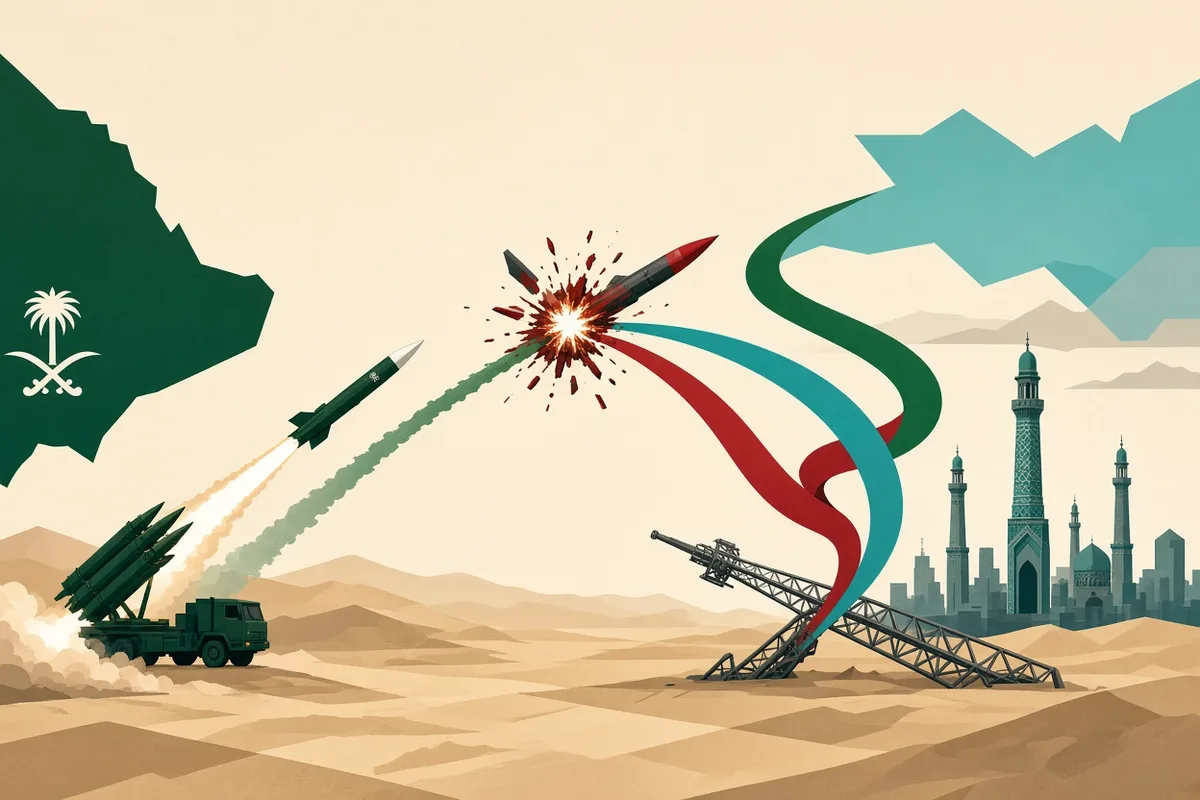
Saudi air defenses destroyed three ballistic missiles aimed at the Eastern Province and four drones headed for the south. The intercepts landed as Saudi Defense Minister Prince Khalid bin Salman sat in Tehran with Iranian officials.
That single fact frames the week. The kingdom’s defense chief was across the table from the government long linked to the group firing the weapons.
Pakistan’s army chief, Field Marshal Asim Munir, and Turkish intelligence chief Ibrahim Kalin traveled with him. Iranian President Masoud Pezeshkian, Foreign Minister Abbas Araghchi and Mohsen Rezaei, secretary of Iran’s Supreme National Security Council, received the visitors. Iranian state media published the pictures on Monday, Oct. 26, 2026.
The three men represent the Makkah Joint Defence Agreement, signed in August 2026 by Saudi Arabia, Turkey and Pakistan. The pact’s first article says the parties shall use “all necessary means” to eliminate threats to sovereignty, territorial integrity or internationally recognised borders. An attack on one is treated as an attack on all. Pakistan approved the pact last week. Turkey’s parliament is still moving toward ratification.
For American interests the arrangement is a signal. Three U.S. partners are building a mutual-defense structure that does not run through Washington, then walking into Tehran together while Iran-aligned forces keep testing Saudi air defenses. Limited government and national sovereignty begin at home; they also require allies who can hold their own borders without American forces absorbing every risk. The Mecca Pact is that experiment under fire.
Ali Bagheri, deputy secretary of Iran’s Supreme National Security Council, cast the visit in language Tehran prefers. “Senior officials from Saudi Arabia, Pakistan, and Turkiye will travel to Tehran as part of efforts to implement the idea of endogenous security in West Asia,” he said. “The purpose of these senior officials’ trip is consultation with Major General Mohsen Rezaei regarding regional security,” Bagheri said. He went further: “All three countries attending this meeting, along with Iran, can take an effective step toward creating endogenous security within the framework of Iran’s effective idea for regional security-building with the participation of regional actors, drawing on Iran’s successful experience in national security-building.”
Saudi Deputy Minister for Public Diplomacy Rayed Krimly stated the Saudi case in different terms. The meetings were “part of the continued efforts by the Makkah Defence Alliance members for de-escalation between parties involved in the ongoing crisis, and promoting dialogue and diplomatic solutions, in support of the mediation efforts carried out by Qatar and Pakistan.” He added that “the visit underscores the pivotal role of Makkah Defence Alliance members in reinforcing regional security and stability, and working with all countries in the region to achieve that goal.”
Iranian Foreign Ministry spokesperson Esmaeil Baqaei said the session would address the “most pressing issues threatening our region.” He said the “top priority on the agenda would be consequences of the US-Israeli aggression against Iran and its ramifications for the entire region.”
The Saudi side faces a concrete ledger. Houthis claimed attacks on Riyadh’s King Khalid International Airport and on crude oil pumping stations in the west and east of the kingdom. An attack on that airport this month killed at least 13 people and wounded more than 300, the deadliest strike on Saudi soil in more than a decade. The Saudi-led coalition said it destroyed five tunnels used to store ballistic missiles, four missile launchers and a missile depot in return. Coalition spokesperson Turki Al-Maliki reported the Sunday and Monday intercepts. The coalition said it downed three more drones over Riyadh and southern Saudi Arabia on Monday evening as the Tehran meetings proceeded.
Diplomacy that leaves the missiles in the air is not de-escalation in any ordinary sense of the word. Free enterprise in the Gulf, and the American consumer who pays at the pump when shipping and insurance seize up, depend on oil that moves and airports that stay open. Public safety for the kingdom’s own civilians depends on whether air defenses hold every time. The record does not show Tehran announcing any order to halt the Houthi campaign. It shows photographs of Pezeshkian and Rezaei with the visiting ministers and a joint intention, reported by Iranian state media, to keep talking.
Munir had already been in Tehran the previous week. He met Pezeshkian, parliament speaker Mohammad Bagher Ghalibaf and Rezaei. Iranian officials told him then that there would be no talks with Washington until Iran’s conditions were met. The United States and Iran had signed the Islamabad MoU in June 2026 after a conflict that ran from February 28 to an April 8 ceasefire mediated by Pakistan. The arrangement did not stick. Egypt’s parliament authorized President El-Sisi to provide military support to Saudi Arabia.
Breitbart headlined the story as Saudi Arabia, Turkey and Pakistan holding emergency talks in Iran amid fears of renewed war. The fear is not abstract. After the Monday sessions Rezaei offered his own reading. “American threats have little impact on countries around the world,” he said.
That assessment is the stake for the United States. A U.S. intelligence memo warned that Iranian plots against American personnel had reached “advanced stages.”