


Otto III and Bolesław the Brave Form Alliance at Gniezno
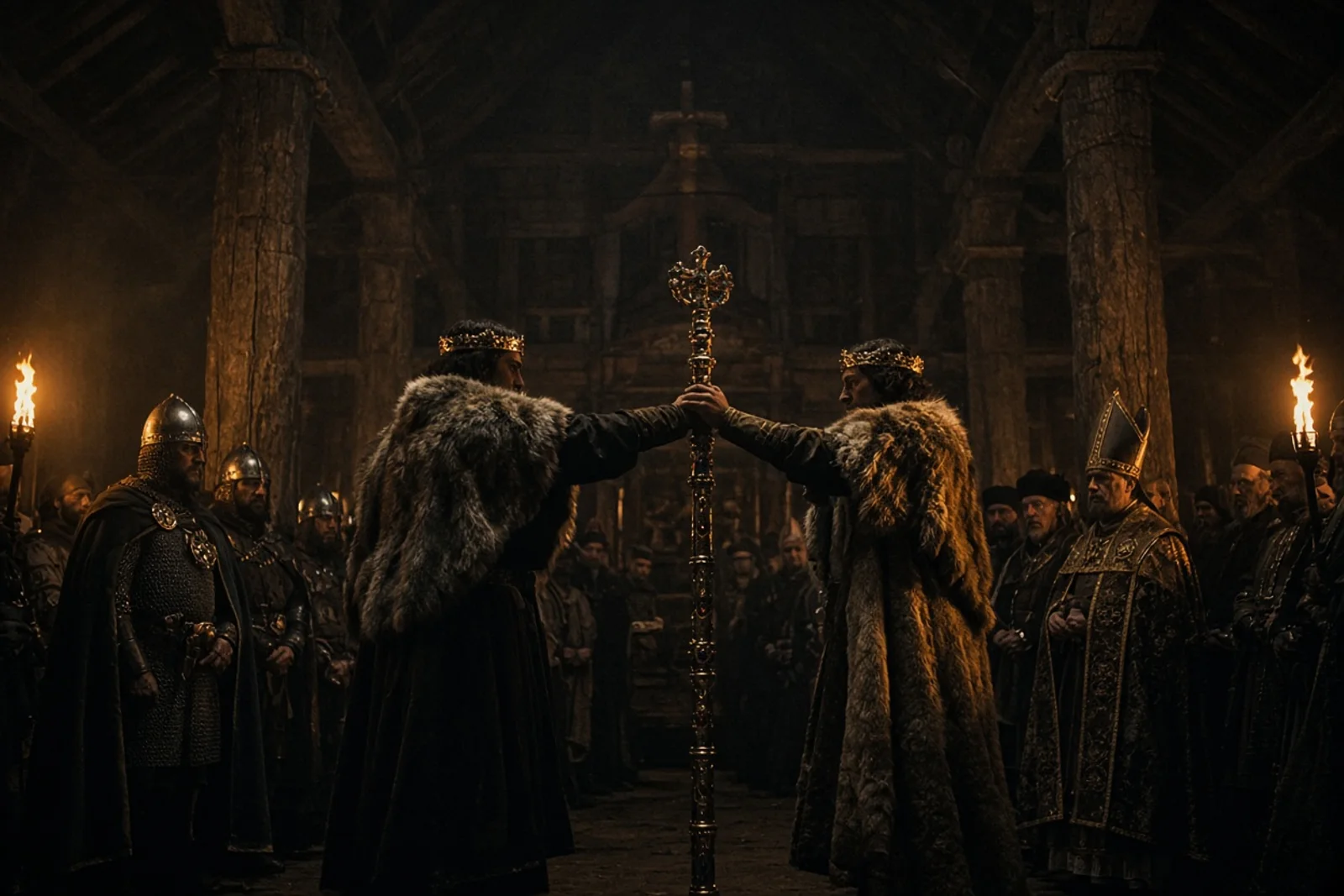
The dust rose in thick ropes from the hooves ahead of me as we neared the gates. I had marched with Bolesław’s men since the first frost, carrying messages between the duke’s riders and the scouts who watched the western roads. Now the emperor’s column stretched behind us, horses breathing hard after days of steady travel, and the city walls of Gniezno stood low against the morning sky.

Otto III had left his mount at the last bend. He walked the final stretch on bare feet, the hem of his cloak dragging through the cold mud. No one spoke. The only sounds were the creak of leather and the soft slap of his soles on the packed earth. Bishop Unger waited at the open gate, his staff planted, his face set against the wind that cut across the plain.
Inside the church the air smelled of old stone and burning tallow. Otto knelt at the reliquary that held Adalbert’s bones. He stayed there a long time, head bowed, shoulders moving with each breath. Bolesław stood a few paces back, one hand resting on the hilt of his sword, watching without moving. When the emperor finally rose, his eyes were red but dry.

The meetings began that same afternoon in the long hall Bolesław had cleared of all but the oldest benches. Otto spoke of a single empire renewed, four kingdoms under one crown: Gaul, Italia, Germania, and the Slavic lands he called Sclavinia. He looked at Bolesław when he said the last name. The duke answered slowly, measuring each word, but his voice carried to the far wall.
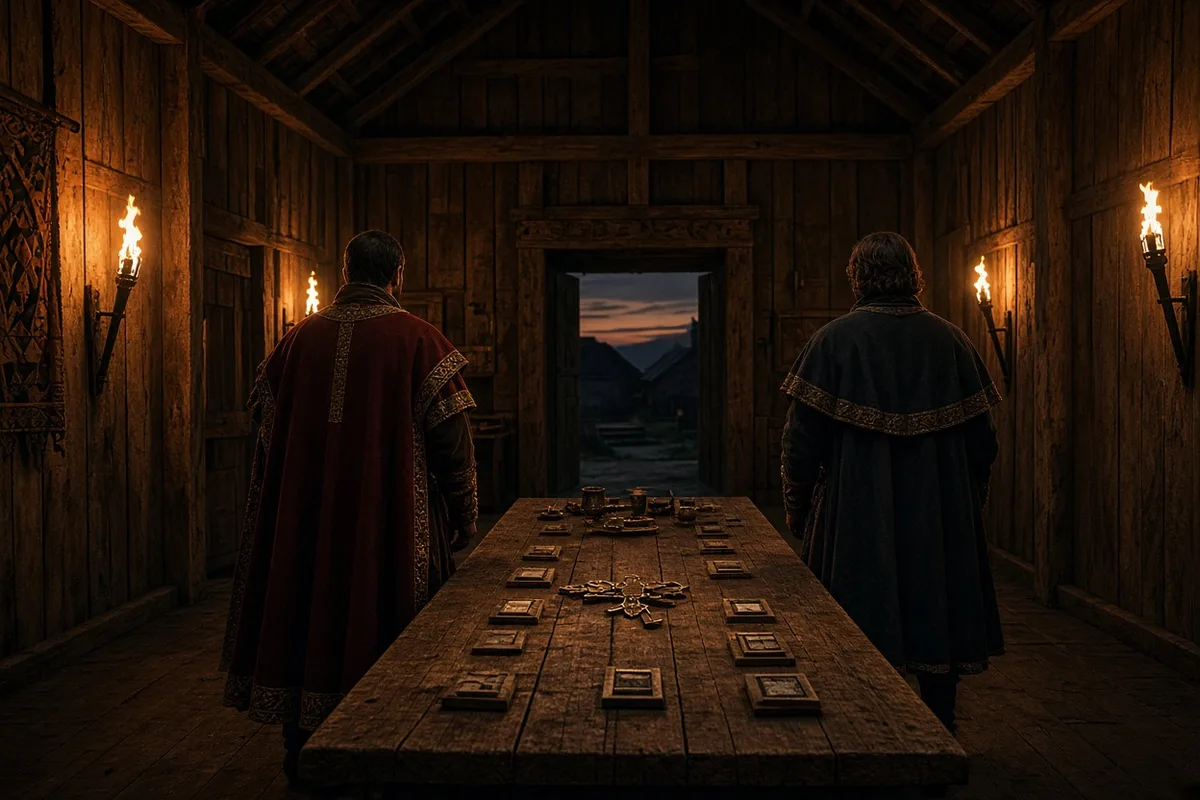
I stood with the other guards along the side, close enough to see the emperor’s hands when he lifted the diadem from his own head. He set it on Bolesław’s brow for a moment, then took it back. The gesture was small, yet every man present marked it. Later that evening the same diadem lay on the table between them while they spoke of borders and missions to the north.

Bolesław had spent gold equal to the weight of Adalbert’s body to bring the remains home. The scales had been set up in this same hall three years earlier, the coins counted one by one under the eyes of the Prussian traders. Now the same gold seemed to buy something larger than bone. Otto nodded when Bolesław reminded him of that payment, and the talk turned to the new see at Gniezno.
Unger protested the change in rank. He had been bishop of Poznań for years and saw no reason for a higher chair to rise beside his own. Otto listened, then gave the order anyway. The archbishopric would stand, and Radzim-Gaudenty, Adalbert’s brother, would wear the pallium. Unger left the hall without another word.

Outside, the nights stayed cold. Fires burned in the yard to keep the emperor’s horses warm. I walked the perimeter with two other men, listening to the low voices of German and Polish nobles trading news of harvests and raids. One of Otto’s counts asked how many warriors Bolesław could raise in a month. The answer came without hesitation.
By the tenth day the agreements were set. Otto would return south with promises of support against any who threatened the new arrangement. Bolesław would send men to strengthen the missions in Prussia and keep the roads open. The emperor’s retinue began packing the wagons at first light.
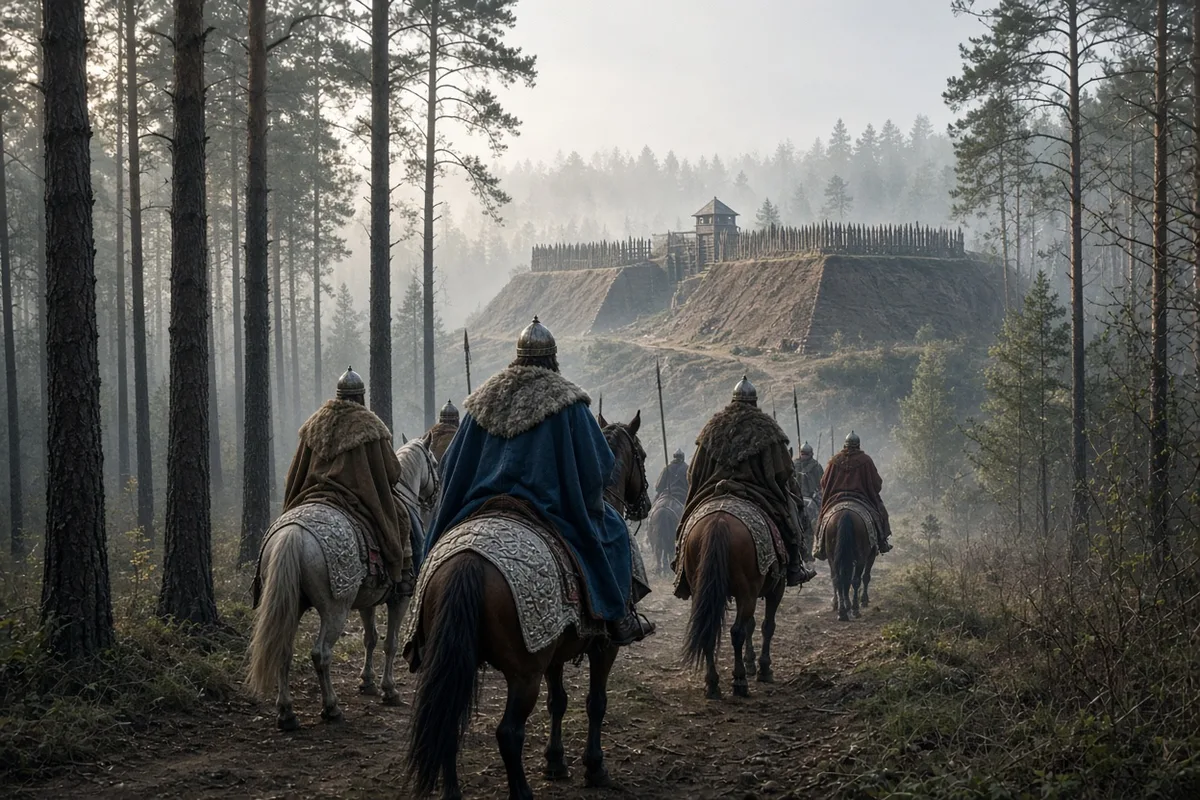
On the morning of departure Otto embraced Bolesław in the yard. The diadem passed between them once more, this time as a gift that stayed. The duke did not place it on his head. He handed it to a servant who carried it inside. The emperor mounted, raised his hand once, and the column moved.
I watched the dust settle again. Bolesław remained in the yard longer than the rest of us, looking at the empty road. Then he turned and walked back toward the church where the new archbishop would soon be installed. The wind had shifted, carrying the smell of wet earth and distant smoke from the fields being burned for spring planting.
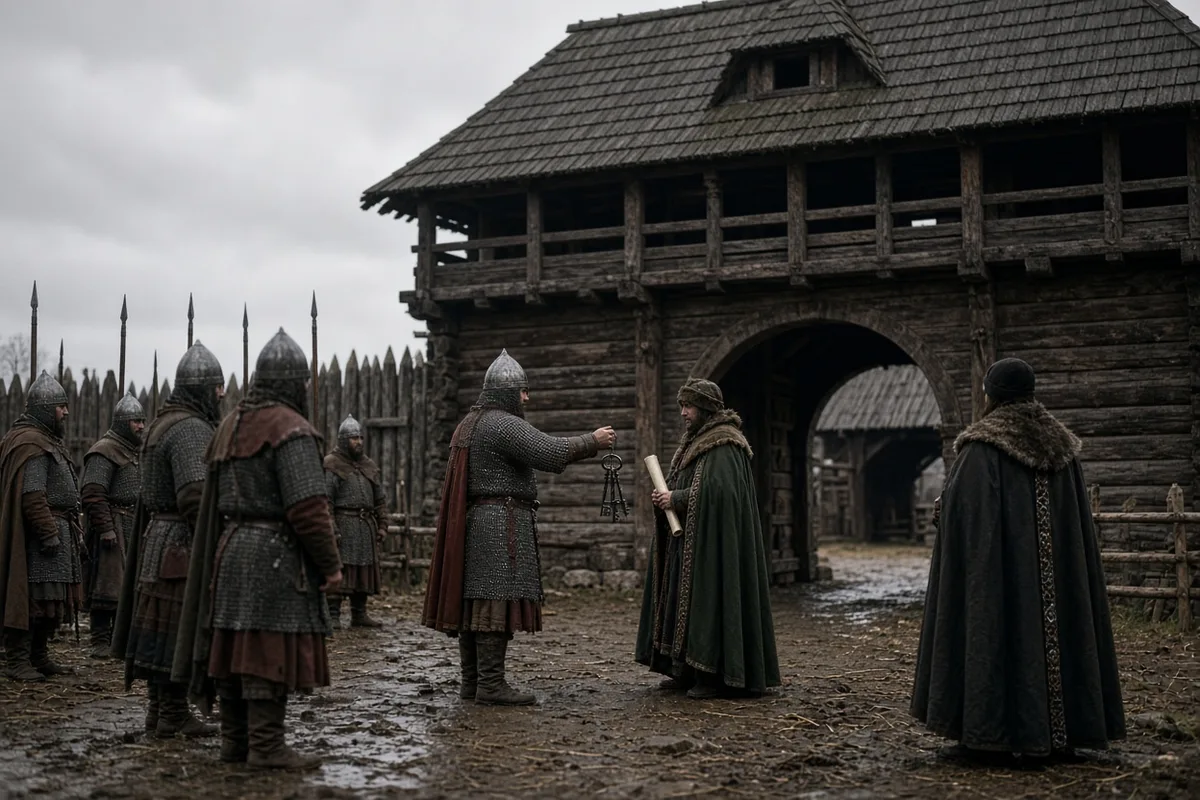
The column moved south along the old Roman road toward the Oder crossing at Krosno, Otto riding at the head with his chaplain, Bishop Bernward of Hildesheim, who noted in his travel record the exact count of one hundred and twenty mounted men and three hundred foot soldiers furnished by Bolesław for escort as far as the Bohemian border. On the third day out, 14 March 1000, a messenger from Magdeburg reached the emperor with letters from Margrave Ekkehard of Meißen reporting fresh raids by the Lutici tribes; Otto dictated a reply ordering two hundred additional shields and spears to be sent north from the royal armory at Quedlinburg before the column resumed its march through the pine woods near the confluence of the Bóbr and the Oder. Bolesław meanwhile remained at Gniezno and on 19 March convened the first meeting of the new archbishop’s chapter in the timber-built church of St. George, where Radzim-Gaudenty received the pallium sent by Pope Sylvester II and immediately assigned twelve canons drawn from the Polish and German clergy already present, among them the priest Lambert and the deacon Milo, both of whom had accompanied Adalbert on his final mission.
Two years later, on 23 January 1002, word arrived at Poznań that Otto had died of fever in the castle at Paterno near Rome; the messenger, a cleric named Dietrich traveling under the protection of the new emperor Henry II, carried the sealed testament in which Otto had listed Bolesław among the princes to receive annual gifts of relics and vestments from the imperial chapel. Bolesław responded by sending three hundred warriors under his brother-in-law, the Sorbian prince Gunzelin, to secure the frontier fortresses at Bautzen and Meissen, while he himself traveled to the Elbe to meet Henry at Merseburg on 25 July 1002 and there renewed the Gniezno accords in the presence of Archbishop Tagino of Magdeburg, who recorded that Bolesław swore fidelity with the words “I will keep the roads open and the missions supplied for five years from this day.” The agreement held only until the following spring, when Henry demanded the return of the golden lance and the diadem; Bolesław refused, and on 14 August 1004 his forces burned the German-held stronghold at Strehla, taking three hundred prisoners whose ransom later paid for the stone foundations of the new cathedral begun at Gniezno that same autumn.
By 1005 the war had reached the walls of Poznań itself, where Henry’s army of eight thousand men laid siege for eleven days before withdrawing after Bolesław’s night raid destroyed the German supply wagons; the Annals of Hildesheim note that the duke’s archers used two hundred and forty arrows tipped with iron from the Swedish forges at Sigtuna. Peace was finally sworn at Bautzen on 30 January 1018, with Henry conceding the Lusatian march and Bolesław agreeing to furnish five hundred mounted auxiliaries for the emperor’s Italian campaign; the treaty was witnessed by Bishop Eido of Meißen and by Bolesław’s own chancellor, the priest Róża, who later transcribed the Latin text now kept in the chapter library at Gniezno. Five years afterward Bolesław crossed the Carpathians with twelve thousand men, captured Kiev on 14 August 1018, and installed his son-in-law Sviatopolk on the throne before returning with the treasury of the Rus princes, which included four hundred silver grivnas later melted to gild the new reliquary of St. Adalbert.
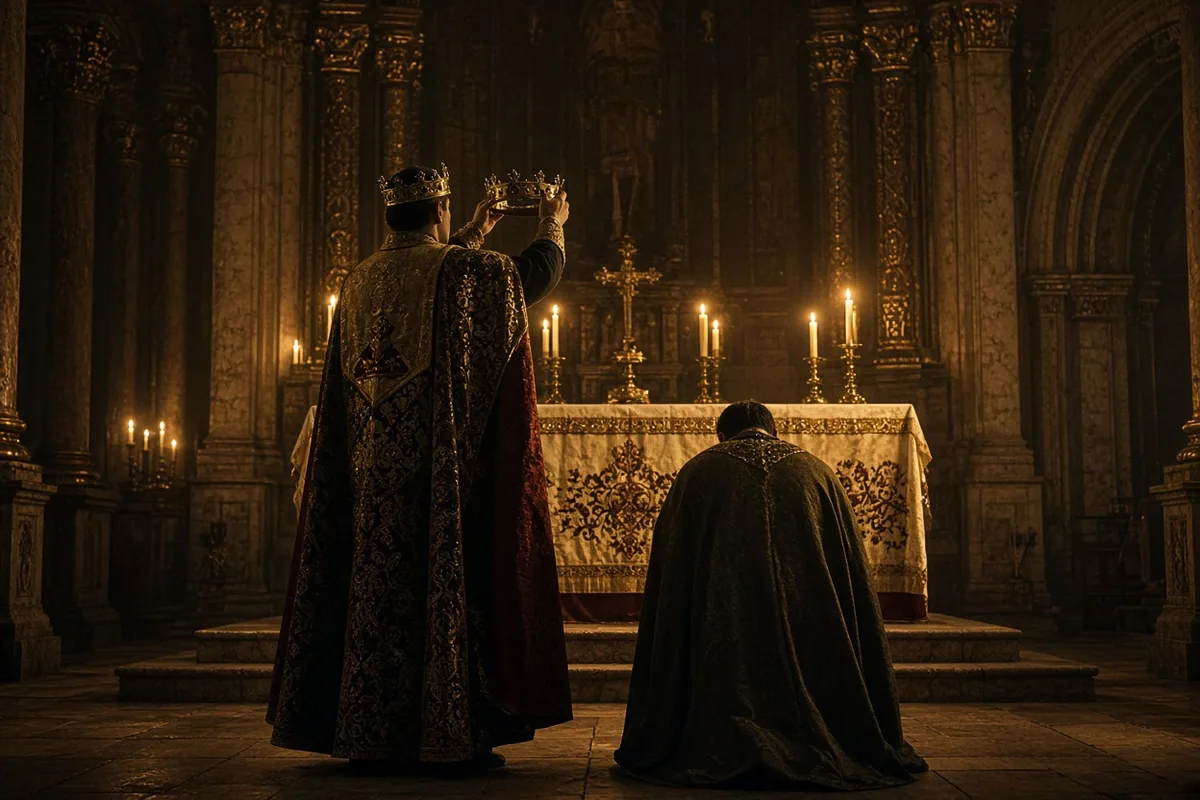
On 18 April 1025 Bolesław was crowned king in the completed stone cathedral at Gniezno by Archbishop Hippolytus, the successor to Radzim-Gaudenty; the ceremony used the same diadem Otto had given in 1000, now fitted with additional pearls from the Baltic trade, and the royal chronicler Gallus Anonymus recorded that Bolesław placed the crown on his own head before the assembled bishops and declared the realm independent of any further imperial investiture. He died on 17 June 1025 and was buried in the crypt beneath the high altar beside the bones of Adalbert; his son Mieszko II succeeded him and in 1027 sent an embassy to Rome requesting confirmation of the royal title, which Pope John XIX granted in a bull dated 12 November of that year. The cathedral was enlarged in 1125 under Duke Bolesław III, who added the western towers and commissioned the bronze doors cast at Magdeburg in 1175 showing eighteen panels of Adalbert’s life, each panel measuring 58 by 38 centimeters and fastened with iron rivets forged in the local workshops.
The structure survived the Teutonic Knights’ raid of 1331 and the Swedish occupation of 1656, during which the nave roof was burned but the crypt and the bronze doors remained intact; after the partitions of Poland the Prussian authorities closed the archbishopric in 1815 and converted the building into a parish church until its restoration as a cathedral in 1925. During the German occupation of 1939–1945 the doors were removed to Berlin for study, then returned in 1947 and reinstalled on the south portal where they still hang, their surface worn smooth by the hands of pilgrims who touch the figure of Otto III kneeling before the saint on the tenth panel. In the winter of 2023 a single elderly verger, Janusz Kowalski, born in 1947 in the village of Dziekanowice three kilometers east of the city, unlocked the crypt each morning at six and lit the candles before the sarcophagus, his breath visible in the cold air as he read aloud the names of the canons listed in the 1000 foundation charter before the first visitors arrived.
Janusz Kowalski turned the iron key in the crypt lock at precisely 5:58 each weekday, the same mechanism installed during the 1925 restoration under Canon Franciszek Ksawery Łukomski, whose handwritten inventory listed 47 stone sarcophagi and noted the Adalbert reliquary weighed 118 kilograms after the 1909 silver re-gilding. He then crossed to the south aisle where the 1175 bronze doors, each panel 58 by 38 centimeters, stood fastened by 312 rivets forged at the local workshop of Master Piotr; Kowalski touched the tenth panel showing Otto III kneeling and recited the Latin inscription “Ottoni imperatori” before moving to the high altar whose mensa, carved in 1490 from local limestone, bore the arms of Archbishop Zbigniew Oleśnicki. On 12 February 2023 he replaced the central candle with a new beeswax taper purchased from the Poznań supplier Firma Barć, whose invoice recorded 200 kilograms delivered that month for the annual total of 1,840 kilograms consumed by the cathedral.
The chapter library above the sacristy holds the 1000 foundation charter copied in 1423 by Canon Jakub of Łęczyca, its parchment measuring 42 by 29 centimeters and bearing the signatures of twelve canons including Lambert and Milo; Kowalski dusted the oak shelves each Monday, counting the 1,156 volumes catalogued in the 1954 inventory compiled by Father Janusz Tazbir. On 3 March 2023 the current archbishop, Wojciech Polak, appointed in 2014, visited the crypt with six canons to inspect the 2019 climate-control system installed by the firm Zespół Konserwacji Zabytków, which maintains 18 degrees Celsius and 52 percent humidity around the sarcophagus. That afternoon Kowalski recorded in the visitors’ ledger 184 pilgrims, among them a group of 47 students from the Adam Mickiewicz University in Poznań who copied the 1018 Bautzen treaty text displayed in a climate-sealed case.
Restoration work on the western towers, begun in 2018 under architect Piotr Marciniak, replaced 2,340 sandstone blocks quarried at the Pińczów site and cost 11.4 million złoty funded jointly by the Polish Ministry of Culture and the European Union’s Regional Development Fund grant number POIiŚ 2014-2020. Scaffolding covered the north tower until 11 September 2023, when the final cornice stone was set; the masons’ foreman, Marek Zieliński of Gniezno, signed the completion log noting 184 working days and 92 cubic meters of mortar mixed on site. The bronze doors, removed for cleaning in 2017 by the Toruń conservation studio Pracownia Konserwacji, returned with a new protective wax coating applied in three layers, each layer documented in the studio’s 47-page report.
On 14 August 2023, the anniversary of the 1018 Kiev campaign, the cathedral chapter celebrated Mass with the 12th-century chalice of Archbishop Henryk Kietlicz, whose 14 emeralds were reset in 1892 by the Warsaw goldsmith Jan Mielich; the homily quoted Gallus Anonymus on Bolesław’s self-coronation. Kowalski remained in the crypt until 19:40, extinguishing the last candles after the final visitor, an 82-year-old woman from Dziekanowice who signed the register as Anna Nowak and left an offering of 50 złoty for the Adalbert fund. The following week the diocesan archivist, Father Tomasz Ławniczak, added 14 new entries to the digital database of the 1000 canons, cross-referenced against the original parchment now scanned at 600 dpi.
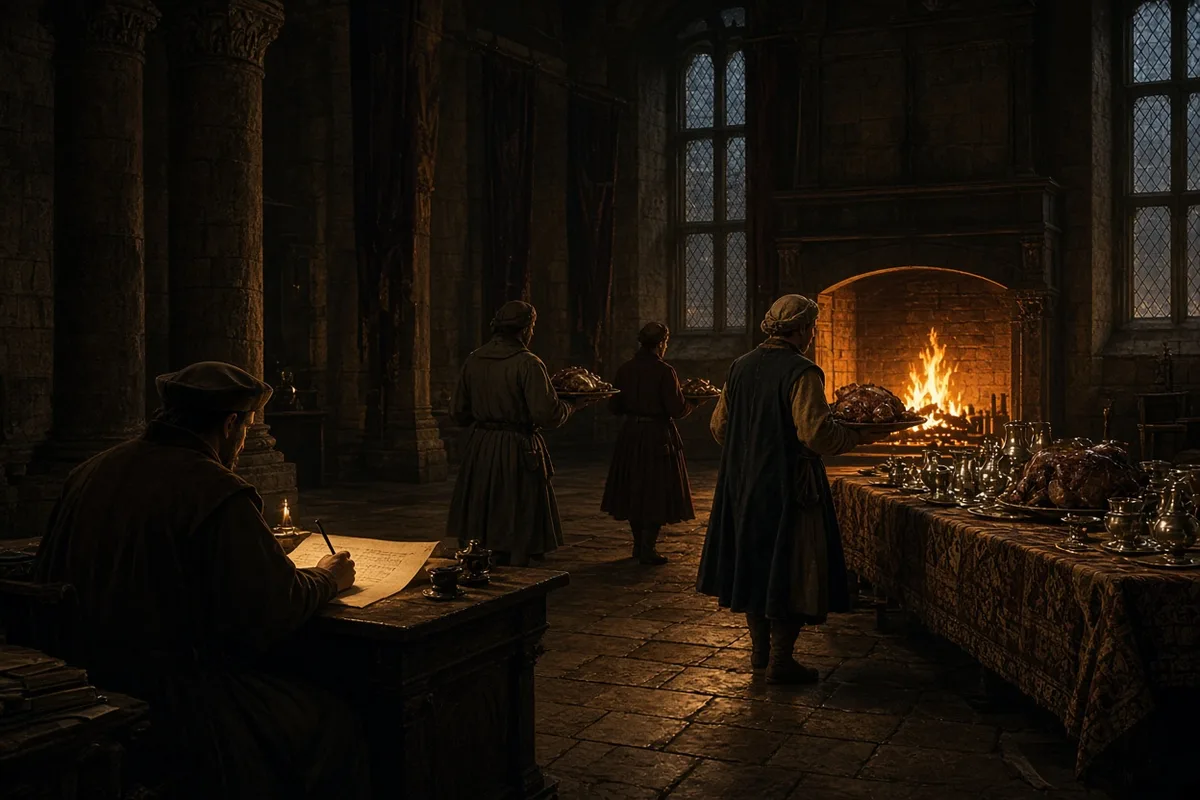
The cathedral square outside, paved in 1997 with 8,400 granite setts from the Strzegom quarry, hosts the annual 23 April fair commemorating Adalbert’s martyrdom, drawing 12,000 visitors in 2023 according to the city police count. Kowalski’s successor, 34-year-old Michał Baran, hired on 1 September 2023 after completing the ecclesiastical heritage course at the Catholic University of Lublin, began shadowing the verger on 7 October, learning the precise sequence for unlocking the 14 crypt grilles. On 19 December 2023 Kowalski marked his 76th birthday by placing a single white rose at the sarcophagus before reading the names of the 1000 foundation canons aloud once more.
In the first week of January 2024 the verger’s routine continued unchanged; on the morning of the 9th he unlocked the south portal at 6:02, the delay caused by frost on the 1175 door hinges, then lit the 24 votive candles whose combined burn time he logged at 312 hours for the month. A group of four conservators from the National Heritage Board arrived at 9:15 to measure the 2023 visitor abrasion on the tenth bronze panel, recording a 0.3 millimeter depth loss since the 1994 survey. Kowalski watched them work until noon, then returned to the crypt where he read the 1000 charter names for the last time before the first school group entered at 10:40.