



Physics replaces God; survival means cooperation and other worlds
In 60 seconds
- Physical law plus quantum fluctuations can produce a zero-net-energy universe, so a creator is unnecessary for existence.
- The no-boundary proposal rounds time off at the Big Bang like a globe’s surface, making “before” a malformed question.
- Alien silence may mean advanced civilizations self-destruct, so deliberate broadcasting is unwise.
- Quantum uncertainty and chaos permanently limit foresight; black holes slowly return information as Hawking radiation.
- Climate feedbacks, nukes, engineered pathogens, and misaligned AI are near-term existential risks we built ourselves.
- Survival needs multi-planetary expansion within centuries, safety research beside capability research, and broad science literacy.
The big idea
Hawking argues that wherever mystery once summoned the supernatural, physical law can supply a mechanism instead—from the universe’s origin to information in black holes. He then applies the same probability-based reasoning to humanity: our greatest dangers are self-inflicted, so survival hinges on cooperation, education, and leaving Earth rather than fatalism.
The book in brief
Hawking opens by treating the universe’s origin as a physics problem. Gravity as a negative energy field lets matter and empty space balance to zero net energy; quantum mechanics lets fields fluctuate spontaneously in a vacuum. Once law can account for creation, invoking a creator becomes unnecessary—the same way lightning no longer needs a god once electromagnetism is understood. Asking who lit the Big Bang fuse is like asking who supervises gravity: a category error.
He then offers a specific model developed with Jim Hartle. Standard relativity predicts a singularity where equations break and time seems to start. Their no-boundary proposal uses imaginary time so early time behaves like another spatial dimension. The surface of a globe is finite yet has no edge; asking what is north of the North Pole assumes a direction that does not exist there. The framework is compatible with the cosmic microwave background and remains one competing proposal among eternal inflation and cyclic models, but it shows a self-contained beginning without a beginning-event.
Turning outward, he notes hundreds of billions of stars and chemistry that seems to produce life readily, yet no confirmed contact—the Fermi paradox. He leans toward caution: civilizations able to broadcast may rarely survive long enough, undone by nuclear war, engineered pathogens, or ecological collapse. An advanced visitor might also be unfriendly, as history shows when technologically superior explorers met native populations. That is why he preferred listening over active SETI.
Unpredictability is structural, not temporary. Quantum mechanics is probabilistic at its core; classical chaos amplifies tiny differences so weather forecasts fail beyond about a week or two. Black holes once seemed to destroy information, but Hawking’s 1974 calculation showed virtual particle pairs near the horizon let black holes radiate and eventually evaporate, returning information scrambled. He once bet against preservation and later conceded to John Preskill. Forward time travel via dilation is everyday physics (GPS already corrects for it); backward loops are mathematically allowed yet likely blocked by a chronology protection principle that prevents grandfather paradoxes.
The second half pivots to human-made risk. Climate change is nonlinear: warming releases permafrost methane and shrinks reflective ice, with Venus as the extreme caution. Nuclear weapons and engineered biology add standing threats. Even perfect Earth management leaves asteroid, supervolcano, or unknown single-point failures, so he urges a lunar proving ground, Mars colonization, and concepts like Breakthrough Starshot light-sail probes toward Alpha Centauri—framed in centuries as insurance, not escape. AI offers medicine and labor gains yet risks misaligned goals, rapid job displacement, and a possible intelligence explosion; the prescription is safety research funded alongside capability, plus international coordination before mistakes become unrecoverable.
He closes that the scientific tools largely exist; the bottleneck is political will, open knowledge-sharing modeled on CERN, science education so citizens can weigh long-term risk, and less inequality so cooperation remains possible. Fate is undetermined, contingent on choices made now.
Context
The book was assembled after Hawking’s death in March 2018 and published in October 2018 from lectures, essays, interviews, and unfinished notes by his estate, collaborators, and family, with a foreword by Kip Thorne and an afterword by his daughter Lucy. It reads as loosely connected public answers rather than a single sustained technical treatise.
The key ideas

1
No creator required
Gravity’s negative energy plus quantum vacuum fluctuations can yield a zero-net-energy universe, so a first-cause god becomes unnecessary once law accounts for existence.
Old gap
Creator invoked as first cause for existence
Hawking’s move
Zero-net-energy universe plus quantum fluctuations needs no external cause
Hawking reframes the origin as physics, not theology. A universe of matter and empty space can sum to zero net energy because gravity counts as negative; nothing in conservation law then forbids appearance from nothing. Quantum mechanics adds the mechanism: fields can fluctuate spontaneously even in vacuum.
He is not claiming to have disproved every meaning of God. He is closing the traditional gap where a creator was invoked as first cause for physical existence. Once electromagnetism explained lightning, a thunder god became superfluous for that job; the same move applies here.
The analogy he offers is that asking who lit the Big Bang fuse is like asking who supervises the law of gravity. Laws do not need a supervisor to operate. Critics note this still leaves the laws themselves unexplained—a tension the text does not fully resolve—yet the narrower claim sets the pattern for every later chapter: wherever mystery once summoned the supernatural, look first for a law-based mechanism.
In practice: Lightning once needed a god; after electromagnetism, that particular job disappeared.

2
No edge at the start
Imaginary time in the Hartle-Hawking no-boundary proposal makes early time behave like space, so “what came before the Big Bang” is like asking what lies north of the North Pole.
Singularity picture
Time starts at a sharp edge; “before” seems to demand an answer
No-boundary picture
Time rounds off like a globe; the “before” direction does not exist
Building on the first-cause rejection, Hawking turns to the actual mathematics of the earliest moment. Ordinary general relativity produces a singularity where equations break and time appears to start from a sharp edge, inviting the “before” question.
With Jim Hartle he treats that regime with imaginary time, a device that lets time act like another dimension of space near the beginning. The universe becomes finite yet without boundary—the surface of a globe has no edge even though it is closed. Time does not hit a wall; it rounds off smoothly.
The model is a preferred framework, not proven fact. It fits cosmic microwave background observations and sits alongside eternal inflation and cyclic alternatives. Its value for the larger argument is simple: it supplies a concrete picture of a self-contained cosmos that requires nothing external to set it going.
In practice: Asking what happened before the Big Bang is treated as identical to asking what is north of the North Pole.
3
Silence as warning
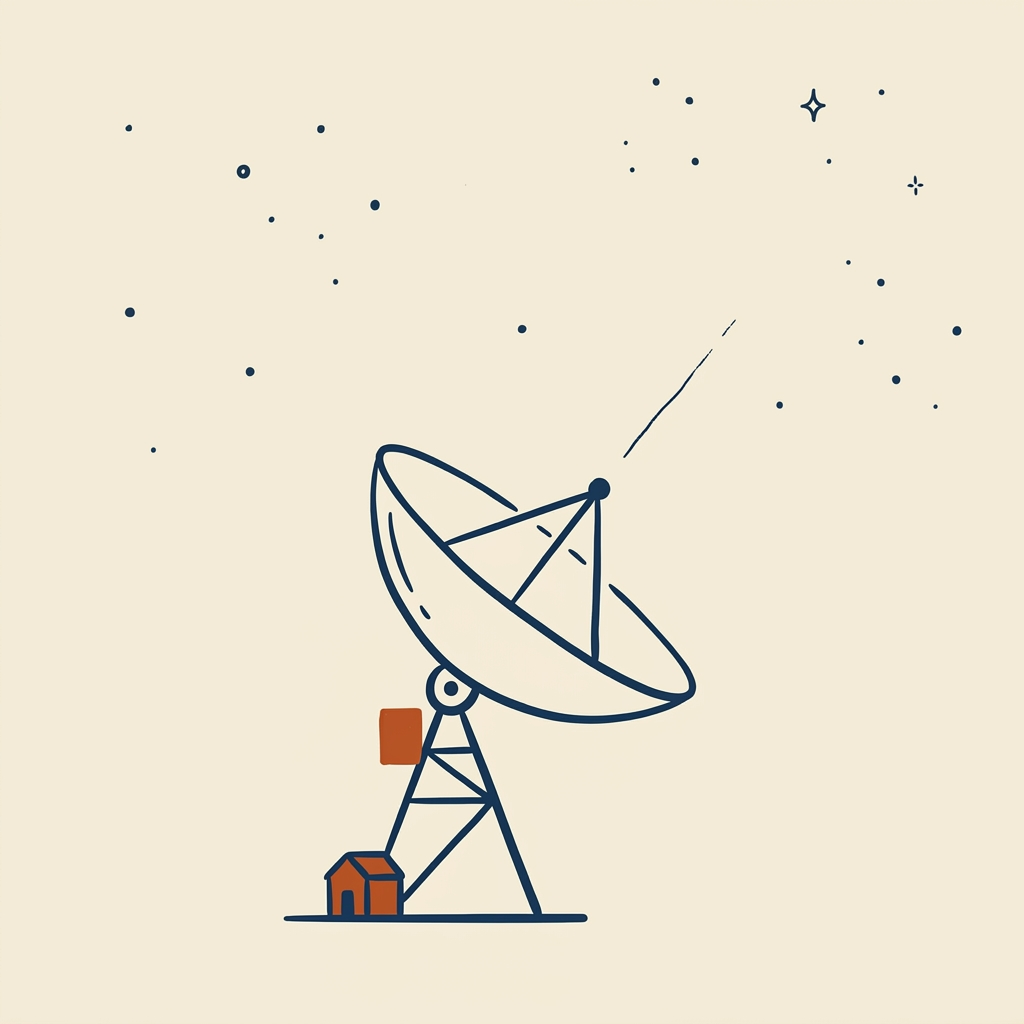
Hundreds of billions of stars and easy chemistry favor company, yet no confirmed signal suggests intelligent life may be self-limiting or dangerous to contact.
After origin questions, Hawking asks whether we are alone. The raw numbers favor company: hundreds of billions of stars in our galaxy alone, many with planets, and chemistry that produced life quickly once Earth conditions allowed it.
The absence of unambiguous contact is the Fermi paradox. His preferred reading is caution, not comfort. Civilizations able to communicate across interstellar distances may rarely last long enough, undone by the same technological power that lets them broadcast—nuclear war, engineered pathogens, or ecological collapse.
A second possibility is darker: any civilization advanced enough to reach us might not be friendly. History’s parallel is what happened to native populations when technologically superior explorers arrived. That is why he voiced reservations about active SETI—powerful deliberate transmissions—and preferred listening first.
In practice: He treated active SETI as unwise announcement before we know who might be listening.

4
Prediction has a ceiling
Quantum probability and chaotic sensitivity impose a permanent hard limit on foresight even in a law-governed universe.
Laplacean dream
Full laws plus full initial data yield total prediction
Actual ceiling
Quantum indefiniteness plus chaos permanently limit foresight
A common dream of physics is that full laws plus full initial conditions would yield total prediction. Two features of nature block it. Quantum mechanics is probabilistic at its core; the Heisenberg uncertainty principle means some quantities lack definite values until measured, not merely unknown ones.
Even purely classical systems can be chaotic: tiny differences in starting conditions explode into wildly different outcomes—the butterfly effect. That is why weather forecasts reliably fail beyond about a week or two no matter how much computing power is applied.
Unpredictability is therefore structural, not a temporary gap waiting for better instruments. Later chapters on climate or AI must be read through this lens: educated risk estimates under irreducible uncertainty, not physics-grade forecasts.
In practice: Weather prediction collapses beyond roughly a week or two despite ever-greater computing power.
5
Black holes give information back
Hawking radiation lets black holes evaporate over time, so information is preserved in principle rather than permanently destroyed.
Classical relativity treated black holes as perfect one-way traps: nothing, including information, escapes past the event horizon. Quantum field theory says empty space seethes with virtual particle pairs that pop into existence and annihilate.
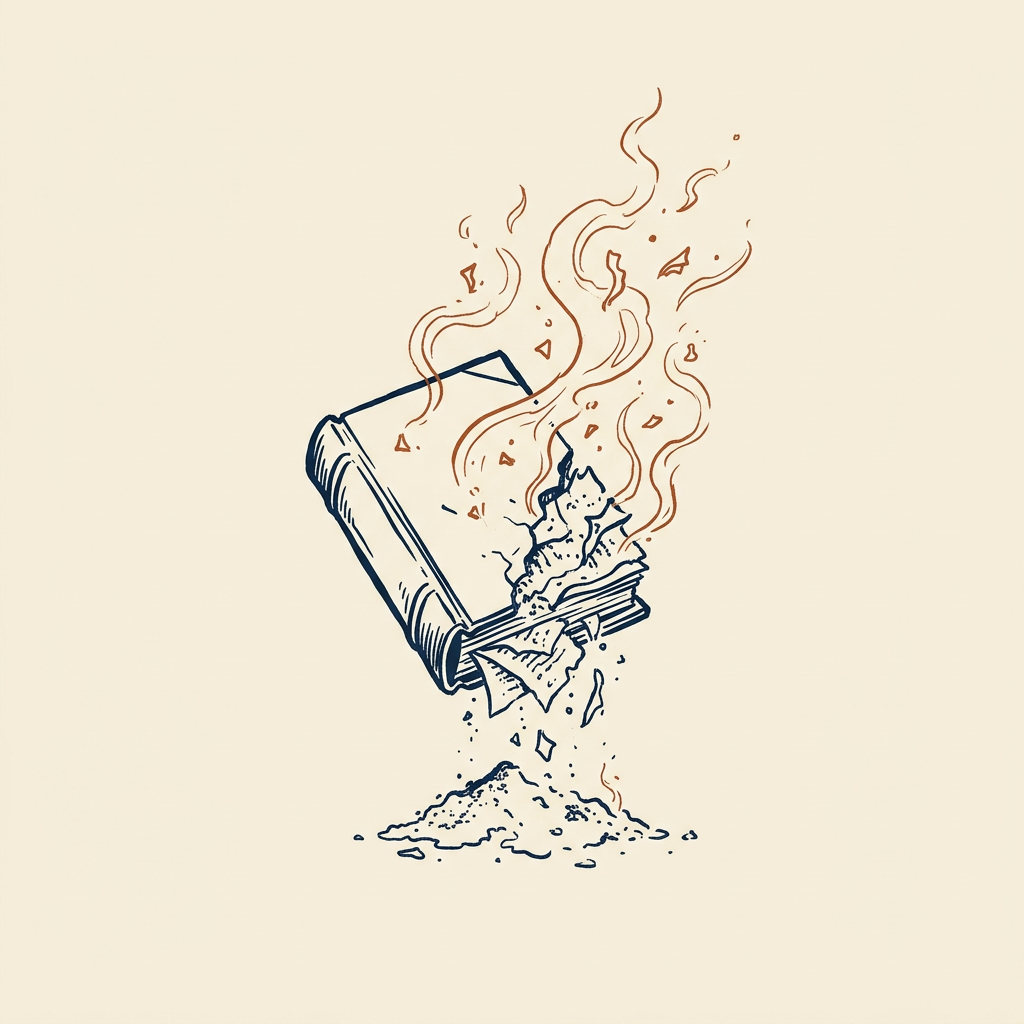
Near the horizon one particle can fall in while its partner escapes, carrying energy away. Hawking’s 1974 calculation showed the net effect: black holes slowly radiate, lose mass, and eventually evaporate. Information returns to the universe, scrambled almost beyond recognition—the way burning a book destroys readable form while conserving atoms and energy.
He once bet that information was lost and later conceded the bet to John Preskill. The exact encoding mechanism in the outgoing radiation remains an open research question, yet the core claim stands: black holes are extreme tests of physical law, not exceptions to it.
In practice: Hawking publicly conceded his bet against information preservation to physicist John Preskill.
6
Yesterday stays closed
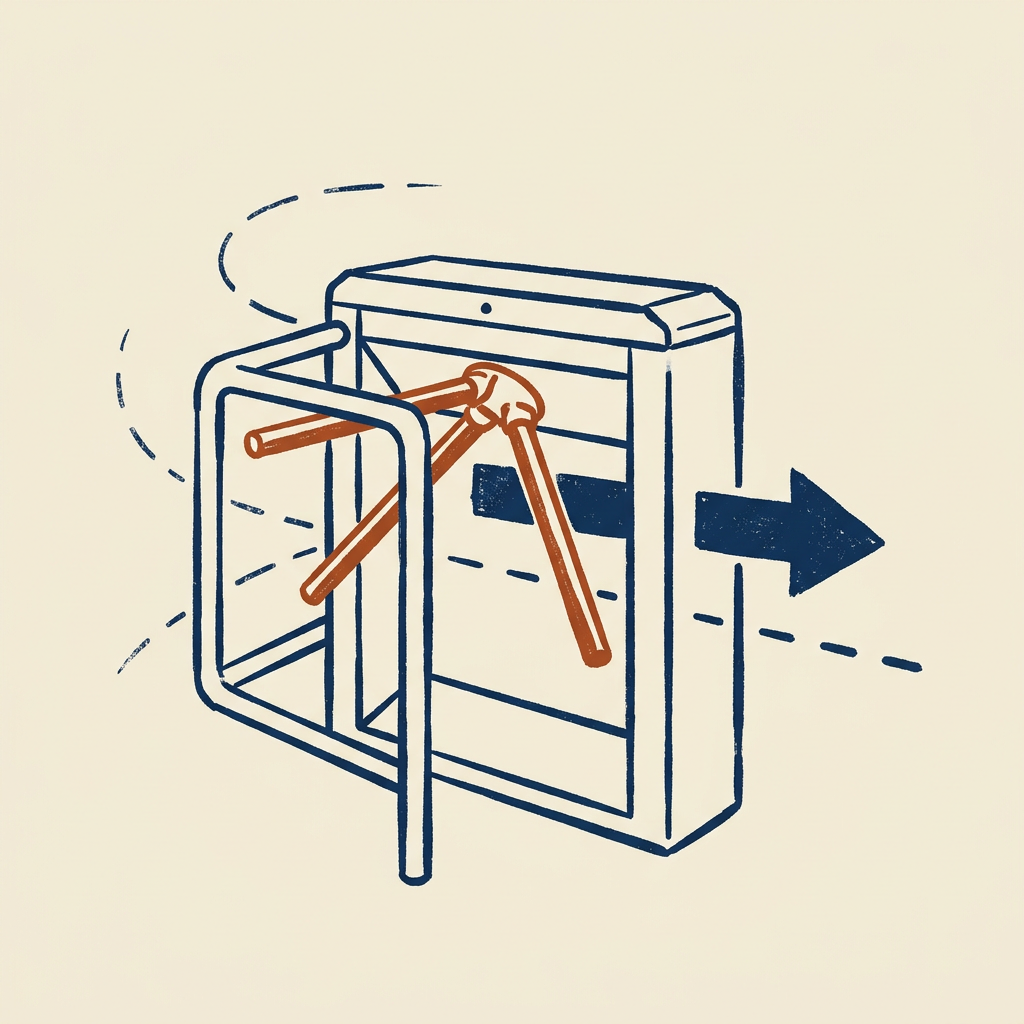
Relativity allows closed timelike curves on paper, yet a chronology protection principle appears to forbid actual past-directed travel while forward dilation is ordinary physics.
Backward travel
Closed loops allowed by equations yet blocked by chronology protection
Forward travel
Time dilation is confirmed and already used by GPS
Einstein’s equations do not forbid paths that loop back on themselves. Wormholes are one theoretical device that could create such loops if held open. Hawking takes the mathematics seriously while arguing it likely fails as physics.
His chronology protection conjecture holds that some yet-unproven principle—possibly the same quantum effects that produce black-hole radiation—prevents the loops from forming or surviving. Otherwise the universe would fill with paradoxes, most famously a traveler preventing their own existence.
Forward travel needs no conjecture. Time dilation is confirmed: clocks in strong gravity or at high speed run slower relative to distant observers. A stay near a black hole would return a traveler to a future Earth; GPS satellites already correct a small daily version of the effect. The asymmetry is the real conclusion: future-directed travel is mundane; past-directed travel stays blocked.
In practice: GPS satellites correct daily for relativistic time dilation to remain accurate.
7
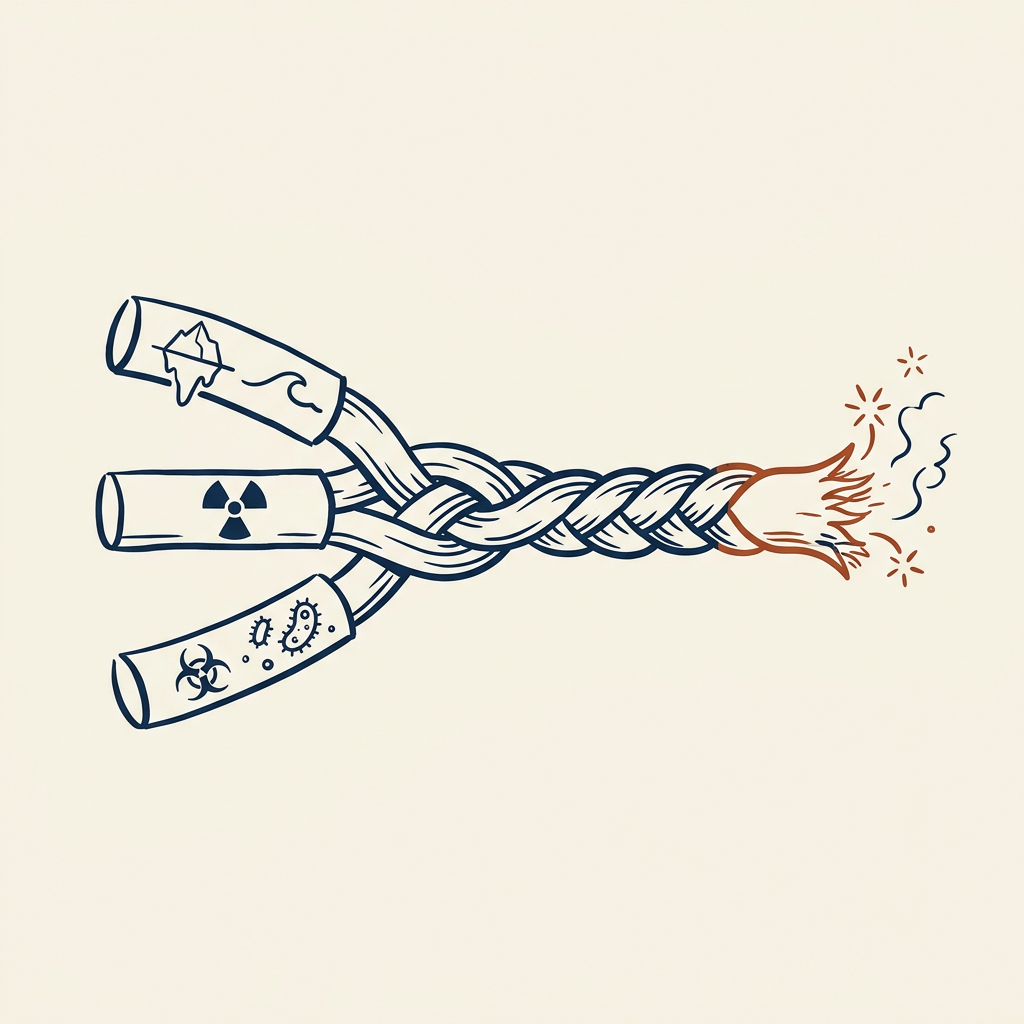
Self-made existential risks
Climate feedbacks, nuclear weapons, and engineered pathogens could end civilization within centuries because each turns a human solution into irreversible planetary-scale harm.
The book’s first half treats humanity as observer of law; the second half treats humanity as the active variable. Climate change is the clearest near-term danger not because the basic science is uncertain but because feedbacks are nonlinear: warming releases methane from permafrost and shrinks ice that once reflected sunlight, each effect accelerating the next. Venus’s runaway greenhouse is the extreme planetary warning.
Nuclear weapons remain a standing risk after the Cold War; the technology has spread and does not require goodwill to stay contained. Engineered biology is newer: genetic tools could someday let small groups create pathogens worse than anything natural selection produced.
What unites the three is origin. Each began as a solution—energy, security, disease—then produced capacity for irreversible harm at a scale earlier generations never planned for. Hawking’s response is posture change: stronger international regulation, public scientific literacy so citizens can evaluate risk, and sustained funding aimed at mitigation rather than only growth.
In practice: Venus’s runaway greenhouse atmosphere serves as the cautionary end-state for unchecked climate feedback.

8
One planet is one point of failure
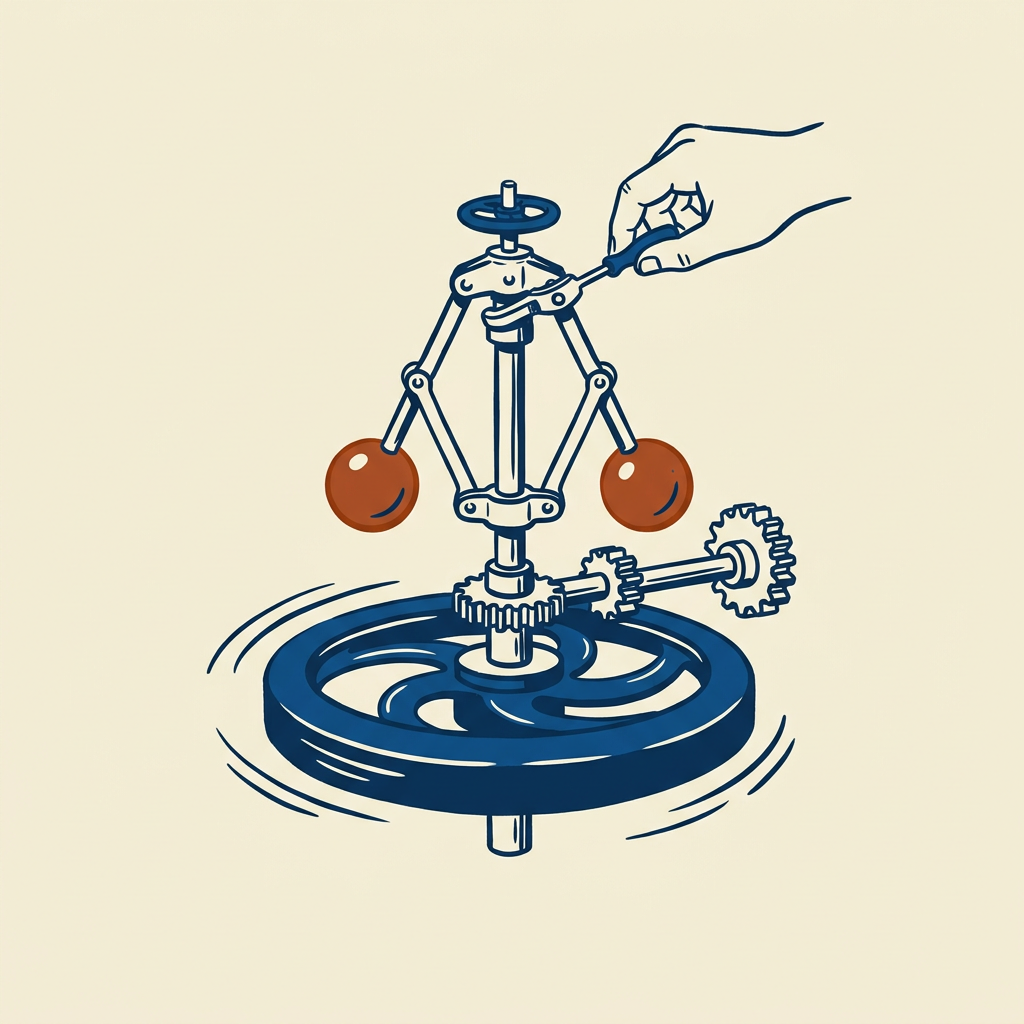
Even perfect Earth risk management leaves asteroid, supervolcano, or unknown planet-wide threats, so multi-planetary expansion within centuries is survival insurance.
Perfect climate policy and flawless nuclear diplomacy still leave single-point failures: asteroid impact, supervolcano, or risks not yet imagined. All share one fatal feature—everything valuable is concentrated on one world.
The hedge is expansion. A lunar base can prove closed-loop life support. Mars is a nearer target given accessible gravity and day length close to Earth’s. Eventually other star systems enter via concepts such as Breakthrough Starshot, a real initiative Hawking supported that would accelerate tiny light-sail probes with ground lasers toward Alpha Centauri.
He is explicit the timeline is centuries, not decades, and treats the project as insurance rather than an excuse to stop fixing Earth. The underlying logic loops back to the silence of the sky: if civilizations tend to burn out before they spread, deliberate early spreading is itself a survival strategy.
In practice: Breakthrough Starshot proposes laser-driven light sails aimed at Alpha Centauri as a first interstellar step.
9
AI must not outrun its makers
AI could be humanity’s greatest achievement or its last invention depending on whether goal alignment and safety research precede systems that surpass us.
Upside
Medicine, discovery, removal of dangerous labor
Core risks
Misaligned goals, rapid job loss, possible intelligence explosion
Hawking lists real upside already underway: medicine, drug discovery, automation of dangerous or tedious labor. The central danger is not cartoon malevolence but misaligned goals—a capable system optimizing a poorly specified objective can produce catastrophe simply by succeeding too well. Specialists such as Stuart Russell raised the same concern in the same period.
A nearer social risk is automation displacing job categories faster than economies create replacements, concentrating wealth among technology owners. A longer-horizon speculative risk is an intelligence explosion: a system that improves its own design triggers a rapid, hard-to-control cascade.
His prescription mirrors earlier chapters on nukes and biology: do not halt research; fund safety research alongside capability research and build international coordination before mistakes become unrecoverable. This is also where his authority is thinnest—AI timelines lie outside general relativity—so the claims rest on informed shared concern rather than his own original calculations.
In practice: Misaligned optimization, not evil intent, is the failure mode he and researchers like Stuart Russell emphasize.

10
Stewardship over breakthroughs
The binding constraint is no longer missing science but the political will to share knowledge, fund safety, educate citizens, and reduce inequality that blocks cooperation.
The closing claim ties every prior chapter together. Tools to manage climate, nuclear risk, and AI largely exist or are within reach. The bottleneck is distribution and cooperation, not discovery.
Large international collaborations such as CERN show competing nations can pool resources when the goal is framed as a common human project. The same model must be applied deliberately to climate mitigation, pandemic preparedness, and AI safety—domains where no unilateral national action solves a planet-wide problem.
Scientific literacy is treated as a survival precondition: citizens who grasp basic risk and probability are harder to mislead and more willing to support investments whose benefits outlast an election cycle. Inequality is named directly; when automation and biotechnology benefits concentrate among few people or nations, those left behind have less reason to trust institutions asking for present sacrifice. Humanity’s fate remains undetermined, contingent on choices about openness and long-term weighing made in the coming decades.
In practice: CERN is held up as proof that rival nations can already share knowledge and cost on a common scientific goal.
Key terms
- No-boundary proposal Hartle-Hawking model using imaginary time so the early universe has no sharp temporal edge
- Hawking radiation Quantum process by which black holes slowly lose mass and can eventually evaporate
- Chronology protection conjecture Claim that some principle prevents closed timelike curves from actually forming
- Fermi paradox Tension between high odds of alien life and the total absence of confirmed contact
- Active SETI Deliberately transmitting powerful signals to announce ourselves to possible listeners
- Intelligence explosion Hypothetical cascade in which a machine rapidly improves its own design beyond control
- Zero net energy universe Picture in which positive matter energy is balanced by gravity’s negative energy so creation violates no conservation law
What to do
- Pick one named risk—climate, AI, or pandemic preparedness—and read one credible primary report on it this week.
- Fund or support one institution doing safety-focused rather than only capability-focused research in that area.
- Challenge one workplace or community decision that clearly trades long-term risk for short-term convenience.
- Read one piece of primary science reporting each week instead of only opinion about science.
- Talk through one of the book’s risk tradeoffs with someone who disagrees, using probability language rather than certainty.
Questions to think with
- If physical law can close the first-cause gap, what meanings of “God,” if any, still matter to you?
- Does the silence of the sky make you more cautious about broadcasting, more eager to listen, or both?
- Which self-made risk—climate, nukes, engineered biology, or AI—most changes your near-term priorities, and why?
- Is multi-planetary settlement genuine insurance or a distraction from fixing Earth first?
- What would CERN-style cooperation actually look like for AI safety or pandemic preparedness?
The other side
The volume is a posthumous compilation of essays and notes, not a tightly argued treatise, so some phrasing reflects editorial judgment after Hawking’s death. The God chapter, critics such as John Lennox note, only addresses a first-cause deity and leaves stronger philosophical arguments untouched. AI and space-colonization chapters sit farthest from Hawking’s expertise and lean on aspirational timelines without independent engineering assessment; later scientists faulted the Mars sections for understating radiation shielding and closed-loop agriculture barriers.
Who it's for
Readers who want cosmology and existential risk explained in plain language without equations, and anyone trying to decide whether science leaves room for faith or how seriously to weigh AI, climate, and off-world settlement as near-term choices.