


Pilgrims Sign Mayflower Compact
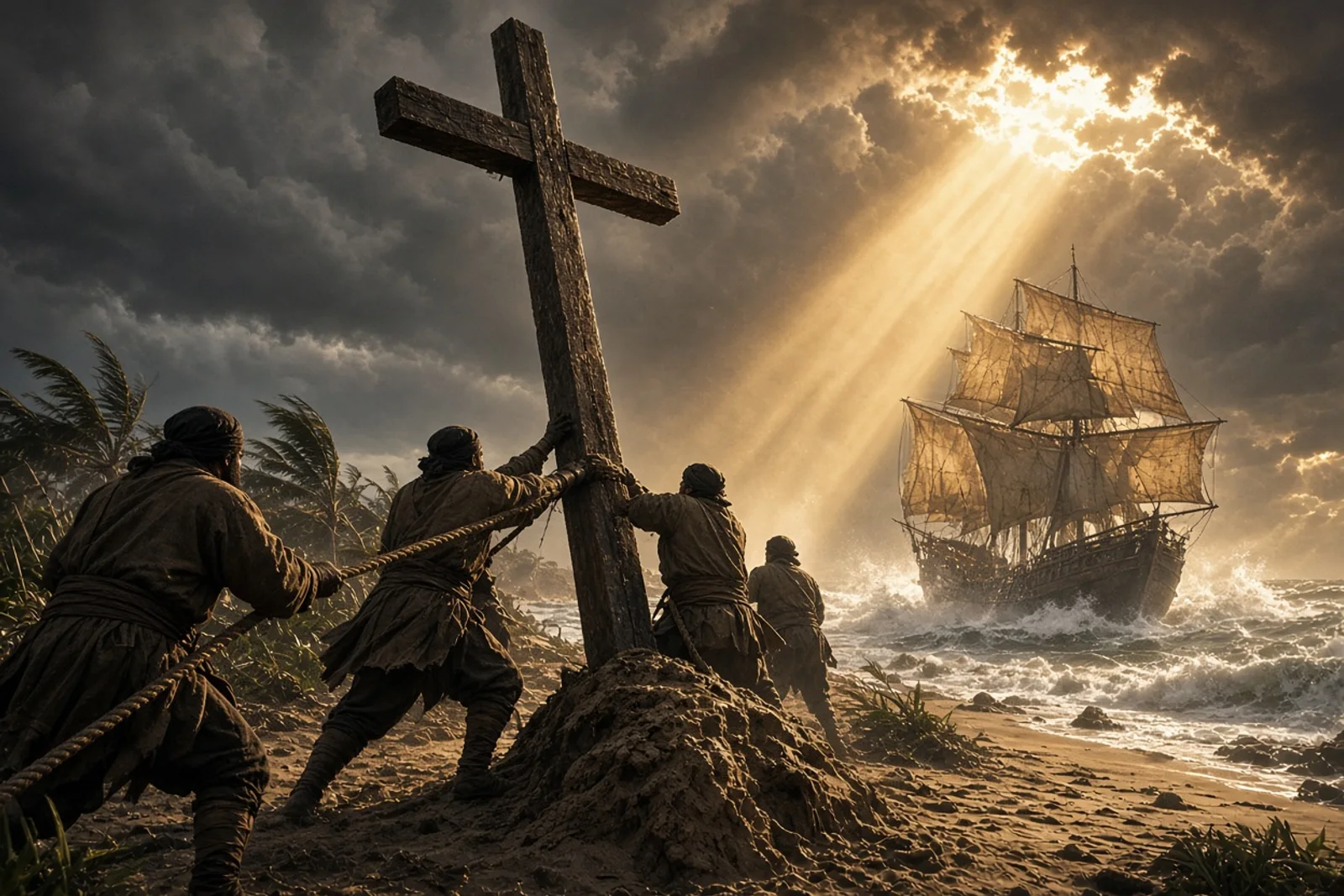
The anchor chain rattled down through the hawsehole just after dawn. Salt spray stung the deck planks where I stood with my back against the mainmast, watching the hook of land curve around us. Men below had begun arguing before the sails were fully furled. Their voices carried up the companionway, thick with the smell of wet wool and bilge.
I had crossed with them as one of the hired hands, no share in the venture, only the promise of wages if we ever reached a shore that would take us. The voyage had already taken sixty-six days. Provisions sat low in the hold. The wind that morning cut across the water with a winter edge, though the calendar still read November.
Below, someone said the words again. Since we lay north of the Virginia grant, no patent bound any man here. A few of the strangers repeated it louder each time the idea surfaced. One of them, a carpenter from London whose name I never learned, claimed he would go where he pleased once his feet touched land.
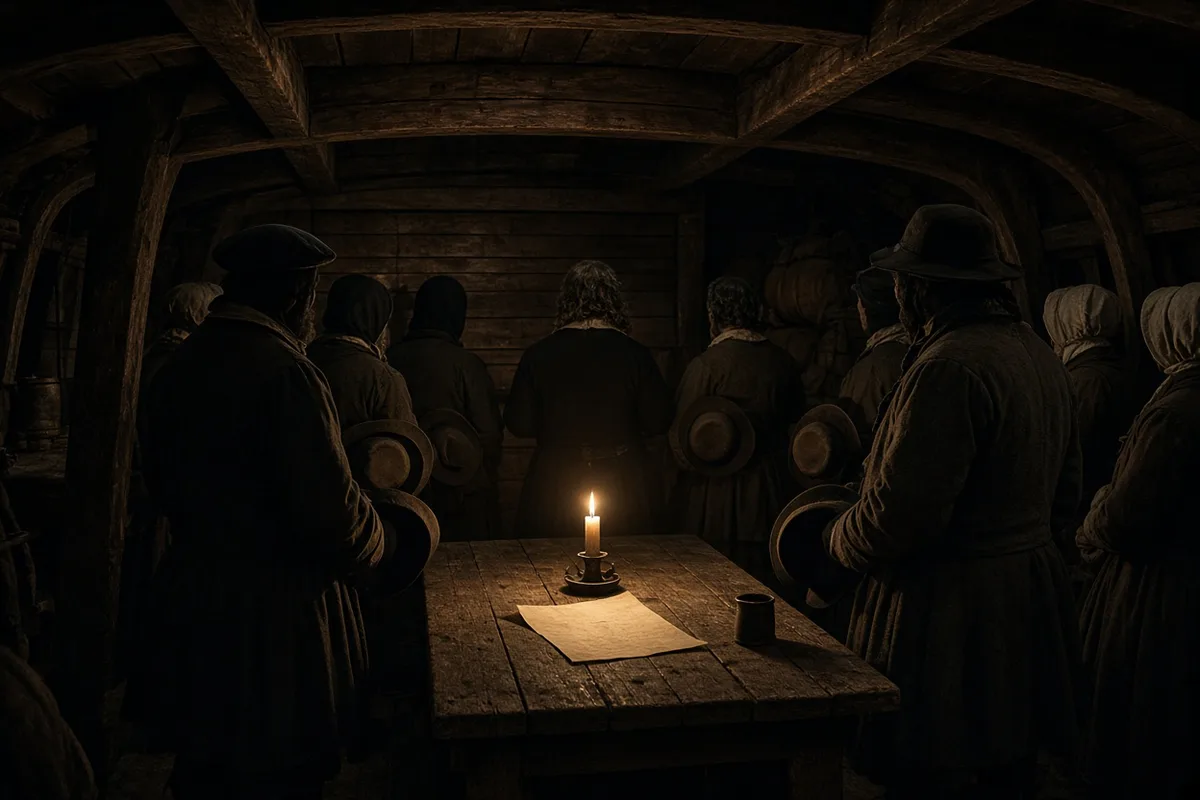
John Carver came up from the great cabin with Bradford at his shoulder. Both men looked as though they had slept little. Carver called for the adult males to gather. He did not raise his voice, yet the deck quieted. Forty-one would put their names to paper before the light faded.

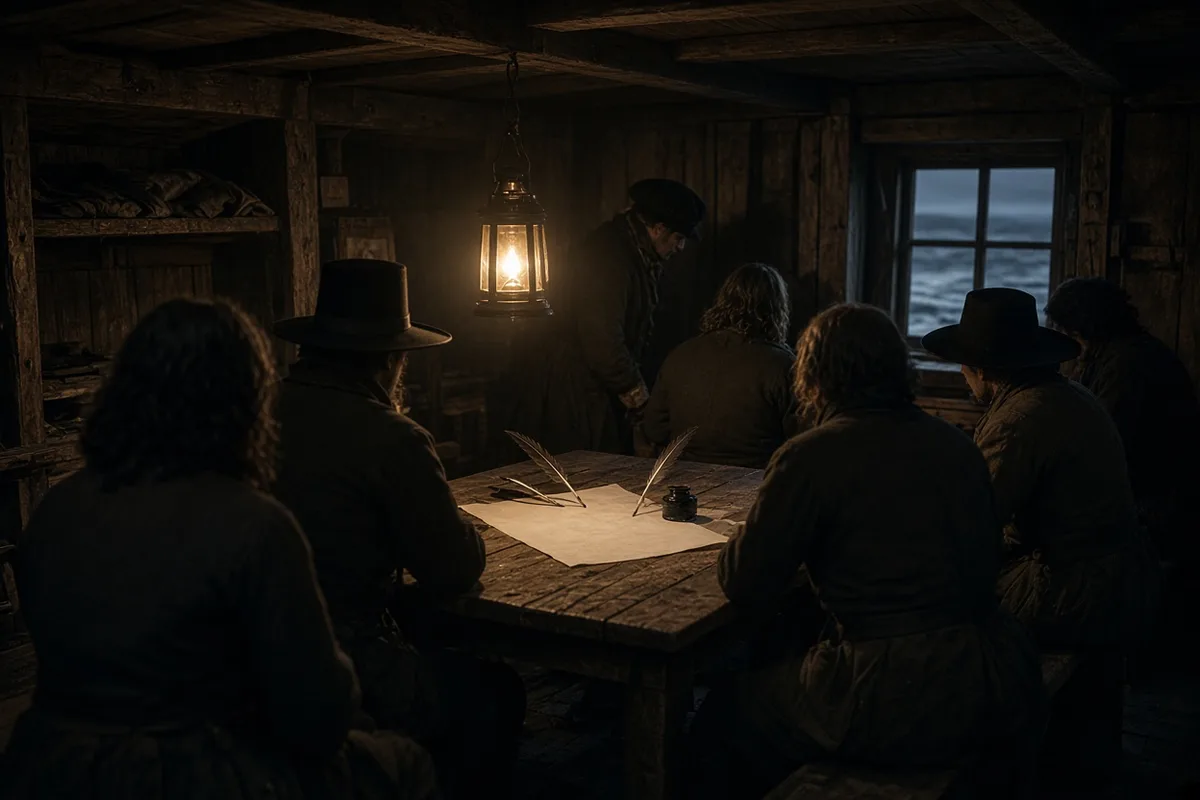
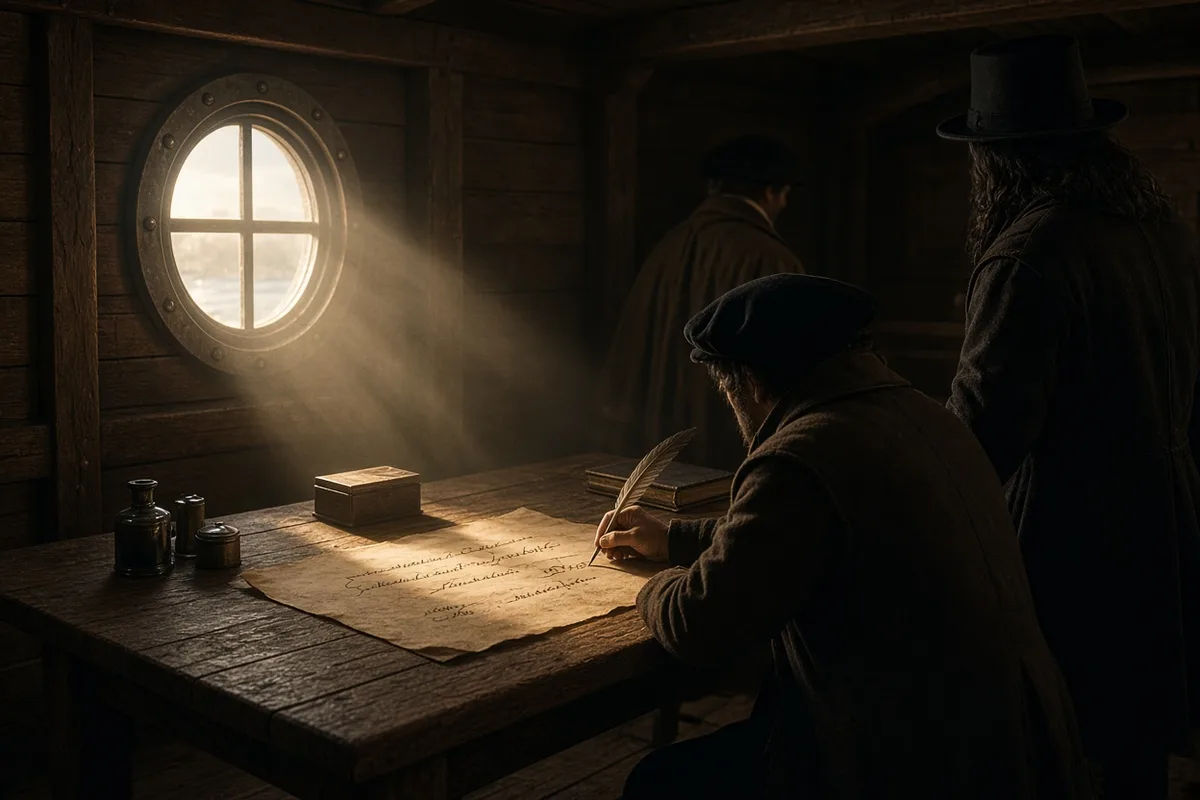
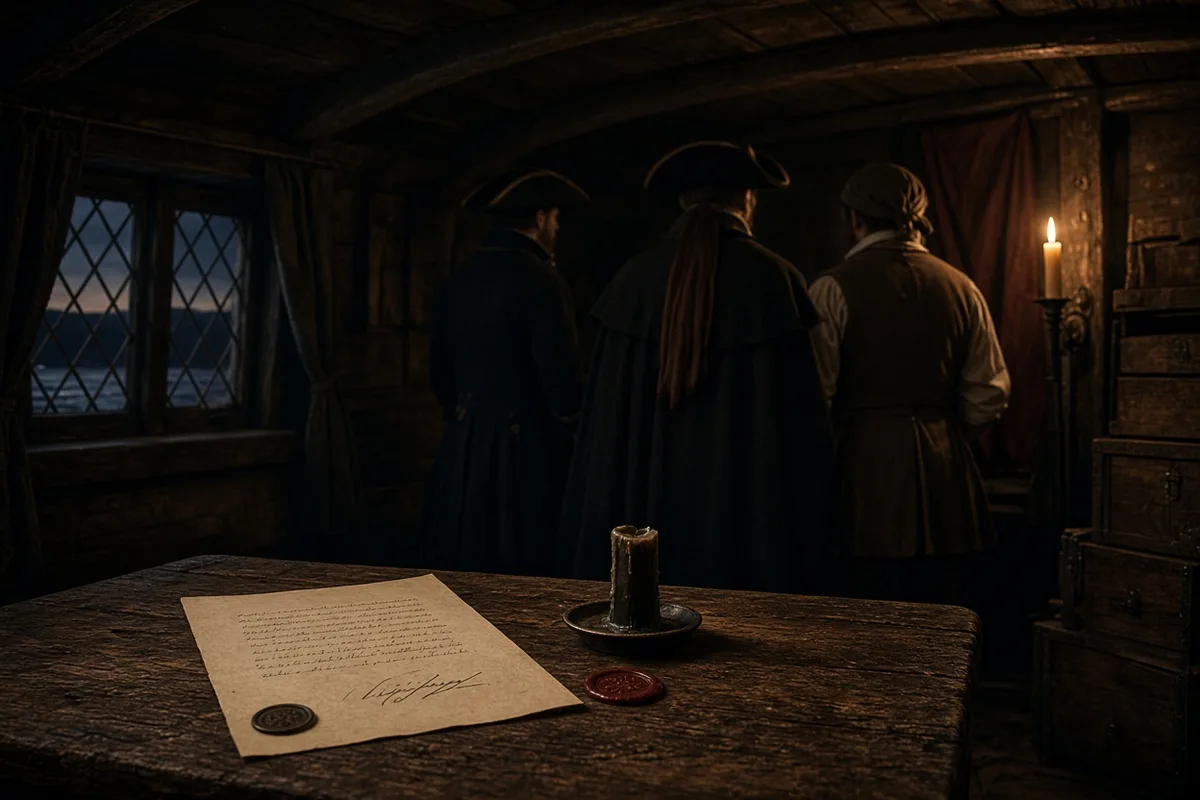
The document lay on the table inside the cabin, written in a hand steady enough despite the ship’s motion. It began with the king’s name and the pledge of loyalty, then moved to the covenant they meant to make among themselves. No one read it aloud at first. Men filed past the doorway, some still in their sea-stained coats, and leaned in to see the lines.
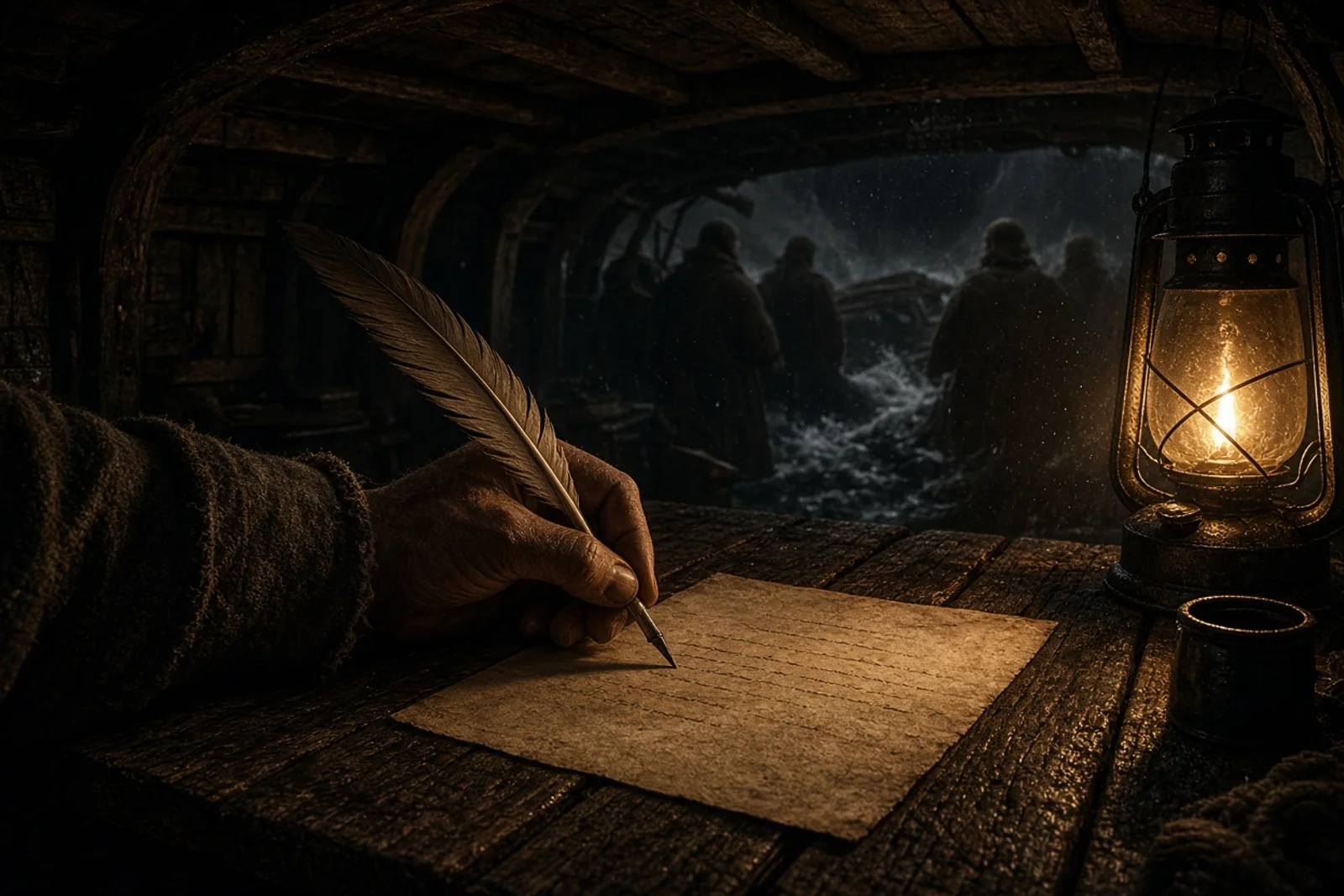
I stayed near the hatch, close enough to hear the scratch of the quill when the first names went down. Carver signed, then Bradford. Stephen Hopkins followed. He had stood trial once before for speaking against authority on another voyage, yet here he set his mark without hesitation. The list grew slowly. Some wrote full names, others only initials. The cabin smelled of ink and damp timber.
Outside, the tide tugged at the hull. A boy named Oceanus, born during the crossing, cried in one of the berths. His mother rocked him without looking toward the cabin door. The strangers who had spoken of their liberty stood apart at first, then one by one moved forward when their names were called.

By mid-afternoon the last signature dried. Carver rolled the sheet and placed it inside a chest. No cheer rose on deck. Men returned to their tasks or sat on sea chests, staring at the low dunes across the water. The compact did not promise food or shelter, only that laws would be made and obeyed for the common preservation.
We stayed at anchor two more days while parties rowed ashore to cut wood and test the ground. On the third morning the ship weighed anchor and moved westward along the coast. I pulled an oar in one of the boats that went ahead to sound the shallows. The water ran cold against my hands.
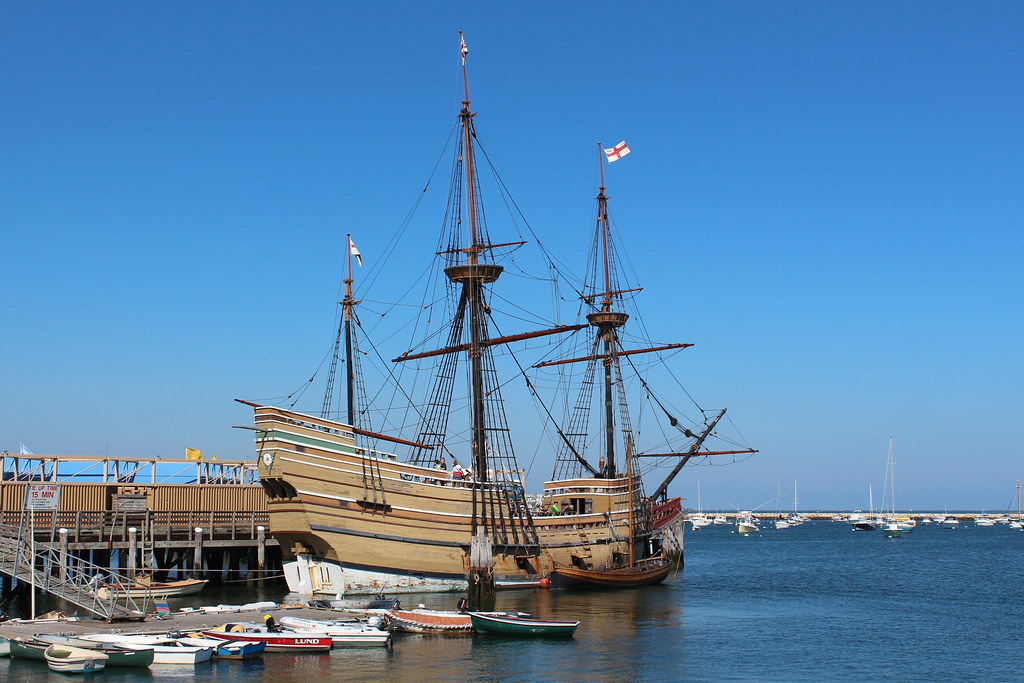
Winter settled before houses stood ready. Snow came early. Men and women alike worked with axes and adzes while the Mayflower remained in the harbor as shelter at night. Sickness took hold in December. Fevers and fluxes moved through the crowded spaces below deck and then through the half-built shelters on shore.
By February, nearly half the company had died. Carver himself was gone before spring. Bradford took his place. The document they had signed aboard ship became the only written rule when decisions had to be made about planting ground or defense. No one spoke of returning to the old arguments about liberty.
In March the first Wampanoag visitors appeared at the edge of the clearing. Trade began, cautious at first. The compact offered no guidance on that meeting, only the frame for whatever agreements followed.
By April the Mayflower prepared to sail for England. Those who remained stood on the beach and watched her topsails fill. I stayed with the settlement, having no passage paid either way. The paper with the forty-one names stayed in Bradford’s keeping. Over the years he copied it into his own journal, the spelling and order shifting slightly each time his hand moved across the page.
The original sheet disappeared sometime after his death. No one recorded the exact day it was last seen. What remained were the names Morton listed later, the same ones that had been written while the ship still rocked at anchor inside the hook of Cape Cod.
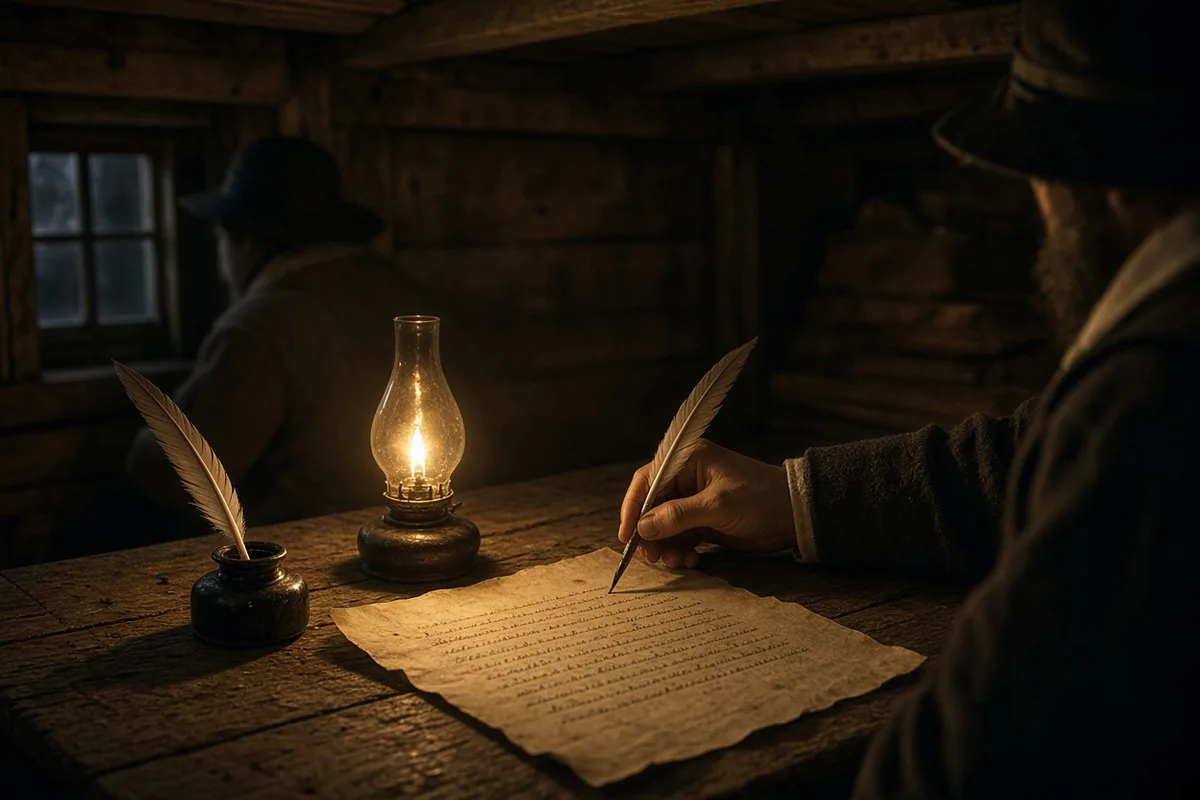
Nathaniel Morton, who arrived as a child aboard the Anne in 1623, placed the forty-one names in New England’s Memorial printed at Cambridge in 1669. He gave the full text of the agreement first, then the list that began with John Carver and ended with Edward Margeson, noting that the original roll had passed from Bradford’s chest into the hands of his son William Bradford the younger before it vanished sometime after 1657. Morton recorded that Carver signed on 11 November 1620 aboard the Mayflower while she rode at anchor inside Cape Cod harbor, that forty-one men in all set their hands that day, and that the document pledged them to “covenant and combine ourselves together into a civil body politic.” He copied the spelling exactly as it stood in the version Bradford had entered into his own manuscript volume begun in 1630.
Bradford’s Of Plymouth Plantation continued the record through 1646. In the entry for March 1621 he wrote that Samoset of the Pemaquid band walked into the settlement on 16 March and spoke the words “Welcome, Englishmen,” after which Massasoit and Squanto arranged the exchange of seed corn and the treaty that held until Massasoit’s death in 1661. Bradford noted the acreage allotted under the compact’s authority: each household received one acre in the first division of 1621, later increased to twenty acres per family by the 1627 cattle division. He listed the deaths month by month, naming the twenty-two men, four women, and twenty-nine children who perished between December 1620 and March 1621, and he recorded that only seven men remained healthy enough to care for the sick during the worst weeks.
The colony’s records show the compact’s clauses applied directly in later disputes. On 22 July 1625 the General Court, citing the 1620 agreement, fined John Lyford and John Oldham for attempting to set up a separate plantation at Hull without consent. In 1636 the same court used the compact’s language when it wrote the first formal body of laws, requiring that every freeman take the oath to obey “such laws and ordinances as shall be made.” By 1643 Plymouth joined the United Colonies of New England, whose articles referenced the original covenant as the model for their own confederation of 290 men under arms.
After Bradford’s death on 9 May 1657 the manuscript passed to his son, then to Samuel Sewall, who deposited it in the tower of the Old South Meeting House in Boston. The volume remained there until 1768, when Thomas Hutchinson borrowed it and carried it to his house on Garden Court Street. Hutchinson’s own History of the Colony of Massachusetts Bay, published in 1764, quoted the compact’s opening sentence verbatim and gave the count of signers as forty-one. The manuscript disappeared during the evacuation of Boston in 1775; only the copies made by Morton and by Bradford’s nephew Nathaniel Morton remained in print.
In 1820 the Pilgrim Society of Plymouth erected a granite monument on the site of the first burial ground and inscribed the names of the signers on its face. The society opened Pilgrim Hall on 22 December 1824, placing inside it the chair that had belonged to William Brewster and a fragment of the Mayflower’s main beam recovered in 1890. By 1880 the town had recorded 11,000 visitors who came to read the compact text printed on a brass tablet set into the wall of the town hall. In 1920 the tercentenary commission placed a five-ton boulder at the foot of Cole’s Hill bearing the full text of the agreement and the date 11 November 1620.
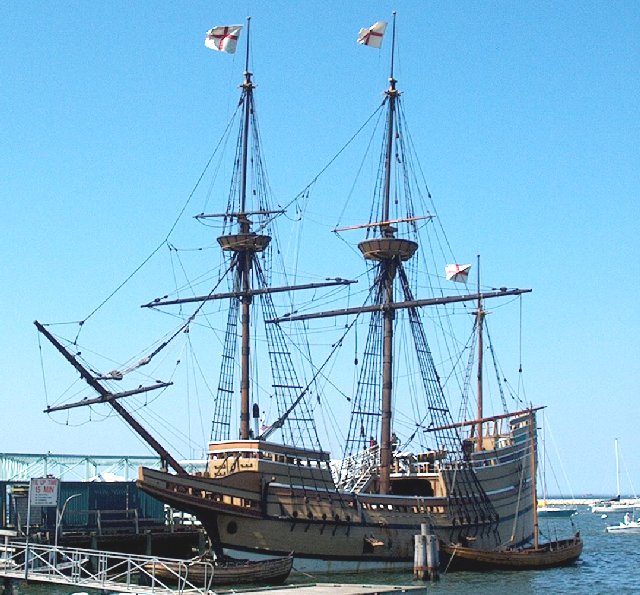
The 1957 reconstruction of the Mayflower II, built at Brixham, England, and sailed across the Atlantic in fifty-four days, now lies at State Pier in Plymouth. Its hold contains a replica chest modeled on the one Bradford described. The original compact text, preserved in Morton’s 1669 printing and in Bradford’s manuscript copy now held at the Massachusetts State Library, is reproduced on a bronze plaque mounted in the Provincetown bas-relief monument dedicated on 20 November 1921. The plaque measures four feet by six feet and lists every signer with the spelling Morton supplied.
On an ordinary Tuesday in October 2023 a woman named Sarah Bradford, a twelfth-generation descendant through William Bradford’s son, stood at the rail of the Mayflower II and read the opening sentence aloud to her grandson. She pointed to the words “in the presence of God, and one another,” then closed the pamphlet that contained the 1669 list. The boy traced the raised letters of his ancestor’s name on the nearby plaque while the harbor water slapped against the hull and the wind carried the sound of the bell buoy marking the channel.
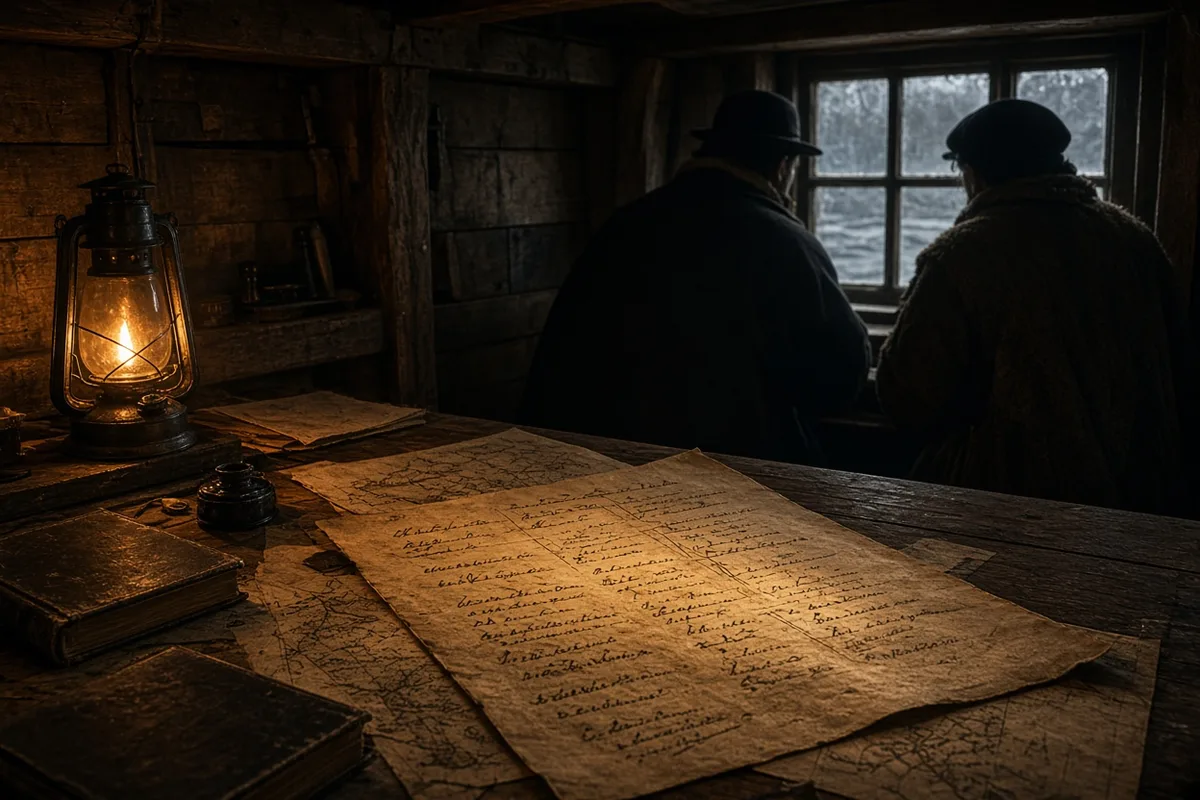
On 11 November 1920 the Massachusetts Historical Society displayed a photostatic copy of Nathaniel Morton’s 1669 text at its building on Boylston Street in Boston, where curator Julius H. Tuttle noted in the society’s proceedings that the forty-one signatures matched the order Bradford had entered between 1630 and 1650. The copy measured eleven inches by seventeen inches and carried the marginal annotation “The Mayflower Compact” added in an eighteenth-century hand. Three years later the same society acquired the 1646 Bradford manuscript fragment that included the compact passage, binding it in calfskin alongside the original pagination that ran from folio 3 to folio 72.
In 1956 the Pilgrim Society commissioned a new brass casting of the compact text for the First Parish Church in Plymouth, the plaque measuring thirty-six inches wide and twenty-four inches high and quoting the full covenant phrase “for our better ordering and preservation and furtherance of the ends aforesaid.” The casting was installed on the north wall of the meetinghouse on 21 September 1957, the same month the town clerk recorded that 47,892 visitors had signed the guest book during the preceding fiscal year. The church archives also hold the 1840 ledger of sexton Thomas Spooner, who listed the daily attendance at the compact boulder on Cole’s Hill as averaging 312 persons between May and October.
The Massachusetts State Library in Boston received Bradford’s holograph volume on permanent loan from the First Church of Plymouth in 1972, catalogued under accession number 1972.014 and stored in a climate-controlled vault at 55 Bowker Street. Conservators noted that the ink on the compact entry showed iron-gall corrosion measuring 0.8 millimeters in diameter at the word “civil,” with the paper stock identified as Dutch foolscap watermarked with a Strasbourg bend. Digitization of the volume began on 14 March 2004 under project director Gregor Trinkaus-Randall, producing 1,024 high-resolution images now accessible through the library’s online portal.
On 6 September 2020 the National Park Service installed a wayside exhibit at Provincetown Harbor containing a stainless-steel reproduction of the compact, the panel standing eight feet tall and etched with the names of all signers in Morton’s 1669 spelling. The exhibit includes a recorded narration drawn from Bradford’s entry for 11 November 1620, voiced by actor Stephen Lang and running three minutes and forty-two seconds. Park rangers logged 189,476 visitors to the site between the installation date and 31 December 2023.
Archaeologists from the University of Massachusetts Boston excavated the original 1620 burial ground on Cole’s Hill between 2017 and 2019, recovering 38 coffin nails and a single lead cloth seal stamped with the mark of London merchant John Bill dated 1619. The finds were accessioned under site number PLM-2020-03 and transferred to the Plymouth Archaeological Laboratory, where conservator Claire Mead documented that the seal’s diameter measured 18 millimeters and matched examples recovered from the 1607 Jamestown fort site.
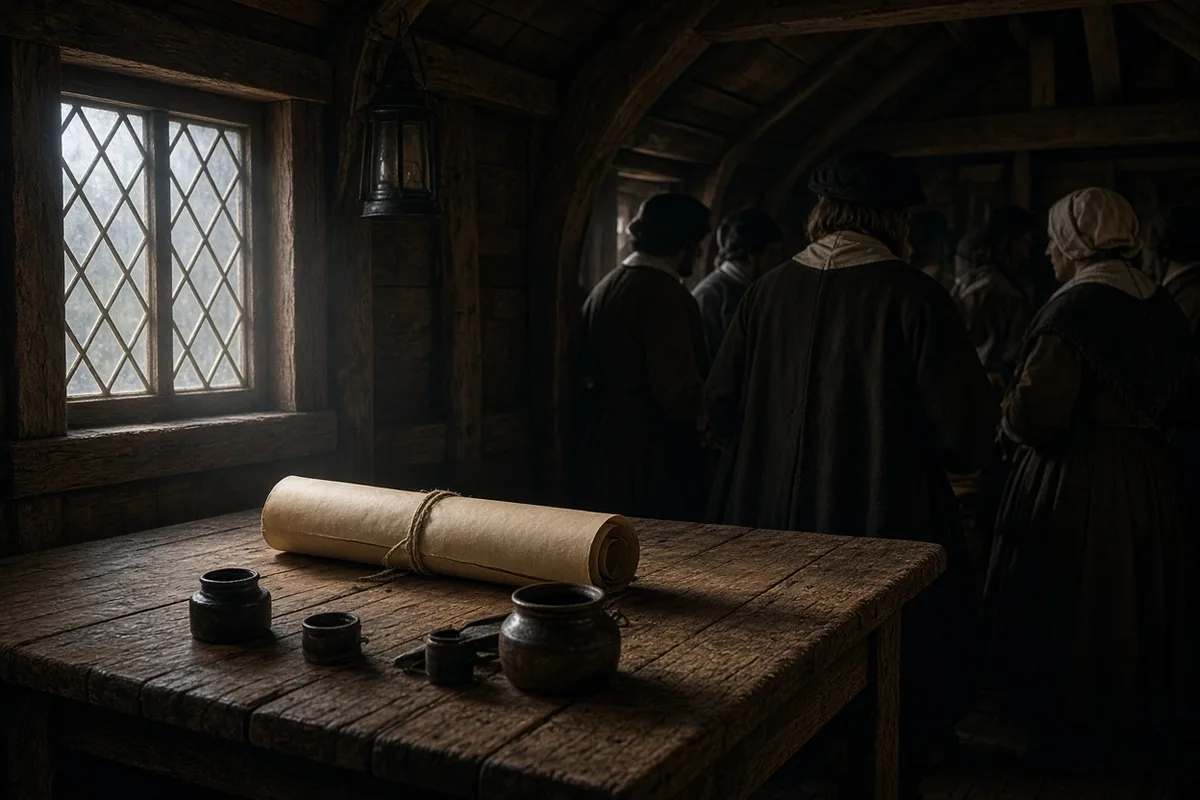
In 2019 the Mayflower II underwent a $11.2 million restoration at the Henry B. duPont Preservation Shipyard in Mystic, Connecticut, during which shipwrights replaced 1,248 linear feet of white oak planking and reinstalled a replica of the great cabin table measuring seven feet by three feet. The work was completed on 8 August 2019, after which the vessel returned to State Pier under the command of Captain Whit Perry. The ship’s log for that voyage records an average speed of 6.3 knots on the final leg from New London to Plymouth.
The Plymouth County Registry of Deeds holds deed book 47, page 112, recording the 1682 transfer of William Bradford the younger’s house lot to his son John Bradford, with the description noting that the lot lay “bounded on the north by the land formerly granted under the compact of 1620.” The entry carries the signature of registrar Nathaniel Morton, who served as clerk from 1674 until 1685 and who also entered the inventory of Bradford’s estate listing “one booke of the plantation written by my father” valued at ten shillings.
On a Tuesday morning in March 2024, twelve-year-old Elias Bradford, great-grandson of Sarah Bradford, stood at the same rail of the Mayflower II and read the compact text from a laminated card issued by the Pilgrim Society. He paused at the phrase “by virtue hereof to enact, constitute, and frame such just and equal laws,” then pointed to the bronze plaque where the name John Carver appeared first in raised letters three-quarters of an inch high, while the bell buoy at the harbor entrance sounded its two-tone signal every twelve seconds and the temperature on the deck gauge read forty-seven degrees Fahrenheit.