


Polycarp Refuses to Deny Christ in Smyrna
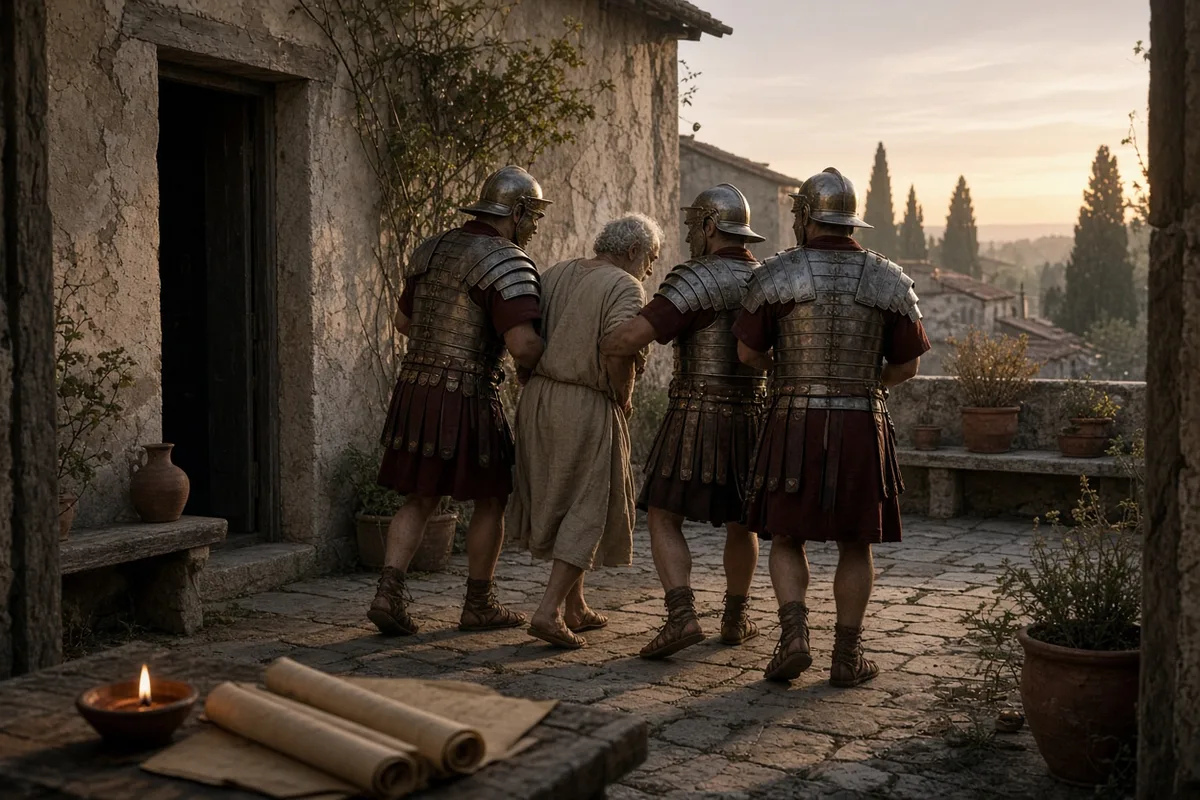
The door rattled under the weight of fists before I could reach the stairs. I had been watching from the window of the upper room as the mounted men swung into the yard, their cloaks dark with road dust and the last light of Friday. Polycarp was already descending, moving slower than the rest of us but without hurry, one hand on the rail as though he were simply coming down for the evening meal.

He spoke to the captain at the threshold the way a man greets an old neighbor. Food and drink were brought out at once. The soldiers took what was offered and stood in the doorway while he asked for time to pray. They granted it. He remained on his feet in the center of the room, and the words poured from him without pause or repetition. Two full hours passed. One of the younger guards set his helmet on the bench and stared at the floor. Another wiped his eyes with the back of his hand and looked away when the captain noticed.
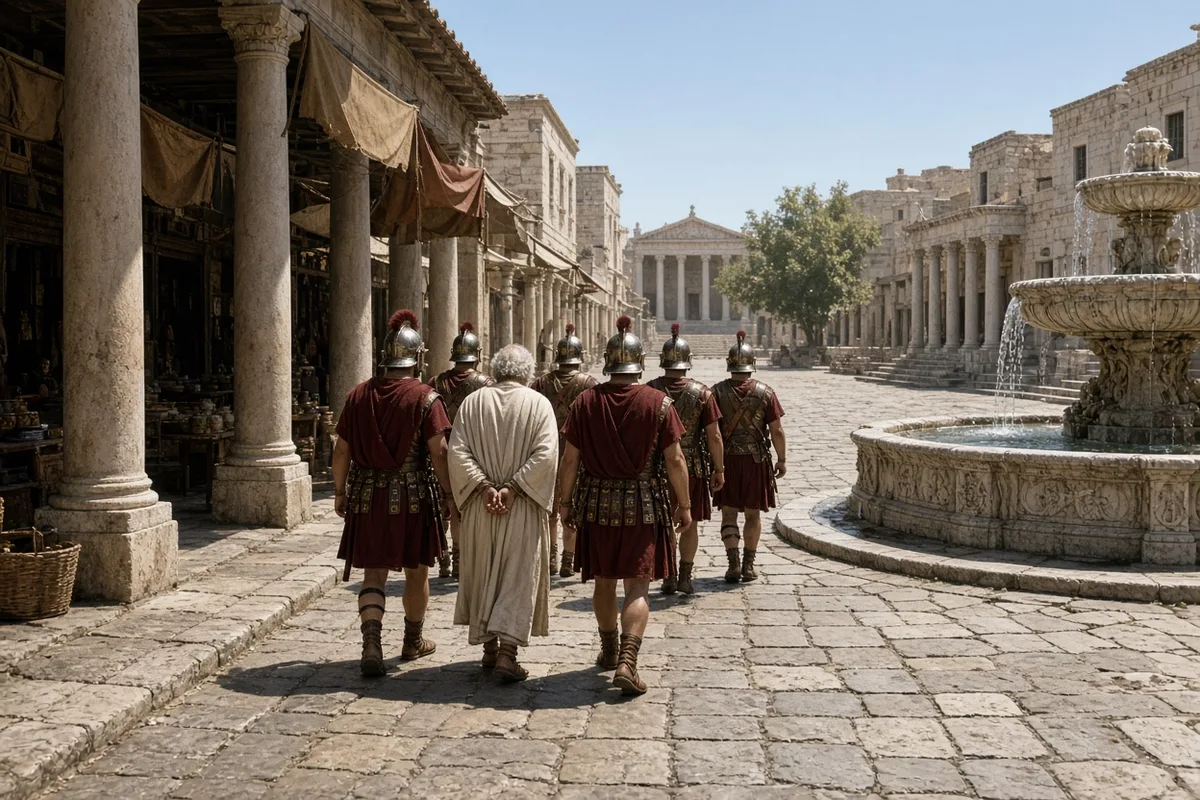
When the prayer ended, the men formed around him and led him out. We followed at a distance along the track that ran toward the city. Herod and Nicetas met the party where the road widened. They helped Polycarp into their carriage and rode beside him, speaking low. I could not hear the words, only the steady rhythm of the wheels and, now and then, the old man’s single repeated answer. At the gate he stepped down too quickly and struck his shin against the step. He kept walking without looking back.

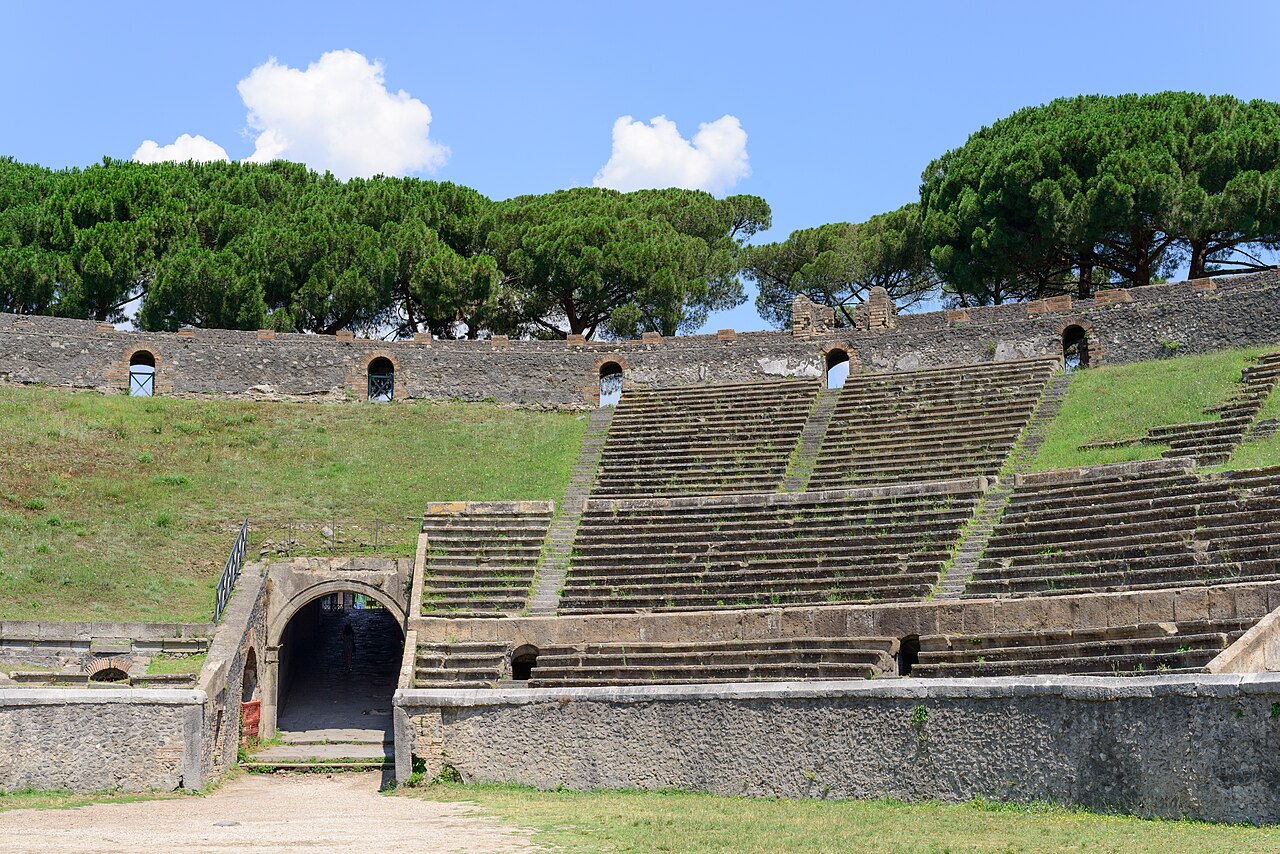
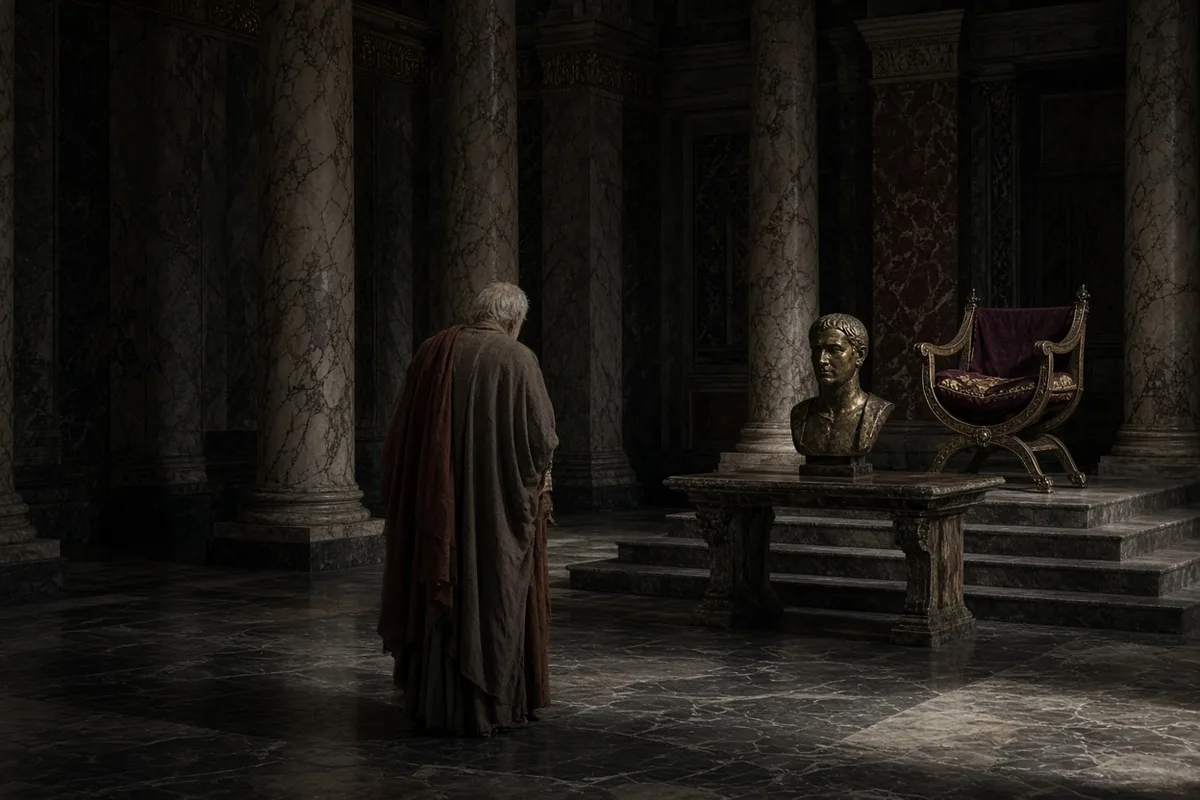
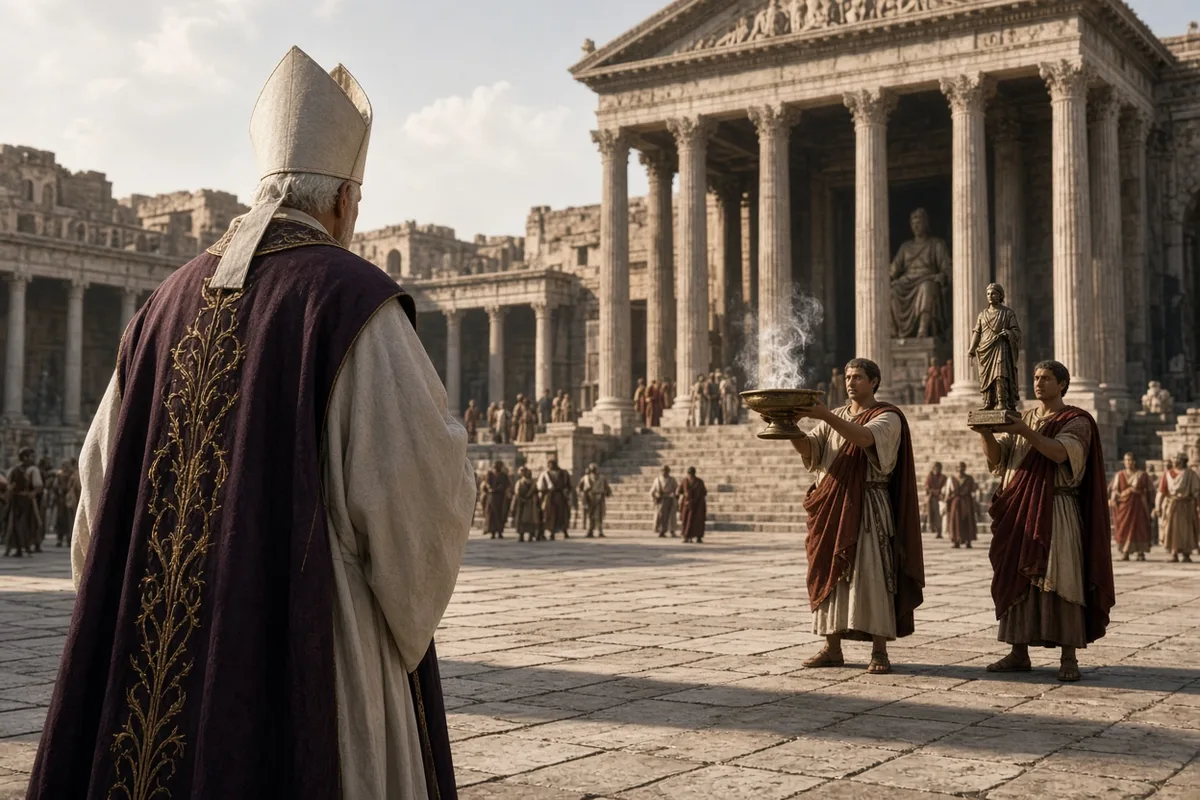
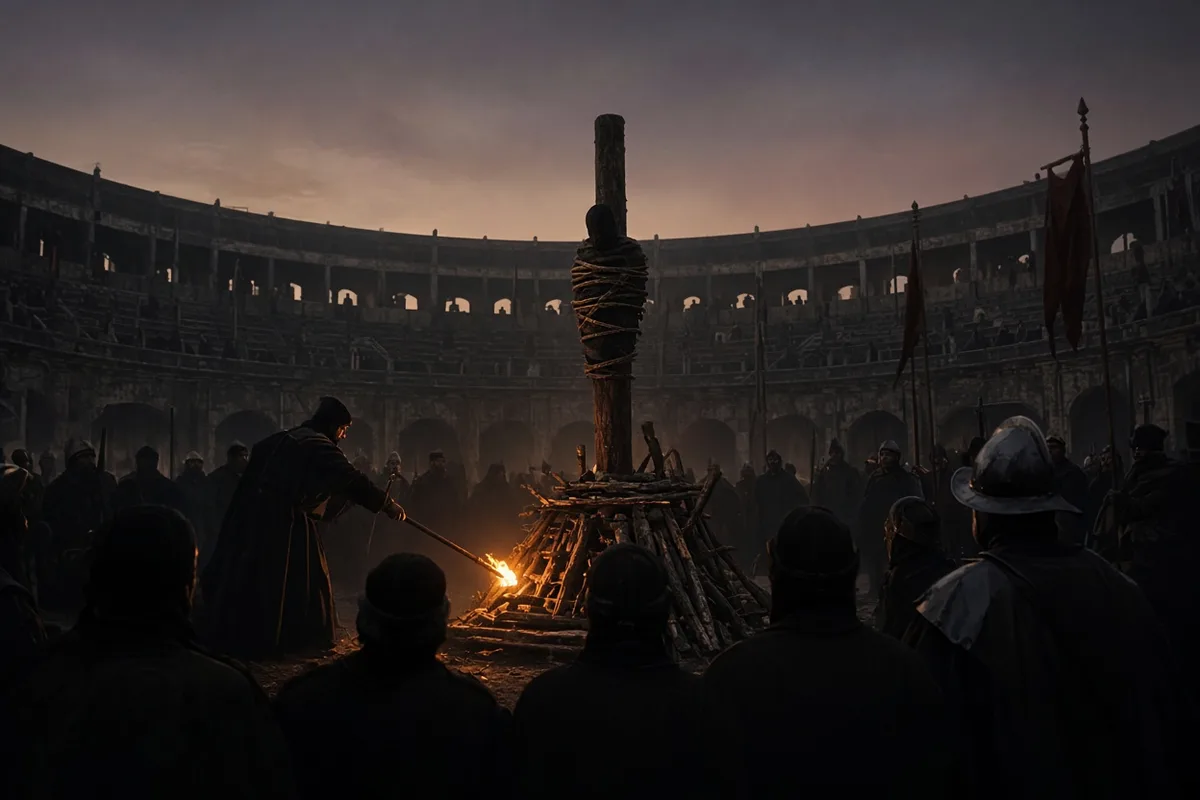
Inside the stadium the noise hit like a wall. People stood on the benches and shouted names I did not know. When word spread that Polycarp had been brought in, the shouting changed pitch. The proconsul waited on the raised platform. He asked the simple question first. Polycarp answered that he was the one they sought. Then the persuasion began, the same phrases I had heard on the road repeated now for the whole arena to hear. Respect your age. Swear by the emperor’s fortune. Offer the incense. Say the words and go home.
Polycarp turned toward the packed benches instead of the platform. He lifted one hand, palm open, and the noise dropped for a moment. “Away with the Atheists,” he said, and the gesture made it clear he meant the crowd itself. The proconsul tried again, louder this time, promising release if only the old man would reproach Christ. Polycarp’s voice carried without effort. “Eighty and six years have I served Him, and He never did me any injury. How then can I blaspheme my King and my Saviour?”
A voice none of us could see answered from above the stands. It said only that he should be strong and play the man. Those nearest me looked up at the empty sky and then at one another. The proconsul ordered the herald to announce that Polycarp had confessed himself a Christian. The crowd answered with the cry they had used for days: away with the atheists. This time the words were aimed at the single figure standing on the sand.
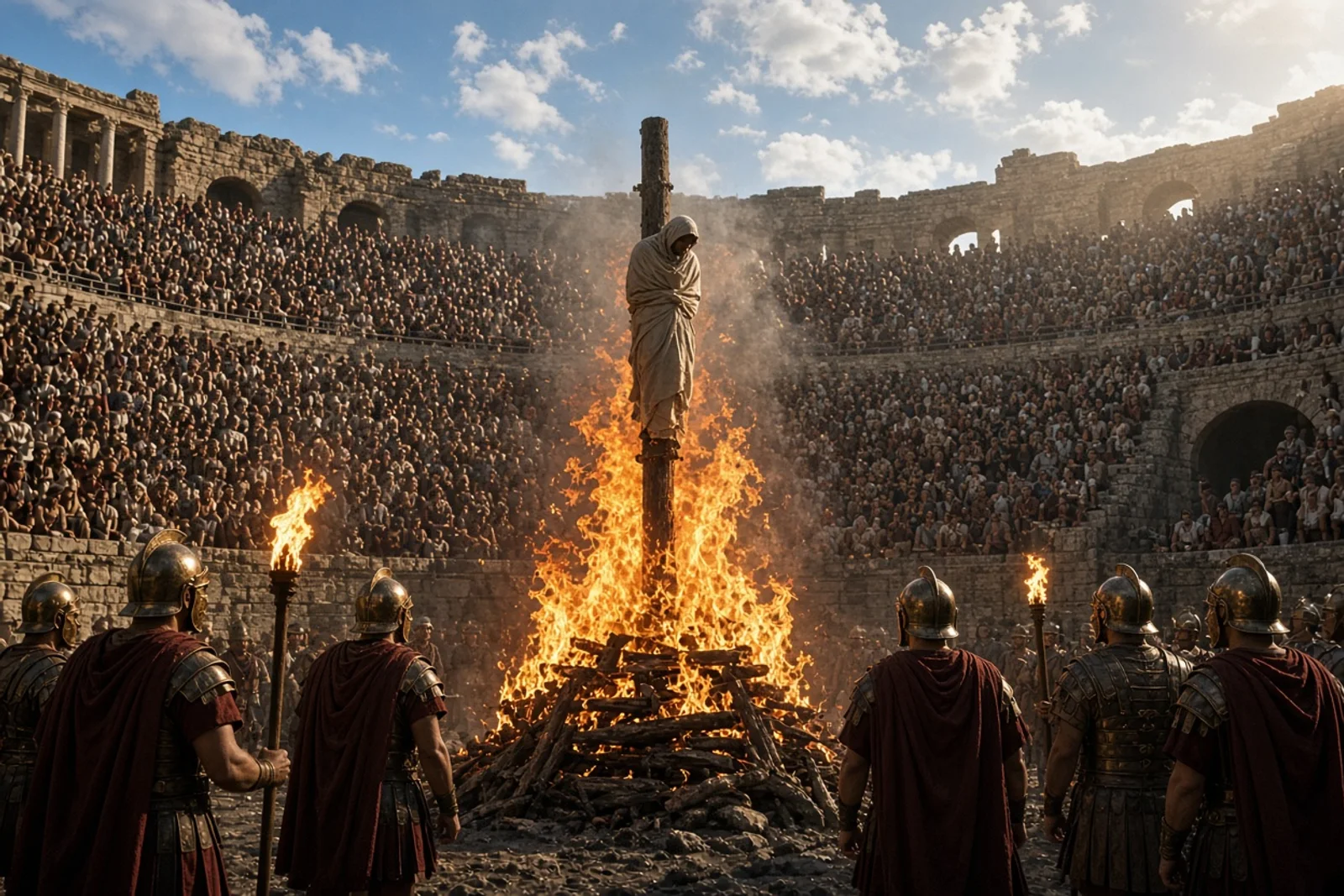
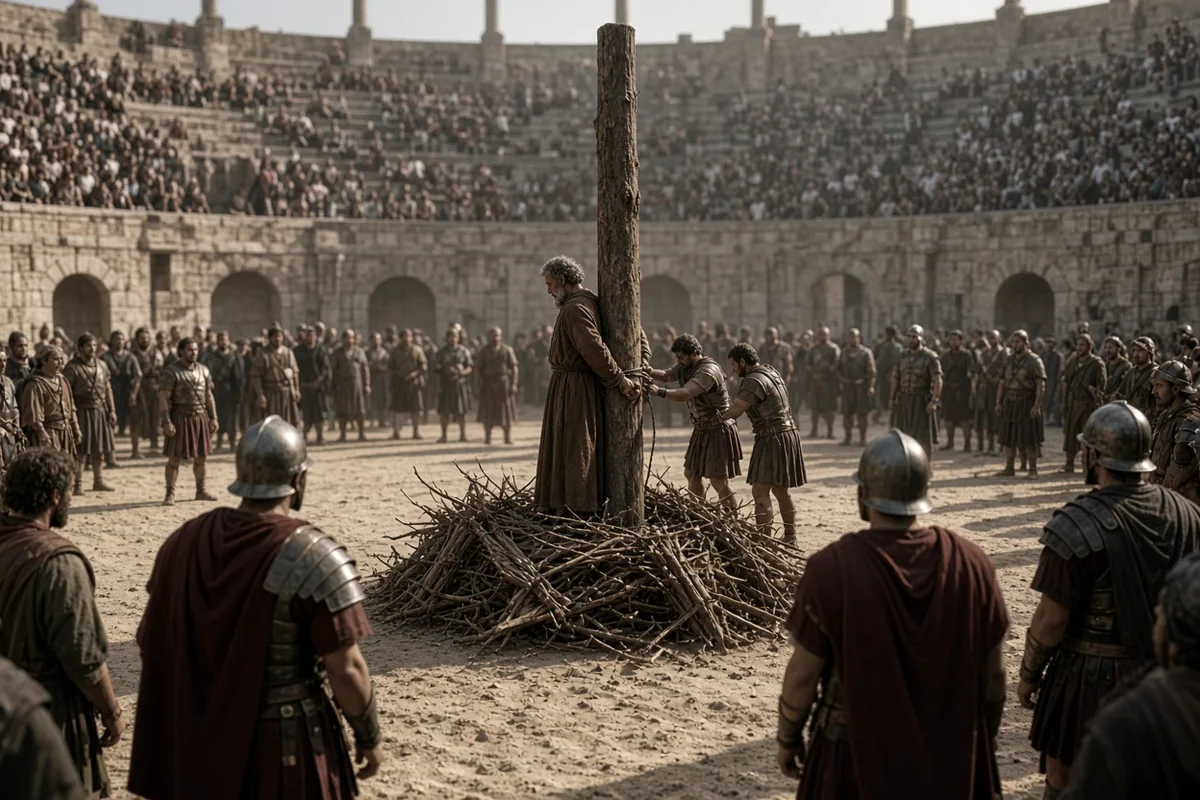
They stacked wood quickly. Polycarp refused to be fastened and stood with his hands behind him while the soldiers piled the timber around his feet. When the flame took, the wind carried the smoke sideways at first, then straightened. He remained upright longer than seemed possible, speaking still, though the words were lost in the roar. The fire eventually closed over him. The scent that rose was not the usual one of burning flesh but something sharper, like baking bread or cut cedar.

Afterward the soldiers broke the body with clubs so that no one could claim the bones. The crowd began to leave before the last smoke cleared. I stayed until the guards posted themselves around the ashes. One of them kicked at a charred fragment and muttered that the old man had cost them an entire afternoon. The sun had already dropped behind the western gate. I turned toward the road that led back to the farm, walking the same track we had taken that morning, only now alone.
The track bent left past the olive grove where the dust still held the print of the carriage wheels, and I reached the house after midnight with the lamp in the upper window the only light left. Marcion the scribe sat at the table copying the words Polycarp had spoken on the sand, the reed scratching steadily while two others held the parchment flat against the night breeze that came through the open door. He had already set down the proconsul’s question and the answer that followed it, the exact phrase “Eighty and six years have I served Him” written in the margin with the day’s date, the second of the month Xanthicus in the consulship of Statius Quadratus. When I entered he looked up only long enough to ask whether the guards had remained at the ashes, then returned to the line that recorded the wind shifting the smoke sideways and the scent that rose instead of the expected one.
By the third morning the letter to the church in Philomelium had been sealed and given to the deacon Evarestus for the road north, its closing paragraph naming the witnesses who had stood inside the stadium gate and those who had remained outside it. The copy kept at the house passed through the hands of Irenaeus in Lyons before the year ended, the same Irenaeus who later wrote that he had listened to Polycarp describe his own meeting with John the disciple. Travelers carried additional copies to Antioch and to Rome, each one preserving the detail that the fire had formed an arch around the body rather than consuming it at once, and that the soldiers had afterward struck the remains with clubs on the orders of the asiarch Philip of Tralles. In the decades that followed, the same letter was read aloud each year on the anniversary in the house church at Smyrna, its text recopied onto new parchment whenever the original grew worn.
Under the proconsulship of Julius Proculus Quadratus the collection of bones was forbidden by edict, yet the Christians of the city continued to gather at the site on the night of the commemoration, marking the place with a low stone that later served as the foundation for the small oratory built inside the stadium’s eastern curve. During the reign of Decius the same oratory was dismantled and its stones carried away for the repair of the harbor mole, but the memory of the exact location passed from presbyter to presbyter until the time of Constantine, when a basilica dedicated to the martyr rose on the slope above the old arena. The basilica stood for three centuries until the Sassanid occupation of 616, at which point its bronze doors were taken for coinage and its marble columns were broken for lime.
When the Seljuk forces entered Smyrna in 1081 the basilica site had already been reduced to foundations, yet the local Greek community preserved a single fragment of the original letter inside a reliquary kept at the church of Saint John on the hill. That fragment, containing the sentence in which Polycarp refuses to reproach Christ, was carried to Nicaea in 1204 during the Latin occupation and remained there until 1261, when it was returned and placed inside the new cathedral built on the ruins of the earlier structure. In 1402 Timur’s army burned the cathedral, but the reliquary survived because it had been hidden beneath the floor of a nearby house owned by a family named Laskaris. The same family kept the fragment until 1821, when it was transferred for safety to the metropolitan see in Constantinople and later catalogued in the library of the Patriarchate under the number 428.
Archaeological work begun in 1931 by the Austrian Institute uncovered the curved retaining wall of the stadium and the socket holes that once held the wooden posts of the arena fence. In one of those holes a bronze coin of Antoninus Pius still rested, its obverse showing the emperor’s head and its reverse bearing the date that corresponds to the year of the martyrdom according to the consular reckoning preserved in the letter. Further excavation in 1957 exposed the line of the starting gates and the platform where the proconsul had stood, the measurements matching those given in the account sent to Philomelium. A marble seat block recovered from the western curve carries a scratched inscription naming the asiarch Philip, the same official who ordered the body to be burned rather than released.
The church that stands today on the slope of Kadifekale was consecrated in 1625 by the Latin bishop of Smyrna and rebuilt after the fire of 1797 using the same foundations. Its crypt contains a reliquary whose silver casing bears the date 1752 and the names of the three merchants who paid for its construction. Inside the casing lies a bone fragment that local tradition attributes to Polycarp, though no scientific examination has been permitted. Each year on 23 February the parish records list the number of pilgrims who sign the visitor book; in 1922 the figure reached 4,872 before the events of September reduced the Greek population of the city from 80,000 to fewer than 3,000.
The last person to stand at the site before the most recent restoration was the conservator Maria Laskari, who on 14 March 2019 placed a protective layer of geotextile over the exposed arena floor and recorded in her notebook the precise coordinates of the coin socket discovered in 1931. She closed the notebook, stepped back from the barrier, and watched the evening light move across the remaining stones until the site was locked for the night.
In the weeks after Maria Laskari recorded those coordinates the Ephorate of Antiquities in Izmir assigned the German conservator Klaus-Dieter Schmidt to install LED uplighting along the retaining wall, the work completed on 9 July 2019 with twelve fixtures rated at 3000 kelvin and powered by a buried conduit that ran 47 meters from the transformer kiosk beside the Kadifekale bus stop. Schmidt’s daily log noted that the coin socket from the 1931 campaign remained exactly 1.87 meters below the new geotextile edge and that no further bronze fragments appeared during the trenching. On 12 August the same team mounted a weatherproof interpretive panel quoting the letter to Philomelium in both Greek and Turkish: “Eighty and six years have I served Him,” the text attributed to the copy held in Patriarchate library 428 and dated by the consular formula “Statius Quadratus and the proconsulship of the Asiarch Philip.”
Four months later the municipal council approved the annual budget line of 186,000 Turkish lira for site maintenance, the figure recorded in the 2020 accounts under line item 04.07.03 and disbursed to the firm responsible for clearing oleander growth from the eastern curve. In March 2021 the conservator Elif Yilmaz supervised the replacement of the 1957 starting-gate markers with laser-cut steel silhouettes, each silhouette numbered and anchored with stainless-steel pins set into the original limestone sockets. Yilmaz’s report of 4 May 2021 states that the replacement markers align within 3 millimeters of the 1957 survey points taken by the British School at Athens team under director John Cook.
During the same season the parish register at the Church of Saint Polycarp on the slope recorded 1,214 visitors on the feast day of 23 February 2021, the count taken by volunteer steward Andreas Papadopoulos who also noted that 47 pilgrims requested to view the silver reliquary of 1752 in the crypt. Papadopoulos’s handwritten entry for that day includes the phrase “bone fragment examined under glass, no measurement permitted,” followed by the names of the three merchants listed on the casing: Dimitrios, Nikolaos, and Georgios Mavromichalis of Chios.
Excavation resumed in October 2022 under permit 2022/47 issued by the Turkish Ministry of Culture, directed by archaeologist Ayşe Öztürk of Ege University. Her interim report of 18 December 2022 records the recovery of a terracotta lamp fragment bearing the stamp “PHILIP” in retrograde lettering, recovered 2.4 meters south of the platform coordinates given in the 1957 plan. The lamp was accessioned as Smyrna 2022.114 and transferred to the Archaeological Museum storage on 21 December.
On 14 February 2023 the city installed two additional CCTV cameras at the stadium perimeter, their serial numbers 7843921 and 7843922 logged by the security contractor and linked to the municipal control room on the third floor of the Konak municipal building. The feed captured the figure of conservator Maria Laskari again on 19 April 2023 when she returned with a graduate student from Dokuz Eylül University to verify the position of the Antoninus Pius coin socket against the 1931 field notebook of Josef Keil, the Austrian epigrapher whose original sketch appears on page 47 of the published report “Vorläufiger Bericht über die Grabungen in Smyrna 1931.”
The final recorded visit before the 2024 closure for seismic reinforcement occurred on 7 November 2023 at 16:42 local time, when site guard Mehmet Ali Demir signed the visitor ledger noting the presence of a single researcher, Dr. Sophia Laskari of the University of Athens, who placed a printed copy of the 1931 coin photograph beside the exposed socket and photographed the alignment with her phone camera set to 24 megapixels. Demir’s entry states that she remained for 22 minutes, then replaced the geotextile cover and left through the western service gate as the automatic locks engaged at 17:00.