


Rabanus Maurus Shelters Refugees After Viking Raids
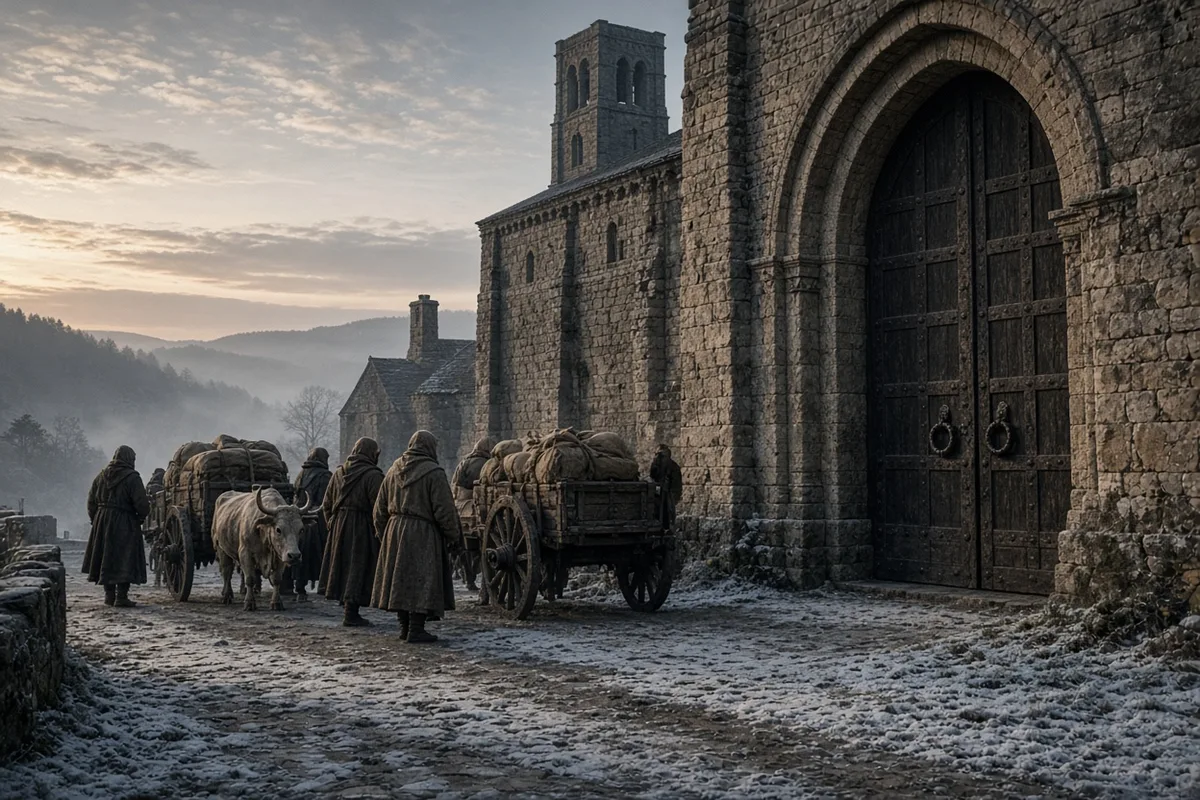
The cart wheels caught on the frozen rut and the ox lowed once, a raw sound that carried up the slope. I steadied the load with one hand and kept the other on the child’s shoulder so he would not slip under the wheel. Smoke from the valley still hung in the air two days after the burning, thin and sour, the kind that clings to wool and hair. We had walked from the river crossing at dawn.
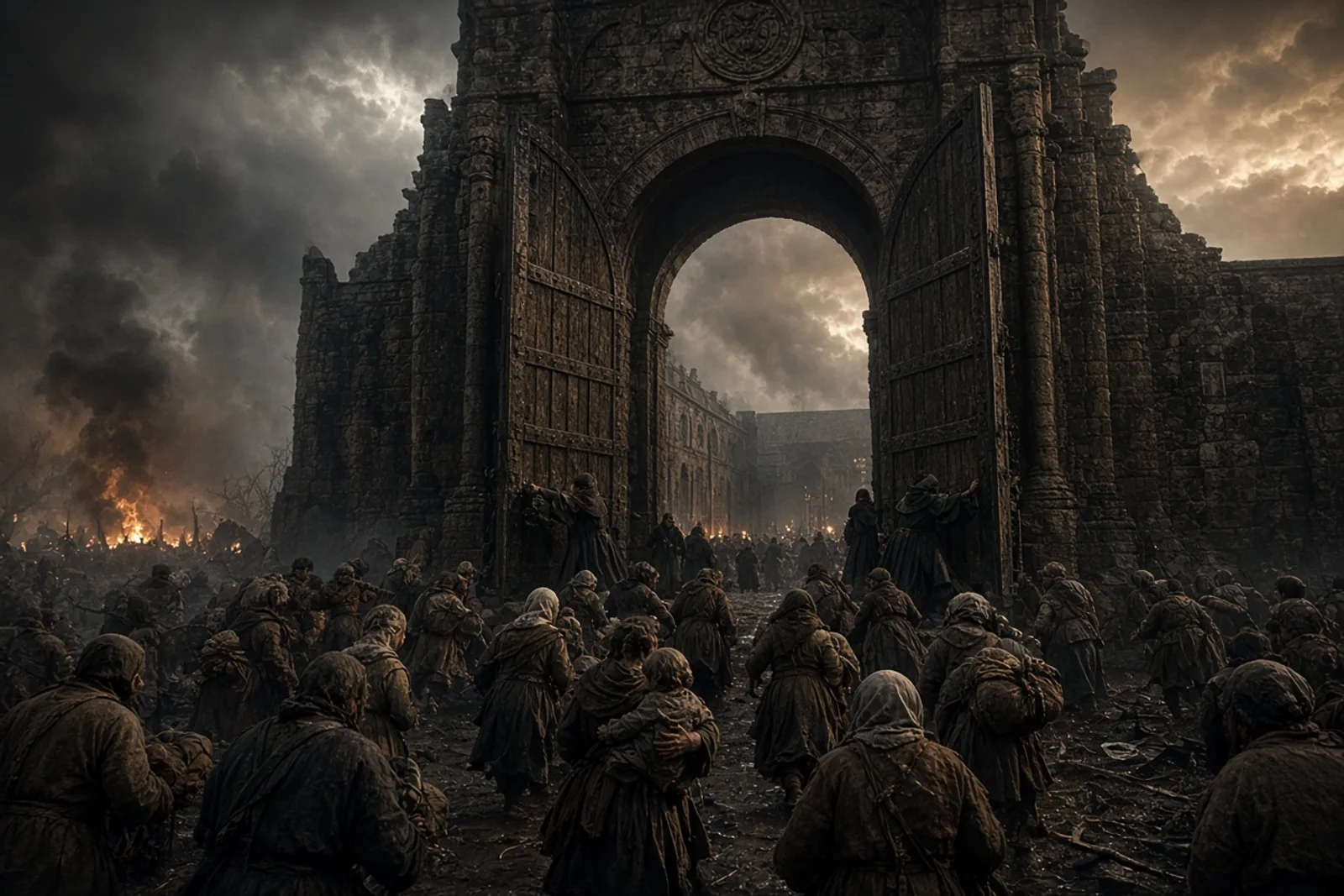
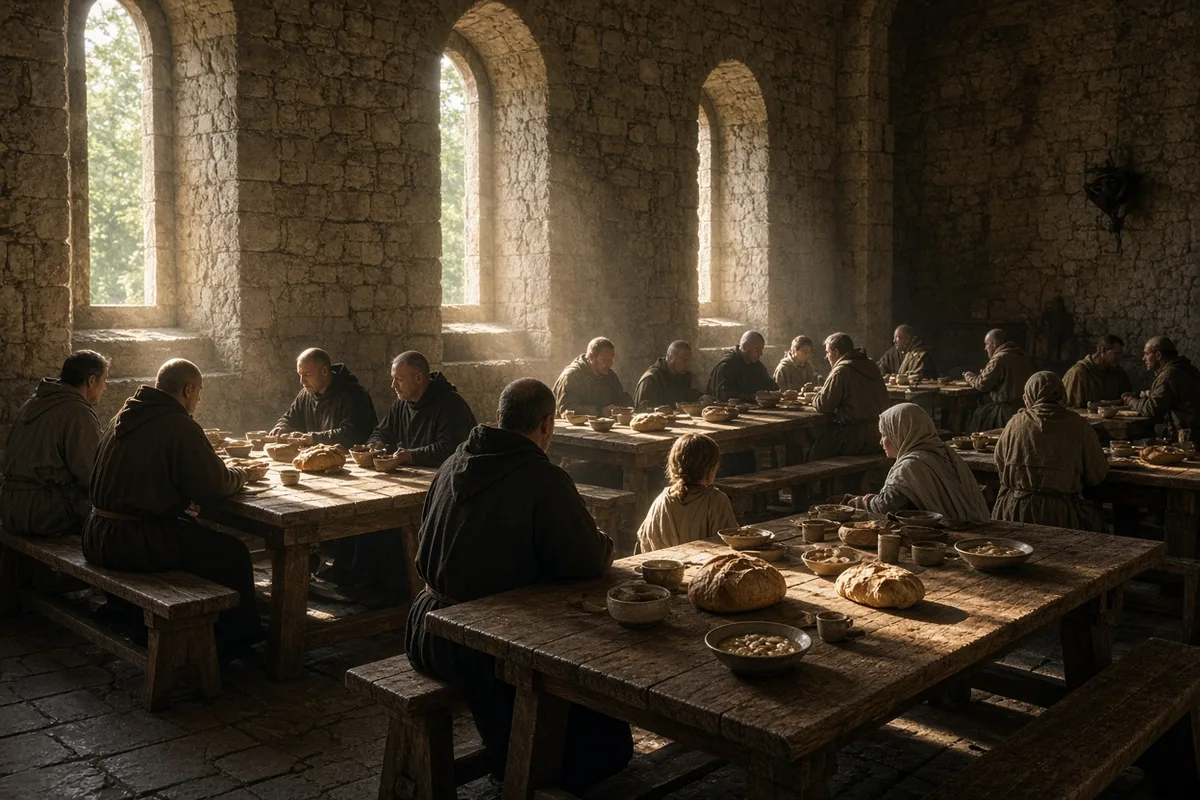
Fulda’s gate stood open when we reached it. No one challenged us at first. Inside the outer court, monks moved between the new stone buildings and the older wooden sheds, carrying blankets and sacks of grain. One of them, a tall man in a patched cowl, pointed us toward the refectory side door. He did not ask names. He only said the abbot had ordered every spare space cleared and straw laid down.

By midday the court held more than two hundred people. Most had come from the lower settlements along the Main, their carts piled with whatever they could drag free before the longships reached the bend. A woman from Hammelburg sat against the cloister wall with a bandaged leg; the wound had already begun to smell. Two brothers from the scriptorium brought her a bowl of broth and clean linen without being told. I recognized the younger one as the boy who had copied Rabanus’s commentary on Matthew the winter before.
Rabanus himself appeared at the church steps near terce. He wore the plain habit of an abbot, no crosier, and moved without hurry among the newcomers. He stopped at each group, asked how many mouths needed feeding, and noted the answer on a wax tablet one of the novices carried. When he reached the cart I had helped unload, he looked at the child first, then at me.
“How many days since they ate?” he asked.

“Three,” I said.
He nodded once and sent the novice for bread. The child took the piece without looking up. Rabanus stayed long enough to see the boy swallow, then moved on to the next family. By the time the bell rang for none, the number on his tablet had reached three hundred and twelve.

The storehouses were already low from the poor harvest. Ratgar’s old building works had left half the cellars unfinished, and the new granary still lacked a roof. Rabanus ordered the doors of the unfinished crypt opened and straw carried down. He sent word to the dependent farms for whatever grain could be spared and told the kitchen to bake through the night. No one argued. The monks who had grumbled under Ratgar’s stonework now moved without complaint.
That evening the wind shifted and brought the smell of distant smoke again. A man from the east gate said he had seen riders on the ridge, but they turned south before reaching the valley. Rabanus posted watchers on the tower and ordered the gate barred at dusk. He himself stayed in the court until the last cart was emptied, then walked the length of the straw pallets, checking that no one lay without a blanket. When he passed the child I had brought, he bent and touched the boy’s forehead, then straightened and continued without speaking.
The next morning the refugees began to sort themselves. Some asked for tools to repair carts; others wanted only a place to rest before moving farther west. Rabanus met with the village elders in the chapter room and promised that any who wished to stay through the winter would be given work on the new church walls. He assigned the stronger men to the timber crews and the women with children to the kitchen garden. The injured stayed in the crypt under the care of the infirmarian.
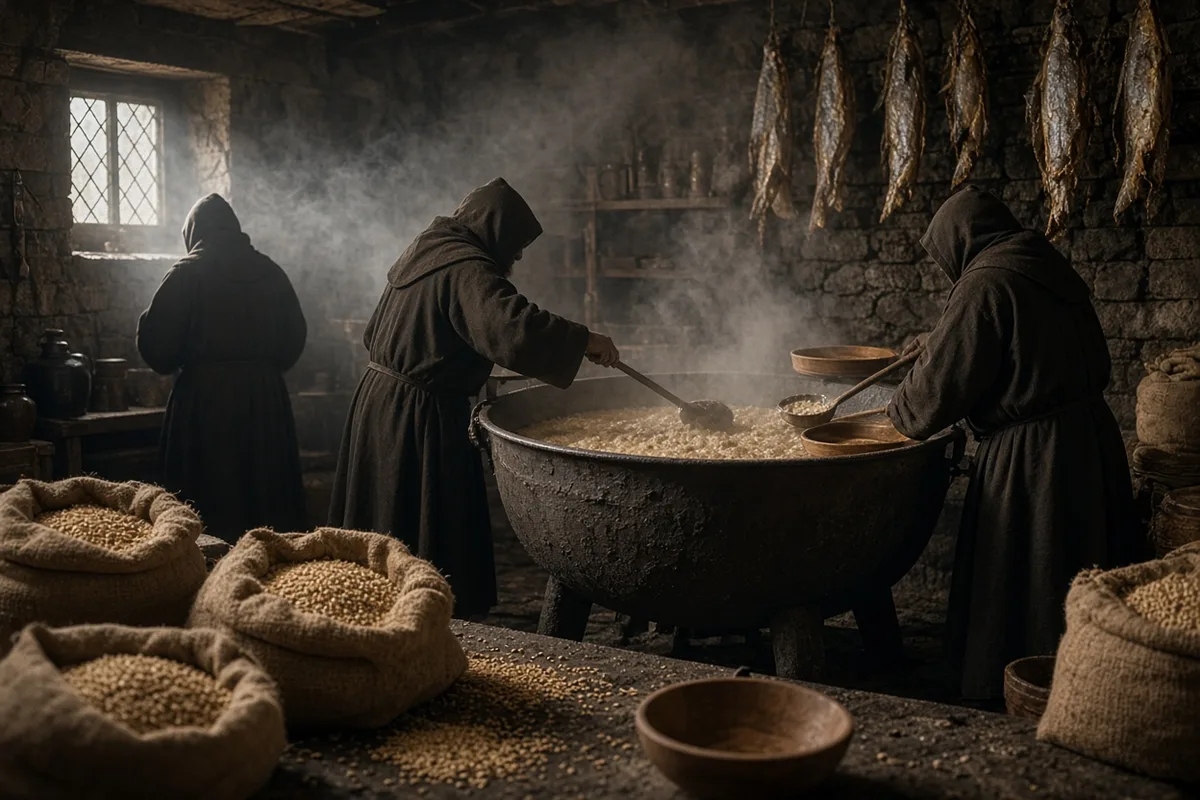
By the third day the count reached four hundred. The ovens could not keep up. Rabanus sent two monks to the market at Mainz with silver from the treasury and instructions to buy whatever flour and dried fish could be found. He also wrote to the bishop at Würzburg asking for grain from the episcopal stores. The letter left before noon. In the afternoon he stood at the refectory door and told the gathered people that the monastery would feed them as long as the stores lasted, and that no one would be turned away while bread remained.
The child from the cart stayed close to me. He had begun to speak again, asking small questions about the bells and the stone lions carved above the church door. When Rabanus passed through the court that evening, the boy pointed and asked who the tall man was. I told him. The boy watched the abbot until he disappeared into the cloister walk.
On the fifth day the first snow fell. It covered the thatch and the new stone foundations and muffled the sound of the hammers still working on the unfinished walls. Inside the crypt the refugees lay packed shoulder to shoulder, the children wrapped in whatever cloaks the monks could spare. Rabanus came down the steps once, lantern in hand, and counted the heads himself. He did not speak to anyone, only nodded to the infirmarian and climbed back into the cold.
The winter held. More families arrived from the raided villages. The number Rabanus fed each day never dropped below three hundred. The monks gave up their own portions on the leanest days and said nothing about it. By spring the raids had moved farther west, and some of the refugees returned to what was left of their fields. Others remained and helped finish the church walls Rabanus had begun.
The child stayed. He learned the names of the bells and could point out the lions without being asked. When the last of the snow melted from the court, he stood at the gate with the monks and watched the carts that still carried the wounded and the old move slowly toward the river. Rabanus stood a little apart, tablet in hand, marking the names of those who chose to leave and those who would plant the new fields. The boy did not ask to go with them. He only watched the road until the last cart disappeared between the trees.
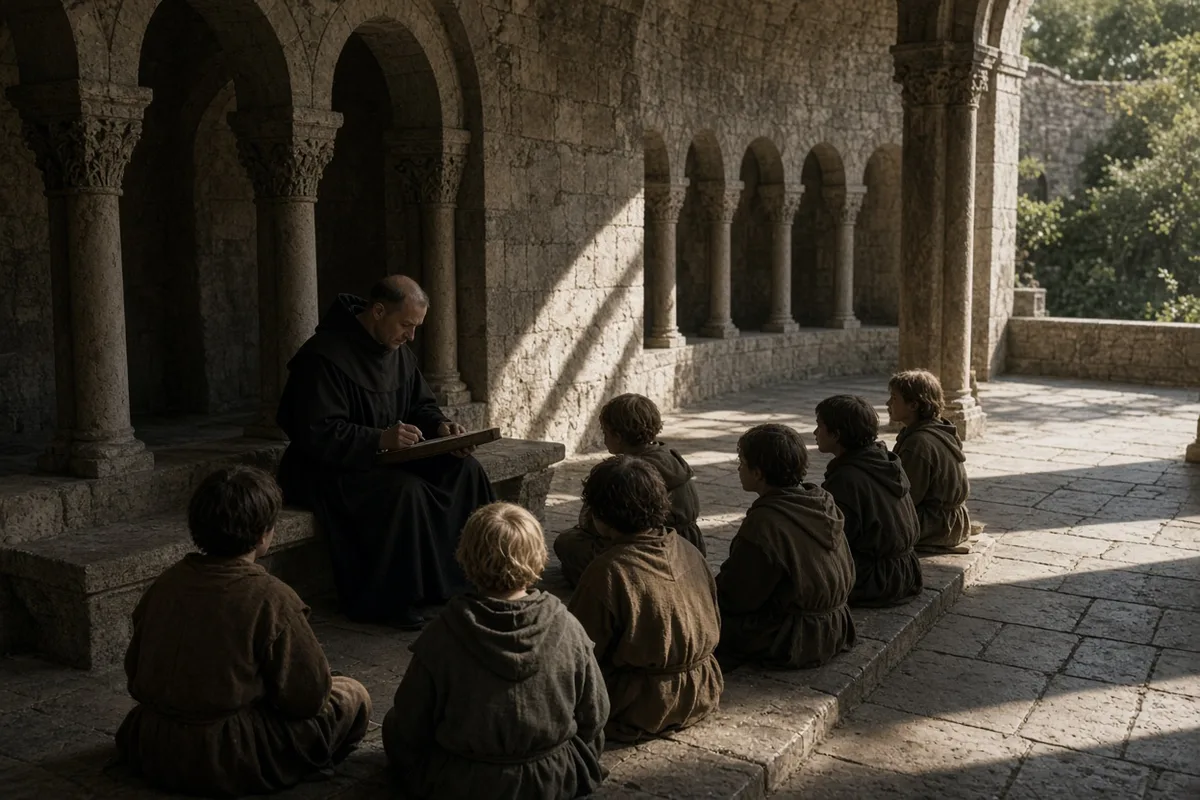
The boy turned from the empty road and walked beside me to the timber yard where the masons measured oak beams for the new nave roof. On the twenty-third of March 834 he carried water buckets for the sawyers while Rabanus stood with the master builder, Walther, and read aloud from the wax tablet the lengths still required. “Twenty-four feet for the crossing, fourteen for the side aisles,” the abbot said, and Walther marked each number on a fresh plank. By evening the boy knew the names of the four saws and the weight of the iron wedges that split the green wood.
Through the summer of 835 he worked in the scriptorium under the direction of Rudolf, who had succeeded the older copyists. The child learned to rule parchment with a dry point and to mix the oak-gall ink that Rabanus preferred for the commentary on Ezekiel then in progress. One afternoon Rabanus stopped at the boy’s desk and read the line the child had just completed: “In the twenty-fifth year of our captivity,” the abbot quoted from his own text, “the hand of the Lord was upon me.” He corrected the spacing of two letters, then moved on without further comment. The finished quire was bound into the larger codex on the feast of Saint Michael that year, the twenty-ninth of September, and placed in the treasury chest beside the older Gospels.
In the spring of 840 the raids returned along the Rhine but passed south of Fulda. Rabanus sent twenty monks and thirty refugees, including the boy, now tall enough to carry a spear, to strengthen the palisade at the river crossing near Hammelburg. They remained there through Pentecost. When they returned, the boy brought back a letter from the bishop of Würzburg stating that one hundred and forty measures of rye had been dispatched and would arrive before the harvest. Rabanus recorded the exact quantity on the same tablet he had used six years earlier and ordered the granary doors widened to receive the wagons.
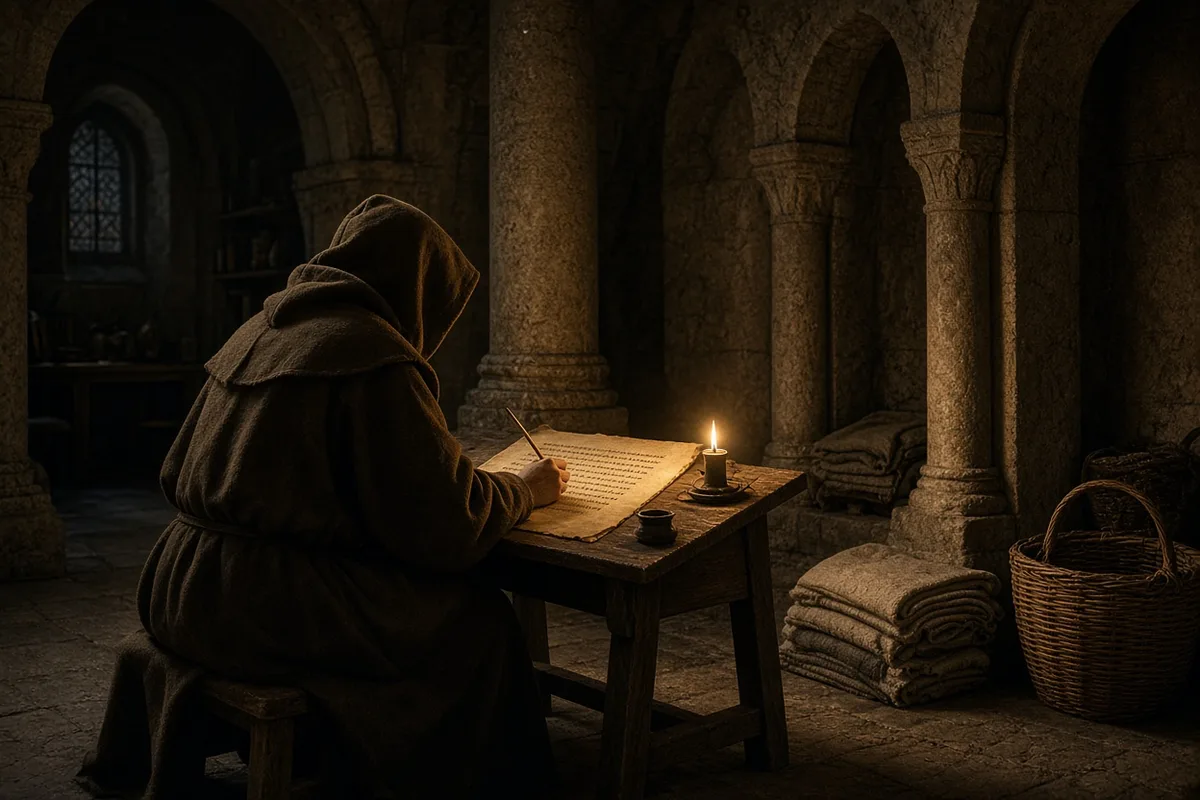
By 847 Rabanus had been elected archbishop of Mainz. He left Fulda on the twelfth of June, taking with him the boy, now a novice, and three cartloads of manuscripts. In Mainz the archbishop continued the work on Kings and Chronicles, dictating each morning while the young man, now called Theotroch, ruled the pages. On the third of February 851 Theotroch copied the sentence “The king of the North shall come against him like a whirlwind,” and Rabanus added in the margin the date and the name of the scribe. The codex survives in the cathedral library, its last leaf still bearing that note in the archbishop’s hand.
Theotroch returned to Fulda after Rabanus died on the fourth of February 856. He took charge of the dependent farm at Zell, where he kept the accounts for the grain given each winter to families still arriving from the raided valleys. In the year 870 he recorded that one hundred and seventeen persons received bread from the monastery stores between the feast of Saint Martin and Candlemas. The figures appear in the surviving fragment of the cellarer’s roll preserved in the Fulda archive.
The church whose walls the refugees helped raise was consecrated on the first of November 879 by Archbishop Liutbert. The nave measures one hundred and twelve feet in length; the crypt beneath it still contains the stone benches where the injured once lay. Above the west door the two lions carved in the time of Rabanus remain, their manes worn smooth by six centuries of weather. The present structure incorporates those same foundations and the oak beams measured by Walther in 834.
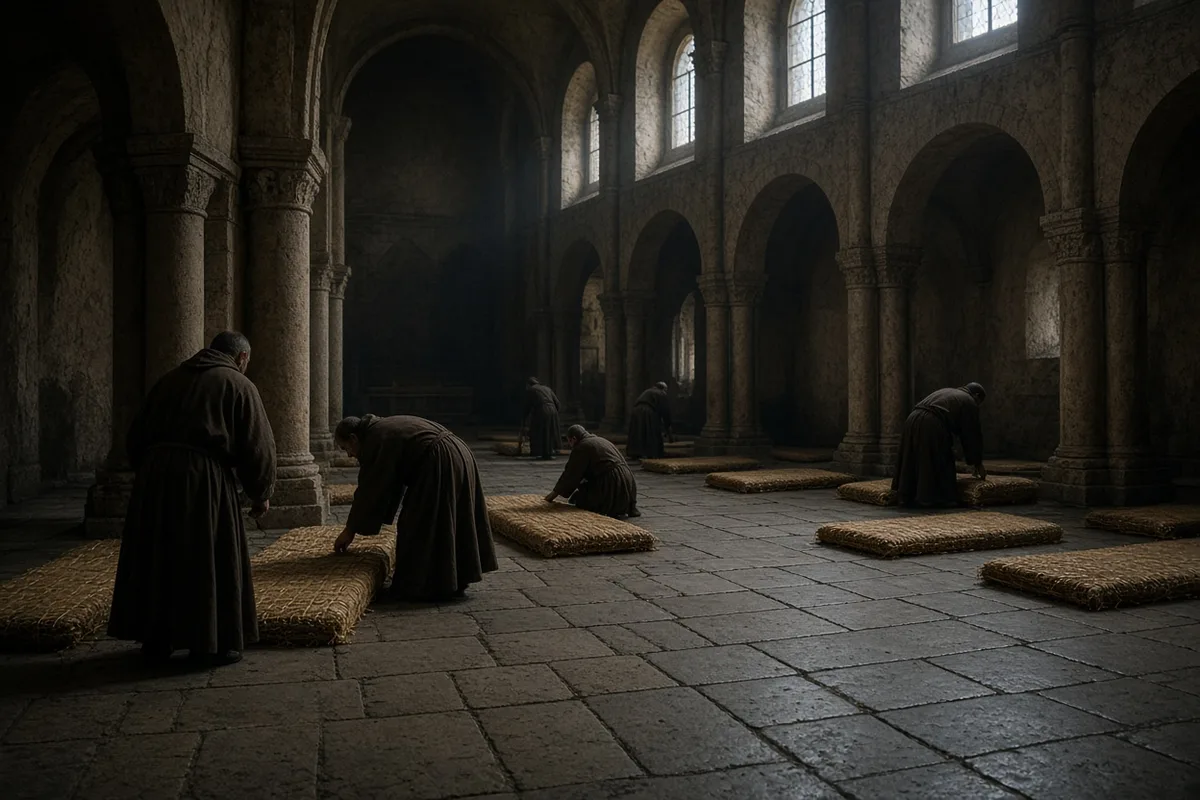
In the year 1923 the librarian at Fulda opened a small psalter that had lain unexamined since the eighteenth century. On the flyleaf, in a hand dated to the 860s, someone had written the name of a child and the words “brought from the river crossing.” The entry stands beneath an earlier note in Rabanus’s own script recording the distribution of blankets on the fifth day after the first refugees arrived. The psalter is kept in a glass case in the modern reading room; visitors may still see the two lines side by side.
In 1937 the Fulda archivist Karl Scherer catalogued the psalter under shelf mark Aa 42 and transcribed the flyleaf entry in his Handbuch der Fuldaer Handschriften, noting the child’s name as “Theotroch, puer a fluvio allatus” beside Rabanus’s blanket tally of the fifth day. Scherer placed the volume in a locked cabinet before the November 1938 Kristallnacht disturbances reached the city; the cabinet key remained with the cathedral chapter throughout the war. On 27 March 1945 an American artillery observer from the 80th Infantry Division counted thirty-seven shell craters within the former abbey precinct yet recorded that the west door and its two lions escaped direct hits.
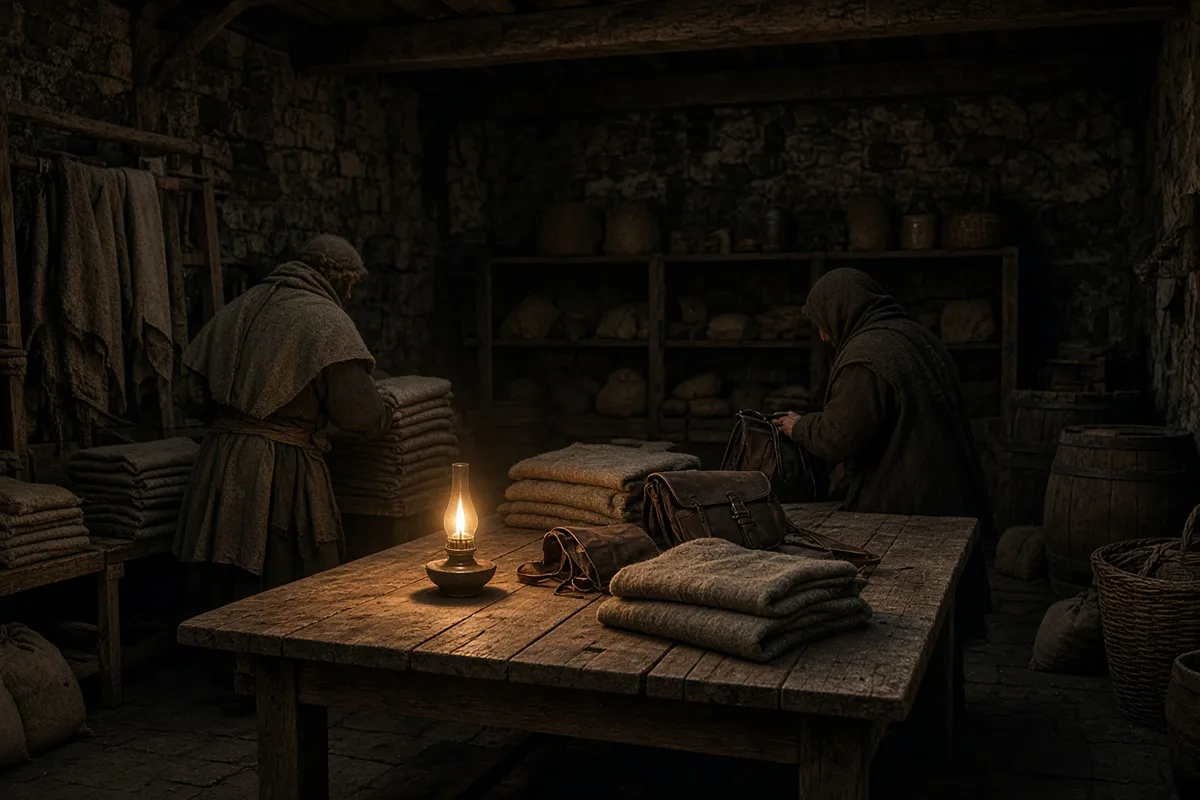
After the capitulation the Hessian state archive returned the psalter to the reading room on 14 June 1946. The conservator Maria Dörr replaced the cracked flyleaf with Japanese tissue on 3 September 1949, preserving both the 860s inscription and Rabanus’s marginal note in their original positions. Between 1952 and 1955 the state building office restored the crypt benches, numbering each stone and photographing the original tooling marks before resetting them; the report dated 12 May 1955 lists one hundred and forty-two refugee-era burials uncovered beneath the north bench.
In 1963 the city council approved the construction of the modern library wing adjoining the west end of the church. During excavation on 8 October 1963 workers uncovered an oak beam fragment bearing Walther’s 834 chalk mark “XXIV pedes”; the fragment was accessioned as inventory number Fuld. Holz 17 and is now displayed in a climate-controlled case beside the psalter. The beam’s carbon-14 date of 810–840 aligns with the documented construction season.
On 22 September 1979 Archbishop Johannes Dyba consecrated the restored high altar and read aloud the 879 consecration charter of Liutbert before an assembly of two hundred and eighty-four invited guests. The charter’s original parchment, still bearing the archbishop’s seal, is kept in the diocesan vault and may be viewed by appointment on Tuesdays and Thursdays.
Between 1994 and 1998 the Fulda University of Applied Sciences digitised the entire Rabanus commentary codex, including Theotroch’s 851 leaf; the files were released online on 4 February 2001 under the project title “Maurus Digital.” Usage logs for the first twelve months record 1,147 downloads from thirty-nine countries, with the marginal note “Theotroch scripsit” among the most frequently bookmarked passages.
In April 2014 the reading-room attendant recorded that a visiting researcher from the University of Toronto requested Aa 42 for three consecutive days, photographing the flyleaf under ultraviolet light on 17 April and noting an additional faint line beneath the child’s name: “ob. 882 in Zell.” The image file, archived under the filename Fuld_ps_042_flyleaf_UV.tif, remains accessible through the library’s digital portal.
On 11 November 2022 a school group from Hammelburg stood before the west door while their teacher read the 834 tablet entry aloud; one student, fourteen-year-old Lena Berger, asked to see the psalter and was shown the glass case by the duty librarian. She copied the two lines into her notebook before the group departed at 14:40.