



Recurring pain is often a game both players already want

In 60 seconds
- People run three ego states—Parent, Adult, and Child—and most relationship trouble comes from confusing which one is speaking.
- A crossed transaction, when the reply comes from the wrong ego state, is what makes ordinary talk suddenly sting.
- A game is a repeated series of plausible transactions with a concealed motive and a predictable payoff both sides seek.
- Painful games beat silence because even bad strokes satisfy recognition hunger better than none at all.
- The suffering is the point: each game confirms a childhood life position about one's own worth.
- Naming the game while it runs drains the payoff; autonomy means awareness, spontaneity, and game-free intimacy.
The big idea
Berne argues that much ordinary social behavior is not spontaneous but scripted: people run repeated hidden-agenda patterns called games, drawn from childhood decisions about their worth, to guarantee recognition even when the payoff is pain. Freedom comes from noticing the pattern in real time, choosing a response instead of running the script, and risking genuine intimacy without a guaranteed ending.
The book in brief
Berne starts from a simple observation: people are rarely as free in conversation as they feel. What looks like spontaneous talk is often a rehearsed pattern with a predictable ending, and the first job is learning to see the three distinct ego states that actually do the talking.
Once those states are visible, he treats a single exchange as a transaction. Complementary exchanges can run smoothly for years; crossed ones stall and sting. Underneath many of them runs a second, psychological message. When a series of such ulterior exchanges repeats across years and partners and always cashes out in the same feeling, he calls it a game.
He then explains why anyone would play a painful game at all. Three hungers—stimulus, recognition, and structure—drive social life. Games sit between empty pastimes and real intimacy because they deliver reliable strokes without the risk of being truly known. The payoff is double: an external advantage and, more important, fresh proof of an early verdict on the self.
From there the book catalogues the patterns that fill marriages, parties, bedrooms, prisons, and clinics. In each setting the surface topic is rarely the real one; naming the pattern itself is what breaks it. Institutions meant to help can become permanent furniture of the very structure they were built to stop.
The argument lands on autonomy. Awareness, spontaneity, and intimacy are the capacities that let a person choose transactions rather than run them. Recognizing a game mid-play often empties its prize on the spot, because the confirmation it seeks depends on someone staying blind to the second layer.
Context
Eric Berne published the book in 1964. It mattered because it gave lay readers and clinicians a plain vocabulary for manipulation and self-deception in marriage, work, and therapy, and it helped launch transactional analysis as a popular alternative to strict psychoanalysis.
The key ideas
1
Three voices inside
Every person operates from three ego states—Parent, Adult, and Child—and most relationship trouble comes from confusing which one is speaking.
Berne divides personality into three observable states shown in tone, posture, and word choice, not abstract Freudian structures. The Parent is borrowed behavior taken wholesale from actual parent-figures: rules and warnings absorbed but never examined. The Adult processes information here and now and updates its view. The Child is the person's own childhood experience replayed, encoded before language could argue against it.
These are not roles tried on but states a person genuinely enters, complete with matching voice, vocabulary, and gesture. The diagnostic test is not content, since identical words can come from any state, but manner and effect. His clinical claim, built from watching patients in group therapy shift visibly between states within a single sentence, is that people spend enormous energy running relationships from Parent or Child while believing they are being reasonable.
Recognizing which state is active moment to moment is the first necessary skill. Every later concept—the transaction, the game, the script—is built from exchanges between these three states operating in two people at once. Without this vocabulary, arguments, apologies, and advice all look like isolated events rather than patterned exchanges between specific parts of two people.
In practice: A man saying you should always check the oil before a long drive, finger raised and flat tone, is in Parent; a woman calculating fuel cost against distance is in Adult; someone wailing that it is not fair when a plan collapses is in Child.

2
When answers miss
Most bad arguments are not disagreements about facts but a mismatch between which ego state sent a message and which one answered it.
Complementary
Response comes from the state the stimulus targeted; can run for years
Crossed
Response comes from an unexpected state; the exchange stalls with a nameless jolt
Once ego states are visible, Berne treats a single exchange as the smallest unit of social behavior: a transaction—one stimulus from one person's ego state, one response from the other's. A transaction is complementary when the response comes from the state the stimulus targeted, and complementary transactions can continue indefinitely. A boss barking orders to a compliant employee, Parent to Child, can run smoothly for years however unequal it is.
Trouble starts with the crossed transaction: a stimulus aimed at one state gets answered from an unexpected one. The exchange stalls because the original question never gets the answer it sought, and both feel a jolt of confusion or anger they cannot name. Drawn from recorded marital and group sessions, his point is that the felt sting of a bad conversation is the signal a transaction has crossed, a sharper diagnostic than vague talk of communication problems.
This two-axis model, sender state and receiver state, becomes the skeleton for everything that follows. A game is nothing more than a patterned, repeated series of transactions with a hidden second layer, and that layer cannot be seen without first naming which state is transmitting and which is receiving. A crossed transaction can occur even with a polite sentence if tone carries the wrong state.
In practice: A wife asks, Adult to Adult, whether he knows where her keys are, and her husband snaps back from Parent to Child, asking why she always loses things.
3
The second message
A recurring painful pattern in a relationship is usually not an accident but a game whose ending both players already know and secretly want.
Social level
The polite words spoken out loud
Psychological level
The hidden dare or agenda the exchange is really advancing
A transaction can carry two messages at once: a social-level message, the words spoken, and a psychological-level message, what the transaction is actually doing. Berne calls this an ulterior transaction. From it he defines a game precisely: a recurring series of superficially plausible transactions with a concealed motivation, leading to a predictable, well-defined payoff.
Three features separate a game from ordinary interaction: repetition across years and partners, an ulterior quality where something other than the stated purpose is pursued, and a payoff—a bad feeling, a self-justification, a shift in status—that the player was aiming for all along, however unconsciously. People do not stumble into painful recurring situations by accident; they execute a script whose ending they already know, because the ending, however unpleasant, delivers something needed.
This reframes victim and persecutor roles as parts in a play both people rehearsed, not simply one person's fault. A game always requires at least two willing, if unaware, players. The usual delivery is confirmation of an old belief about themselves or others.
In practice: A salesman says this one is better but you cannot afford it—a product claim on the social level that is really a dare aimed at the customer's Child; if the customer buys, the concealed layer decided the sale.
4
Why pain wins
People choose painful games over silence because guaranteed bad recognition still beats the anxiety of no recognition at all.
- IntimacyGame-free direct exchange with no hidden agenda
- GamesUlterior patterned exchanges that guarantee strokes
- ActivitiesGoal-directed work
- PastimesSafe talk about shared low-stakes topics
- RitualsFixed low-risk exchanges like greetings
- WithdrawalMere physical presence with no engagement
Before cataloguing individual games, Berne explains the underlying need through three hungers. Stimulus hunger is the biological need for sensory input, evidenced by observations of institutionalized infants whose development suffers from touch deprivation even with adequate nutrition. Recognition hunger is the social version: since adults cannot survive on literal touch, they settle for its symbolic substitute, the stroke—any unit of recognition, a nod, a compliment, an insult, even a fight.
Structure hunger is the need to fill time with a plan, since unstructured time produces the same anxiety in adults that stimulus deprivation produces in infants. He names six ways people structure time together, ascending in psychological risk: withdrawal, rituals, pastimes, activities, games, and intimacy. Games occupy the slot between empty small talk and real intimacy because they deliver guaranteed strokes, even bad ones, without the vulnerability real intimacy requires.
A person raised in a household starved of affection learns early that being recognized, even through conflict, beats not being recognized at all. A game becomes a reliable machine for producing that recognition on demand. People would rather play a painful game than sit in silence because silence threatens recognition hunger more severely than a fight does.
In practice: Institutionalized infants with adequate nutrition still suffered developmentally from touch deprivation, showing why adults settle for symbolic strokes that include insults and fights.
5
The payoff is the point
The suffering a game produces is not a side effect but the actual goal, engineered from a decision about self-worth made in early childhood.
External payoff
Practical advantage—winning the argument, an excuse, a license to leave
Internal payoff
Confirmation of the old life position about self-worth or others' untrustworthiness
Every game cashes out in two payoffs, internal and external, both tracing to an early decision about one's worth relative to others—what Berne calls the existential or life position. A chronically criticized child may settle, often before age five, on something like I am not OK, you are OK, and everything done as an adult, including which games are chosen, tends to prove that early verdict, because an untested belief needs continual confirmation to survive contact with reality.
The internal payoff is this confirmation—fresh evidence that I really am unlovable or people really cannot be trusted. The external payoff is the practical advantage gained meanwhile, such as an excuse to avoid work or license to end a relationship without taking blame. This is a stronger, more cynical claim than most therapy models of the era offered: the suffering is the point, engineered from decisions made long before the adult situation existed.
This sets up the idea of a script, a childhood life-plan with a preferred final scene, where games are the individual scenes an adult stages repeatedly in service of reaching that scripted ending, however unhappy it looks from outside.
In practice: In Now I've Got You, You Son of a Bitch, a person maneuvers a partner into a small provable mistake then erupts in righteous anger; the external win is the argument, the internal prize is fresh proof that people always let you down.

6
Marriage games named aloud
Naming a marital game out loud, in front of both partners, breaks it more effectively than addressing whatever surface topic it appears to be about.
Berne argues a long-term partnership without at least one working game rarely survives, because games supply the guaranteed stroke exchange couples need to tolerate daily proximity. These patterns are rarely about the surface topic—money, chores, sex—and confronting the surface topic directly changes nothing, because the argument was never really about it.
What does change the pattern is naming the game itself, which breaks the ulterior transaction by exposing the hidden layer. Once a spouse can say the game's name, the game usually stops working, because games depend on at least one player remaining unaware of the second layer running beneath the visible one. His clinical observation, drawn from couples he treated, is that the pattern holds across different surface topics.
Several named patterns recur. Corner sets a partner up so any response, action or inaction, can be criticized, guaranteeing a win regardless of what the other person does. Partners rehearse childhood scripts about entitlement and rejection rather than negotiate the stated issue at all.
In practice: In If It Weren't For You, a wife blames her husband's restrictions for stopping her from something she secretly never wanted; when he relaxes a rule, she finds another reason not to act, exposing that the restriction was never the real obstacle.

7
Party stroke contests
Sociable small talk often functions as disguised competition for strokes rather than genuine exchange, which is why offering real solutions rarely helps.
In social settings Berne finds a lighter but equally patterned family of games that mostly fill pastime slots with disguised competition. What links them is that they let acquaintances generate real emotional heat—solidarity, indignation, superiority—without the risk of genuine self-disclosure, since the stated topic is never really the point; the point is the exchange of strokes disguised as content.
Ain't It Awful lets participants trade complaints about shared misfortunes with no intention of fixing anything, since fixing it would end the game. Blemish fixes obsessively on a single flaw in another person or situation, letting the player avoid a larger, more threatening judgment by narrowing attention to something safely criticizable.
Skilled hosts and group leaders can shift a room simply by asking a direct, Adult-level question about someone's actual situation, which strands the game because it removes the safe impersonal target and asks for a real answer instead—something the game was designed specifically to avoid producing.
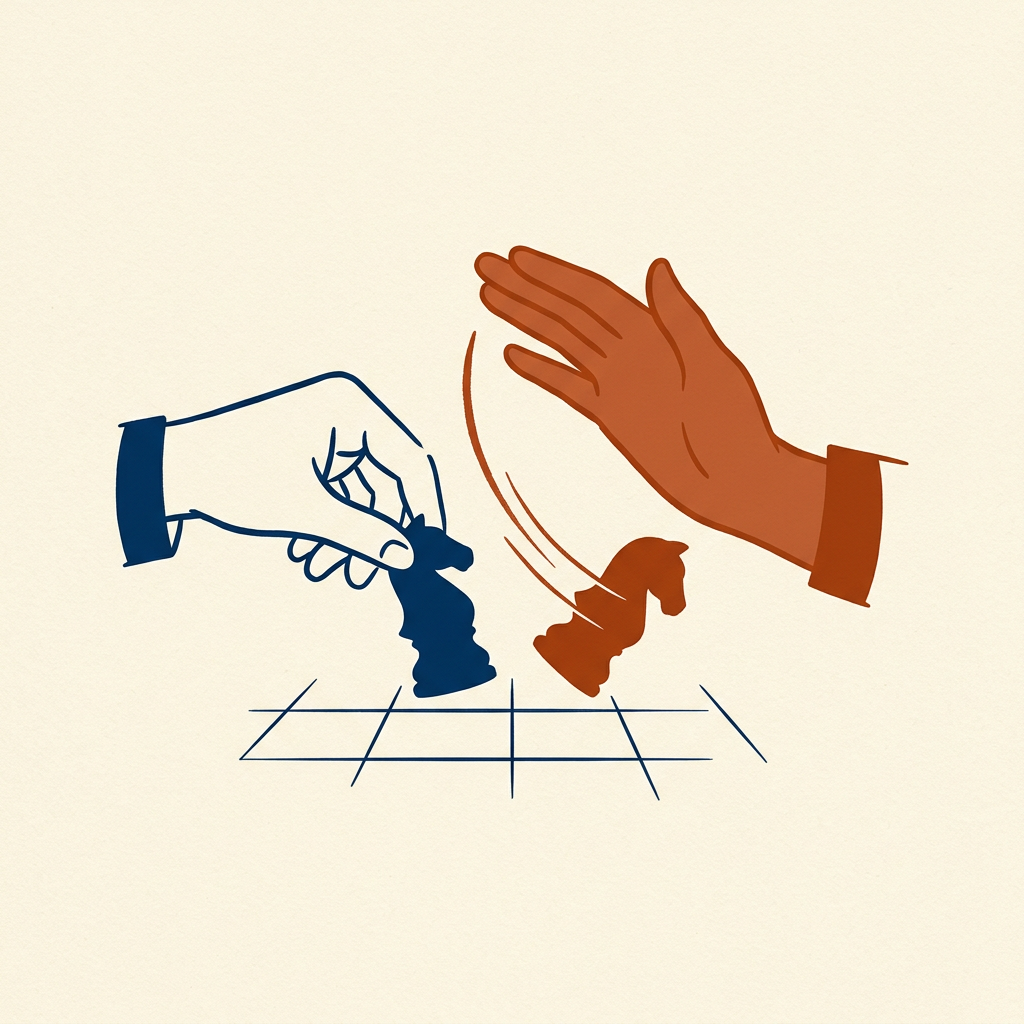
In practice: In Why Don't You—Yes But, one person presents a problem, the group offers solutions in good faith, and every suggestion is rejected with a reason it will not work; the payoff is proof that no one can help.
8
Sex as managed contest
Sexual games substitute a managed, scripted contest for real vulnerability, so the intensity they produce is rarely about desire at all.
Scripted contest
Managed intensity with a known ending and no real risk of rejection
Real vulnerability
Actual risk of being known and possibly rejected without a guaranteed payoff
Sexual games, Berne holds, are among the most damaging because they use the appearance of intimacy to avoid intimacy itself, converting apparent closeness into another vehicle for an old script. Both major patterns share a substitution: real vulnerability, the actual risk of being known and possibly rejected, is replaced by a managed contest whose ending is scripted in advance, so the player experiences intensity without genuine danger of an unplanned outcome.
He treats this as the sexual family's version of the mechanism found in marital and social games—controlled risk standing in for real risk—but flags it as more consequential because the stakes, reputation, safety, and actual relationships are higher, making these games harder to interrupt once running.
His broader claim is that sexual desire itself is rarely the actual driver in these patterns; the driver is the old childhood decision about worth and safety, and sex simply supplies unusually potent material for staging it repeatedly. Let's You and Him Fight has one person arranging two others to compete for attention, proving desirability without ever risking a personal choice or rejection.
In practice: In Rapo, a person invites sexual interest, escalates the interaction, then abruptly and often publicly punishes the other for responding; the payoff is moral superiority plus confirmation that the opposite sex is predatory.
9
Helpers who need failure
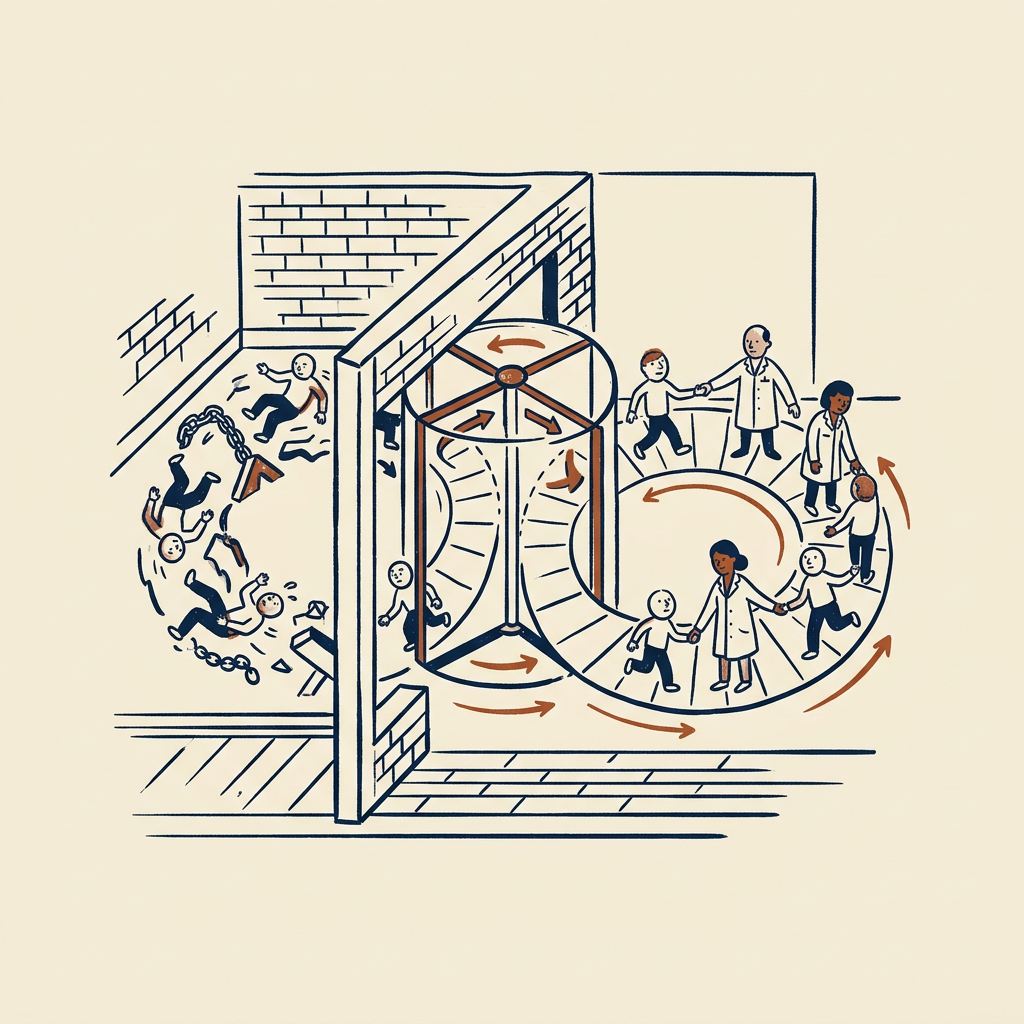
Institutions built to fix a problem can end up sustaining the very game they were meant to end, because staff need the game's structure too.
Berne extends the same analysis far from the therapy room, arguing the mechanism is identical whether players are patients, spouses, or repeat offenders. A game can look from outside exactly like a moral failing, an addiction, or a crime wave, while functioning underneath as a stable social structure giving every participant, including bystanders and professionals, a guaranteed role and a guaranteed stroke.
Cops and Robbers describes offenders who commit crimes almost designed to be caught, feeling disappointment rather than relief when they get away clean; the real payoff was never the theft but the chase and the confirmation, embedded since childhood, of being someone who gets caught and punished. Alcoholic assigns roles to an entire cast around the drinker—the nagging spouse, the friend who supplies one more drink, the professional who intervenes—and the drinking itself is nearly secondary to the roles played around it, which is why removing alcohol without addressing the surrounding game often just shifts the cast onto a different substance.
This is his most unsettling claim: the fixing institution can become a permanent part of what sustains the problem. Both helper and client can need the failure more than either needs the stated goal of assistance.
In practice: In I'm Only Trying to Help You, a helper's advice predictably fails, renewing frustration at an ungrateful client who will not be helped, while the client proves again that no one can really help them.

10
Autonomy without the script
Recognizing a game while it is being played is often enough to drain its payoff, because the confirmation it seeks depends on someone remaining unaware.
Having catalogued the games, Berne asks what a person looks like without them, and his answer is demanding: autonomy requires three capacities—awareness, spontaneity, and intimacy—that few adults hold at once. Awareness means perceiving the world directly through one's own senses in the present, rather than through inherited Parent judgments or replayed Child fears. Spontaneity means having the option to express any of the three ego states honestly, choosing a response rather than being driven into it by an old script.
Intimacy, the rarest, is a game-free exchange of authentic feeling between two people's Adult or Child states, with no ulterior transaction running underneath. He treats it as inherently risky, since without a script guaranteeing the payoff, either person could genuinely be rejected, which is precisely why most people retreat to games instead. He allows a category of good games: patterns like mutual openly enjoyed teasing or generous mentorship, where any ulterior motive serves the other person's growth rather than confirming a painful old belief.
The book's argument converges here: the task is not eliminating all structure and drama, since some structure is a genuine human need, but making the ulterior layer visible so a person can choose transactions rather than run them unconsciously. Recognizing a game while playing it often drains its payoff immediately.
In practice: Seeing an actual sunset rather than the sunset one was trained to admire is his image of awareness—direct present perception instead of Parent judgment or Child fear.
Key terms
- Parent The ego state of borrowed rules and warnings taken wholesale from parent-figures
- Adult The ego state that processes here-and-now information and updates its view
- Child The ego state that replays the person's own childhood experience
- transaction One stimulus from one person's ego state plus one response from another's
- crossed transaction A reply that comes from an unexpected ego state and stalls the exchange
- stroke Any unit of recognition—a nod, compliment, insult, or fight
- ulterior transaction An exchange carrying both a spoken social message and a hidden psychological one
- game A recurring series of plausible transactions with a concealed motive and a predictable payoff
- life position An early decision about one's worth relative to others, often settled before age five
- autonomy The rare combination of awareness, spontaneity, and game-free intimacy
What to do
- Ask, when talk turns sour, which ego state the other person's message came from and which one you are about to answer with.
- Answer a Parent-to-Child jab from Adult instead of matching it.
- Write down the actual sequence and ending of one recurring argument in your closest relationship.
- Name that pattern out loud next time it starts, calmly and without blame.
- Replace one safe pastime conversation each day with a single direct question about how someone is actually doing, and stay for the real answer.
Questions to think with
- Which ego state am I usually in when my closest relationship goes sour?
- What payoff might I be collecting from a fight I claim to hate?
- If I named the game out loud next time it started, what would I risk losing?
- Where do I choose guaranteed bad recognition over the anxiety of silence?
- What would a game-free exchange look like with the person I play the most games with?
The other side
The strongest fair objection is evidentiary. Berne relies on case vignettes from his own practice and group sessions, not controlled studies, and defines games by clinical impression rather than reproducible measurement, leaving no way to test whether a named game is a real category or a clever label applied after the fact. Transactional analysis never delivered the predictive, falsifiable results contemporary clinical psychology required, and mainstream training largely moved on by the 1980s. A related limit is that the book barely engages power, poverty, or structural inequality and treats players as roughly equal choosers—an assumption that fits his mid-century patients but risks excusing the more powerful party when later readers apply game language to abuse or economic dependency. Dated gender-role assignments in several marital and sexual games add another filter a modern reader must work through.
Who it's for
Someone stuck in a recurring argument that keeps returning in disguise will get the most practical use, as will therapists, coaches, and managers who need a plain-language model for why rational advice fails to change behavior. General readers curious about the mid-century roots of pop psychology and terms like ego states and strokes will also find the full book rewarding.