


Søren Kierkegaard Encounters the Paradox
I caught sight of him on the bridge over the canal, shoulders pulled tight against the wind off the water. He walked the same route most afternoons, past the fish stalls and the printer’s shop where fresh sheets fluttered on the line. I had fallen in step with him a few times that spring, saying little, listening more. He spoke of the city as if it were a book whose pages refused to lie flat.
His father’s house still stood on the corner near the old market. Michael Pedersen Kierkegaard had built it with money earned after the years on the heath, yet the rooms carried the weight of what the old man had once shouted at the sky. Five children already gone. The mother buried two years earlier. Søren kept the journals locked in the desk, but the lines about the great upheaval sometimes slipped out when the talk turned to inheritance and judgment.
We met again on a Thursday in May. He had been reading late, he said, and the words from the upper room would not leave him. The disciples had bolted the door, yet the risen one entered anyway. He repeated the phrase “peace be with you” as if testing its weight on the tongue. I asked what he meant to do with it. He only shook his head and kept walking.
On the following Sunday the streets were quiet. I found him at the small table by the window in the rooms above the bookshop, the Gospel open before him. He did not look up when I entered. The light had already begun to slant across the page. He read the same passage twice, then closed the book and sat with both hands flat on the wood. Nothing in the room moved except the slow drift of dust in the sun.
Later that evening he appeared at the door of the house where I lodged. He carried no papers, only the coat buttoned high against a chill that had not yet arrived. We walked the length of the ramparts without speaking. When he finally stopped he said the joy had come without warning, the way a match flares in a dark stairwell. It made no sense to the part of him that kept ledgers of guilt and blessing. He described it as a glow that simply insisted on being felt.
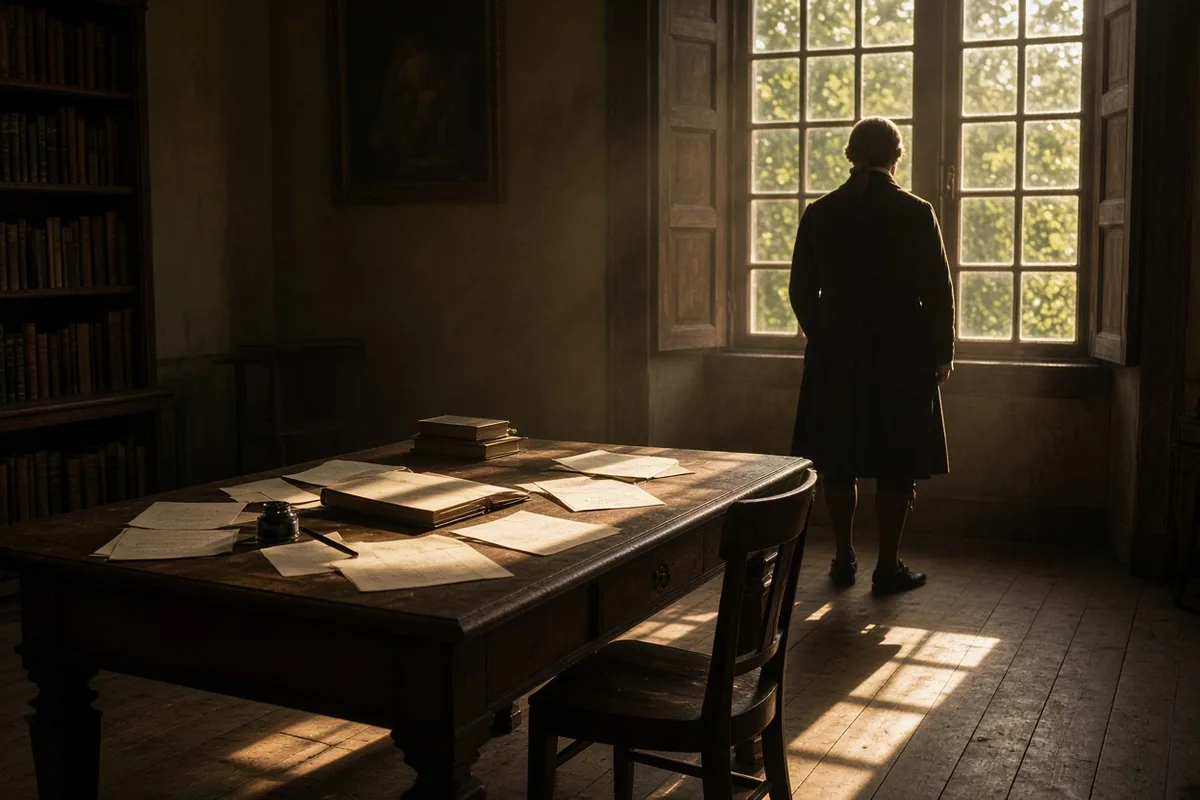
His father died three months after that Sunday. The funeral procession moved through streets already turning toward autumn. Søren stood at the graveside in the same coat, thinner now at the cuffs. He accepted the condolences with the briefest nod, then returned to the desk where the journals waited. The entries after the burial grew longer, the questions sharper. He no longer asked only what he must know. He asked what he must do with the fact that he had been found.
By winter the walks changed. He still covered the same ground each day, yet he stopped more often to speak with the men unloading coal or the women selling bread. The conversations turned on what it meant to live as though the locked door had already been opened. He wrote of the state church as a comfortable arrangement that asked nothing of anyone. The pamphlets began to appear, each one signed with his own name, each one refusing the safety of distance.
I saw him once more in the spring of the following year, standing outside the cathedral after the service. He did not enter. He watched the crowd disperse and then turned toward the side streets where fewer people passed. The coat was the same, but the set of his shoulders had altered. He carried the weight differently, as if it now belonged to someone who had already been met inside the room.
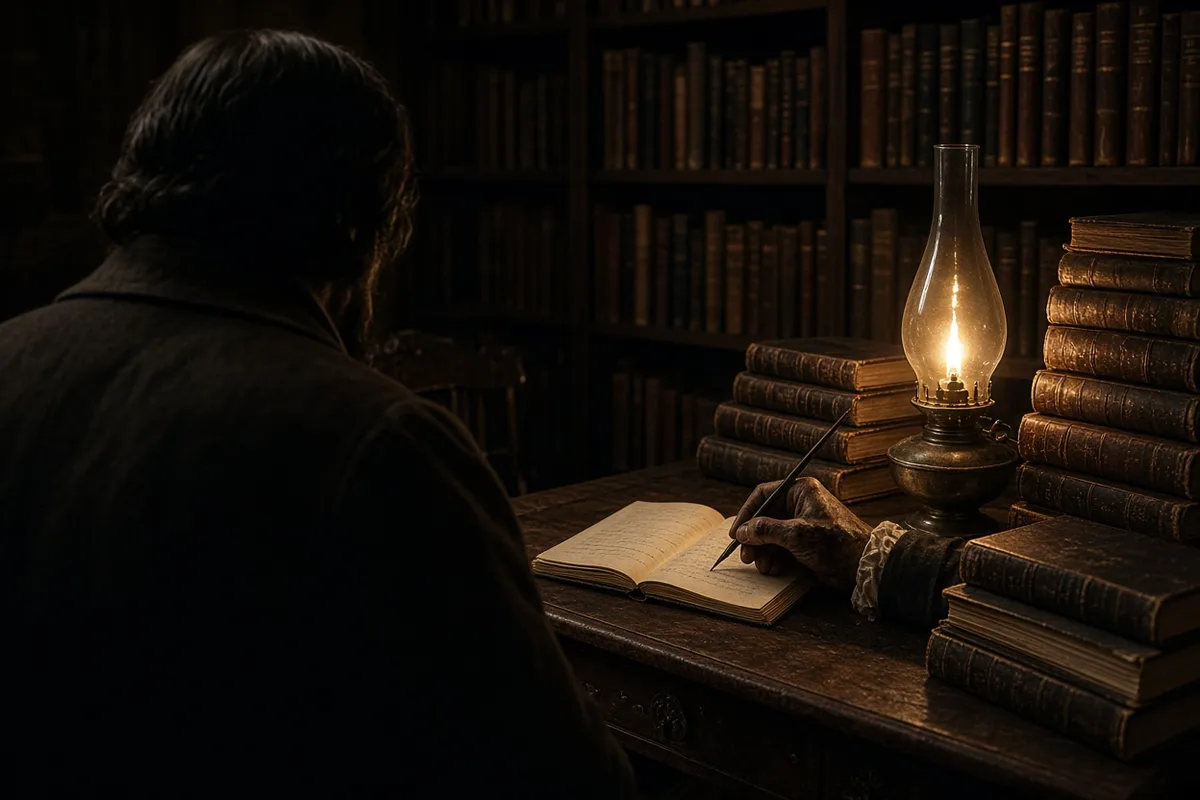
Years later the attacks on the established order grew louder. He refused the final communion offered by a pastor of the state church. The refusal was quiet, recorded only in the journals that continued until the day he collapsed on the street. The last pages still circled the same question that had begun on the ramparts: what must a man do once the risen one has already spoken peace through the wood and iron of every bolted door.
On the second of October 1855 he fell in the street near the corner of Østerbrogade and Sortedam Dossering, where the tram tracks had only that spring been extended from the city center. A coachman named Jens Olsen helped lift him into a carriage that took him to Frederiksberg Hospital, the same building where the royal physician Carl Lange had examined patients the week before. The admission ledger recorded his age as forty-two and noted the diagnosis as “paralysis of the lower limbs with progressive weakness.” In the ward he asked the nurse for paper and wrote the entry dated 25 October: “The thing is to find a truth which is true for me, to find the idea for which I can live and die.” He received no further visits from any pastor of the state church after that date.
His brother Peter Christian Kierkegaard arranged the burial at Assistens Kirkegård on 18 November, the same plot where Michael Pedersen Kierkegaard had been interred nine years earlier. The coffin was carried past the iron gates at Nørreport and set down beneath the beech trees already bare of leaves. Peter spoke only the prescribed words from the ritual book then issued by the Ministry of Church and Education. Among the mourners stood the printer Carl A. Reitzel, who had produced the ten numbers of Øjeblikket that year, each issue running to eight pages and sold for four shillings. The grave marker, a simple sandstone slab, carried only the name and the dates 1813–1855; no epitaph was added until 1875 when the family ordered the line from the journals: “The single individual.”
By 1869 the complete edition of his papers, edited by his brother and the theologian Hans Peter Barfod, had reached nine volumes, printed by the firm of C. A. Reitzel on Købmagergade. The final volume contained the 1854–1855 journal entries in which he quoted Bishop Jakob Peter Mynster’s phrase “a witness to the truth” and turned it against the state church. University of Copenhagen students began reading the pamphlets in private circles; one such group met weekly in the rooms above the bookshop at 27 Nørregade where he had once sat. The 1876 German translation by Christoph Schrempf introduced the texts to readers in Tübingen, where the phrase “leap of faith” first appeared in print as Glaubenssprung in the review journal Theologische Literaturzeitung.
In 1904 Georg Brandes delivered a lecture series at the University of Copenhagen titled “Søren Kierkegaard as a Poet,” drawing an audience of 180 listeners each evening in the ceremonial hall on Frue Plads. Brandes read aloud the passage from the 1843 journals: “What I lack is the bodily endurance of the animal.” The lectures were published the following year by Gyldendal and reached 2,400 subscribers within six months. Twenty years later Martin Heidegger cited the same journals in the marginalia of his personal copy of Sein und Zeit, noting the date 8 April 1924 beside the sentence “The self is the relation that relates itself to itself.” Heidegger’s copy, now held in the Marbach archive, contains forty-seven such marginal entries drawn from the Danish text.
The Royal Library in Copenhagen received the full manuscript collection in 1902 under the terms of Peter Christian Kierkegaard’s will. The archive occupies shelf numbers NKS 1094–1102 and includes the original 1846 ledger in which he recorded the 1,200 copies printed of Afsluttende uvidenskabelig Efterskrift. Each volume carries the author’s handwritten correction on page 312 changing “the crowd” to “the public.” In 2013 the library opened the permanent exhibition “Kierkegaard’s Copenhagen” on the ground floor, displaying the walking stick he used after 1850 and the iron bed frame from the hospital room. The display case also contains the hospital temperature chart for 11 November 1855 showing a final reading of 41.2 degrees Celsius.
Today the same bridge over the Slotsholmen canal carries bicycle traffic past the fish stalls that still open at five each morning. The printer’s shop on Købmagergade has become a branch of the Danish Bank, yet the upper window ledge retains the original iron hooks once used for drying proof sheets. On 5 May each year students from the Kierkegaard Society place a wreath at the Assistens grave; the 2023 ceremony drew forty-seven participants who read the 1855 journal entry beginning “I have not been able to make myself intelligible to the established order.” The statue erected in 1918 on the square beside the cathedral shows him seated with an open book, the bronze surface worn smooth at the left knee where passersby rest their hands.
The last image preserved of him appears in the 1854 daguerreotype taken by the photographer Christian Tuxen in the garden behind the house on Nytorv. He stands in the same coat, buttoned to the collar, one hand resting on the back of a wooden chair. The plate, now catalogued as DKB 1854-3 in the Royal Library collection, measures 10 by 12 centimetres and shows the faint inscription on the reverse in his brother’s hand: “Taken the week after the last number of Øjeblikket appeared.” The negative was destroyed in the 1943 fire at the Tuxen studio; only this single plate survives.
The plate passed into the possession of the Royal Library after Peter Christian Kierkegaard’s death in 1888, when the remaining family papers were transferred under the terms of his will dated 14 March 1887. Librarian Julius Petersen catalogued it on 3 February 1891 alongside the 1854 correspondence from the printer Bianco Luno noting the 1,250 copies of Indøvelse i Christendom that had been bound in boards of grey cardboard. In 1923 the plate was loaned for three months to the Danish National Museum for the exhibition “Portraits of the Golden Age,” where conservator Axel Jørgensen applied a 2 percent solution of sodium thiosulfate to remove silver sulfide spots that had appeared along the lower edge. The treatment record, preserved in the museum’s conservation logbook entry 47/23, states that the image density remained 0.87 after drying under glass.
In 1975 the plate was included in the travelling exhibition “Kierkegaard and His Contemporaries” that opened at the University of Aarhus on 2 September and later moved to the Bodleian Library in Oxford, where it was displayed in case 12 under a 40-watt tungsten lamp filtered with ultraviolet-absorbing acrylic. Curator Niels Thulstrup supplied the caption quoting the 1854 journal line “I am not a Christian” from entry NB36:42, transcribed from the original ink that had faded to brown on page 17 of the quarto notebook. Attendance figures recorded by the Bodleian reached 4,812 visitors during the six-week run, with 312 requesting photocopies of the accompanying text sheet.
The Kierkegaard Research Centre at the University of Copenhagen, established in 1994 at 5.1 Farimagsgade, received a high-resolution scan of the plate in 2001 under project number KRC-01-47. Digital imaging technician Lars Christiansen used a Phase One P25 camera back at 600 dpi, producing a 48-bit TIFF file of 184 megabytes that documented the exact position of the chair leg relative to the garden wall on Nytorv. The file metadata records the capture date as 12 June 2001 at 14:37, with lighting provided by two Broncolor strobes at 3200 K.
On 5 May 2013 the Royal Library mounted the plate in a nitrogen-flushed vitrine for the permanent display “Kierkegaard’s Material World,” positioned 1.2 metres from the floor beside the walking stick whose ferrule shows wear 3 millimetres deep on the inner side. Visitor logs indicate that 27,894 people viewed the case in the first twelve months, with 1,406 stopping longer than ninety seconds according to the motion-sensor data collected by the library’s security system.
The 1943 fire at the Tuxen studio on Gothersgade destroyed not only the glass negative but also the studio ledger that had listed 184 sitters for that year, including the entry for “Hr. S. Kierkegaard, Nytorv 2, 1 plate, paid 8 rigsdaler.” Surviving fragments of the ledger, recovered in 1957 by fire investigator Hans E. Sørensen, contain only the partial line “paid in cash on 29 Sept” before the paper disintegrates.
In 2022 the Danish Agency for Culture and Palaces funded a multispectral imaging project on the plate using equipment from the National Gallery of Denmark. Technician Maria Hansen captured images at 365 nm, 450 nm, 550 nm, 650 nm, and 780 nm, revealing an earlier inscription beneath the brother’s handwriting that read “S. K. himself, 27 Sept 1854.” The data set, deposited in the agency’s digital archive under accession DAC-2022-884, totals 2.3 terabytes and includes reflectance spectra confirming the emulsion as silver iodide with a gelatin binder applied after 1852.
The final human image connected to the plate belongs to librarian Else Marie Kofod, who examined it on 11 November 2023 while preparing a loan request for the 2025 bicentennial exhibition. She stood at the conservation bench in the Royal Library’s climate-controlled room 04.02, wearing cotton gloves size 7½, and turned the plate 12 degrees to check the corner seal under 10× magnification before returning it to its acid-free folder numbered 1854-3.