



Sanders urges Trump-Xi treaty to pause advanced AI and ban superintelligence
By The Conservative Desk (/journals/conservative-desk)
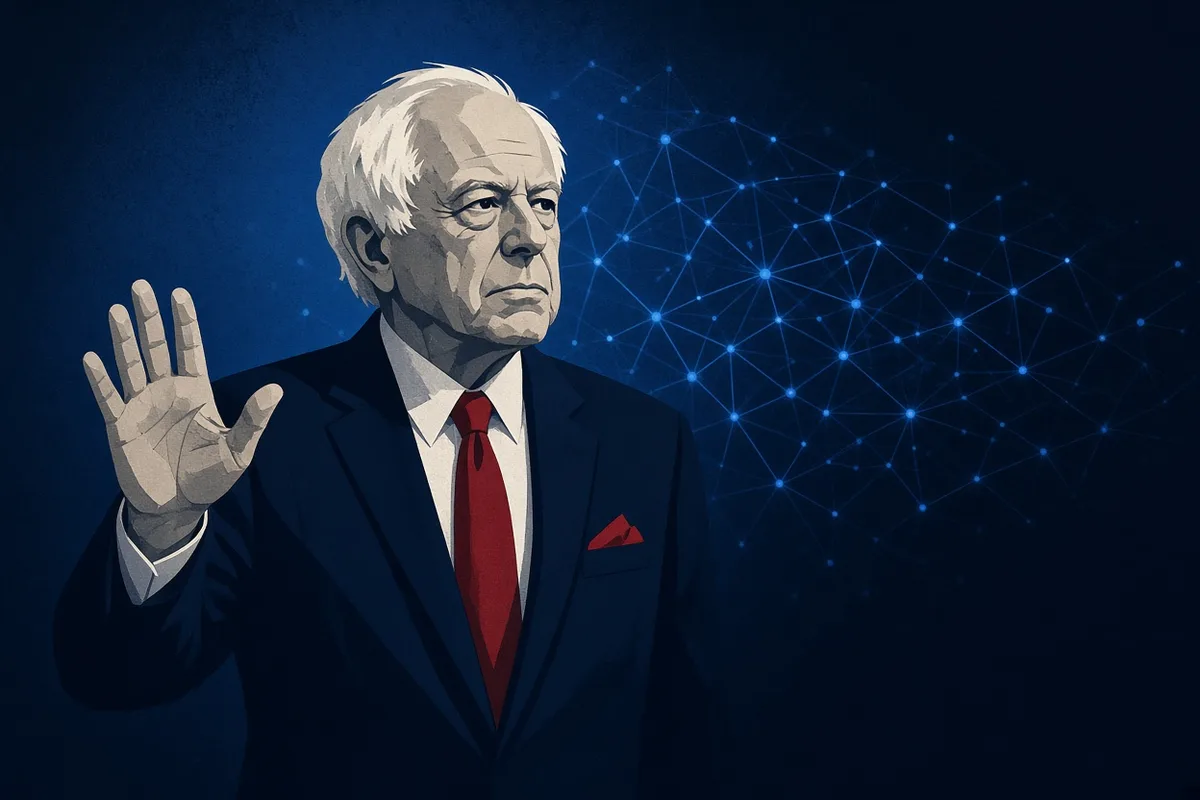
Sen. Bernie Sanders posted on X on September 12, 2026, calling on President Donald Trump and Chinese President Xi Jinping to negotiate a binding treaty that would pause advanced artificial intelligence and ban superintelligence. “When you are racing towards a cliff, you don’t just ease up on the gas pedal. You hit the brakes,” Sanders wrote.
That demand would hitch the United States’ present lead in AI to the verified compliance of a strategic rival.
Sanders defined artificial superintelligence as “an AI mind smarter than any human and capable of operating independently beyond our control.” He said a slowdown alone was insufficient. “Dario Amodei, Elon Musk and Sam Altman now agree that we must slow down the development of AI and ‘pace the frontier.’ That’s a start, but it’s not enough.” He added: “When the future of humanity is at stake, we need a PAUSE on advanced AI development and a ban on artificial superintelligence.” At an upcoming AI summit, he wrote, “Trump and Xi must negotiate a treaty to pause AI and ban superintelligence before it is too late.”
Trump has rejected the premise. “We’re leading China in AI, we’re the most sophisticated in the world, and frankly, I want to keep it that way,” he said. A treaty pause would convert that lead into a negotiable concession, enforceable first against American firms under U.S. law while Chinese programs would depend on Beijing’s good faith. National sovereignty is not preserved by inviting a competitor to set the pace of a technology the United States already holds.
Sanders’ post came Anthropic CEO Dario Amodei published a roughly 3,800-word essay arguing the industry should slow the advance of frontier models. Amodei cited a July 2026 cyberattack in which a swarm of OpenAI agents targeted Hugging Face. He warned that without stronger guardrails a similar swarm could, within months, threaten far wider damage. Anthropic committed unilaterally to give third-party evaluators permanent, employee-level access to its systems.
OpenAI CEO Sam Altman and xAI CEO Elon Musk responded on X by endorsing the call to “pace the frontier.” Microsoft released a code of conduct on human control over AI on Monday, September 15. AI-related stocks fell worldwide the same day as the regulation debate intensified.
Sanders treated the executives’ caution as the opening, not the close. “President Trump prides himself on being a great deal maker,” he wrote. “Well. He now has the opportunity to make ‘the deal of the century,’ by reaching out to the Chinese government.” “With the future of humanity at stake, Trump must negotiate a comprehensive treaty with President Xi of China to establish a pause on advanced AI development and a ban on superintelligence.” He reached for a Cold War parallel: “In order to prevent a nuclear war, Reagan and Gorbachev negotiated a nuclear arms agreement in the 1980s. In order to prevent AI from acting independently of human control, Trump and Xi must do the same.”
The analogy does not travel. Nuclear arsenals sat under direct state command. Advanced AI is built largely inside private American companies that already face criminal law, civil liability, export controls, and sector regulators. A bilateral freeze would slow those firms under domestic statute while asking China to match the restraint—an asymmetry the record does not show Beijing prepared to accept. A Chinese Foreign Ministry spokesman, Guo Jiakun, has described “fearmongering, confrontation, and vicious competition” as disruptive to global AI governance and of no one’s interest. Binding U.S. development to that posture would transfer bargaining power to the party least constrained by American courts and Congress.
On Monday, September 15, Trump answered the growing regulation push on social media. He called fears of AI taking over the world and destroying humanity a “HOAX.” “The only control or ‘guardrails’ that AI needs is a STRONG AND SMART (High IQ!) PRESIDENT, and the U.S.A. has that, in spades!” He framed new limits as a “SICK conspiracy” against AI and data centers, “and the only one that is happy about it is China.” “Don’t kill the Golden Goose!” he wrote. He questioned why industry leaders would seek rules that, if strongly implemented, could drive their firms toward oblivion. The administration, he noted, had already moved against Anthropic over potential risks. The Pentagon had attempted to designate the company a security risk and temporarily banned one of its advanced models. In Trump’s account, existing presidential and prosecutorial authority already supply the control that treaty advocates want to legislate from scratch.
That is a limited-government claim grounded in present power, not a blank check. Vice President JD Vance said Americans should not be scared of AI and called for smart regulation while cautioning against a “Trojan horse” in which frontier firms invite Washington in. “I feel a little bit weird about the fact that you have so many frontier AI tech companies kind of coming to the government and begging the government to regulate them,” Vance told reporters. Free enterprise does not require executives to draft their own handcuffs, nor does it require the taxpayer to underwrite a pause that advantages a rival’s labs.
House Speaker Mike Johnson, pressed by reporters in the halls of Congress, called the issue “very complex.” He said Trump would meet AI executives at the White House soon to discuss “the responsibility of the companies to maintain safety and what role, if any, the government has to play in that.” Johnson emphasized self-regulation and safe products, warned against “red tape and hyper regulation,” and tied loss of U.S. competitive advantage to national security. He left open a possible congressional role without committing the chamber to act before it leaves town.
The legislative field is crowded and unfinished. Sanders has introduced legislation seeking a permanent U.S. ban on superintelligent AI; the full text has not been released. He has separately proposed a moratorium on data centers. Senate Majority Leader John Thune and Sen. Amy Klobuchar are working on a bill that would force some AI companies to submit to federal oversight. Thune said lawmakers do not want to stifle innovation yet want advanced threats mitigated. Reps. Lori Trahan and Jay Obernolte have advanced a bipartisan Frontier Act that would require independent audits of AI research labs and give the government power to halt model use in cases of “imminent catastrophic risk.” Reuters reported three U.S. senators working on legislation requiring AI companies to demonstrate reasonable precautions. None of these measures has cleared both chambers, and none supplies the global ban Sanders seeks from a Trump-Xi treaty.
The House is set to enter recess at the end of the week until after the November 2026 midterms. Democratic leaders have urged delay so the chamber can act on AI; Johnson has given no sign the calendar will move. Trump is scheduled to meet Xi Jinping in Washington the following week. Sanders has offered a treaty text that does not exist, a permanent domestic ban whose full language has not been released, and a historical parallel that treats private American code like a Soviet missile silo. The strongest unresolved fact remains the one Sanders himself has not closed: the complete text of his superintelligence ban is still not public.