



Security and growth run together, not up a ladder
In 60 seconds
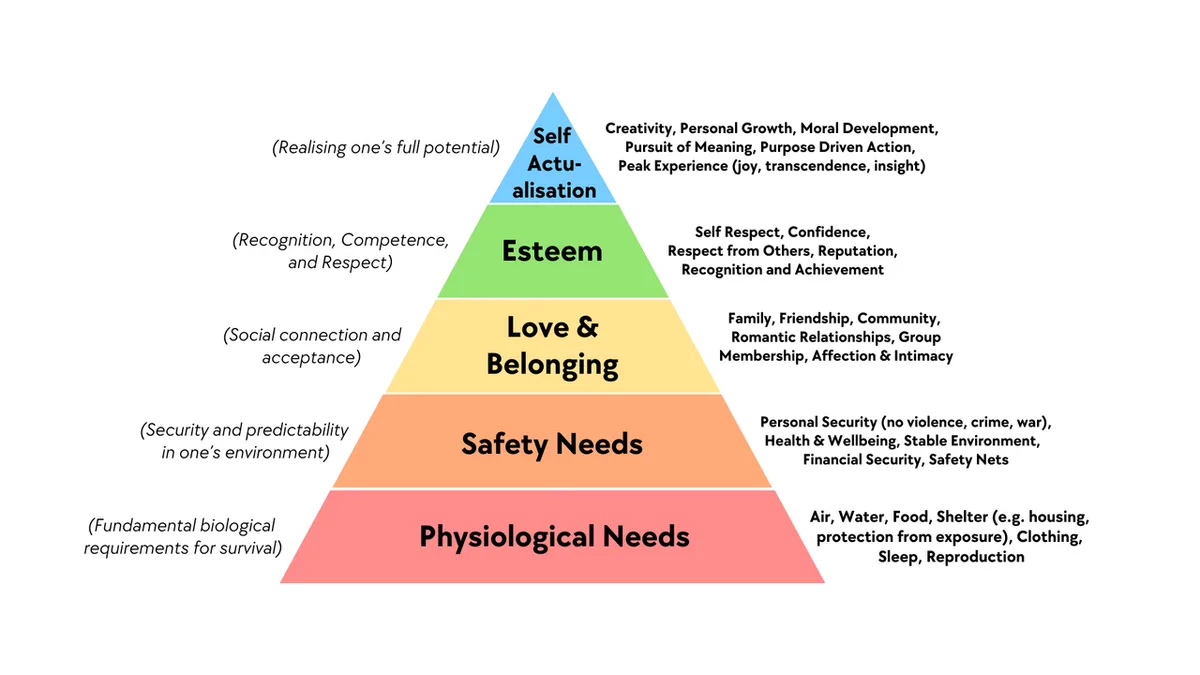
- Maslow never drew the famous pyramid; later consultants flattened his fluid needs into a rigid staircase.
- Kaufman replaces it with a sailboat: the hull is safety, connection, and esteem; the sail is exploration, love, and purpose.
- You do not need a perfect hull before raising any sail—small security enables growth, and small growth can steady security.
- Self-actualization is ten measurable traits ordinary people show in degrees, not a club for saints and geniuses.
- Transcendence—moments when the self’s edge dissolves—is healthy only when it crowns a reasonably built life, not when it bypasses unfinished hull work.
- The book’s practical edge: patch one leak and try one small exploration this week instead of waiting for ideal conditions.
The big idea
Kaufman contends that popular psychology turned Maslow into a staircase that bars growth until every fear is gone, which was never Maslow’s real view. Security and growth are two systems that must work at once, like a boat’s hull and sail, so ordinary people can become more whole, creative, and connected without waiting for perfect safety.
The book in brief
Kaufman starts by dismantling the five-tier pyramid almost every textbook still teaches. He went into Maslow’s archive at Brandeis and found notebooks, letters, and unfinished writing that treat needs as overlapping and fluid, not stages you finish before climbing. The pyramid, he argues, was a later management-consultant diagram that left out Maslow’s late push toward self-transcendence and told people under stress that meaning was not for them yet.
In place of the staircase he offers a sailboat. The hull holds safety, belonging, and self-esteem—the security needs that keep you afloat. The sail holds exploration, love, and purpose—the growth needs that catch wind and move you. A strong hull with no sail sits still; a full sail on a leaking hull sinks. The rest of the book walks each plank and panel in turn.
Safety is treated as a felt state, not a fact sheet: chronic vigilance from past trauma can lock a person in defensive scanning even when they are housed and unthreatened, leaving no bandwidth for curiosity. Belonging splits into fear-driven conformity versus being known without losing your place. Self-esteem splits into fragile ranking against others versus stable mattering through contribution.
On the sail side, exploration is a lifelong nutrient of approaching the unfamiliar, not a luxury for the already secure. Mature love wants another person’s unfolding for its own sake rather than using them as supply. Purpose is framed as a daily practice of connecting actions to something larger—often by reframing work you already do—rather than a single hidden calling.
Kaufman then tests Maslow’s self-actualization traits in ordinary adults and finds ten that cluster statistically and track wellbeing. The book closes on transcendence: brief peak moments or steadier plateau experiences where the boundary of self softens into felt unity. Those moments help only when they deepen engagement with life; chasing them to escape unfinished security work is what he calls transcendence downward.
Context
Scott Barry Kaufman published Transcend in 2020 after reading Maslow’s unpublished notebooks at Brandeis and running his own empirical work on self-actualization traits. The book mattered for readers who had absorbed the pyramid as gospel and for therapists, coaches, and managers who needed a wellbeing frame that was not a rigid checklist—especially people who felt growth had to wait until every insecurity was gone.
The key ideas

1
The pyramid never existed
The five-tier pyramid was a posthumous simplification; Maslow treated needs as overlapping and fluid and later pushed past self-actualization toward self-transcendence.
Textbook pyramid
Rigid stages finished before you may grow
Maslow’s actual view
Overlapping needs, including self-transcendence
Kaufman opens by showing that the staircase almost everyone learned was never Maslow’s diagram. It spread through management training after Maslow’s death in 1970, turning a rich, unfinished body of work into neat corporate stages.
In the Brandeis archive he found a thinker who saw needs running together, not a checklist you complete before you earn curiosity or purpose. Later writing pushed toward motivation beyond the individual self entirely.
The damage, on Kaufman’s account, is practical. The pyramid tells people under financial stress, illness, or shaky relationships that meaning and creativity are not for them yet. That implication is false, and it is what the sailboat is meant to correct.
In practice: Introductory textbooks still print the pyramid even though Maslow never drew it; consultants adapted his ideas into a tidy training graphic.

2
A sailboat, not a staircase
Security needs form the hull and growth needs the sail; both systems run at once, and neither waits for the other to be perfect.
Hull without sail
Afloat but stuck in place
Sail without sound hull
Moving but liable to sink
Kaufman’s central image is simple. The hull—safety, connection, self-esteem—keeps you from capsizing. The sail—exploration, love, purpose—catches wind and takes you somewhere.
You do not need a flawless hull before raising any sail. A little security lets you risk a little growth; small acts of growth can, in turn, steady how safe and worthy you feel.
This pattern explains what the strict pyramid cannot: people in hardship who still find purpose and creativity, and people with money, status, and stable relationships who stay empty because their sail never goes up.
In practice: Highly successful professionals who meet every security need on paper yet feel empty because they never built the exploratory, purposeful side.

3
Safety is a feeling
Chronic anxiety keeps the threat system scanning so hard that curiosity and openness cannot land, even when objective danger is gone.
The first hull plank is safety, and Kaufman separates it from mere physical security. Someone can be housed, fed, and unthreatened yet still feel unsafe if past trauma or ongoing stress keeps the nervous system locked on vigilance.
He draws on attachment work and adverse childhood experiences to argue that early instability can recalibrate threat detection long after the danger has passed. A hull taking on water absorbs attention; none is left for the sail.
Someone scanning for threat cannot also be curious about a new idea or open to an unfamiliar person. Restoring a felt sense of safety often has to come before gains in curiosity and relationship quality register at all.
In practice: Combat veterans with post-traumatic stress who cannot enjoy ordinary pleasures because the threat system will not stand down long enough to notice them.

4
Belonging without muting
Healthy belonging lets you keep your individual voice inside a group; connection driven by fear of exclusion produces brittle silence that only looks like harmony.
Deficiency connection
Agree and mute yourself to keep your seat
Growth connection
Disagree, stay known, and still belong
Kaufman splits social connection into two motives. Deficiency-driven connection is compliance and self-muting to avoid rejection. Growth-oriented connection is mutual recognition in which disagreement does not cost you your place.
He stresses that perceived isolation, not just headcount of contacts, is what tracks poor health outcomes. Feeling known matters more than proximity to more people.
In teams and workplaces the split is concrete. Groups that punish dissent get quiet that looks cooperative but is actually self-protection. Belonging built on being known, rough edges included, holds when strain arrives.
In practice: Google’s internal research found psychological safety—the sense you will not be humiliated for speaking up—was the strongest predictor of team effectiveness, above individual talent.

5
Mattering versus winning
Self-esteem built on comparison and status is fragile under criticism; esteem built on contribution and being relied on stays steadier.
Comparison esteem
Worth rises and falls with rank and approval
Contribution esteem
Worth rests on competence and mattering
Kaufman contrasts two routes to worth. One is contingent on external scoreboards—grades, likes, income, rank. That path, he notes via contingent self-worth research, tracks more anxiety and worse relationship quality.
The other is stable mattering from competence and real contribution. Criticism then lands as information about a task rather than a verdict on the whole self.
Social media is his recurring case of engineered, comparison-laden hits that never accumulate into stability. Mastering a skill or being needed by others can persist on days when no one is watching. Safety, connection, and this kind of esteem together set how much risk a person can take without capsizing.
In practice: Likes and follower counts that demand constant renewal, versus the quieter esteem of being relied on for a skill you have actually built.

6
Curiosity as growth fuel
Exploration of novelty and ambiguity is a necessary nutrient at every life stage, kept alive by small low-stakes acts rather than deferred until life is ideal.
The first sail panel is exploration—the drive toward the unfamiliar, the unresolved, the slightly uncomfortable not-knowing that learning requires.
Kaufman links this to openness to experience and to divergent thinking: minds willing to leave the obvious path generate more original responses when asked for unusual uses of a common object. Play pursued for its own sake, unrelated to productivity, tracks later resilience and flexible problem-solving.
The warning is against waiting. Reading outside your field, taking an unfamiliar route, or asking a naive question keeps the exploratory muscle alive so love and purpose still have a mind that can be surprised.
In practice: People higher in openness produce more varied, original uses for an ordinary object—a stand-in for a mind that will wander off the safe path.

7
Love without using
Being-love values the other person as an end in themselves; Deficiency-love treats them as supply for reassurance, status, or security.
Deficiency-love
Partner or child as needed supply
Being-love
Other person’s unfolding wanted for its own sake
Kaufman revives Maslow’s split between D-love and B-love. D-love gets anxious or possessive when the supply feels threatened. B-love wants the other’s growth even when it does not directly benefit you and can tolerate their independence without panic.
The distinction is diagnostic, not a purity test. Everyone carries some D-love; the aim is proportion. Unresolved hull leaks—insecure attachment, shaky esteem—tend to spill into the sail and turn love into another patch job.
Working on safety, belonging, and stable worth frees capacity for love that wants the other person’s flourishing rather than needing it as fuel.
In practice: A parent curious about a child’s emerging interests even when they diverge from the parent’s hopes, versus a parent who treats divergence as betrayal of their own identity.

8
Purpose as a practice
Purpose is built by the meaning you assign to what you already do and by small redesigns of that work, not discovered once as a hidden calling.
Tasks as chores
Same work framed as mere cleaning
Tasks as care
Same work framed as aiding healing
Kaufman pushes against the treasure-hunt view of purpose. Same tasks can feel empty or sustaining depending on the frame people put around them.
He treats job crafting—light reinterpretation and redesign of daily work—as evidence that purpose is largely interpretation plus small action, not waiting for the perfect vocation. Purpose aimed at contribution beyond the self tends to outlast pure personal achievement milestones that go dry once reached.
Exploration opens possibility, love directs care outward, and purpose organizes both into direction. Hull and full sail together set up the book’s last claim about what can lift the boat briefly clear of the water.
In practice: Hospital custodians doing identical tasks: some describe only cleaning; others describe helping patients heal, with far more satisfaction and initiative.

9
Ten traits, ordinary people
Self-actualization is a measurable cluster of ten traits—appreciation, acceptance, authenticity, purpose, and more—found in degrees in ordinary adults, not reserved for a handful of geniuses.
Maslow built his original portrait from a few exemplary lives, which made the idea feel like hagiography. Kaufman and colleagues built the Characteristics of Self-Actualization Scale and published its validation in the Journal of Humanistic Psychology in 2018, using factor analysis on hundreds of adults.
Ten traits clustered reliably: continued freshness of appreciation, acceptance, authenticity, equanimity, purpose, truth-seeking, humanitarianism, peak experiences, good moral intuition, and creative spirit. They tracked independent wellbeing measures.
The traits do not form one fixed personality type. Someone can run high on some and lower on others. Self-actualization becomes incremental and recognizable—an unguarded moment of ordinary appreciation, a choice from real values, a spell of creative absorption—rather than a mythic finish line.
In practice: The 2018 scale showed Maslow’s impressionistic list could be measured in a broad adult sample and linked to life satisfaction, not only in famous exemplars.

10
Transcendence after the work
Moments when the self’s boundary dissolves into felt unity help only when they deepen ordinary engagement; using them to skip unfinished security and growth work is transcendence downward.
Transcendence downward
Intensity used to skip hull and sail work
Healthy transcendence
Unity that returns you more engaged with life
Maslow’s late unpublished writing moved past self-actualization toward self-transcendence—identification with something beyond the individual self. Kaufman separates brief peak experiences of awe and unity from steadier plateau experiences of serene appreciation.
He notes contemporary psychedelic-assisted therapy research, including Johns Hopkins work led by Roland Griffiths, in which a guided mystical-type experience correlated with lasting gains in wellbeing and openness when preparation and integration were present.
The risk is clear on his account: chasing intensity—substances, ideology, spiritual practice—to escape trauma or loneliness is avoidance, not transcendence. Healthy transcendence tends to follow a boat already reasonably built, then returns the person more connected to ordinary life, not less functional.
In practice: A single supported psilocybin session producing a mystical-type experience linked to months-later wellbeing gains when integrated, versus using peaks to bypass unaddressed loneliness or trauma.
Key terms
- Sailboat model Kaufman’s image: security needs as the hull, growth needs as the sail, both working at once.
- Hull Safety, belonging, and self-esteem—the security system that keeps you afloat.
- Sail Exploration, love, and purpose—the growth system that moves you somewhere.
- Deficiency-love (D-love) Loving someone mainly as a source of reassurance, status, or security.
- Being-love (B-love) Loving someone for their own unfolding, wanting their growth even when it costs you comfort.
- Contingent self-worth Esteem that rises and falls with external scoreboards like approval, appearance, or rank.
- Job crafting Reframing and lightly redesigning the work you already do so it connects to a larger purpose.
- Characteristics of Self-Actualization Scale Kaufman’s 2018 survey tool that turned Maslow’s traits into a measurable profile in ordinary adults.
- Peak experience A brief, often spontaneous moment of unity, awe, and softened self-boundaries.
- Transcendence downward Using intense or mystical experiences to avoid unfinished safety, belonging, and growth work.
What to do
- Pick one leaking hull need—unresolved anxiety, a relationship where you mute yourself, or worth tied to comparison—and address it directly this week.
- Do one small deliberate exploration you have been postponing: read outside your field, ask a question you feel embarrassed not knowing, or try something unfamiliar for no productive reason.
- In your closest relationship, catch one moment you want the other person a certain way for your comfort, and practice wanting their growth even if it costs some reassurance.
- Raise a little sail before the hull is perfect; do not wait for ideal circumstances to start.
Questions to think with
- Which part of your hull is taking on the most water right now—felt safety, authentic belonging, or stable mattering—and what would one direct repair look like?
- Where are you still treating exploration, love, or purpose as rewards you must earn after life calms down?
- In your closest ties, when does connection tip into muting yourself or using the other person as supply?
- Which of the ten self-actualization traits do you already notice in small degrees, and which stay furled?
- Are any intense experiences in your life deepening ordinary engagement, or mostly helping you skip harder daily work?
The other side
Much of the book’s evidence is self-report surveys correlated with other self-report wellbeing measures, which risks circularity, and the self-actualization scale’s samples were largely online, English-speaking, and Western. The sailboat is a rich metaphor rather than a sharply falsifiable model, and the book treats stuck growth mainly as an individual psychological problem, with limited attention to how poverty, discrimination, and structural inequality create safety and belonging deficits that personal reframing cannot fix.
Who it's for
Readers who learned the pyramid as fact and want Maslow’s actual, unfinished thinking; people who feel growth must wait until every insecurity is gone; and therapists, coaches, and managers who need a wellbeing frame that is not a rigid checklist.