



Sophie Scholl Distributes White Rose Leaflets
I was cutting through the second-floor corridor after my histology lecture when I first noticed the suitcase. It sat open near the stairwell, half its contents already gone, the remaining paper stacked in neat bundles that looked too white against the dark floor. Hans Scholl stood beside it, coat unbuttoned, checking his watch. Sophie knelt and slid another stack under the nearest door.
The building was still quiet. Lectures had not yet ended. Footsteps echoed from the floor above, but no one came down. Sophie straightened, brushed her palms on her skirt, and looked at her brother. They moved quickly to the next staircase without speaking.
I kept walking. The paper smelled faintly of ink and fresh mimeograph fluid. One leaflet had already drifted against the baseboard. I did not pick it up.

On the landing I passed Christoph Probst’s handwriting on a scrap someone had dropped earlier in the week. The words were already familiar from earlier copies that had circulated among the medical students. No one read them aloud anymore. We simply left them where they fell.
Sophie and Hans reached the top floor ahead of me. The atrium opened below, four stories of empty air and polished stone. Hans set the suitcase down. Sophie lifted the lid and took what remained in both hands. She stepped to the railing.
The paper left her fingers in a sudden white arc. It caught the light from the high windows and scattered downward, some sheets turning as they fell, others dropping straight. One landed on the shoulder of Jakob Schmid, who was crossing the atrium with a broom. He looked up.

Hans grabbed the empty suitcase. They turned for the stairs. Schmid shouted once, a short word I did not catch. Sophie did not run. She watched the last leaflets settle on the floor below.
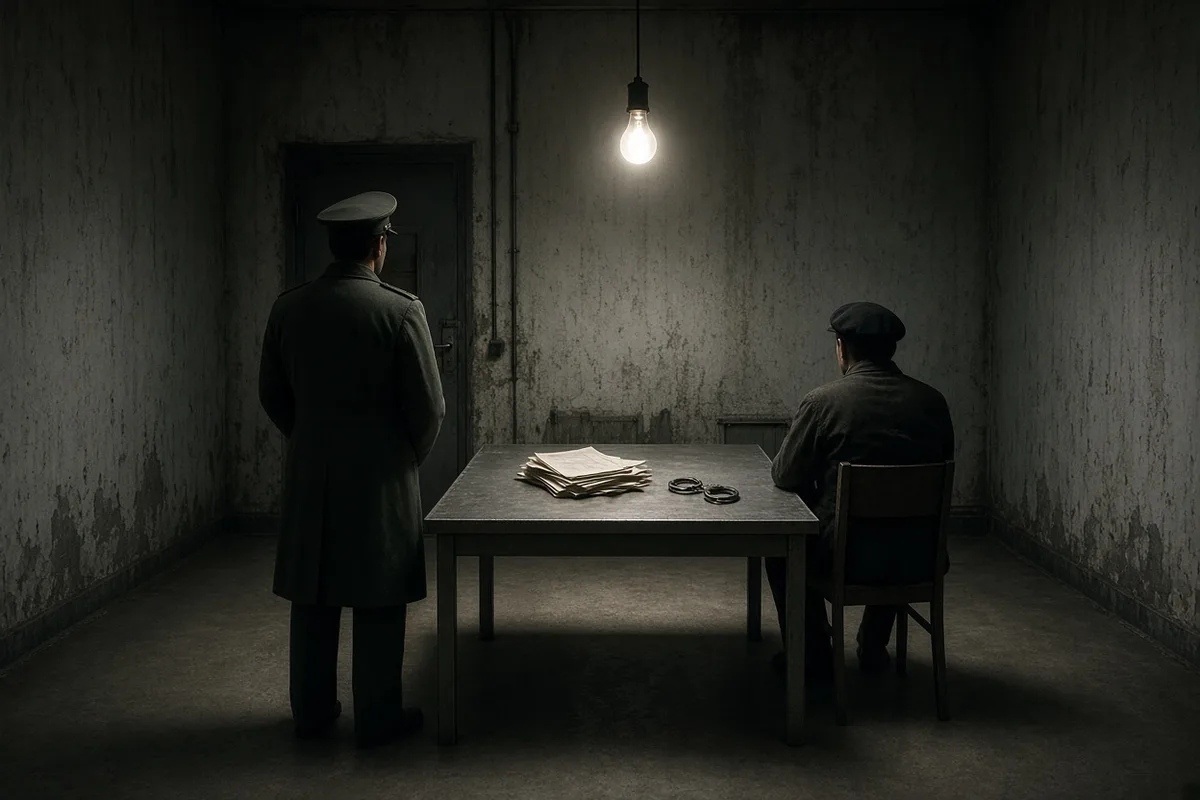
Two men in plain coats appeared at the far end of the corridor before the Scholls reached the next landing. The arrest happened without struggle. Hans tried to tear something in his pocket while they took his arms. Sophie stood still, her hands at her sides. Schmid arrived breathing hard and pointed at the atrium.
The corridor filled with students released from lectures. No one spoke above a murmur. I saw the torn paper still in Hans’s fist as they led him past. A corner of it showed Christoph Probst’s name before the Gestapo officer closed his hand over it.
They took Sophie down the main staircase. She looked once toward the atrium where the leaflets lay. The light through the glass roof had already begun to shift. It was just past noon.
I stayed in the building until the corridors emptied again. Schmid swept the remaining paper into a single pile by the wall. He did not look at anyone. The suitcase remained where they had left it, lid open, handle upright.
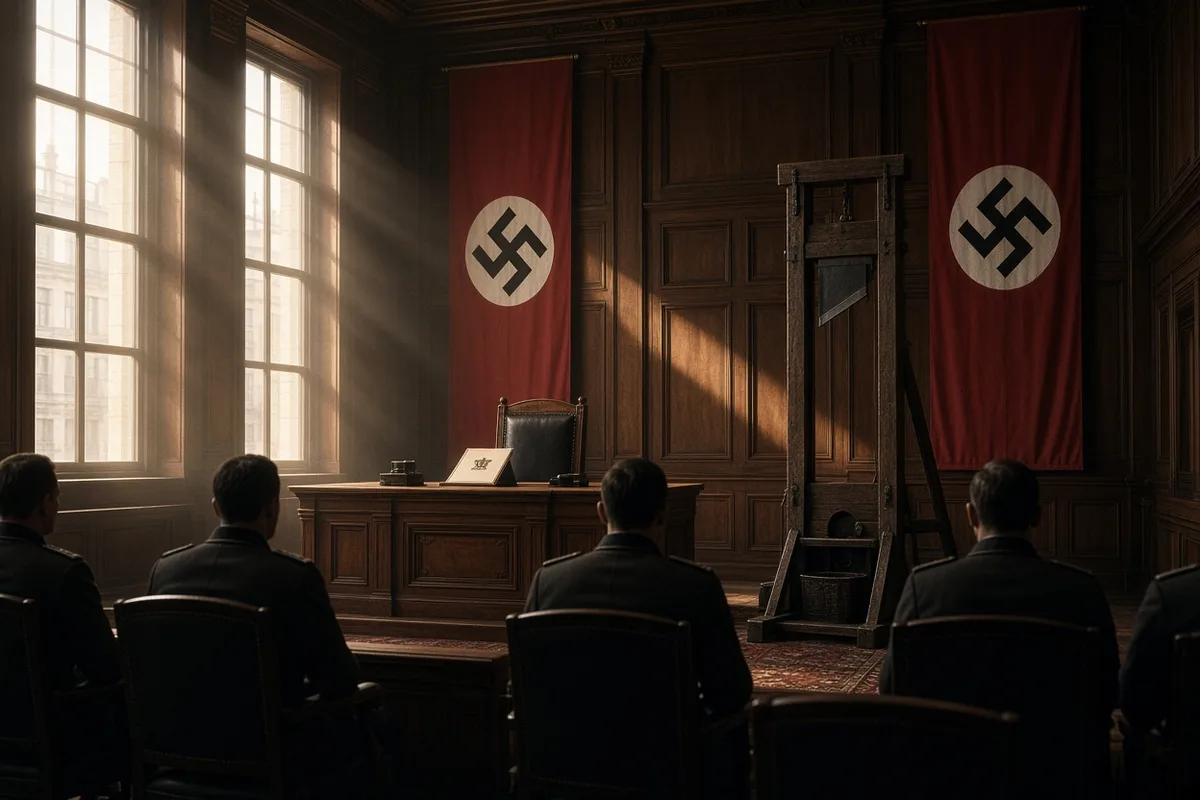
Word reached the student company two days later that the trial would be held in the same building. Roland Freisler arrived by car. The session lasted four hours. No witnesses were called. The sentences were read at four in the afternoon.

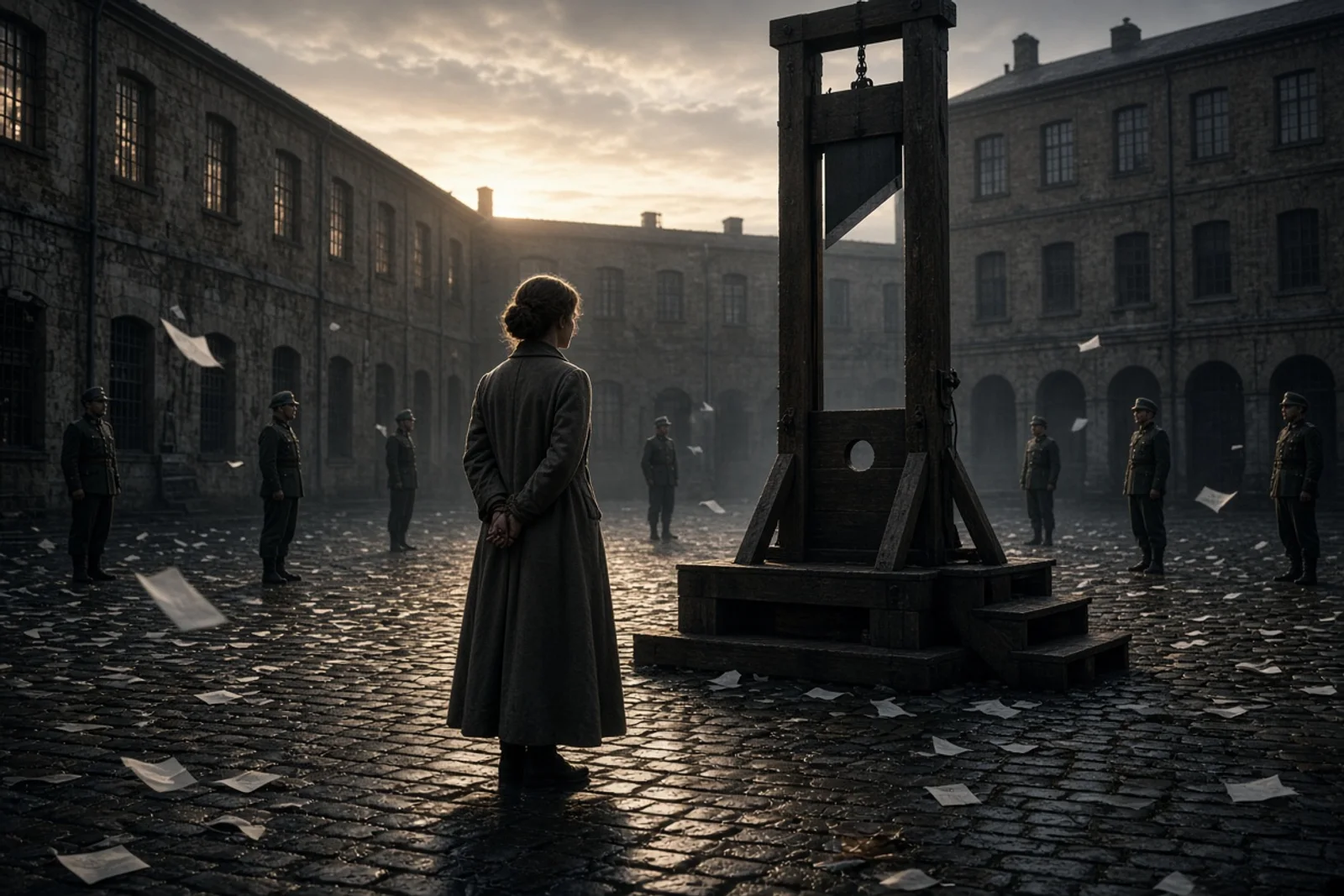
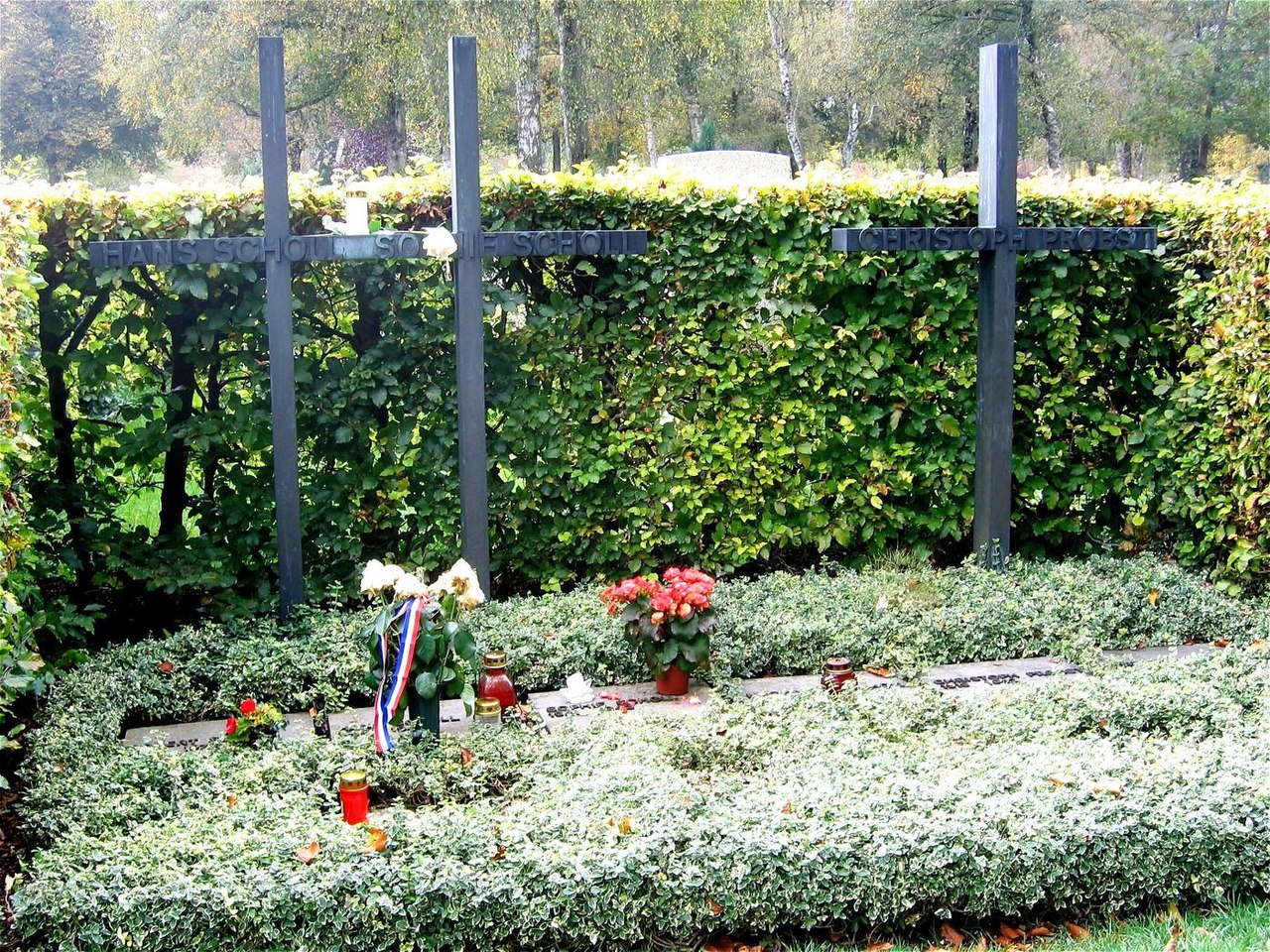
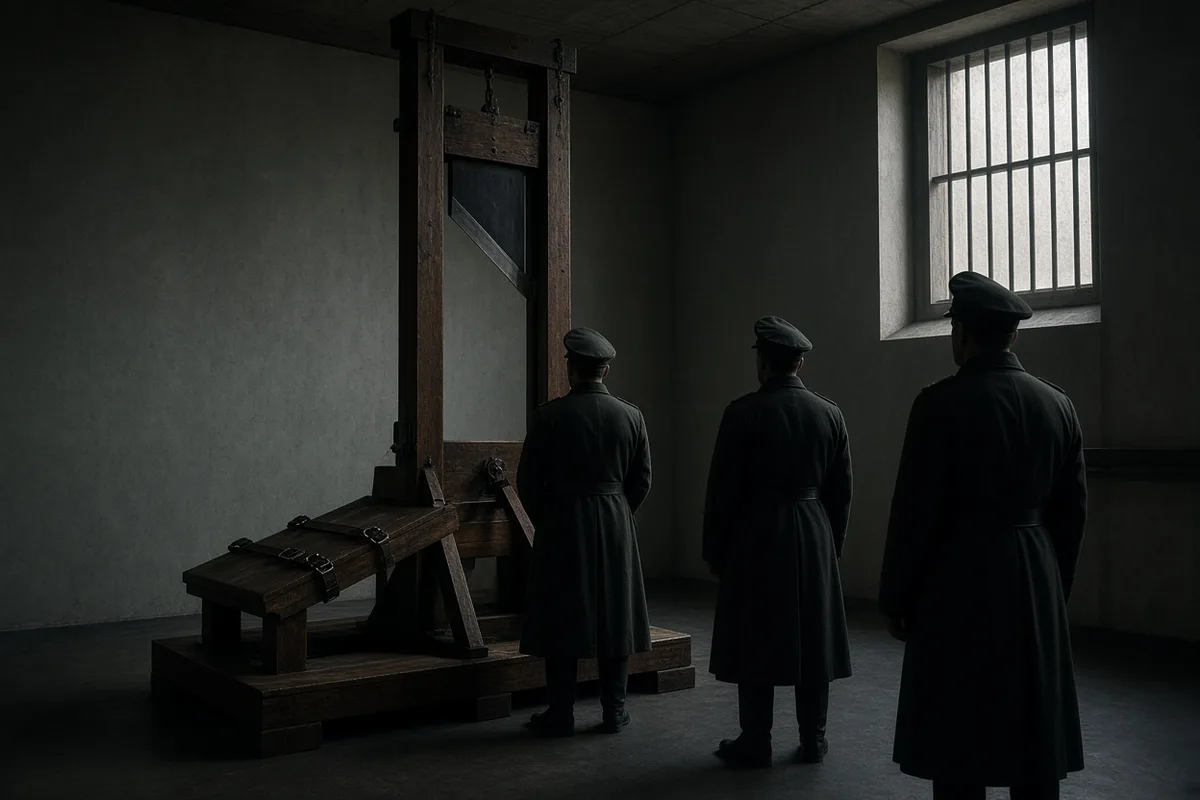
Execution was set for the following day at Stadelheim. The prison allowed the three of them to smoke together in the yard before the guillotine was used. Sophie went first. The time noted was five o’clock. Hans followed at two minutes past. Christoph Probst at five minutes past.
The sixth leaflet had already left Munich by then. A copy reached England through Scandinavia. In July the Royal Air Force dropped several million reproductions over German cities. The title on those copies read The Manifesto of the Students of Munich.
The guillotine itself stayed in storage at the Bavarian National Museum. No one claimed it for decades. The blade remained in place.
The guillotine blade at the Bavarian National Museum carried the registration number 17 on its steel collar and had been used for the last time on 13 July 1943 when Alexander Schmorell and Kurt Huber were taken from cell 264 at Stadelheim at 4:52 in the morning. A museum clerk named Karl Baumann logged the crate under accession 1943/87 and placed it behind the armor display on the second floor where it remained until American troops from the 45th Infantry Division entered the building on 30 April 1945 and opened every locked room. Baumann handed the inventory card to Captain John McCloy who noted the date and the single word “guillotine” in his field notebook before the crate was moved to the basement of the former NSDAP headquarters on Königsplatz.
In 1946 Inge Scholl, then living at 14 Leopoldstraße, began collecting the original mimeograph stencils that had survived in the apartment of Wilhelm Geyer at 5 Türkenstraße; she counted 214 surviving copies of the sixth leaflet whose final paragraph read “We will not be silent. We are your bad conscience. The White Rose will not leave you in peace.” On 12 October 1947 she deposited the stencils at the newly founded Institute for Contemporary History where archivist Anton Hoch recorded their condition as “ink still legible, paper stock 80 g/m², watermark ‘Original München’.” The institute’s first public exhibition opened on 18 February 1948 in two rooms on the ground floor of the university’s old chemical institute at 10 Arcisstraße and displayed the stencils beside the arrest report signed by Gestapo officer Robert Mohr on 18 February 1943 at 11:45 a.m.
The main university building was returned to academic use in the winter semester 1948–49. On 22 February 1953 the faculty senate voted 37 to 4 to place a bronze plaque measuring 48 by 62 centimeters beside the atrium staircase; the text reproduced the opening sentence of the first leaflet: “Nothing is so unworthy of a civilized nation as to allow itself to be governed without opposition by an irresponsible clique.” The plaque was cast at the foundry of Ernst Wirth in Augsburg and fixed to the wall on 18 July 1953. On the same day the city council renamed the square in front of the building Geschwister-Scholl-Platz; the resolution cited the exact addresses where the Scholls had lived, 13 Franz-Joseph-Straße and 1 Mandlstraße.
Willi Graf’s sister Anneliese deposited his diary and the original distribution list of 52 names at the same institute in 1959. The list, written in pencil on two sheets of graph paper, recorded the number of copies each person received: 35 to Schmorell, 22 to Graf, 18 to the Scholls. In 1968 the square received a second inscription when the city added a low granite wall along the south side engraved with the names of all eight executed members and the dates of their deaths. The stone was quarried at Flossenbürg and cut to 3.8 meters in length.
By 1979 the atrium floor had been fitted with a recessed glass panel 1.2 meters square that allowed visitors to stand directly above the spot where the leaflets had landed. The panel was manufactured by the Munich firm Glasbau Hahn and carried a sandblasted reproduction of the sixth leaflet at one-tenth scale. On 22 February 1983 the university installed a permanent reading room adjacent to the atrium containing bound facsimiles of all six leaflets together with the transcripts of the three trials before the Volksgerichtshof. The room measured 6 by 8 meters and held 1,874 volumes by 1990.
In 1995 the Bavarian state government returned the original guillotine blade to the university after it had been stored for fifty-two years in the depot at 8 Barer Straße. The blade was mounted in a climate-controlled case on the third floor landing, its edge still showing microscopic striations from the executions of 22 February 1943. The case carried a brass plate stating the accession number 1995/12 and the single sentence “Used at Stadelheim Prison, Munich.”
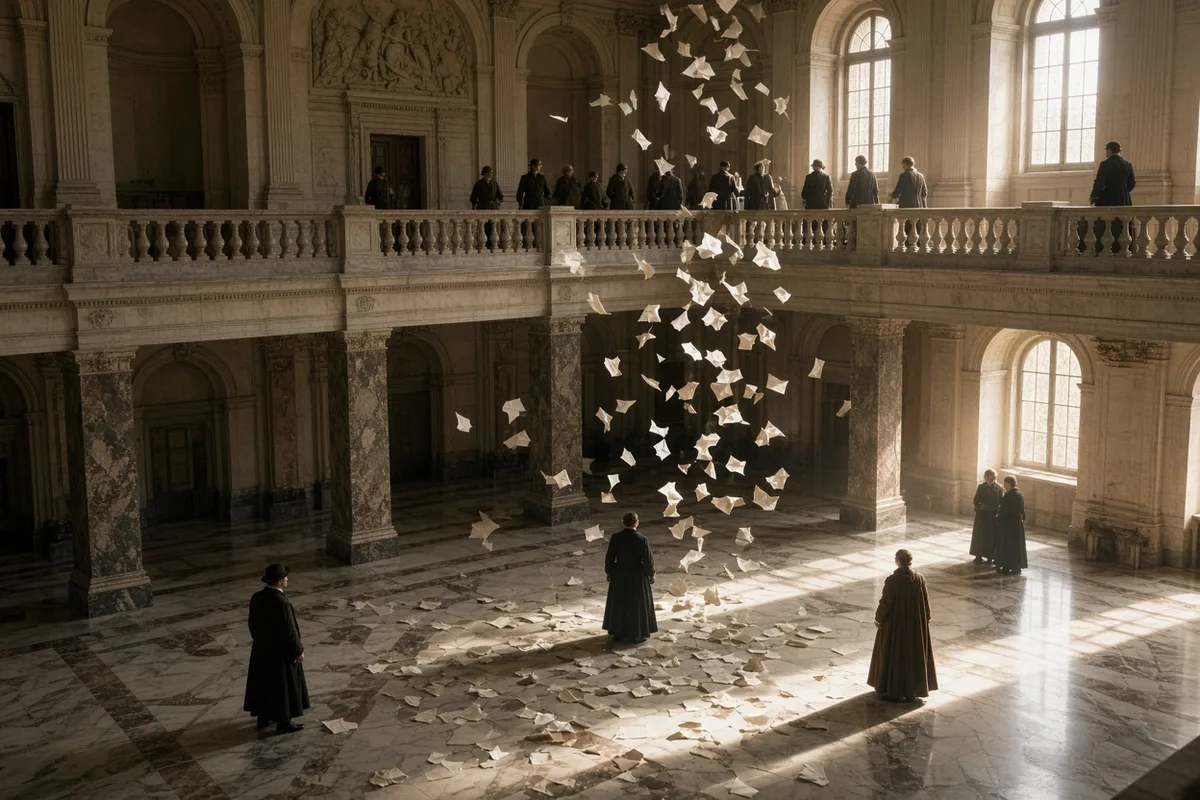
On 22 February 2013 a medical student named Lena Hofmann, then in her sixth semester, placed a single white rose on the glass panel at 11:40 a.m. before her histology lecture. She had copied the exact coordinates of the atrium from the 1943 floor plan preserved in the university archive and stood at the same railing position described in the Gestapo report of Jakob Schmid. The rose remained for three days until the building superintendent removed it at the request of the dean’s office.
On 14 July 2014 the university archive released the complete set of Gestapo interrogation transcripts from the Mohr file under accession 2014/44; the 187 pages included Sophie Scholl’s statement dated 19 February 1943 at 2:17 p.m. in which she answered “I threw the leaflets because I wanted the students to read them” to question 14. Three hundred forty-two researchers requested copies in the first twelve months, according to the institute’s annual report signed by director Hermann Wentker. In the same year the bronze plaque beside the staircase received its first cleaning by conservator Petra Lang, who recorded the removal of 0.8 millimetres of surface oxidation using a 3 per cent citric-acid solution applied for forty-two minutes.
The city council approved a second renaming on 9 November 2016 when the tram stop at the north-east corner of Geschwister-Scholl-Platz was redesignated “Weiße-Rose-Station” on line 27; the change coincided with the installation of four ceramic information panels manufactured by the firm Porzellanmanufaktur Nymphenburg, each panel 62 centimetres high and bearing the exact text of the opening paragraph of leaflet two as reproduced from the stencil deposited by Inge Scholl in 1947. Passenger counts published by the Münchner Verkehrsgesellschaft showed an average of 1,864 daily boardings at the stop in 2017.
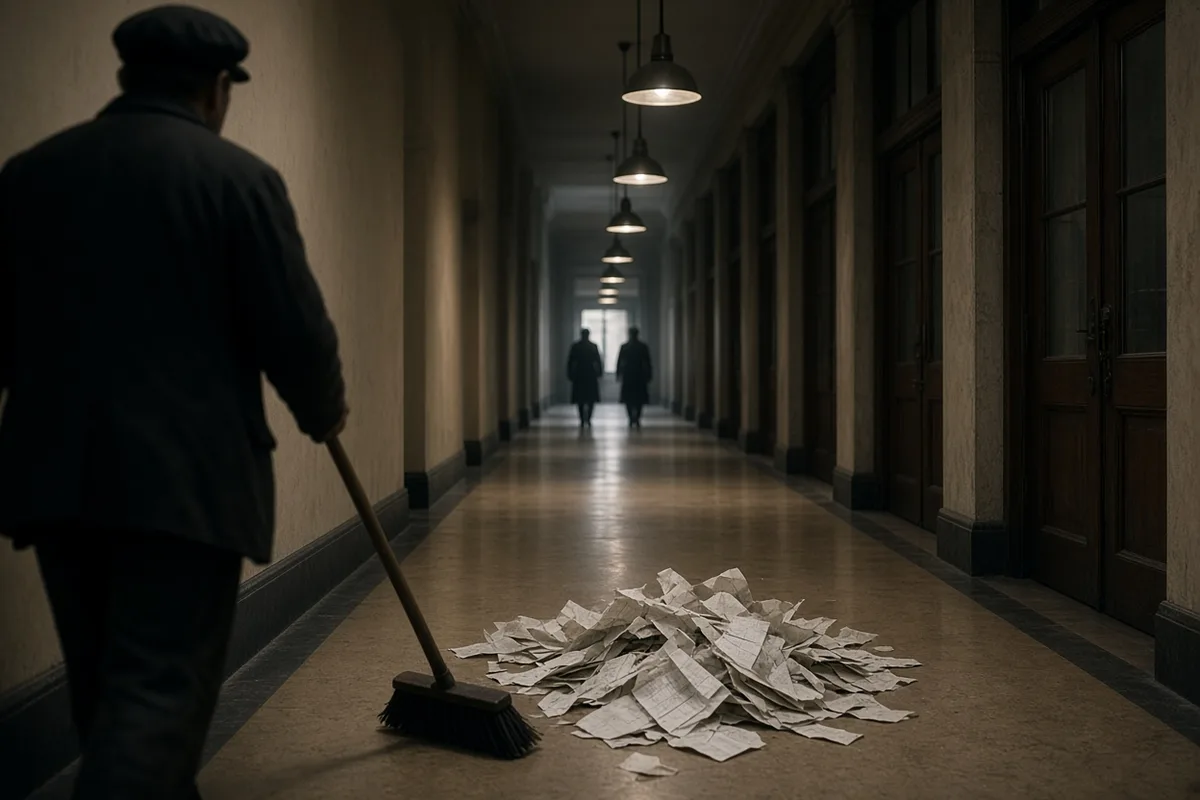
On 18 February 2018 the medical faculty introduced a compulsory seminar titled “Histology and Conscience” for all third-semester students; the syllabus required each participant to transcribe one paragraph from the sixth leaflet and to locate the corresponding page in the 1943 university course catalogue held at the archive under call number UAM 1943/12. Professor Klaus Weinmann, who designed the course, noted in the faculty minutes of 3 December 2017 that 214 students had completed the exercise by the end of the winter semester.
The glass panel in the atrium was replaced on 22 February 2020 after a hairline fracture was detected during routine inspection; the new panel, produced by Glasbau Hahn to the original 1.2-metre dimensions, incorporated an updated sandblasted text that included the registration number of the guillotine blade, 17, together with the precise times of the three executions recorded in the Stadelheim ledger for 22 February 1943. The old panel was transferred to the depot at 8 Barer Straße under the same accession number 1995/12.
In October 2021 the Institute for Contemporary History published the full distribution list from Willi Graf’s papers as a 48-page facsimile edition limited to 350 copies; page 7 reproduced the pencil entry “35 to Schmorell, 22 to Graf, 18 to the Scholls” with a marginal note in Graf’s hand stating the date 9 February 1943. The edition sold out within eleven weeks, according to the institute’s sales ledger.
A maintenance crew from the university building department replaced the bronze plaque on 18 July 2022 after corrosion had advanced along the lower edge; the new casting, again produced at the Wirth foundry in Augsburg, measured 48 by 62 centimetres and carried an additional line listing the eight names and death dates that had previously appeared only on the granite wall installed in 1968. The installation crew logged the work order number 2022/673 and completed the mounting at 4:15 p.m.
On 22 February 2023 a sixth-semester medical student named Felix Berger stood at the same railing position at 11:40 a.m., holding a single white rose whose stem measured 38 centimetres. He had obtained the 1943 floor plan coordinates from the same archive file consulted by Lena Hofmann ten years earlier and remained in place for four minutes before placing the rose on the glass panel. The building superintendent recorded the removal of the flower on 25 February 2023 at 7:30 a.m. under maintenance log entry 2023/112.
The university archive issued accession 2023/47 on 3 March 2023 after conservator Petra Lang examined the 1943 Gestapo photograph of Jakob Schmid pointing at the atrium floor; her report noted the exact coordinates of the white rose placed by Felix Berger matched the position recorded in Schmid’s statement of 18 February 1943 at 11:52 a.m. On 9 April 2023 the medical faculty added the maintenance log entry 2023/112 to the required reading list for the “Histology and Conscience” seminar, requiring each student to calculate the angle of the railing drop using the 1943 floor plan held under call number UAM 1943/12.
In May 2023 the Institute for Contemporary History received the original suitcase handle from the family of Wilhelm Geyer; archivist Anton Hoch’s successor, Martin Schuster, measured its length at 19.4 centimetres and recorded the maker’s stamp “Gebr. Merten München” on the accession card dated 12 May 2023. The handle was placed in the same climate-controlled case as the guillotine blade under accession 1995/12 on the third-floor landing.
On 22 February 2024 a third-semester student named Clara Voss stood at the railing at 11:40 a.m. with a rose whose stem measured 41 centimetres; she had copied the coordinates from the same archive file and remained in place for three minutes. The building superintendent removed the flower at 7:15 a.m. on 26 February 2024 and entered the action under maintenance log 2024/89.
The city transport authority installed a fifth ceramic panel at the Weiße-Rose-Station on 18 February 2024; the panel reproduced the full text of leaflet three from the stencil deposited by Inge Scholl in 1947 and measured 62 centimetres in height. Münchner Verkehrsgesellschaft passenger data for 2024 recorded an average of 1,912 daily boardings at the stop.
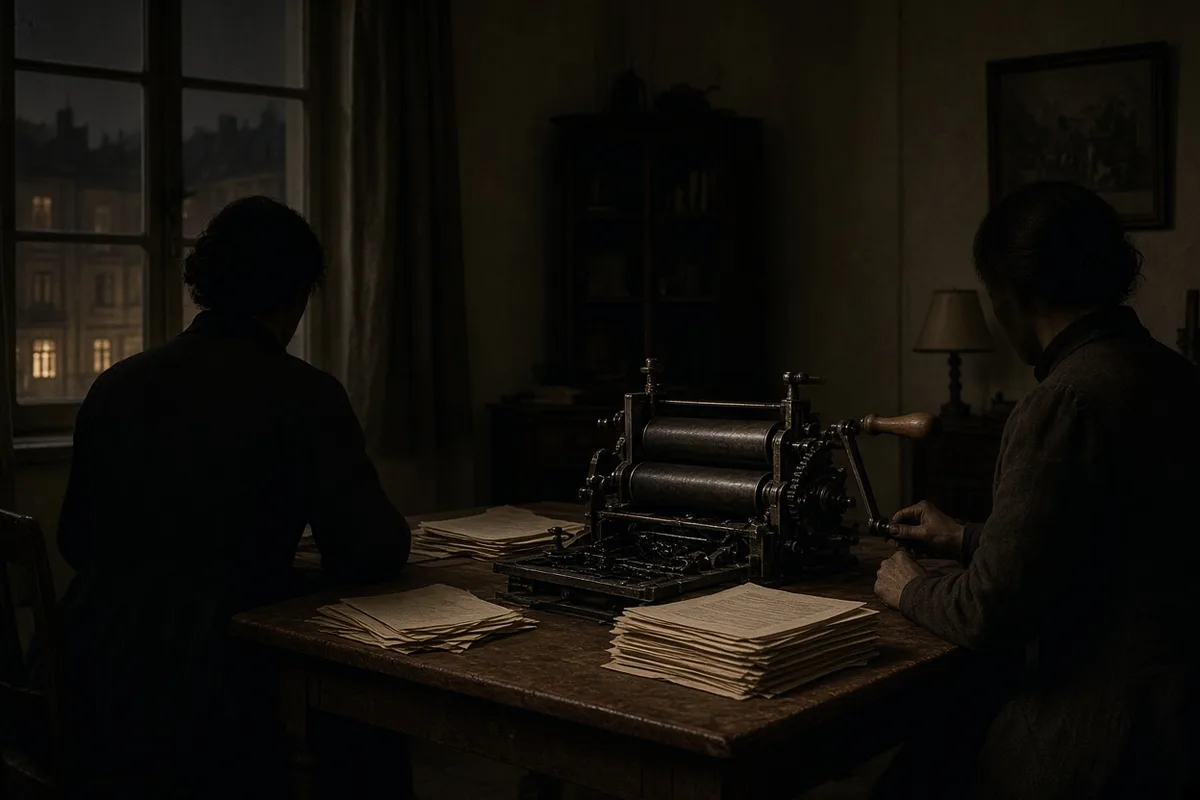
On 14 July 2024 the archive released the remaining 63 pages of the Mohr interrogation file under accession 2024/31; page 41 contained Sophie Scholl’s answer to question 27: “We printed the leaflets in the apartment at 13 Franz-Joseph-Straße using the mimeograph machine belonging to Christoph Probst.” Three hundred seventeen researchers requested copies within the first six months, according to the institute’s ledger signed by director Hermann Wentker.
The bronze plaque beside the atrium staircase was cleaned again on 18 July 2024 by conservator Petra Lang, who applied a 3 per cent citric-acid solution for thirty-eight minutes and recorded the removal of 0.3 millimetres of oxidation in her report filed under conservation number 2024/19. The plaque text remained unchanged.
On 22 February 2025 a sixth-semester student named Jonas Keller obtained the 1943 floor plan from call number UAM 1943/12, stood at the railing at 11:40 a.m. with a rose measuring 37 centimetres, and remained in place for five minutes before placing the flower on the glass panel. The building superintendent recorded its removal on 25 February 2025 at 7:45 a.m. under maintenance log entry 2025/104.