



Napoleon Hill argues desire and persistence convert thought into wealth
By Books (/journals/books)
In 60 seconds Vague wishing fails; write an exact dollar amount, deadline, plan, and exchange, then read it aloud twice daily. Self-doubt is a learned habit that emotionally charged repetition can replace, priming the mind to notice aligned opportunities. Narrow specialized knowledge aimed at a defined purpose beats broad formal education for building wealth. Ordinary people create wealth by recombining existing ideas, as when Gillette joined razors with disposable blades. A small harmonious group working toward one objective produces combined intelligence no individual mind holds alone. Six nameable fears—poverty, criticism, ill health, loss of love, old age, death—quietly kill persistence until diagnosed.
The big idea
Hill argues that personal wealth follows a repeatable inner sequence—burning desire, disciplined belief, specialized knowledge, imaginative recombination, cooperative alliance, persistence, and fear management—rather than luck or birthright. He claims interviews with self-made industrialists show this process converts thought into material achievement.
The book in brief
Hill starts from a Depression-era problem: circumstance seemed to decide everyone’s fate, yet he insists wealth follows an inner process anyone can run. The opening move is converting vague longing into a burning, specific, quantified target; without that, later steps have nothing to work on.
He then attacks the internal brake of disbelief. Faith becomes a trained psychological state built by emotionally charged repetition, because he claims the subconscious accepts vivid imagined outcomes as real and begins steering attention and ideas toward them. That feeding of the subconscious sits prior to ordinary planning.
Knowledge comes next, but not the general kind. Narrow expertise aimed at the defined purpose beats broad schooling; that expertise then supplies the raw material for synthetic imagination, which recombines existing ideas into a written plan rather than waiting for rare inborn inspiration.
Plans still fail alone. A small group working in strict harmony multiplies intelligence beyond any single mind, and persistence—continuing past the first failures—keeps the joint effort alive even when strong emotional energy must be deliberately aimed at the work.
The sequence closes by dragging hidden brakes into the open. Six nameable fears, especially fear of criticism, quietly dissolve persistence while disguised as caution. Naming the fear is the diagnostic first step. The book lands as a formula of specificity, belief practice, applied knowledge, recombination, alliance, endurance, and fear inventory—durable in its demand for concrete targets and sustained effort, weaker where it treats thought as directly attracting circumstance.
Context
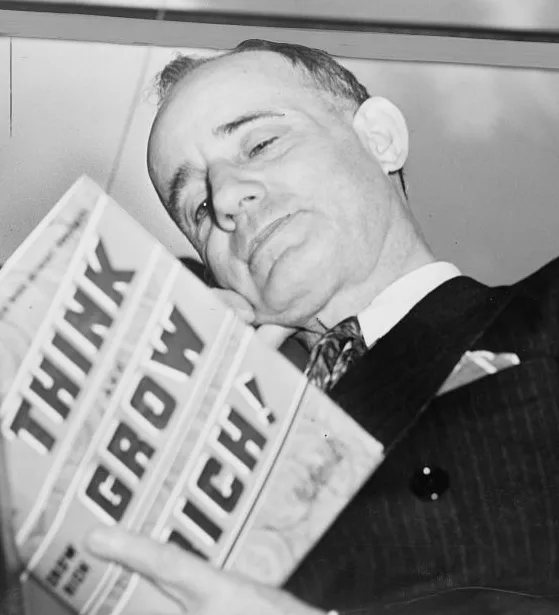
Napoleon Hill published the book in 1937 during the Great Depression, drawing on interviews with self-made magnates such as Andrew Carnegie and Henry Ford. It offered a psychological explanation for success when circumstance seemed to determine fate, and became a foundational text of American self-help literature. The claim that Carnegie commissioned a twenty-year study of five hundred successful people has never been independently verified, and no primary documentation of that arrangement survives.
The key ideas
1
Desire must be specific
Vague wishing produces nothing; only a desire sharpened into a quantified goal with a deadline begins turning thought into money.
Hill separates ordinary longing from the desire that produces results by demanding specificity and intensity. A target must occupy the mind until it becomes obsessive rather than optional.
Readers write an exact dollar figure, a possession date, a plan for getting it, and what they will give in exchange, then speak the whole statement aloud twice a day. The ritual is designed to lock a foggy wish into a single measurable aim.
He claims most people fail not from missing opportunity but from never forming that concrete obsessive target in the first place. Later techniques have nothing to grip if the aim stays vague.
His stories come from men who already won, so they cannot show how often the same ritual fails. The narrower mechanism—that unspecific goals rarely draw intense pursuit—still explains why he makes this the mandatory first move.
In practice: Edwin Barnes arrived in Edison’s town with no money and no connections, took a menial job solely to stay near Edison, waited years with the fixed intention of becoming a business associate rather than an employee, and eventually became exclusive distributor of the Ediphone.
2
Faith is practiced belief
Self-doubt is not a passive absence of confidence but an active learned habit that deliberate repetition of belief statements can replace.
Hill treats the main internal obstacle as disbelief that a goal can actually be reached. He frames faith as a psychological state built by repeating emotionally charged instructions to oneself until belief settles; he calls this process autosuggestion.
He claims the subconscious cannot distinguish a vividly imagined outcome from a real one. Repeated affirmation of success therefore primes the mind to notice opportunities and generate ideas that line up with the target. He offers a six-step affirmation method, spoken aloud morning and night, as the practical tool.
No controlled evidence shows affirmation produces achievement rather than simply better feelings; the link between confident people and successful people could run either direction or stem from resources he leaves out. The more defensible point is narrower: persistent self-doubt actively suppresses effort and risk-taking, and deliberate counter-practice is more useful than leaving that doubt unaddressed.
Belief still needs a body of usable knowledge before it can turn into action; feeling certain without material to work with leaves the person stuck at intention.
In practice: Hill’s own method requires reading a structured affirmation aloud every morning and every night until the stated outcome feels settled rather than merely hoped-for.
3
Feed the subconscious
The subconscious acts as a mechanism that can be deliberately fed instructions through repeated emotionalized thought, separate from and prior to conscious planning.
Hill elaborates the mechanism behind belief: the conscious mind acts as guard at the gate, while the subconscious shapes behavior and even attracts opportunity. That deeper layer, he claims, responds only to emotion combined with repetition, not to cold logic alone.
Readers are told to visualize themselves already possessing the goal in detail, with feeling, as though it has already happened. The instruction is to keep supplying the finished picture until behavior begins organizing around it.
He draws on no clinical psychology of his time, and the idea that thought directly attracts external circumstance lacks support. What remains useful is narrower: emotionally vivid rehearsal keeps attention oriented toward relevant opportunities a person might otherwise ignore—a mechanism closer to selective attention than to mysticism.
Without emotionally charged repetition, he argues, conscious plans stay thin because the deeper layer that drives daily behavior never receives clear instructions.
In practice: Visualize already holding the exact outcome—the sum, the role, the finished result—complete with the feelings that would accompany it, rather than picturing the struggle to get there.
4
Specialize over schooling
Formal general education is far less valuable for wealth creation than narrow specialized knowledge acquired and applied toward a specific purpose.
Hill draws a sharp line between knowledge and organized, applied knowledge. A person with modest schooling but deep expertise in one narrow domain, combined with clear purpose, will outperform a broadly educated person without direction.
The practical move is to identify exactly what specialized knowledge a goal requires, then acquire it through targeted courses, apprenticeship, or hired expertise. Assuming general intelligence or a degree will suffice is, in his view, a common and costly mistake.
The claim matches the observation that domain-specific skill development often beats generalized ability in professional outcomes. He still overstates by dismissing formal education too broadly; systems, timing, and capital access also shaped the fortunes he studied.
Knowledge remains inert until organized into an actual actionable plan; collecting credentials without a destination leaves the learning unused.
In practice: Henry Ford had little formal schooling yet organized specialized knowledge in engineering and manufacturing efficiently enough to build an industrial empire.
5
Recombine known ideas
Wealth is created through the deliberate combination of existing ideas into new forms, and ordinary people can train this synthesizing imagination.
Hill splits imagination into two kinds. Creative imagination he treats as rare and largely inborn. Synthetic imagination—the ability to rearrange existing known ideas, facts, and experiences into new combinations—is available to anyone and is where wealth typically comes from.
Ordinary people can deliberately practice combining ideas from different fields to solve a problem tied to their defined desire. The instruction is to treat the goal as a puzzle solvable by recombination: study adjacent industries, existing tools, and successful models, then assemble a specific written plan rather than waiting for untrained inspiration.
This is one of his more durable claims. Later work on creativity and invention has broadly supported the recombination model, including the pattern that most breakthroughs combine prior components rather than arriving from nothing.
The output must be a written plan of action. Inspiration without a concrete assembly of steps stays ornamental.
In practice: King Gillette did not invent the razor or disposable parts; he combined the two into the disposable-blade razor and turned an old product category into a new fortune.
6
Build a mastermind alliance
Sustained achievement requires a small group in active harmonious cooperation because no single mind holds enough knowledge, energy, and perspective to execute a large plan alone.
Hill introduces a specific mechanism, not merely a support network: two or more people working in strict harmony toward a defined objective produce a combined intelligence exceeding the sum of their individual minds—an emergent third force, in his description. He names this the mastermind.
Practically, readers should identify people whose skills complement their own gaps, meet regularly, and maintain genuine harmony rather than mere transactional alliance. He claims discord destroys the group’s combined mental power.
The concept anticipates later attention to group cognition and complementary team composition. The language of an emergent mental force overstates what coordination actually does, yet the underlying insistence on organized cooperation has real merit.
Few individuals hold every piece of knowledge a serious plan requires. Without the group, even a strong personal plan stalls at the limits of one person’s reach.
In practice: Andrew Carnegie’s inner circle of specialists in steel production, finance, and sales let him achieve at a scale no individual could reach alone, regardless of personal genius.
7
Persist past early quitting
Most people quit at the first, second, or third failure, and the ability to continue past repeated rejection separates those who eventually succeed from those who do not.
Hill pairs two claims in this stretch of the book. One is that sexual desire is the most powerful human emotion and that men who redirect it into work rather than dissipating it gain persistent drive—he calls this sex transmutation; the evidence is entirely anecdotal and impossible to verify. The second claim is sturdier.
Most people, he says, quit at the first, second, or third failure. The ability to continue past repeated rejection is what separates those who eventually succeed from those who stop short. He treats high, channeled emotional energy as fuel for that endurance rather than as a mystical force.
Research on long-term achievement does show sustained effort through setback correlating with eventual success, though the same survivorship problem remains: he interviewed only those who persisted and succeeded, not the larger number who persisted and still failed.
The practical warning is simple. Many abandoned efforts sit inches from a result the next person will claim.
In practice: A gold prospector quit three feet from a vein, sold his equipment, and watched the buyer find the gold soon after.
8
Name the six fears
Nearly all failure to act on a plan traces back to one of six specific nameable fears, and naming a fear precisely is the first step to dissolving its control.
Hill catalogs six fears he claims underlie almost all human hesitation: fear of poverty, fear of criticism, fear of ill health, fear of loss of love, fear of old age, and fear of death. Each operates largely below conscious awareness, disguised as caution, procrastination, or rationalization.
A person cannot act with real persistence while an unexamined fear quietly runs underneath decisions. His method is diagnostic: examine your own hesitations and match them to one of the six categories. Naming the specific fear robs it of the vague power it holds while unnamed.
Fear of criticism, he argues, is the most common and most crippling in professional life. It causes people to hide original plans rather than risk mockery, which blocks cooperative work with others before a plan ever meets the world.
The taxonomy is Hill’s personal framework, not a clinical study. Read it as a practical checklist for locating hidden brakes, not as an empirically validated model of fear.
In practice: Fear of criticism leads people to conceal original plans from potential allies, killing the harmonious cooperation a large goal requires.
Key terms burning desire A wish sharpened into an exact goal with a number, a deadline, and obsessive intensity autosuggestion Repeated, emotionally charged self-instruction meant to reach the subconscious specialized knowledge Narrow expertise acquired and applied toward one defined purpose rather than broad schooling synthetic imagination The trained ability to rearrange existing ideas and facts into new combinations mastermind Two or more people in strict harmony whose combined intelligence exceeds the sum of their separate minds sex transmutation Hill’s claim that sexual energy can be deliberately redirected into ambition and creative output persistence Continuing past the first, second, and third failures instead of quitting early six ghosts of fear Hill’s list of six hidden fears—poverty, criticism, ill health, loss of love, old age, death—that quietly stop action
What to do
Write down one specific financial or career goal with an exact number and a deadline, then read it aloud twice today. Identify the one piece of specialized knowledge your goal requires and book a concrete step to acquire it this week. List two people whose skills fill a gap in your plan and reach out to one before Friday to propose regular focused collaboration. Write down your strongest hesitation about the goal and name which of the six fears it resembles.
Questions to think with What exact number and deadline would turn your current vague wish into a target you could read aloud twice a day? Which single specialized skill, if acquired this month, would move your plan further than another year of general reading? Who already holds knowledge you lack, and what would harmonious regular work with them actually look like? Which of the six fears most often disguises itself as caution in your decisions? Where have you already quit three feet from a result, and what would continuing one more interval require?
The other side
The central weakness is survivorship bias: Hill interviewed people who had already become extraordinarily wealthy and reverse-engineered traits from their stories, never studying a comparable group who held the same desire, faith, and persistence and still failed. Modern work on entrepreneurship points to family wealth, geographic access to capital, and timing as explaining far more variance than his framework allows. The Carnegie commission story has never been independently verified, the sex-transmutation material rests on unverifiable private-life claims, and the book has almost nothing to say about systemic barriers or lack of capital that limit who can act on the advice regardless of mindset.
Who it's for
Someone starting a business who wants a psychological framework for persistence rather than another tactics list, or a person stuck in a job who suspects their own doubt—not their circumstances—is the main obstacle. Readers of modern success literature who want the origin of the genre’s emphasis on specific goals and grit will also get that lineage, provided they separate the durable discipline from the mystical claims.
Read the full summary in Library →