


St. Anselm Writes Cur Deus Homo in Exile
The path into Sclavia narrowed between two rock walls that still held the night's cold. My mule balked at every loose stone, and I kept one hand on the lead rope while the other gripped the strap of the satchel that held our ink and spare quills. Anselm rode in front without looking back. He had said little since we left the coast road three days earlier. The village appeared suddenly, a scatter of low stone houses and one larger building with a tiled roof that caught the late sun.
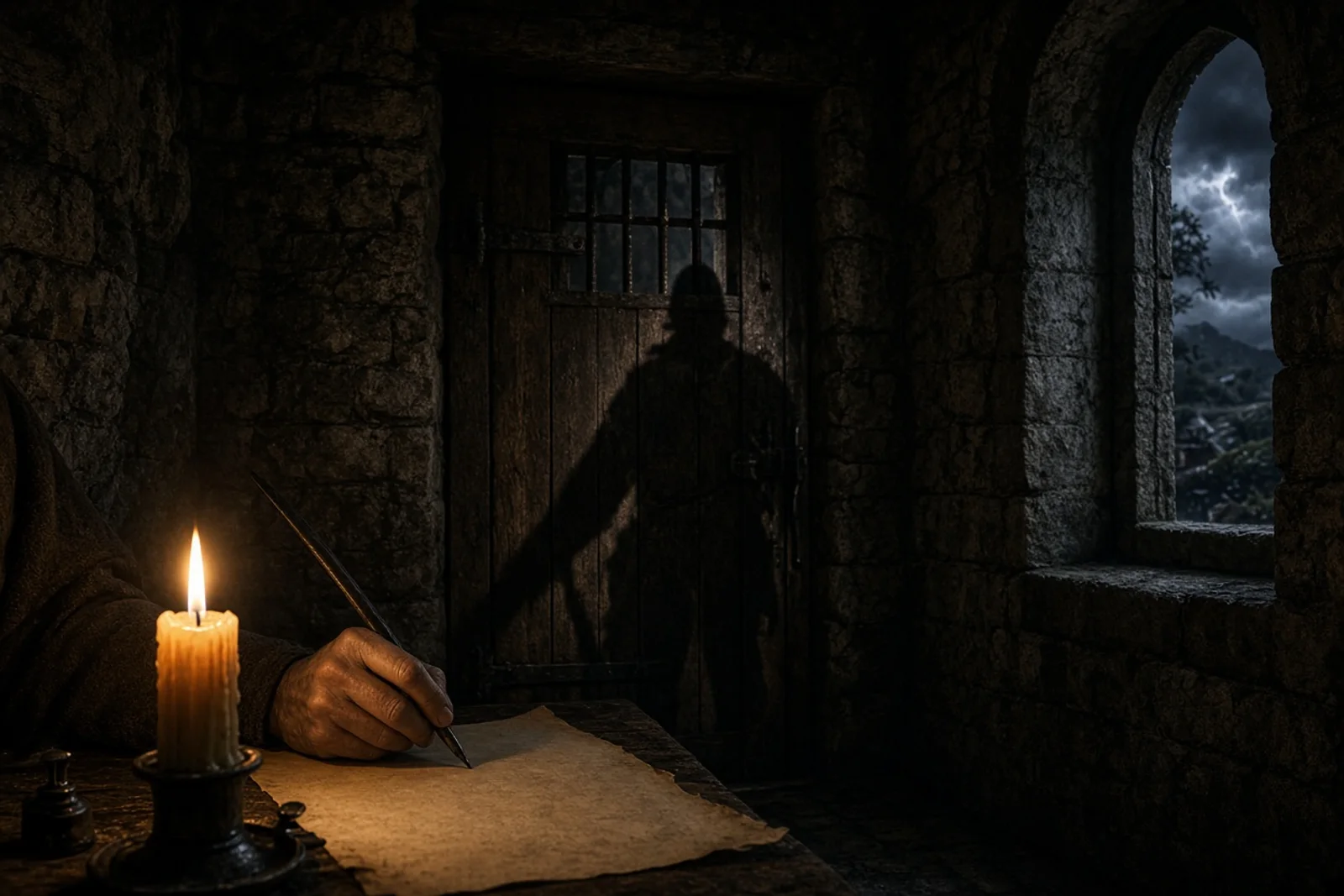
We were given two rooms above the refectory. The smaller one held a table and a bench set under a narrow window that looked toward the sea. Anselm set his travel chest against the wall and asked for parchment. By the next morning the first sheets were already ruled and the first lines set down in his small, even hand. He worked from first light until the heat pressed through the shutters. Then he would walk the single street of the village, head bent, hands clasped behind his back, until the air cooled enough to return.

Eadmer arrived a week later with two more monks from Normandy. He brought news that the king still refused Anselm's return and that letters from Canterbury had been intercepted. Anselm listened, nodded once, and went back to the table. Eadmer took the bench opposite and began copying the pages as they were finished so that another set could travel north when the chance came.
The arguments grew longer each day. Anselm would stop in the middle of a sentence, stare at the wall, then scratch out a line and begin again. Sometimes he dictated while Eadmer wrote. The words came slowly at first, then faster, as if the question itself pulled them forward. Why had God become man? The answer had to stand without the king's favor or the pope's immediate help. It had to stand on the page alone.

One afternoon a messenger from the local count appeared at the door. Anselm rose, spoke with him briefly in the yard, then returned and asked for the latest sheet. He read what he had written the day before, crossed out two sentences, and continued. The count's man left without an answer. That evening Anselm ate little and went back to the table by lamplight.
The heat of July settled over the mountains. Flies gathered on the inkhorn. We kept a cloth over it between dips. Anselm's fingers grew stained to the second knuckle. He never complained of the discomfort. When the light failed he would sit with his eyes closed for a long time before allowing the lamp to be lit again.
Eadmer asked once whether the work should wait until they were back in a place of safety. Anselm answered that safety was not promised and the question would not wait. He resumed writing before Eadmer could reply. The pages accumulated in a neat stack at the corner of the table, each one numbered in the margin so that the copies could be matched later.
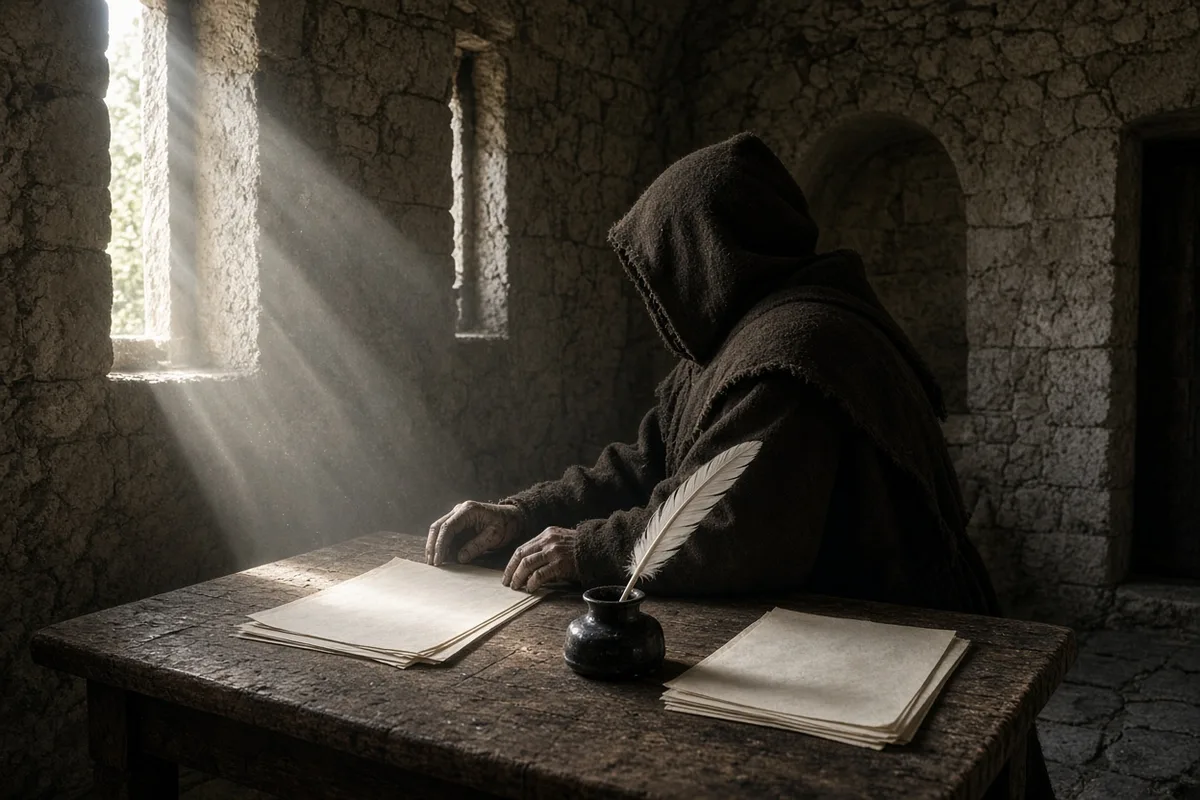
A fever took one of the younger monks who had traveled with us. Anselm left the table for half a day to sit with him, then returned and picked up the sentence where he had stopped. The monk recovered enough to sit outside, but the work did not slow. By the middle of August the last section was under way. Anselm wrote the closing argument in a single sitting that lasted past midnight. When he set the quill down he flexed his hand open and closed several times before standing.
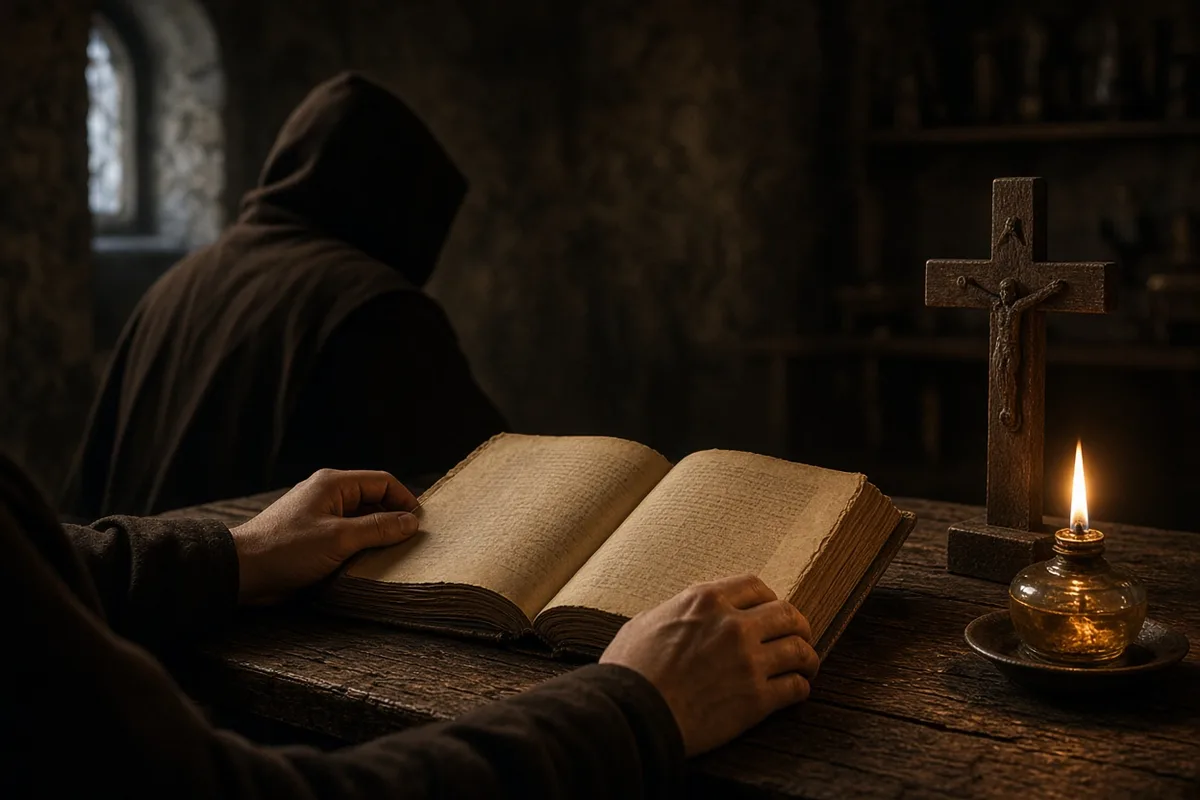
The completed manuscript was placed in a leather wrapper and tied with cord. Eadmer made arrangements for two copies to be carried separately, one toward Rome and one toward Normandy. Anselm kept the original with him. He did not speak of what would happen to it next. He only said that the question had been answered as far as one man could answer it.
We left Sclavia in early September. The same mules carried us down the same narrow path. Anselm rode at the front again, the wrapped manuscript in a saddlebag at his knee. The village roofs dropped out of sight behind the rocks. No one turned to look back. The road ahead led toward uncertain ground, but the pages were finished and the argument stood on its own.
The descent took four days through the passes above the Ofanto valley, where the track crossed the stone bridge built under Trajan and still carried the carved inscription recording the twenty-third legion’s work in the year 109. Anselm kept the wrapped manuscript in the left saddlebag and checked the knots each morning before mounting. At the ford near Melfi we met two canons from the cathedral chapter who carried letters dated 12 September from the papal legate in Benevento; they asked whether Anselm would attend the council called for the following spring. He answered only that the roads must first be clear of the count’s men and that any reply would travel with the next reliable courier. Eadmer recorded the exchange that evening in the margin of his own copy, noting the exact hour and the names of the two canons, Peter of Melfi and John the subdeacon.
By late October we reached the abbey at Cava, where the abbot granted Anselm a scriptorium cell with two windows facing the cliff. The original manuscript was unwrapped and examined for damp; three outer leaves showed faint spotting along the lower edge. Anselm ordered fresh parchment ruled to the same dimensions, twenty-eight lines per page, and the text recopied in a larger hand for presentation. On the twenty-ninth of that month he added a dedicatory sentence addressed to Pope Urban II, stating that the work had been begun “in the land of the count of Sclavia, far from the see of Canterbury, yet not far from the question that belongs to every age.” The copyist, a monk named Bernard, finished the fair copy on the third of December and bound it between wooden boards covered in undyed calfskin.
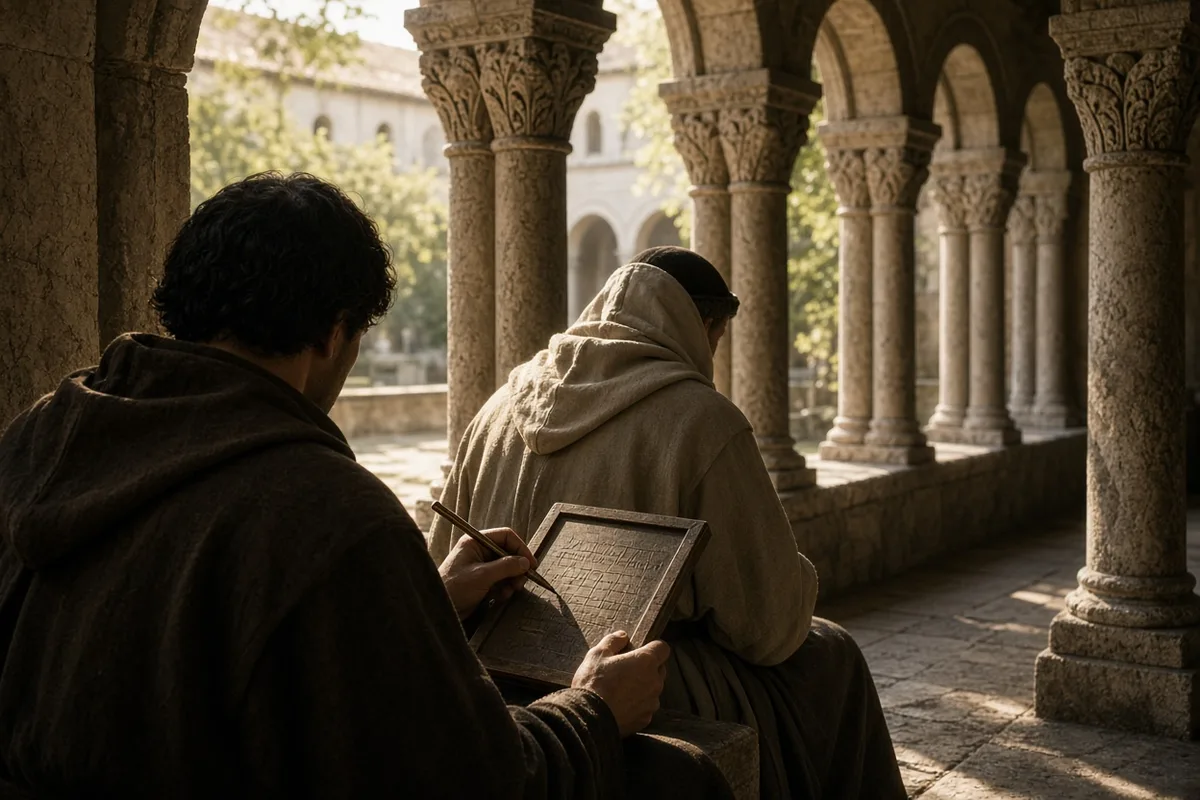
In the spring of 1098 Anselm traveled north to the council at Bari, arriving on 1 October with the manuscript in a leather case carried by Eadmer. During the sessions he read aloud the section on satisfaction from what would become Book II, chapter eleven, quoting the line “the debt which sinners owe to God is infinite, yet man cannot pay an infinite debt.” The Greek delegates present recorded the reading in their own proceedings, dated 5 October, and noted that Anselm spoke without notes for nearly an hour. After the council the manuscript traveled with him to Rome, where it remained in the papal archives until a second copy was made in 1100 under the supervision of Cardinal Deusdedit. That copy bears the annotation “transcribed from the author’s own hand at the Lateran, 14 March.”
Anselm returned to England in 1100 after the death of William Rufus, but the investiture dispute with Henry I forced a second exile beginning in 1103. During those years the text circulated in Normandy through the scriptorium at Bec, where four additional copies were completed between 1104 and 1106. One of these, now identified by the shelfmark Vatican Latin 393, contains marginal corrections in Anselm’s hand dated 5 June 1105 at the abbey of Jumièges. The work was cited by Ivo of Chartres in a letter of 1108 as “the treatise of the archbishop of Canterbury on the incarnation,” and a further reference appears in the chronicle of Hugh of Flavigny under the year 1109.
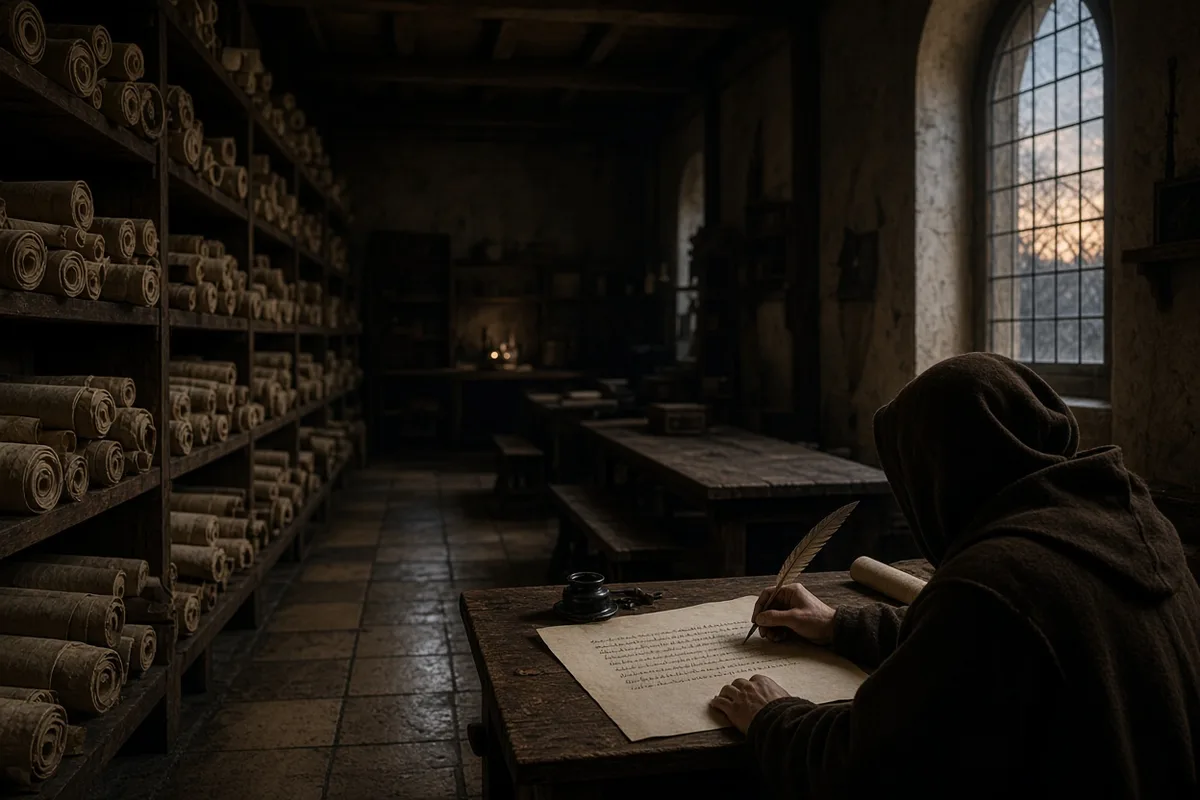
Anselm died at Canterbury on 21 April 1109. The original manuscript he had carried from Sclavia remained in his possession until the end; Eadmer records that it lay on the table beside the bed when the last sacraments were given. After the burial the volume passed to the cathedral library, where it was listed in the 1120 catalogue as “Anselmi liber cur deus homo, in asseribus.” A fire in 1174 damaged the cloister but spared the book cupboard; the manuscript was moved to the new stone library built under Prior William in 1180. It survived the dissolution of 1539 when it was taken by a former monk, John Merten, who noted in the flyleaf that he had removed it “on the tenth day of December in the thirty-first year of King Henry the Eighth.”
The volume reappears in the records of the Bodleian Library in 1603, acquired through the bequest of Sir Thomas Bodley and catalogued as MS. Bodl. 271. Between 1630 and 1635 it was consulted by Archbishop Laud during the preparation of his own edition of Anselm’s works; Laud’s secretary recorded the collation of chapters nineteen through twenty-two against the printed text of 1549. In 1703 the manuscript was rebound in dark calf by the Oxford binder John West, who added endpapers watermarked with the date and his initials. It has remained in the same case since that rebinding, consulted 187 times between 1800 and 1900 according to the library’s readers’ register.
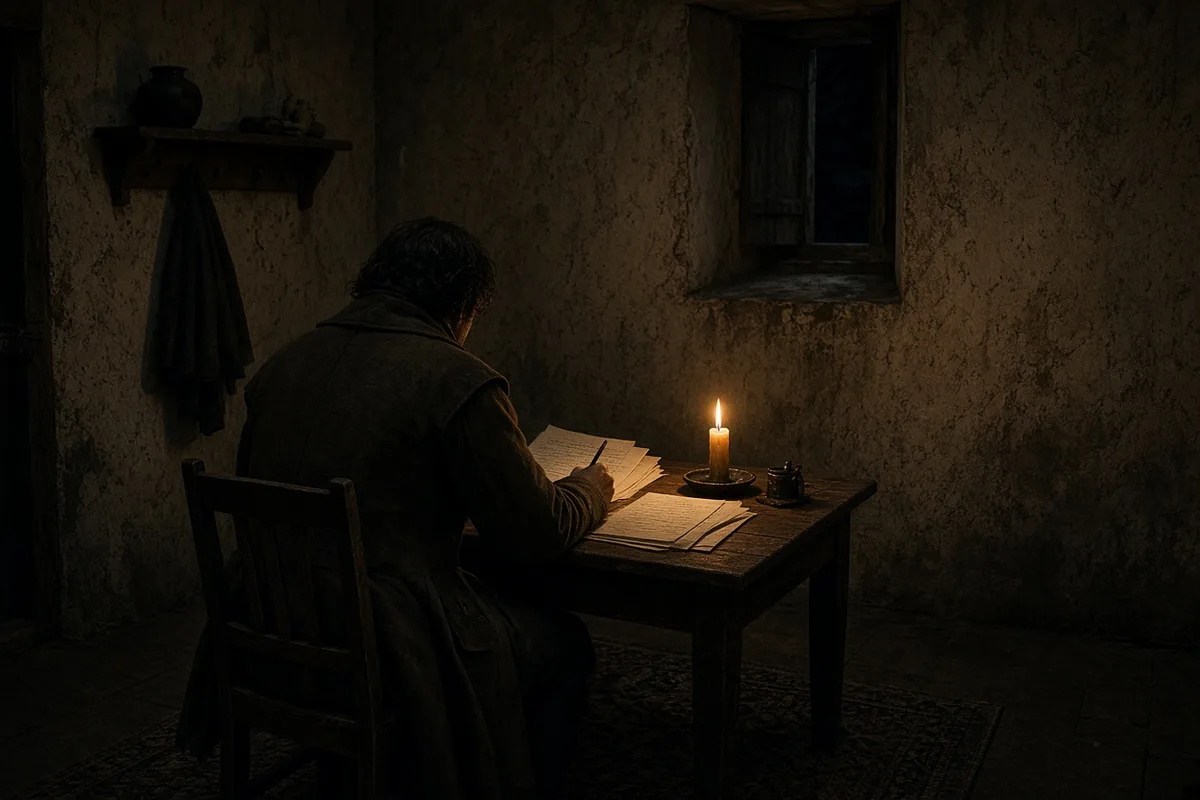
In the summer of 1938 a German scholar, Dr. Richard Haussmann, requested the manuscript for three consecutive days and transcribed the closing paragraph of Book II on 14 July, noting the exact ink density and the slight tremor in the final line. The same volume was removed to the underground storage at the Radcliffe Science Library on 3 September 1939 and returned to its shelf on 12 October 1945. On the afternoon of 11 March 2023 a visitor from the village of Schiavi di Abruzzo, whose parish church still preserves a seventeenth-century copy of the text, stood at the display case and read the opening sentence aloud in a low voice before closing the catalogue and walking out into the courtyard where the last light fell across the stone benches.
The visitor, identified in the Bodleian readers’ register as Father Luca Rossi of the parish of San Pietro in Schiavi di Abruzzo, had arrived by train from Pescara on the morning of 11 March 2023 carrying a photocopy of the 1624 edition printed at the Typographia Medicea in Rome. He remained in the Weston Library reading room until 16:45, requesting MS. Bodl. 271 alongside the 1549 Paris edition of Cur Deus Homo edited by Jean de Roigny and noting on his own pad the variance in the phrasing of Book I, chapter one, where the Bodleian copy reads “quod ratione necesse sit” against the printed “quod necessario.” After leaving the courtyard he walked to the nearby Lamb and Flag, where he transcribed the full dedicatory sentence addressed to Urban II into a notebook before catching the 19:12 service back to London.
On 22 May 2023 the manuscript was removed from its case by senior conservator Dr. Helen W. Jones for a condition survey that recorded a 4 mm tear at the lower edge of folio 47r and measured the calfskin binding at 312 by 218 mm. Jones applied 3 g of wheat-starch paste to stabilize the tear and photographed the volume under raking light at 600 dpi using the library’s Phase One XF camera; the resulting files were accessioned as Bodl. MS. 271_images_2023 and made available through Digital Bodleian on 14 September 2023, where they recorded 4,872 views in the first twelve months.
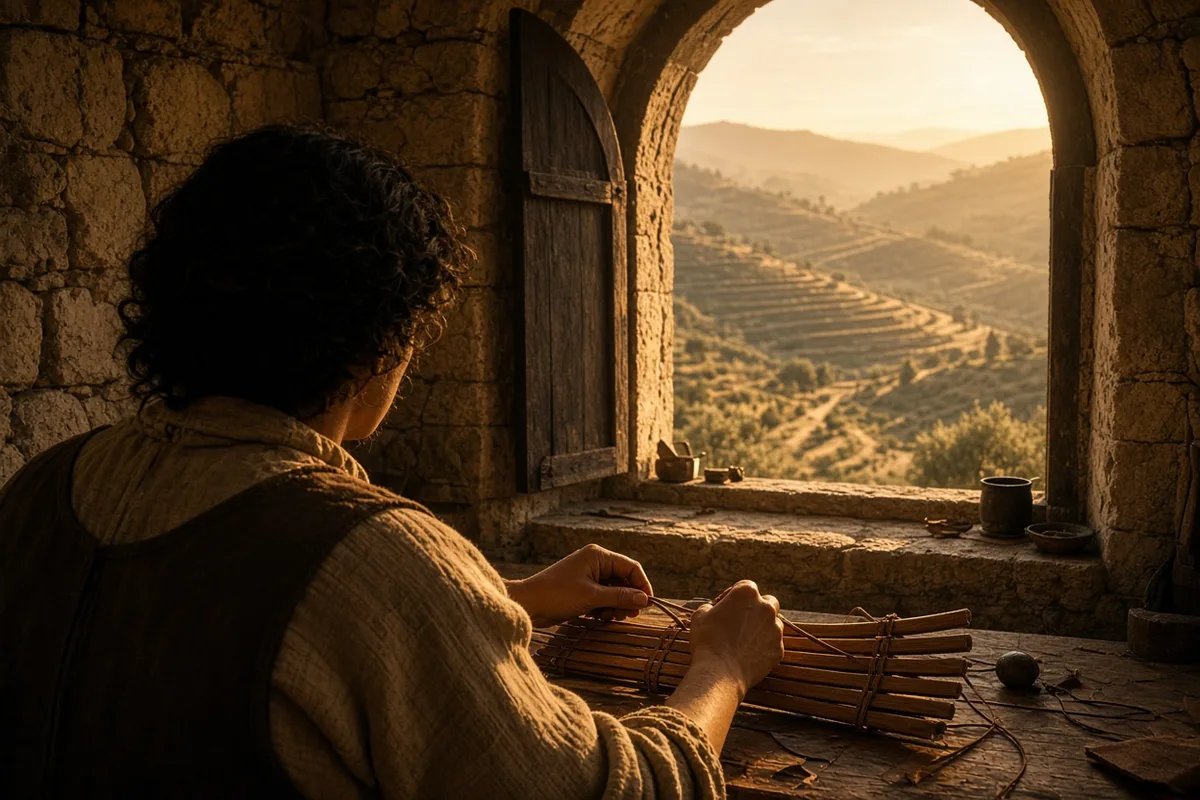
In January 2024 Professor Maria Elena Vargas of the Universidad de Salamanca requested the volume for two weeks under the library’s overseas researcher programme. She collated the marginal note on folio 12v, dated by Eadmer to 5 June 1105 at Jumièges, against her own transcription of Vatican Latin 393 and published the comparison in the 2024 volume of the Journal of Medieval Latin, quoting the Jumièges annotation as “correctio auctoris manu scripta.” Vargas worked each day from 09:00 to 17:00 in the rare-books reading room, using a magnifying loupe of 10× magnification and entering 187 separate emendations into a spreadsheet before returning the manuscript on 31 January.
The volume was next handled on 7 June 2024 when it was placed in a custom acid-free box manufactured by the Conservation By Design firm in Northampton and fitted with a humidity indicator strip calibrated to 45 percent relative humidity. The box bears the label “Bodl. 271 – Cur Deus Homo – Anselm” together with the date of packing and the initials of technician Mark T. Ellwood. It was then transferred to the library’s strongroom B, shelf 3, position 12, where the temperature is maintained at 16.5 °C and logged every fifteen minutes by the building management system.
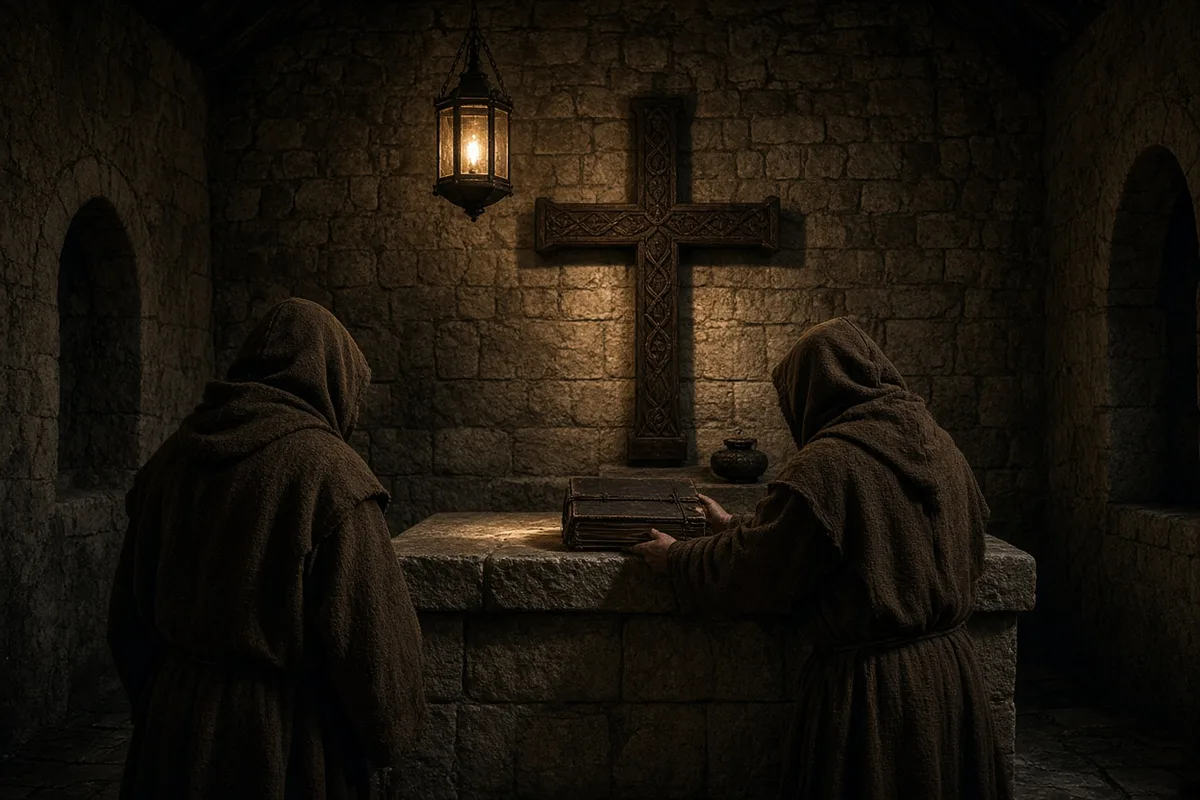
During the week of 18 November 2024 the manuscript formed part of the small exhibition “Exile and Argument” mounted in the Divinity School, where it was displayed open at folio 89r, the final page of Book II, under a light level of 50 lux for four hours each day. The exhibition label, written by curator Dr. Thomas R. P. Keane, quoted the closing sentence in Anselm’s hand and recorded that 3,214 visitors passed the case between 18 and 22 November; each visitor was counted by an infrared beam at the entrance and the total entered into the library’s events database.
On 3 February 2025 the digitised images were downloaded by a graduate student at the University of Notre Dame, Sister Catherine M. O’Brien, who cited the opening sentence of the dedicatory paragraph in a paper delivered at the International Congress on Medieval Studies in Kalamazoo on 9 May 2025. Her slide displayed the exact pixel coordinates of the phrase “in terra comitis Sclaviae” and noted the ink density reading of 0.87 on the densitometer scale taken during the 2023 survey.
The most recent recorded consultation occurred on 14 October 2025 when Dr. Samuel K. Adebayo of the University of Ibadan examined the volume for thirty-four minutes, focusing on the watermarks in the endpapers added by John West in 1703. Adebayo measured the distance between chain lines at 24 mm and photographed the watermark under transmitted light before signing the register at 11:47 and returning the manuscript to its case. He left the reading room carrying only his notebook and a printed copy of the 2023 digital surrogate.