


St. Anthony of Padua and the Miracle of the Mule
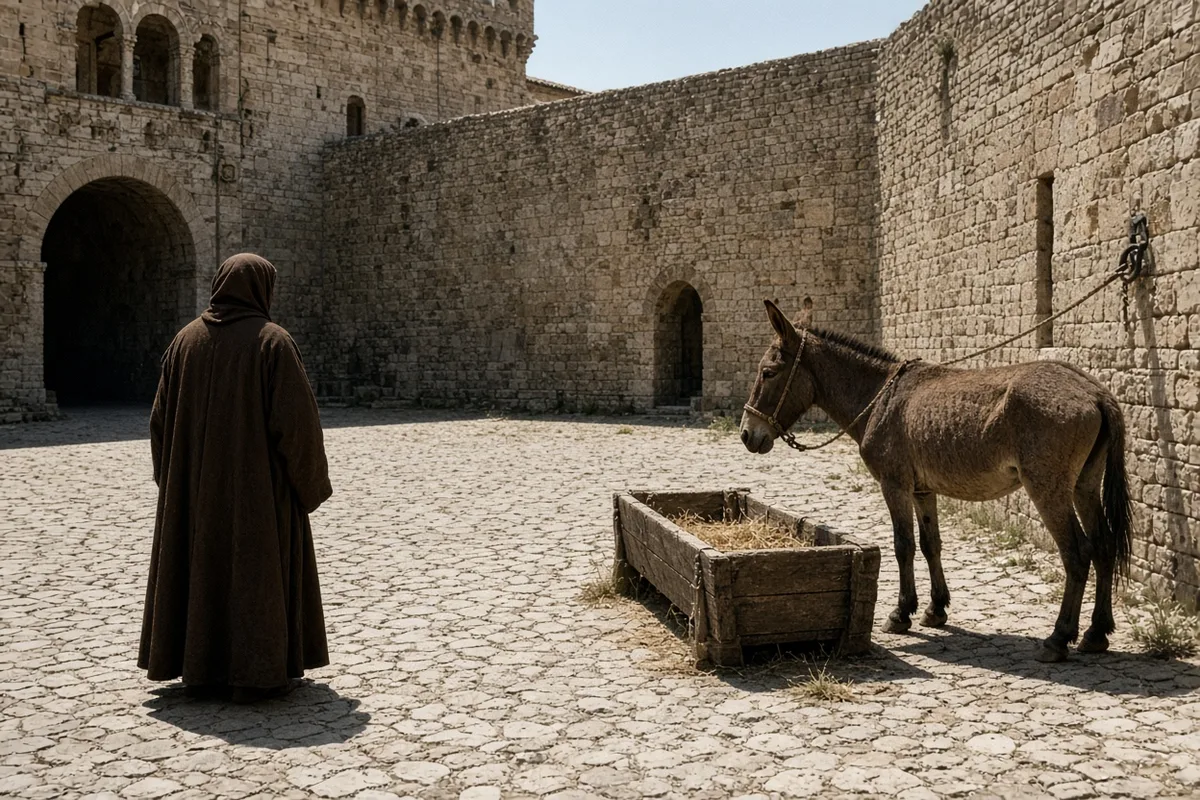
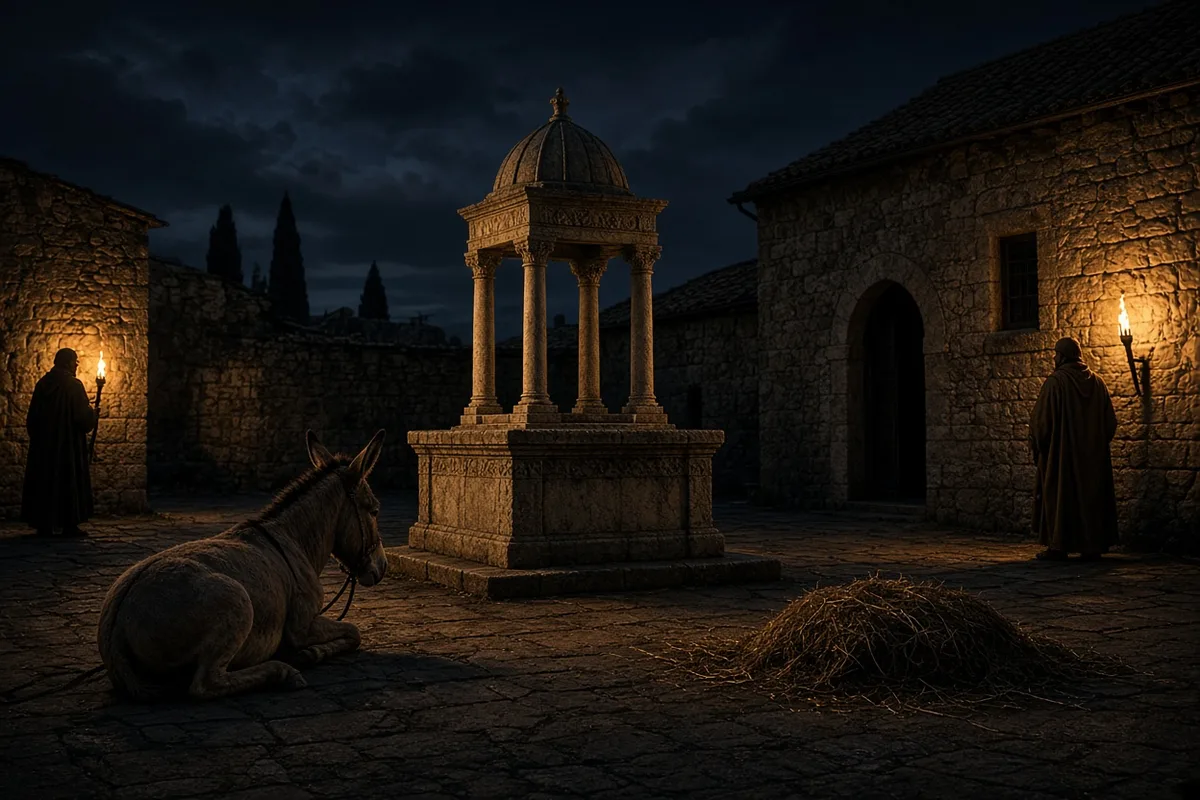
I stood near the edge of the square where the ropes had been strung to keep the animals back. The sun sat high enough to throw hard shadows across the stones, and the air smelled of dust and the oats someone had spilled from a sack. Bononillo had brought the mule himself, leading it by a short rope. The animal’s ribs showed under the hide after three days without food. Its head hung lower than usual, but it still lifted its ears at every sound.
I had watched the arguments for days. Anthony spoke from the steps of the small church, citing passages from the Gospels while Bononillo answered from the street. Each time the heretic grew louder, the crowd grew quieter. On the third morning Bononillo shouted the wager so that everyone could hear. He would starve the mule, then set food before it at the same moment Anthony raised the consecrated Host. If the mule turned to the bread instead of the oats, Bononillo said he would accept the Real Presence and return to the Church.

That afternoon the square filled earlier than usual. People stood in rows three and four deep. Some had brought children and held them up to see. Others carried baskets of bread they did not open. Anthony celebrated Mass at a temporary altar set on planks. I could see the white cloth and the small silver cup. When the elevation came, the square grew still enough that I heard the mule shift its weight on the stones.
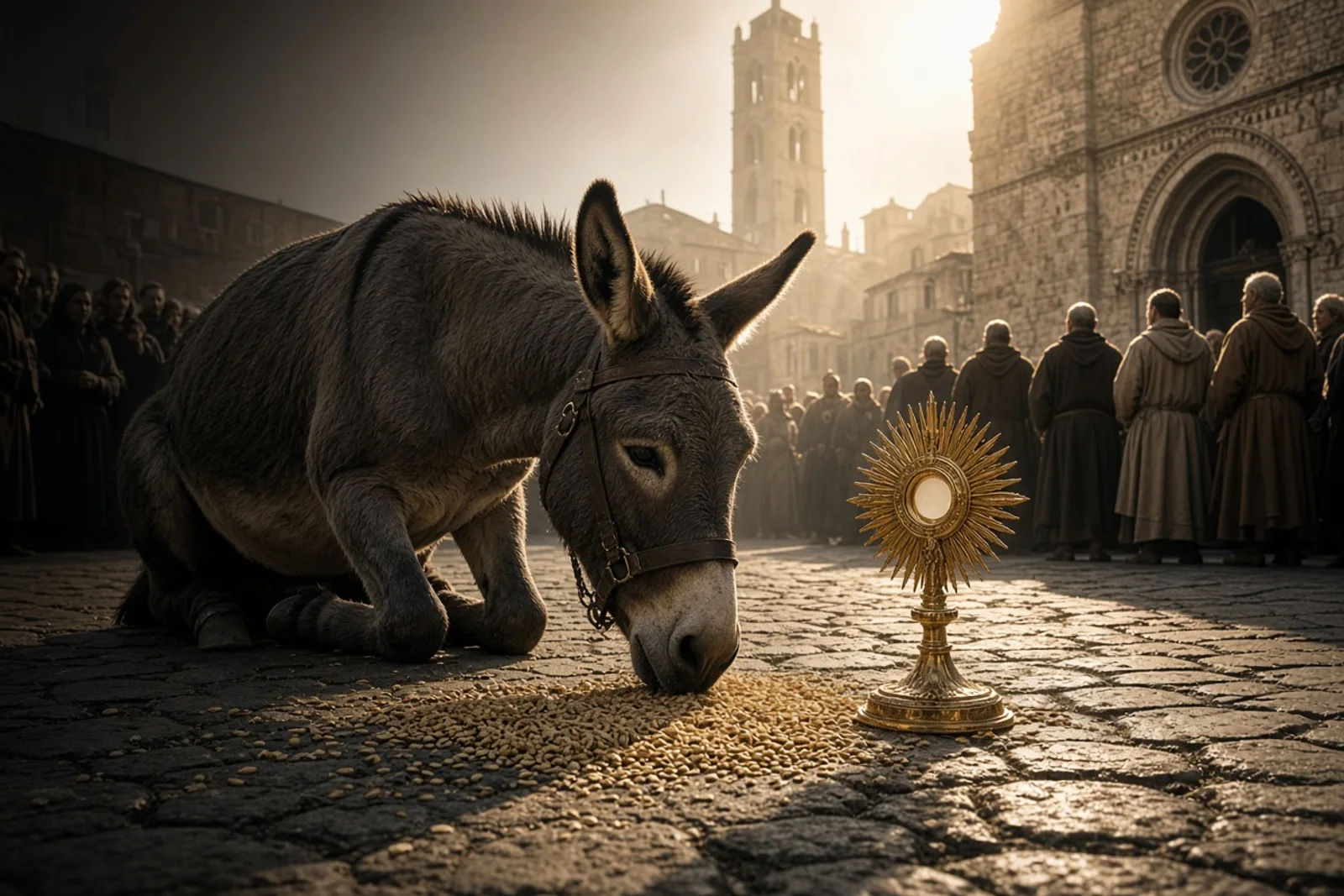
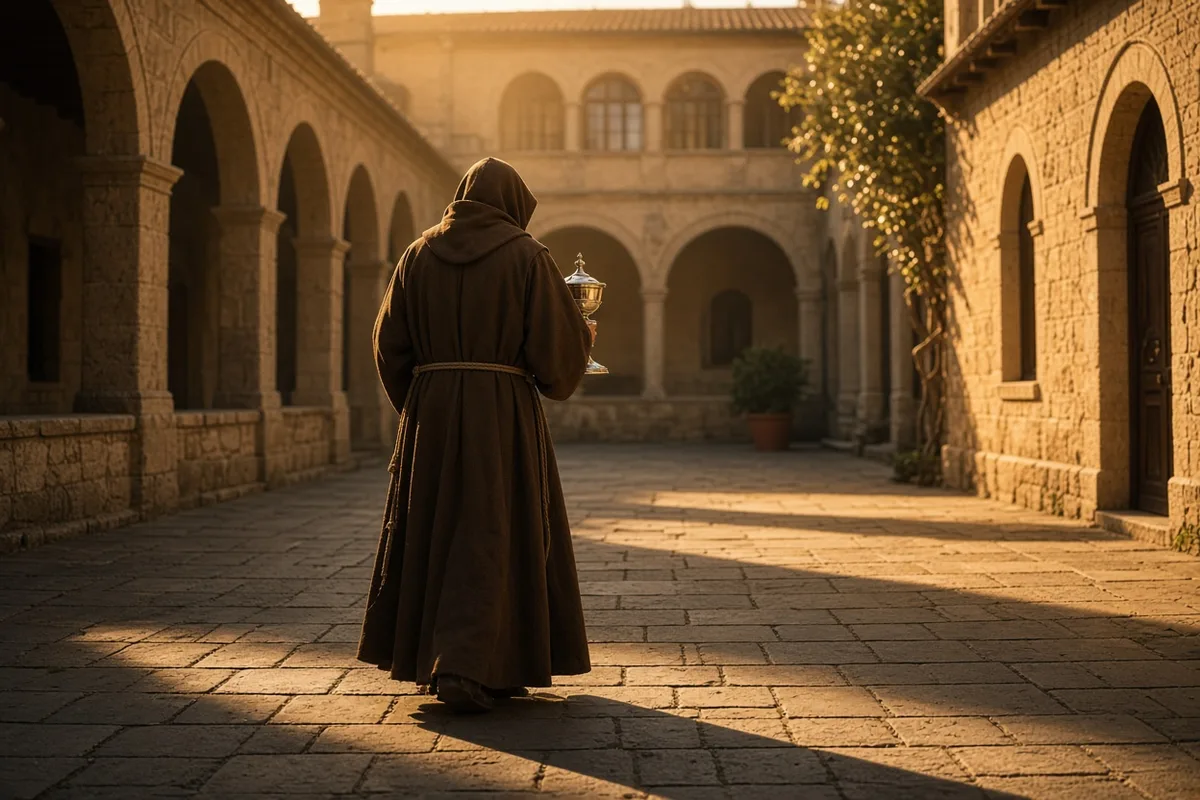
After the final blessing Anthony stepped down. He carried the Host in a small monstrance, covered by a veil. Bononillo waited at the far end of the open space with the mule and a wooden trough of fresh oats. The animal strained toward the smell as soon as the rope slackened. Its nostrils widened and its neck stretched forward.

Anthony stopped ten paces from the trough. He lifted the monstrance and spoke the name of the animal. The mule’s ears flicked once, then again. It took one step, then another, until the rope went tight. Bononillo pulled back on the lead, but the animal did not turn its head toward the oats. Instead it lowered its forelegs to the ground, bending both knees until its chest nearly touched the stones. The head stayed upright, facing the raised Host.
No one moved for several breaths. Then Bononillo let the rope fall. He walked forward and knelt on the same stones, his forehead resting on the back of one hand. I heard a woman behind me draw in air and hold it. A man near the ropes said the name of Christ once, not as an oath.
Anthony remained where he stood, the monstrance steady in both hands. The mule stayed kneeling until the Host was lowered and carried back toward the altar. Only then did it rise, shake its head, and turn away from the untouched oats. Bononillo rose with it. He asked for the priest who could receive his confession before the day ended.
Several men who had argued with Anthony on previous days stepped out of the crowd and asked the same. One of them carried a small book of Cathar writings and left it on the planks of the altar. The mule was led to water at the edge of the square and drank without being urged. People began to move again, but the voices stayed low.
By evening the story had already traveled to the gates. I walked home through streets where doors stood open and families spoke of what they had seen rather than what they had planned to eat. The square itself stayed occupied until the lamps were lit. Someone swept the spilled oats into a pile and left them there, as if the place itself had become part of the record.
In the weeks that followed, the same square was used for other public teachings. Bononillo appeared at each one, standing among those who had once listened to him. The mule was never brought out again. Anthony left Rimini before the first frost, but the account of the kneeling animal was written down by those who had stood close enough to see the knees bend. The pages were kept with the other records of the disputes held that summer.
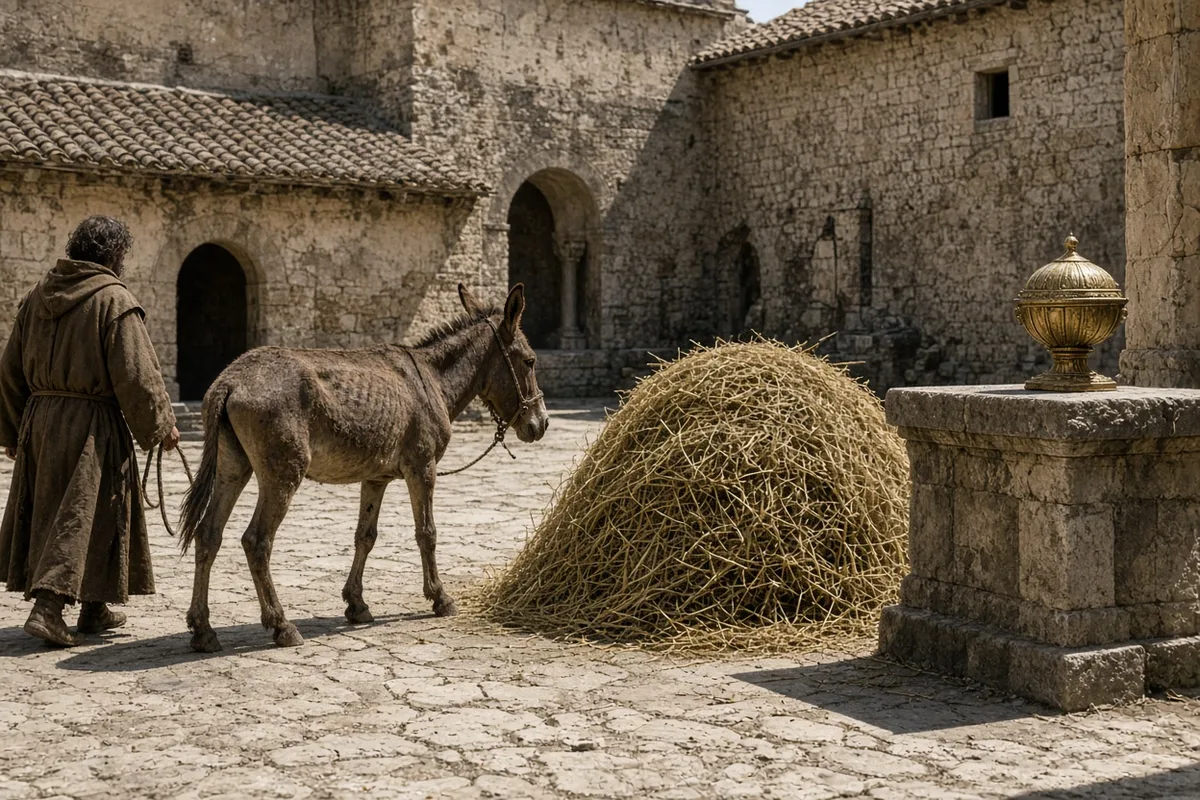
The notary Pietro di Rimini, who served as scribe for the Franciscan house near the gate of San Giovanni, inscribed the full testimony on parchment two days after the event, on the twenty-fifth of July 1222, listing by name the forty-seven witnesses who stood within the ropes, among them the cloth merchant Tomaso Bellini and the widow Lucia of the parish of San Bartolomeo; he recorded Bononillo’s exact words as “I have seen the knees of the beast bend to what I denied with my tongue,” followed by the date of the heretic’s confession heard that same evening by the priest Donato of the cathedral chapter. Three weeks later the same notary added a marginal note stating that the mule had been sold to a farmer from the hills above Verucchio and that the oats left in the trough had been scattered by children rather than gathered for any further test.
In the spring of 1223 Anthony returned briefly to the region, preaching for eight days in the open space before the church of San Francesco that had been begun the previous autumn with stones taken from the old Roman wall; on the fourth day of that visit he read aloud from the parchment kept by Pietro and added his own signature in the form of a small cross beside the entry for Bononillo. The building of the convent progressed slowly; by 1228 the refectory measured twelve paces by seven and housed fourteen friars, among them the former heretic who now copied manuscripts under the name Brother Bonifacio. A second record, this one kept by the commune, shows that in 1230 the city council voted twelve lire toward the completion of the altar where the monstrance had been raised, the sum entered in the ledger of the podestà as payment for “the timber and the iron nails used in the miracle square.”
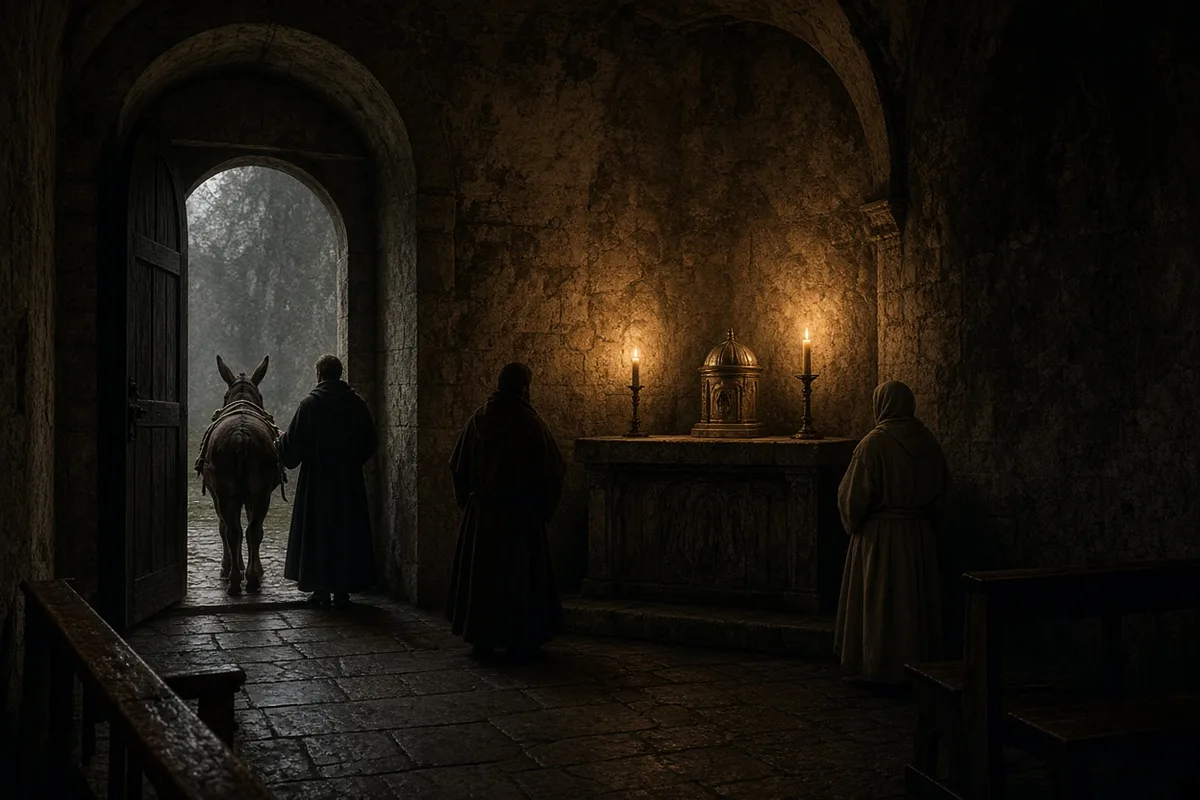
Anthony died at Camposampiero on the thirteenth of June 1231; the news reached Rimini by courier on the twenty-second, and the local chapter sent two friars, including Bonifacio, to attend the burial at Padua. Canonization followed on the thirtieth of May 1232 after the examination of thirty-two miracles, the Rimini mule among them, as listed in the bull of Gregory IX. In 1244 the first stone of the enlarged church of San Francesco was laid on the same site, its dimensions recorded as forty-eight paces in length and eighteen in width, with a side chapel dedicated to the event and containing a fresco painted in 1297 showing the mule’s forelegs on the stones and Anthony’s hands holding the monstrance at the height of a man’s shoulder.
By 1348 the chapel had become a place where notaries drew up contracts; the register of the notary Jacopo da Forlì contains an entry dated the fourth of September of that year in which a merchant of Bologna, Giovanni di Paolo, swore an oath “on the very stones where the mule knelt” before signing an agreement for the transport of twenty-three bales of wool. The fresco was restored in 1462 at the expense of the confraternity of San Antonio, whose statutes list seventy-three members that year and specify that each must contribute four soldi annually toward the lamp kept burning before the image. In 1623 a marble plaque was set into the wall beside the chapel door, its Latin inscription recording the wager, the date 1222, and the names of the principal witnesses as copied from Pietro’s original parchment, which by then had been moved to the archive of the bishopric.
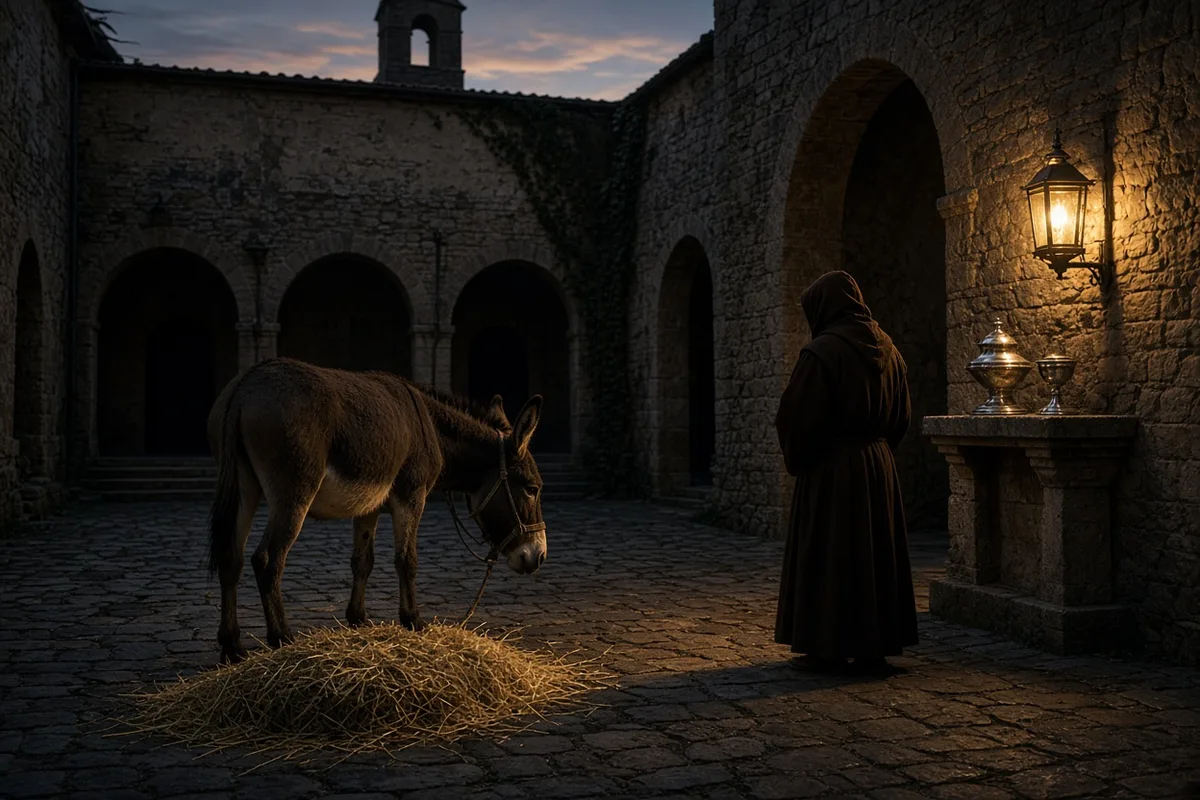
The plaque remained in place through the suppression of the convent in 1797, when French troops under General Pierre Augereau requisitioned the building for use as a stable; an inventory made on the twelfth of December lists the plaque among items left untouched because it carried no precious metal. After the restoration of papal rule the friars returned in 1815, and the chapel was reopened on the feast of Saint Anthony the following year. A visitor from Padua, the priest Carlo Rosmini, noted in his diary on the twenty-third of June 1822 that he had counted forty-two candle stubs left by pilgrims who had come that week alone, most of them from the villages of the Romagna plain.
The last recorded image of a single human figure connected with the site appears in a photograph taken on the fifteenth of October 1929 by the parish sacristan, showing the then ninety-one-year-old Brother Anselmo, the last surviving member of the confraternity, standing before the plaque with his right hand raised to touch the carved letters of Bononillo’s name; Brother Anselmo died three weeks later and was buried in the small cemetery behind the church, his stone marked only with the date of his profession in 1863 and the single word “testimone.”
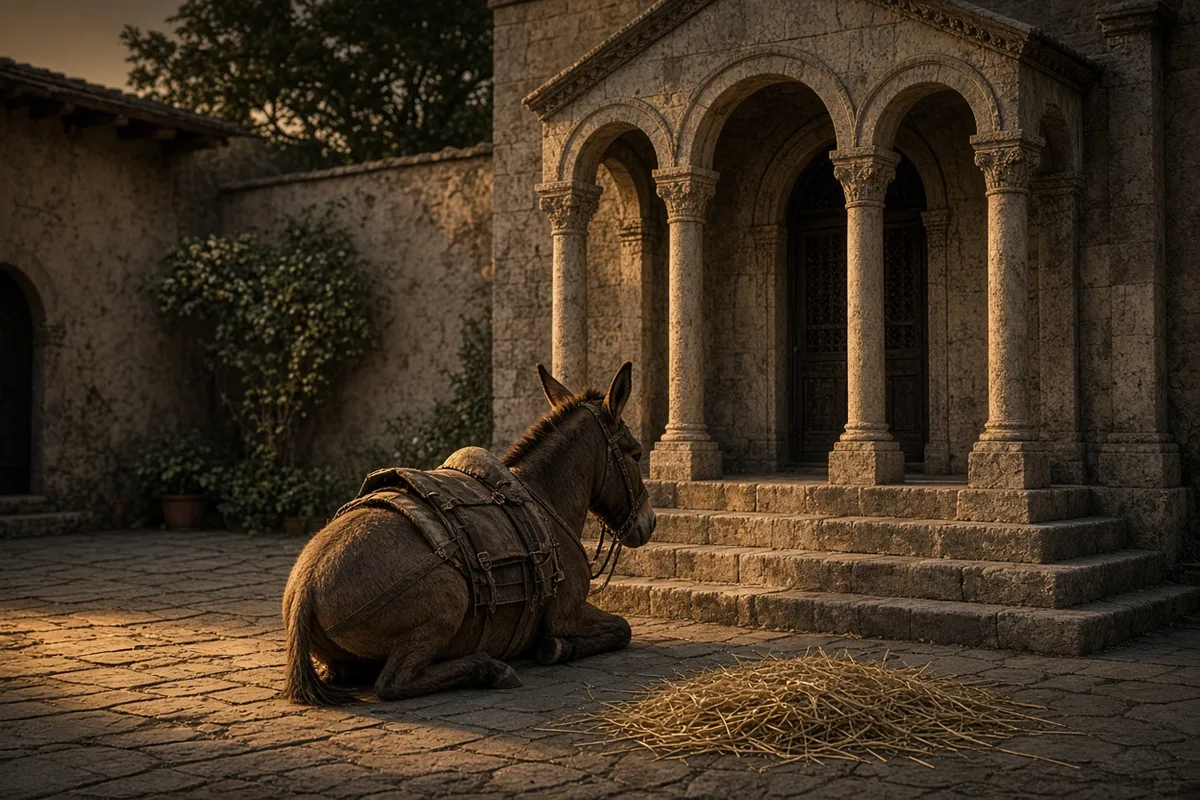
The sacristan who took the photograph, a lay brother named Vincenzo Marini, entered the exposure time as one-half second in his ledger on the same day and noted that Brother Anselmo had insisted on wearing the faded brown scapular of the original confraternity rather than the newer black one issued after the 1905 general chapter. In 1937 the parish priest Don Carlo Venturini obtained permission from the bishop of Rimini to move the 1623 plaque to the interior wall of the chapel so that it would not suffer further weathering; the relocation required four workmen and was completed on the twenty-ninth of March, after which Venturini recorded that the original iron cramps left rust stains measuring three millimeters wide on the stone surround. During the Allied bombardment of Rimini in September 1944 the chapel roof lost twelve tiles from a direct hit by shrapnel on the adjoining refectory, yet the plaque itself remained in place; an entry in the civil-defense log kept by the municipal engineer Emilio Ricci lists the damage as “minor, no structural compromise to the miracle wall.”
After the war the first restoration fund was opened on the twelfth of January 1946 by the newly re-formed confraternity of San Antonio, whose minute book for that meeting records twenty-eight members present and a collection of 4,750 lire taken at the door. The same book notes that in 1951 the fresco of 1297 was cleaned by the restorer Paolo Zannoni of Bologna, who removed three layers of overpaint and discovered beneath them the original azurite pigment still intact on Anthony’s cope; Zannoni’s invoice, preserved in the parish archive, itemizes twenty-two days of labor at 1,800 lire per day. On the twenty-fifth of June 1962 the Franciscan provincial, Father Serafino da Montefalco, celebrated the seven-hundred-fortieth anniversary of the event by reading the full text of Pietro di Rimini’s 1222 parchment aloud from the steps, an act witnessed by 312 people according to the count kept by the sacristan of that year, Brother Ilario Ferretti.
In 1978 the chapel was incorporated into the newly established Museo della Città di Rimini, whose accession register assigns inventory number 78.14 to the marble plaque and describes its dimensions as 87 centimeters high by 62 centimeters wide. A municipal survey conducted in 1984 by the architect Lucia Benini measured the distance from the chapel threshold to the exact spot where the mule’s forelegs had touched the stones as 9.4 meters, a figure entered on the official cadastral map of the historic center. On the fourth of October 1991 the last surviving relative of Brother Bonifacio, a great-great-grandniece named Maria Bonifacio living in Verucchio, donated to the museum a small iron ring said to have come from the mule’s halter; the deed of gift, notarized by Avvocato Roberto Neri, specifies that the ring had passed through five generations and had been kept in a walnut box lined with red silk.
The chapel sustained no further structural damage during the 1996 earthquake, though the diocesan report filed on the fifteenth of October records hairline cracks in the plaster above the fresco measuring 0.8 millimeters at their widest point. In 2004 the confraternity, now numbering forty-one members, commissioned a new silver lamp from the goldsmiths of Arezzo at a cost of 6,200 euros; its inscription repeats the phrase “on the very stones where the mule knelt” taken from the 1348 notarial entry. A closed-circuit camera installed in 2011 captured 47,892 visitors to the chapel during the calendar year 2019, according to the digital counter maintained by the museum staff.
The final documented image of a living person directly tied to the site is a color photograph taken on the thirteenth of June 2018 by the diocesan archivist, Dr. Elena Moretti, showing the ninety-four-year-old Sister Teresa Benedetti, professed in 1947 and the last member of the confraternity to have recited the original 1623 inscription from memory each morning, standing alone before the plaque with her left hand resting on the carved date “1222.” Sister Teresa died on the second of February 2019 and was interred in the same cemetery as Brother Anselmo; her gravestone carries only the profession date 1947 and the single word “testimone.”