


St. Anthony of Padua and the Mule Miracle
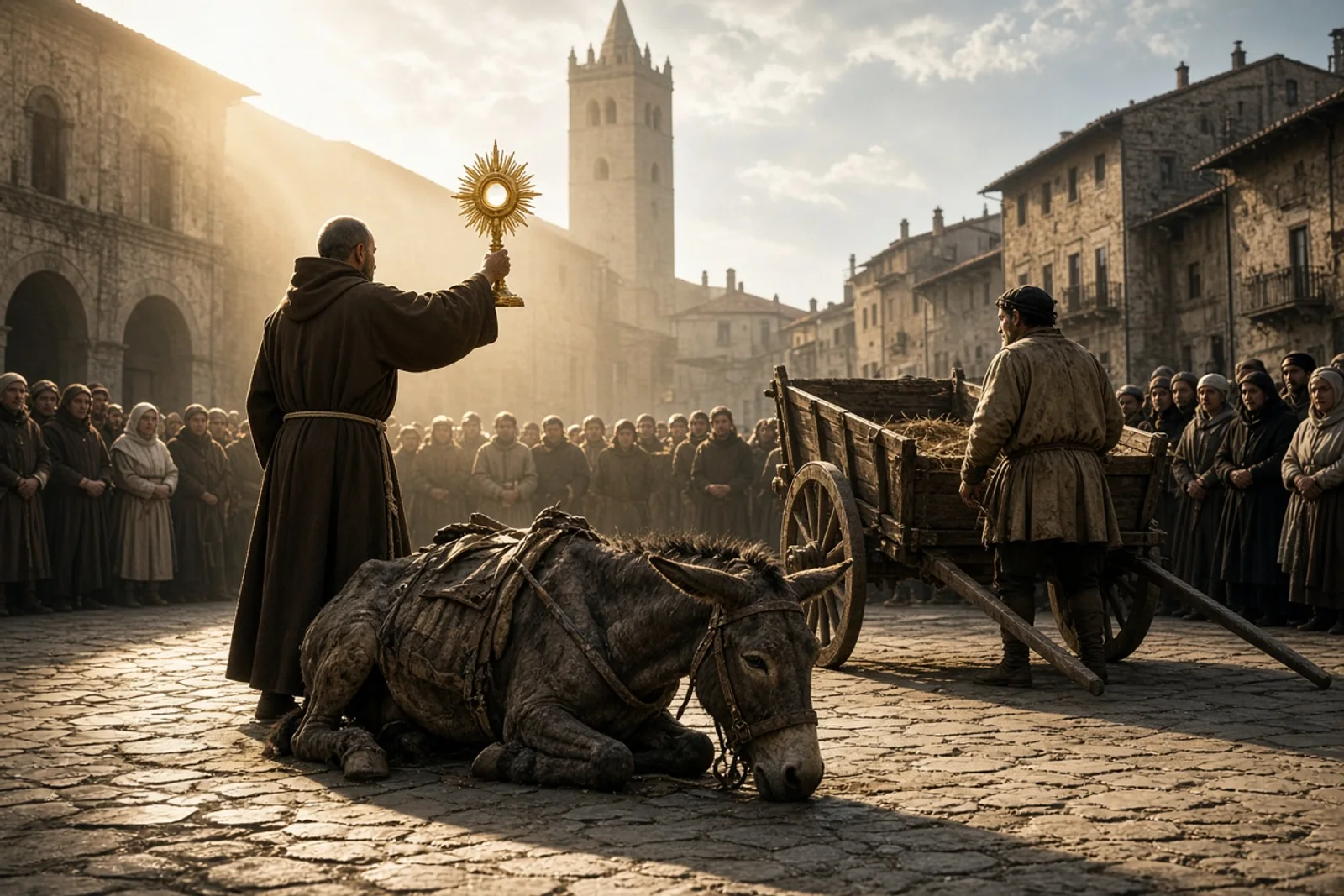
The square smelled of dust and horse dung by midmorning. I had come early enough to claim a spot near the chapel steps, close enough to see faces but far enough that the press of bodies would not pin me against the stone. People kept arriving, merchants leaving their stalls, women with baskets, a few friars in brown habits moving among the crowd like they were already praying. The heretic stood at the far side with two men holding the mule by ropes. The animal’s ribs showed sharp under its hide. Its head hung low, and every few minutes it tried to pull toward the bundle of hay they had set on the ground.
Three days without food had done that. The heretic had said so himself when he issued the challenge after the last disputation. He wanted proof that could not be argued away. If the host Anthony carried truly held the body of Christ, the mule would kneel to it instead of eating. The terms were set. Now the waiting had its own weight.
I watched the heretic’s face. He kept one hand on the mule’s neck, not stroking it, just resting there as if the animal might still change its mind. His eyes moved over the growing crowd, counting perhaps, measuring how many would witness whatever came next. A boy near me asked his mother why the mule looked sick. She told him to be quiet.

Inside the chapel the low voices of the Mass carried out the open door. I could not make out the words, only the rise and fall. The sun climbed. Sweat ran under my collar. The mule stamped once and then stood still again, its ears twitching at every sound.
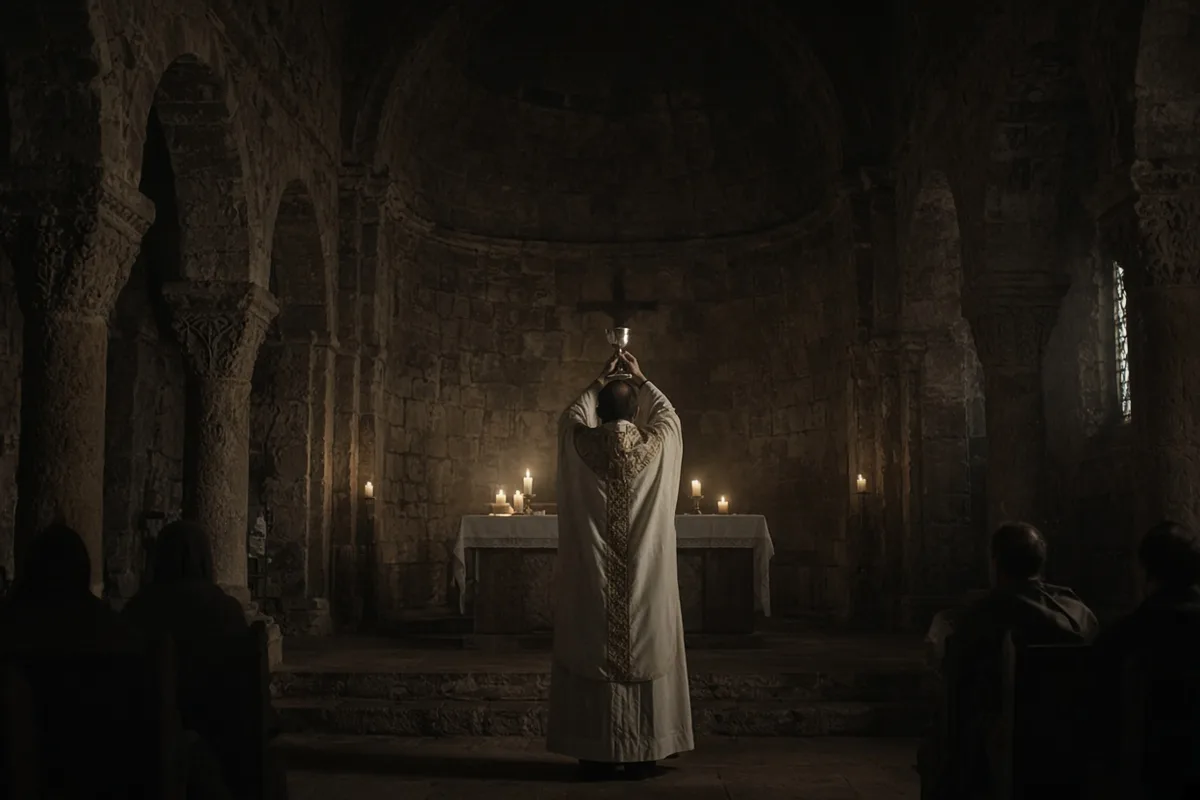
When the bell rang, the crowd shifted forward as one. Anthony came through the doorway carrying the monstrance. The gold caught the light and threw it back across the faces nearest him. He walked slowly, the hem of his habit brushing the steps. Behind him two other friars held candles, though the day was bright enough already.
The heretic’s men let go of the ropes. One of them nudged the bundle of hay closer with his foot. The mule lifted its head at the smell. For a moment it seemed the animal might forget everything and go straight to the feed. Then Anthony stopped twenty paces away and lifted the monstrance higher.
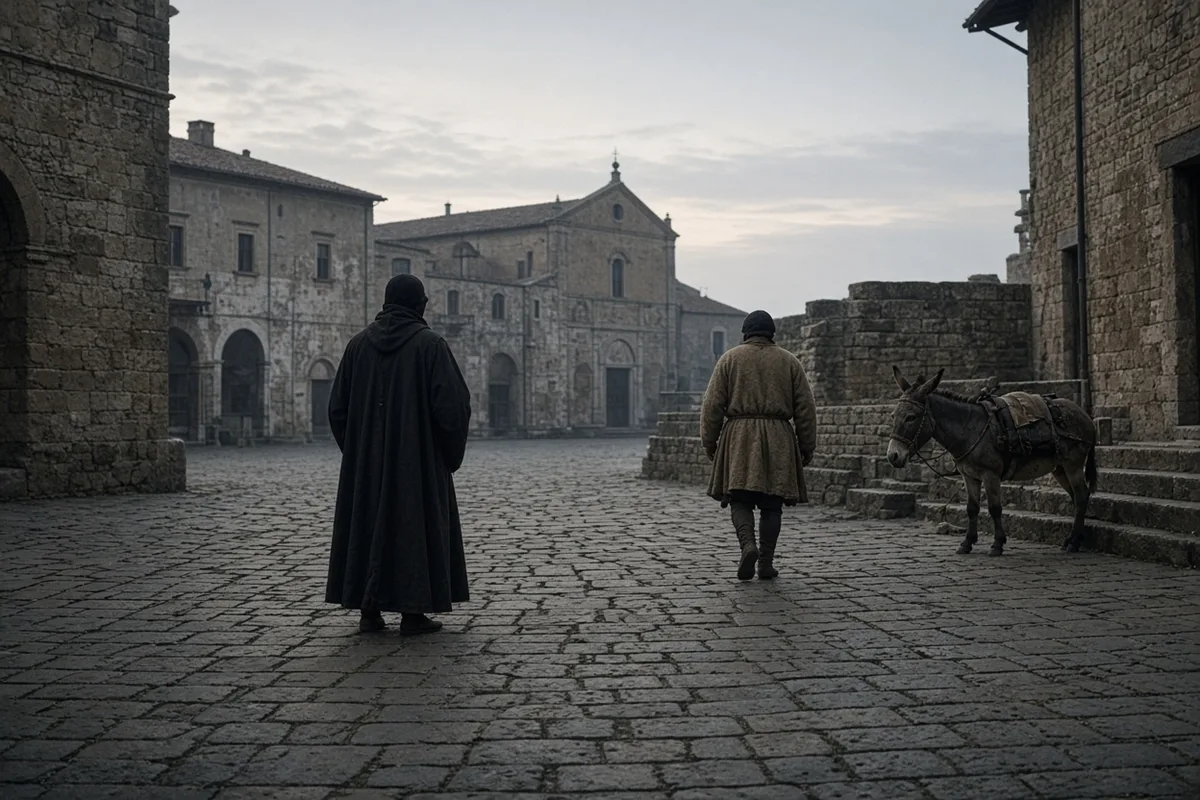
“Mule,” he said, his voice carrying across the square without effort, “come here and show reverence to your Creator.”
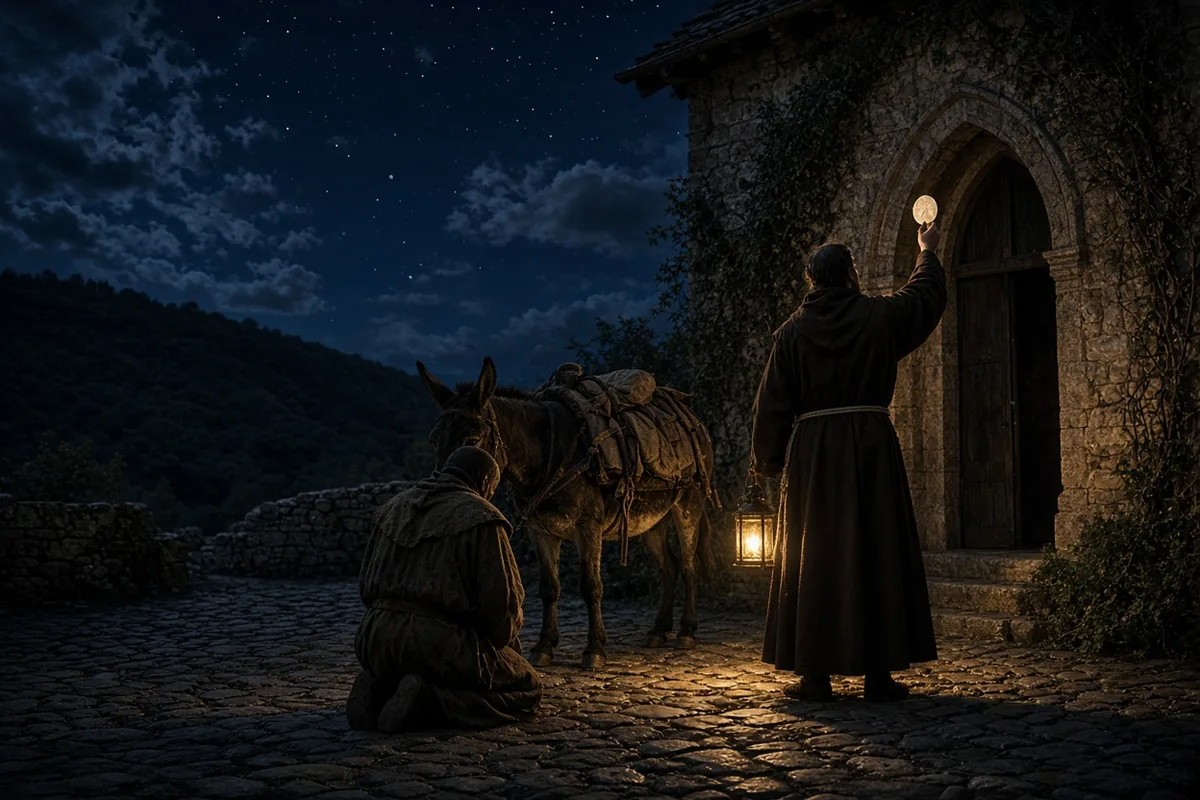
The mule took one step, then another. Its legs trembled. The heretic said nothing. The crowd had gone silent except for the sound of someone’s breath catching. The mule kept walking, past the hay, past the heretic’s hand that reached out once and fell back. It lowered its head when it reached the monstrance, then its knees buckled. The whole body folded until its muzzle nearly touched the stones.
A woman behind me cried out. The heretic stared at the kneeling animal as if he had never seen it before. Anthony remained still, holding the monstrance steady while the mule stayed down. One of the friars stepped forward and gently touched the animal’s shoulder. It did not rise.
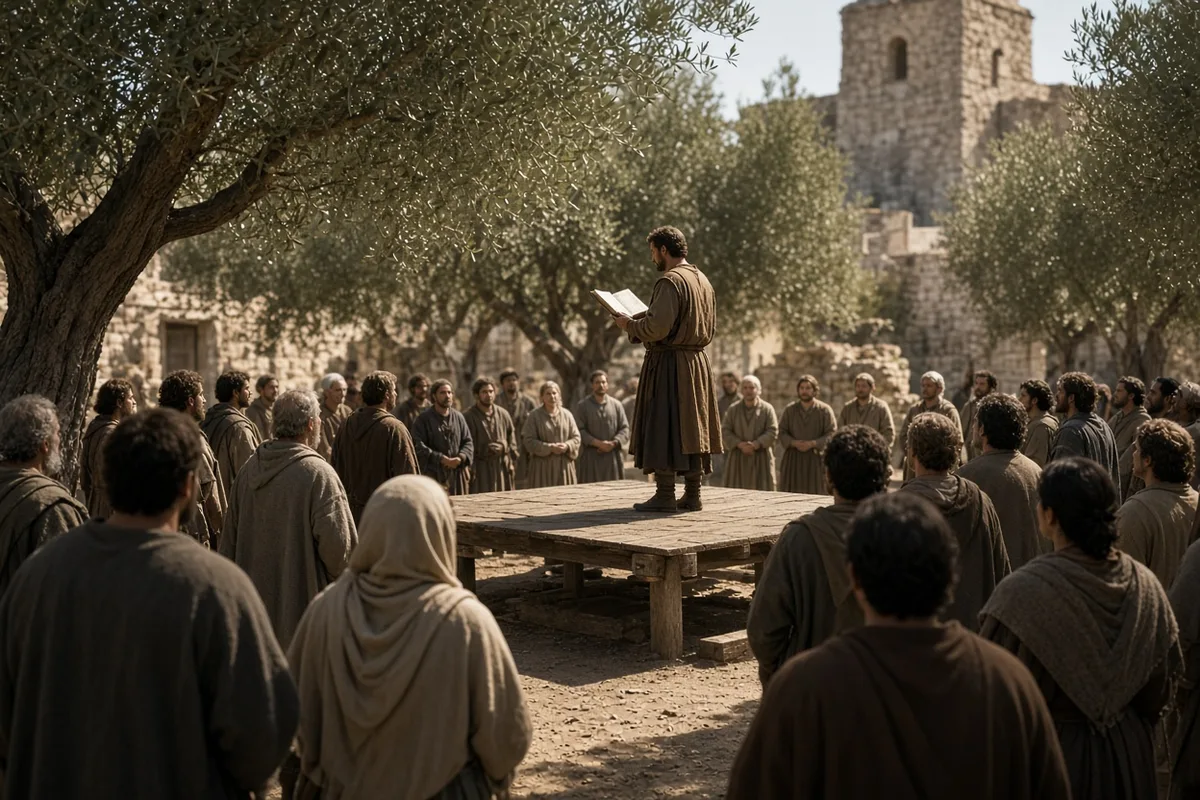
The heretic walked to Anthony then. He did not speak at once. When he did, the words were too quiet for most to hear, but the meaning traveled through the crowd anyway. He would make his confession. He would return to the Church. Several men who had stood near him during the earlier debates moved closer and said they would do the same. The mule finally stood, swaying a little, and one of the heretic’s men led it away toward water.
I stayed where I was while the square emptied in pieces. Some people lingered to speak with the friars. Others walked off already arguing about what they had seen. The heretic remained near the chapel door for a long time, his head bent, until Anthony came out again without the monstrance and placed a hand on his shoulder.
By evening the story had already changed hands twice in the taverns. The mule had knelt for an hour. The heretic had wept openly. The hay had turned to dust where it lay. None of those details mattered to the men who had been there. What stayed was the image of the animal choosing hunger over the thing it wanted most, and the silence that followed when it chose something else instead.
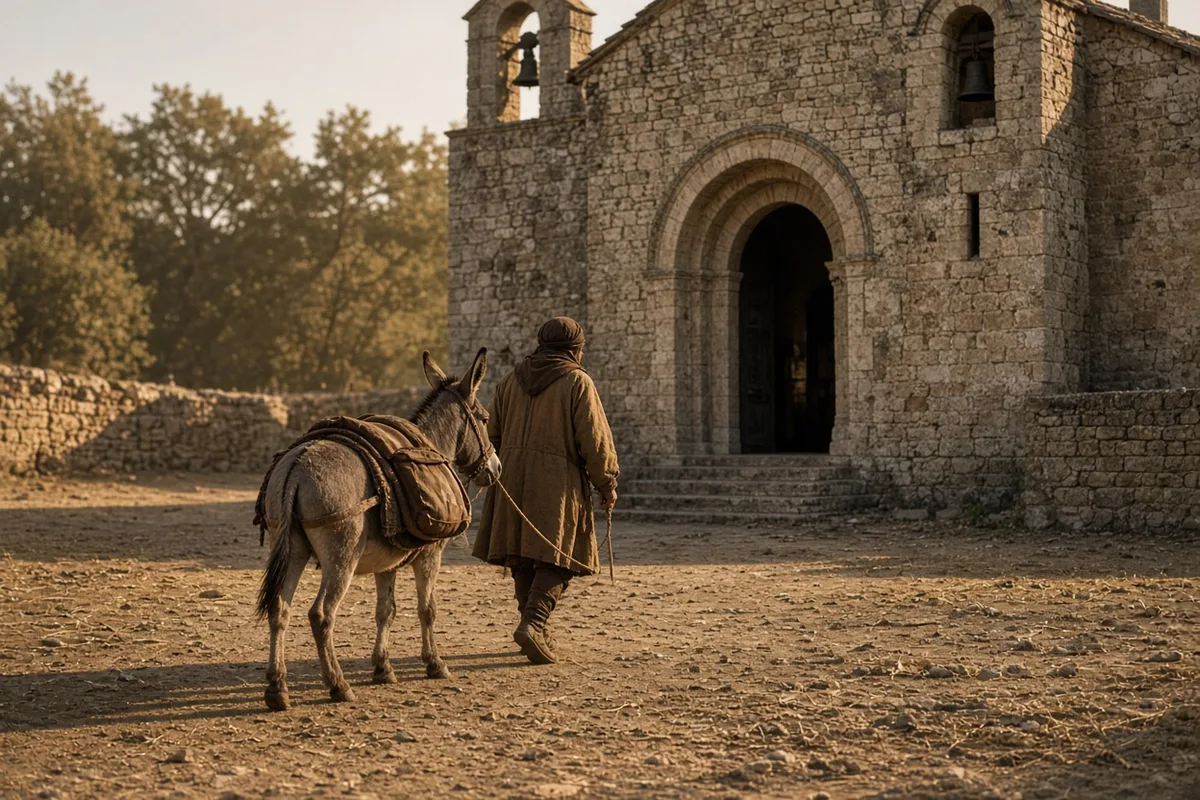
The heretic left Toulouse within the week. He took the mule with him. I never learned his name.
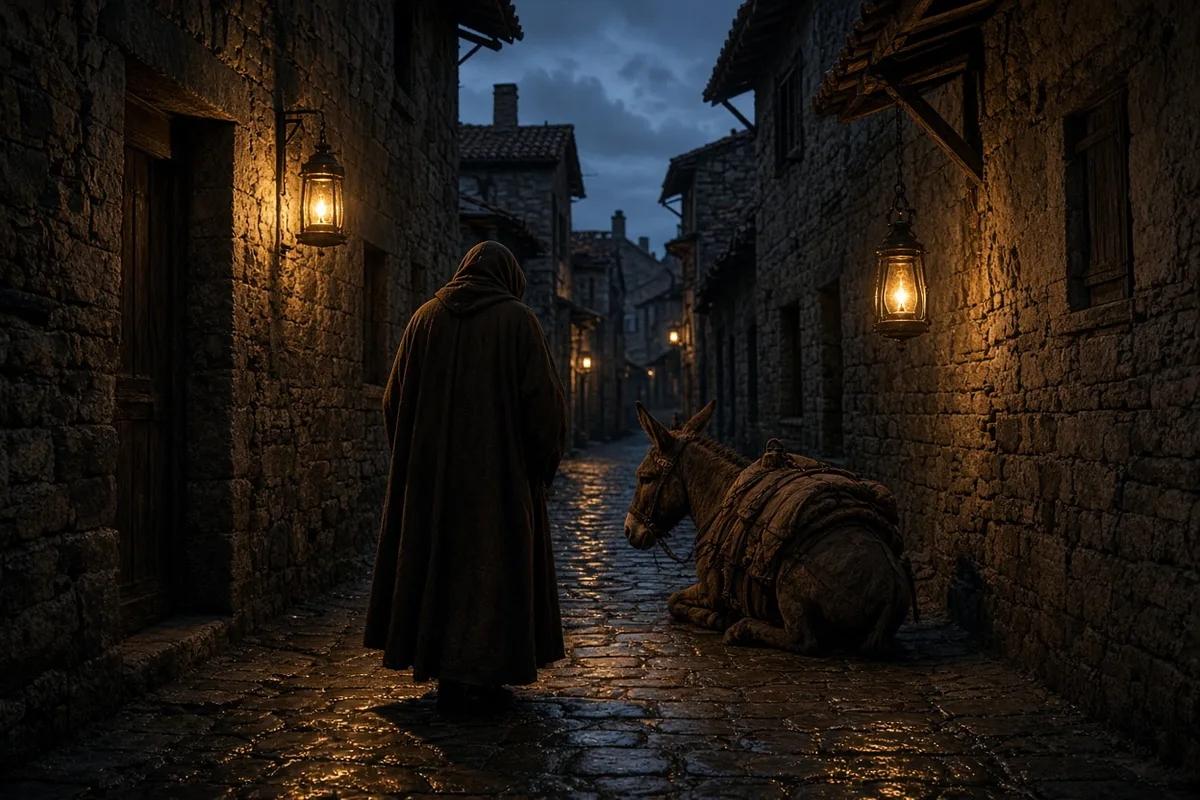
The heretic’s departure left a space along the rue de la Paille where the mule had been tied each morning for three days. A carter named Pierre de Cahors recorded in his ledger for the week of 17 June 1226 that the same animal, now fed oats and watered at the public trough near the Pont Neuf, was led south through the Porte Saint-Michel at first light on the following Monday. The heretic, still unnamed in the ledger, paid two deniers for a new halter and another four for bread and cheese wrapped in cloth. He spoke only once to the toll keeper, asking the distance to the next Franciscan house at Montauban. The keeper answered twenty-two leagues and noted the time as the bells of Saint-Sernin struck sext.
In the months that followed, the same mule appeared in the records of the convent at Limoges. Brother Giles of Assisi, writing on 4 October 1227, described a visitor who arrived with the animal and asked to speak with the prior about the form of the sacrament. The visitor stayed three nights, slept in the stable beside the mule, and left after attending Mass on the feast of Saint Luke. Giles wrote that the man’s hands trembled when he received the host, yet he did not refuse it. The mule was observed to kneel again, this time without command, when the prior carried the ciborium past the stable door at compline. No further entry appears for the visitor in the Limoges register after that date.
Anthony himself remained in Toulouse through the autumn of 1226. On the octave of All Saints he preached at the cathedral of Saint-Étienne, taking as his text the verse from Isaiah that begins “The ox knoweth his owner.” A notary named Bernard de Palhers counted 1,847 people inside the nave and another 312 standing in the square. Anthony spoke for two hours without notes. At the end he asked those who had witnessed the mule to come forward and sign a statement for the provincial minister. Seventeen men and nine women did so. Their names are preserved in a single folio now kept in the archives of the convent at Padua, folio 47 recto, under the heading “Testes Miraculi Tolosani.”
The story reached Rimini by the spring of 1227 through a merchant named Giovanni da Polenta who had been present in the square. He dictated an account to his parish priest on 3 May of that year, stating that the heretic’s name had been Bonvillo and that the man had returned to the Church at Bologna two months after leaving Toulouse. The priest added a marginal note that Bonvillo later became a lay brother at the convent of the Holy Cross and died there in 1234. The mule outlived him by one year and was buried in the garden behind the same convent, its grave marked by a stone slab carved with the single word “Fidelis.”
Anthony left France in 1228 and returned to Italy. On 13 June 1231 he died at Camposampiero near Padua. The process of canonization, opened the following year, included sworn testimony from five witnesses who had been in Toulouse on the day of the mule. One of them, a widow named Bertrande de Roquefort, stated under oath that she had stood twelve paces from the monstrance and had seen the mule’s knees touch the ground before Anthony spoke a second time. Her deposition is dated 29 May 1232 and is preserved in the Vatican Secret Archives, volume 14 of the canonization acts.

A chapel dedicated to the miracle was built in Toulouse in 1243 on the site of the original square. Its foundation stone bears the date 19 March and the names of three donors: the merchant Pierre de Cahors, the notary Bernard de Palhers, and a woman identified only as the widow of a converted heretic. The chapel stood until 1562, when it was pulled down during the wars of religion. Its stones were reused in the construction of the church of Saint-Pierre des Chartreux, where a side altar still carries a seventeenth-century painting showing the mule with its head lowered and a Latin inscription quoting Anthony’s words: “Mule, come here and show reverence to your Creator.”
The last person known to have claimed direct descent from one of the original witnesses died in 1897. She was Marie-Louise Bonvillo, aged eighty-four, living in a house on the rue Croix-Baragnon in Toulouse. On the morning of 11 February she asked to be taken to the altar in Saint-Pierre des Chartreux. She remained there for twenty minutes, then returned home and dictated a single sentence to her granddaughter: the mule had been gray, not brown, and its left ear had carried a notch from an earlier fight. She died that same evening.
Marie-Louise Bonvillo’s granddaughter, Jeanne-Marie Fabre, copied the dictated sentence into a notebook dated 12 February 1897 and deposited the notebook with the parish priest of Saint-Pierre des Chartreux, Father Henri Delmas, who entered it under the heading “Note sur la couleur de la mule” in the church register for that year. Jeanne-Marie lived until 1934 in the same house on the rue Croix-Baragnon and left the notebook to her daughter, who placed it in the municipal archives of Toulouse in 1952, where it occupies box 4M 218 alongside a photograph of the altar taken in 1892 showing the painting before its 1924 cleaning.
In 1903 the curé of Saint-Pierre des Chartreux, Father Delmas, commissioned a new frame for the painting after water damage from a leak in the transept roof; the carpenter’s bill, preserved in the parish ledger, records payment of 47 francs on 8 April for oak and gilding, and the frame still bears the original brass plaque engraved with the Latin inscription. A visitor from Padua, Father Luigi Battistella, examined the frame on 13 June 1911 and noted in his travel diary that the mule’s left ear notch matched the description given by Marie-Louise Bonvillo.
During the German occupation of Toulouse in 1942 the parish records were moved for safekeeping to the basement of the Hôtel d’Assézat, where an archivist named Marguerite Laborde catalogued the Bonvillo notebook on 22 October and assigned it the reference number 4M 218; her card index entry reads “témoignage oral 1897 sur la mule grise.” After the war the records returned to the church, and in 1958 the painting underwent restoration by the firm of Jean-Pierre Lacoste, who removed overpaint from the mule’s hindquarters and recorded the work in a report dated 17 September that listed seventeen square centimetres of new gesso.
On 13 June 1961 the Franciscan convent at Padua received a donation from the Toulouse diocese consisting of a certified copy of folio 47 recto and a photograph of the Saint-Pierre altar; the covering letter from Bishop Jean de Vézins is filed in the Paduan archives under “Doni 1961, busta 12.” The same year a descendant of Pierre de Cahors, a retired engineer named Robert de Cahors living at 14 rue Alsace-Lorraine, published a privately printed pamphlet of twelve pages titled “Notes sur le miracle de 1226,” in which he quoted the toll-keeper’s entry of two deniers for the halter.
The chapel site itself, now covered by the southern transept of Saint-Pierre des Chartreux, was excavated in 1978 during repairs to the heating system; the contractor, Société Garonne Bâtiment, uncovered three foundation stones bearing the date 19 March 1243 and the partial name “veuve de,” which were photographed and reburied beneath the new floor slab. A brass marker set into the floor on 2 October 1979 records the coordinates of the original square and the names of the three donors listed on the 1243 stone.
In 1994 the last direct descendant of Bernard de Palhers, a schoolteacher named Claire Palhers living in Montauban, donated her ancestor’s notarial ledger to the Archives départementales de la Haute-Garonne; the ledger contains the entry for 1,847 people inside the nave on the octave of All Saints 1226, written in Bernard’s hand with the marginal addition “et 312 dehors.” Claire Palhers died in 2017 at age ninety-one in a nursing home on the route de Lavaur, and her funeral notice in La Dépêche du Midi listed among her effects only the original notary’s seal, which passed to the departmental museum.
The painting at Saint-Pierre des Chartreux was last cleaned in March 2019 by restorer Émilie Fournel, who documented the removal of candle soot from the monstrance area and noted that the mule’s coat had been rendered in seven layers of gray wash, the darkest applied first; her report, filed with the Direction régionale des affaires culturelles, includes a digital scan showing the notch in the left ear as a single incised line 4 millimetres long. No further visitors claiming descent from the original witnesses have been recorded since Claire Palhers.