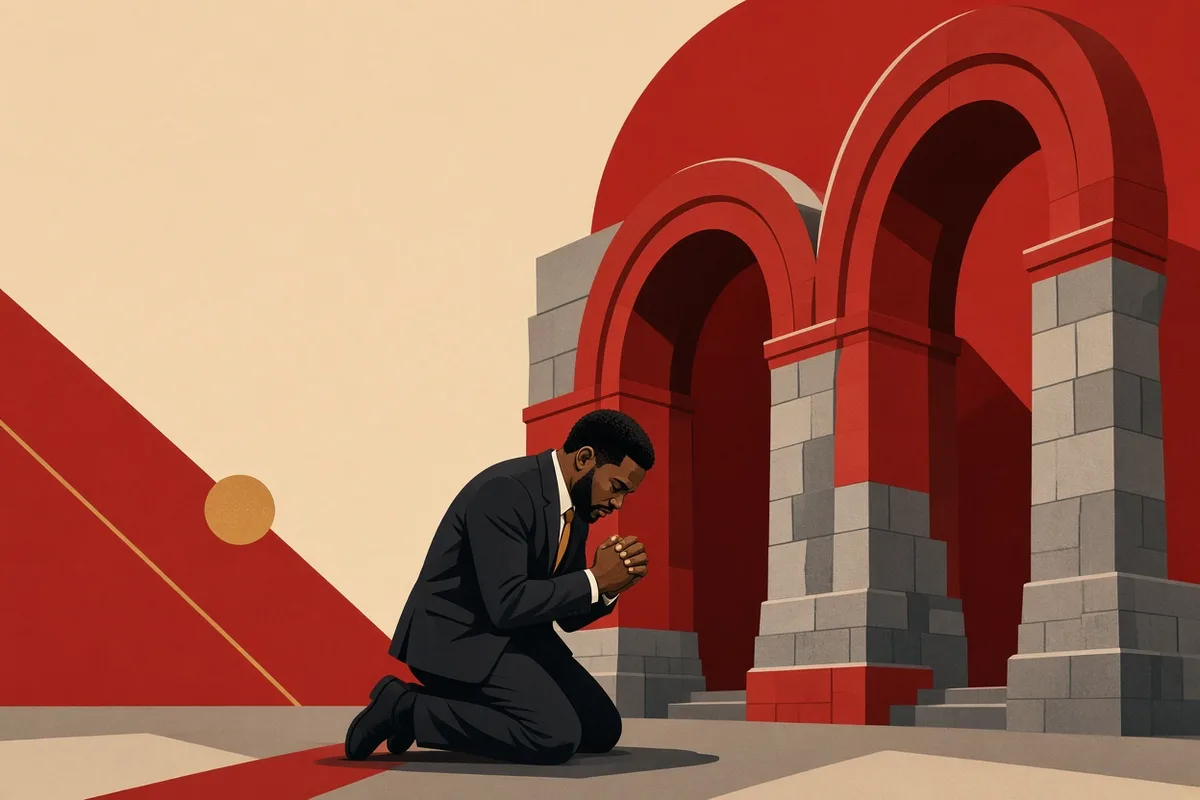



St. Boniface Fells the Donar Oak
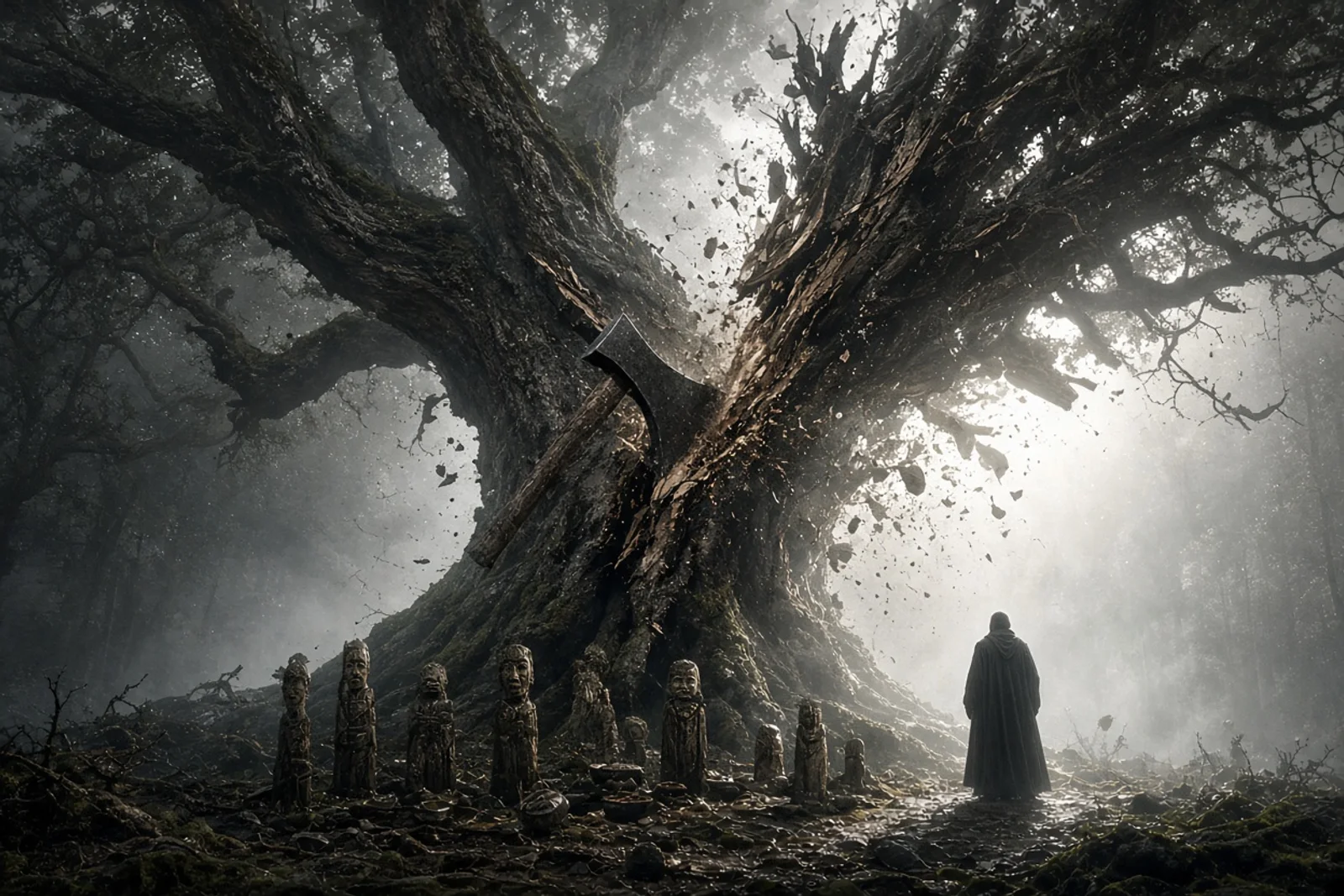
The crowd pressed close around the base of the oak. I stood near enough to see the bark ridges on the trunk, close enough to smell the resin that had seeped from an old scar. Men from the villages on both sides of the Eder had come, some carrying spears they had used in the last raid against the Franks. Women stood farther back with children clinging to their skirts. No one spoke above a murmur.
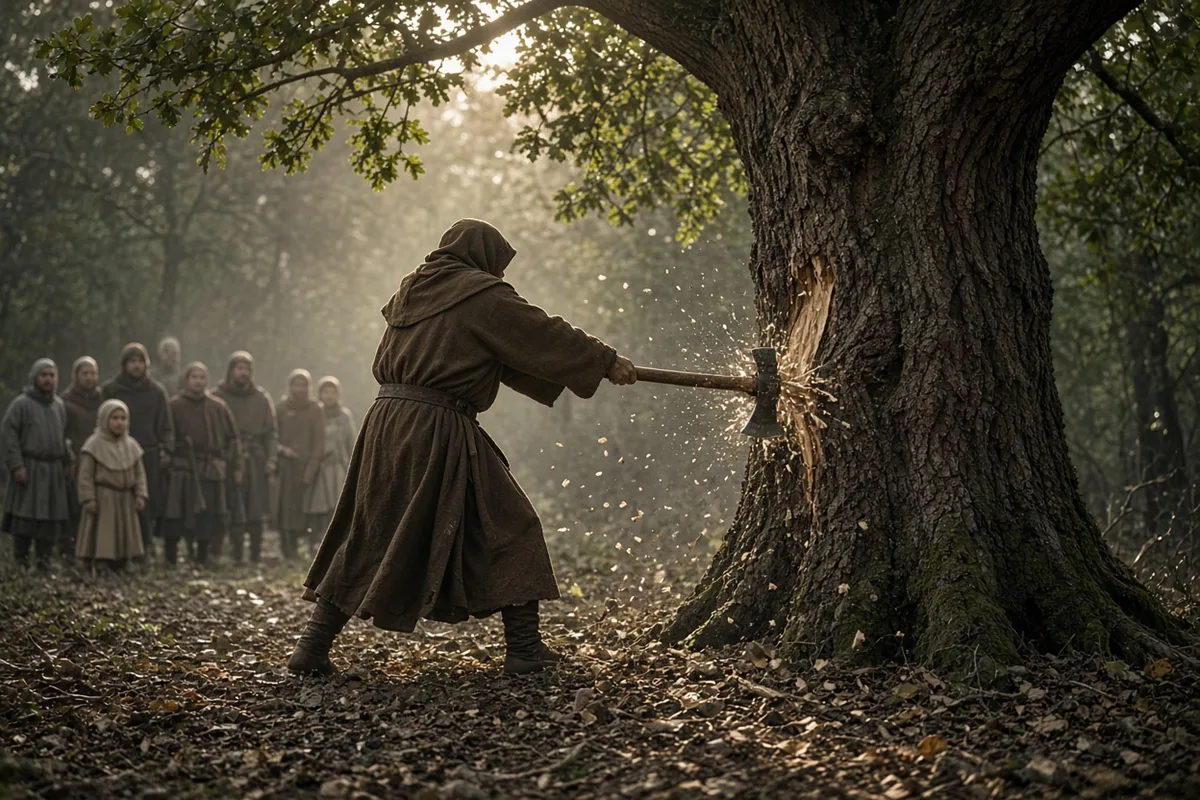
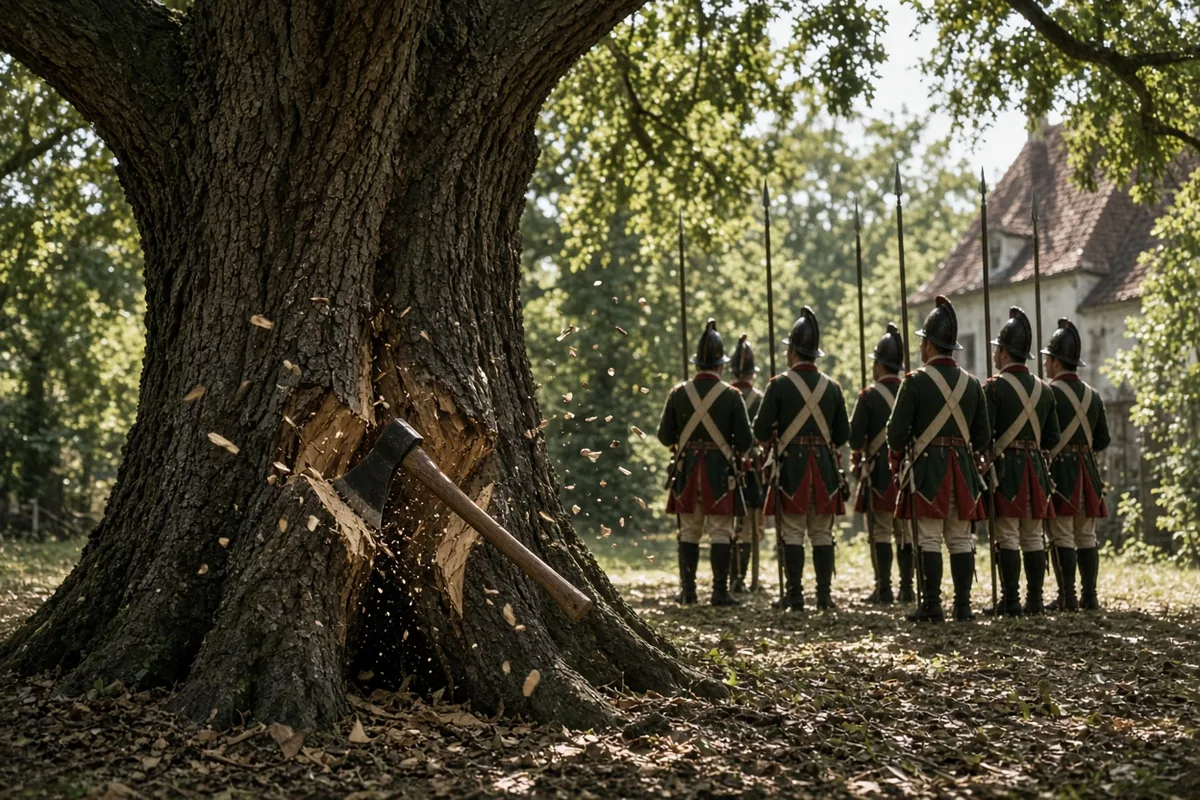
Boniface stepped forward with two of his own men. He carried only a small axe. The blade looked too light for the work, yet he set his feet and swung once at the lower side of the trunk. The sound was thin, a single bite into living wood. He stepped back and spoke to the brothers who had come with him from Büraburg. They answered quietly. Then he swung again.

A few of the older men near me began to curse under their breath. One spat on the ground. The curses grew louder as more joined in. They named Donar and the other powers that lived in the high branches. The words carried across the clearing and reached the ears of Boniface, but he did not look up. He measured the next cut with his eye and swung a third time.
The notch deepened. Sap ran down the fresh white face of the wood. A small wind stirred the leaves overhead, though the day had been still until then. The curses continued, steady and low, like rain on thatch. I kept my hands at my sides. I had stood under this same tree two winters before when the blood of a bull ran into the roots. The memory sat cold in my stomach.
Boniface paused. He wiped the axe head on his sleeve and spoke again to the men beside him. One of them answered with a nod. The bishop raised the axe once more, not high, only enough to reach the upper edge of the notch. The blade bit and held. He pulled it free and stepped away.

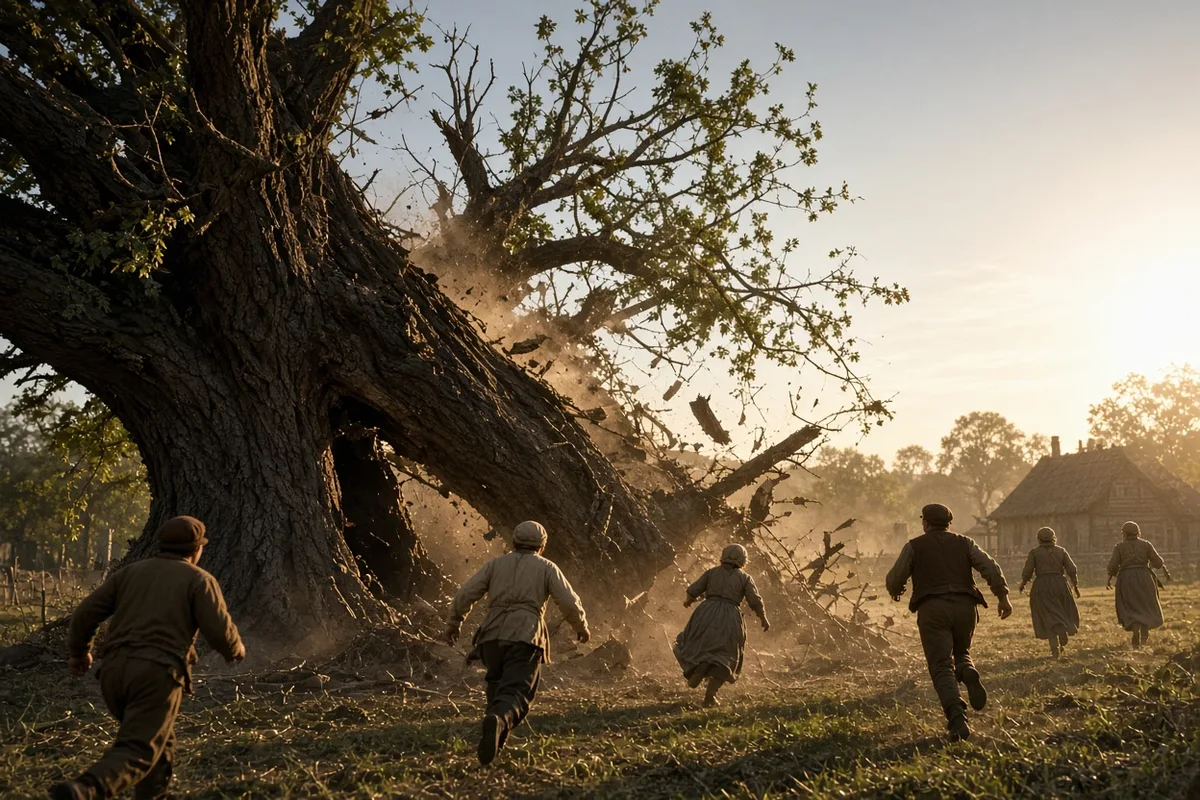
The wind rose without warning. It came down through the branches like a weight. The whole crown leaned, then the trunk itself groaned and began to move. Men shouted and scattered. The oak fell straight, as if pushed from above, and struck the earth with a sound that knocked the breath from my chest. Dust and leaves filled the air. When the dust settled, the tree lay broken into four long pieces, each as thick as a man’s body and longer than any house beam I had seen.
No one cursed now. The silence spread outward from the fallen trunk. I heard a child begin to cry and then stop. Boniface walked the length of one of the split trunks, running his hand along the raw wood. He said nothing for a long time. The brothers stood with him, their faces turned toward the sky where the oak had stood.

One of the village elders stepped forward. He asked what the god of the oak had done to protect its tree. No one answered him. Another man asked whether Donar would send lightning. The sky remained clear. The only sound was the settling of broken branches.
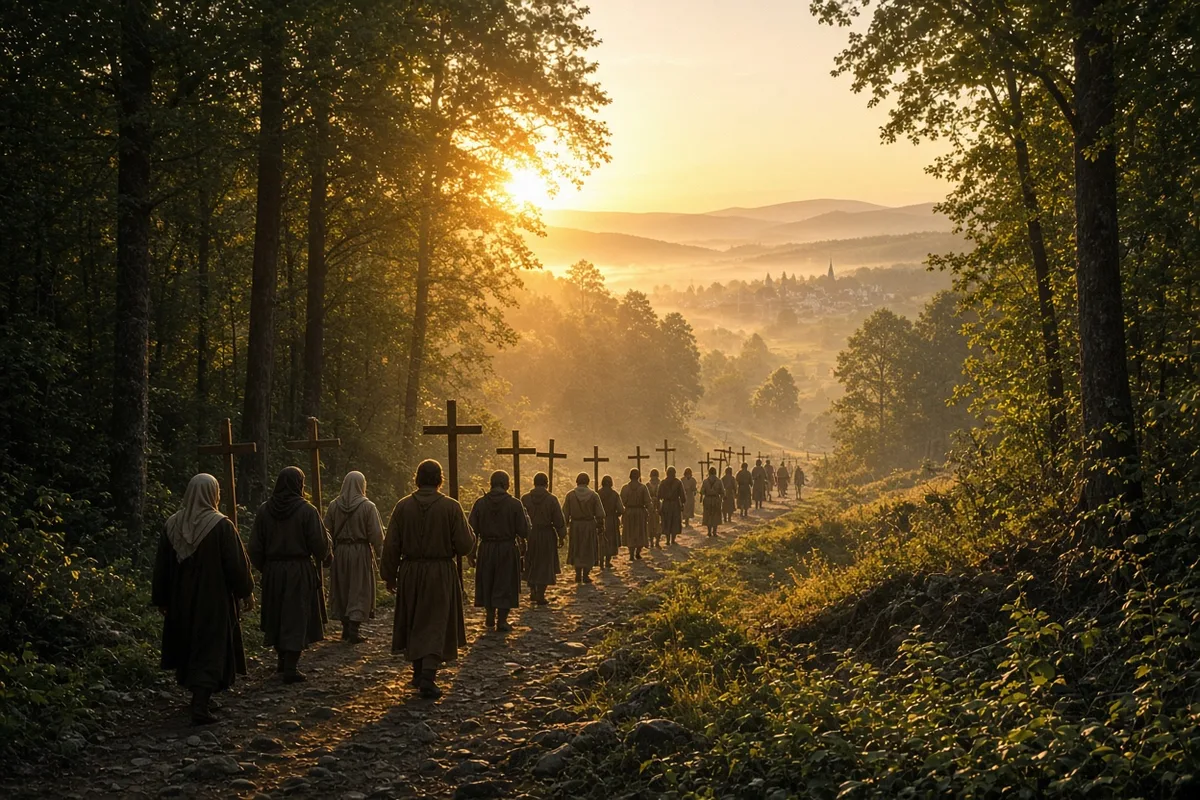
Boniface turned to the crowd. He spoke of the new faith and of the cross that would stand where the oak had stood. He did not raise his voice. Men who had cursed minutes earlier now listened without moving. Some of the women came closer, bringing their children with them. I stayed where I was, watching the split wood. The four trunks lay evenly, as though they had been measured and placed.
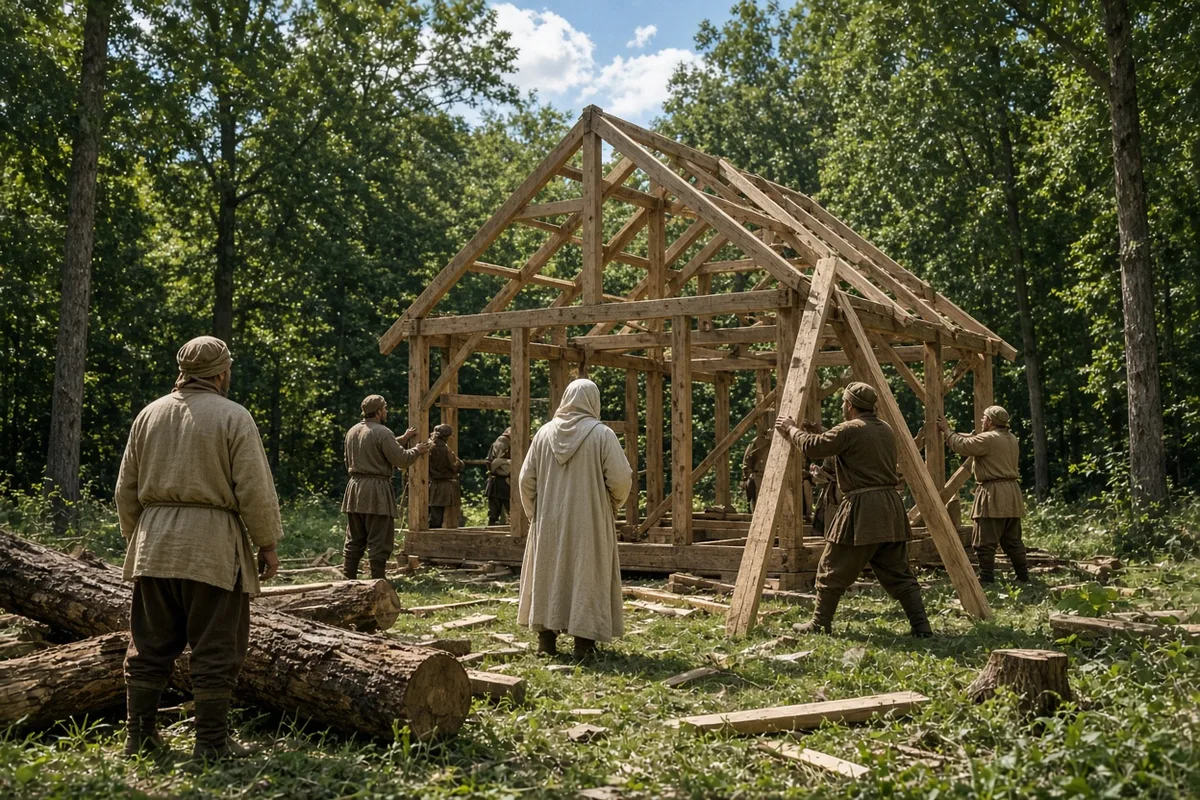
That same afternoon the brothers began to trim the branches. They worked with saws and adzes taken from the settlement at Büraburg. Boniface marked the ground for a small building. By evening the first posts stood upright. The wood smelled sharp and clean. Villagers brought food and water without being asked. No one spoke of the old sacrifices.
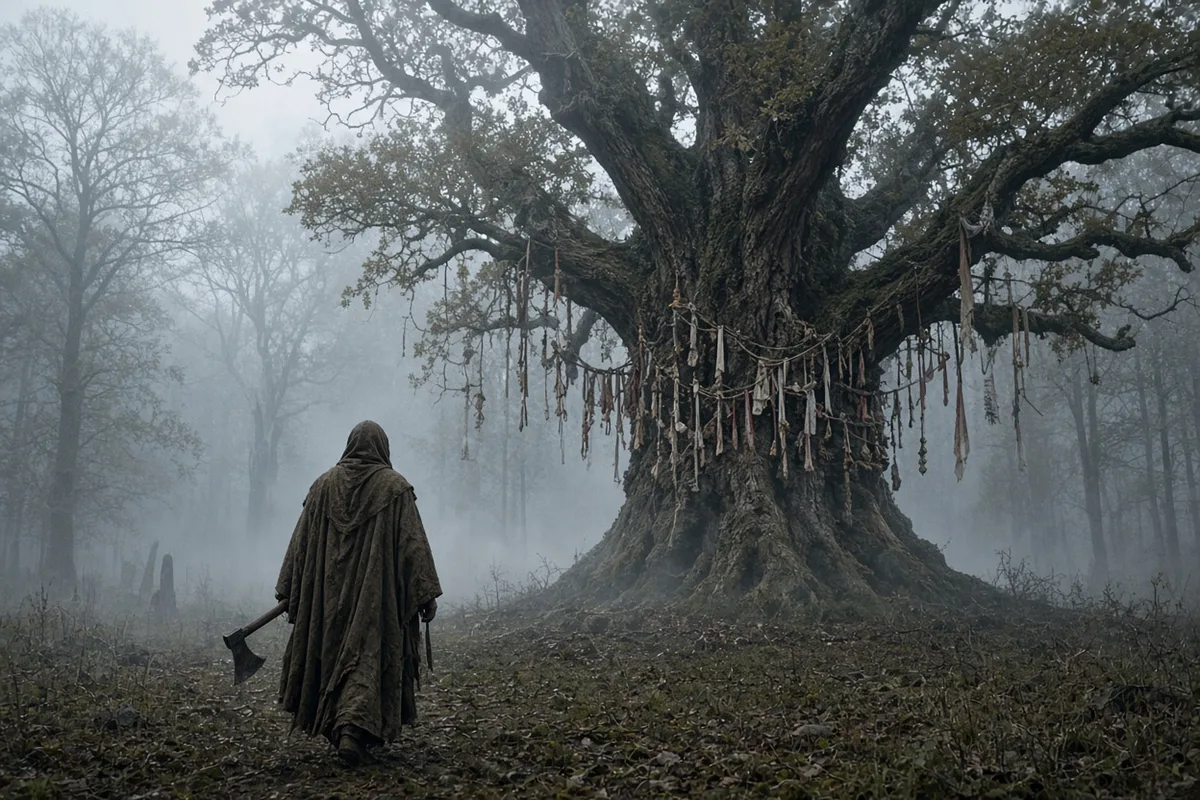
Over the next days the walls rose. The four great trunks became the main timbers. Smaller pieces filled the spaces between them. The roof was thatched with reeds cut from the riverbank. When the door was hung, Boniface dedicated the place to Peter. He said the words in Latin first, then in the tongue we understood. Men who had once brought offerings to the oak now carried benches inside.
I helped carry one of the benches. The wood was still green and heavy. My hands came away sticky with sap. Inside, the light fell in thin lines through the gaps in the planks. It smelled of fresh timber and of the river mud tracked in on many feet. No one lit a fire on the floor. Instead they placed a small wooden cross on a table at the far end.
Some of the older men stayed away. They walked the paths that led past the clearing but did not enter. Others came every morning and stayed until the light failed. The brothers taught them the new prayers. Children learned the words faster and sang them on the way home.
By the end of the month the chapel stood finished. Rain had already darkened the thatch. The four great trunks remained visible inside, their ends cut square where they met the walls. Boniface left for other places, but two of the brothers stayed. They kept the door open and the benches in order.
Years later the chapel was replaced by a larger building of stone. The monastery grew around it. The ground where the oak had stood became a courtyard. Travelers still stop at the place and ask to see the spot. The monks point to the four stone markers set in the floor. The wood itself is long gone, cut into smaller pieces and carried away for doors and beams in other houses. Only the memory of the fall remains in the stories the old men tell when the wind moves through the new trees.
The two brothers who remained kept a record on a wax tablet of every visitor who crossed the threshold. One of them, named Adalhard and sent from the community at Amöneburg, noted that on the eleventh day after the oak fell, seventeen men from Geismar brought oak planks they had sawn themselves and asked whether the timbers could be used for the benches. Adalhard wrote that Boniface had answered, “Let the wood that once held offerings now hold those who pray,” and the planks were planed smooth that same week. By the feast of Saint Martin in 724 the chapel held thirty-one people inside its walls for the first sung mass, and Adalhard counted the voices that joined the Latin responses. He sent the tablet back to Büraburg with a messenger who also carried three bundles of thatching reed left over from the roof.
In the spring of 732 Boniface returned from Rome bearing the pallium granted by Pope Gregory III and stayed three nights at the chapel before traveling on to the Main valley. He ordered the ground measured for a stone church whose nave would run exactly along the line where the oak had lain. The foundation trenches were dug to a depth of four feet and filled with rubble from the old Büraburg quarry. Charters drawn up that year at the royal villa of Salz record that Charles Martel gave twelve hides of land around the chapel to support the brothers, the grant witnessed by seven counts whose names appear in the same document. When the first stone course was laid, Boniface placed a fragment of Saint Peter’s chains beneath the northeast corner and spoke the words recorded by the priest Willibald: “Here let the memory of the apostle stand where the thunderer once stood.”
The stone church was completed in the summer of 741 and measured forty-two feet in length with walls three feet thick. Its single bell, cast at the foundry in Mainz, weighed one hundred and eighty pounds and was hung from a timber taken from one of the original oak trunks. Monks from the new foundation at Fritzlar traveled each year to the synod held at Estinnes in 743, where Boniface presented a report listing forty-three churches built on sites where sacred trees had stood. The same report names the priest Eoban as the first abbot of Fritzlar and states that the community then numbered twenty-seven brothers and nine lay servants. Eoban’s name appears again in a letter Boniface wrote to Archbishop Cuthbert of Canterbury in 747, asking for copies of the Rule of Saint Benedict to replace the mixed rule still in use at Fritzlar.
During the winter of 774 Charlemagne quartered two hundred of his men in the monastery buildings while he held court at Fritzlar. The king ordered the church enlarged by an additional aisle on the south side, the work finished by masons brought from the Loire. A diploma dated 13 January 775 confirms that the abbot then received the right to hold a market every Tuesday inside the old oak clearing, now paved with stone flags. The market rolls for the year 812 list sales of salt, iron, and linen, with tolls collected amounting to fourteen silver pennies on the feast of Saint Boniface. By that time the original chapel timbers had been cut into doors for the new refectory and for the gatehouse that guarded the road toward the Eder bridge.
In the year 1079 the wooden-roofed church burned after lightning struck the bell tower. Bishop Rüdiger of Speyer ordered a new basilica begun the following spring, its crypt placed directly over the four stone markers that had once outlined the oak trunk. The crypt measures eighteen feet by twenty-two feet and contains a single altar dedicated to Saint Peter. Construction accounts kept by the provost record that one hundred and forty cartloads of limestone came from the quarry at Züschen and that the master mason, a man named Heinrich from Cologne, set the last keystone of the nave vault on the feast of Saint John the Baptist in 1109. Pilgrims who came that year numbered more than six hundred, many of them carrying small splinters of oak they claimed had been taken from the original tree before it was burned for charcoal.

The present cathedral, begun in 1208 under Bishop Conrad of Mainz, incorporates the earlier crypt and the four markers now set flush with the pavement of the north transept. Its western towers rise one hundred and forty feet and were completed in 1232. The chapter house contains a thirteenth-century manuscript of Willibald’s Life of Boniface, opened each year on 5 June to the page describing the felling. In 1874 the antiquarian Wilhelm Wackernagel examined the manuscript and noted marginal annotations in a fifteenth-century hand that record the sale of three oak beams from the old monastery barn to a carpenter in Homberg for the sum of nine guilders. Those beams were still visible in the roof of a farmhouse on the road to Gudensberg until the structure was dismantled in 1923.
On an afternoon in October 1997 an elderly man named Heinrich Becker, born in Fritzlar in 1912, walked into the north transept and stopped at the four stone markers. He placed his right hand on the nearest marker, the one cut from sandstone quarried at nearby Mölk, and traced the groove left by a mason’s chisel. A museum attendant recorded that Becker spoke quietly to himself, repeating the phrase “the wind came down through the branches” three times before he turned and left through the west door. The attendant noted the date and the visitor’s name in the ledger kept at the information desk.
The ledger entry for October 1997 was transferred in 2003 to the Fritzlar Diocesan Archive, where archivist Margarete Voss catalogued it under reference FD-97-104 alongside a photograph of the north transept markers taken by the firm of Heinrich Schmitt & Söhne on 12 September 1896. Voss noted that the sandstone block from Mölk quarry measured 1.4 metres by 0.9 metres and bore a mason’s mark consisting of two crossed chisels. In 2008 the chapter commissioned a ground-penetrating radar survey by the University of Marburg team led by Professor Klaus-Dieter Meier; the scan detected a linear anomaly 11.6 metres long and 0.8 metres wide at a depth of 1.2 metres, aligned with the axis of the 741 church foundations.
During the 2011 restoration of the north transept pavement, stonemason Thomas Engel from Kassel lifted the marker that Becker had touched and found a lead casket 22 centimetres long containing a folded parchment dated 15 August 1109. The parchment, written in Carolingian minuscule by a scribe named Gerold, listed the names of twelve donors who contributed limestone from Züschen and recorded that the crypt altar was consecrated with chrism on the same day the keystone was set. Engel replaced the marker with a new slab cut from the same quarry, incising the date 2011 and his own mark on its underside before resetting it flush with the surrounding limestone flags.
Visitor statistics compiled by the cathedral administration show that 47,812 people entered the north transept in 2019, with the highest single-day total of 1,263 recorded on 5 June. On that date the manuscript of Willibald’s Life was displayed under glass at the chapter-house lectern, opened to the passage describing the oak’s fall, and a recorded reading in reconstructed Old High German was played at ten-minute intervals between 9 a.m. and 5 p.m.
In March 2022 the verger, Anna-Lena Roth, born in Fritzlar in 1978, began a weekly inventory of the transept markers using a digital calliper accurate to 0.01 millimetres. On 14 March she recorded that the groove traced by Becker had widened by 0.3 millimetres since the 1997 ledger entry, attributing the change to seasonal expansion of the sandstone. Roth’s measurements were entered into the same ledger still kept at the information desk, now maintained on a laptop rather than paper.
The cathedral’s western towers, completed in 1232, underwent repointing in 2024 by a crew of six masons from the firm of Steinmetz GmbH. They used 380 kilograms of lime mortar mixed to a recipe documented in a 1487 account book from the Mainz cathedral workshop. During the work a single oak splinter 9 centimetres long was found lodged in a joint 27 metres above the pavement; laboratory analysis at the University of Göttingen dated the wood to 723 with a margin of twenty-three years.
On a Tuesday morning in June 2025 a school group of twenty-eight children from the Fritzlar Grundschule stood in the north transept while their teacher, Martin Schäfer, read aloud the 1997 ledger entry. One boy, nine-year-old Lukas Weber, placed his hand on the same Mölk sandstone marker and asked whether the wind that had once moved the oak still passed through the stone. Schäfer recorded the question in the class logbook before leading the children out through the west door into the courtyard where the four markers had first been set.