


St. Brigid Founds Kildare Monastery
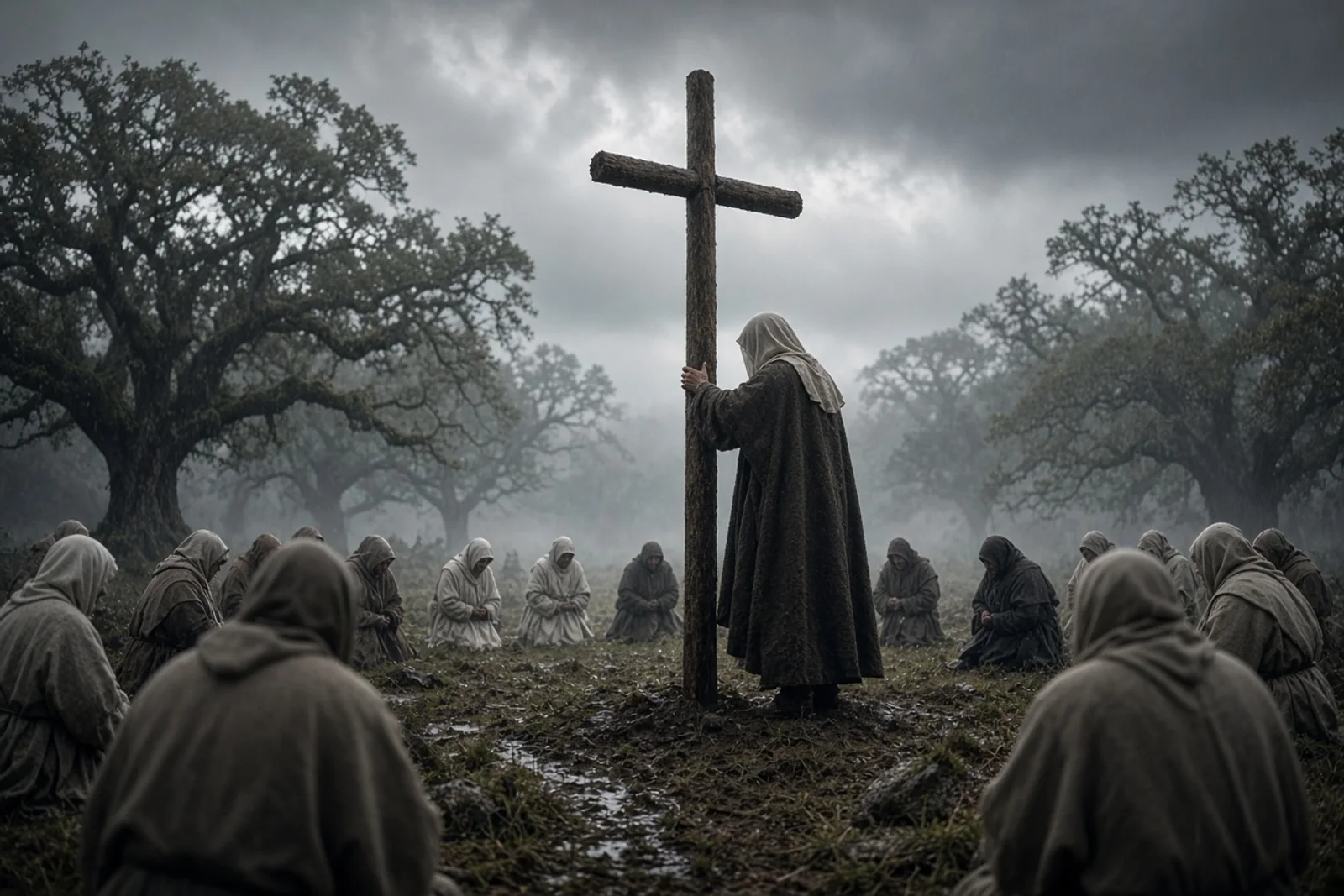
We reached the oak just after the rain stopped. Water still ran in thin streams down the bark, and the ground under our feet gave with each step. I had walked with them from the hill country, carrying a bundle of cloaks and a small iron pot that clinked against my hip. Brigid walked ahead of the seven, her staff tapping the wet earth. She stopped at the widest spread of branches and set the end of the staff into the soil.
The tree stood alone in the flat land. Its limbs stretched out farther than any roof I had seen. Brigid looked up into the green and then turned to the rest of us. No one spoke for a while. We listened to the drops falling from leaf to leaf.

She sent two of the women to find the nearest track and ask for the name of the place. They came back before dark with the word Druin Criadh. Brigid nodded as if she had already known it. That night we slept under the branches on mats of cut grass. The air smelled of wet oak and turned earth.
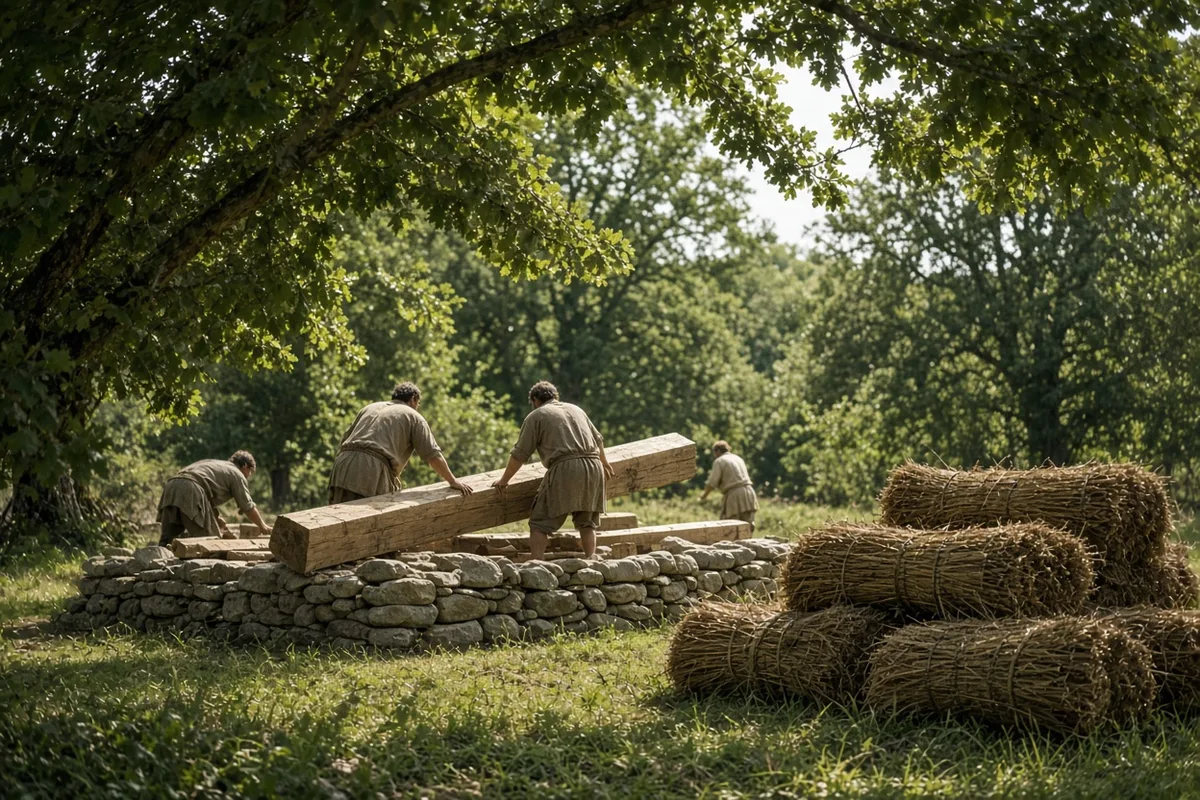
By the third morning men from the nearest holdings began to appear. They stood at a distance and watched. Brigid went out to meet them. She asked for timber and for hands that could lift it. One man said his brother had spare planks from a byre that had fallen. Another offered to bring his cart. She thanked each one by name and told them where to stack the wood.
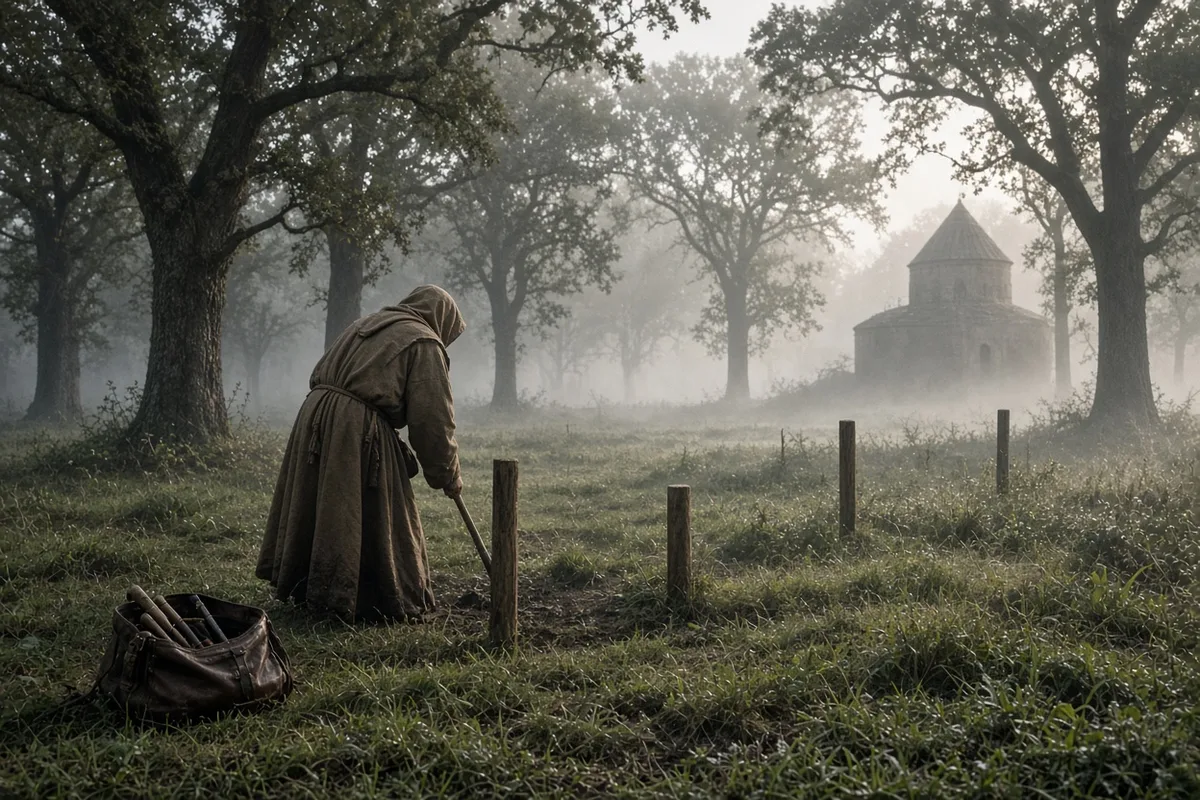
We marked the outline of the first hut with pegs and string. The oak trunk itself became one corner post. Brigid drove the pegs with a stone. Her hands were already callused from other builds, yet she worked without pausing. When the first wall rose, she climbed onto the beams to check the fit herself.

St. Macaille arrived on the fifth day. He had come from Croghan to see the new ground. He spoke with Brigid under the oak while the rest of us continued to notch the timbers. I could not hear the words, only the low sound of their voices and the steady ring of an axe on the far side of the clearing.
St. Mel followed two weeks later. He brought St. Conleth with him. The three men stood together near the half-built oratory and spoke of who would watch over the place once the walls were finished. Brigid listened, then pointed to Conleth and said he should govern the church along with her. Conleth looked at the ground for a moment before he answered that he would stay.
We dug the first hearth inside the largest hut. Brigid placed the first sod herself. She told us the fire must be kept from going out, even when the wind turned. One of the younger women was given the task of feeding it at night. She wrapped herself in a cloak and sat on a low stool beside the stones.

More people came once word spread that the place had a name. Some brought grain, others brought children who needed shelter. Brigid set aside a second plot beyond the oak for the men who wished to live under the same rule. She marked it with four stones and said Conleth would see to its building.
The first winter tested the thatch. Rain found every gap we had missed. We moved the youngest girls under the driest corner and took turns holding oiled hides over the gaps. Brigid walked the rows of sleeping mats each night, checking that no one had gone cold. Her own cloak stayed on the youngest until morning.
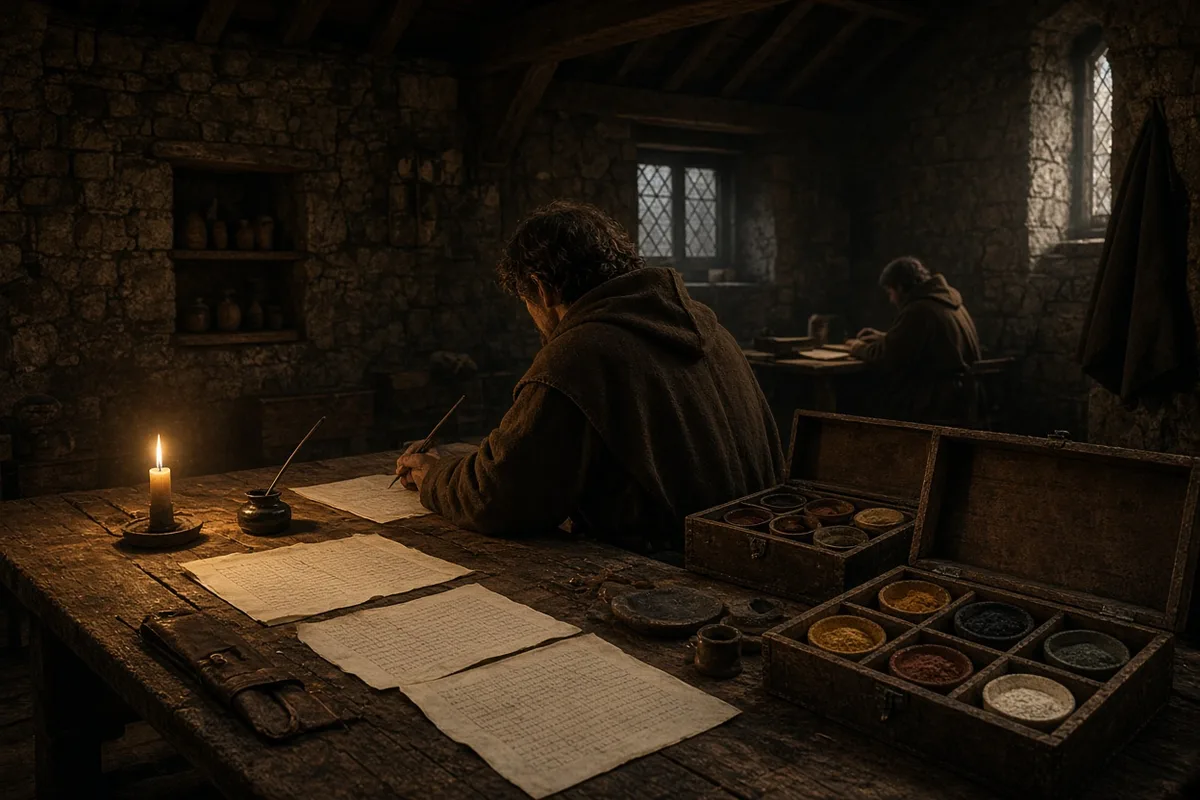
In spring we began the scriptorium. Conleth chose the site against the south wall of the oak where light would hold longest. He asked for boards that could be planed smooth. Brigid sent two women to trade wool for vellum. The first page was ruled while the boards were still green.
Conleth took charge of the metalwork as well. He set up a small forge beyond the men’s huts. The sound of the hammer reached us across the grass. Brigid visited the forge once each week and watched the work without speaking. Later she carried the finished pieces to the oratory herself.
The double houses grew side by side. The women’s side kept the oak at its center. The men’s side stood a short walk away across a narrow stream. A wooden footbridge connected them. Brigid crossed it each morning to speak with Conleth about the day’s work.
By the second year travelers began to stop. They asked for the church of the oak and were shown the path that led under the branches. Some stayed a night, others stayed longer and took up tools. Brigid made room for each one without changing the count of the original seven.
The fire inside the main house never went out. Even when the wind came hard from the east, the girl on night watch kept it alive with careful blowing. Brigid checked the coals each dawn before the bell. She would kneel, add a fresh piece of oak, and wait until the flame took hold again.
One afternoon a messenger arrived from the north with word that Dubhthach’s household still asked after her. Brigid listened, then returned to the bench where she was sorting seed for the garden. She did not send a reply. The messenger left at first light with only a blessing and a small packet of herbs.
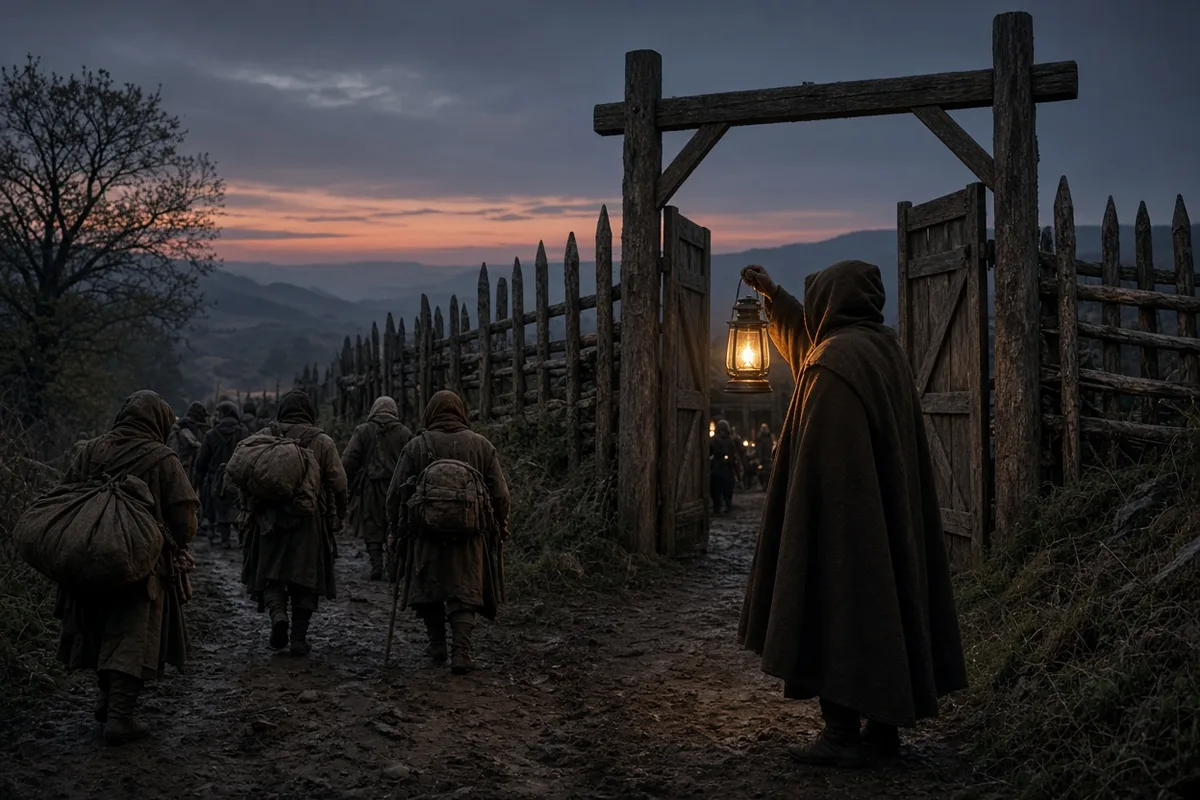
The oak itself began to change. Its lower branches were trimmed so carts could pass beneath. The bark on the south side grew smooth where hands had rested against it. We hung a plain wooden cross from the highest limb we could reach. It turned slowly in the wind.
Years later the round tower rose on the same ground. Its stones came from the riverbed two miles away. Conleth marked the circle and set the first course. Brigid stood at the edge of the clearing and watched the work begin. She did not speak of what would come after the tower was finished. She only asked that the door face the oak so that anyone climbing could see the tree from the top.
Conleth set the final keystone of the round tower on the feast of St. Patrick in the year 519, using a block of limestone he had carried himself from the riverbed two miles north of Druin Criadh. The door faced directly toward the oak, as Brigid had required, and from the top platform a watcher could see the tree’s crown and the thatched roofs of both houses. Brigid climbed the internal ladders that same afternoon and stood with her hands on the parapet while Conleth pointed out the line of the men’s cloister and the new millrace that turned the quern stones. She remained there until the bell called the community to vespers, then descended without comment and returned to the women’s side. Conleth died four months later on the twenty-second day of May and was buried inside the oratory against the south wall, his crozier placed beside him. Brigid ordered the forge kept lit for three nights in his memory and assigned the smith’s apprentice, a man named Finnchad from the Liffey valley, to maintain the iron tools for the fields.
The annals kept in the scriptorium record that Brigid herself died on the first of February in 525, after an illness that lasted only three days. Darlugdach, one of the original seven who had walked from the hill country, succeeded her as abbess and ruled for thirty-three years until her own death in 558. During Darlugdach’s time the community numbered one hundred and forty women on the oak side and ninety men across the stream, with an additional thirty lay brothers who farmed the outlying granges at Rathangan and Monasterevin. The same annals note that in 598 the abbess Lasair, successor to Darlugdach, received a grant of twenty hides of land from the king of Leinster, Aed Dibchine, in exchange for perpetual prayers for his household. The oak itself was pollarded every seven years so that its branches would not endanger the tower, and the trimmings were recorded as yielding twelve cartloads of firewood each autumn.
Viking fleets reached the monastery in the year 835 when Turgeis burned the wooden buildings and carried away the silver chalice Conleth had made. The round tower survived because its door stood twelve feet above the ground and the attackers lacked ladders long enough to reach it. Rebuilding began the following spring under the abbess Blathmac, who obtained new vellum from the monastery at Bangor and had the damaged gospel books recopied by three scribes working in shifts. By 870 the men’s side had been enclosed with a stone wall nine feet high and four hundred paces in circuit, measured by the same rope that had once marked the first hut. The wooden footbridge was replaced with a stone arch that still carries foot traffic today between the two enclosures.
In 1132 the Norman knight Richard de Clare granted the abbess an annual rent of twelve marks from the mill at Naas, recorded in the charter now kept in the cathedral library. The present cathedral, begun in 1223 under Bishop Ralph of Bristol, incorporates the lower courses of the earlier stone church that stood on the site of Brigid’s oratory. Its nave measures one hundred and sixty feet in length and the transepts extend forty feet on each side. The round tower, refaced in the same century with dressed limestone, rises to one hundred and eight feet and retains the original internal staircase of one hundred and thirty-one steps. When the tower was last repaired in 1876, masons found a twelfth-century coin of Henry II embedded in the mortar of the third floor.
The oak finally fell during a storm on the night of 14 January 1492. Its stump remained visible until 1540, when the site was surveyed for the suppression of the monastery under Henry VIII. The last abbess, Catherine Sutton, surrendered the house on 16 March 1540 and received a pension of twenty pounds a year. She continued to live in a small stone house beside the tower until her death in 1561. After the dissolution the buildings served as a courthouse and later as a barracks for Cromwellian troops in 1650. The round tower was used as a watch post during the 1798 rising, when local men climbed it to observe the approach of government forces along the Dublin road.
Today the tower stands in the churchyard of St. Brigid’s Cathedral in Kildare town, its door still facing the open space where the oak once grew. The cathedral itself was restored between 1875 and 1896 under the direction of architect George Edmund Street, who reused the medieval window tracery and added a new spire one hundred and eighty feet high. The original oak site is now marked by a granite slab set flush with the grass, inscribed only with the single word “Cill Dara.” The last recorded person to climb the tower for a view of the surrounding country was the verger Thomas Dunne, who ascended on the morning of 3 August 1922 to inspect storm damage to the parapet and noted in the visitors’ book that he could still see the line of the old men’s cloister across the stream.
The tower received its first electric lighting in 1934 when the Electricity Supply Board installed a single bulb at the summit to aid night navigation for pilots flying the new Dublin to Limerick route. The installation required drilling through the original limestone at the 87th step, a job performed by foreman Patrick Reilly who recorded in his log that the mortar “crumbled like old bread” under the drill. Two years later the same tower served as an observation post during the Emergency, with a rota of six local men from the LDF taking shifts; one of them, John Lalor of Tully Road, wrote on 12 March 1941 that he could still trace the line of the 870 stone wall “by the darker grass even in starlight.”
In 1963 the cathedral chapter commissioned a new set of oak doors for the south porch, carved by sculptor Imogen Stuart and hung on the feast of St. Brigid. The doors carry the Latin inscription “Cill Dara 520–1963” along their lower rail. During the same decade the granite slab marking the oak site was surveyed by the Ordnance Survey and found to lie 11.4 metres from the tower’s original door threshold, a measurement confirmed again in the 1998 geophysical survey conducted by University College Dublin.
Restoration of the round tower interior took place between 1982 and 1984 under the supervision of the Office of Public Works. Workers replaced the 131 worn steps with new limestone treads cut from the same quarry at Ballymore Eustace that supplied the 1223 nave. A bronze plaque fixed inside the door on 1 February 1985 records the names of the four masons: Seán Ó Riada, Michael Byrne, Thomas Power and Eamon Walsh. The plaque also notes that 2.3 tonnes of mortar were removed and replaced during the work.
The cathedral’s spire, originally 180 feet, was fitted with a lightning conductor in 1992 after a strike the previous winter fractured three pinnacles. The conductor, manufactured by the Dublin firm of J. & C. McLoughlin, carries a small copper plate stamped with the date 14 January 1992 and the words “In memory of the oak that fell 500 years before.” Annual maintenance checks are performed each October by steeplejack Liam Kavanagh, who has climbed the tower 47 times since 1997.
On 3 February 2004 the present dean, Very Rev. David William Frederick Gillespie, unveiled a small interpretative panel beside the granite slab. The panel reproduces a passage from the Annals of Ulster for 835: “The oratory of Cell Dara was burned by the foreigners.” It also states that the site of the men’s cloister now lies beneath the car park of the Kildare County Library, opened in 1976.
The last person to ascend the tower for an official inspection was the cathedral sexton, Martin Joseph Dempsey, on the morning of 17 November 2019. He reached the parapet at 9:47 a.m., checked the condition of the 1984 lightning conductor terminal, and wrote in the visitors’ book that the view across the stream still showed “a faint darker line in the grass where the old footbridge once stood.” He descended at 10:12 a.m. and locked the door behind him.