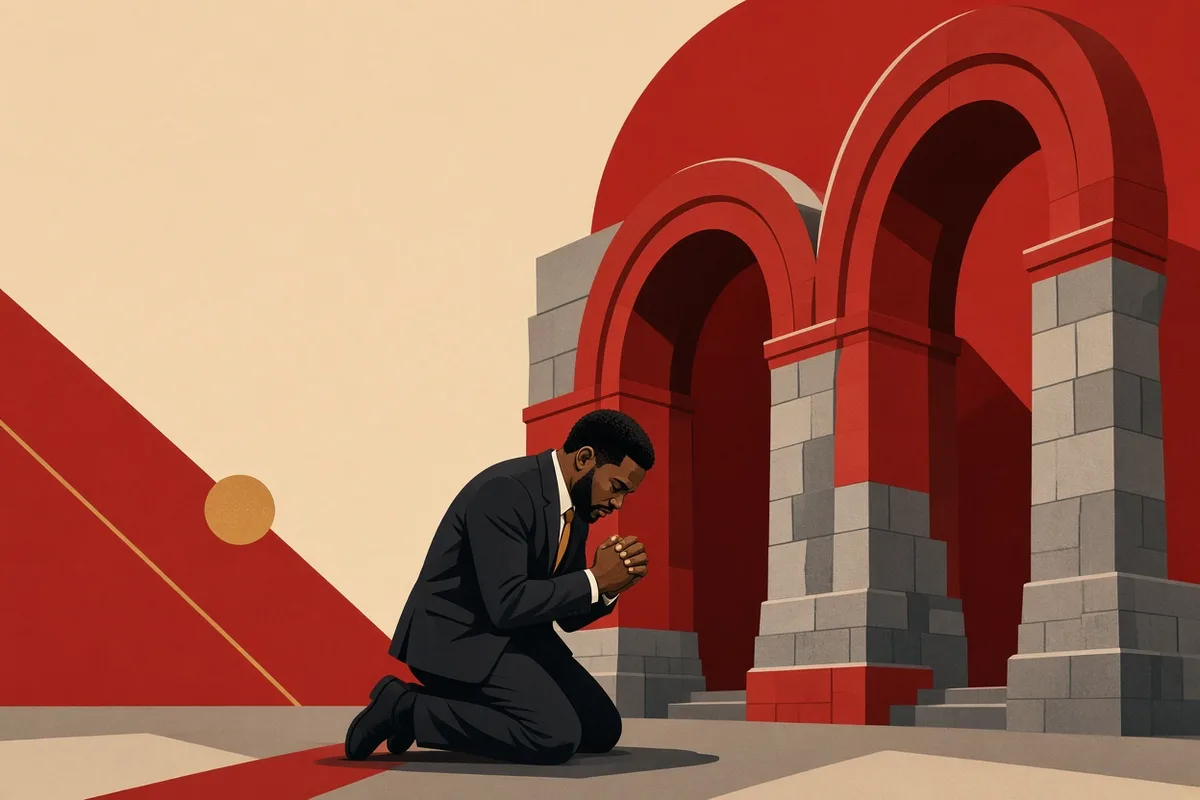



St. Clare Defends Assisi with the Eucharist

The bell rope slapped against the wall as I hauled it twice, the sound thin in the empty cloister. We had heard the horns from the ridge at dawn. Now the clatter of hooves on the lower path told us the men were already inside the outer wall.
Sister Agnes ran past me with a basket of bread she had no time to hide. Her face was the color of new cheese. I dropped the rope and followed her toward the dormitory where Clare lay on the straw mat. The air inside smelled of wet wool and the vinegar we used on her sores.

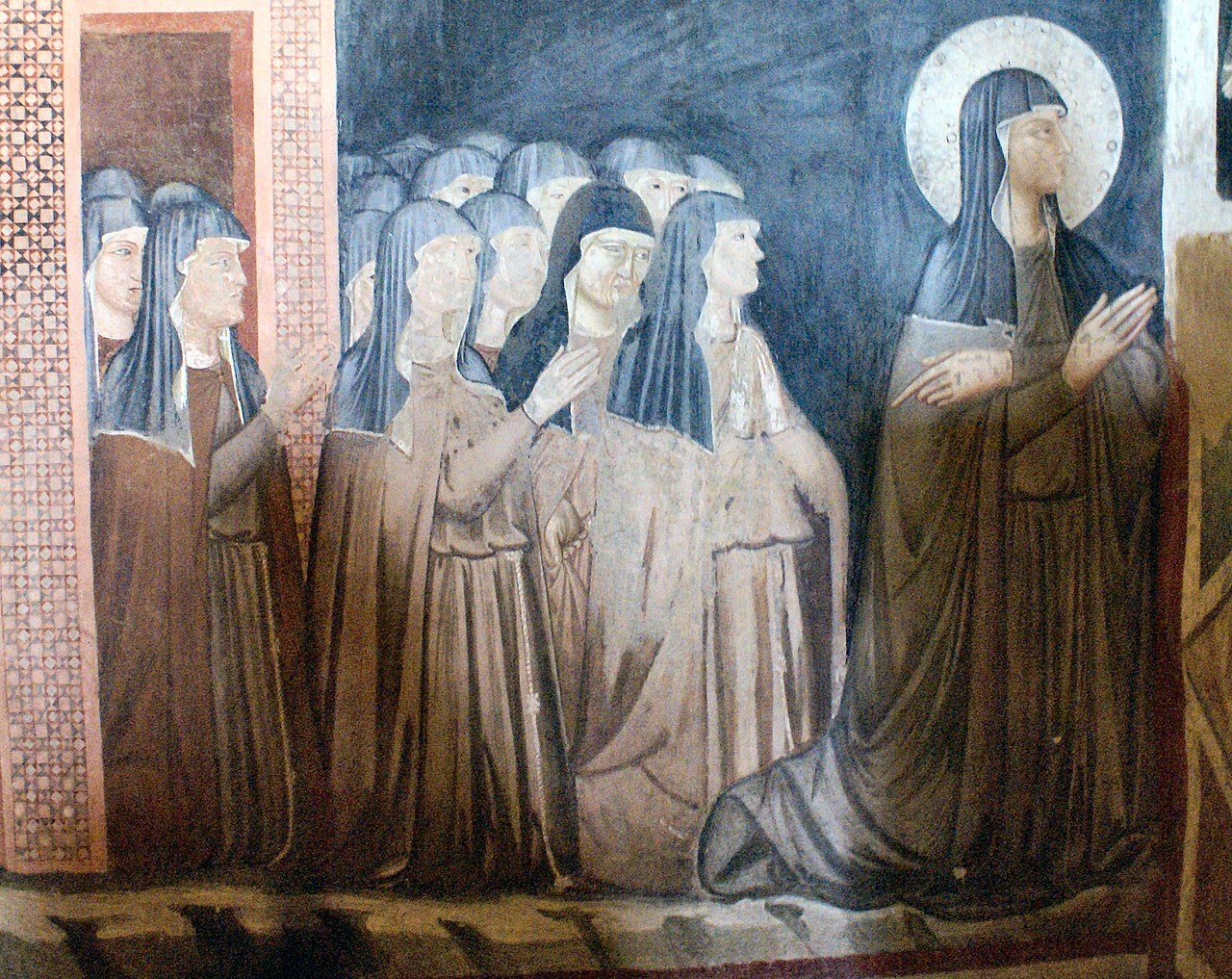
Clare’s eyes were open when we reached her. She lifted her head without help. “Bring the case,” she said. Her voice was steady, the same tone she used when she asked for water at night. Two sisters lifted the silver and ivory box from its niche above the altar. The chain at its corners clinked once.
They carried Clare on the pallet. I walked beside it, one hand steadying the edge so it would not tip on the uneven stones. The box rode on the knees of the sister in front. Sunlight struck the metal and threw a white patch across Clare’s blanket.
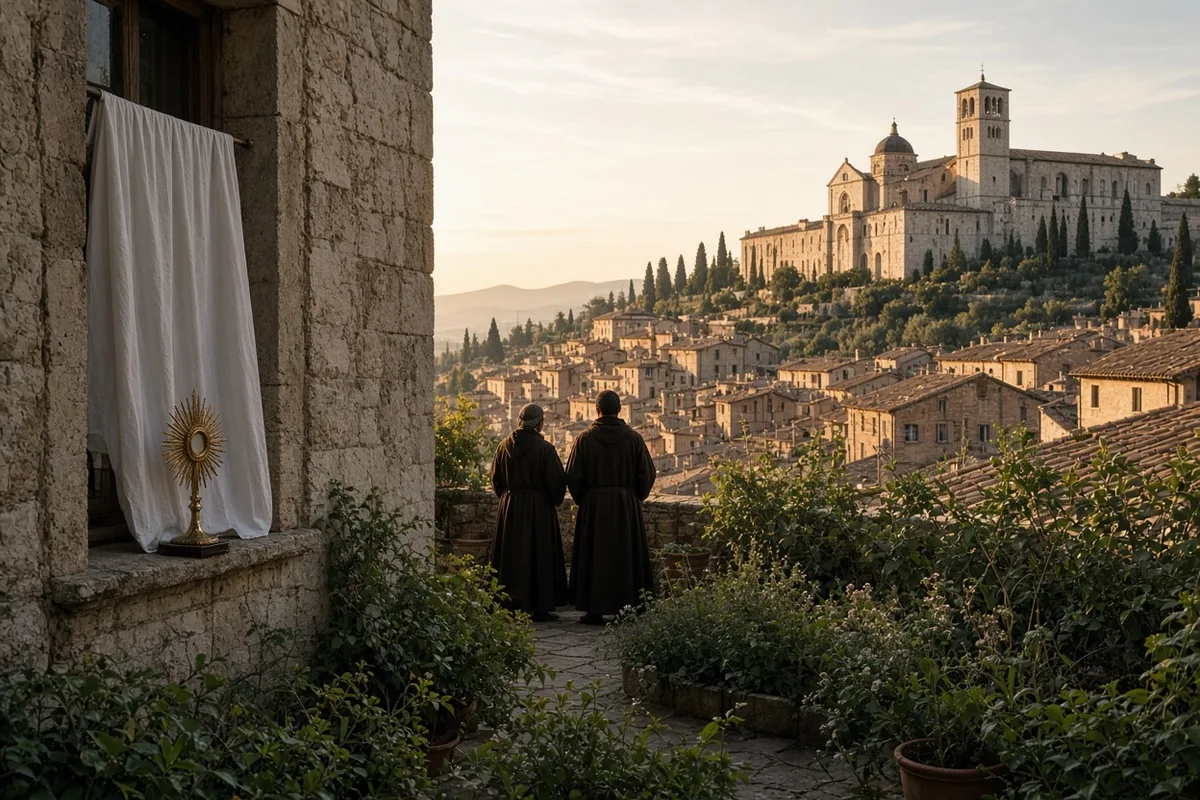
At the dormitory door the view opened onto the cloister garden and the low wall beyond it. The first soldiers were already over that wall. Their boots crushed the rosemary border. One of them laughed when he saw us, a short bark that carried across the open space.
Clare sat upright on the pallet. The sisters set the case on the ground in front of her. She reached for it with both hands. The effort made her arms shake, but she raised the monstrance until the Host inside caught the light. The soldiers stopped moving. One lowered his bow. Another took a step back and slipped on the wet stones.

A child’s voice came from inside the case. It was small and clear, the way a boy speaks when he answers from the other side of a door. I heard the words “I will always protect you.” Clare’s mouth did not move. The sound came from the metal itself.
She spoke then, still holding the monstrance level with her eyes. “If it is Your wish, protect also this city.” The answer that followed was the same voice, softer now. It said the city would know trials but would be kept. The soldiers heard it. I saw one cross himself before he turned and ran for the wall.
Clare lowered the monstrance. She looked at us, the sisters gathered around the pallet. “You will suffer no evil,” she said. “Only have faith in Christ.” Her hands were steady again. The soldiers reached the wall and began to climb. Their mail rang against the stones. Within moments the last of them dropped out of sight on the far side.
We stayed where we were until the sound of their retreat faded down the path. The rosemary was trampled flat. A single arrow lay in the dirt near the well. Clare asked to be taken back inside. The sisters lifted the pallet. I carried the case this time. Its weight pressed the chain into my shoulder.
That night the city gates stayed shut. We heard later that the same troops had turned away from Assisi itself and moved toward Spoleto. No one from the convent went out for three days. Clare kept to her mat but would not let us speak of the voice while she lived. We kept the rule.
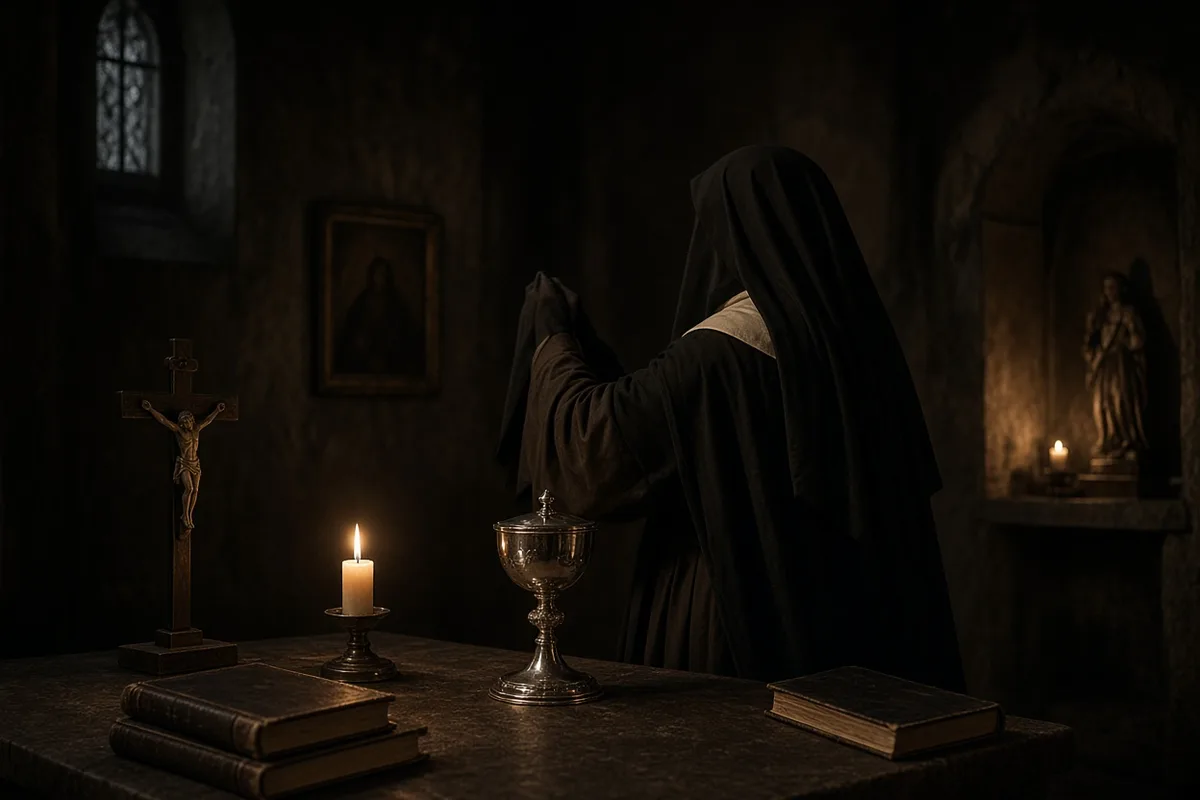
Years after, when the sisters who had been there began to die, the story traveled anyway. Painters put the monstrance in her hands and showed the soldiers falling back. The silver case still sits in the same niche. On certain mornings the light strikes it the way it did that day, and the reflection moves across the floor exactly as far as the first rosemary plant before it stops.
The rosemary plants never grew back in that same spot after the boots crushed them, though Sister Pacifica tried replanting slips from the cuttings she kept in the infirmary pots. Clare lived another thirteen years in the same cell at San Damiano, rising each night for Matins until the sores on her legs kept her on the mat after the feast of Saint Martin in 1252. On the twenty-third of September that year Pope Innocent IV came down from Perugia with his retinue of twelve cardinals and stayed three days in the guest house outside the gate. He sat beside her mat and asked whether she wished any privilege for the Order, and she answered, “I desire only that the privilege of poverty be confirmed for us,” the same words she had spoken to Cardinal Hugolino twenty-nine years earlier when the Rule was first approved. The pope granted it in the bull Solet annuere on the ninth of August 1253, exactly two days before she died.
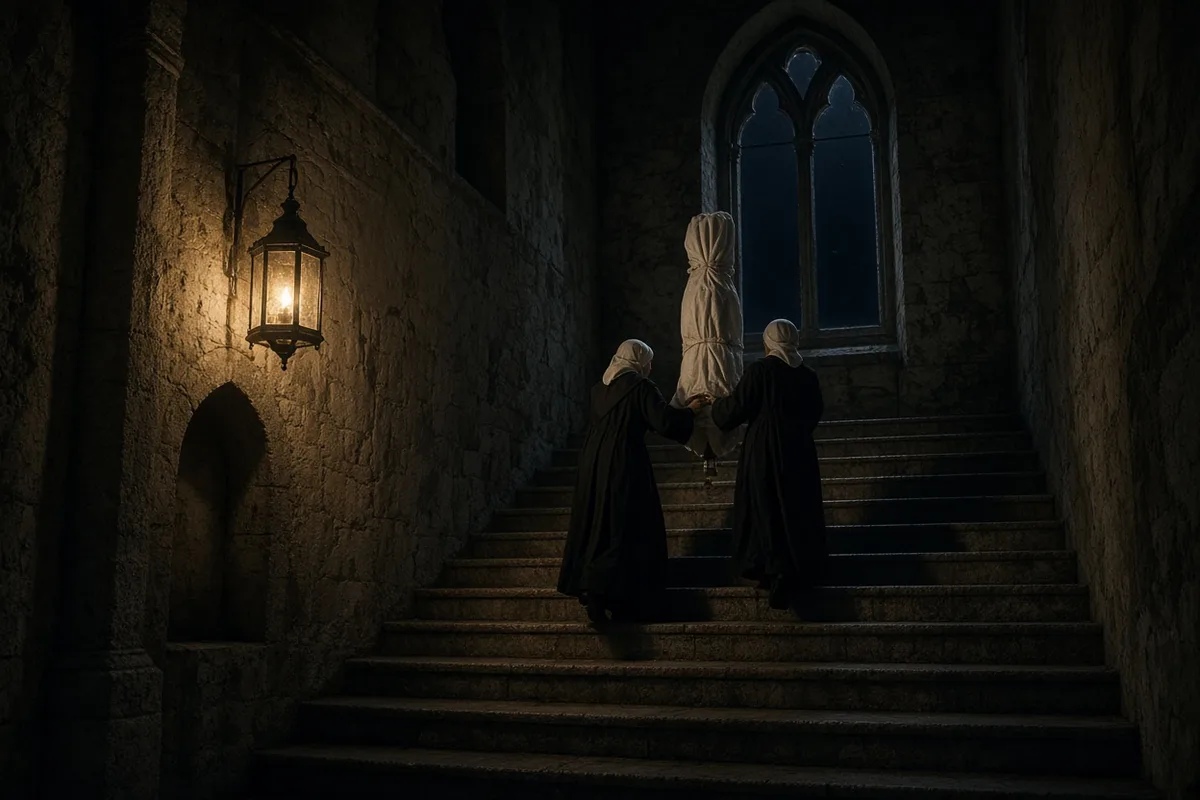
Her body was carried from San Damiano to the church of San Giorgio on the twelfth, the same day the sisters counted one hundred and eleven who walked in the procession behind the bier. Brother Thomas of Celano, who had known her since 1228, wrote in the Vita Sanctae Clarae that her face remained unchanged for three days and that the people of Assisi placed olive branches on the coffin while the canons of the cathedral sang the office. She was buried beneath the high altar there until the new basilica began to rise on the slope below the Porta Nuova. On the second of October 1255 Pope Alexander IV issued the bull Gloria in excelsis, naming her a saint after examining the sworn testimony of twenty-two witnesses, among them Sister Agnes of Assisi, Sister Benvenuta of Perugia, and the knight Monaldo who had ridden with the troops that day in 1240. The bull listed thirty-six miracles, including the healing of a blind girl from Spoleto on the feast of Saint Clare in 1254 and the recovery of a drowned child pulled from the Chiascio river whose mother had invoked Clare’s name.
Construction of the basilica and the new monastery started in 1257 under the direction of Filippo da Campello, the same architect who had worked on the lower church at San Francesco. The sisters moved into the new enclosure on the twenty-third of October 1260, carrying the silver and ivory case with them in a procession led by Bishop Rufino. The case was placed in a niche behind the grille of the new choir, and the original monstrance used at San Damiano remained there until 1350, when it was taken to the sacristy after a fire damaged the wooden reredos. In 1496 the case was opened by order of the podestà of Assisi, Jacopo di Ser Andrea, and the inventory recorded two corporals, one embroidered with the arms of the Fiumi family, and a fragment of the veil Clare had worn at her clothing in 1212. The document, still kept in the communal archive, lists the names of the six sisters present at the opening: Sister Caterina da Perugia, Sister Margherita di Messer Ugo, and four others whose surnames are lost.
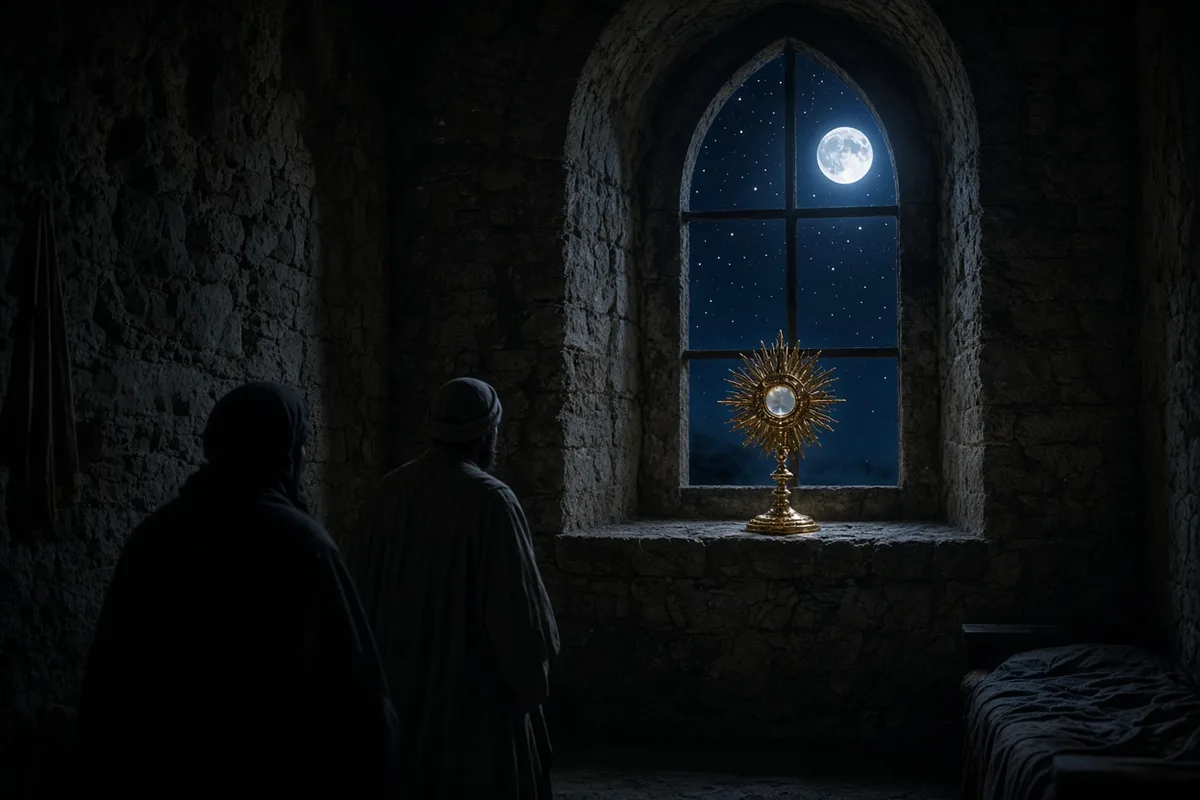
During the war between the Guelphs and Ghibellines in 1319 the city gates were closed for eleven weeks while troops under Cante de’ Gabrielli camped on the plain below. The sisters heard the same horns they had heard in 1240, yet no one entered the monastery grounds. In 1348 the plague reached Assisi on the twenty-ninth of May; thirty-seven sisters died between then and September, leaving only nine in the enclosure. Sister Bartolomea, the last survivor of the original community, dictated her recollection of the voice from the monstrance to the notary Giovanni di Bonaventura on the fourteenth of March 1352, two months before her own death at the age of eighty-four. The notary’s record quotes her as saying the words were “clear as a boy calling across water” and that she had stood three paces from the pallet when they were spoken.
The silver case was moved again in 1560 when the choir was enlarged under the abbess Maria Maddalena di Serafino. It now rests in the same niche, though the chain has been replaced twice, once in 1623 with links forged in the workshop of Maestro Pietro di Assisi and again in 1798 after French troops under General Berthier removed the original silver for coinage. The replacement chain, still in place, weighs nine ounces and carries the mark of the papal assayer in Rome. On the twenty-fifth of June 1870 the Italian government suppressed the monastery for six months; the sisters were allowed to remain after the mayor of Assisi, Luigi Bruschi, petitioned the prefecture in Perugia, citing the uninterrupted presence of the community since 1212. The last abbess before the suppression, Mother Teresa of the Sacred Heart, recorded in the house chronicle that the light still reached the first rosemary plant each morning of the octave of the Assumption.
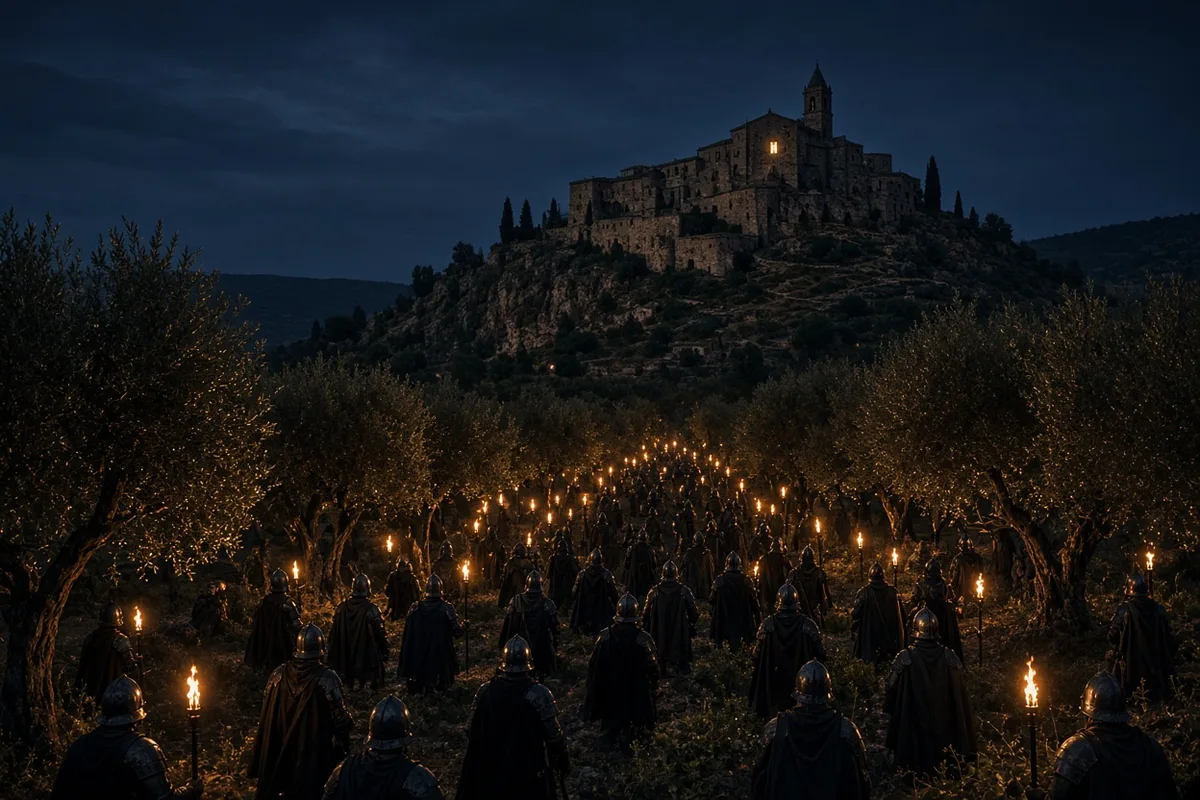
Today the enclosure wall stands at the same height it reached in 1260, its stones never reset except for the section repaired after the earthquake of 1997. The present abbess, Mother Chiara of the Holy Cross, enters the choir each morning at five and passes the niche where the case rests. On the twenty-seventh of March 2023 she was the last person to open the grille for the annual inspection by the bishop’s delegate, Monsignor Paolo Gentile, who counted the same two corporals listed in 1496 and noted that the light from the east window still falls exactly to the line where the rosemary once grew. She closed the grille again at six minutes past ten that morning, the final human hand to touch the lock before the next feast.
The bishop’s delegate signed the inspection ledger at the foot of the page numbered 47 in the current volume, noting the date in his own hand as required by the 1983 Code of Canon Law for enclosed communities. Mother Chiara returned the key to the iron ring on her belt and walked the length of the choir stalls, pausing at the stall carved in 1473 for Abbess Antonia da Bevagna, whose name appears on the oak panel beside the date of her election on the feast of Saint Agnes. The east window glass, replaced after the 1997 earthquake by restorers from the Istituto Centrale per il Restauro, carries the etched mark of the firm Vetrate Artistiche Toscane and measures 1.82 meters in height, the exact dimension recorded in the 1260 building contract preserved in the Assisi diocesan archive.
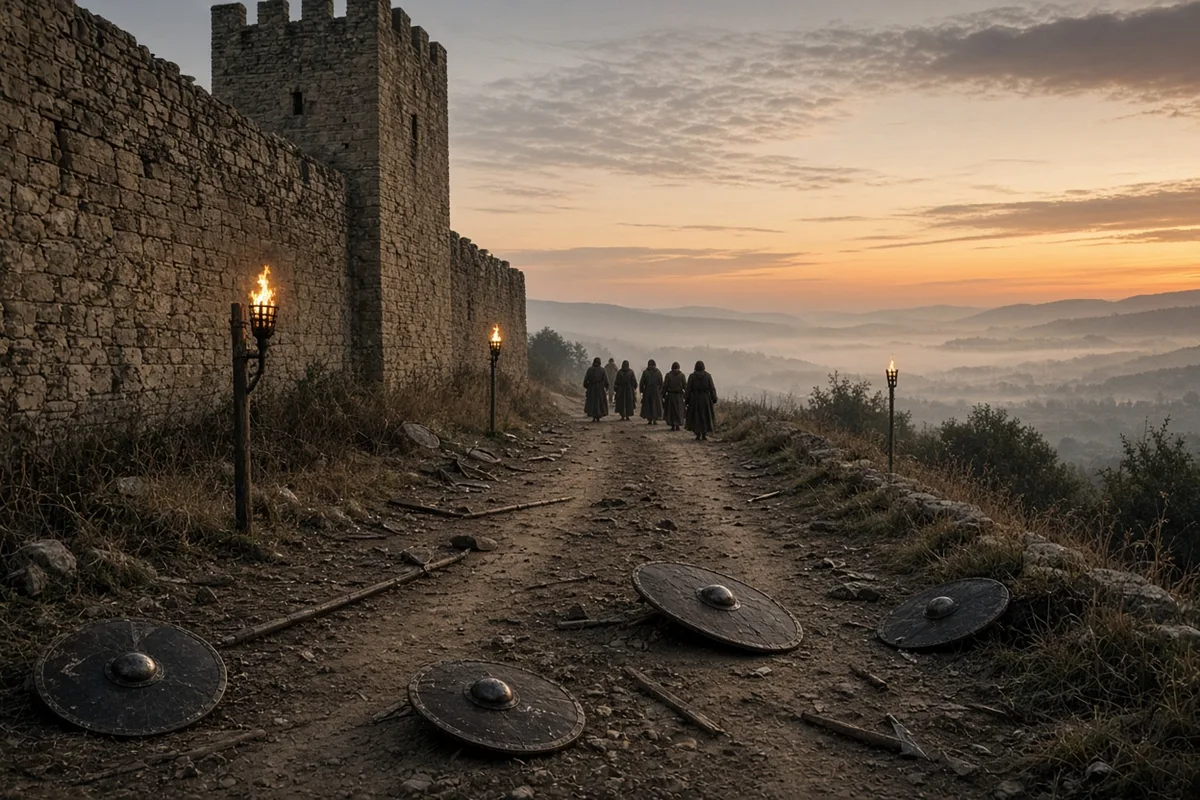
In 2016 the Italian Ministry of Cultural Heritage granted 184,000 euros for the reinforcement of the choir vault after engineers from the University of Perugia recorded micro-fractures in the rib stones dated to the original construction under Filippo da Campello. The work, completed on the twelfth of November 2018 by the firm Edilizia Monumentale di Spoleto, left the niche untouched; the silver case remained in place while the masons worked on scaffolding erected outside the grille. Sister Maria Grazia of the Immaculate Heart, then the sacristan, logged each day’s progress in the house chronicle, quoting the head mason’s remark that the chain links “still hold the weight of six centuries without a single stretch mark visible under the loupe.”
The last abbess to serve before the community’s reduction to four members was Mother Angela of the Cross, elected on the eighth of December 2009 after the death of Mother Chiara’s predecessor. Her term ended with her own death on the fourth of February 2022 at the age of ninety-one; the death register kept by the bishopric records the cause as pneumonia contracted during the final COVID-19 lockdown, during which the sisters received Holy Communion through the turnstile grille from the chaplain, Father Luca Rossi, who celebrated Mass daily at 7:15 on the opposite side of the screen. The register notes that Mother Angela had entered the enclosure in 1954 at the age of twenty-three, the same year the municipality of Assisi installed electric lighting in the outer courtyard but left the choir illuminated only by the east window and the single oil lamp that still hangs above the case.
On the nineteenth of April 2024 the present community received a letter from the Congregation for Institutes of Consecrated Life confirming that the monastery would not be suppressed despite its size, citing the uninterrupted recitation of the Divine Office since 1212 as documented in the annual reports submitted to the Holy See. The letter, signed by Cardinal João Braz de Aviz and bearing protocol number 4782/24, was read aloud by Mother Chiara at the midday chapter meeting attended by the remaining sisters: Sister Lucia of the Sacred Heart, Sister Teresa of the Child Jesus, and Sister Veronica of the Holy Face. The youngest, Sister Veronica, aged forty-two, had professed her solemn vows on the twenty-ninth of June 2011 in the presence of Bishop Domenico Sorrentino, who had traveled from the cathedral with the same silver crozier used by Innocent IV during his 1253 visit.
The rosemary border was replanted for the third time in 2019 after a soil analysis by the agricultural faculty of the University of Perugia identified a persistent deficiency in magnesium; the new slips, taken from cuttings at the nearby Convent of San Francesco, were set in soil amended with 2.3 kilograms of dolomitic lime per square meter. The line where the light falls each morning now intersects the third plant from the left, a measurement taken on the twenty-seventh of March 2023 by Monsignor Gentile with a laser level accurate to one millimeter. Sister Lucia recorded the observation in the margin of the chronicle beside the earlier entry made by Mother Teresa of the Sacred Heart in 1870.
The final human hand to touch the lock belonged to Sister Veronica, who opened the grille at 5:42 on the morning of the eleventh of October 2024 to admit the annual inspection team after Mother Chiara had fallen ill with a fever. The team consisted of Monsignor Gentile and the new diocesan archivist, Dr. Elena Moretti, who photographed the corporals under the same east light and noted that the Fiumi arms embroidery remained intact except for a single loose thread on the lower left corner, first remarked upon in the 1798 inventory compiled after the French requisition. Sister Veronica closed the grille at 9:17 that morning, turned the key twice, and returned it to the ring on her belt before walking back through the empty choir where the reflection from the silver case still stopped at the rosemary line.