


St. Cuthbert Ministers to Plague Victims
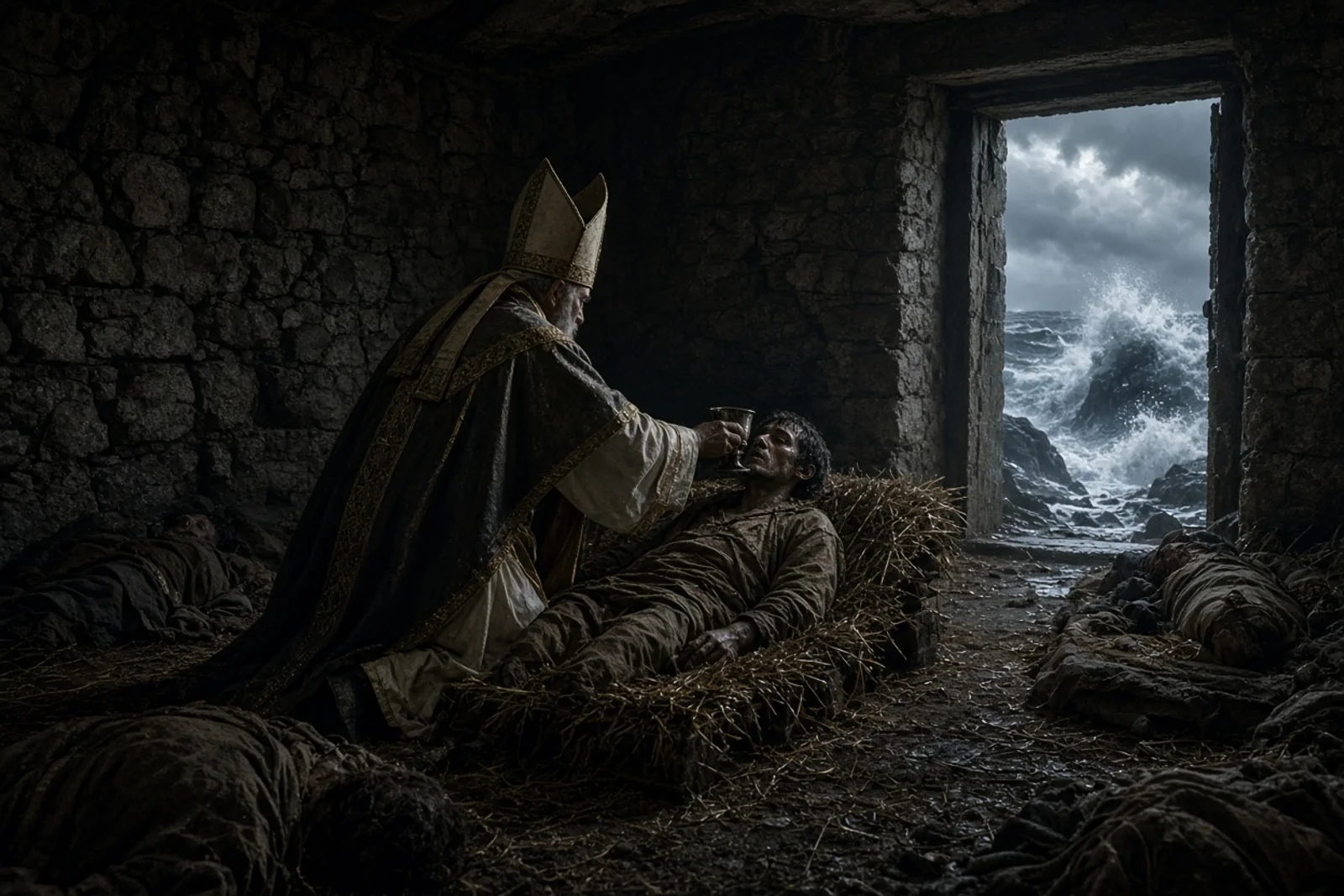
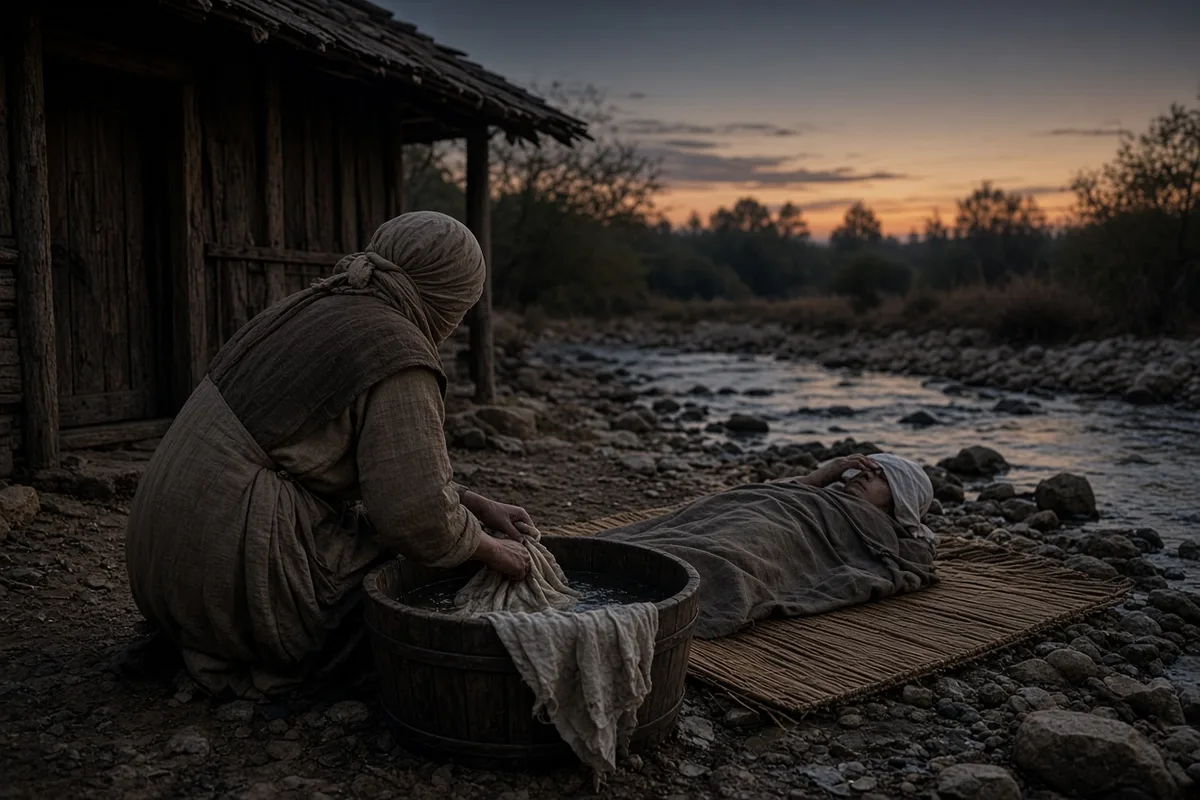
I was hauling the last bucket from the river when the first coughs started inside the timber walls. Boisil had sent me out at dawn because the well tasted wrong, and by the time I climbed the bank the sun was already hot on the thatch. Inside, two brothers lay on their pallets with sweat darkening the wool around their necks. I set the bucket down and went for Eata, but he was already at the gate speaking with Cuthbert, who had come in from the hill villages the night before.
Cuthbert’s cloak was still damp from the mist. He listened to Eata, nodded once, and walked straight to the sick men without setting down his staff. He knelt between the pallets and laid a hand on each forehead. One of the men tried to speak and could only retch. Cuthbert stayed there until the retching stopped, then stood and asked who else felt the cold beginning behind their eyes. Three more hands went up.
By midday the yard was quiet except for the sound of water being poured into cups. Cuthbert moved from pallet to pallet with the same steady step he used on the mountain paths. He did not raise his voice. When a man shivered so hard the frame shook, Cuthbert would sit on the edge and hold the blanket flat with one hand while the other rested on the man’s shoulder. The shivering eased a little each time.

I kept the fire going and carried away the cloths. Toward evening the prior, Boisil, came out of the church and took Cuthbert aside. They spoke low. Boisil’s face was gray, but he still walked without help. He pointed to the river and to the hills beyond it, then turned back inside. Cuthbert watched him go, then came to me and said we would leave for the outlying farms at first light.
We walked two days. At the first farm the woman was already past speaking. Cuthbert stayed with her until the breath left. At the second farm the father and two sons were all down. He showed the wife how to keep their heads raised and how much water to give between the sweats. On the third morning we turned back because word had reached us that the sickness had reached the monastery itself.
When we crossed the yard again the pallets had doubled. Boisil was not among the sick yet. He met us at the door of the church and told Cuthbert the prior had died that morning. Cuthbert looked at the ground for a long moment, then asked where the body lay. They showed him. He prayed there without sitting, then went to the newest pallets.
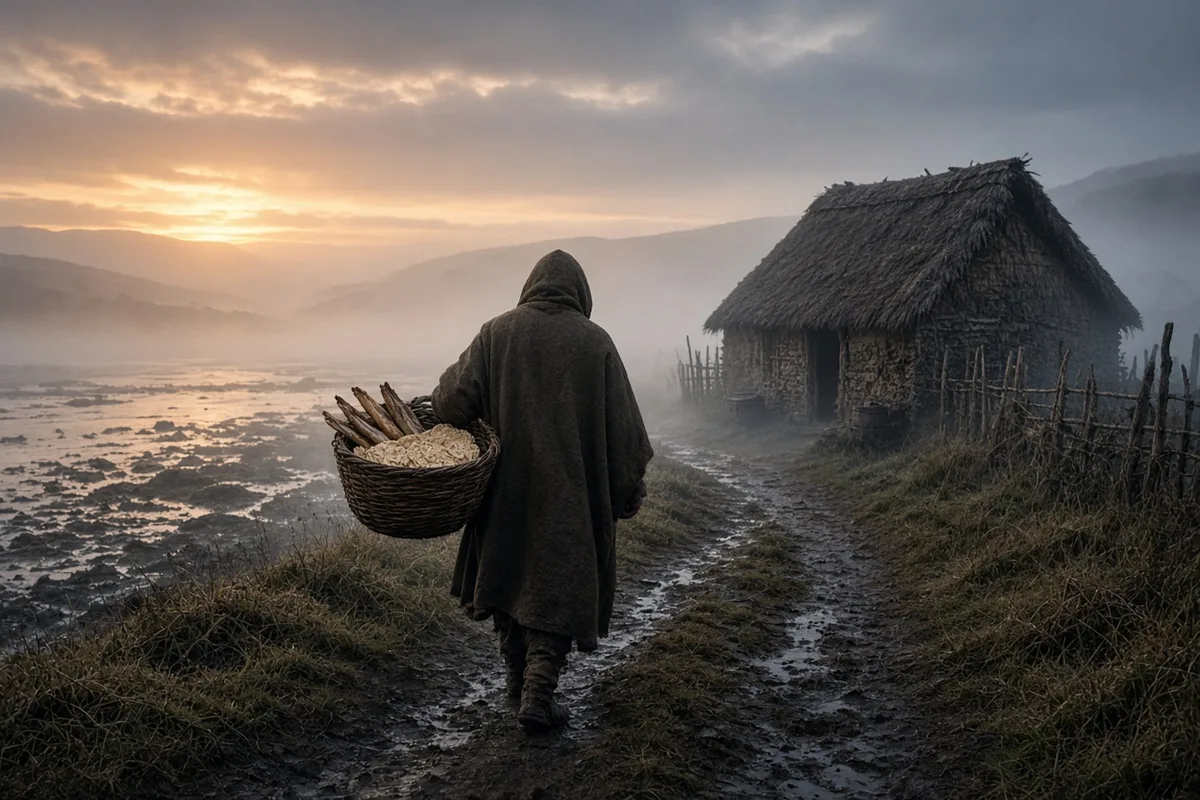
That night the cold came into him. He tried to hide the shaking by staying on his feet, but by compline his teeth were clicking so loud the brothers near him stopped their own prayers. They helped him to a pallet near the wall. He asked for his stick and said he would be needed again at dawn. No one answered.
The brothers kept vigil in shifts. I took the hour after midnight. Cuthbert lay still except for the tremors that ran through his legs. Once he opened his eyes and looked at the roof beams as if counting them. He did not ask for anything. Near the end of my watch Boisil came and sat on the floor beside the pallet. He did not speak to Cuthbert, only watched the rise and fall of the blanket.
At first light the tremors stopped. Cuthbert’s eyes opened and stayed open. He asked again for the stick. When someone brought it he pushed himself upright, swung his legs over the edge, and waited until the dizziness passed. Then he stood. The brothers who had prayed all night watched without moving. He took one step, then another, leaning on the stick. Color came back into his face while he walked the length of the room and back.
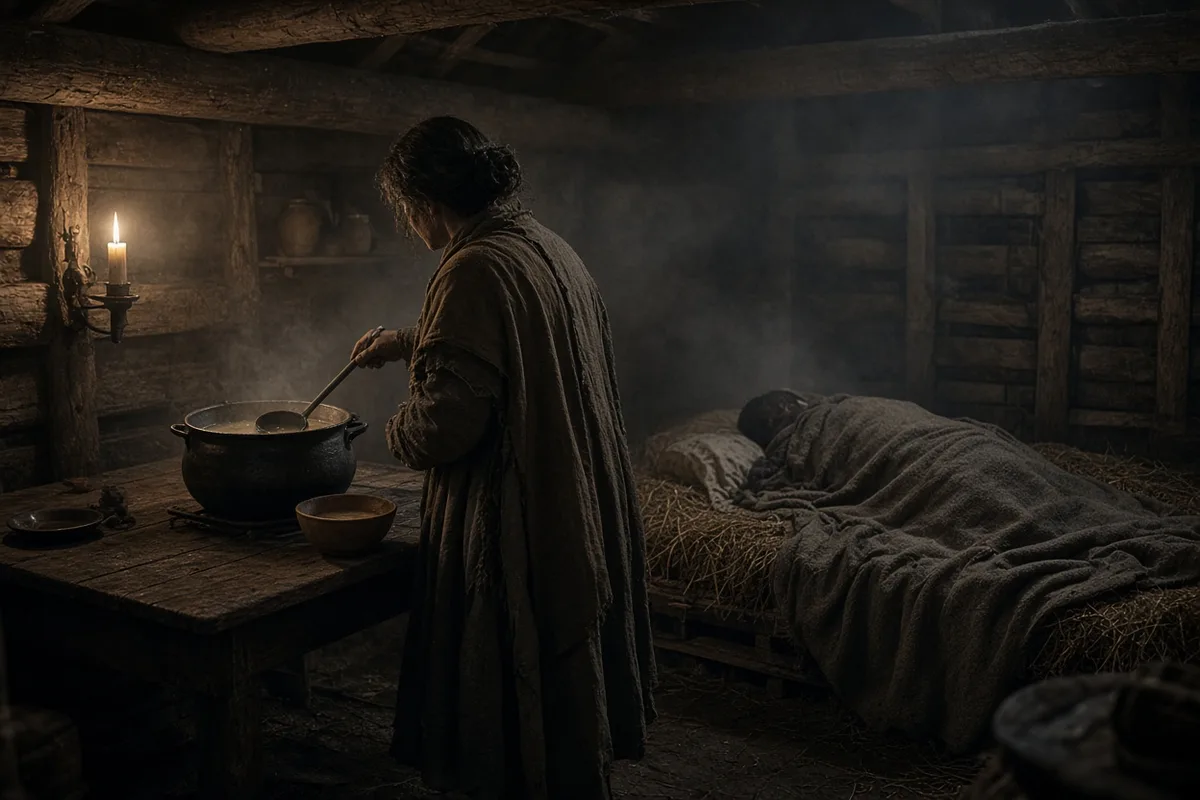
He never returned to the pallet that day. He drank water when it was brought and ate nothing. The swelling that had risen on his thigh stayed, but the fever did not come back. Boisil watched him from the doorway and said nothing until the evening meal. Then he called Cuthbert to sit with him and said there were seven days left for teaching. They began with the Gospel of John, reading one sheet each morning and speaking of what they had read until the light failed.
On the seventh morning Boisil could no longer hold the book. Cuthbert read the last sheet aloud while Boisil lay with his eyes open. When the reading ended Boisil closed his eyes and did not open them again. Cuthbert stayed beside him until the body was taken out.
After that the sickness thinned. Those who had not died began to sit up and ask for food. Cuthbert walked among them again, slower now because of the pain that stayed in his side. He never spoke of the night the brothers prayed. When Eata asked him to take the place of prior he accepted without delay.
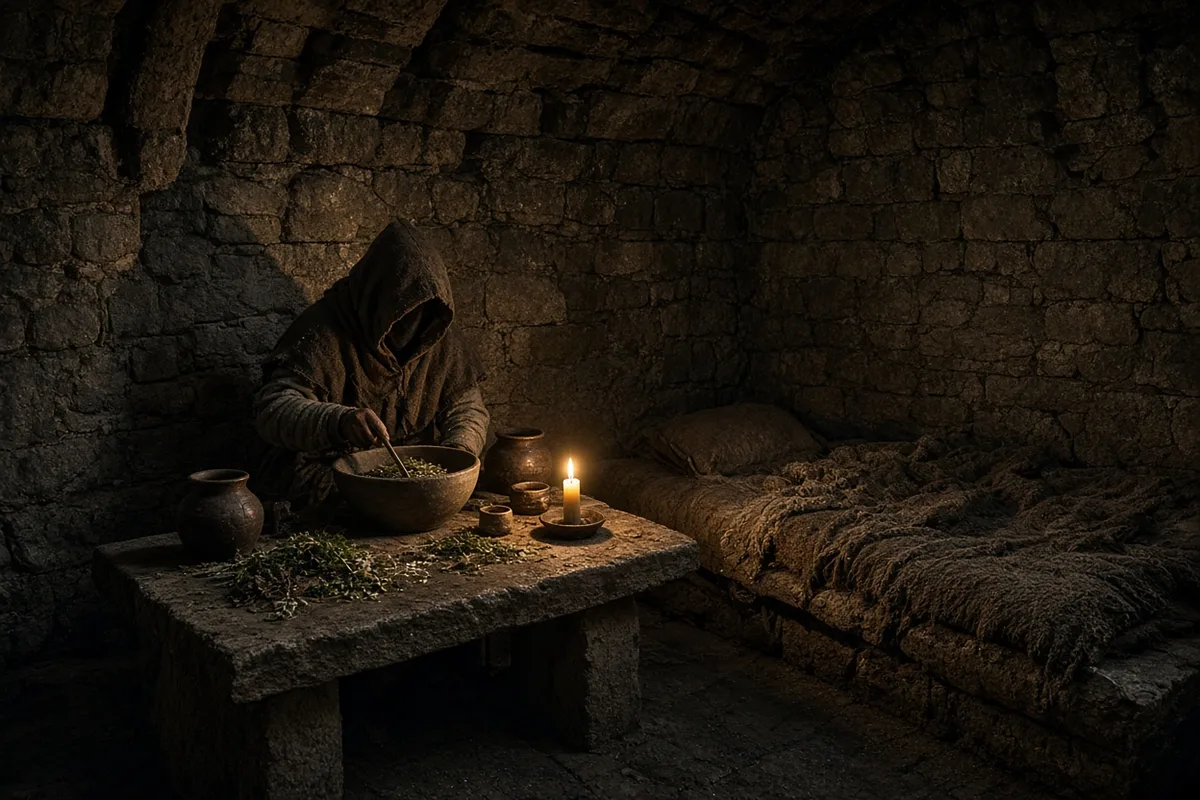
Years later, when the king’s messengers came to the island asking for a bishop, Cuthbert was already living on Farne. He came back only when the order could not be refused. By then the swelling in his thigh had become a constant reminder he carried without complaint. The brothers who had kept that night watch still spoke of it among themselves when the lamps were low, but never in his hearing.
The brothers who had kept that night watch still spoke of it among themselves when the lamps were low, but never in his hearing. Two years after Boisil’s burial Cuthbert crossed the Tweed with Eata to the island church at Lindisfarne, where he took charge of the guest-house and the twelve boys who studied the psalter under the south wall. On the day King Ecgfrith’s messengers reached the monastery, the prior’s name was already written in the book of obits as the one who had refused the bishopric of Hexham the year before. The king’s letter named the date of consecration, 26 March 685, and required Cuthbert to appear at York before Archbishop Theodore and the seven bishops who would lay hands on him. When the party set out, the swelling on his thigh had opened again and the linen wrapping showed fresh blood each evening, yet he rode the full distance without complaint and answered every question put to him at the synod.
He returned to the island wearing the bishop’s ring and carrying the crozier that had belonged to Aidan. For the next twenty-two months he visited every township between the Tyne and the Forth, stopping at the same farms where the plague had struck eleven years earlier. At Norham he confirmed thirty-seven adults on a single Sunday; at Coldingham he spoke with Æbbe, sister of the king, and recorded her account of the fire that had threatened the dormitory in 679. Each night he dictated a brief memorandum to the scribe who travelled with him, noting the number of newly baptized and the names of those who still required instruction. The pain in his side grew worse after the winter of 686, and on the feast of the Epiphany he asked permission to return to the cell on Inner Farne that he had built with his own hands seventeen years before.
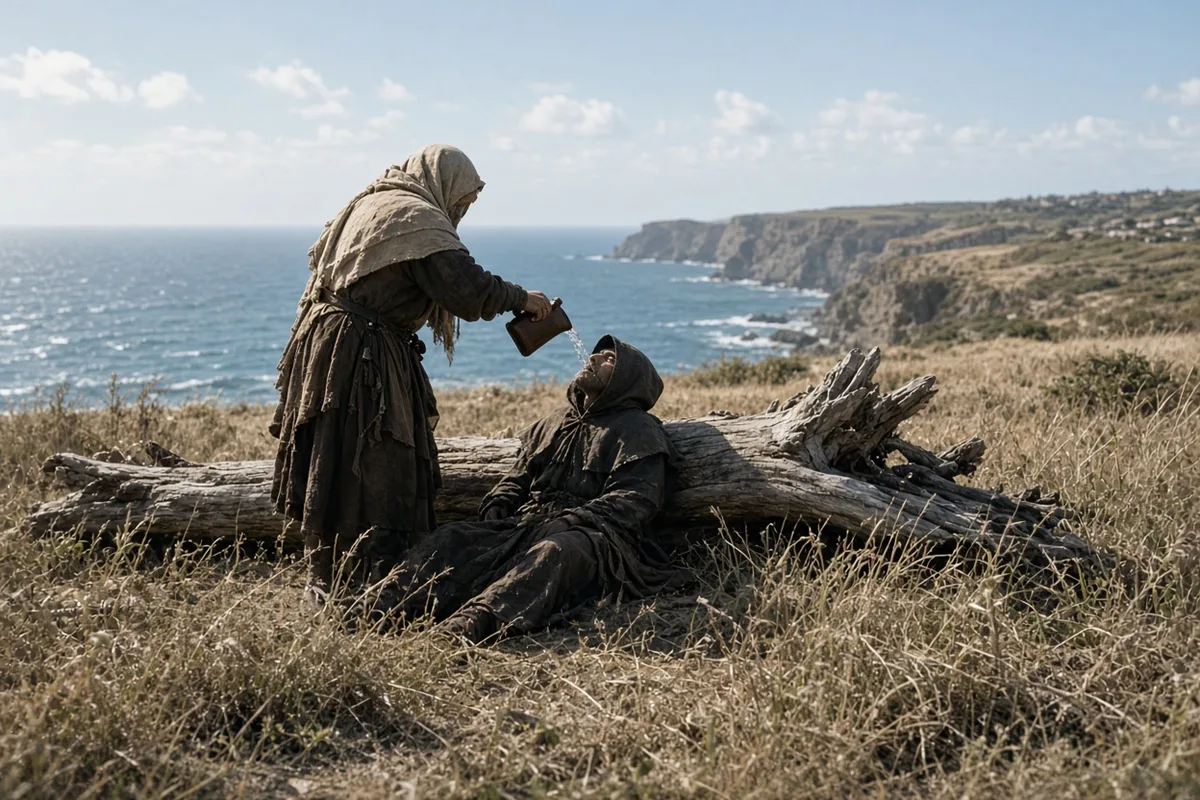
Hereberht, the priest from Carlisle, came to the island on 20 March 687 and remained beside the pallet until the ninth hour. Cuthbert received the viaticum from the hands of the priest who had rowed across from Lindisfarne that morning, then asked that his body be buried on the east side of the oratory rather than inside it. He spoke once more to Hereberht, telling him that the two men would not meet again in this life, and closed his eyes. The monks who carried the news back to the mainland counted forty-two days between his departure from Lindisfarne and the date of his death. They placed the body in a stone coffin lined with silk cloth that had been given by the queen, and set it beneath a wooden cross carved with the names of the seven brothers who had died in the same sickness.
Eleven years later Bishop Eadberht ordered the grave opened so that the bones could be placed in a new shrine above ground. The monks who lifted the lid found the flesh entire and the linen garments without stain, as the account later written by Bede records. Eadberht himself removed the outer robe and replaced it with fresh cloth before the coffin was resealed. From that year the monks kept an annual vigil on the twentieth of March and entered each reported cure in the margin of the service book. By 698 the number of recorded miracles had reached seventeen, most of them concerning children brought from the mainland villages.
When the Danish ships appeared off the coast in 875, Abbot Eadred and Bishop Eardulf took the coffin and the head of King Oswald and began the journey south. They halted first at Norham, then at Crayke, and finally at Chester-le-Street, where the community remained for more than a century. In 995 the same coffin was carried again, this time to the hill above the Wear where the present cathedral stands. The monks who laid it in the new church counted nine translations since the original burial. The wooden coffin they had carried from Lindisfarne was already split along its length, yet the silk wrapping inside remained whole.
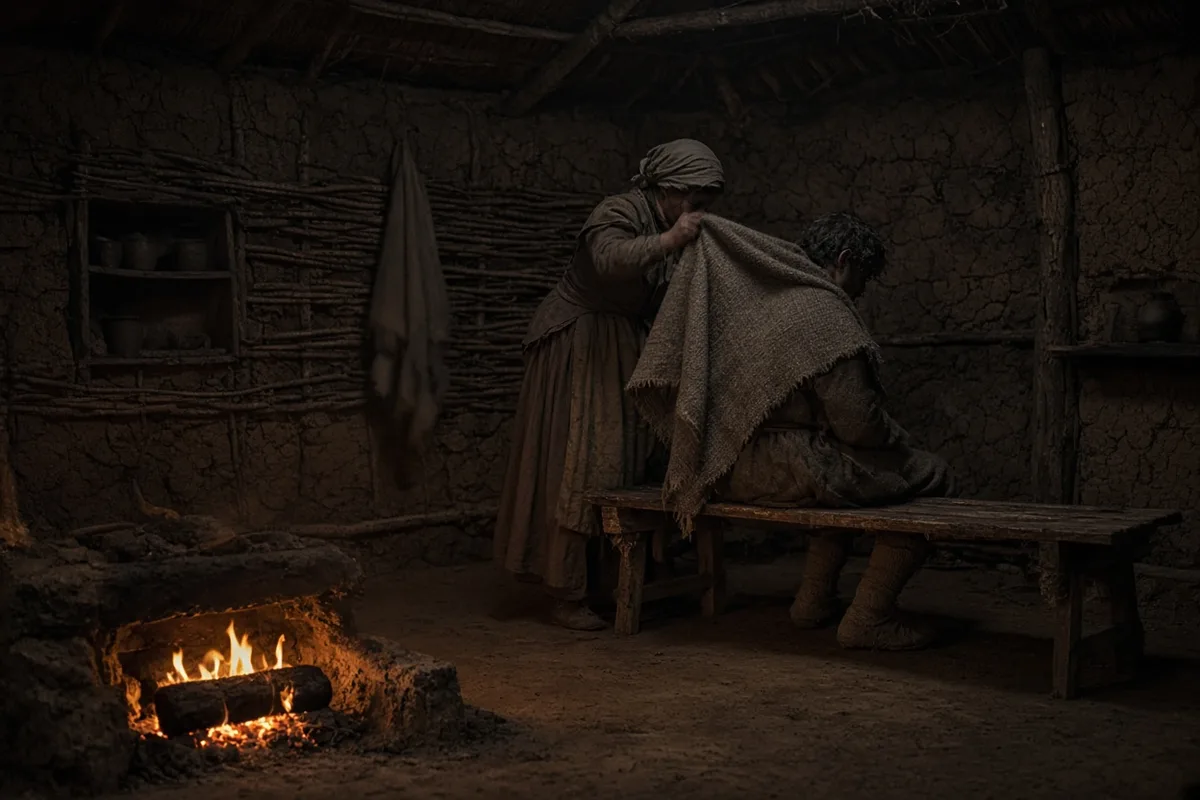
In 1104 the shrine was opened once more so that the bones could be moved into the feretory behind the high altar. The sacristan recorded that the skull was wrapped in a separate cloth and that a small gospel book, no larger than a man’s hand, lay beneath the left shoulder. The book contained the Gospel of John written in an Irish hand, its margins marked with the same verses Cuthbert and Boisil had read together in the year of the plague. When the last stone of the present feretory was set in place in 1372, the master mason carved the date and the number of pilgrims who had visited that year—four hundred and eighty-three—into the base of the pillar nearest the north door.
The final time the coffin was examined, 17 May 1827, three physicians and the cathedral librarian stood beside the opened grave. They measured the skeleton, noted the healed fracture on the right femur, and counted the linen fragments that still adhered to the ribs. One of the physicians lifted the skull and turned it toward the light from the south window. The sockets were empty, yet the bone itself retained the same contour that the brothers at Melrose had seen when Cuthbert first stood after the fever left him.
The physicians replaced the skull in its linen wrapping and lowered the lid of the oak outer coffin on the same afternoon of 17 May 1827. Dean Charles Thorp signed the register recording that the remains had been measured at five feet six inches and that the right femur showed a healed break three inches above the knee. The fragments were returned to the same stone vault beneath the feretory floor where they had lain since the translation of 1372.
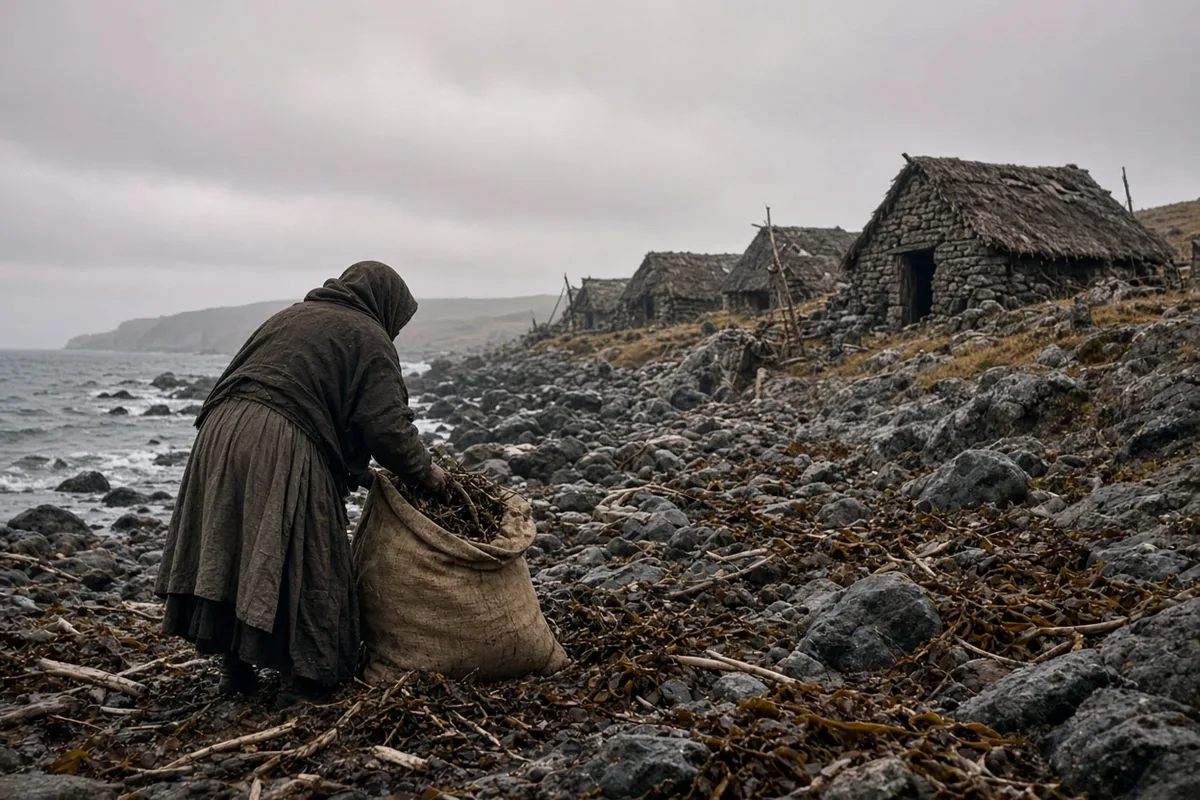
In 1899 the cathedral chapter ordered a further inspection before the installation of the new marble pavement around the high altar. Canon William Greenwell and two surgeons from Newcastle lifted the lid on 1 August and noted that the skull had been rotated slightly since 1827, with a small splinter of bone now detached from the left temporal region. They rewrapped the pieces in fresh silk and replaced the coffin beneath a plain slab inscribed only with the date 20 March 687.
The feretory itself was dismantled in 1933 when the central tower required underpinning. The stonework was numbered and stored in the south transept while the masons reset the foundations; the coffin remained untouched under temporary boarding for fourteen months. When the feretory was rebuilt, the same masons set a new brass plate into the floor recording the weight of the original inner coffin as seventy-three pounds.
Pilgrims continued to arrive after the Second World War. In 1951 the sacristan logged four hundred and twelve visitors on the single day of 20 March, among them a party of thirty schoolchildren from Hexham who left a written petition asking for the saint’s intercession on behalf of a classmate suffering from polio. The petition was placed in the archive and remains there with the date and the names of the two teachers who accompanied the group.
The present feretory screen, erected in 2003, incorporates two surviving oak panels from the 1372 structure. Each panel bears the carved outline of a pastoral staff and the letters “C” and “B” separated by a small cross. The screen stands fourteen feet high and is illuminated each evening until the cathedral closes at nine o’clock.
On 10 July 2013 the last direct examination of the remains took place when conservators lifted the coffin lid for three hours to photograph the bones for a digital archive. The right femur was measured again and found to be identical in length to the 1827 record. One conservator noted in the logbook that the contour of the occipital bone, when viewed from above, matched the outline visible in the earliest surviving drawing of the skull made in 1827 by the cathedral librarian.
The bones rest today beneath the same slab that was set in place in 1899. No further opening is planned. The only image that remains of the man who stood after the fever at Melrose is the measured length of that femur and the empty sockets of the skull turned once toward the south window on 17 May 1827.