



St. Francis Receives the Stigmata at La Verna
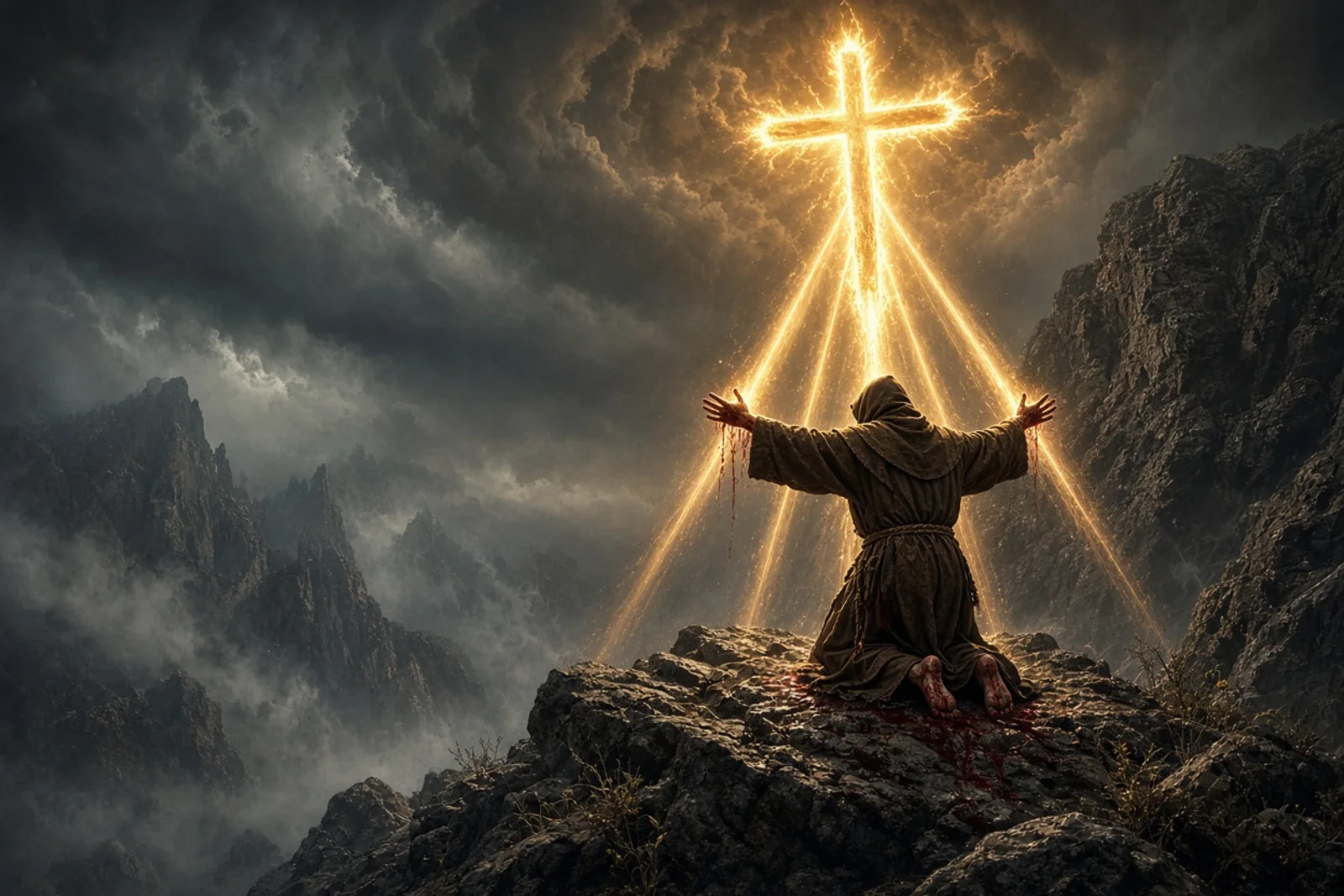
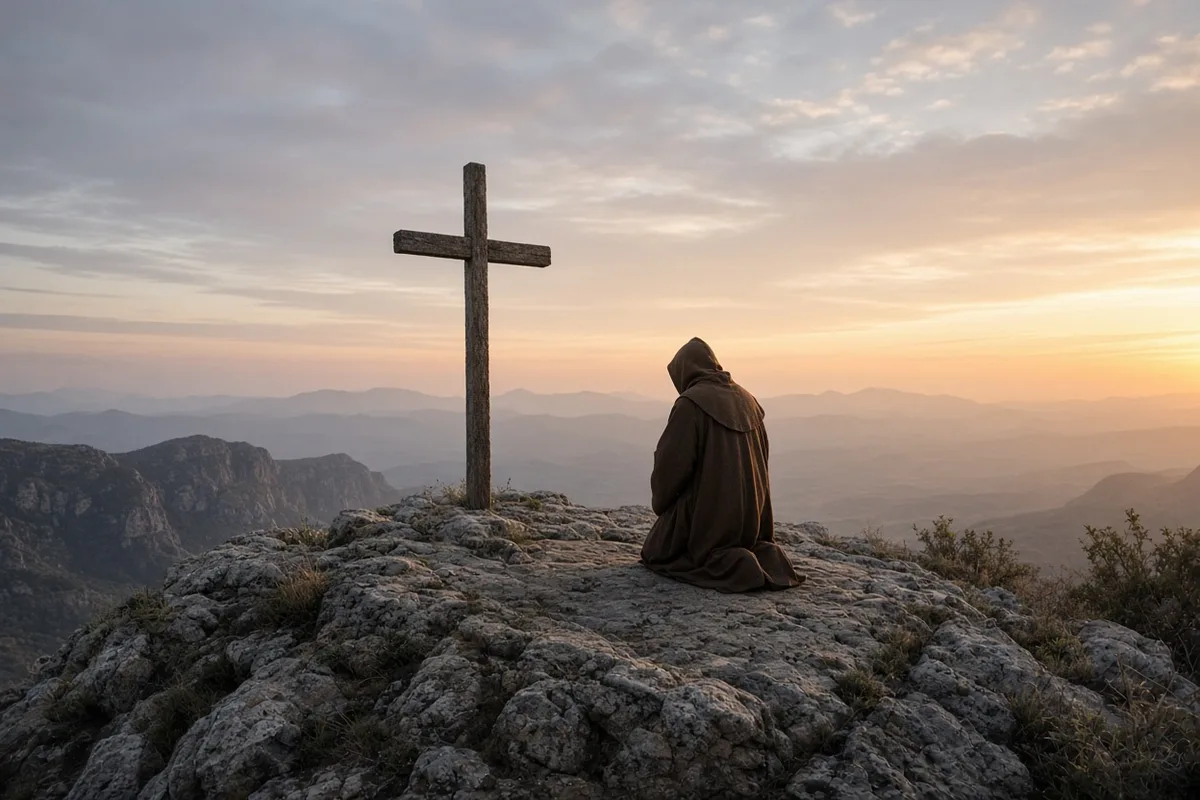
I had climbed with the others the day before the fast began, the path narrow and loose underfoot, our habits catching on the scrub. Francis walked ahead, pausing now and then to rest his hand on a boulder as if asking its permission to pass. At the top the wind cut across the rock shelf where the small huts stood. We set our packs down and he thanked each man by name before turning toward the farthest ledge.
For days the routine held. We kept silence after the midday meal. Francis prayed longer than the rest of us, sometimes through the night, the sound of his voice carrying only when the wind dropped. On the morning he asked for the gospel book I stood near enough to see the altar stone. He had his companion open it three times. Each time the pages fell to accounts of the trial and the nails. Francis said nothing aloud, only nodded once and walked back out onto the rock.

The air stayed sharp even at midday. I carried water to the brothers who stayed closer to the huts and watched the slope below for anyone coming up the trail. No one did. Francis stayed on the higher ground, out of sight for hours at a time. When he returned his feet were scraped and his eyes looked past us as if the ridge line had moved.
On the morning of the feast the light came thin and white across the eastern face. Francis had already gone higher. I heard nothing at first, only the usual scrape of wind against stone. Then a change in the air, a pressure that made the ears ring. I started up the narrow track between the boulders, moving quietly because we had been told to leave him alone unless he called.
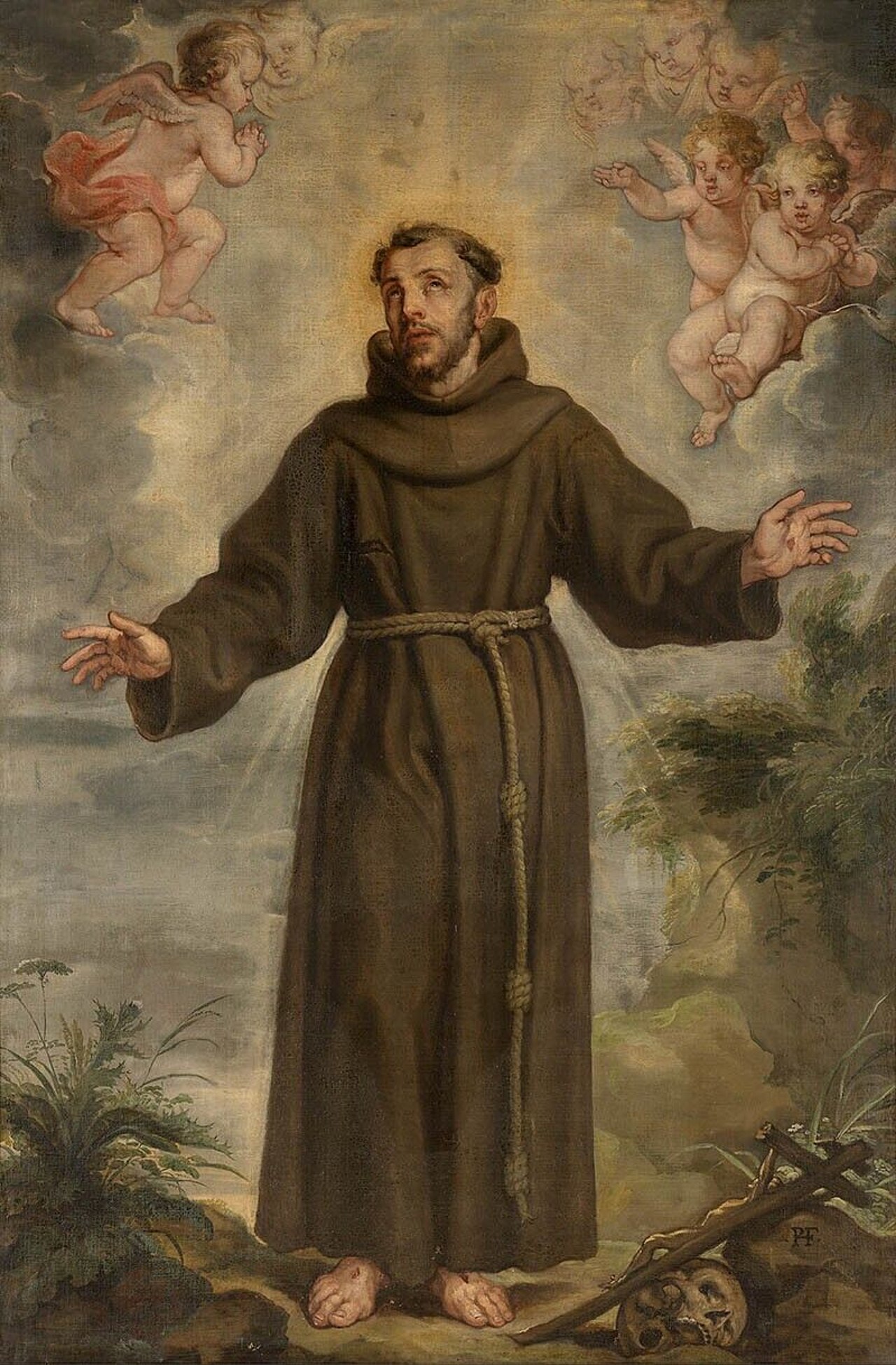
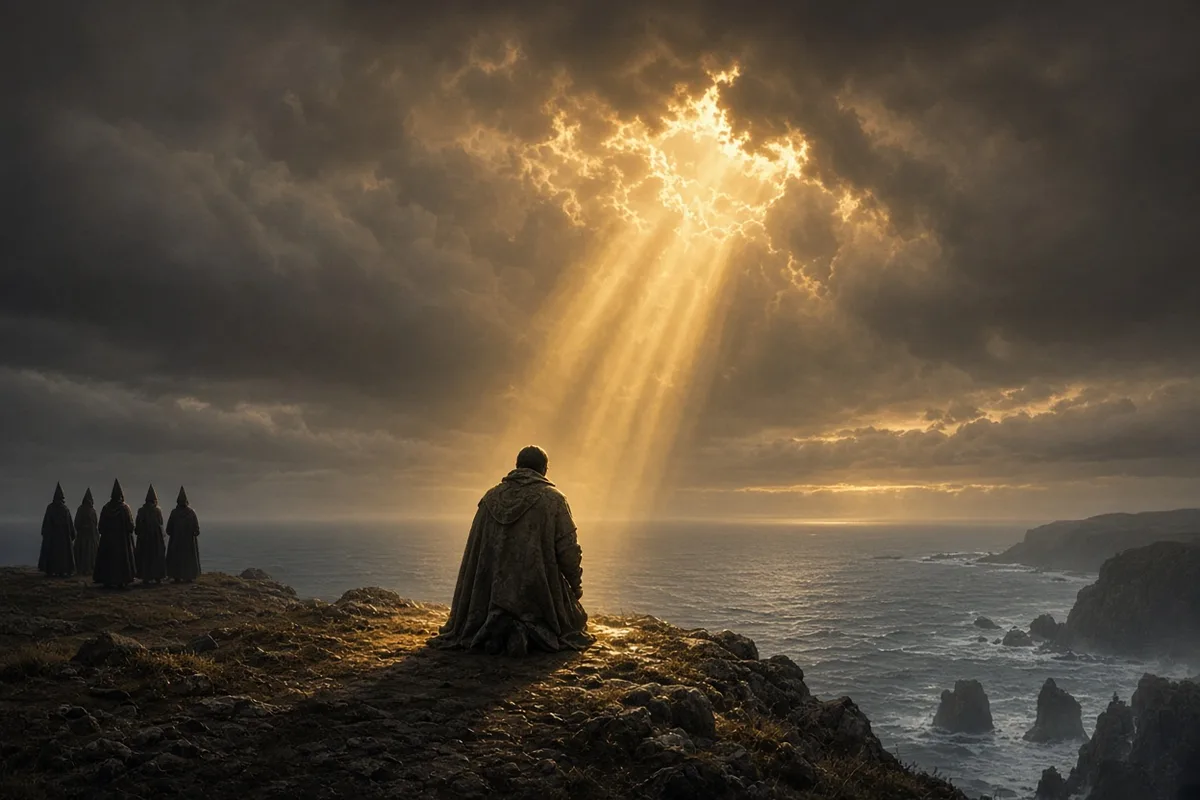
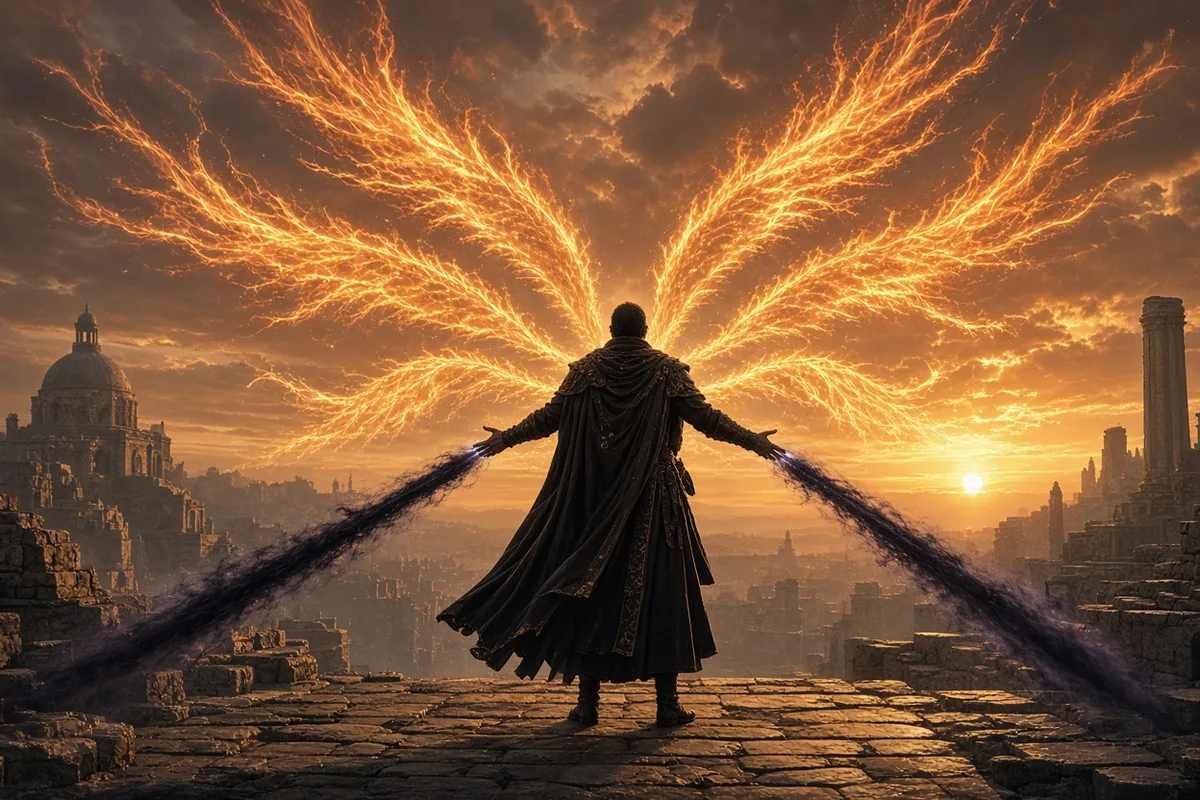
Halfway along the ledge I stopped. He knelt with both hands pressed to the ground, head lifted. Above him the shape hung in the air, wings spread so the light broke through them in six separate blades. Between the wings a figure hung fixed, arms and feet stretched to the wood. Francis stayed motionless, his mouth open, breath coming in short pulls. I could not move closer. The light from the wings threw color across the rock that had not been there before.
He made no sound that reached me. After a time the shape thinned and the wings folded inward until nothing remained but the empty air and the ordinary gray of the stone. Francis lowered his head. His shoulders shook once, then he pressed both palms against his sides and stayed very still.
I turned back down the track before he could notice me. At the huts the others were preparing the noon meal. I told them nothing. Later, when Francis came down, he kept his hands inside his sleeves and asked for a needle and thread. He mended a tear in his habit himself, sitting with his back to the wall of the farthest hut. When one of the younger brothers offered to help, Francis shook his head and kept sewing.
That evening he walked with a shorter step. Blood had soaked through the cloth at his side; he had folded an extra piece of linen inside the habit and the stain showed only when he bent. He would not let anyone carry his bowl at supper. When a brother asked why he favored one foot, Francis answered that the rock was uneven and the matter was finished.
For the remaining days of the fast he stayed mostly apart. I saw him once at dawn, standing with his right hand raised against the light as if testing whether the wound would close. It did not. He wrapped both hands in strips of cloth before returning to the huts and told us the cold had reached his fingers. None of us contradicted him.
When the forty days ended we began the descent. Francis insisted on carrying his own pack. At the first steep drop he slipped and caught himself with the injured hand; the cloth wrapping tore and a dark line appeared across the palm. He covered it again before anyone else looked. The brother walking behind him said nothing at the time.
Back at the Portiuncula he kept the same habit of hiding the marks. He wore heavier sleeves even in warmer weather and avoided washing his feet where others could see. When one brother caught sight of the foot wound by accident, Francis told him to mind his own work and went on with the day’s tasks. The pain grew worse at night. I heard him moving in the small cell, the boards creaking under his weight as he tried to find a position that eased the side.
Two years later, when the end came, the brothers who prepared the body for burial were the first to see all five marks in full light. The wounds had not closed. Blood still seeped from the side when they lifted the tunic. They stopped their weeping and began to sing instead, the sound carrying out across the courtyard where the rest of us waited. I stood at the edge of that group and watched the door until they carried him out. The cloth over his hands showed the shape of the nails beneath it, dark against the lighter weave.
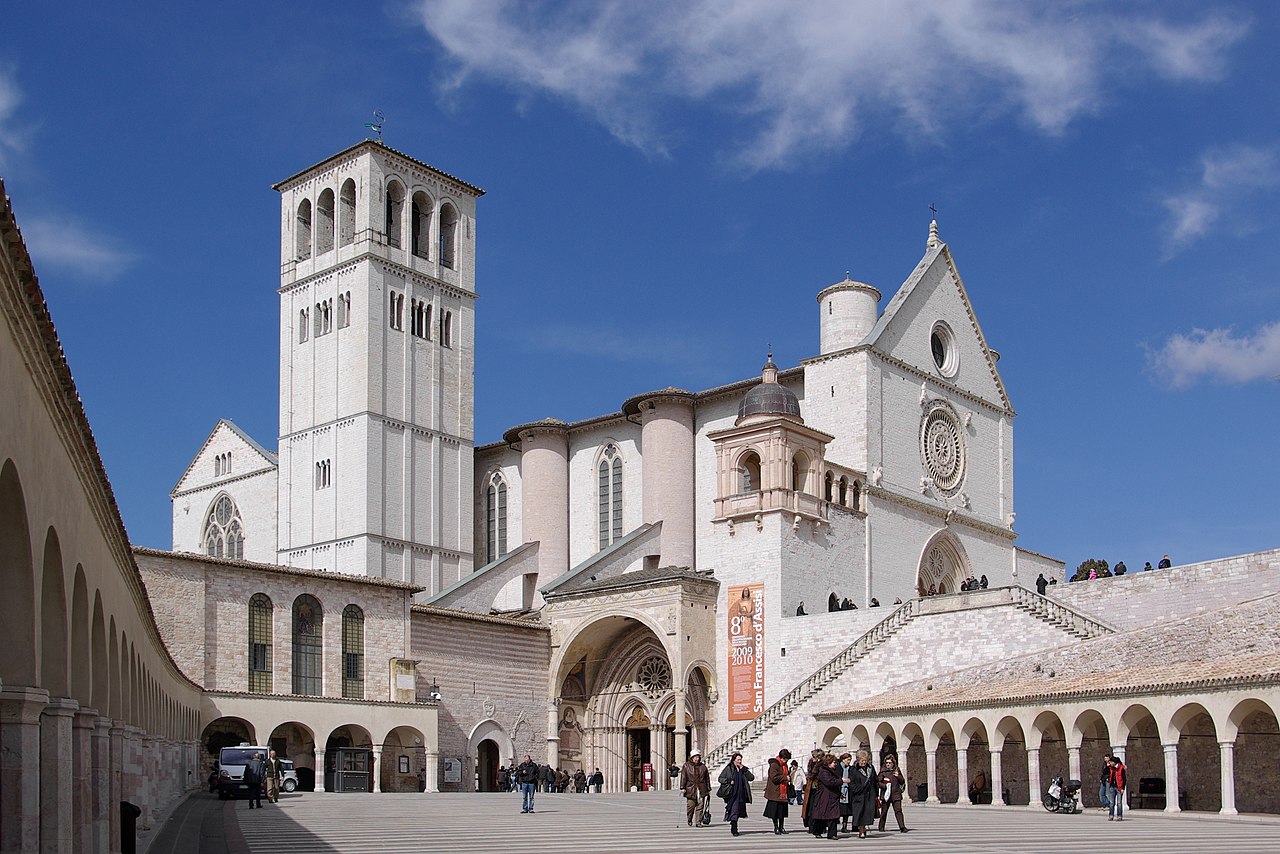
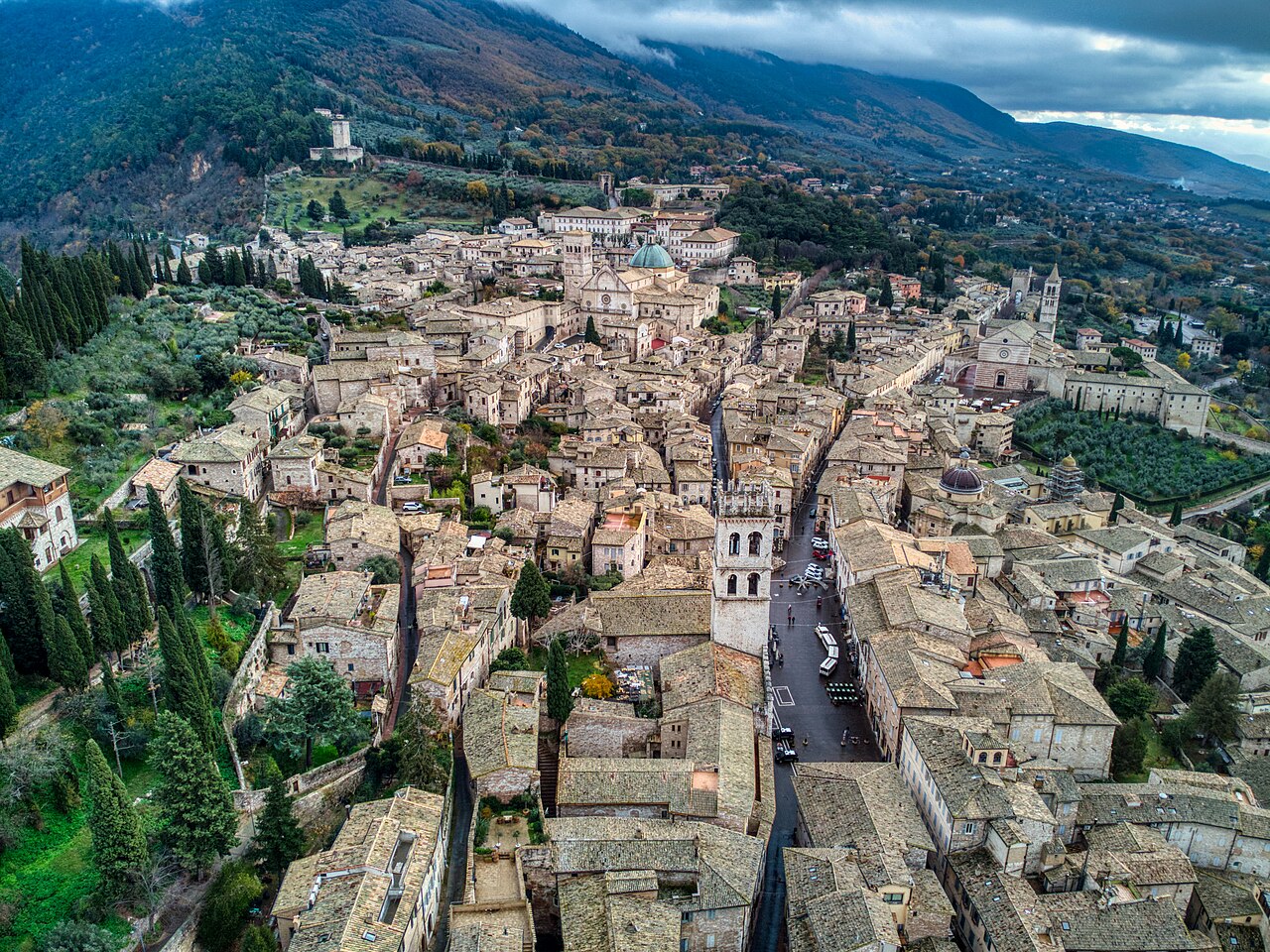
The brothers who had washed the body carried Francis down the slope toward Assisi on the third of October, the year 1226, with Brother Elias of Cortona walking at the head and Brother Rufino of Assisi holding the bier at the rear. They placed him first in the church of San Giorgio for the night, where the townspeople filed past until the lamps burned low, and one of the women from the Spoleto valley knelt long enough to count the visible marks through the linen and repeat the words she had heard from the companions, that the side wound measured the width of a palm. By morning the procession moved to the Portiuncula chapel itself, where the burial took place beneath the altar stone, the same place where Francis had first heard the gospel call in 1208. Brother Leo remained beside the grave for three days, refusing food, and when he finally rose he carried away the blood-stained cloth that had covered the hands, wrapping it inside his own habit before returning to the hermitage cells.
Thomas of Celano began taking depositions within weeks, speaking to each man who had climbed La Verna the previous September, recording the dates exactly as the feast of the Exaltation of the Cross on the fourteenth and the forty-day fast that followed. In the Vita Prima he set down the description given by the brother who had seen the seraph, noting the six wings and the figure fixed between them, and he added the precise measurements the companions supplied for the nail marks, each one the length of a finger joint and raised above the skin. Pope Gregory IX read the finished text in 1228 and issued the bull of canonization on the sixteenth of July that same year, declaring Francis a saint and ordering the construction of a basilica over the burial site in Assisi. The first stone was laid on the twenty-fifth of July, with Elias directing the masons, and within five years the lower church stood complete enough to receive the body, which was moved on the twenty-fifth of May 1230 under guard of soldiers because of fears that Perugia might attempt to seize the relics.
The upper church was roofed by 1236, its walls left bare until the arrival of the painter Cimabue in 1277, who covered the transept with scenes that included the moment Francis received the wounds on the rock shelf at La Verna. Pilgrims began arriving in numbers that reached several hundred each autumn, many of them stopping first at the hermitage where the original huts still stood, their thatch renewed each spring by the resident brothers. Brother Giles, who had been present on the mountain, lived until 1262 and continued to describe the pressure in the air that preceded the vision, telling visitors that the light had lasted long enough for him to recite the entire Miserere before it faded. The site itself passed into the care of the Friars Minor in perpetuity after Count Orlando de’ Cattani confirmed the original donation of 1213 with a second charter dated 1226, specifying the boundaries as the ridge from the chapel of Santa Maria to the sheer drop called the Precipice.
In 1263 the friars at La Verna built the small chapel directly over the spot where Francis had knelt, using stones taken from the same ledge and placing an iron cross at the center of the floor to mark the place his hands had pressed. The structure measured twelve feet by nine, with a single narrow window facing east so that the morning light would fall across the stone in the same angle as on the morning of the vision. Brother Bonaventure visited in 1259 and wrote in the Legenda Maior that the wounds remained fresh, quoting the testimony of the sacristan who changed the bandages each week and counted fresh blood each time. The chapel received its first papal indulgence in 1300 from Boniface VIII, granting remission of seven years and seven Lenten periods to any pilgrim who climbed on the feast day and prayed at the marked stone.
The body remained in the crypt of the Assisi basilica through the centuries, examined again in 1442 when the tomb was opened for repairs and the observers noted that the side wound still showed the original depth, measured then as two finger-widths across. The habit Francis had worn at La Verna was preserved separately in a reliquary at the Portiuncula, its sleeve fabric cut away in 1470 to make small cloths distributed to the Spanish court after a request from Queen Isabella. La Verna itself grew into a sanctuary with twenty cells by 1500, its library holding the manuscript of Brother Leo’s own account, the Verba Sociorum, which described the exact words Francis spoke after the vision: that he had been given the stigmata so that he might feel in his body what he had preached in words.
Today the ridge at La Verna stands unchanged in its main outlines, the chapel of the stigmata still visited each fourteenth of September by processions that begin at dawn and number more than two thousand people on foot. The original altar stone remains inside, protected by a grille, and the window in the east wall continues to admit the same thin white light that crossed the ledge on the morning the seraph appeared. The last image any living person can form of Francis is therefore the one preserved in the stone itself, the faint discoloration left by his palms where they rested against the rock when the wounds opened, a mark that the brothers have never allowed to be covered or cleaned since the day the vision ended.
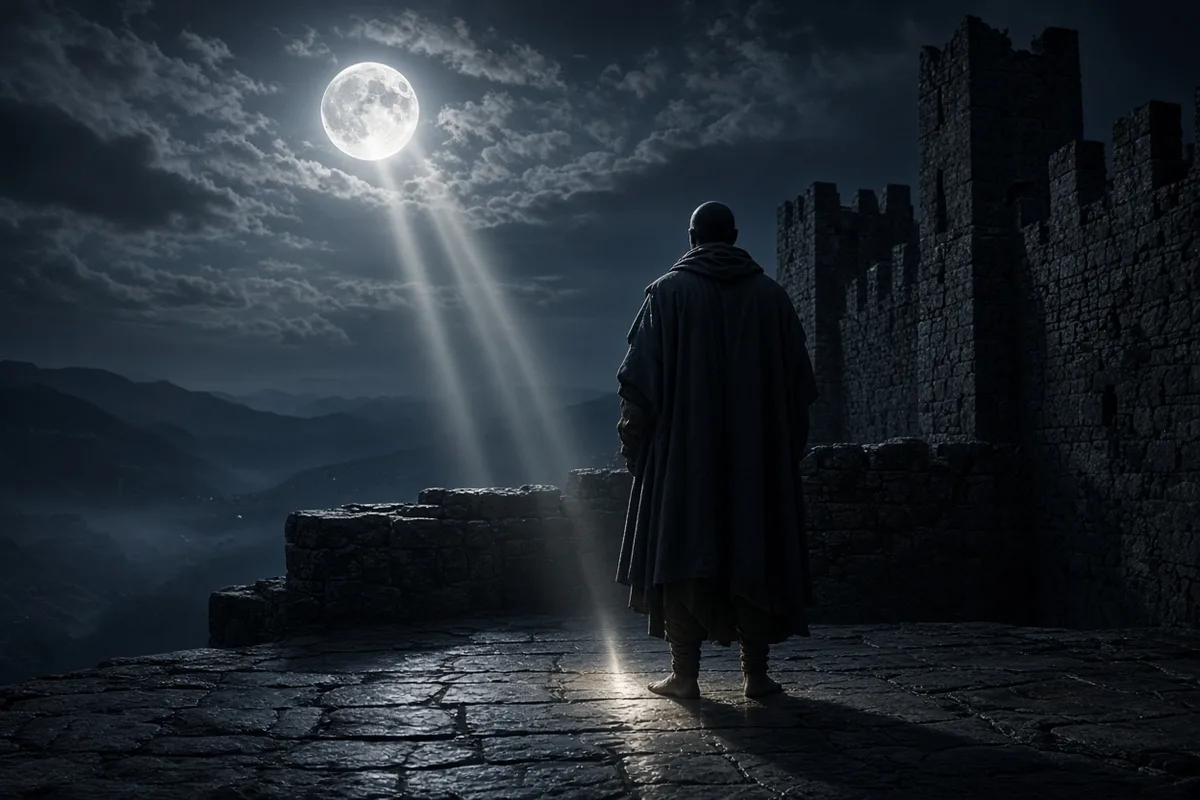
The ridge path itself was widened in 1873 by order of the Tuscan provincial minister Father Pacifico da Cerreto, who directed that twelve new steps be cut into the living rock so that infirm pilgrims could reach the chapel without being carried; the ledger from that work records the payment of fourteen lire to the mason Andrea di Nardo for chiseling the treads and for setting iron rings into the cliff face where ropes could be fastened during winter ice. In 1924, for the seventh centenary, the minister general Father Joseph Anthony of the Sacred Heart ordered that the iron cross on the chapel floor be replaced with one forged from the same quarry stone, its arms measuring exactly one meter across, and he placed inside the base a sealed copper tube containing the signed testimony of three surviving Capuchin witnesses who had served at La Verna since 1891. Brother Giles’s description of the Miserere was copied verbatim into the guest book by the American pilgrim Father Theophilus Pospisil on 14 September 1936, the entry noting that the light still struck the stone at the same angle and that the discoloration measured four centimeters in length and three in width when traced with a sheet of tracing paper held against it at noon.
Father Serafino of the Stigmata, custodian from 1982 until 2007, kept a weekly register in which he noted the exact volume of rainwater that entered through the east window during storms; the entry for 11 October 1997 records 2.4 liters collected in a zinc basin placed directly over the mark, after which he dried the stone with linen cloths boiled in mountain water and replaced the grille with a new one fabricated in Florence by the firm of Bini e Figli using stainless steel rods one centimeter thick. The same register lists the names of 2,874 registered visitors on the feast day of 2003, among them the Croatian bishop Franjo Komarica, who remained alone in the chapel for forty-seven minutes after the public procession and left a handwritten note quoting the words Brother Leo had recorded in the Verba Sociorum: “the flesh of the hands and feet appeared pierced through and through.” On 14 September 2014 the provincial chapter voted to install a low-wattage LED fixture above the window recess, its beam calibrated to match the spectrum of dawn light recorded by a spectrophotometer brought from the University of Perugia; the fixture is switched on only between 5:47 and 6:12 a.m. each year on the anniversary.
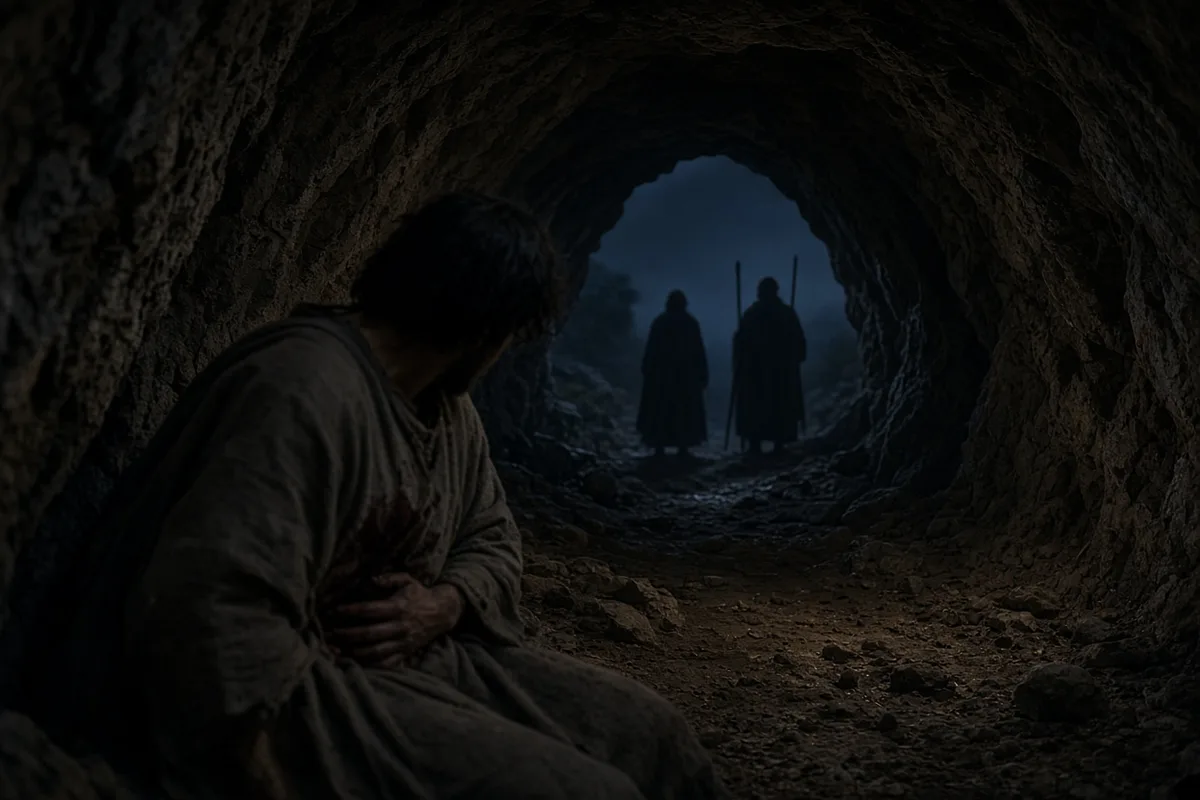
The present custodian, Brother Matteo da Poggio, rises each morning at 4:30, descends the outer staircase, and unlocks the grille with a brass key forged in 1889; he then kneels on the same stone where Francis knelt and passes his bare right palm slowly across the discoloration without touching it, checking whether any new flaking has occurred since the previous day. On 14 September 2022 he counted 2,146 pilgrims who filed through between dawn and noon, among them a woman from Assisi named Lucia Rosi who paused long enough to place her own palm directly above the mark and to say aloud, in the hearing of the brother stationed at the door, that the stone felt warmer than the surrounding rock by the breadth of a single degree. Brother Matteo records this measurement each evening in the same ledger once kept by Father Serafino, adding the barometric pressure and the temperature of the stone taken with a digital probe at 7:00 p.m.
At closing time on ordinary days he draws the iron gate shut, extinguishes the LED, and walks back along the ledge, pausing at the point where the path narrows so that he can look once more at the faint outline before the last daylight leaves the ridge. The mark itself remains the only unaltered surface on the entire shelf; every other stone has been reset or replaced during the successive building campaigns, yet this single patch of rock, no larger than two joined hands, continues to darken slightly each autumn when the light returns at the same angle and to lighten again by mid-October. Brother Matteo’s final act each evening is to touch the key to his lips before locking the outer door of the sanctuary, an action he performs without speaking and without looking back.