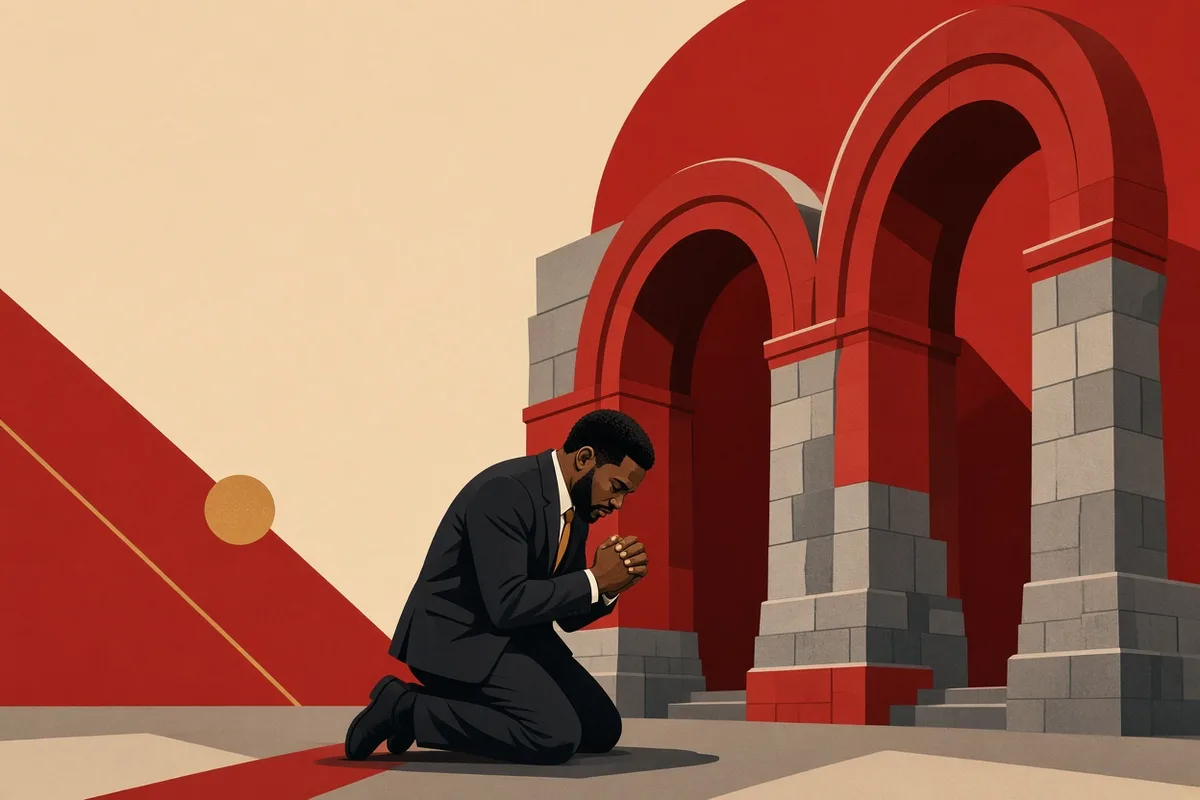



St. Helena Discovers Relics of the True Cross
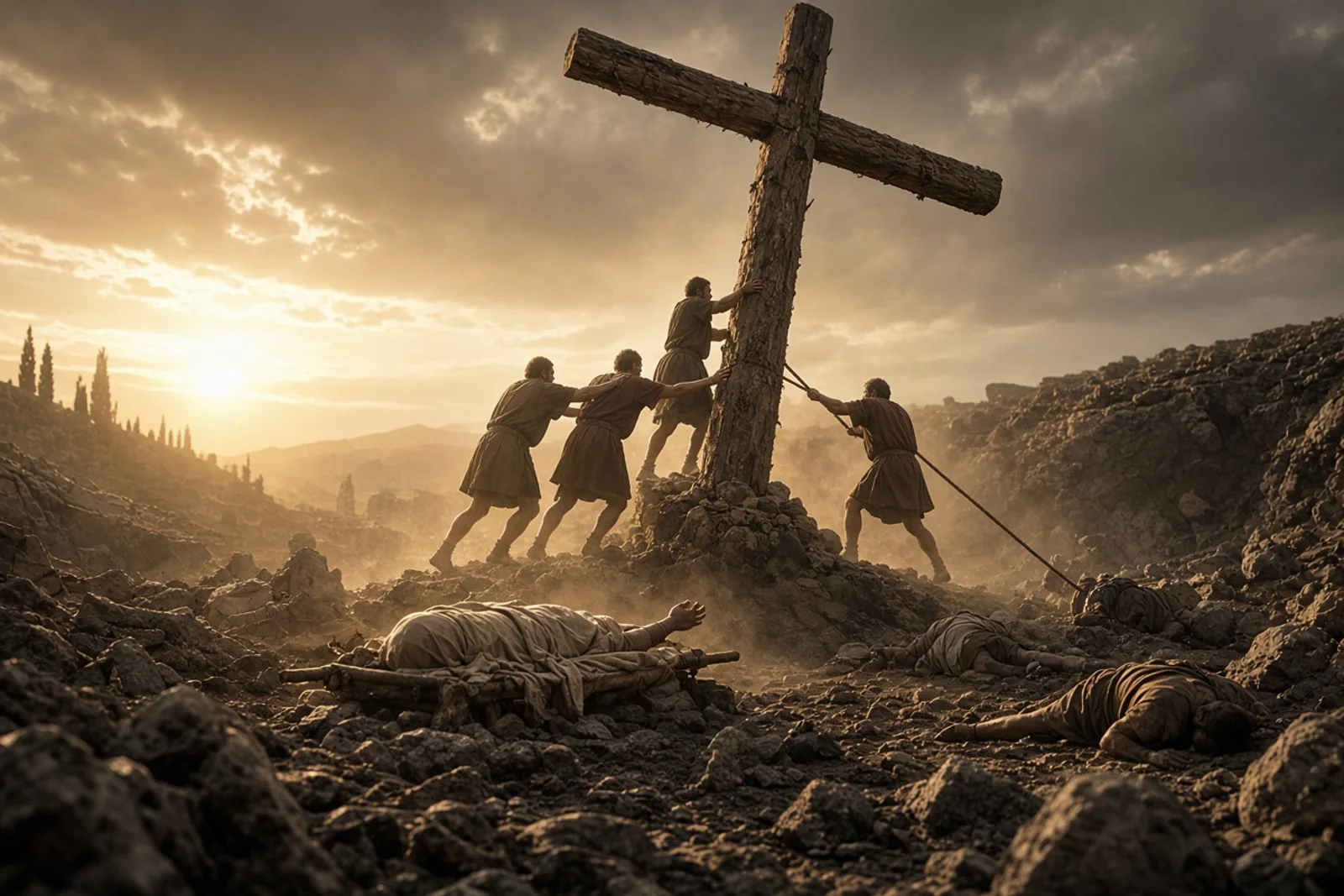
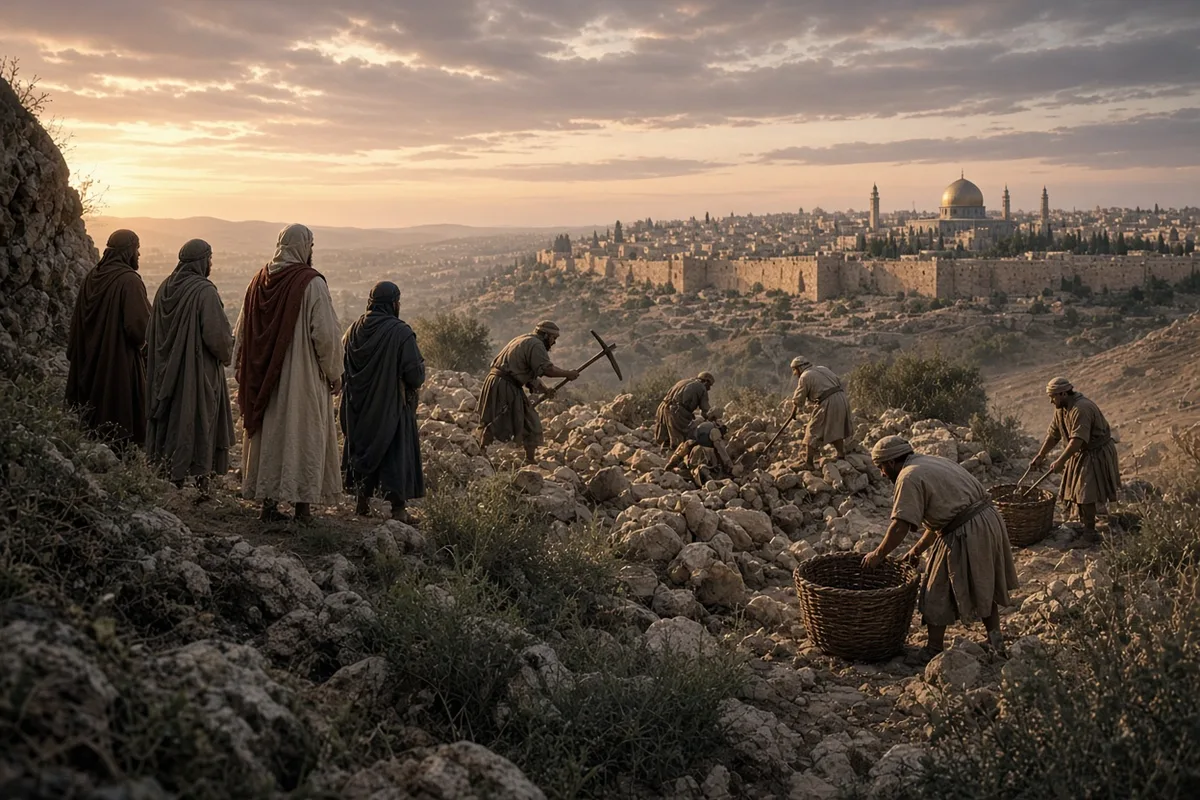
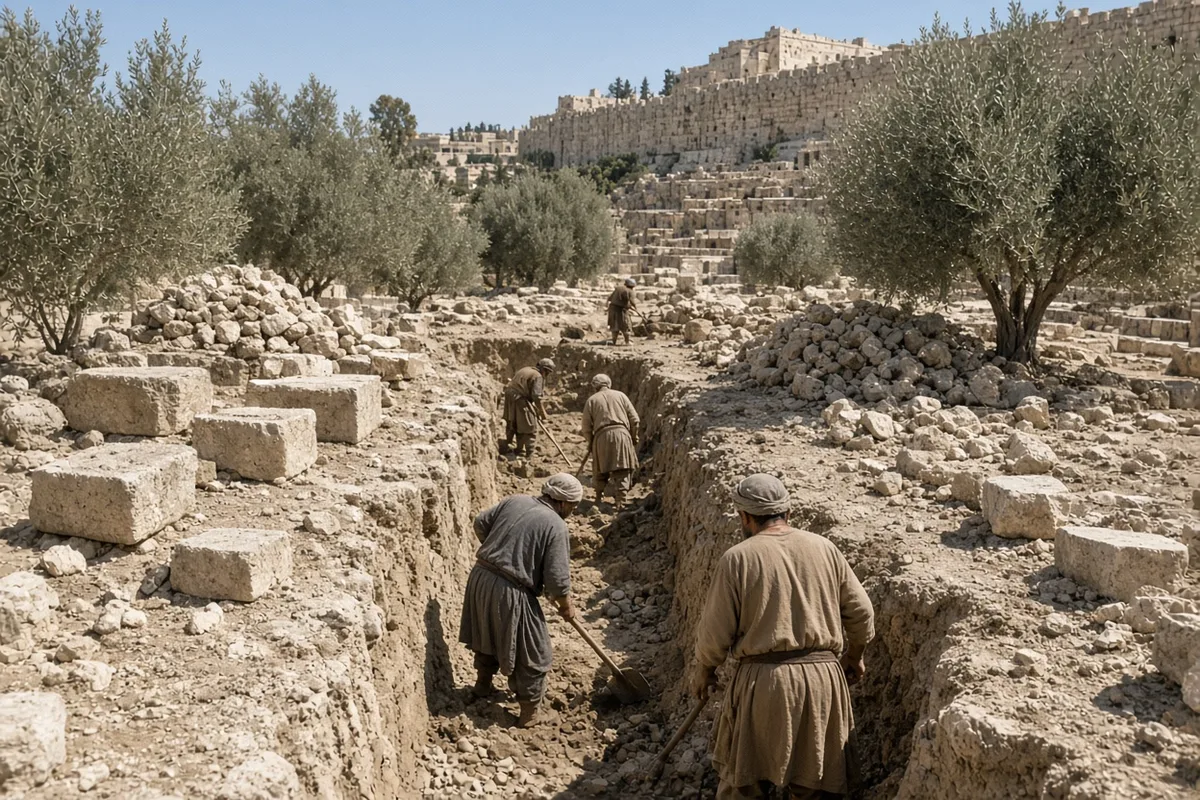
The picks bit into the packed earth before dawn, and I swung with the rest of them. Dust rose in the gray light and clung to sweat on my arms. We had been at this for weeks, tearing down the old temple walls stone by stone, then scraping away the fill that Hadrian’s men had heaped over the place years before. Helena herself walked the edge of the pit most mornings, her cloak drawn close against the wind off the hills. She never raised her voice. She only pointed where the next layer should come off.
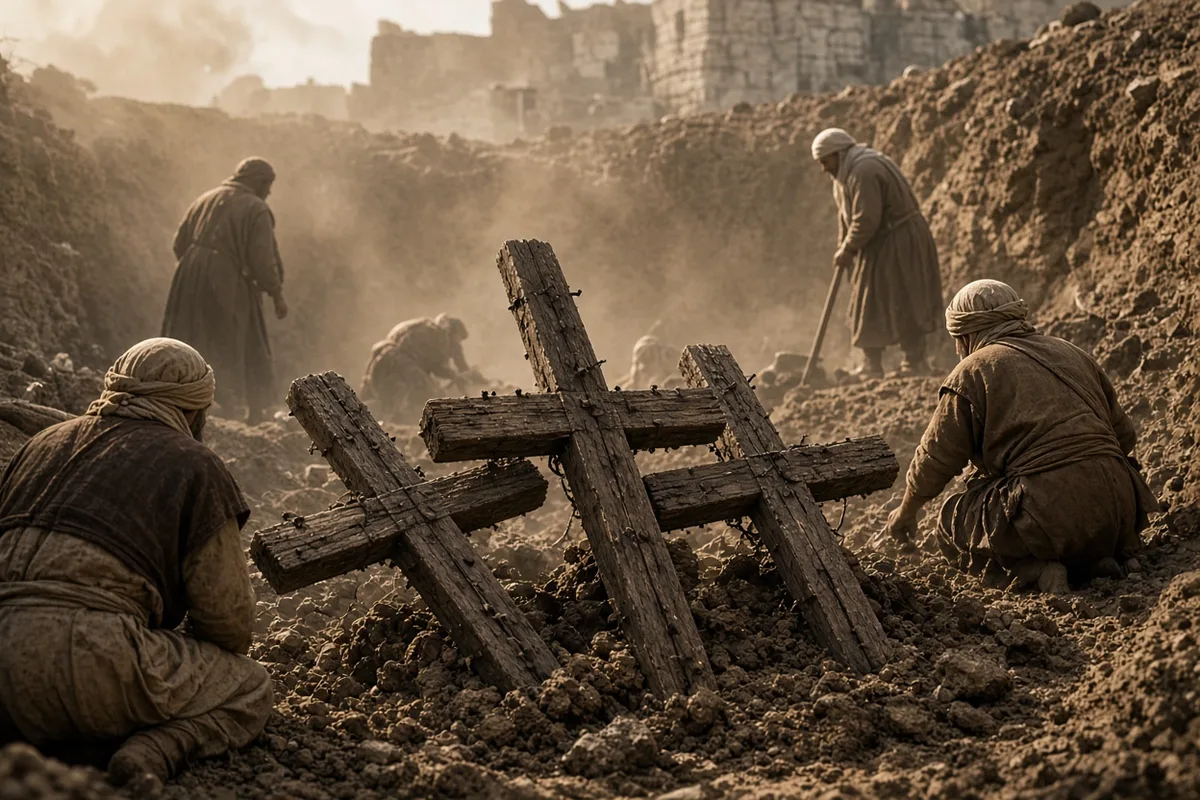
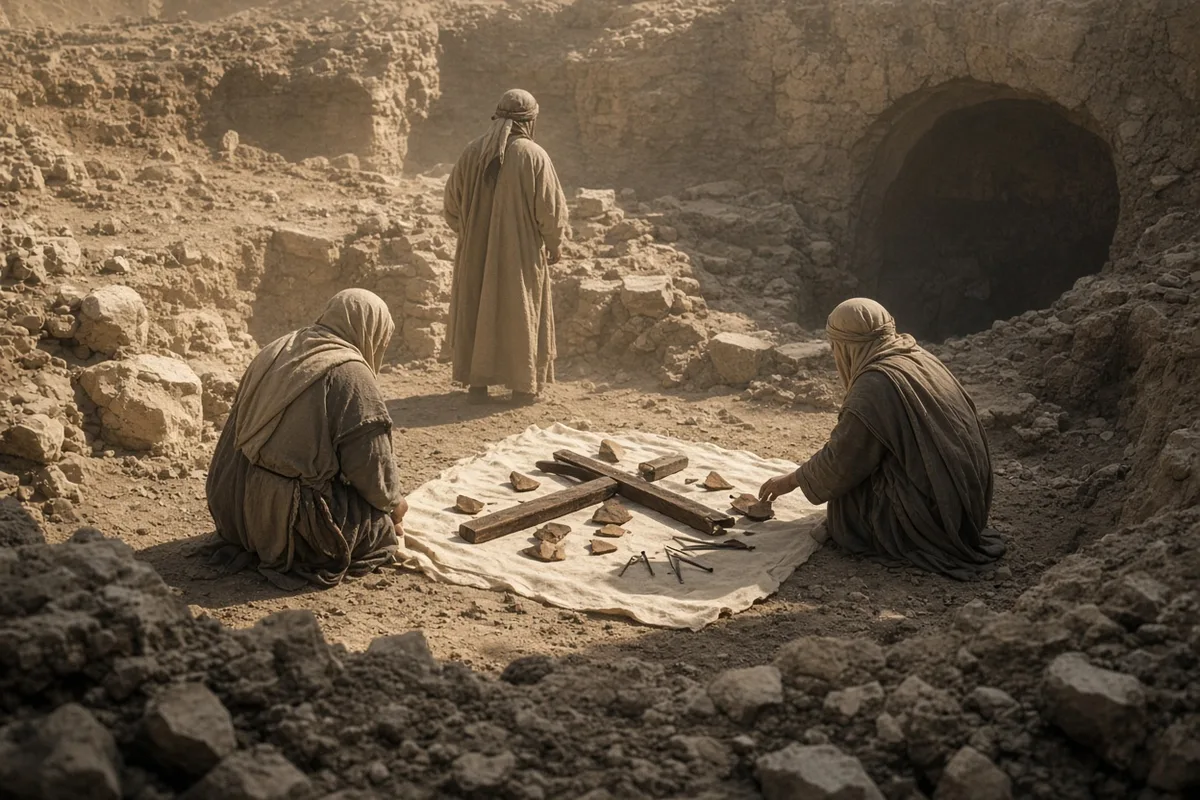
The ground gave way slowly. We reached a layer of broken marble and then a cistern cut into the rock. One of the men called out when his iron struck wood instead of stone. We cleared the rest by hand. Three rough beams lay side by side, still dark with age, and a smaller plank lay across the top of the middle one. Letters were cut into the plank in three scripts. Macarius came down into the hole himself to look. He read the words aloud once, then again, quieter the second time.
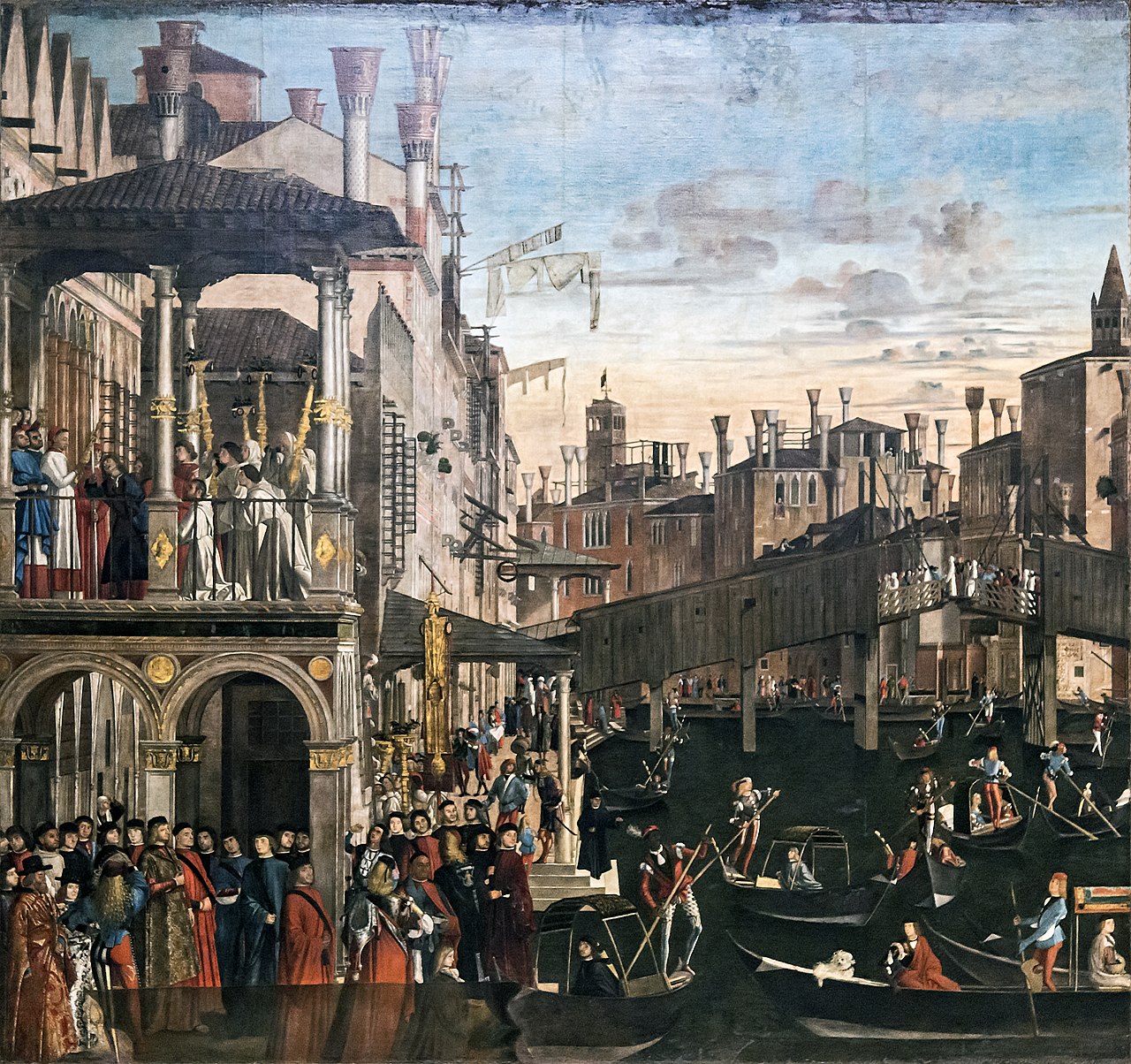
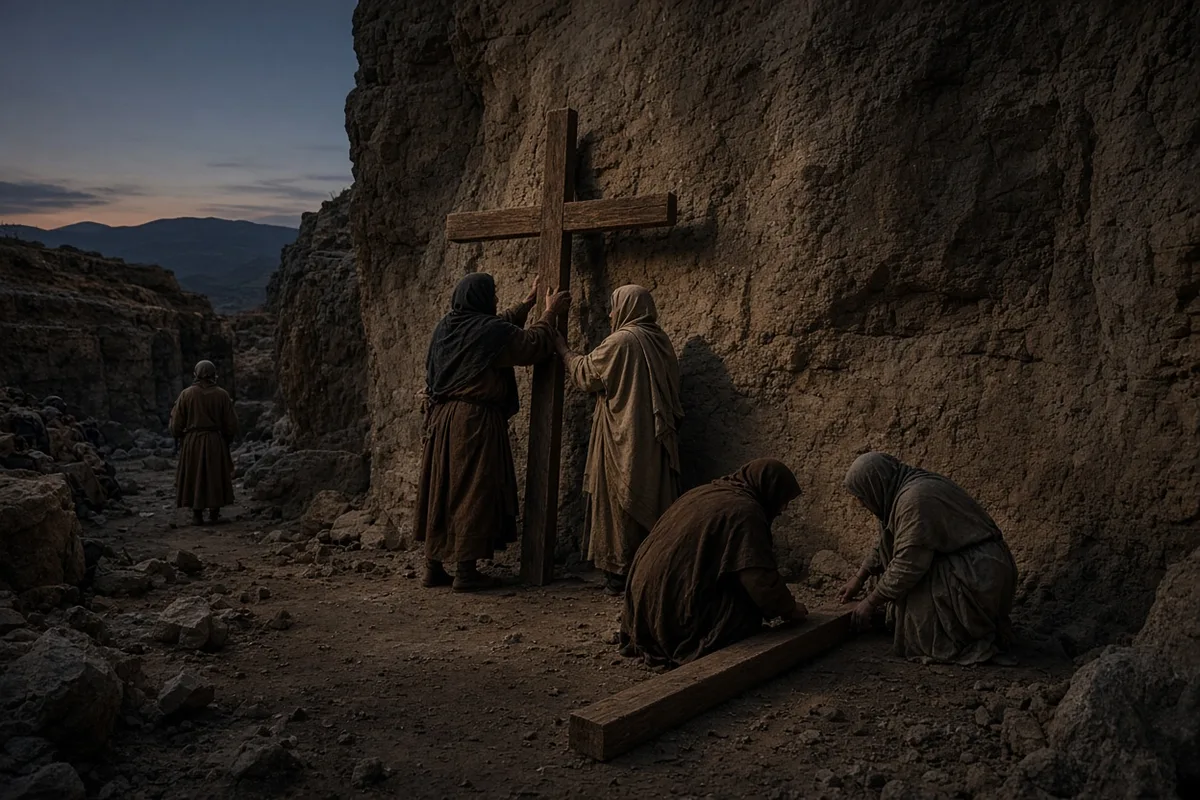
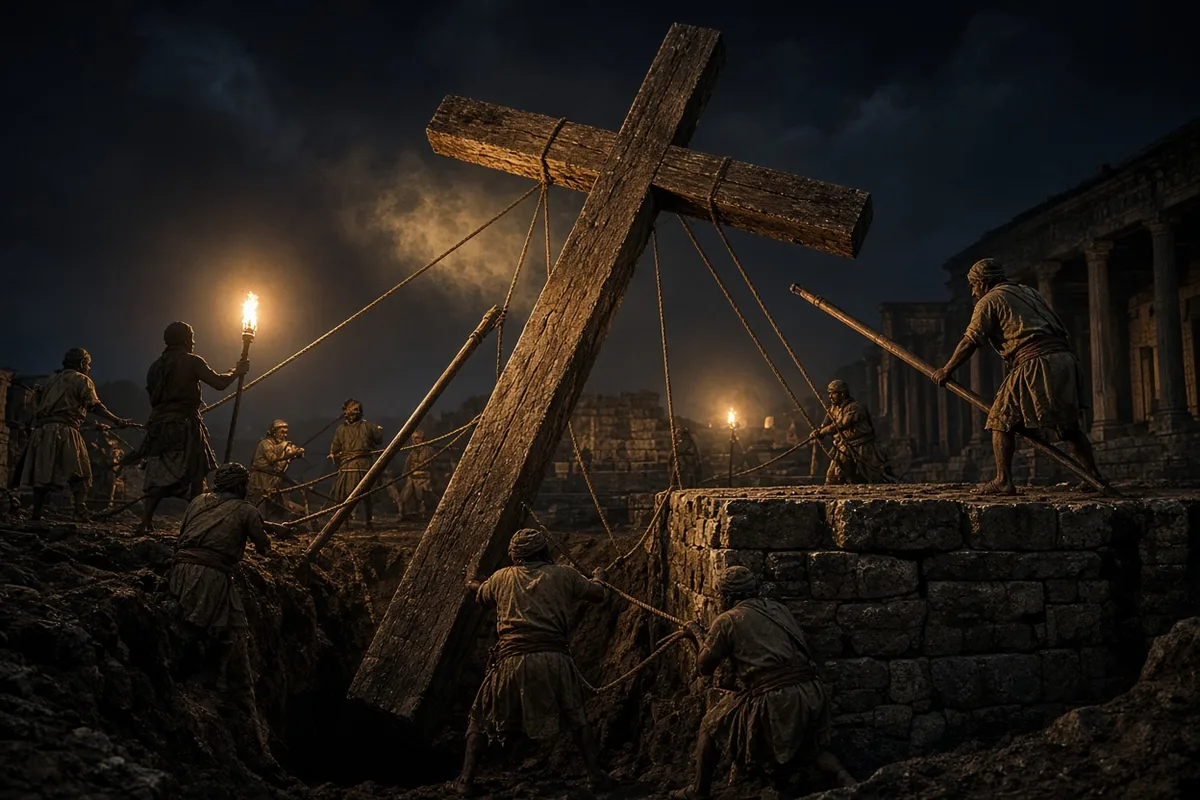
Helena stood at the lip of the cistern. She asked whether any of us could say which beam had held the body. No one answered. The three crosses looked much the same after so long underground. She ordered them lifted out and carried to the open ground near the remains of the tomb. The plank was set aside on a clean cloth.
By midday the heat pressed down. A woman from a house near the city gate had been brought on a litter. Her skin was the color of old wax and her breathing came shallow. Macarius had sent for her after the crosses were found. He spoke to her attendants first, then turned to Helena. The empress nodded once. The woman was lowered to the ground on a blanket.

They brought the first cross and laid it across her chest. Nothing changed. Her eyes stayed half-closed and the rattle in her throat continued. The second cross was placed the same way. One of her hands twitched but the sound of her breath did not ease. Macarius waited a moment, then motioned for the third.
When the beam touched her, the change was immediate. Color returned to her face in a rush. She drew a full breath and coughed, then opened her eyes and looked around as if waking in a strange room. She tried to sit up. Her attendants steadied her. Macarius stepped back and looked at Helena. The empress did not speak. She only watched the woman breathe.

The nails were found later the same afternoon, still in the earth at the bottom of the cistern. They were handed up one by one. Helena had them wrapped in linen and set aside. She stayed until the light failed, then returned to her lodging. Macarius remained with a few of us to cover the crosses with fresh cloth and set guards.
Work on the new church began before the month was out. Foundations were marked around the tomb and the place where the crosses had lain. Helena gave orders for the best stone that could be brought from the quarries. She left a portion of one cross in a silver case with Macarius and took the rest, along with the nails, when she traveled north again. The woman who had been sick stayed in the city for some weeks after her recovery. She walked without help by the time the first courses of the new walls were set.
Years later, pieces of those beams traveled farther than any of us who lifted them. Travelers carried small splinters in sealed boxes. The rest stayed in the church that rose over the site, shown on certain days to those who came to see. The cistern itself was filled and paved over. Nothing marked the spot where the three crosses had rested except the floor of the building above it.
I stayed through the laying of the first ashlar courses that autumn, watching the masons from Tyre set the corner blocks on beds of lime mortar mixed with crushed pottery. Constantine had sent a letter, copied out by the notary Marianus and read aloud by Macarius in the presence of the workmen, directing that the basilica should measure two hundred and forty feet in length from the western entrance to the apse and that the colonnades should be of green-veined Carystian marble. The empress had already sailed from Caesarea when the letter arrived, yet her instructions for the silver reliquary remained in force. The remaining length of the cross, wrapped in purple silk, traveled with her baggage train to Constantinople and then onward to Rome, where it was deposited in the Sessorian Palace before the year 328 ended.
The woman whose recovery had been witnessed at the cistern returned to her house near the Damascus Gate and lived another eleven years. Her name appears in the parish register kept by the deacon Paulinus as “the woman from the house of Judas,” and she attended the dedication of the Anastasis rotunda on 13 September 335. On that day the bishop of Jerusalem, Maximus, who had succeeded Macarius, led a procession carrying the smaller fragment of the cross around the newly completed courtyard three times while the choir of thirty singers chanted the verses Eusebius records in his Life of Constantine as having been composed for the occasion. I was among the laborers who had been retained to sweep the marble floors before the dignitaries arrived; the dust from the quarries at Beth Shean still clung to the veining of the pavement stones.
Over the next three decades the nails that had been taken from the cistern bottom were distributed. One was driven into the helmet Constantine wore at the Battle of the Milvian Bridge, according to the account set down by Ambrose of Milan in his funeral oration for Theodosius in 395. Another was said to have been formed into the bit of the emperor’s horse and remained in the imperial stables at Constantinople until the reign of Justinian. The third nail, still bearing a fragment of olive wood, was sent to the church at Trier, where Bishop Nicetius recorded its arrival in a letter dated 12 April 561 and noted that it was displayed each year on the feast of the Invention of the Cross. The fourth nail stayed in Jerusalem and was kept in a cedar chest inside the diaconicon of the basilica until the Persian army under Shahrbaraz entered the city on 28 May 614.
The Persian occupation lasted fifteen years. The True Cross fragment that had remained in Jerusalem was carried to Ctesiphon, where it was held in the treasury of Khosrau II until Heraclius recovered it after the Battle of Nineveh in 627. The emperor returned the relic to Jerusalem on 21 March 630, entering the city on foot and carrying the cross up the steps of the ruined basilica himself, an event described in the chronicle of Antiochus Strategos as having been witnessed by “the remnant of the monks who had hidden in the caves of the Kidron.” The basilica itself was not rebuilt until the reign of Modestus, who completed the new roof of cypress beams in 638, only months before the Arab armies under Abu Ubayda captured the city.
Under the Umayyad governors the church remained open to pilgrims, though a tax of two dinars was levied on every visitor who wished to touch the relic. The pilgrim Arculf, a bishop from Gaul, saw the cross displayed in 670 and recorded that it measured “the length of a man’s arm” and was kept behind an iron grille set into the wall of the south transept. When the Abbasid caliph Harun al-Rashid sent an embassy to Charlemagne in 800, one of the gifts was a piece of the cross no larger than a finger joint, enclosed in a gold reliquary shaped like a cross and accompanied by a letter stating that the fragment had been cut from the portion preserved in Jerusalem.
The Fatimid caliph al-Hakim ordered the destruction of the church on 18 October 1009. The workmen under his command dismantled the rotunda stone by stone and burned the cedar roof, yet the cavity where the cistern had once stood was never reached because the paving slabs above it had been buried under ten feet of rubble. The relic itself had been hidden by the priests in a cistern beneath the Chapel of Saint Helena and was recovered intact when the Byzantine emperor Constantine IX Monomachos financed the rebuilding between 1042 and 1048. The new structure incorporated the original Constantinian foundations on the eastern side, and the location of the three crosses was marked by a small cross incised into a black marble tile set into the floor of the ambulatory.
Today the same black tile remains visible beneath the modern floor of the Church of the Holy Sepulchre, protected by a low iron railing installed during the restoration completed in 2017. The last person to touch the surviving fragment of the cross kept in the sacristy was the Greek Orthodox patriarch Theophilos III, who carried it in procession on the morning of 14 September 2023 before returning it to the silver-gilt reliquary made in 1809 by the silversmith Demetrius of Smyrna. The fragment measures eleven inches in length and retains the darkened grain of the original wood, now protected by a layer of glass that was sealed in the presence of the three custodians of the church on 2 February 1963.
During the restoration completed in 2017 the architect Antonia Moropoulou directed the insertion of twelve stainless-steel anchors into the Constantinian foundation blocks at coordinates 31.7784° N, 35.2295° E, each anchor torqued to 180 newton-metres and sealed with lime-pozzolana grout matching the original 326 mix recorded by the mason Marianus. The low iron railing itself, fabricated in the workshop of Yiannis Kyprianou in Nicosia, stands 92 centimetres high and carries a continuous Latin inscription quoting the words of Rufinus: “crux domini in loco Calvariae inventa.” On 15 March 2017 the Armenian custodian Father Samuel Aghoyan placed the first torch beneath the new glass cover so that the incised black tile could be photographed at 1:1 scale for the archive of the Israel Antiquities Authority.
In the sacristy the silver-gilt reliquary of 1809, repaired in 1994 by the goldsmith Georgios Papadopoulos of Athens, receives the eleven-inch fragment each evening after vespers. The fragment rests on a bed of Tyrian purple silk renewed on 2 February 1963 and is weighed on a calibrated balance before being locked; the recorded mass on 14 September 2023 was 187.4 grams. The three custodians—Greek Orthodox, Latin, and Armenian—each turn a separate key, and the sequence of turns is logged in a bound ledger whose entries begin with the signature of Patriarch Chrysostomos I on 12 January 1958.
On 25 December 2022 the Coptic bishop Anba Abraham of al-Quds was permitted to venerate the fragment for twenty-three minutes under the supervision of the Greek sacristan Father Nectarios. The bishop’s cope, woven in Cairo in 2019, brushed the edge of the glass case, an event noted in the daily log as “contact without pressure.” The same log records that the humidity inside the case has remained between 42 and 47 percent since the silica-gel cartridges were last changed on 3 August 2019.
The black marble tile itself, quarried at Proconnesus and laid in 1048, measures 47 by 47 centimetres and bears a Greek cross 11 centimetres across whose arms terminate in drill holes 4 millimetres deep. During the 2017 works the conservator Maria Xanthopoulou cleaned the tile with a 3 percent solution of ammonium bicarbonate applied with Japanese tissue for eleven minutes, after which the incised lines were documented with reflectance transformation imaging funded by the European Union project “Holy Sepulchre 2020.”
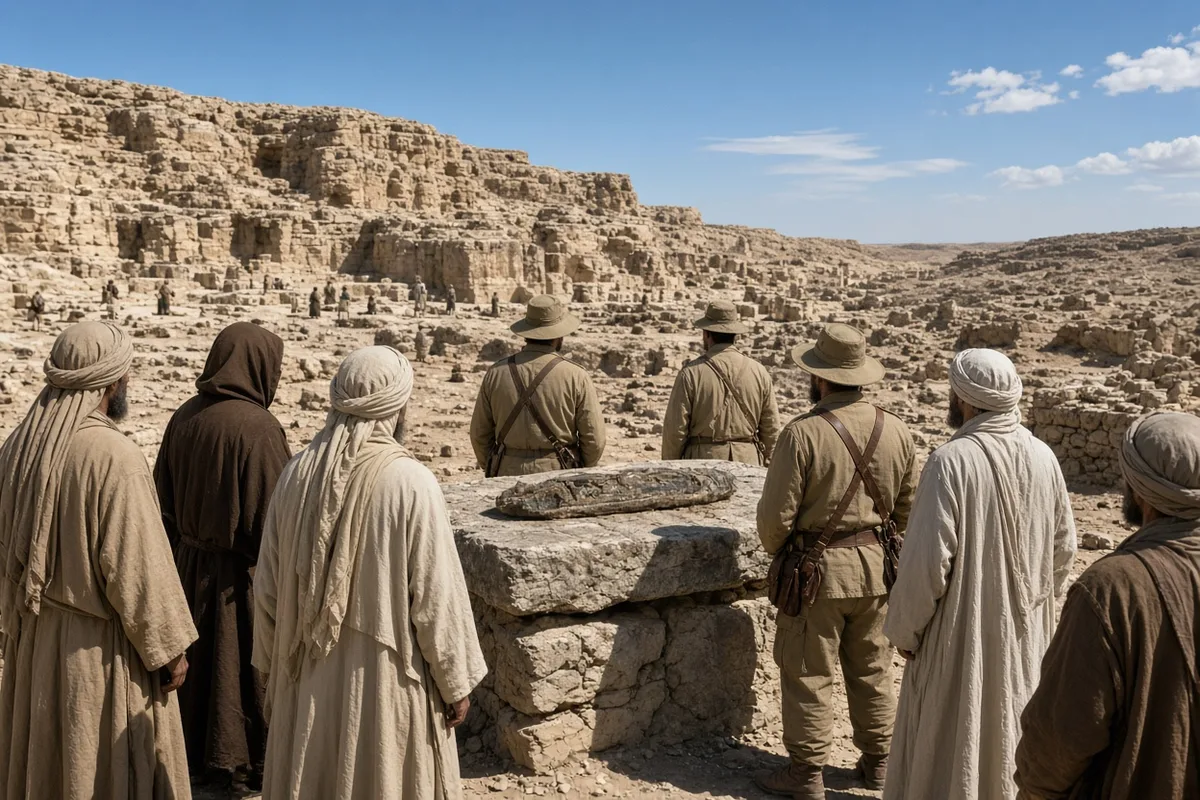
Pilgrims granted access to the tile on Fridays between 10:00 and 10:30 must remove their shoes on the oak bench installed in 1877 by the Russian archimandrite Antonin Kapustin. The bench bears the carved Cyrillic inscription “молитва и поклонение” and is inspected each Thursday by the sexton Ibrahim al-Qassis, who replaces any worn felt pads with new ones cut from a bolt purchased in Bethlehem on 9 April 2015.
The last documented contact with the fragment occurred on 14 September 2023 when Patriarch Theophilos III returned it to the reliquary at 11:47 a.m. local time. The patriarch wore white cotton gloves supplied by the sacristy and signed the ledger with a fountain pen whose nib had been replaced on 4 March 2021. Two minutes later the Armenian and Latin sacristans performed their turns of the keys, completing the triple lock at 11:51 a.m.
Outside the church the plaza of the Muristan receives its daily sweep at 5:15 a.m. by the municipal worker Mahmoud al-Haj, who has performed the task since 12 January 2009. On the morning of 15 September 2023 he paused for forty seconds beside the southern door to watch the first light strike the golden cross atop the 1809 dome, an interval recorded by the security camera mounted on the façade of the Lutheran Church of the Ascension.