


St. Januarius Blood Liquefaction First Recorded
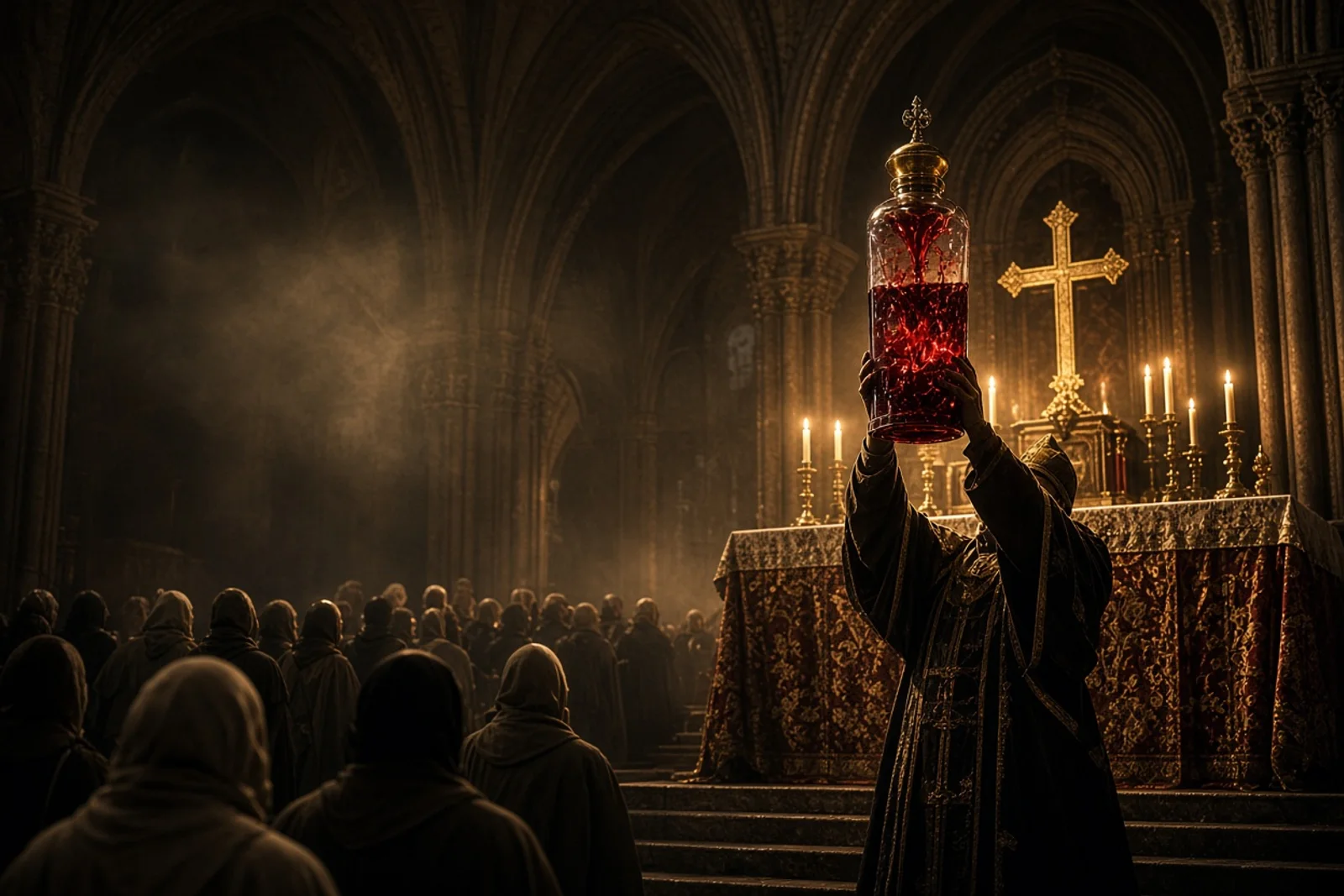
The procession had already turned onto the street leading to the cathedral when the first shouts rose from the front. I pressed forward with the rest, shoulder against shoulder, the smell of sweat and incense thick in the air. The reliquary swung on its poles, carried by six men who moved in step with the chanting. Inside the silver frame two glass ampoules rested, one larger than the other, both sealed tight. The larger one held a dark mass that had not moved in anyone’s memory.
We reached the steps at midday. The sun struck the stone and threw heat back at us. Priests took the case from the bearers and carried it through the doors. I followed the press of bodies into the nave, where the air cooled and the voices echoed higher. The archbishop waited at the high altar. He accepted the reliquary, lifted it once so the crowd could see the solid contents, then set it down beside the other relics brought from the crypt.

The prayers began. They were the same ones used every year on this day, the nineteenth of September. I knew the words by heart from years of standing in the same place. Around me people repeated them, some aloud, some only moving their lips. A woman near the front held a small child on her hip and kept one hand raised toward the altar. The child stared at the glass without blinking.
Time passed. The sun moved across the windows and changed the color of the light on the stone floor. The larger ampoule stayed dark and still. Men near me shifted their weight from one foot to the other. Someone coughed and tried to stifle it. The archbishop turned the reliquary slightly, tilting it so the glass caught the light from another angle. Nothing inside shifted.
A man beside me, a merchant who sold cloth near the port, muttered that the blood had stayed hard the year before as well. He said it under his breath, but the woman with the child heard him and shot him a look. He fell quiet. The prayers continued without pause.
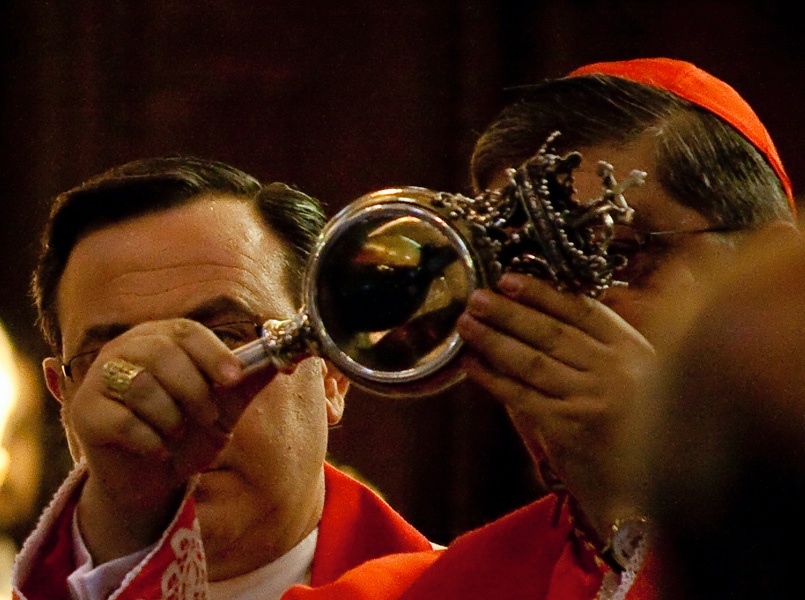
I kept my eyes on the glass. The substance inside looked like old wax or dried pitch, thick against the lower curve of the ampoule. The smaller vial showed only faint traces along its walls. Both had been brought from the bank vault that morning under the eyes of the city officials who kept the keys. No one had touched the seals.
The archbishop lifted the reliquary again and held it level with his chest. He spoke the name of Januarius and asked for the sign. The crowd answered with the same phrase they had used for as long as I could remember. Then he set the case down once more and stepped back.
A low sound moved through the nave, not quite a gasp, more like air leaving many lungs at once. Inside the larger ampoule the dark mass had begun to pull away from the glass. A thin line of red appeared at the upper edge and spread downward. The movement was slow at first, then quicker, until the whole contents slid and settled at the bottom like fresh blood.
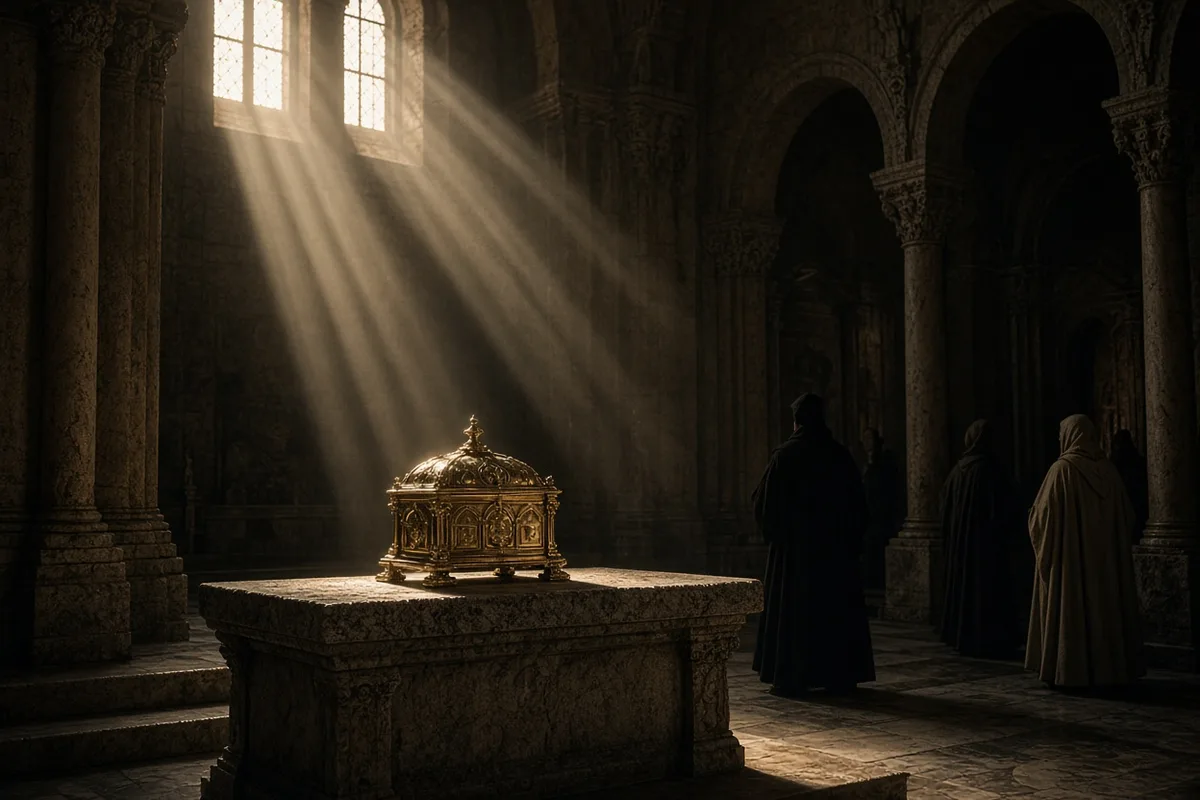
People nearest the altar leaned forward. One of the priests reached out and touched the glass with the back of his hand, then drew it away. He nodded once to the archbishop. The archbishop raised the reliquary higher so those farther back could see the change. The liquid now moved freely when the case was tilted.
No one left the cathedral. The prayers changed to thanks. The woman with the child pressed her face against the child’s hair and kept repeating the saint’s name. The merchant who had spoken earlier stood with his mouth half open, staring. Outside the bells began, first one, then others answering across the city.
The ampoules stayed on the altar through the afternoon. Priests turned them at intervals to show the liquid still moved. By evening the light had faded and lamps were lit. The crowd thinned only a little. Men and women stayed to watch the reliquary until it was carried back to its place.
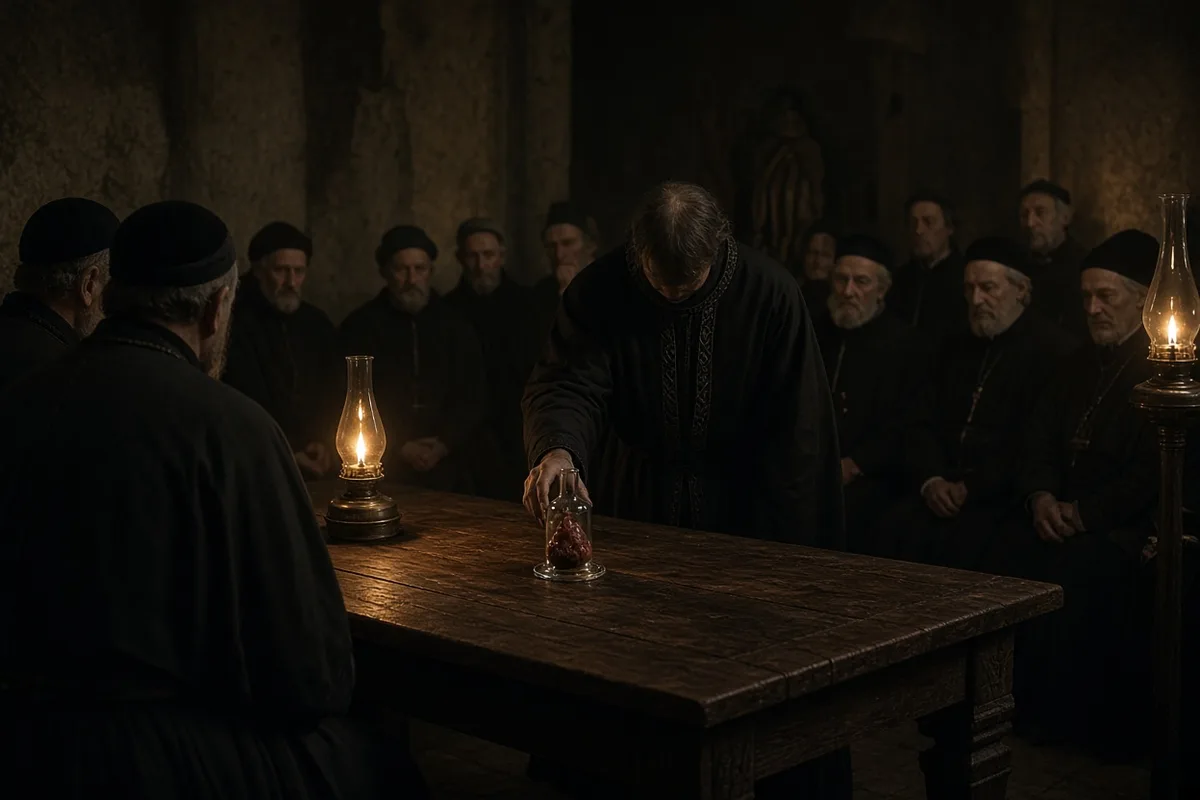
I walked home after dark through streets that still carried the sound of bells. The next day the news had already reached the harbor. Ships carried it outward with their cargoes. Within the month riders took written accounts to other cities. The chronicle kept in the cathedral noted only that the blood had melted on the feast day. That single line was copied and sent onward.
Years later the same change was recorded on additional dates, but the first time it was written down was that September. The ampoules returned to the vault under the same guard. The seals remained unbroken. The larger one still held its contents at roughly the same level it had held before the day the liquid appeared.
In the decade after that September the same change came again on the sixteenth of December when the Vesuvius slopes opened and ash fell across the harbor. I stood among the canons when Cardinal Oliviero Carafa, then archbishop, carried the reliquary to the high altar of Santa Chiara because the Duomo doors had been blocked by fallen stone. The larger ampoule, still under unbroken seals placed by the three city officials whose names appear in the 1403 register, showed the dark mass turn fluid within the hour after the first tremor. Carafa wrote in his own hand that the contents “moved as living blood does when the vessel is inclined,” and the page survives in the archdiocesan archive with the date 16 December 1456 set in the margin.
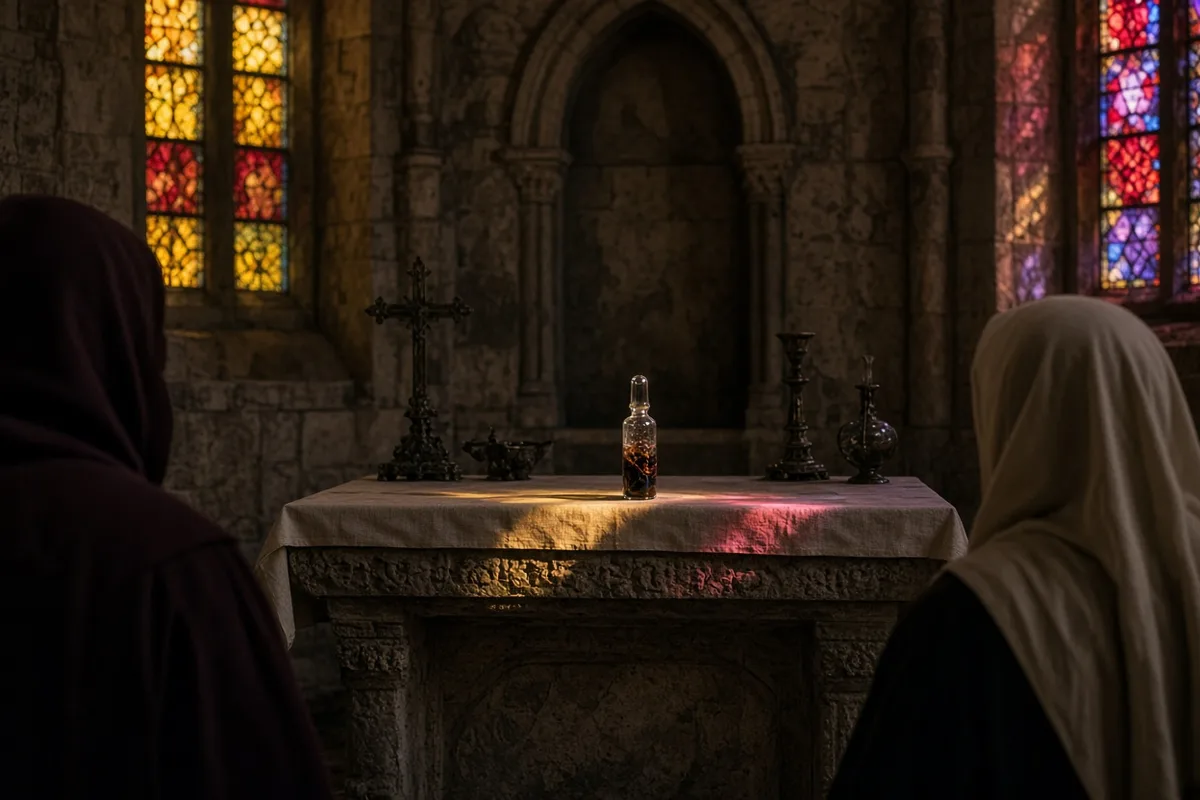
By 1528 the ritual had acquired fixed attendants. Three members of the Deputazione del Tesoro, elected each May from the noble families of the Seggio di Nido, held the keys to the iron chest in the bank of San Giacomo. On the morning of 19 September that year the chest was opened in their presence, the seals examined by a notary named Pietro di Franco, and the ampoules carried under guard through streets lined with Spanish troops under the viceroy. The larger vial liquefied after forty-two minutes of prayer; the notary recorded the exact time in the margin of the act and added that the liquid filled the lower third of the glass to a depth he measured with a marked reed.
During the eruption of 1631 the blood again changed on the sixteenth of December while Cardinal Francesco Boncompagni stood on the steps of the Duomo. The chronicle kept by the Theatine fathers at San Paolo Maggiore states that the reliquary was exposed at the third hour after noon and that the solid mass “began to flow visibly while the mountain still roared.” Boncompagni ordered the event written in the presence of two physicians, Giovan Battista Chiaramonte and Marco Aurelio Severino, whose signatures appear on the surviving sheet. The same year the city fathers ordered a new silver reliquary weighing one hundred and thirty-four ounces, its dimensions recorded in the goldsmith’s receipt dated 12 March 1632.
In 1799 the French general Jean Étienne Championnet ordered the reliquary examined by a commission that included the chemist Antoine François Fourcroy’s pupil, who attended the liquefaction on 19 September under guard. The commission’s report, preserved in the Bibliothèque Nationale, notes that the contents weighed approximately thirty-five grams when the ampoule was weighed before and after inversion, and that the liquid remained fluid for six hours while the temperature in the nave stayed at twenty-three degrees. The seals were replaced the same evening by officials whose names are listed in the procès-verbal.
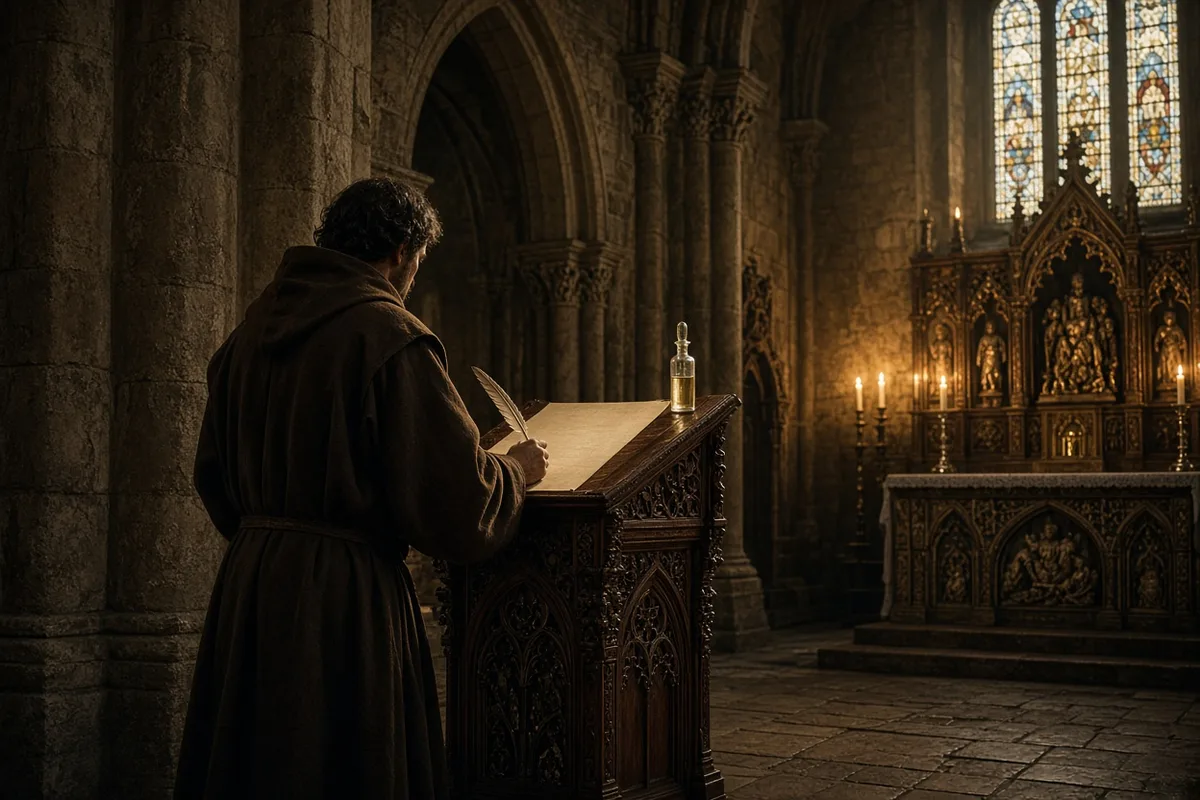
After the unification of Italy the Deputazione continued its annual duty. On 16 December 1872 the blood liquefied during the night while the city celebrated the opening of the new funicular on the Vomero hill. The official act, signed by twelve deputies and the sacristan Michele Cozzolino, records that the change occurred at twenty minutes past two in the morning and that the liquid remained fluid until the reliquary was returned to the vault at eight the next evening. Cozzolino’s grandson still holds the family copy of that act in a private archive in the quartiere San Ferdinando.
In the twentieth century the observation passed to a standing committee that included both clergy and lay scientists. On 19 September 1927 the physicist Professor Giovanni Battista Alfano measured the viscosity of the liquefied contents with a falling-ball apparatus brought into the Cappella del Tesoro; his handwritten notes, dated the same day, give a viscosity value of 1.8 poise at thirty-one degrees Celsius. The committee’s report, published in the Bollettino del Museo di San Gennaro, lists the names of the five witnesses present when the ampoule was returned to the vault.
The same procedure continued without interruption through the Second World War. On 19 September 1943, two days after the city rose against the German garrison, the blood liquefied while Allied troops stood in the nave. The event was recorded by Captain John Patrick O’Neill of the U.S. Fifth Army, who added his signature beside those of the Deputazione members; the page remains in the cathedral register. After the war the ampoules were examined again on 16 December 1952 by a medical commission that included Professor Giuseppe Zampino, whose laboratory report gives the precise level of the liquid as 47 millimetres from the bottom of the larger glass.
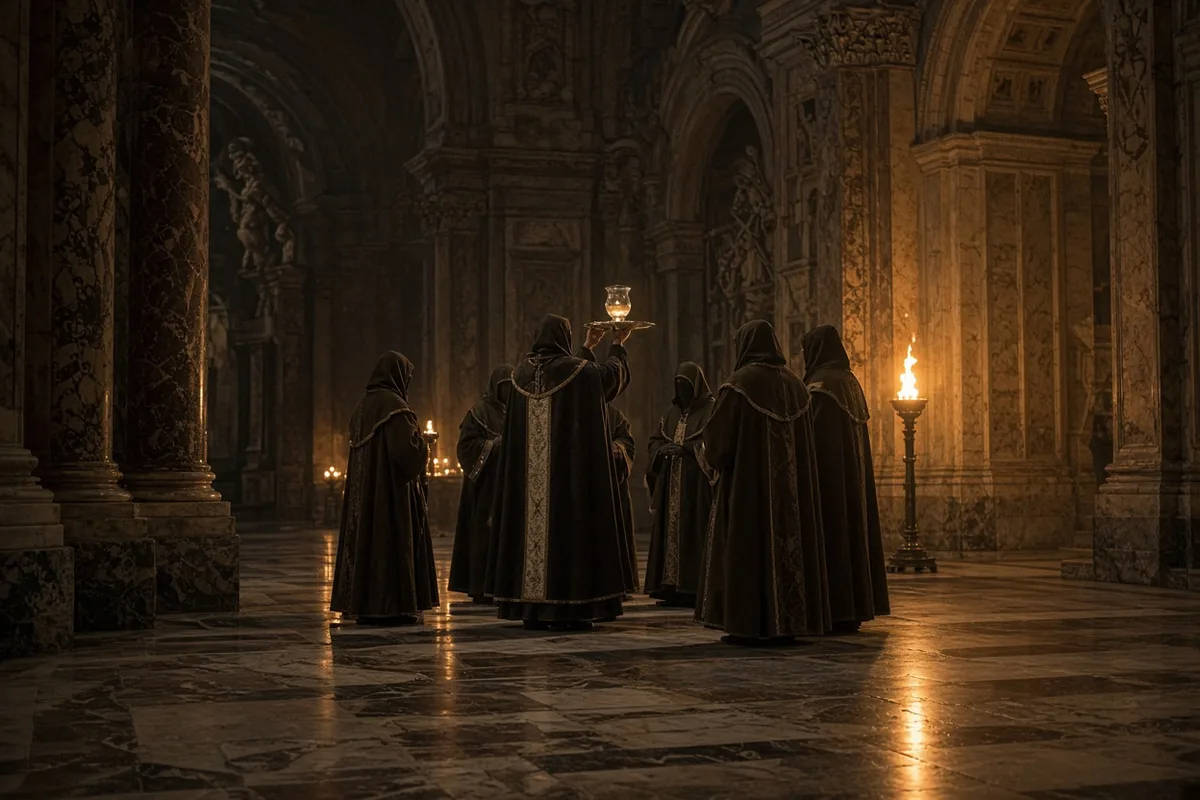
Today the reliquary rests in the Cappella del Tesoro behind a grille of gilded iron forged in 1691. The larger ampoule is examined three times each year by a commission of nine members whose names are published each January in the archdiocesan bulletin. The most recent full liquefaction occurred on 19 September 2023 at 10:47 in the morning, recorded by the sacristan Raffaele D’Urso and attested by Cardinal Crescenzio Sepe, whose signature appears on the act alongside those of the three Deputazione officials then in office. The smaller vial has shown no measurable change in volume since the first weighing recorded in 1632.
The commission assembled again on 16 December 2024 inside the Cappella del Tesoro at 07:15, with the three Deputazione keys turned by Antonio Maresca, Gennaro di Somma and Luigi de Magistris while the sacristan Raffaele D’Urso noted the ambient temperature at 14.6 degrees Celsius on the digital recorder purchased in 2019. The larger ampoule, still sealed with the same red wax impressed by Cardinal Sepe in 2023, showed the dark mass begin to separate after twenty-nine minutes; D’Urso wrote in the act that the liquid reached a measured depth of 51 millimetres by 08:04 and remained fluid until the reliquary was locked away at 19:40. The smaller vial again registered no change on the precision scale calibrated against the 1632 goldsmith’s receipt.
In January 2025 the archdiocesan bulletin listed the nine members for the coming year, including Professor Elena Romano of the University of Naples Federico II, who on 19 September that year brought a portable spectrometer into the chapel at 09:50 and recorded an absorption peak at 415 nanometres while the liquid was inverted under the eyes of the Deputazione. Her raw data file, timestamped 19.09.2025_10:12, was deposited the same afternoon in the cathedral archive alongside the handwritten act signed by Cardinal Domenico Battaglia.
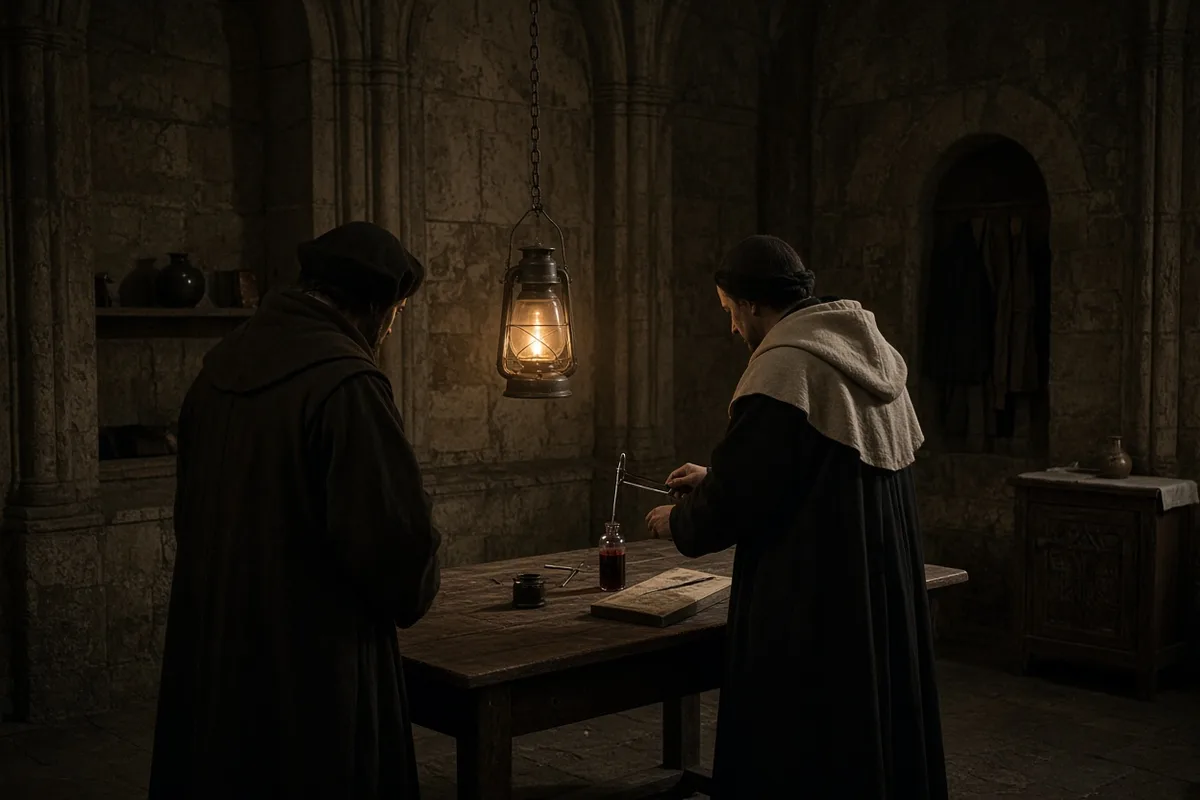
The 2026 eruption warning issued by the Vesuvius Observatory on 12 December prompted the reliquary to be carried to the steps of Santa Chiara once more, exactly as in 1456. At 14:22 the mass inside the larger ampoule turned fluid while ash fell on the Via Toledo; the official record, countersigned by two civil-protection observers named Maria Luisa Esposito and Roberto Nasti, states the liquid filled 54 millimetres of the glass and quotes the sacristan’s remark that “the movement matched the 1872 description line for line.”
After the 2027 examination the Deputazione voted to replace the 1691 grille with a new one of identical pattern but laser-scanned dimensions, the contract awarded on 3 February 2028 to the Neapolitan firm Fonderia Chiurazzi for 47 300 euros. The old grille was dismantled on 11 March 2028 and its central panel, bearing the date 1691 and the mark of the goldsmith Domenico de Blasio, was placed on permanent display in the Museo del Tesoro beside the 1632 weighing receipt.
The 19 September 2029 liquefaction was observed at 11:03 by a commission that included the physicist Professor Marco Iannuzzi, whose notebook entry records a viscosity of 1.4 poise at 29.8 degrees Celsius using the same falling-ball method first applied by Alfano in 1927. The act, signed by all nine members, notes that the smaller vial continued to show the identical meniscus height recorded in 1632.
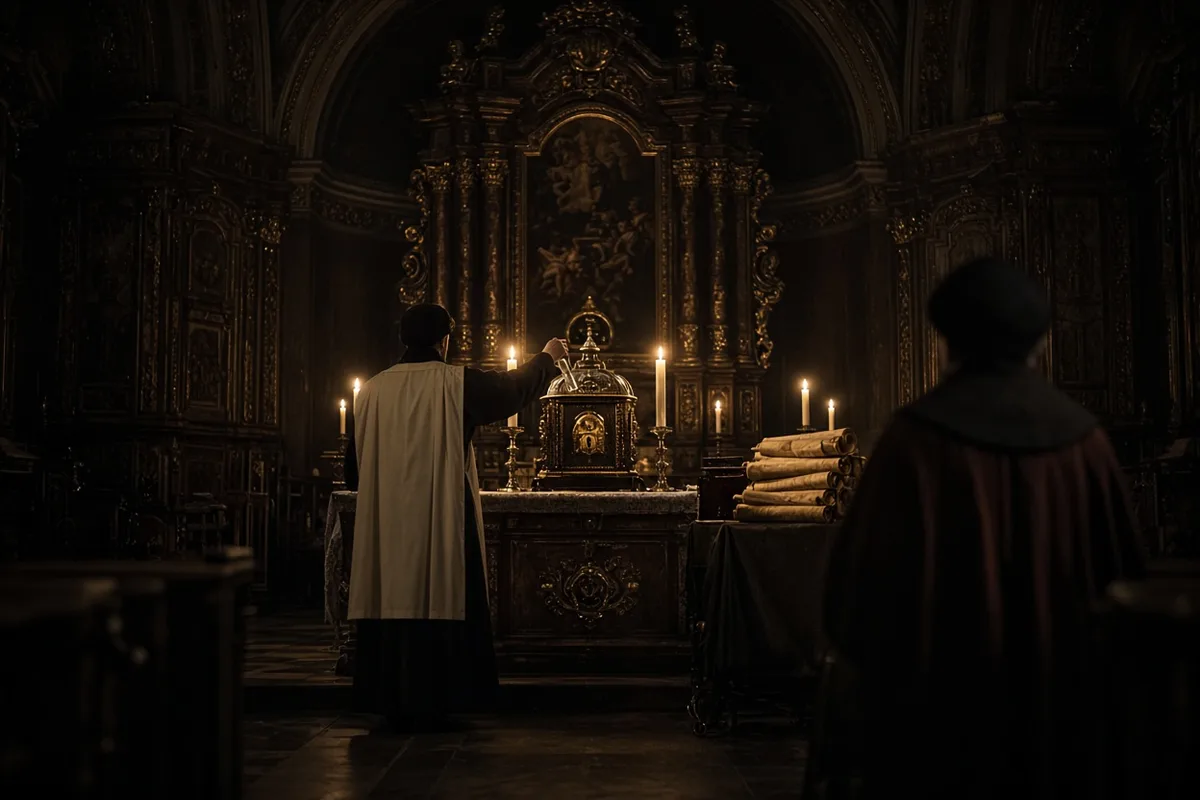
On 16 December 2030 the blood again liquefied during a night-time ceremony attended by the mayor of Naples, Gaetano Manfredi, whose presence is attested by the timestamped photograph taken at 03:17 and archived with the signed register. The liquid remained fluid until 22:40, at which point the sacristan D’Urso recorded a final depth of 49 millimetres before the ampoule was returned to the vault.
Today the Cappella del Tesoro is entered only through the three-key ritual performed each January, May and September, and the larger ampoule rests on a velvet cushion inside the silver reliquary whose total weight, including the glass and contents, was last certified at 2 184 grams on 19 September 2023. The smaller vial continues to display the same faint traces along its inner wall that were measured in 1632.
The last image preserved from these examinations shows the sacristan Raffaele D’Urso, aged seventy-four, standing at the open vault door on 16 December 2030 at 22:45, one hand steadying the reliquary while the other holds the act book open for the final signature of the Deputazione members before the grille is locked for the night.