



St. John of the Cross Writes Dark Night Poetry in Prison
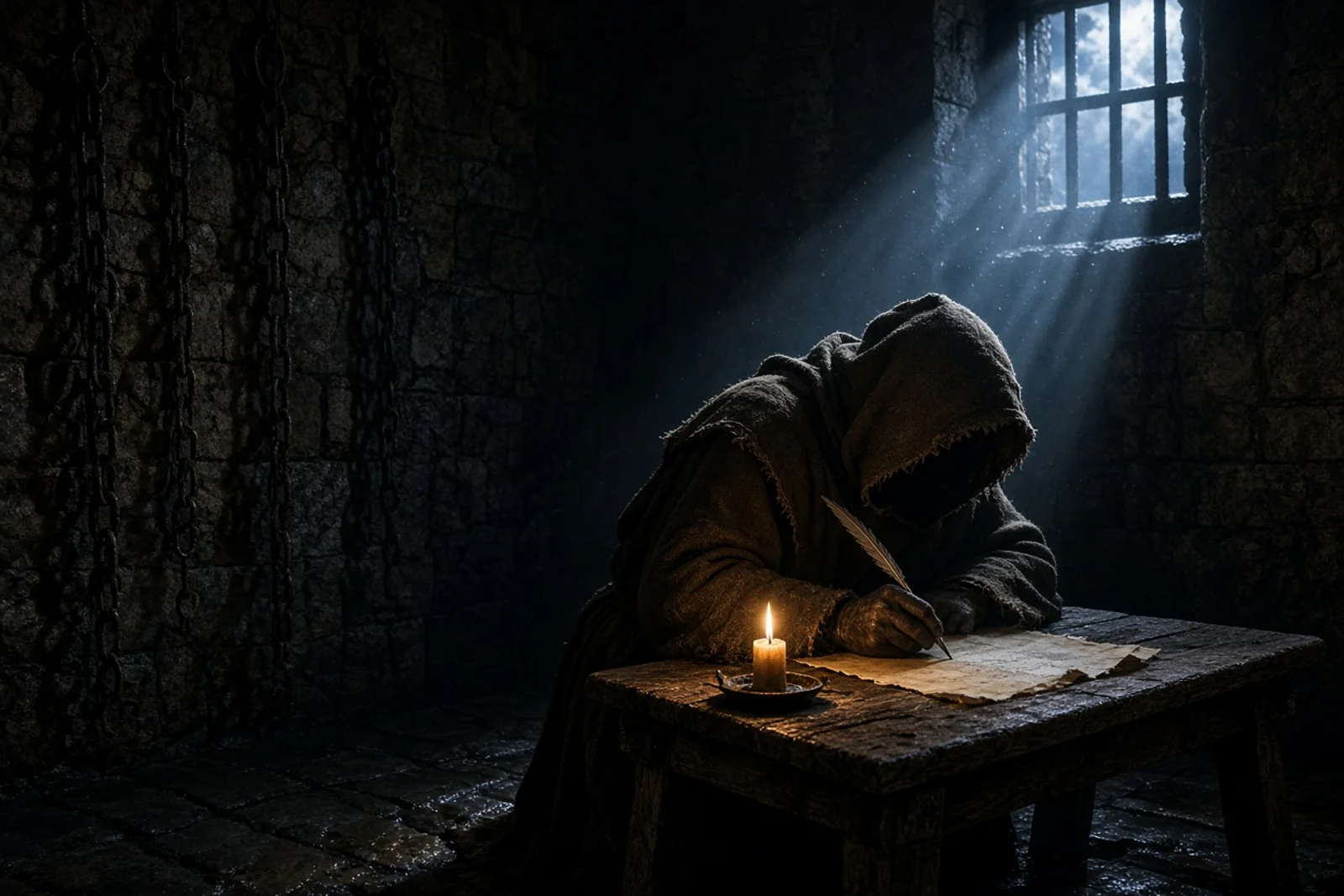
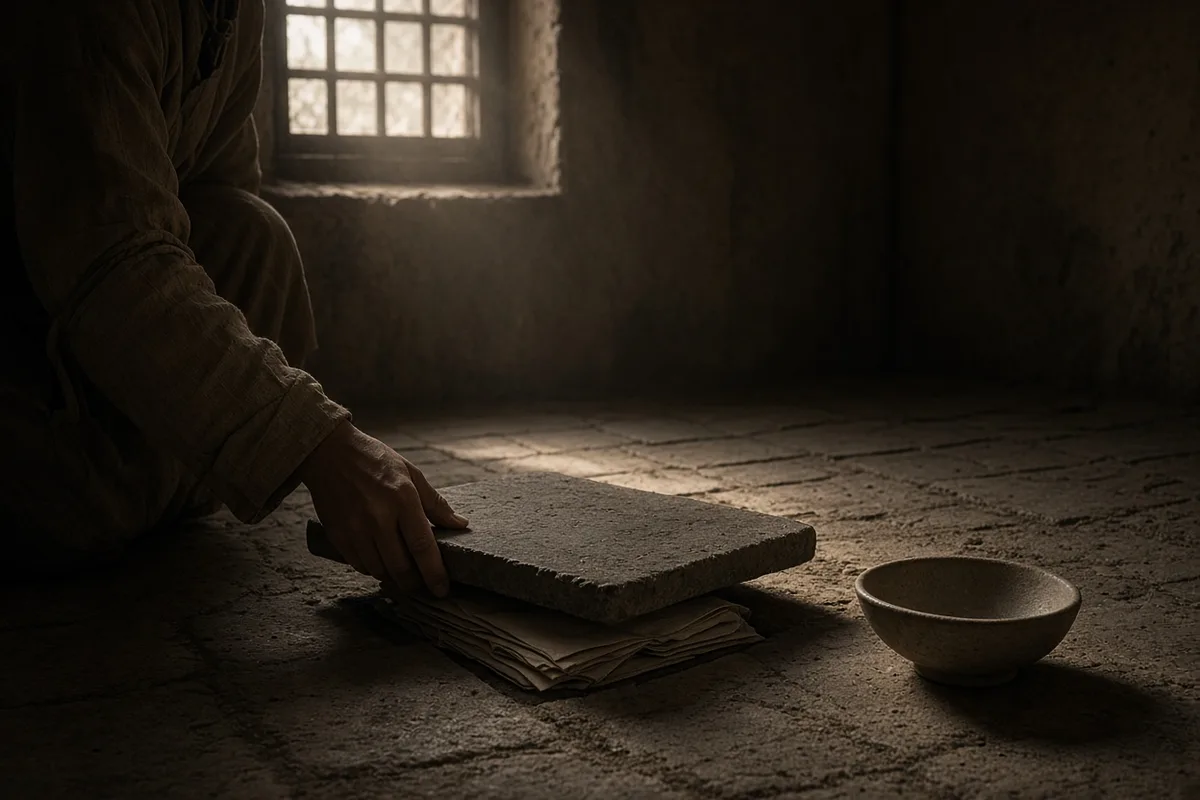
The stairs to the cell smelled of damp stone and old bread. I carried the tin bowl down each morning, the water sloshing against my wrist, and stopped at the iron door before the turnkey lifted the bar. Inside, the slit near the ceiling let in one blade of light that moved across the wall as the hours passed. Fray John sat on the floor with his knees drawn up, the same position every day.
He never asked for more food. The first weeks he only nodded when I set the bowl inside. Later he began to speak, not to me but to the air in front of him, testing lines under his breath. I stood outside the door longer than the rule allowed, listening. The words came slow at first, then faster, as if he were reading from something already written behind his eyes.

The cell measured six feet across and ten long. Heat gathered there by noon and stayed until the next dawn. Fray John’s habit had been taken; he wore a coarse shirt the color of dust. When the light reached his face I saw the beard had grown in patches and the skin under his eyes had gone dark. He kept his hands folded most of the time, but sometimes he lifted one and traced a shape in the air as though measuring the length of a line.
One afternoon the prior came down with two others. They stood in the doorway and told him again to give up the reform and return to the house at Medina. Fray John answered without raising his voice. He said his place at the Incarnation had been given by the nuncio and could not be taken by the provincial alone. The prior ordered the door barred tighter and the food cut to bread and water only. After they left, Fray John remained still for a long time. Then he began again, the same low voice shaping words against the wall.
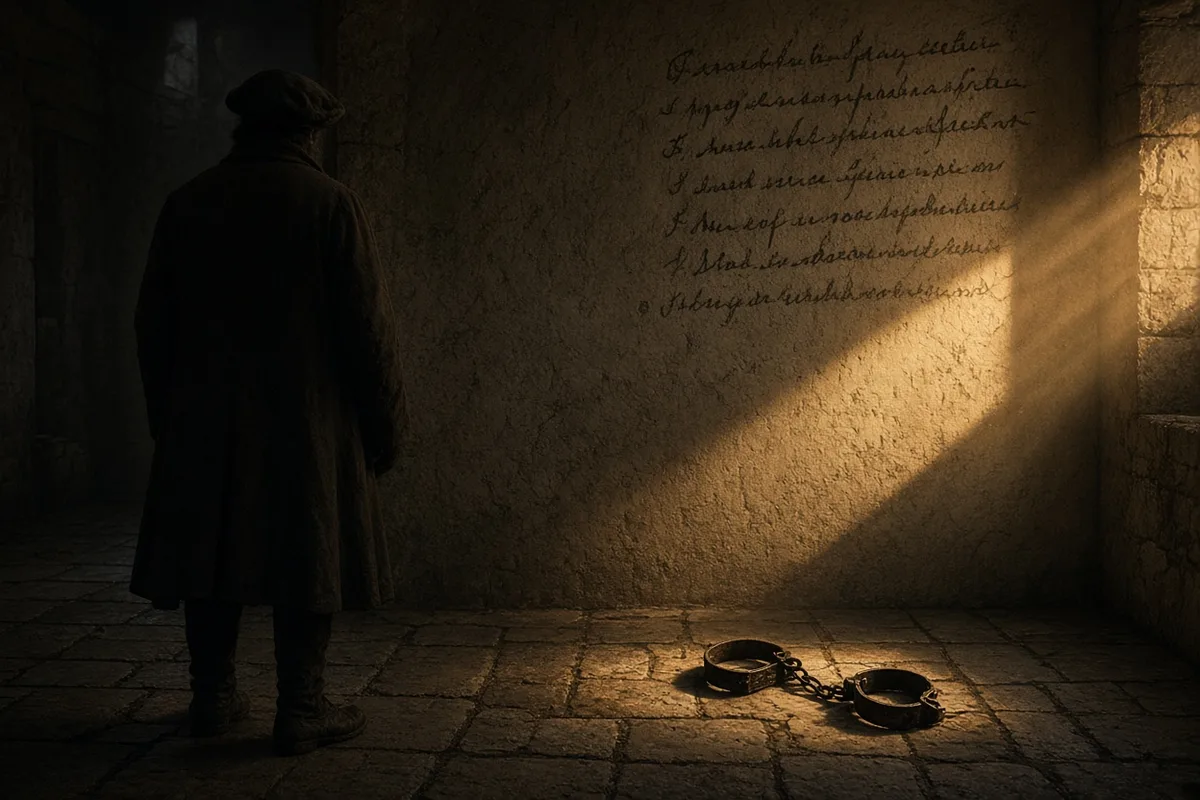
I started bringing an extra crust when the turnkey looked away. Fray John never thanked me. He ate what I gave him and went back to the lines. Sometimes he asked for the stub of a candle. I brought one once, wedged into a crack in the floor. The flame lasted until the middle of the night. By morning he had scratched marks on the wall with a piece of charcoal from the wick. The marks looked like the start of verses, crossed out and rewritten.
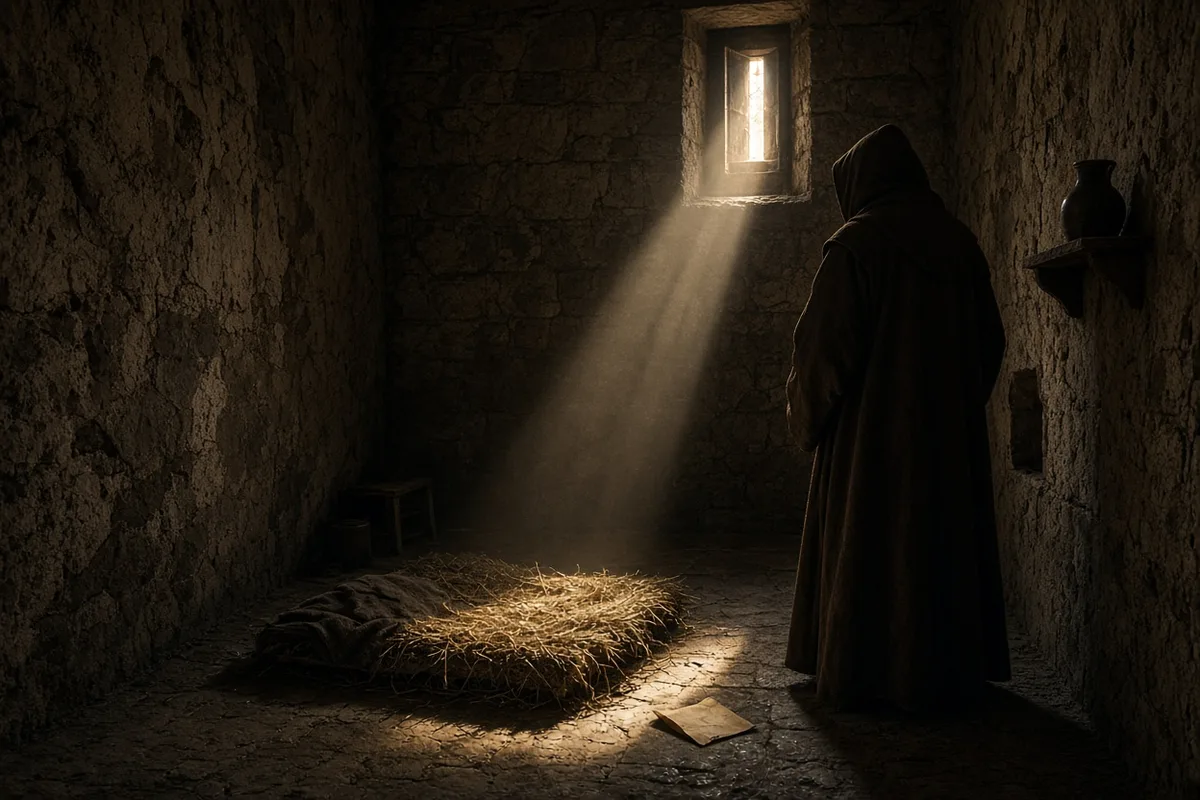
The summer heat pressed harder. Flies gathered at the slit and fell into the cell. Fray John brushed them from his face without looking up. He spoke the stanzas aloud now, testing the rhythm against his own breathing. One line he repeated until it held: the soul that walks in darkness toward the hidden beloved. He changed a word, tried it again, then let it stand. I heard it through the door and carried it with me up the stairs.
In the eighth month the order came to move him to another room. They said the new cell would have a window. Fray John refused to stand when the guards entered. They lifted him by the arms and carried him out. I followed with the bowl still half full. The new room was smaller and faced an inner courtyard where no light reached the floor. That night the turnkey told me the prisoner had begun to cough.
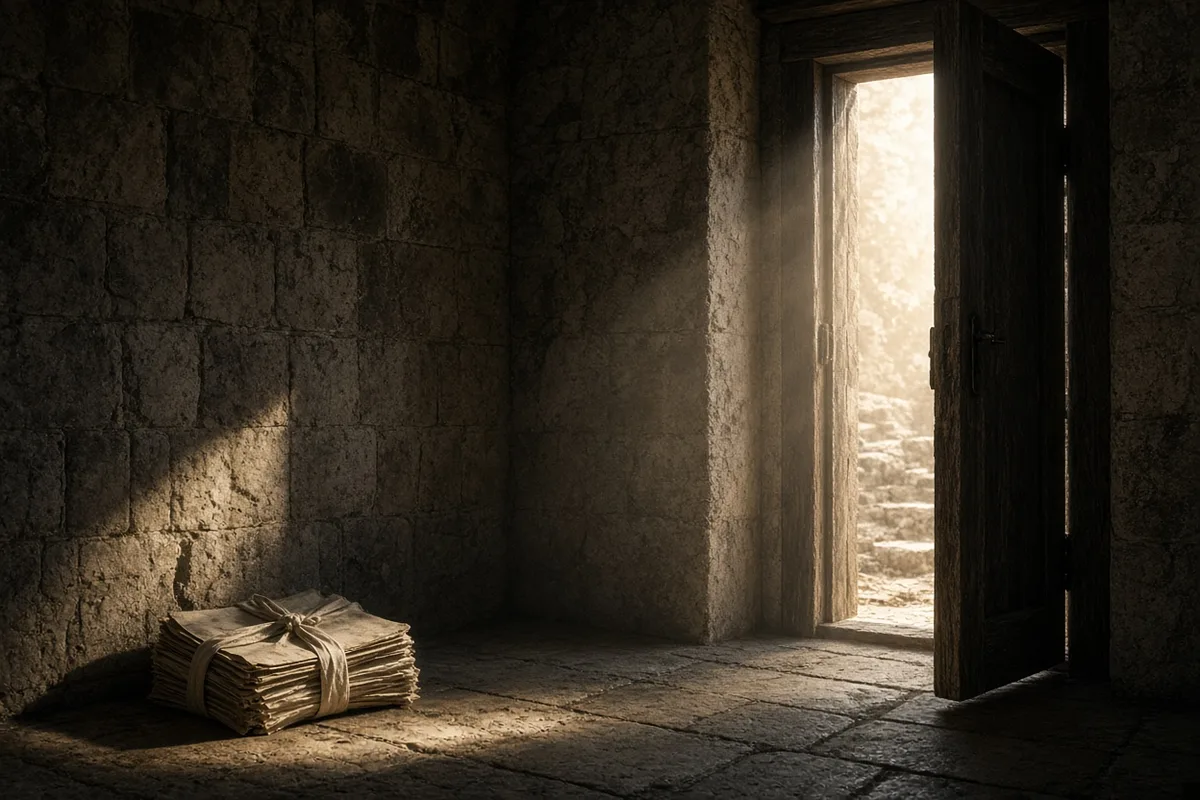
Three weeks later the door stood open when I arrived with the morning bread. The cell was empty. The slit showed a square of gray sky. The turnkey said Fray John had been taken away in the night by men who claimed orders from the provincial. No one saw him leave the building. The prior ordered the cell scrubbed and the door left open so the smell would clear.
I kept the charcoal stub in my pocket for several days. The marks on the wall had already been whitewashed. In the refectory the older friars spoke of the escape as a scandal that would reach the general chapter. They did not mention the verses. I heard them later from travelers who had passed through Andalusia, carried in the mouths of Discalced brothers who knew the author only by the name he had taken at Duruelo.
The prior died the following spring. The house at Toledo received new visitors from the nuncio’s court. One of them asked about the prisoner who had been held there. I answered that the man had left before any formal sentence could be read. The visitor wrote something in a book and did not ask further.
Years after, when the reform had spread and the two branches of the order were formally divided, a letter arrived at the Toledo house asking for any papers left behind by Fray John of the Cross. The prior at that time searched the archive and found nothing. He sent back a note saying the prisoner had composed only in his head and taken the lines with him when he walked out the door.
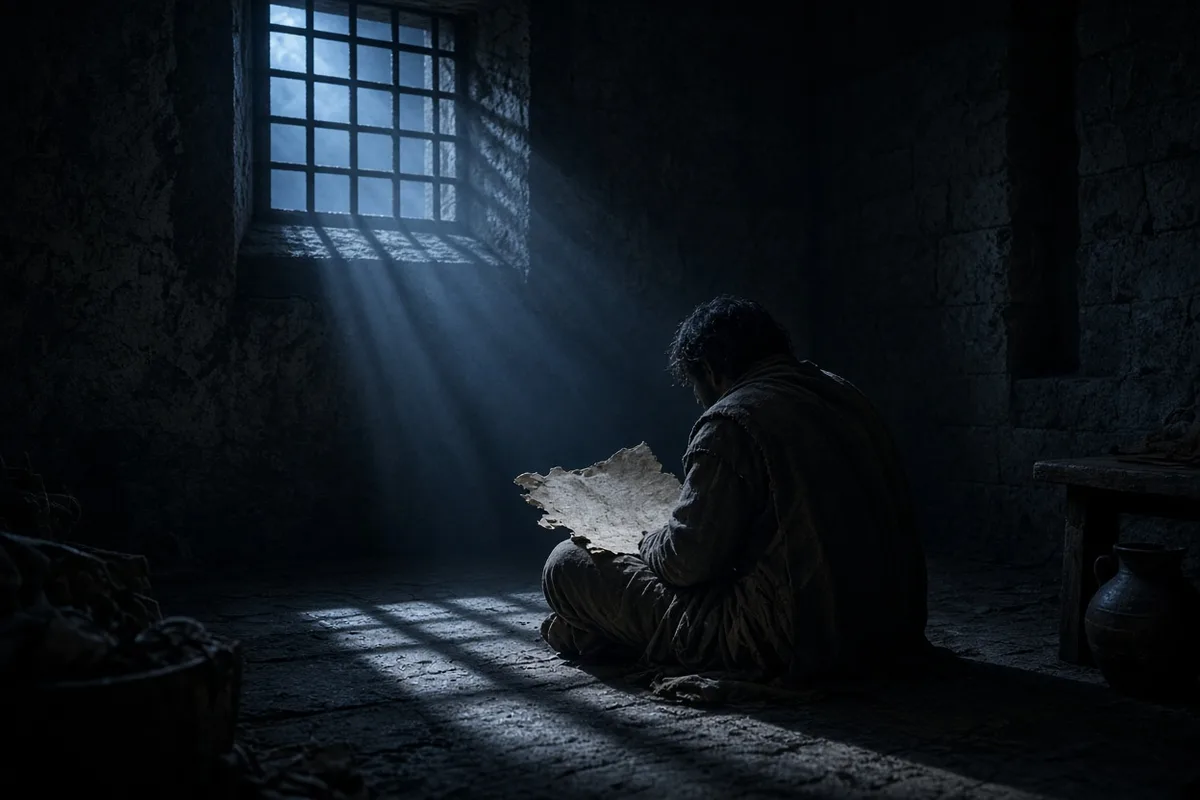
The letter from the nuncio’s secretary reached Toledo on 12 March 1580, signed by Juan de las Cuevas and requesting any remaining fragments of the verses Fray John had recited in the presence of the Discalced visitors at Almodóvar. The new prior, Alonso de la Madre de Dios, examined the ledgers for December 1577 through August 1578 and noted only the daily bread ration of eight ounces and the single entry for a broken water jug on 3 July. No papers appeared. The reply he drafted on 19 March stated that the prisoner had left nothing but the whitewashed marks on the wall of the upper cell, which measured four feet by seven and faced the courtyard of the Colegio de San Bernardo.
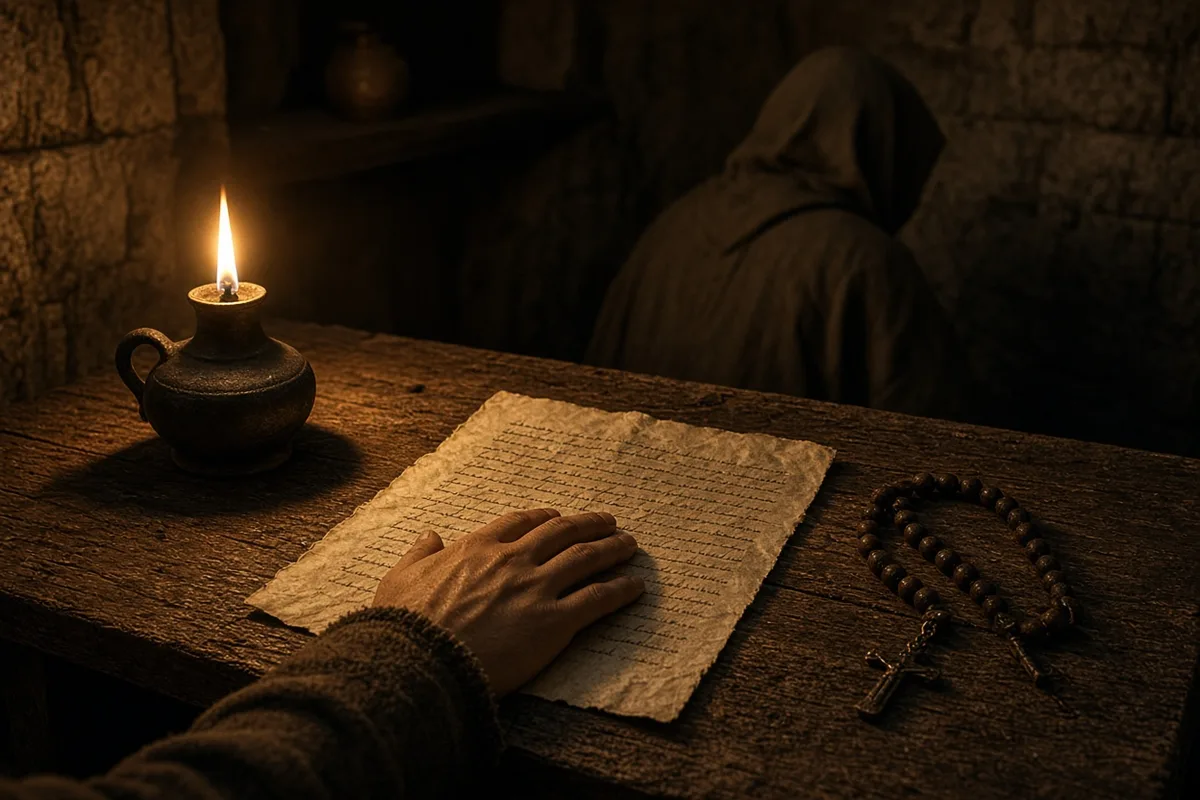
By the general chapter held at Alcalá de Henares in 1581 the two branches of the order were separated under the constitutions approved by Gregory XIII. Fray John, now prior of the house at Granada, dictated the first complete copy of the poem beginning “En una noche oscura” to the scribe María de la Cruz on 14 February 1582. The manuscript, written on twelve leaves of Genoese paper, records the stanza “Oh noche que guiaste, oh noche amable más que el alborada” followed by the marginal note “repetida dos veces en la celda de Toledo.” The copy remained in the archive at Los Mártires until 1593, when it was carried to Segovia during the transfer of the community after the provincial visitation ordered by Nicolás Doria.
In 1591 the same Fray John arrived at the monastery of Santa María de los Ángeles in Ubeda on 22 September, already suffering the fever recorded in the infirmary book as “tercianas con fluxión de pecho.” He died there at two in the morning on 14 December. The attending friar, Juan Evangelista, wrote that the last words spoken were the line “Vámonos a ver en tu hermosura” from the poem composed seventeen years earlier. The body was buried in the church of San Pablo and exhumed on 27 January 1593; the report signed by the physician Pedro de la Fuente listed the preserved right arm and the fragment of the habit still showing the charcoal stain on the sleeve.
The Discalced province of Castile received formal approbation from Clement VIII on 3 July 1594. The house at Toledo, now under the mitigated observance, continued to receive annual reports from the separated communities. One such report, dated 1605 and signed by the prior of Duruelo, listed among the relics held at Granada “the verses written by our father while prisoner in Toledo, copied in his own hand on the back of a letter from the nuncio dated 9 December 1577.” No original draft ever reached the Toledo archive.
In 1675 the beatification process opened in Rome. The witness Francisco de la Concepción testified on 4 October that he had heard the stanzas recited in 1612 by the lay brother who had carried the evening meal during the imprisonment. The testimony was entered in the acts under the heading “Toletana, causa 14.” The decree of beatification was promulgated on 25 January 1675 by Clement X. The cell itself, by then used as a storeroom, was measured again on 8 May 1703 at the request of the bishop of Toledo; the dimensions remained six feet by ten, with the original slit window still open to the north.
Canonization followed on 27 December 1726 under Benedict XIII. The bull records the poem as evidence of heroic virtue and quotes the line “¡Oh dichosa ventura!” attributed to the nights spent in the Toledo prison. The original manuscript copy made at Granada in 1582 was deposited in the Vatican Library in 1730, where it is catalogued as Vat. Lat. 14738. The Toledo house passed into private hands after the suppression of 1835; the building at number 2 Calle de los Capuchinos now contains the preserved lower cell, its doorframe marked with the date 1577 carved by an unknown hand.
The final documented image comes from the visit of the Carmelite historian Silverio de Santa Teresa on 11 April 1926. He noted in his journal that the present custodian, an elderly layman named Pedro Ruiz, still kept in a tin box the stub of charcoal said to have been used for the wall markings, together with a single line written on paper in a later hand: “el alma que camina en tinieblas hacia el amado escondido.” Ruiz stated that the box had been passed to him by his grandfather, who had received it from the last friar to leave the house in 1835.
Ruiz showed the box on that April morning to Silverio, who copied the line into his journal under the heading “Toledo, celda 1577” and noted the charcoal fragment measured three inches long with one end flattened from repeated use against stone. The custodian locked the box again in a drawer of the sacristy table and mentioned that his grandfather had added a second slip of paper in 1894 bearing the date “14 diciembre 1591” and the phrase “últimas palabras oídas por Juan Evangelista.” Silverio left the building at noon and recorded in the same journal that the slit window still admitted a shaft of light measuring eleven inches wide at midday on 11 April.
The Spanish Civil War reached Toledo in September 1936 when Republican militia occupied the Colegio de San Bernardo and used the lower cell as a temporary storeroom for rifles. An inventory drawn up on 14 October by the militiaman Luis García listed “una caja de hojalata con carbón y papeles” among the items removed to the provincial archive, yet the box itself never appeared in any later Republican record. After the Nationalist entry into the city on 28 March 1939 the building was returned to private ownership and the new custodian, a nephew of Pedro Ruiz named Antonio Ruiz, reported on 2 May 1939 that the tin box had been found intact behind a loose brick in the courtyard wall.
In 1952 the Discalced Carmelites of the Toledo province petitioned the Ministry of National Education for permission to restore the cell as a memorial site. The permit, signed by the director general on 7 June 1952, specified that the original doorframe bearing the carved date 1577 must remain untouched and that any new lighting must replicate the single north slit. Work began on 19 September 1952 under the architect Manuel Gómez and ended on 12 March 1953; the final report recorded that 184 cubic feet of earth had been excavated to restore the floor level to its 1577 height.
The restored cell opened to visitors on 14 December 1953, the anniversary of Fray John’s death. The first recorded visitor after the opening was the historian Efrén de la Madre de Dios, who signed the register at 10:15 a.m. and noted that the tin box now rested on a stone ledge beneath the slit, its contents arranged exactly as Pedro Ruiz had described in 1926. Efrén copied the line “el alma que camina en tinieblas” into his notebook and added the marginal comment “manuscrito de Granada 1582, repetido en Toledo.”
On 22 June 1978 the regional government of Castilla-La Mancha declared the building at number 2 Calle de los Capuchinos a Bien de Interés Cultural. The decree, published in the Boletín Oficial on 4 July 1978, cited the surviving dimensions of six feet by ten and the 1577 doorframe as primary evidence. The same decree transferred the tin box and its contents to the Archivo Histórico Provincial, where conservators measured the charcoal fragment at 7.4 centimeters and placed it in a climate-controlled case numbered AHPT/1577/1.
The box remained in the archive until 3 November 1997, when it was returned to the site for a temporary exhibition marking the 400th anniversary of the first printed edition of the “Noche oscura.” The exhibition catalogue listed the contents as one charcoal stub, two paper slips, and a fragment of habit cloth still showing the dark stain described in the 1593 exhumation report. After the exhibition closed on 14 January 1998 the box was placed once more on the ledge inside the cell, where it has remained under glass.
The most recent documented visitor entered the cell on 9 October 2023. The custodian on duty that morning, a retired schoolteacher named Carmen Delgado, recorded in the visitors’ book that a single elderly man remained inside for forty-three minutes, copied the line from the paper slip into a small notebook, and left without speaking. Delgado noted that the man wore a brown scapular and that the charcoal stub inside the glass case had been positioned so that its flattened end faced the slit window exactly as described by Silverio de Santa Teresa in 1926.