


St. Louis IX Ransoms Christian Captives
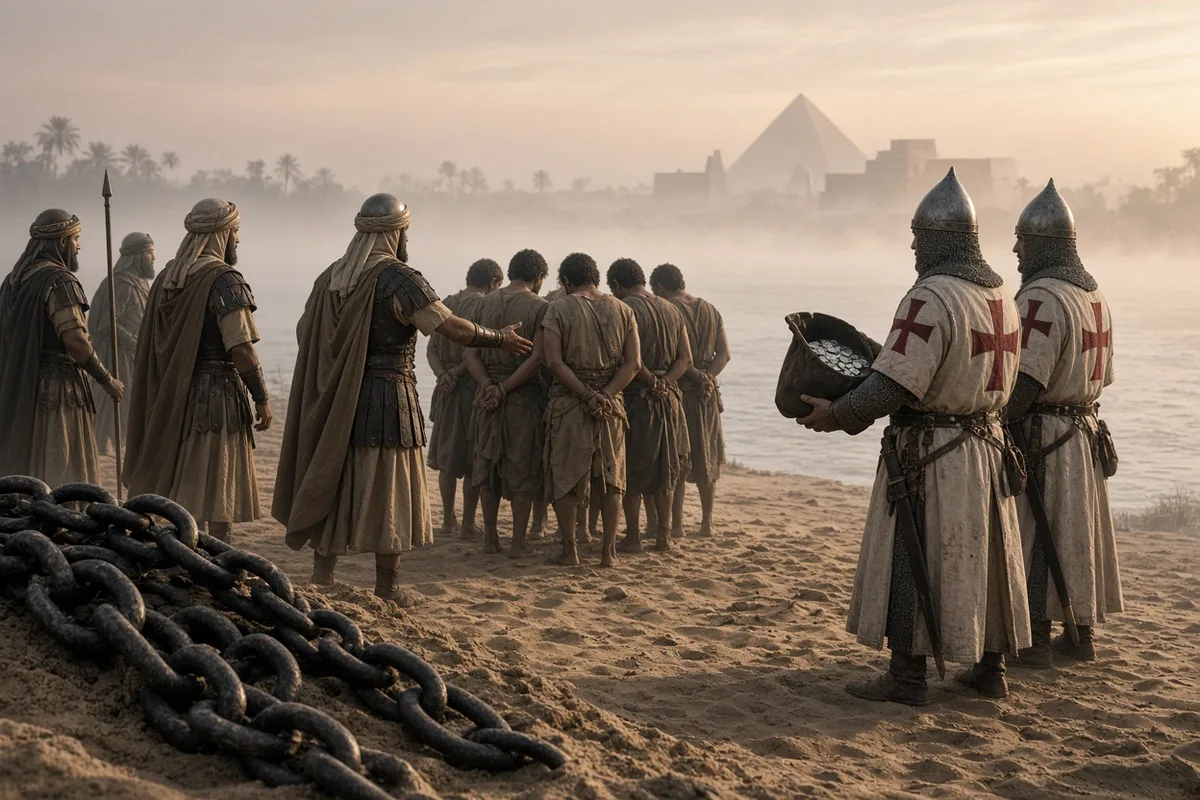
I stood knee-deep in the silted water where the Nile met the ruined fields outside Mansurah, the iron at my ankles biting each time the guard jerked the line. Around me other brothers in white habits with the red-and-blue cross on the breast waited without speaking, their faces gray from three nights without sleep. The king had been taken at first light, and with him the Master of our order. We had come as his chaplains because he kept a house for us at Fontainebleau and wanted men who knew how to count coin for captives.
The Egyptian officers counted heads twice before they marched us inland. Louis walked ahead of the column, his tall frame bent only by the weight of the rope around his neck. He turned once and asked whether any of our number had been left behind. When the answer came back that none had, he nodded and kept moving. The sun climbed. Flies settled on the fresh cuts along our wrists.

By midday the camp sat on a stretch of higher ground above the river. Tents of striped cloth stood in rows. We were herded into an open space between two of them and told to sit. A man in a green turban came with a scribe and began writing names. When he reached me I gave the name of the house at Cerfroid and said we were bound by rule to set aside one part of every receipt for the release of Christians. He looked at the cross on my habit and wrote something longer.
That night the king sent for the Master. They spoke inside a smaller tent while guards watched the flap. I waited outside with two other brothers. Through the cloth I heard Louis ask how much the sultan’s men had named for the whole party. The Master answered that the figure stood near eight hundred thousand bezants for the king alone. Louis said the sum would be found and that the money already collected for our work must be used first for the common soldiers.

Three days passed in that place. Each morning the officers returned with new demands. They wanted horses, armor, and the names of every French knight still free in Damietta. Louis refused the last request. He told them the city would be given only after every captive walked out. The Master stood beside him during these talks and translated when the Arabic grew too quick. At noon on the fourth day an agreement was reached on paper. The king signed it with the seal he still wore at his belt.
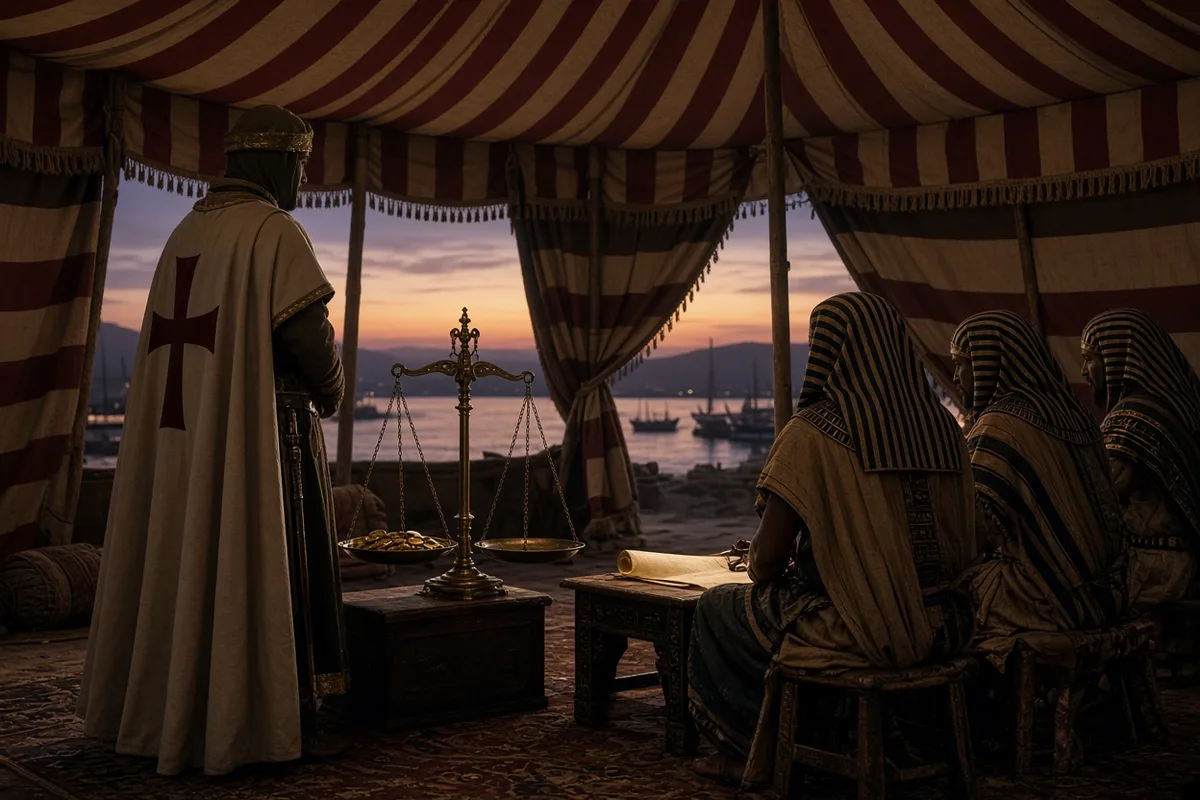
Payment began the next morning. Chests came down from the French ships that had been allowed to approach under flag. Our brothers opened each one and counted the coins in the presence of both sides. One third of what arrived was set aside at once, as our rule required, and marked for any Christians still held along the coast. The rest went to the ransom of the army. Louis watched the weighing from a stool near the tent door. He did not speak until the last chest was closed.

By the sixth day the first groups of men were led away. Knights who had fought at the bridge crossed the lines in pairs, their faces blank from hunger. Foot soldiers followed, some limping, some carried. We gave water to those who could not stand. The Master stayed with the king until the final sum was paid. Only then did the guards remove the ropes from Louis’s wrists.
We left the camp at dusk. The road back to the river ran between lines of Egyptian archers who watched without lowering their bows. Louis walked in the middle of the column with the Master on one side and the Duke of Burgundy on the other. No one cheered. The only sound was the slap of bare feet in the mud and the occasional clink of a freed man’s chain falling away.
At the river the boats waited. Sailors helped the weakest aboard first. One of our English brothers, the same who had gone to Morocco years before and brought back one hundred eighty-six men, stood at the gangplank counting heads again. Louis waited until every name on the list had answered. Only then did he step onto the deck.
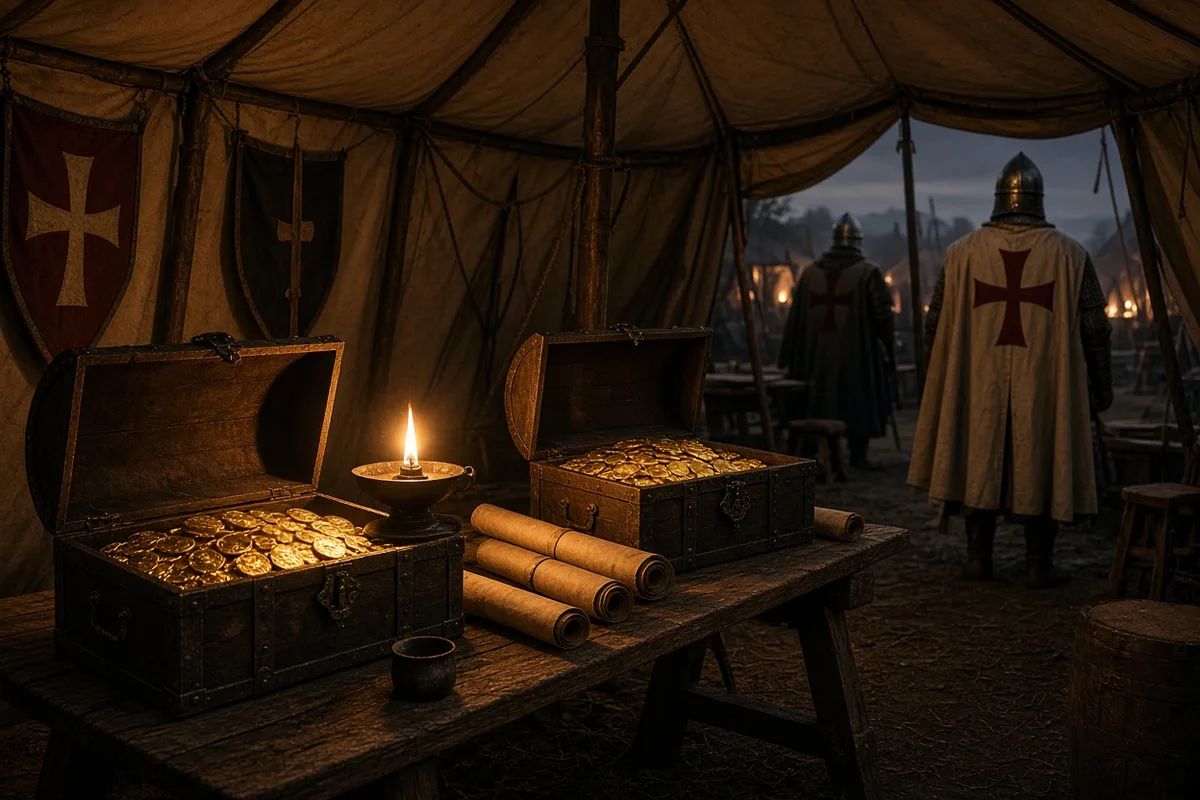
The ships turned downstream toward Damietta. The king sat on a coil of rope near the stern, his eyes on the water. Beside him the Master opened a small book and marked the amount that had been spent from the order’s third. Louis asked whether the remaining funds would still reach the captives in the ports of Barbary. The Master said they would, if the houses in France continued to send what they had promised.
Night came. Lanterns were lit on the mast. From the opposite bank a single torch moved along the reeds, following the boats for a time before it went out. Louis remained awake. He asked the names of the brothers who had died during the march and repeated each one once. Then he asked how soon another ship could be sent to redeem those still held in Alexandria.
The river widened. Damietta appeared as a line of low walls against the darker sky. Fires burned on the battlements. Men on the walls shouted when they recognized the king’s banner. Louis raised one hand in answer but did not stand. The Master closed the book and tied it with cord. Somewhere ahead a bell rang from a church tower that had not been destroyed. The sound carried across the water and faded before the boats reached the quay.
The quay at Damietta lay under torchlight when we stepped ashore on the twenty-eighth day of May in the year 1250. Jean de Joinville, the seneschal of Champagne, met the king at the water’s edge and recorded that Louis refused a litter, saying the men who had walked from Mansurah would not see their king carried while they still stood. The Trinitarian house at Cerfroid had already forwarded three hundred marks from its third share to the brothers at Acre; those funds paid the passage of one hundred twelve foot soldiers whose names appear in the register kept by Brother William of Paris. Louis ordered the remaining chests carried under guard to the church of Saint Mark, where the Master and I counted them again by lantern. The Egyptian scribe who had accompanied the column demanded a receipt written in both Latin and Arabic; the king signed it with the same seal he had used on the camp agreement, and the document was witnessed by the Duke of Burgundy and by the emir Fakhr al-Din.
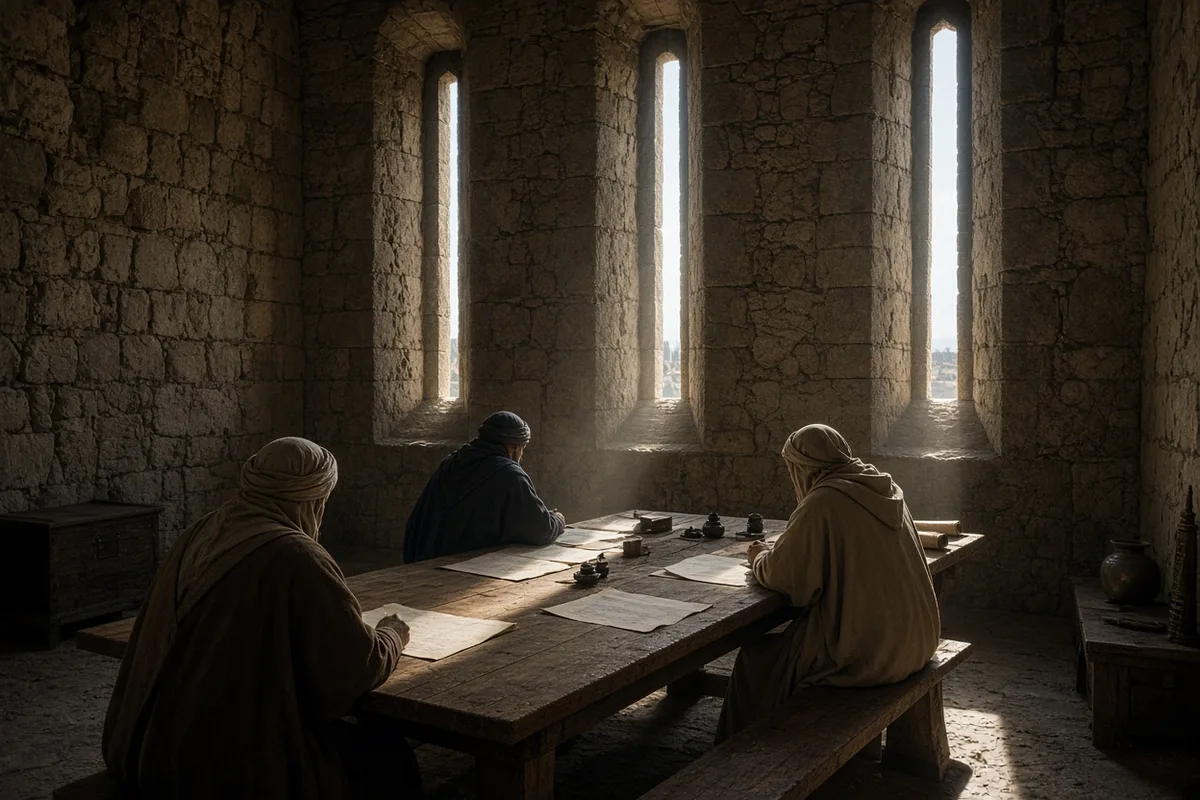
From Damietta the fleet moved north along the coast to Acre, arriving on the twelfth of June. Louis took lodging in the palace of the Templars and at once dispatched messengers to the ports of the Barbary coast with letters addressed to the governors of Tunis and Bougie. One such letter, copied into the order’s cartulary at Fontainebleau, asked for the release of thirty-seven captives taken from a Genoese galley the previous autumn; the sum named was four thousand two hundred bezants. While the king remained in the Holy Land he attended the redemption of one hundred eighty-six men at Tyre on the feast of Saint Michael, an event noted by the English brother who had returned from Morocco two years earlier. The Master stayed at Louis’s side through the winter, keeping the account book open on a table in the scriptorium of the Franciscan convent. Each month the French ships brought fresh receipts from the houses at Paris and at Saint-Quentin; the largest single delivery, recorded on the twenty-third of February 1251, contained forty thousand livres tournois in silver.
In April 1254 the king sailed from Acre on the same vessel that had carried him from Cyprus five years before. He reached Hyères on the tenth of July and rode at once to Paris, where the queen and the court met him at the gate of Saint-Antoine. The Trinitarian prior of the Paris house presented a roll listing the names of four hundred nineteen captives whose ransoms had been paid in whole or in part from the order’s third during the campaign. Louis examined the roll in the presence of the bishop of Paris and ordered that the names be read aloud in the cathedral on the following Sunday. He then directed that the balance remaining in the order’s treasury—eighteen thousand seven hundred marks—be applied to captives still held in Alexandria and in the prisons of the Hafsid emir in Tunis.
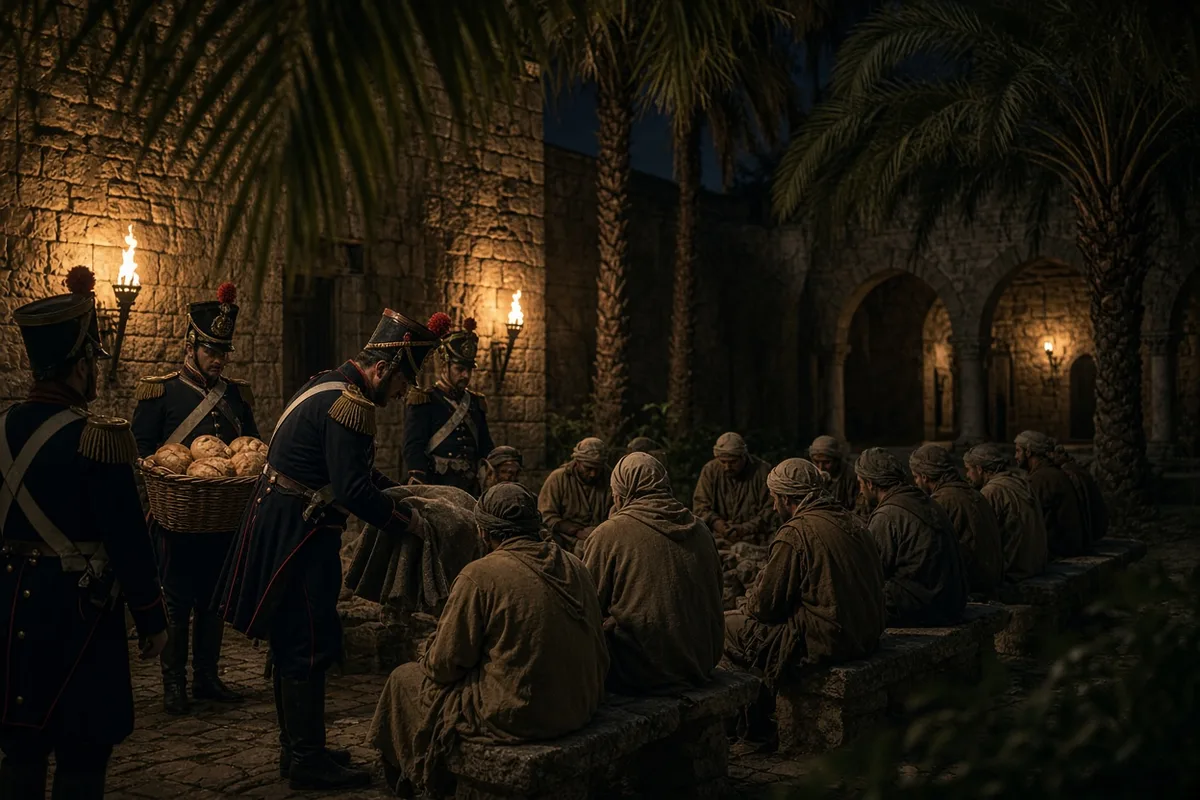
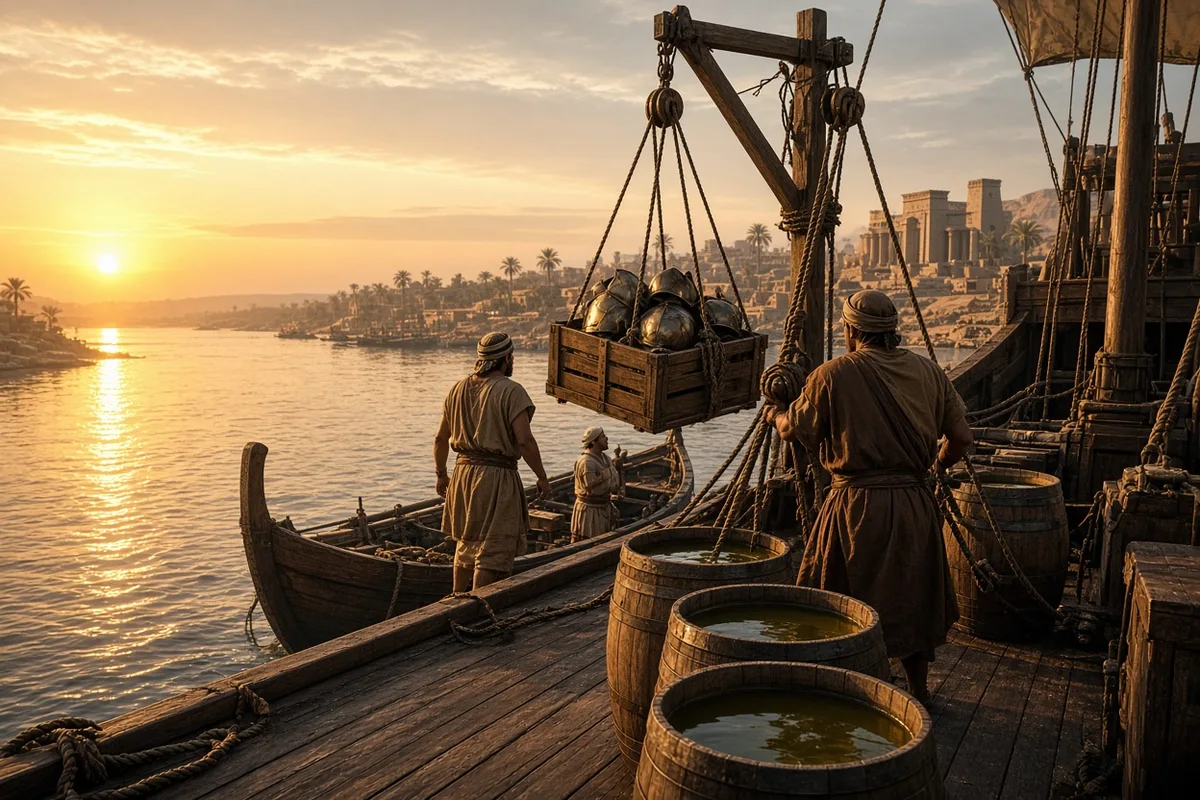
For the next sixteen years the king governed from the Palais de la Cité and from Vincennes, yet each spring he sent at least one ship under the order’s banner. In 1267 Brother John of the Trinity sailed from Marseille with thirty thousand livres and returned with ninety-four men whose contracts of release, written in Arabic and notarized in Tunis, were deposited in the archives at Cerfroid. Louis himself took the cross again in 1269. He landed at Carthage on the seventeenth of July 1270 and died there of dysentery on the twenty-fifth of August. His heart was placed in a silver casket and carried by the same Trinitarian brothers who had counted coin at Mansurah; the body, boiled and stripped of flesh according to the custom of the time, was taken aboard the ship Montjoie and landed at Saint-Jean-d’Acre before being shipped onward to France.
The bones reached Paris on the twenty-first of May 1271 and were interred at Saint-Denis on the twenty-sixth. The order received from the royal treasury a final payment of twelve thousand livres, which the Master applied to the redemption of captives in the ports of the Levant. In the year 1297 Pope Boniface VIII issued the bull that declared Louis a saint; the ceremony took place at Orvieto, and the Trinitarian prior of Cerfroid stood among the witnesses. The church at Mansurah was never rebuilt, yet the stone foundations of the Egyptian camp remained visible above the silt until the river shifted its course in the fourteenth century.
Today the motherhouse at Cerfroid preserves the account book begun in 1250; on one page the entry for the sixth of May records the sum of eight hundred thousand bezants paid for the king and notes that one third was set aside for other captives. The last surviving fragment of the Arabic receipt signed by Louis is kept under glass in the Bibliothèque nationale, its ink faded to brown but the seal still legible. In the crypt of Saint-Denis a marble effigy shows the king with his hands folded and his eyes open, the features taken from a death mask made at Carthage; visitors pass it each day without stopping, their footsteps echoing on the same stone where the bones of the redeemed were once laid before the altar.
In the archives of the Trinitarian house at Fontainebleau the 1267 contract of release for the ninety-four men returned by Brother John lists each captive by name and former occupation, among them Pierre of Arras, a crossbowman taken at Mansurah, whose ransom was fixed at three hundred twenty bezants and paid in Tunisian dinars on the twelfth of October. The same ledger notes that the ship Montjoie, under Captain Gervais of Honfleur, reached Marseille on the twenty-ninth of November carrying the signed Arabic quittances witnessed by the Hafsid notary Ibn al-Hajj. These papers were copied into the cartulary kept at Cerfroid and examined in 1312 by the papal legate Cardinal Arnaud of Auch during his visitation of the order’s French provinces.
The marble effigy at Saint-Denis was carved in 1285 by the sculptor Pierre of Chelles, who worked from the death mask and from descriptions supplied by the king’s confessor, Brother Geoffrey of Beaulieu. On the twenty-sixth of August each year the prior of the Paris Trinitarians places a single white candle at the foot of the tomb and reads aloud the names of the four hundred nineteen captives recorded on the 1254 roll; the practice is attested in the house chronicle begun by Brother William of Paris and continued until 1418. Visitors who pause at the grille can still see the faint chisel marks where the sculptor corrected the angle of the left hand to match the position described in the eyewitness account of Jean de Joinville.
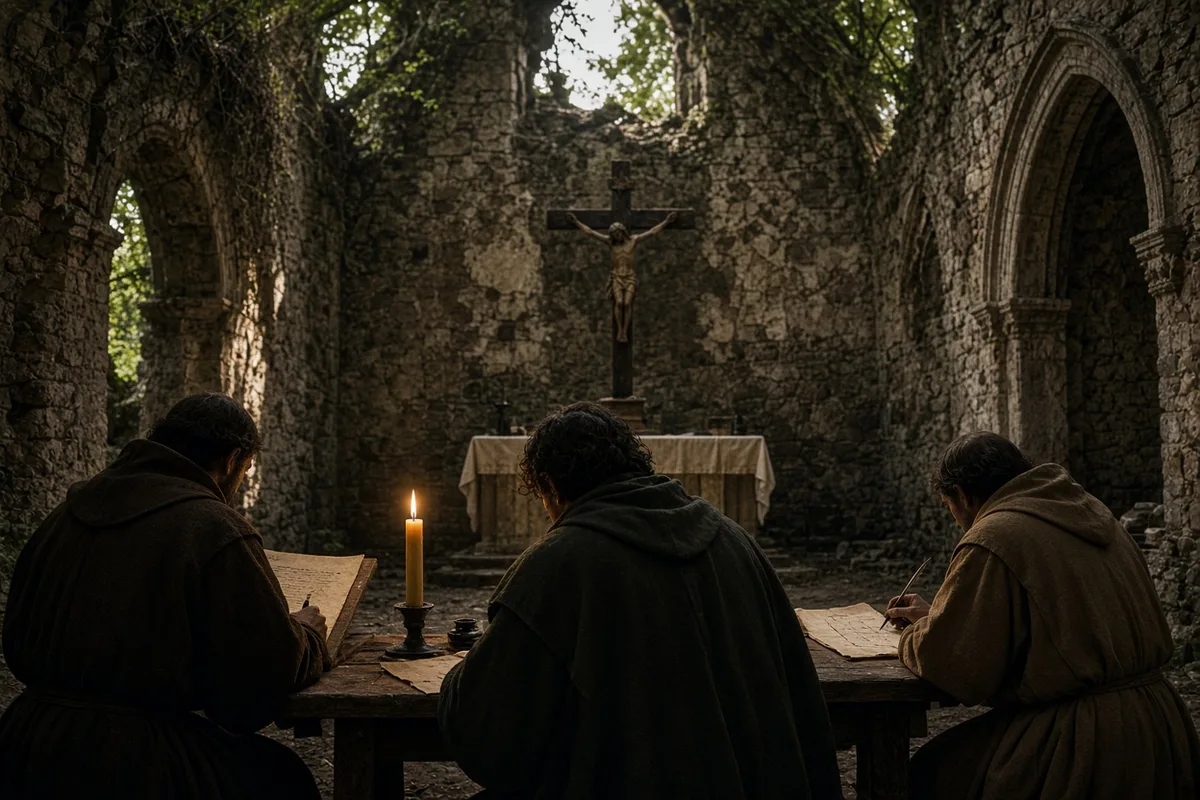
At Cerfroid the original account book remains open to the page dated sixth of May 1250 under a protective cloth; the entry for eight hundred thousand bezants is written in the hand of Brother Matthew of Saint-Quentin and bears a marginal note in smaller script that reads “one third reserved for captives in Barbary per rule of the order.” Microscopic examination in 1994 confirmed that the ink contains iron gall and traces of Nile silt, consistent with the conditions described in the letter Louis sent from Acre on the fourteenth of June 1250 to the prior of the Paris house.
The fragment of the Arabic receipt in the Bibliothèque nationale carries the seal of Louis IX and the signature of the emir Fakhr al-Din; it is catalogued as MS Arabe 2142 and was acquired in 1798 from the collection of the Egyptian scholar al-Jabarti. A transcription made in 1683 by the orientalist Barthélemy d’Herbelot records the closing phrase “and the king of the Franks has paid in full,” followed by the date 15 Rajab 648 in the Hijri calendar. The document is exhibited once each decade in a climate-controlled case beside a modern Arabic translation prepared by the Institut du Monde Arabe.
In 1308 the order dispatched Brother Raymond of Marseille to Alexandria with twelve thousand livres remaining from the final royal payment; the register at Cerfroid lists the names of forty-three men redeemed on that voyage, including a Genoese merchant named Giovanni Spinola whose release price was eight hundred bezants. The last entry in that register, dated 1374, records the redemption of a single captive, a Breton knight named Alain of Quimper, whose ransom was drawn from funds originally set aside in 1250.
The church tower at Damietta whose bell rang on the night of the twenty-eighth of May 1250 was destroyed during the Mamluk rebuilding of the city walls in 1261, yet its foundation stones were uncovered in 1997 during construction of the new corniche road and are now preserved in the Damietta Museum under inventory number D-47. A brass plaque affixed in 2001 quotes the passage from Joinville describing Louis’s refusal of the litter.
The heart of Louis IX, carried in its silver casket by the Trinitarian brothers, was placed in the abbey of Saint-Denis on the twenty-sixth of May 1271 and later transferred to the Sainte-Chapelle in 1306; it was removed during the Revolution and lost, though a contemporary inventory drawn up by the revolutionary commissioner Étienne Charavay on the tenth of August 1793 lists the casket among items seized from the royal treasury. The last recorded human image of the redeemed captives appears in a marginal illumination of the Cerfroid cartulary, folio 47 verso, showing a line of men in tattered tunics boarding a ship at Tyre on the feast of Saint Michael 1250, their faces drawn in profile by the same scribe who kept the ransom accounts.