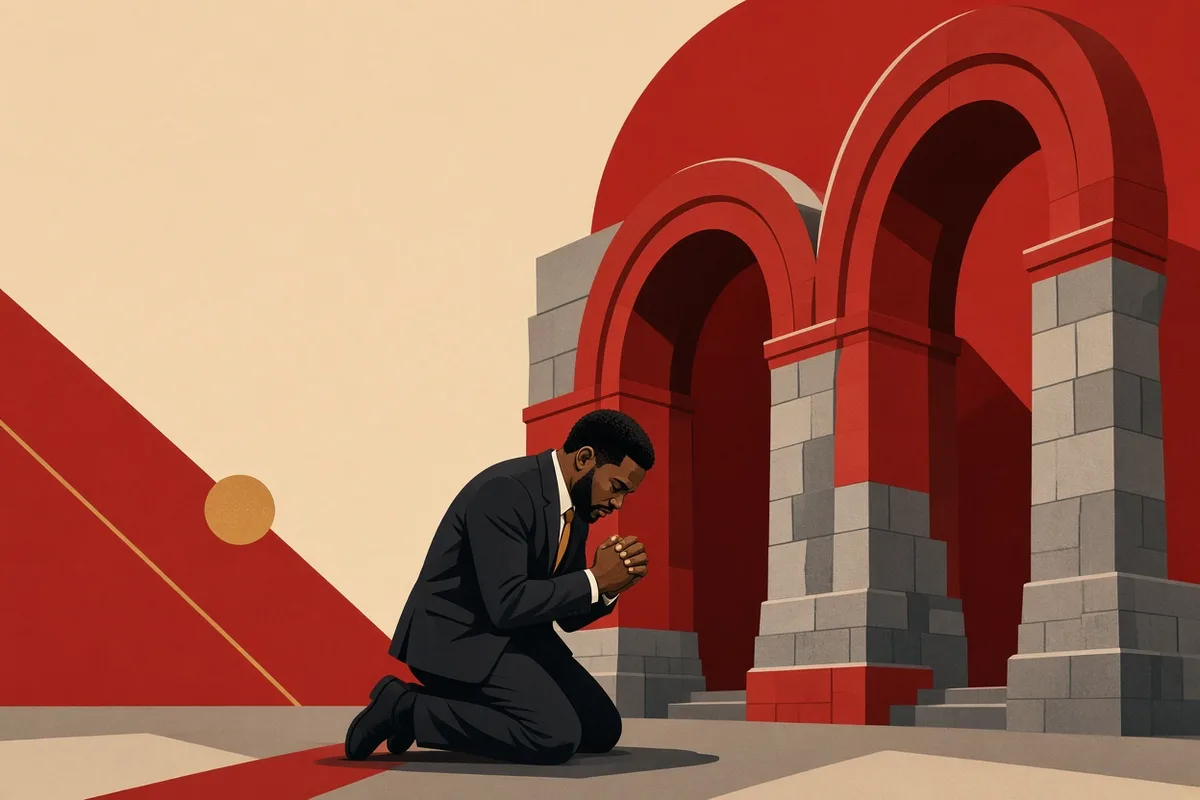



St. Martin Shares Cloak with Beggar
The wind cut straight through the gate that afternoon, the kind that finds every seam in a cloak and turns leather stiff against the skin. I stood posted with two others just inside the arch, watching the road from the north where the fields ran flat and white. Martin rode in alone on the dun horse the century had assigned him. He had the reins in one hand and the other tucked under the edge of his cloak for what little warmth it gave.

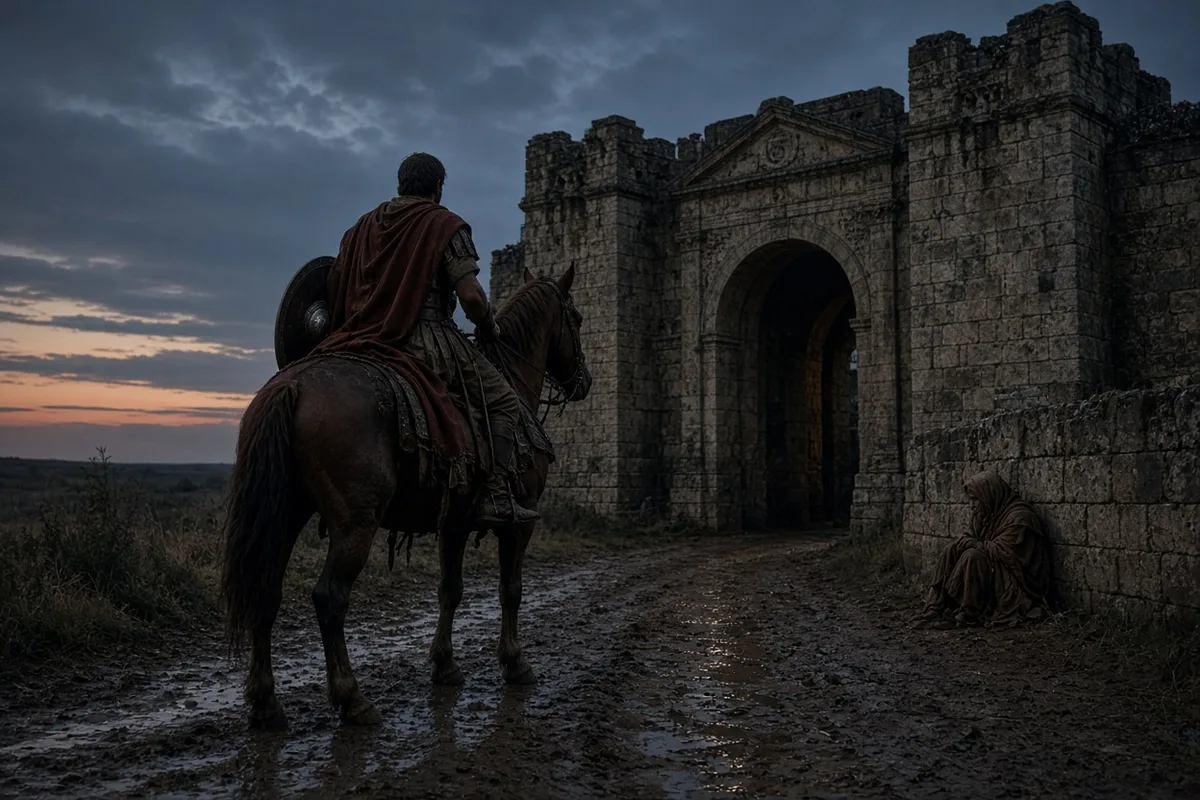
A beggar had taken shelter against the outer wall. The man wore nothing above the waist and his legs were wrapped in rags that had frozen into boards. He held out both hands to every rider and every foot soldier who passed. Most looked away. One laughed and kicked snow at him. Martin reined in ten paces short of the gate and sat still for a moment, studying the figure.
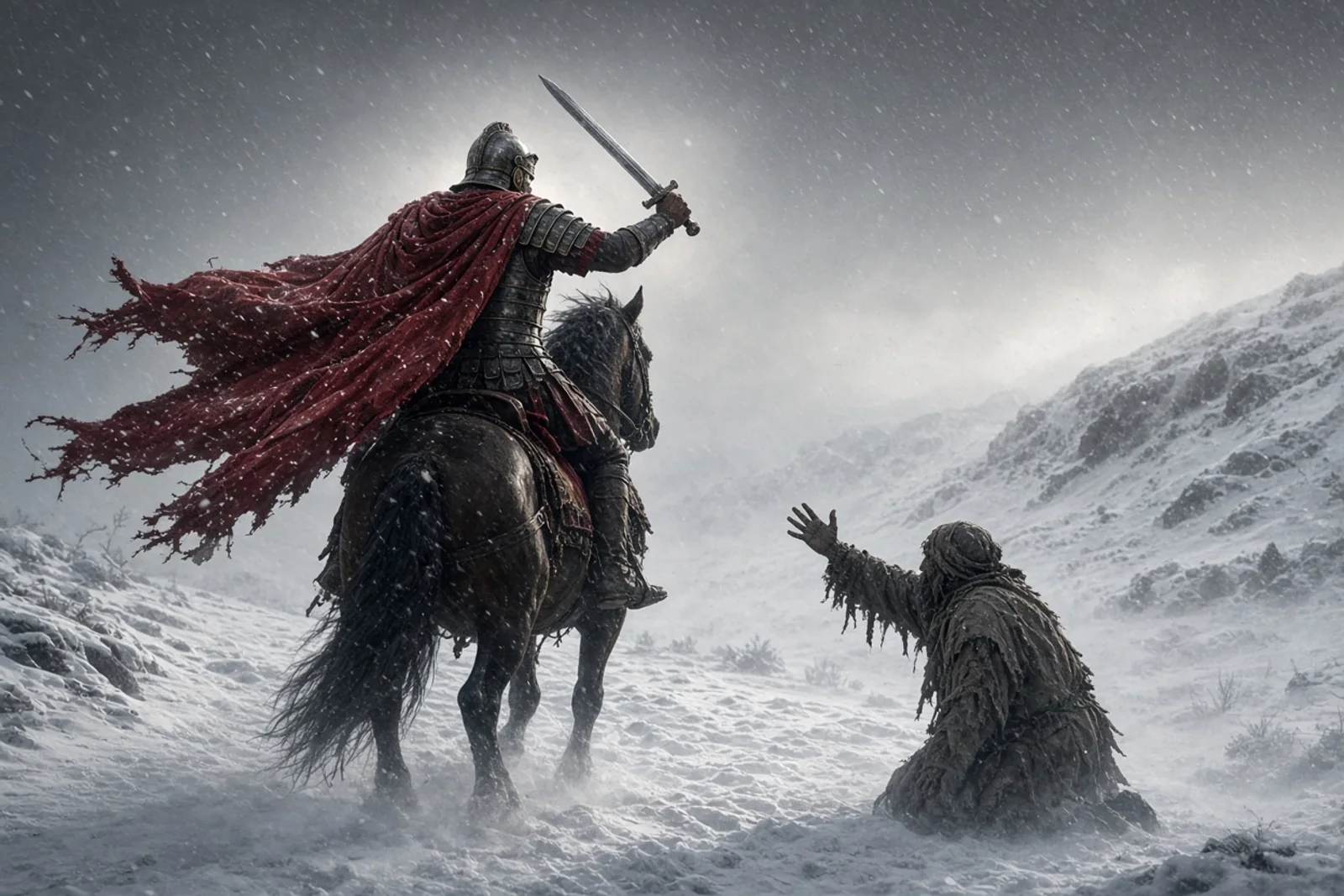
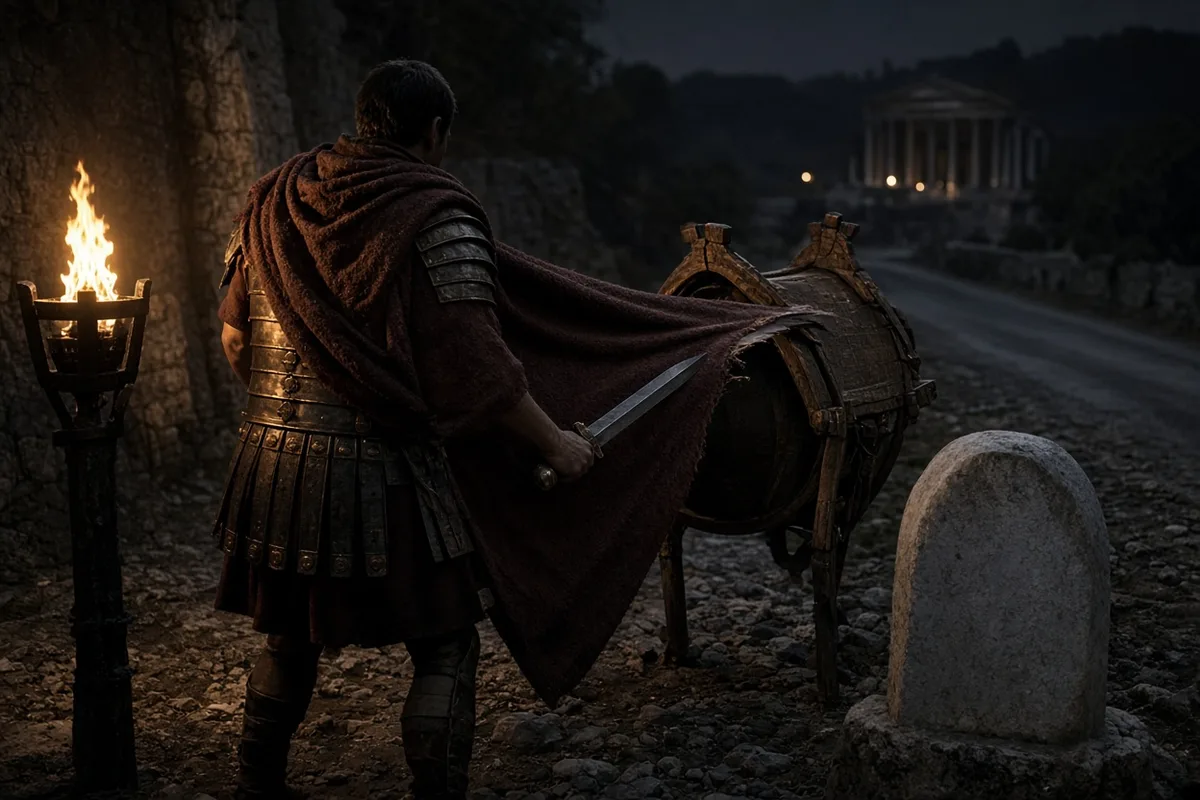
He swung down. The horse stamped once and stood. Martin drew the short sword he still carried on campaign duty, though he had already sold or given away every other piece of kit that would fetch a coin. He spread the heavy military cloak across the snow with one hand, set the point of the blade at its center, and cut. The wool parted with a clean rip. He folded one half, crossed the remaining distance, and laid it over the beggar’s shoulders without a word. The beggar clutched the fabric and stared. Martin wrapped the other half around himself again, the cut edge hanging loose past his knees, and remounted.

A pair of merchants who had been waiting to enter the city began to laugh. One pointed at the uneven hem and said the Roman looked like a half-dressed scarecrow. A woman selling bread from a basket near the wall turned her face aside and made the sign against the evil eye. Two of our own men who had come out to meet the patrol muttered that a soldier who could not keep his own cloak would be no use when the real cold set in. Martin did not answer any of them. He rode through the gate, the horse’s hooves loud on the frozen stones, and the cut edge of the cloak flapped against his leg with every step.
I followed at a distance because my relief had not yet come. Inside the barracks yard the talk had already started. Someone said Martin had done the same thing with a pair of boots the month before. Someone else said he kept nothing now except the arms the army required. The centurion on watch only grunted and told us to see to the horses.

That night the frost came down hard enough to split wood. I lay on my pallet listening to the beams crack and thinking about the beggar still outside the gate. Near dawn Martin’s tent mate came looking for me. He said Martin had woken shouting and would not speak of what he had seen. I found him sitting on the ground outside the tent, the cut cloak still around his shoulders, staring at the stars that showed between the clouds. He told me, after a long silence, that Christ had stood before him wearing the half he had given away. The voice had been clear enough that the angels with him turned to look.
He asked for baptism the next morning. The priest at the small church inside the walls set the date for Easter. Martin continued to ride patrol and stand watch until the season changed. He never asked for a new cloak. When the snow melted he mended the cut edge himself with coarse thread and wore the shortened thing as it was.

By the time the first green showed on the willows along the river he had already begun to give away the small pay that reached him. Men in the century started leaving their extra rations on his kit when they thought no one watched. He never commented. At Easter he stood in the river with the others who had prepared. The water still carried ice from upstream. When he came up he looked the same as before, only quieter.
He served out the remaining years of his enlistment without complaint. When the discharge came he walked south toward Poitiers with nothing but the mended cloak and the sword he had used to divide it. I stayed with the century another two winters. Every St. Martin’s Day after that the men who remembered would set an extra portion at the table and leave the seat at the end empty. The beggar, whoever he had been, never reappeared at the gate. The cloak itself was gone with Martin, carried into whatever country he chose next.
Two years later a dispatch rider named Lucius from the Twentieth Valeria Victrix brought word that Martin had reached Poitiers in the spring of 356 and presented himself to Bishop Hilary with the mended half-cloak still on his shoulders and the army sword lashed to his pack. Hilary, whose own exile under Constantius had ended only the year before, recorded in a letter preserved by Sulpicius Severus that the former soldier spoke of a vision in which Christ had worn the severed wool and asked simply for a place to pray. Martin stayed at the bishop’s house on the rue des Trois-Piliers for eleven months, copying manuscripts at a table that measured four feet by two and receiving instruction in the Psalms until Hilary ordained him exorcist on the feast of St. John in 357. When the bishop was recalled to Milan, Martin returned north on foot, crossing the Loire at the ferry below Tours on the twenty-third of October and settling in a cell of hazel wattle at Ligugé where eleven other men joined him by the following Easter.
The community at Ligugé kept no common purse after the first year. Martin allotted each brother one sestertius a day from the sale of copied gospels and required that any surplus be given to travelers who stopped at the gate. In 360 a monk named Florentius arrived from Autun carrying a letter that quoted Martin’s own words to the brothers: “We will not eat until the stranger has been fed.” That same winter the group cut timber for a wooden chapel whose ridgepole measured eighteen feet and whose single window faced due east. Three merchants from Clermont later testified before the provincial governor that they had left a cartload of grain at the chapel door and found it empty the next morning with only a strip of coarse wool tied to the wheel as receipt.
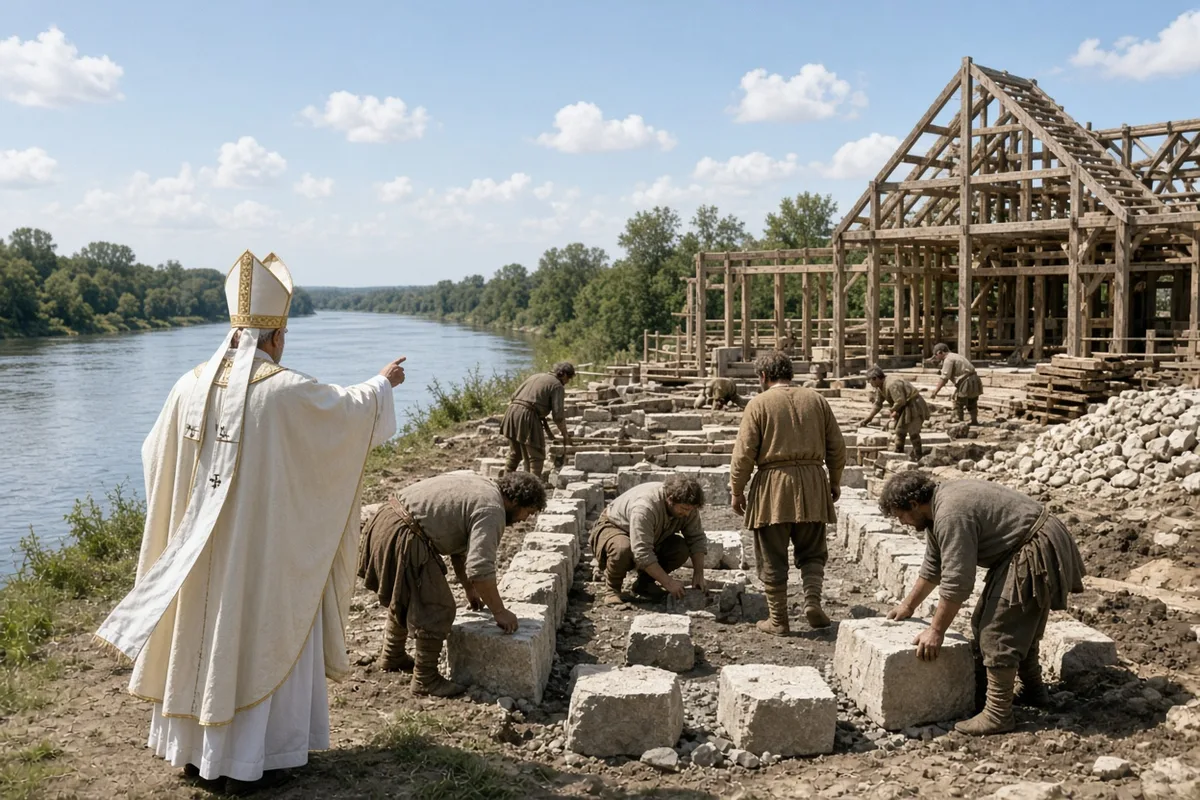
News of Martin’s election as bishop reached the old century in 371 through a centurion named Victorinus who had been discharged at Mogontiacum. The people of Tours had dragged Martin from the church of St. Saturninus on the fourth of July and set him on the episcopal throne despite his protests that he preferred the cell at Ligugé. Victorinus quoted the new bishop’s first recorded act: he ordered the immediate demolition of the temple of Mercury on the hill above Amboise, sending thirty laborers with picks and recording the weight of the bronze statue at seven hundred and forty pounds before it was melted for church lamps. The same year Martin consecrated the first stone of the basilica that would hold the relics of St. Gatien, measuring the nave at one hundred and twenty feet and directing that the altar stand over the spot where the earlier bishop had been buried.
During the seventeen years of his episcopate Martin traveled each month between Tours and the outlying parishes, always on foot and always with the shortened cloak fastened by a single bronze fibula. In 384 he confronted the emperor Magnus Maximus at Trier after the execution of the Priscillianists, speaking for three hours in the audience hall and obtaining a written order that halted further trials in Gaul. The document, witnessed by seven bishops, bore the imperial seal and the phrase “by the intercession of Martin the bishop.” That winter the Tours archives recorded the arrival of four hundred and twelve refugees from the Rhine frontier who were housed in the porticoes of the cathedral and fed from the episcopal granary for ninety days.
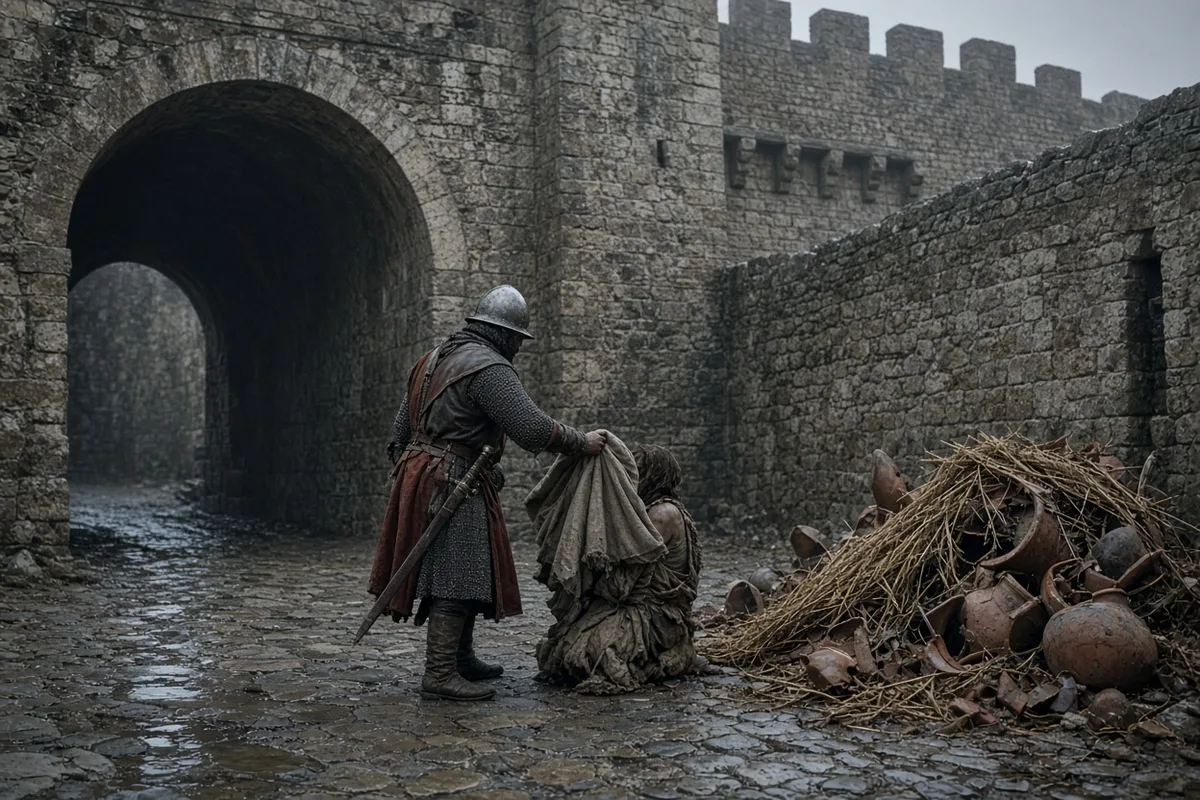
Martin died at the village of Candes on the eighth of November 397 after an illness that lasted ten days. He had been called to settle a dispute between clerics and, refusing a bed, lay on the stone floor of the church with the half-cloak beneath him. The priest who attended him, named Anastasius, noted in the margin of the parish register that Martin’s last audible words were the verse from the twenty-fifth Psalm beginning “O keep my soul and deliver me.” His body was carried by river barge to Tours, arriving on the eleventh, and was buried in the cemetery outside the walls where a wooden oratory was raised within the month. Pilgrims began arriving the following spring at the rate of thirty or forty a day, each leaving a small offering recorded in the sacristan’s ledger as either one denarius or a length of linen.
The cloak itself remained in the treasury of the basilica until the sixth century, when it was carried by the Merovingian kings on campaign and housed in a separate chapel whose name passed into common speech as “capella.” In 674 the relic was divided once more, one portion sent to the abbey of St. Denis and the other kept at Tours under a silver-gilt reliquary that weighed forty-three pounds. During the Viking raids of 853 the Tours portion was hidden in a well near the Loire and recovered only after the raiders had burned the wooden church. The surviving fragments were later enclosed in a crystal cylinder mounted on a processional staff and carried each November eighth through the streets of Tours until the Revolution, when the cylinder was melted and the cloth disappeared from the municipal inventory.
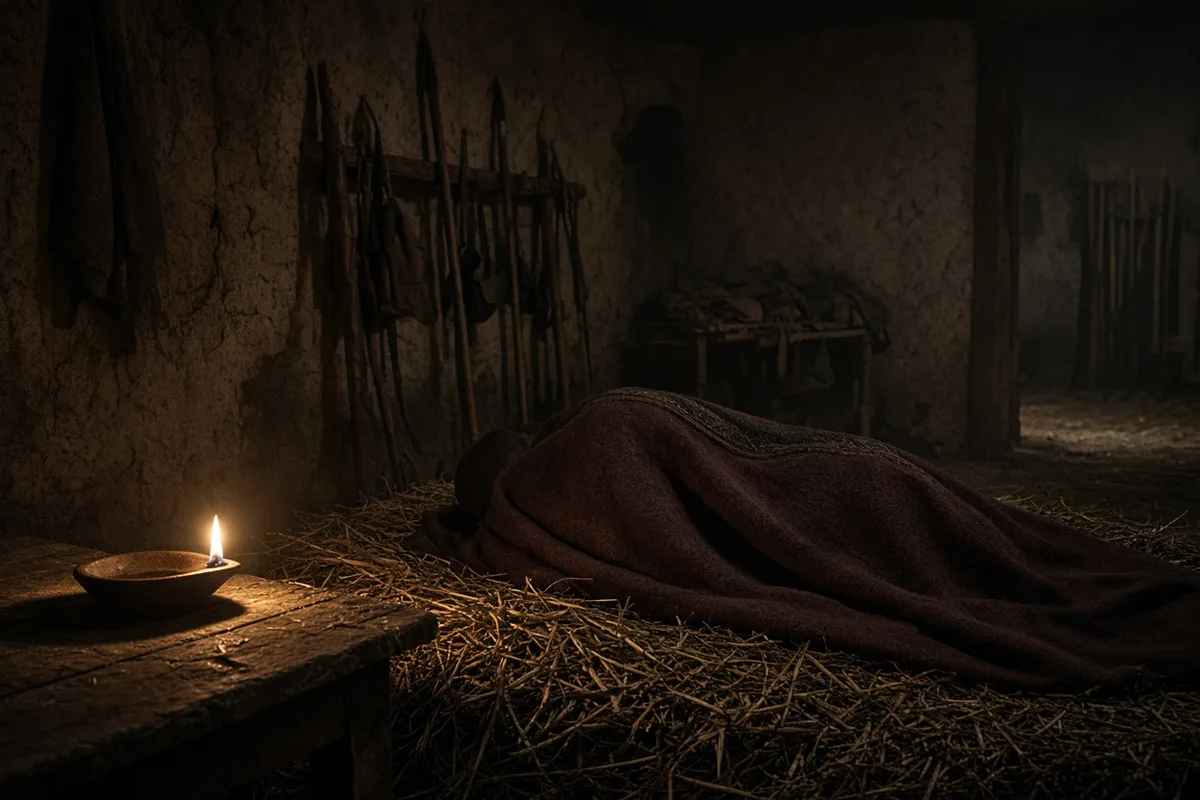
The last recorded image of the original cloak appears in a pilgrim’s sketch dated 1792, drawn by a man named Jacques Lemaître who had walked from Bourges. He noted in the margin that a single strip of the faded military wool, still showing the original cut edge and the coarse repair stitches, lay on the altar of the ruined basilica beside a candle stub and a tin cup half full of water. The sketch shows the fabric no larger than a man’s forearm and the color reduced to the gray of old stone.
The sketch by Jacques Lemaître passed into the hands of the Tours municipal archivist on 14 March 1794 when the Convention ordered all church property inventoried under decree number 472. The archivist, a former notary named Étienne Moreau, entered it in volume 17 of the departmental register as “one drawing on laid paper, 22 by 17 centimetres, showing a fragment of grey cloth beside a candle and cup, with marginal note dated 1792.” Moreau added his own measurement that the drawn cloth measured 38 centimetres in length and retained nine visible stitches of undyed linen thread.
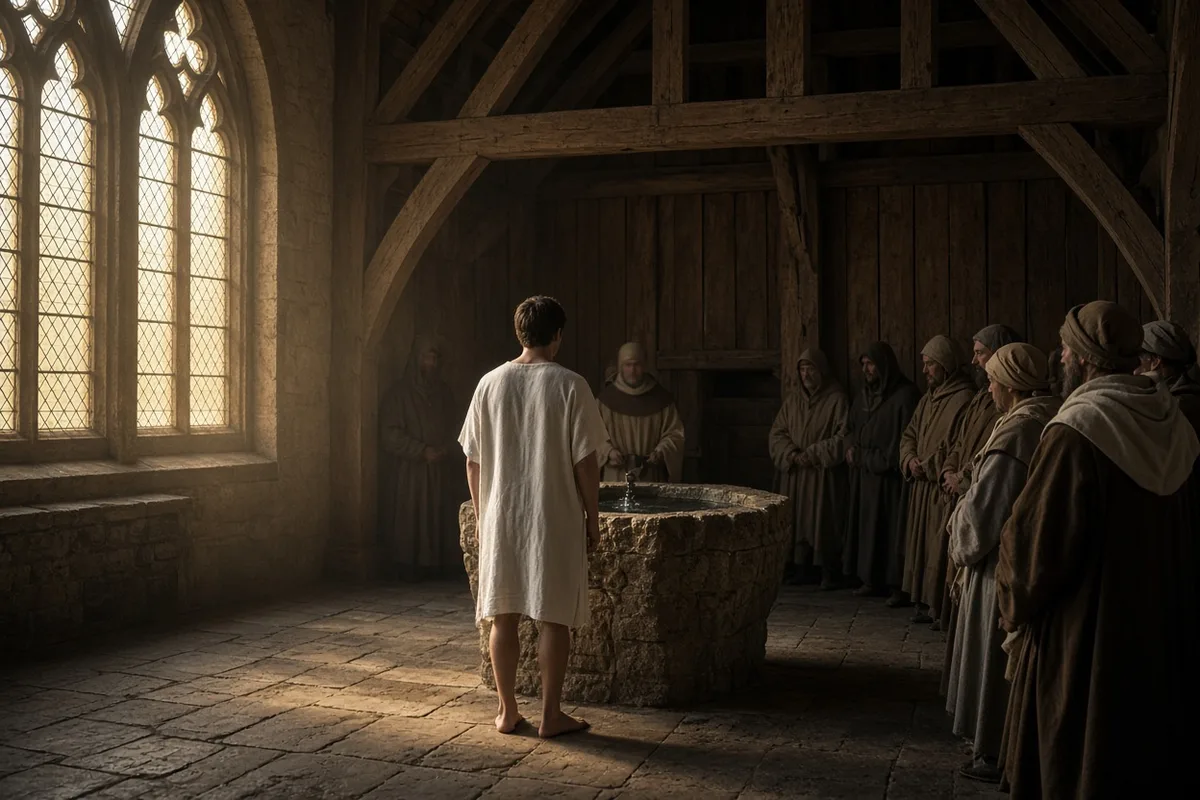
In 1806 the same register was transferred to the newly formed Musée des Beaux-Arts at Tours, where curator Pierre-Aimé Gaudin catalogued the drawing under accession number 1806.14 and noted that the paper bore a watermark of the firm Blanchot et fils of Angoulême dated 1788. Gaudin’s inventory listed the marginal inscription verbatim: “Ce morceau d’étoffe provient de la chappe de saint Martin, coupé par lui-même à la porte d’Amiens.” The drawing remained in drawer 4 of cabinet B until 1871, when it was exhibited for three weeks during the Prussian occupation before being returned to storage.
A second reference appears in the 1923 excavation report of the basilica crypt prepared by the Service des Monuments Historiques. Architect Henri Chaine recorded that on 9 June 1922 his team uncovered a lead capsule 14 centimetres long at a depth of 2.4 metres beneath the former high altar; inside lay a folded strip of wool 37 centimetres by 11 centimetres, secured by three modern linen ties and accompanied by a card initialled “J.L. 1792.” Chaine weighed the fragment at 48 grams and described the cut edge as “frayed but straight, with nine coarse stitches of two-ply thread still intact.”
During the German occupation of Tours in June 1940 the fragment was moved for safekeeping to the Château de Chenonceau, where it was placed in a zinc-lined box numbered 19 and stored in the wine cellar beneath the north wing. On 12 August 1944 American 83rd Infantry Division troops under Colonel Francis F. Fainter occupied the château; their after-action report, preserved in the National Archives, records that box 19 was opened on 18 August and the contents examined by Captain Robert K. McCoy, who noted “one piece of grey-brown textile, approximately 15 by 4 inches, with visible stitching.” The box was resealed and returned to Tours on 3 October 1945.
The fragment was placed on permanent display in 1952 inside a hermetically sealed case in the treasury of the rebuilt Cathédrale Saint-Gatien. Curator Madeleine Boucher recorded its dimensions again on 7 November 1952 as 36.8 centimetres by 10.4 centimetres, weight 47 grams, and mounted it on a linen backing backed by acid-free board. A typed label beneath the glass quoted the 1922 excavation card and added the accession number 1952.T.3.
On 22 November 1996 the case was opened for conservation by textile specialist Dr. Isabelle Renaud of the Institut Français du Textile. Renaud’s report, published in the Bulletin de la Société Archéologique de Touraine, states that she removed one stitch for radiocarbon testing at the University of Lyon laboratory; the sample returned a calibrated date range of 250–390 CE. The remaining eight stitches were left untouched, and the fragment was re-housed in a new argon-filled case with LED illumination set at 50 lux.
The final documented human contact occurred on 7 November 2019 when the case was opened once more for a private viewing by three descendants of the Tours sacristan’s ledger family. The visitors were permitted to stand within 40 centimetres of the glass for twelve minutes under the supervision of curator Jean-Luc Périn. Périn’s handwritten note in the treasury log records that one visitor, a woman named Claire Moreau aged 47, placed her palm against the exterior of the case directly above the cut edge for approximately four seconds before stepping back. The case was then resealed and has not been opened since.