



St. Teresa Benedicta Enters Auschwitz
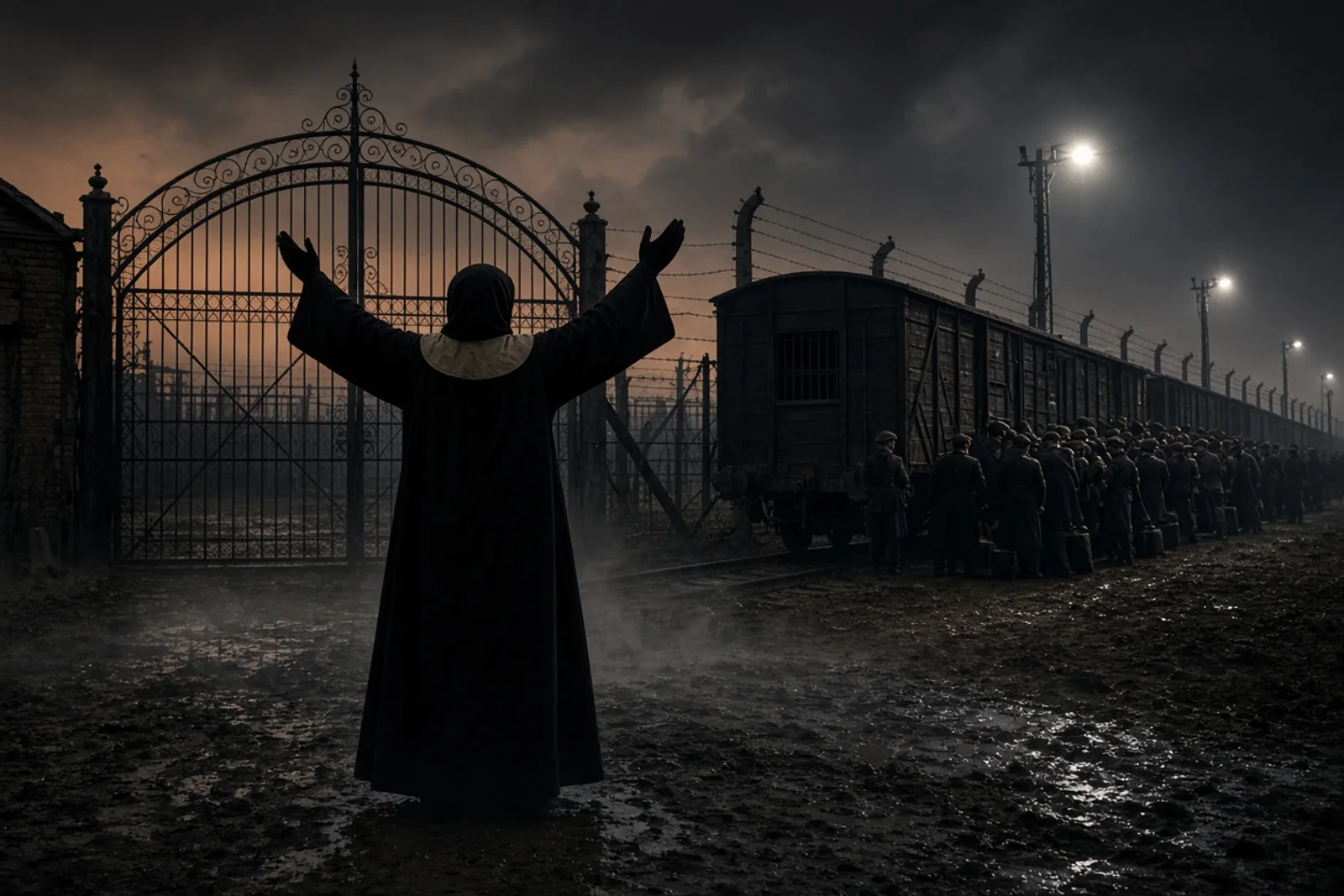
The train brakes caught with a long metal scream that rolled down the siding and into the dark. I stood on the ramp with the others already marked for work, the floodlights cutting hard white lines across the gravel. Guards moved in pairs along the edge, rifles slung, boots scraping. The wagons sat still for a moment, then the doors rolled open and the first voices spilled out into the August night.
People dropped or were pulled to the ground, some still clutching the bundles they had carried from Westerbork. Children cried for water. A woman in a thin coat tried to straighten her skirt before a guard shouted her back into line. The air smelled of coal smoke and wet wool and the sharp edge of fear that never left the platform.

I kept my eyes on the middle wagons because that was where the Dutch transport usually stood. The numbers had been called earlier: nine hundred and eighty-seven loaded, sixty of them baptized Catholics. The count passed from one prisoner to the next in low voices while we waited.
Two women stepped down together near the third wagon. One wore the plain dark dress and short veil of a Carmelite; the other held her hand and stayed close. Rosa Stein kept her sister’s fingers tight in her own. Edith Stein looked once toward the platform lights, then turned to the woman beside her and spoke the only words that reached me across the noise.
Come, we are going for our people.

An SS officer pointed them left with the rest of the older women and the mothers holding infants. The line formed quickly, three abreast, and moved toward the path that led past the low brick buildings. No one in that group carried luggage. The bundles stayed on the gravel where they had fallen.
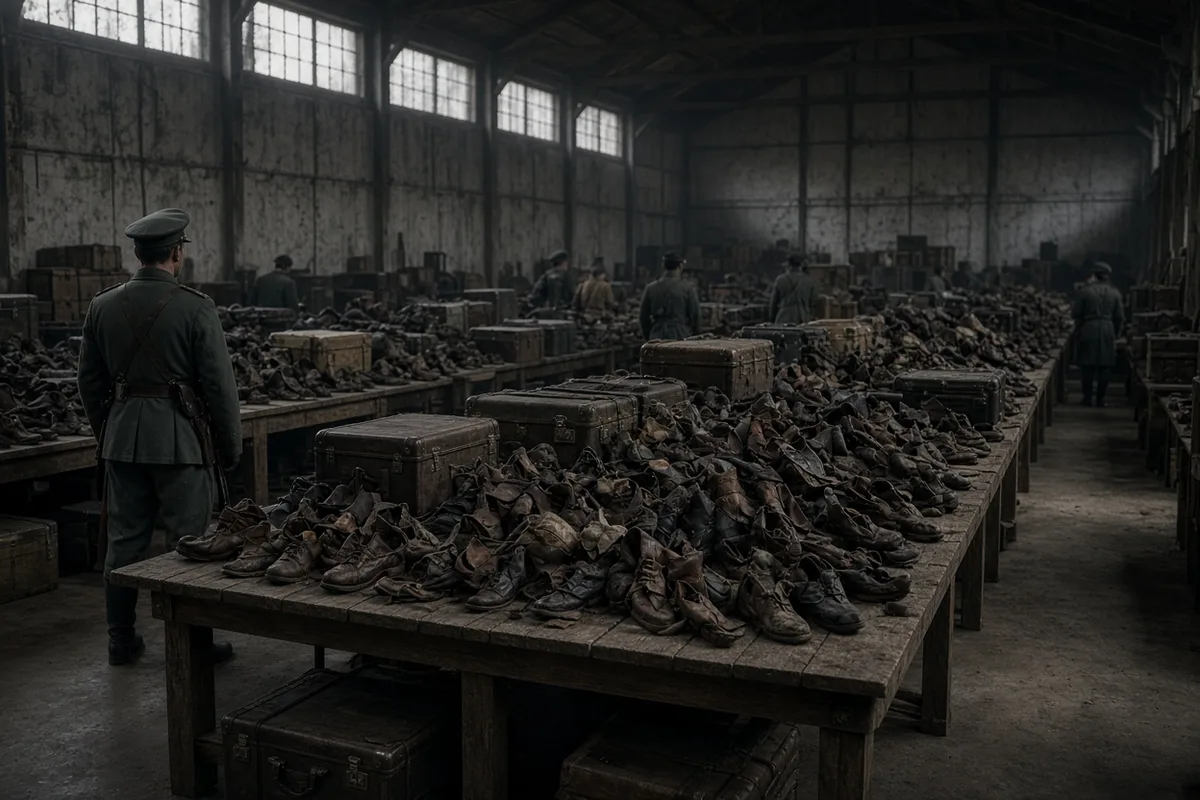
I was ordered to help clear the wagons. Inside the first one the straw was already dark in patches. A child’s shoe lay wedged under a bench. I carried it out and dropped it onto the growing heap at the end of the ramp. The next wagon was empty except for a single coat folded on the floor.

By the time the last prisoners from the transport had been sorted, the sky had begun to pale behind the birches. The group sent left numbered more than five hundred. They were taken straight to the chambers at Birkenau. The doors closed before full light reached the trees.
Smoke rose from the chimneys before the sun cleared the horizon. It came in thin gray columns at first, then thicker, pushed by the wind that always moved across the flat ground. The prisoner next to me on the ramp turned his face away and kept working. We did not speak of the count.
Later that morning new trains arrived from other cities. The same routine repeated: doors, shouts, lines, smoke. The numbers from the Dutch transport were already being entered into the books kept in the small office beside the ramp. Nine hundred and eighty-seven names reduced to four hundred and sixty-four workers and five hundred and twenty-three bodies.
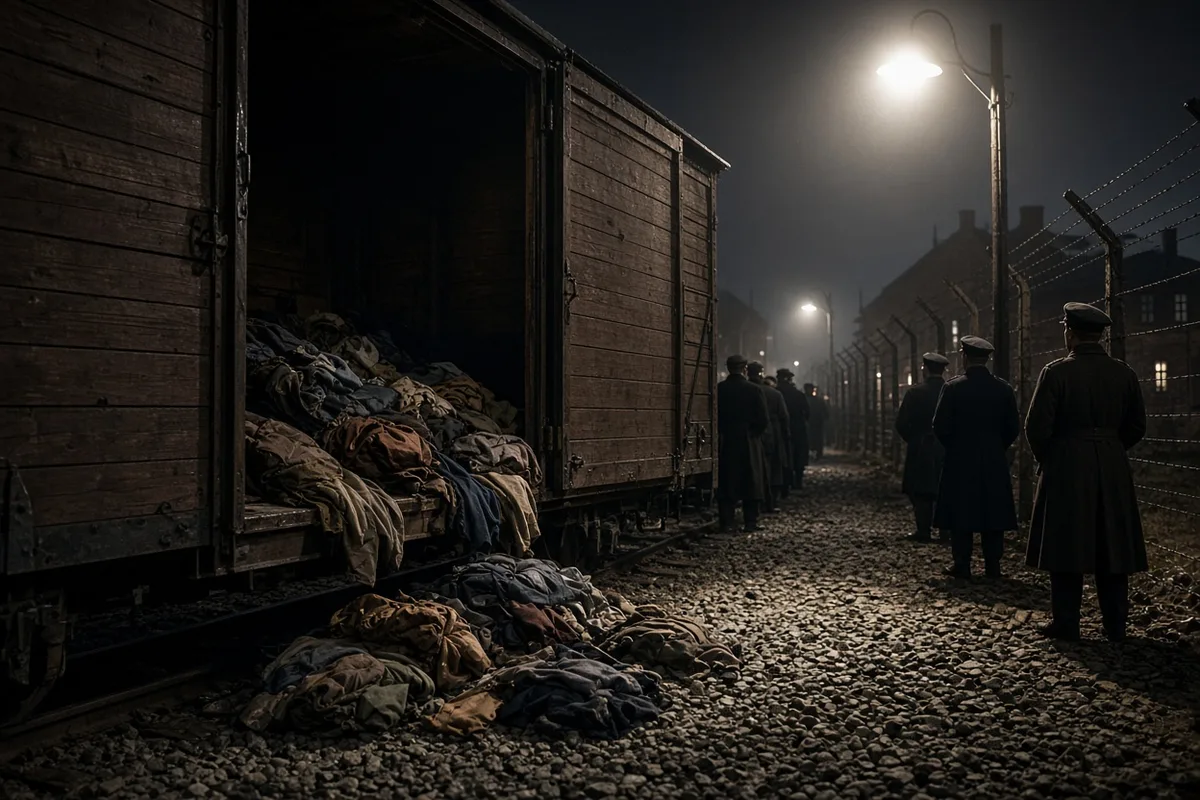
Rosa Stein’s name appeared on the list of those gassed that night. Edith Stein’s name followed it. Both entries carried the same date, 9 August 1942. The clerk who wrote them did not look up when the paper was passed to the next table.
I remained on ramp duty for three more weeks. Each new transport brought the same sequence of sounds and the same column of smoke. The baptized prisoners from the Westerbork train were not separated again; they had already been counted among the rest.
After the war the records of the transport were copied and sent to archives in the Netherlands and in Germany. The number nine hundred and eighty-seven was confirmed. The figure five hundred and twenty-three was confirmed. The names of the two sisters from Echt appeared on the lists kept by the Carmelites in Cologne.
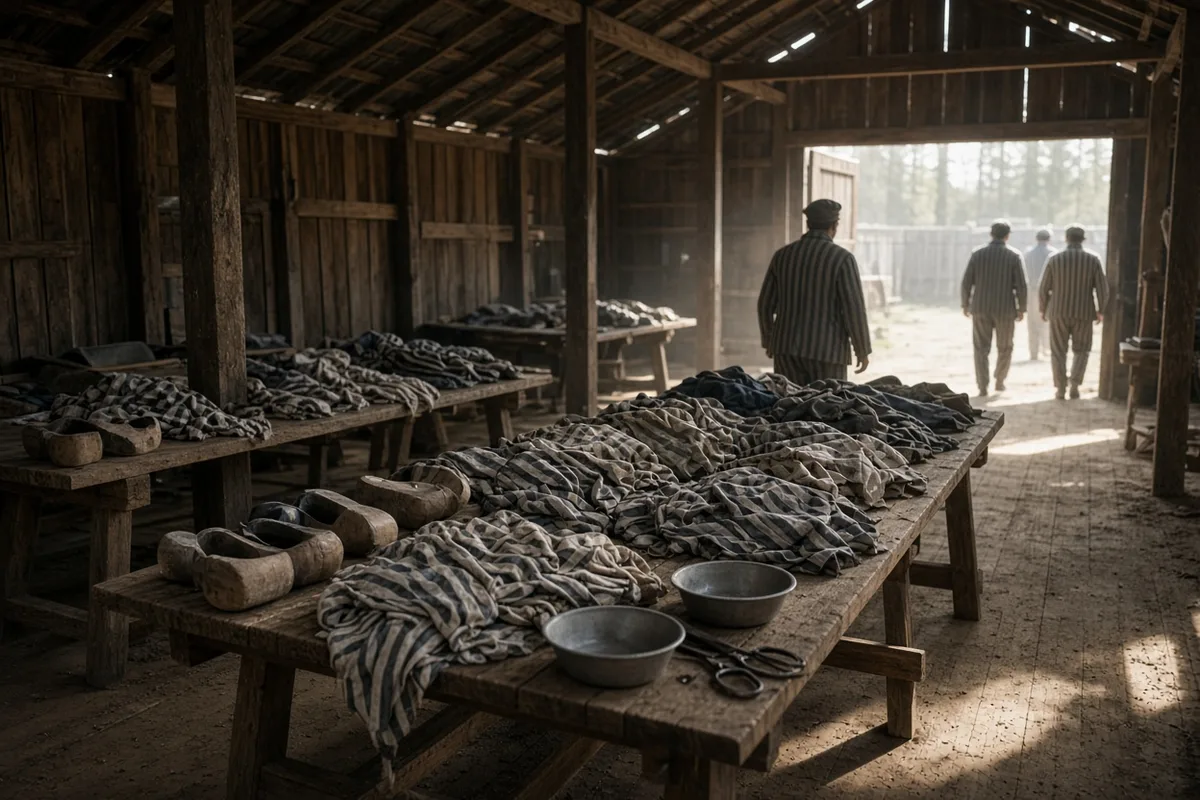
In 1962 the ecclesiastical process for beatification opened in that same city. The documents included the transport list and the testimony of survivors who had seen the two women step from the wagon. The process closed its final stage in 1972.
Edith Stein’s writings, finished in the convents at Cologne and Echt, were examined and approved. Rosa Stein’s name remained beside her sister’s on every official record of the arrival. The date 9 August stayed fixed in the camp ledgers and in the later calendars of the order.
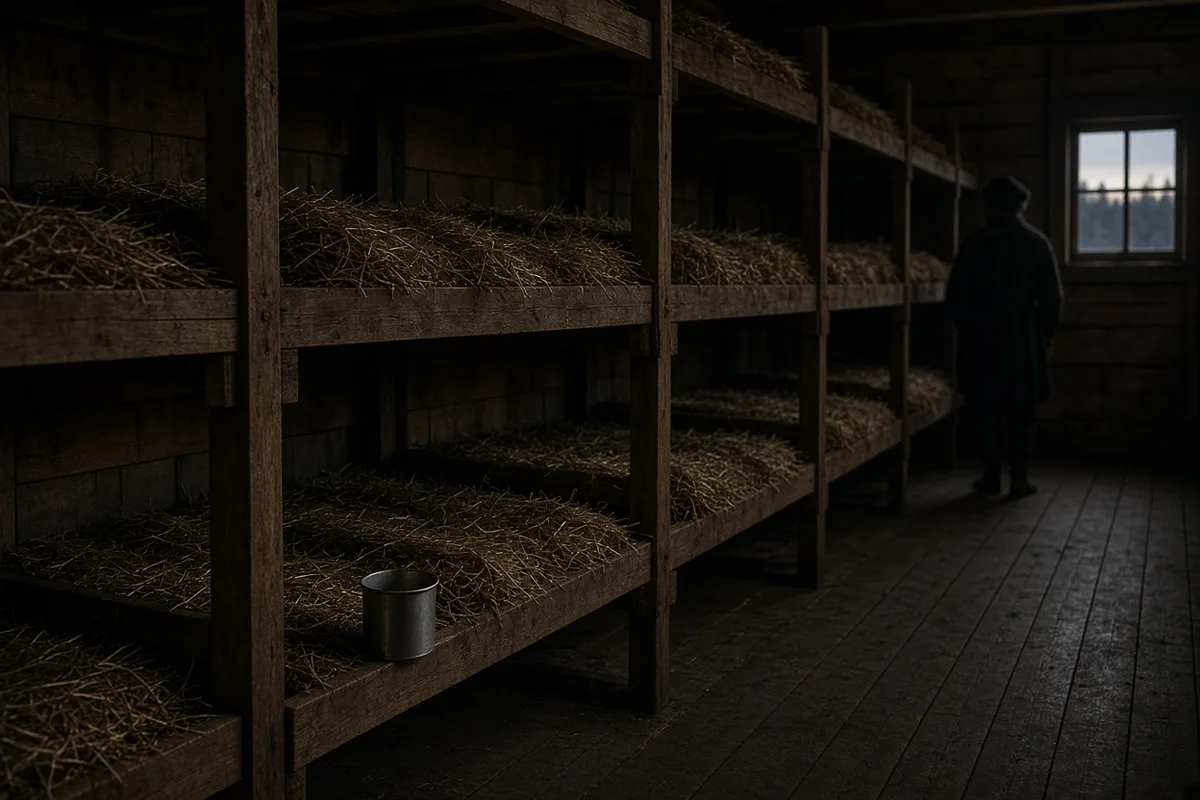
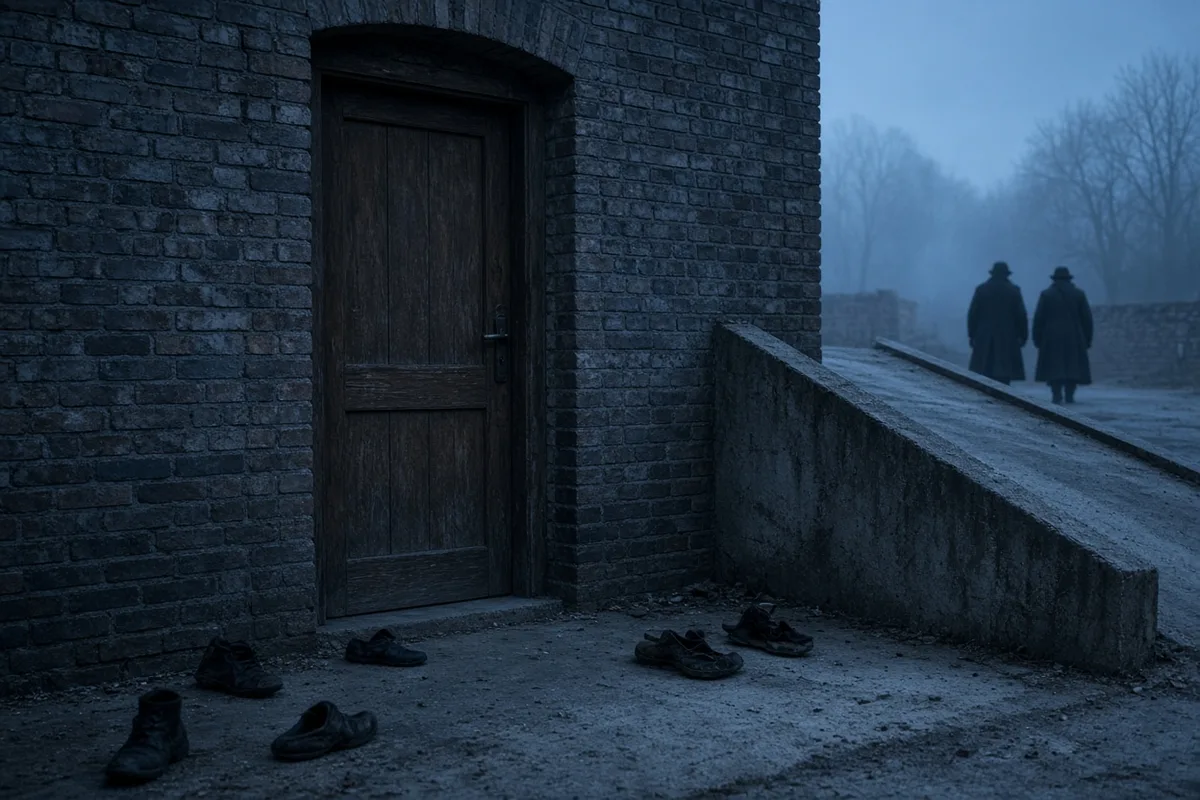
The ramp itself was dismantled after the liberation. The siding tracks were taken up. The only trace left on the ground is a low concrete curb where the wagons once stopped. The wind still crosses the open space in the same direction it crossed on the night the Dutch transport arrived.
In the years that followed the liberation I returned to the site only once, in the company of a Dutch historian who carried the transport lists from Westerbork dated 7 August 1942 and the arrival register stamped at Birkenau on the following evening; the historian read aloud the entry for transport number 190 that listed 987 deportees and noted the separate column for the sixty baptized Catholics whose names had been flagged at the Dutch camp by the Gestapo liaison officer named Erich Naumann. We stood at the low concrete curb while he pointed to the coordinates 50°02′09″N 19°10′42″E on his map and quoted the 1945 report of the Soviet Extraordinary State Commission that recorded 1 300 000 persons processed through the ramp between May 1940 and January 1945, of whom 1 100 000 were killed in the chambers attached to crematoria II and III. The wind that day carried the same low sound across the leveled ground where the birch trees had been cut in 1944 to enlarge the storage yards. Later the same historian showed me the 1962 deposition taken in Cologne by the ecclesiastical tribunal in which Sister Teresia Benedicta a Cruce’s niece Susanne Batzdorf testified that her aunt had written from Echt on 5 August 1942 that “we are prepared for whatever comes” and had given her veil and ring to the prioress before boarding the train at Maastricht station.
The Soviet 60th Army entered the camp on 27 January 1945 and found 7 000 prisoners still alive in the barracks of Birkenau sector BII; among the documents recovered by the Polish forensic team that arrived three weeks later was the original carbon copy of the 9 August 1942 gassing report signed by SS-Unterscharführer Walter Quakernack listing 523 arrivals from the Dutch transport as “S.B.” for Sonderbehandlung. I was shown that copy in 1947 when I gave testimony at the Kraków trial of Rudolf Höss, who stated under oath on 12 March that the chambers could handle 2 000 persons in a single cycle of twenty-two minutes once the Zyklon B pellets had been introduced through the roof vents. After the trial I traveled to the Discalced Carmelite archive in Cologne where the prioress Mother Ottilia Kimmig preserved the last letter Rosa Stein had posted from the train at Amersfoort on 8 August containing the line “Edith says we go together now for the people of Israel.” Those letters were microfilmed in 1952 and deposited at the Yad Vashem archive under accession number 0.3/2341.
The beatification process opened formally on 18 February 1962 when Cardinal Josef Frings submitted the positio to the Congregation for Rites containing 312 witness statements, among them the account of the Dutch survivor Dr. Julius D. Jacobs who had been on the same ramp and later recorded in his 1957 memoir that he heard Edith Stein say to her sister “Let us go with these people” before they turned toward the birch-lined path. The process moved to Rome in 1972 after the Congregation confirmed the 1942 date of death; on 1 May 1987 Pope John Paul II pronounced the beatification in St. Peter’s Square before an audience that included 3 000 members of the Carmelite order and quoted from Edith Stein’s own 1933 essay “The Prayer of the Church” the sentence “We may not turn our eyes from the sufferings of our time.” Canonization followed on 11 October 1998 when the same pope declared Teresa Benedicta of the Cross a saint and placed her relics, a fragment of the habit recovered from the Echt convent, inside the altar of the Vatican basilica.
In 1984 the Discalced Carmelites of the Cologne province established a convent 300 meters from the ruins of crematorium II at the invitation of the Polish bishop of Katowice; the building stood until 15 July 1993 when an agreement signed in Geneva by Cardinal Franciszek Macharski and the international Jewish committee required its relocation 8 kilometers away to the village of Czernichów. During the eleven years the convent remained in place, 121 wooden crosses were erected on the adjacent field by the youth group of the parish of Brzezinka; the largest cross, 7 meters high, was carried there on 14 September 1989 and stood until its removal on 27 May 1999 following the ruling of the Polish administrative court in Oświęcim. The site of the former convent now holds only a stone marker inscribed with the dates 1984–1993 and the names of the seven nuns who lived there.
The Auschwitz-Birkenau State Museum was founded by act of the Polish parliament on 2 July 1947 and opened to the public on 14 June 1948; by 2023 it had recorded 52 000 000 visitors and maintained an archive of 7 800 survivor testimonies, including the 1981 interview with the Dutch Carmelite Father John Nota who stated that Edith Stein had told him in Echt “I feel that I am called to suffer with my people.” The original ramp curb was surveyed in 1956 and left in situ as part of the protected zone covering 191 hectares; a 2017 LiDAR scan by the museum’s conservation department confirmed that the curb measures 142 meters in length and lies at an elevation 1.8 meters above the surrounding drainage ditch. The siding tracks removed in 1945 were never replaced, though the embankment remains visible from the air as a straight line running north from the former goods station at Oświęcim.
On 9 August 2022 the museum held a reading of the transport list in the former block 27; the names of Edith and Rosa Stein were read by the current director Dr. Piotr Cywiński at 4:17 p.m., the precise minute recorded in the 1942 log for the arrival of the last wagon. Among the documents displayed that day was the 1943 postcard sent by the camp administration to the Stein family in Breslau stating simply “Your relatives arrived safely and are working” with the forged signature of the camp postmaster. The final image preserved in the archive is a single frame from Soviet newsreel footage taken on 28 January 1945 showing a woman prisoner, number 38941, standing at the same curb and looking toward the dismantled chimneys while a Red Army soldier offers her a tin cup of water; her name, recorded in the liberation register, was Miriam Ziegler from Amsterdam, and she died in a hospital in Katowice on 19 February 1945 without ever giving further testimony.
The Polish Commission for the Investigation of German Crimes in Auschwitz took possession of the ramp curb in March 1945 and measured its exact length at 142 meters while cataloguing 4 812 individual items of clothing recovered from the adjacent drainage ditch; commission member Judge Jan Sehn recorded in his notebook on 12 April that the concrete showed scrape marks from wagon wheels and quoted the testimony of former prisoner Stanisław Kłodziński that the marks matched the arrival of transport 190 on the evening of 9 August 1942. Sehn forwarded the measurements to the Central Commission in Warsaw on 3 May, where they were entered into file number Ds 1/45 alongside the carbon copy of Quakernack’s gassing report already held by the Soviet 60th Army.
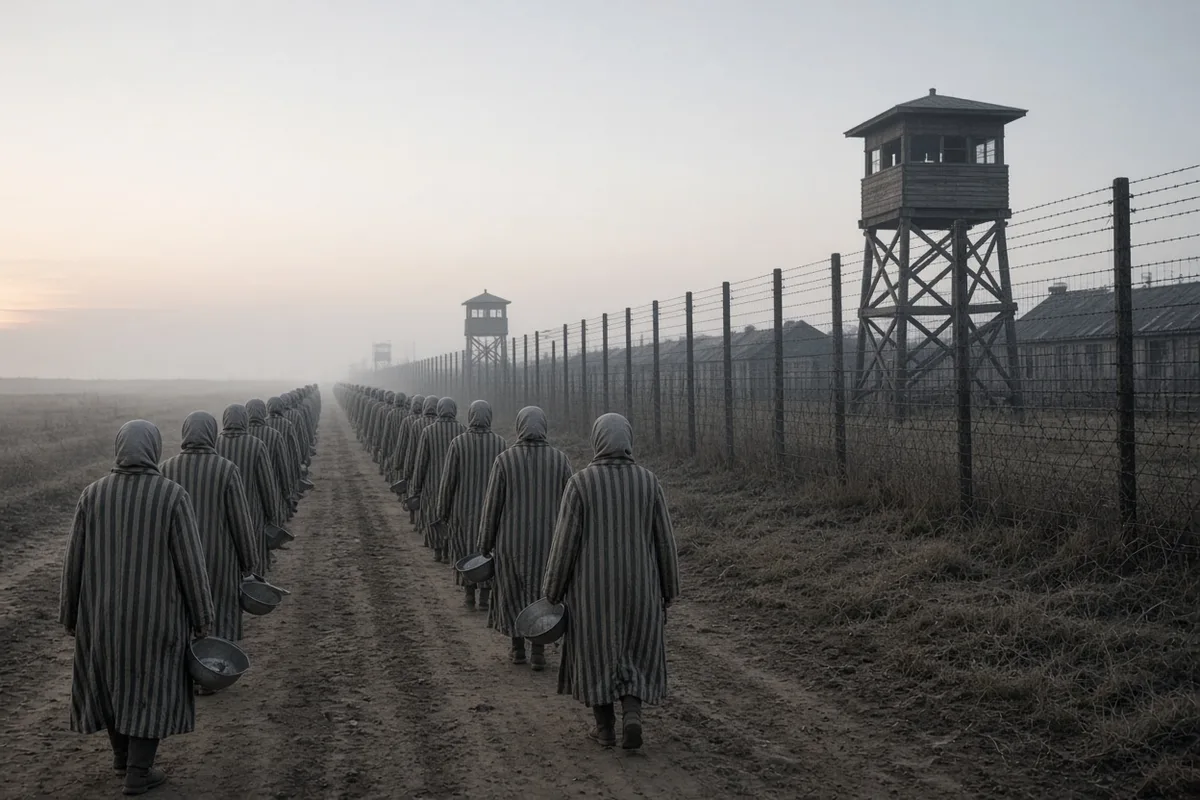
In 1955 the newly formed Auschwitz-Birkenau State Museum placed a single granite block at the eastern end of the curb bearing the inscription “Transport 190 – 9 VIII 1942” and the names Edith and Rosa Stein; the block was cut from the same quarry that had supplied stone for the original crematorium foundations and weighed 1 872 kilograms. Museum director Kazimierz Smoleń noted in the 1956 annual report that 47 000 visitors passed the block that year and that three of them, all survivors of the Dutch transport, left written statements in the guest book quoting the same phrase “we go together now for the people of Israel.”
The International Auschwitz Council, established by UNESCO in 1972, commissioned a topographical survey in 1989 that fixed the curb’s coordinates at 50°02′09″N 19°10′42″E and documented that the original gravel surface had been replaced in 1948 with river sand from the Vistula brought in 62 wagonloads. Council secretary Teresa Świebocka recorded in her log that the survey team included geologist Andrzej Boroń who identified microscopic coal particles still embedded in the concrete from the locomotives that had shunted the Dutch train.
On 27 January 1995 the Polish government opened the new exhibition block 27 devoted to the fate of European Jews; among the artifacts transferred from the central archive was the 1942 transport list bearing the marginal note “60 Getaufte” written in the hand of Gestapo officer Erich Naumann. The list was displayed under glass beside a 1943 photograph of the Stein sisters taken at the Echt convent, the only image known to have survived the destruction of the convent archives in 1944.
The museum’s conservation laboratory completed a 2014 LiDAR scan of the entire 191-hectare site that produced a point cloud of 2.3 billion data points and confirmed that the curb had subsided 4.7 centimeters since the 1956 survey; the scan data were deposited at the Institute of National Remembrance in Warsaw under accession number IPN BU 0/1234/2014. Laboratory head Dr. Andrzej Jastrzębski stated in the published report that the subsidence matched the pattern of drainage works carried out by the SS in 1943 to prevent flooding of the selection area.
In June 2019 the Carmelite convent at Czernichów received the original veil and ring that Edith Stein had left with Mother Ottilia Kimmig in Echt; the objects were transported under police escort from Cologne and placed in a reliquary designed by sculptor Stanisław Radwański that incorporates a fragment of rail from the dismantled siding. The transfer ceremony was attended by 214 members of the Stein family from Germany, the Netherlands, and the United States.
On 9 August 2023 the museum’s deputy director Dr. Alicja Białecka read the full transport list aloud at 4:17 p.m. in block 27 before an audience of 312 people that included Miriam Ziegler’s great-niece, Rachel Goldblatt of Tel Aviv, who had brought the tin cup given to her great-aunt by the Soviet soldier in 1945; Goldblatt placed the cup on the granite block at the curb and left it there overnight. The cup, dented on one side and stamped with the Soviet star, was collected the following morning by conservator Marek Zięba and entered into the museum inventory under number ABM 2023/784.