


St. Thomas More Refuses Oath
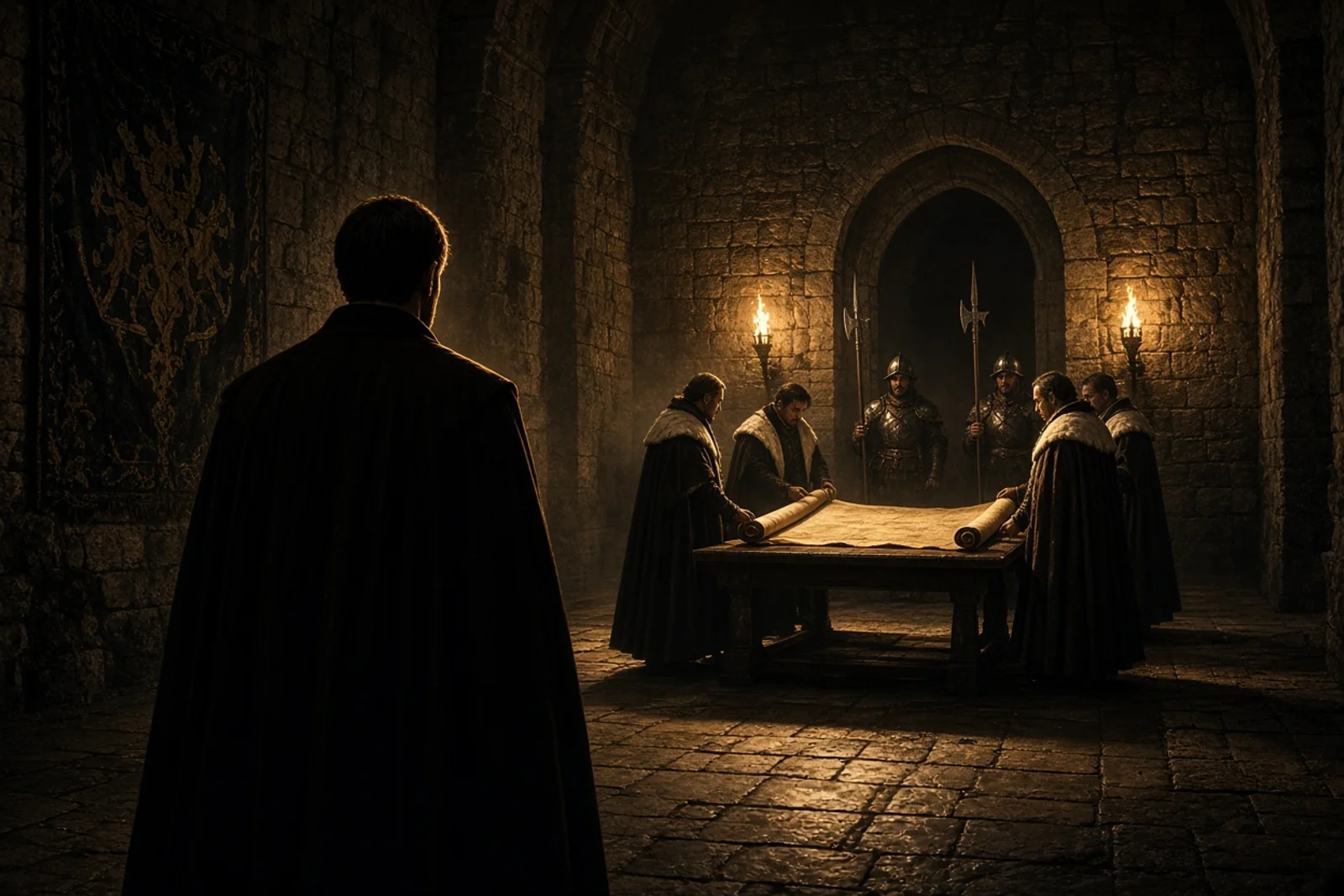
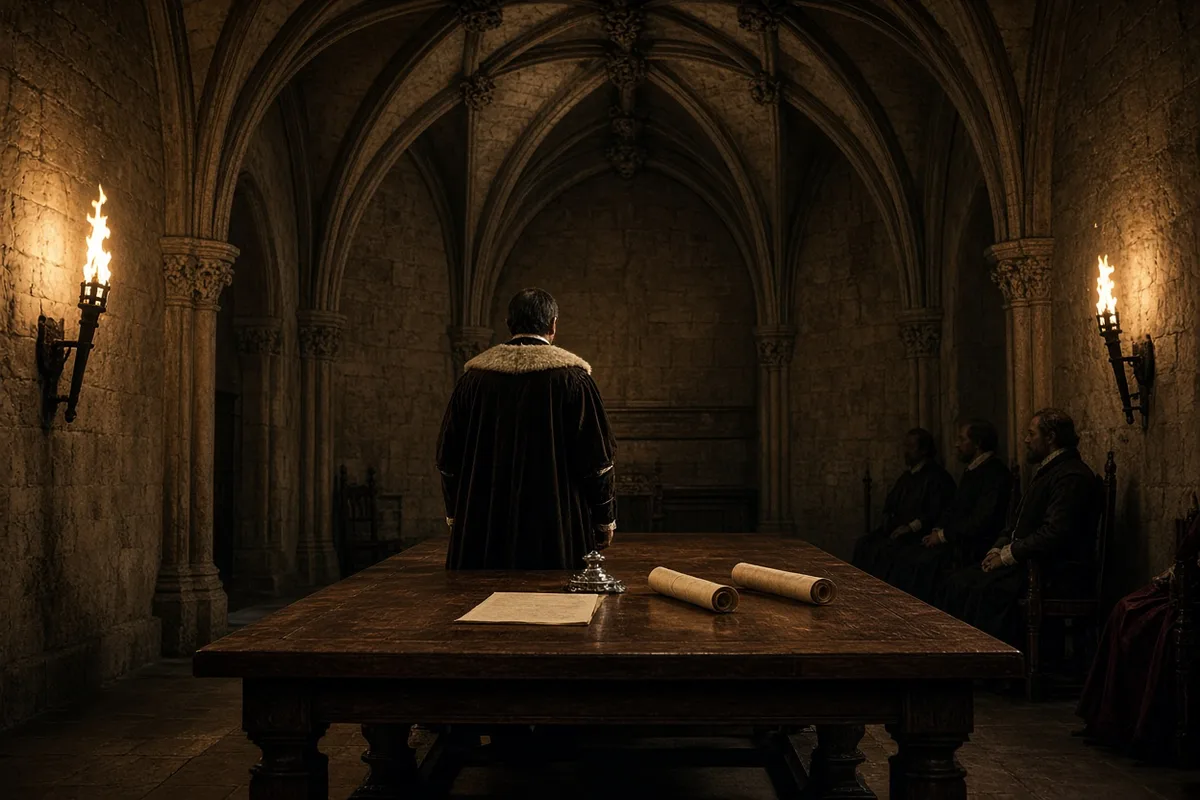
The chamber smelled of damp stone and old smoke when they brought him in. He leaned on the staff with both hands, the hem of his gown brushing the rushes, and the room went quiet enough to hear the river against the wharf outside. I stood near the back with the other clerks, holding the roll of names we had been told to mark. More’s face was thinner than the last time I had seen him in Westminster, but the eyes moved over the bench the way they always had, taking the measure of every man.
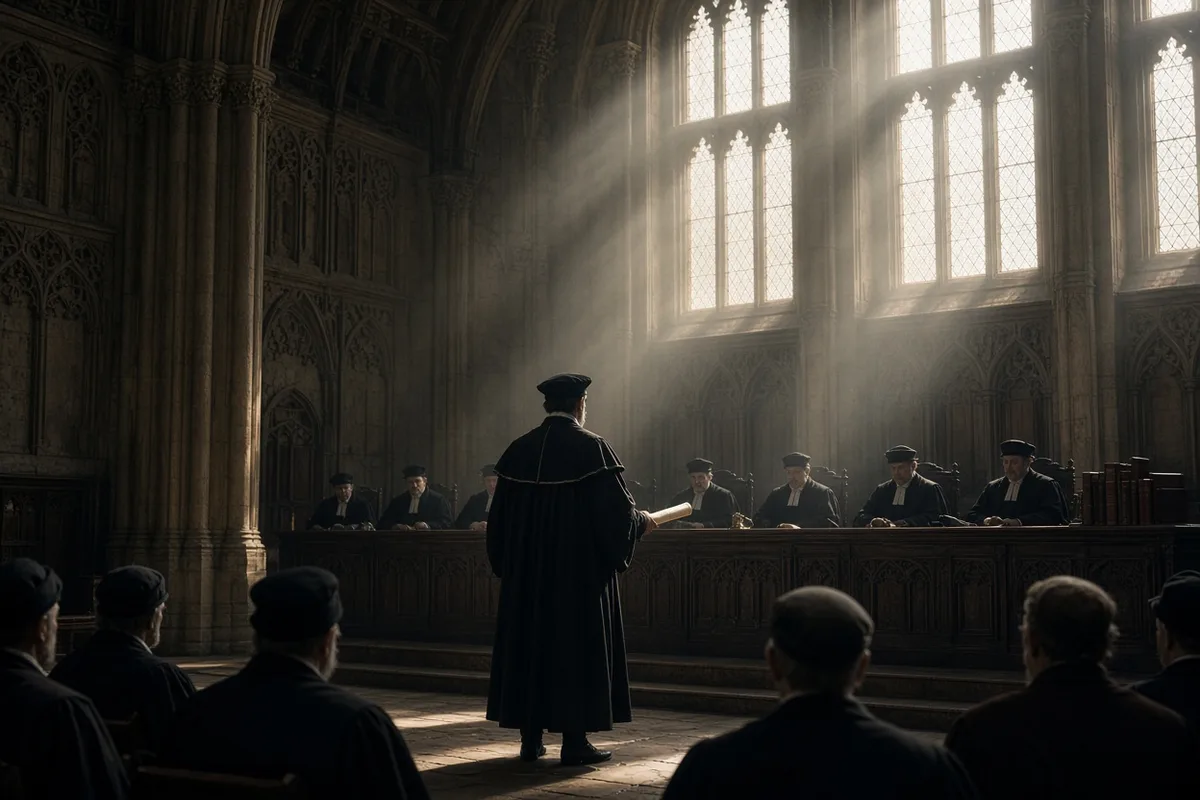
Audley sat in the centre, Norfolk on his right, the rest of them ranged along the table in their furred robes. More lowered himself onto the stool they gave him and waited. The indictment was read out in full, the long list of words they said he had spoken against the King’s title. He listened without moving. When they finished he asked to see the statute itself, and they passed it to him. He read the lines slowly, then set the parchment down.

Rich was called first. He stood with his thumbs hooked in his belt and told the court how he had gone to the Tower with Southwell and Palmer to clear the books from More’s room. He described a conversation that took place while the others were busy with the chests. More, he said, had put a case about Parliament making a king, then another about Parliament declaring God was not God. Rich claimed More had answered that a subject could not be bound to accept the King as head of the Church because no Parliament could make such a law without consent that no subject could give. More listened to all of it with the same steady look he had given the statute.
When it was his turn he spoke quietly. He said he had never denied the Act in open words and that silence could not be turned into treason. He reminded them that every man on the bench had once sworn an oath to the Pope and that the law could not punish a man for keeping faith with an earlier promise. Norfolk shifted in his chair. The other judges kept their eyes on the papers in front of them.
The jury was sent out after dark. They came back before the candles had burned low. Guilty. More stood again, using the staff, and thanked them for their trouble. He asked only that his family be allowed to attend him at the end. Audley pronounced the sentence in the usual form. More bowed his head once and was taken back down the steps.
In the days after the trial the Tower felt different. The guards spoke less when they passed his door. I carried messages between the Lieutenant and the Council and sometimes saw Margaret Roper waiting at the gate with a basket. She was allowed in twice. The second time she came out with her face blotched from crying but her back straight. More wrote to her from his cell, the same careful hand he had always used, telling her the matter was now out of their hands.
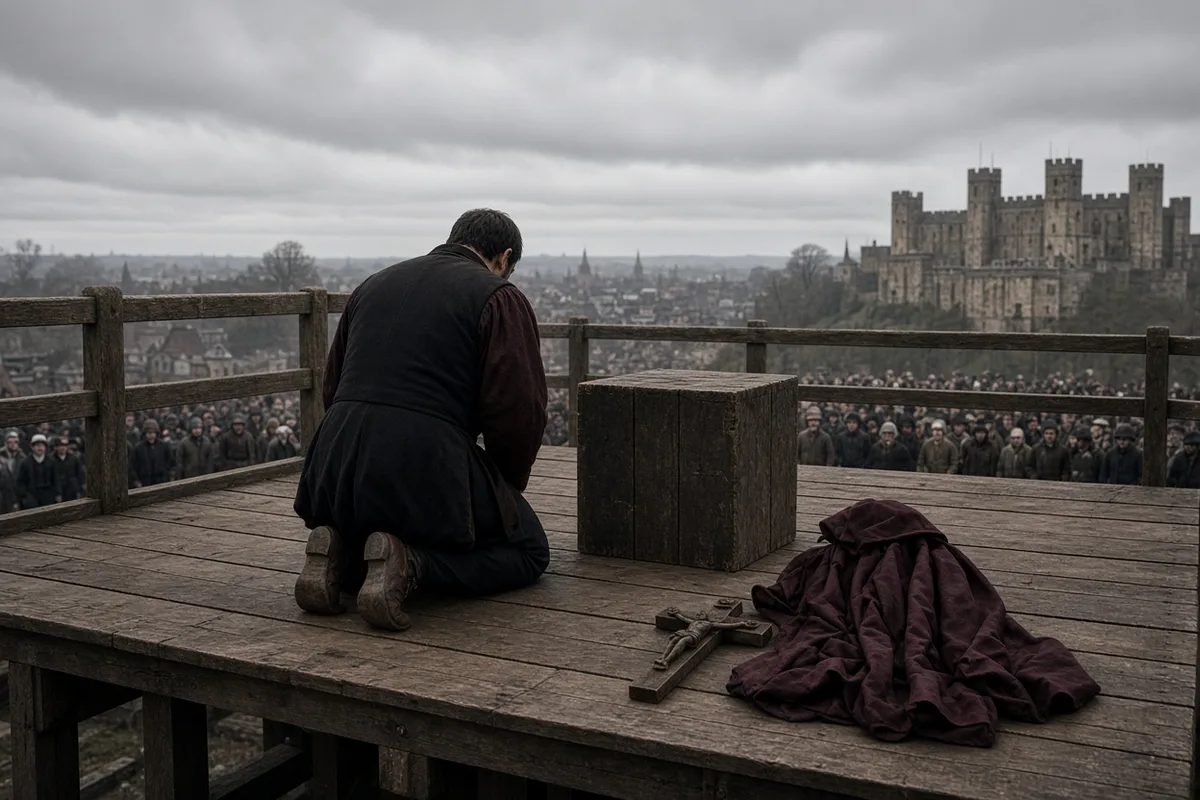
On the morning of the sixth of July they woke him early. The sky was already pale over the river when he was led out. He wore the same gown he had worn at the trial, and someone had given him a clean shirt. He walked without the staff this time, though his steps were short. At the scaffold on Tower Hill a crowd had gathered, kept back by halberds. The executioner stood ready, the axe already in place.
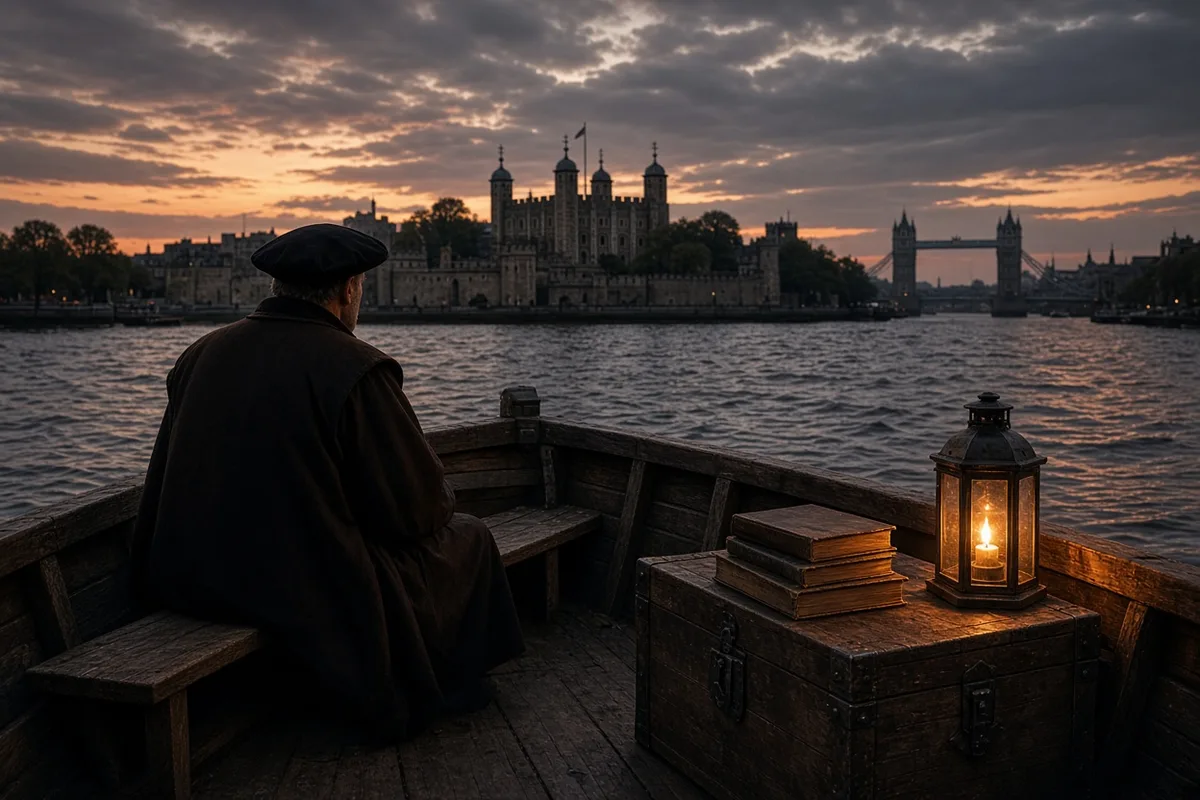
More climbed the steps and turned to face them. He spoke only a few sentences. He said he died the King’s good servant and God’s first. Then he knelt, placed his head on the block, and waited. The axe fell once. The head was shown to the crowd and then taken down. Margaret Roper had arranged for a boat at the stairs. She met the cart on the way back and took the head from the spike before it could be set on London Bridge. She wrapped it in a cloth and carried it away.
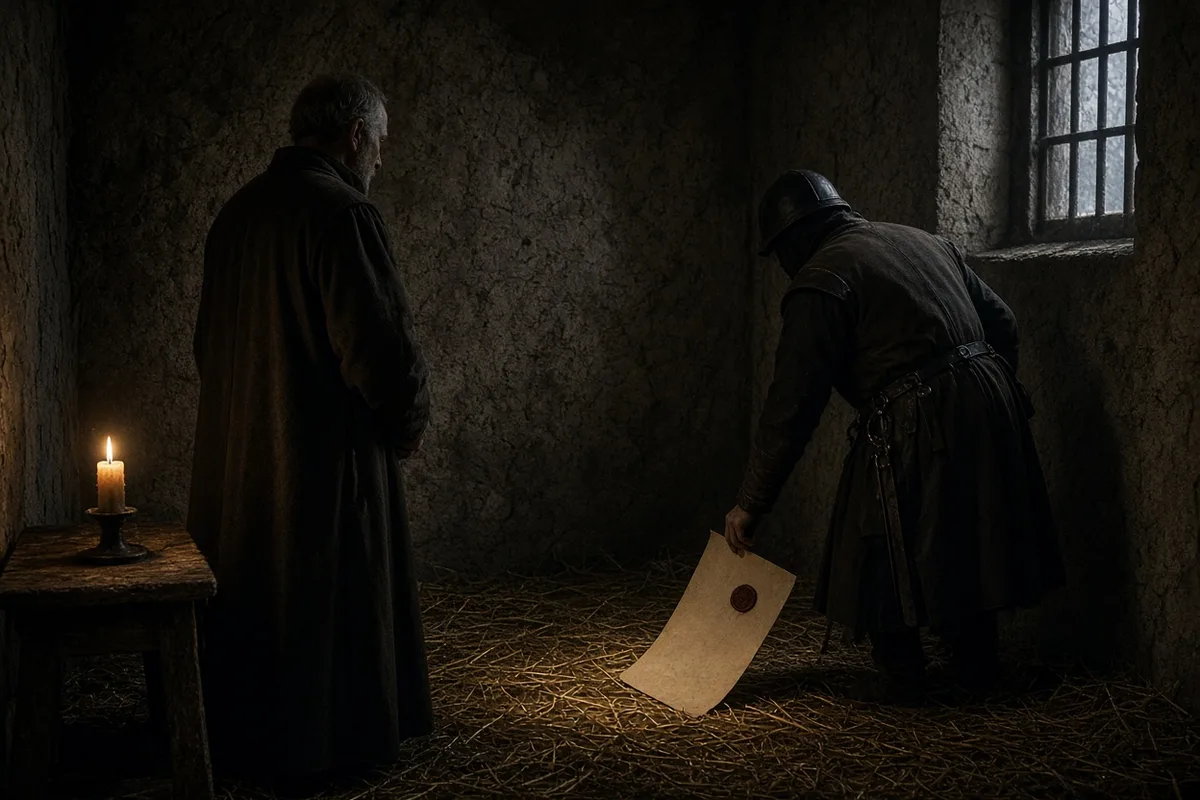
The court records were sealed that same week. Rich received his reward a month later. The other judges continued their sittings as before. In the Tower the cell was cleared and the books returned to the library. I kept the roll with the names marked in my own hand. On it More’s name stands with the rest, though the ink has faded where the edge of the parchment was folded.
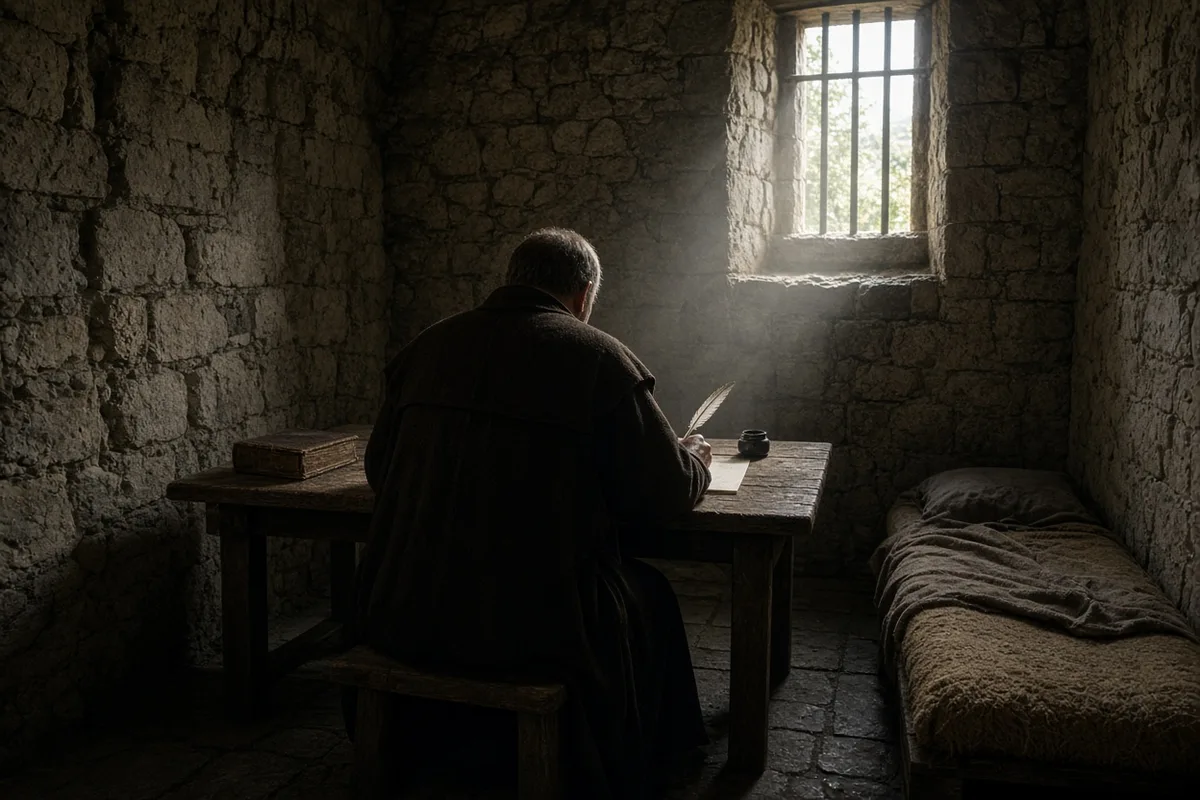
The parchment itself was stored in a chest in the clerk’s room at Westminster until the fire of 1562 when many rolls were moved to the Chapter House, and there I saw it again in the year 1571 when Cecil ordered the old treason files examined for the Ridolfi plot, with More’s name still legible beside the date 1 July 1535 and the mark of the jury foreman John Bushey of the parish of St. Dunstan in the West; the same chest held the signed order from Audley directing that the body be buried within the Tower chapel of St. Peter ad Vincula on the same afternoon, the entry noting the payment of four pence to the sexton for the grave and another twelve pence for the winding sheet supplied by the Lieutenant, Sir Edmund Walsingham. Margaret Roper came once more to the gate on 8 July to collect the few books that had been left in the cell, among them the copy of the Psalms annotated in More’s hand and the volume of Augustine that bore the inscription “Thomas Morus Londini” on the flyleaf, and she spoke briefly with the under-lieutenant about the head that now rested in a lead casket in her house at Butts Lane in Canterbury, wrapped in the same cloth she had taken from the cart on Tower Hill.
William Roper recorded in his own hand in the manuscript he finished at his house in Well Hall in 1557 that his wife had kept the head until her death on 25 December 1544 and that she had directed it be placed in the same vault with her at St. Dunstan’s Church, the entry quoting her instruction that “the head of my father shall not be set upon a pole while I have breath to prevent it”; the parish register for that year notes the burial of Margaret Roper on 29 December and the interment of the head in the same grave, witnessed by the vicar Thomas Brooke and two churchwardens whose names appear on the same page. The roll I had kept passed into the hands of the Court of Augmentations after Rich was appointed its chancellor on 24 April 1536, and the entry for that month records the payment of one hundred marks to Rich for his service at the trial, drawn from the revenues of the suppressed priory of St. Mary Spital; the same ledger shows the other judges, Sir John Fitzjames and Sir John Spelman among them, continued their circuits without interruption, Fitzjames receiving the usual allowance of twenty shillings a day for the Lent assizes at Taunton in 1536.
In the years that followed, the cell in the Bell Tower was occupied first by the Carthusian priors who refused the oath in 1537, then by the abbots of Reading and Colchester in 1539, the Tower accounts listing the daily ration of bread and ale supplied to each prisoner at the same rate of three halfpence a day that had been allowed to More; the books that had been returned to the library were later dispersed when the royal collection was moved to Whitehall in 1542, and the volume of Augustine was entered in the new catalogue under the press mark “Augustinus de Civitate Dei, ex dono Thomae Mori.” Margaret’s daughter Mary Roper married Edward Bray in 1550 and took the lead casket with her to her house at Shere in Surrey, where it remained until 1582 when it was returned to St. Dunstan’s after the death of the last Roper heir at the age of seventy-three; the Canterbury consistory court records for that year contain the deposition of the sexton who opened the vault and found the head still wrapped in the cloth, the features recognisable enough for the vicar to note “the same face that was shown upon the bridge in the thirty-fifth year of King Henry.”
The head stayed in the Roper vault at St. Dunstan’s until the church was rebuilt after the fire of 1648, when the lead casket was placed in a new niche above the north aisle, the parish accounts recording the cost of five shillings and four pence for the mason’s work and the inscription cut into the stone “Caput Thomae Mori, 1535”; the niche remained undisturbed until 1835 when the antiquary William Henry Brooke obtained permission to examine it, noting in his journal the measurements of the skull, twenty-one inches in circumference at the brow, and the absence of the lower jaw that had been lost when the head was removed from the spike. The roll with the marked names was transferred to the Chapter House repository in 1603 and remained there until the records were moved to the new Public Record Office in Chancery Lane in 1856, where it is now preserved under reference KB 8/7, the fold still visible and the ink of More’s entry faded to the colour of weak tea.
What stands today at the site of the scaffold on Tower Hill is a circular paving of granite set in 1929 by the Tower Hill Improvement Trust, the centre marked by a bronze plaque bearing the names of those executed there between 1381 and 1747, More’s name placed between those of Bishop John Fisher and the Earl of Surrey; the plaque records the date 6 July 1535 and the words spoken by More as reported by the eyewitness Anthony de Castelnau, bishop of Tarbes, in his letter to Francis I preserved in the Bibliothèque Nationale. The last human image connected with the events is the Holbein portrait of More painted in 1527, now in the Frick Collection in New York, which shows him holding the staff he used at the trial and wearing the same gown whose hem brushed the rushes when he entered the chamber on 1 July 1535; the portrait was taken from the Roper house at Well Hall in 1590 and passed through the Lumley collection before it left England in 1912.
The portrait reached the Frick Collection after its purchase at auction on 17 January 1912 from the estate of the eleventh Earl of Scarbrough, whose agent recorded the transaction in a ledger now held by the Yorkshire Archaeological Society, noting the payment of £13,500 and the panel’s condition as “sound, with minor craquelure along the lower edge corresponding to the 1590 removal from Well Hall.” The Frick registrar’s accession file for 1912 further notes that the work was cleaned in 1913 by the restorer William Suhr, who extracted a sample of the red lake pigment from the sleeve and matched it to a recipe in the 1525 notebook of the German painter Hans Holbein the Younger preserved in the Basel Kunstmuseum, confirming the date of execution between March and September 1527 when More still held the great seal.
The bronze plaque on Tower Hill was recast in 1949 after the original was damaged by shrapnel during the night of 29 December 1940, the replacement inscribed with the same text taken from Castelnau’s dispatch of 17 July 1535 to Francis I, which reads in the French original “il a dict qu’il mouroit le bon serviteur du Roy et de Dieu premierement,” the new casting funded by a grant of £85 from the London County Council and installed on 6 July 1950 by the Lord Mayor, Sir George Aylwen. Maintenance records of the Tower Hill Improvement Trust show annual inspections each March, with the 1974 entry recording the replacement of two granite setts cracked by frost and the re-lettering of the word “Fisher” after the original gilding had worn through.
At St. Dunstan’s the niche above the north aisle was opened again in 1935 for the quatercentenary commemoration, the dean and chapter minutes of 12 June that year authorising the temporary removal of the lead casket so that the skull could be photographed by the Kent Archaeological Society, whose report gives the exact weight of the casket as eleven pounds seven ounces and notes the presence of a small copper plate inside engraved “M. Roper 1544.” The photographs, now in the Society’s archive at Maidstone, show the skull from three angles with a scale ruler placed beside it, the measurements matching those taken by Brooke in 1835 to within two millimetres.
The roll KB 8/7 was microfilmed in 1958 under the direction of the Public Record Office’s first secretary, Sir David Evans, the negative strips numbered 47 through 51 preserving the faint jury marks and the fold line that had already been noted in the 1571 examination; a duplicate negative was deposited with the British Museum in 1963. In 1997 the original parchment underwent conservation treatment at the new National Archives building in Kew, where the conservator’s report records the application of 4.2 grams of methylcellulose adhesive to secure two small edge tears and the storage of the treated roll in a climate-controlled box at 16 degrees Celsius and 45 percent relative humidity.
Richard Rich’s payment of one hundred marks was entered in the Augmentations ledger under the heading “rewards for service in the late trial of Thomas More, late chancellor,” the same volume showing that on 12 May 1536 he was granted the manor of Leighs in Essex, formerly belonging to the dissolved abbey of Waltham, an estate whose annual value was assessed at £42 13s 4d. Sir John Spelman’s circuit expenses for the western assizes appear in the same ledger under the date 18 March 1536, listing twenty shillings per day plus the cost of stabling six horses at the White Hart in Taunton for eleven nights.
The volume of Augustine marked “ex dono Thomae Mori” remained at Whitehall until the dispersal of the royal library in 1650, when it was purchased by the London bookseller George Thomason for £1 6s and resold in 1664 to the Bodleian Library, where it is now catalogued as Auct. 7 Q 2.8; the flyleaf inscription was transcribed by Anthony Wood in his 1674 survey of Oxford manuscripts, noting the exact spelling “Londini” and the date 12 March 1523 in More’s secretary hand. The Psalms annotated by More passed from Margaret Roper to her daughter Mary Bray and were sold at the Bray estate auction on 4 November 1623, the purchaser recorded as Sir Robert Cotton, whose catalogue entry describes the volume as “a small octavo of 148 leaves, bound in calf with More’s name on the fore-edge.”
The last documented handling of any physical relic occurred on 4 March 1978 when the lead casket at St. Dunstan’s was examined by the Canterbury Archaeological Trust prior to the installation of new underfloor heating; the conservator’s notes record that the casket was lifted, weighed at 5.3 kilograms, and replaced without opening, the operation witnessed by the vicar, the churchwarden, and two representatives of the trust, with the entire procedure photographed on 35-millimetre film now held in the trust’s archive under reference SD/78/3.