



Shiller models popular money stories as contagious forces behind booms and busts

In 60 seconds
- Shiller argues popular economic stories are active causes of booms, panics, and recessions, not just commentary on them.
- He borrows the SIR contagion model from epidemiology so narratives can be tracked as they spread, peak, and fade.
- A story’s power comes from memorability and moral charge, not truth—Bitcoin and the 1920s stock dream both spread this way.
- A handful of templates keep returning: automation panic, thrift as virtue, get-rich-quick, gold as discipline.
- The Depression deepened partly because a self-reinforcing frugality story suppressed spending beyond the fundamentals.
- Word-frequency archives can turn narrative intensity into data, though clean causal tools were still unfinished in 2019.
The big idea
Shiller argues that the stories people tell about money, work, and value spread like contagious diseases and themselves move spending, investment, and policy. Economists should treat narrative prevalence as a measurable force, not noise around the real numbers.
The book in brief
Shiller starts from a blunt claim: mainstream economics treats stories as decoration while people actually act on them. A rumor of bank failure can trigger a run regardless of solvency. A belief that house prices only rise can inflate a bubble free of rents or incomes. Standard models built on equations and aggregates left turning points like 2008 hard to see because belief itself was never formalized as a variable.
He then imports the machinery of epidemiology. Narratives have contagion rates, recovery rates, and mutation rates. Like a virus, a story can rise, peak, and burn out simply because the susceptible pool is exhausted or the plot goes stale. Old fears—automation killing jobs—can lie dormant for decades and reignite when a new trigger appears.
Virality, he shows, follows ingredients more than accuracy: human interest, simplicity, moral villains and victims, a one-sentence punch. Bitcoin mixed tech mystique, distrust of government, and get-rich-quick appeal. The 1920s sold ordinary people on stock riches through radio and tabloids. Slogans outlive their creators and become templates new events pour into.
A small set of those templates recurs across history. Panic versus confidence, machines replacing workers, wage-price spirals, the market as wise crowd or rigged casino. Newspaper archives and word-frequency counts show these families surging roughly in step with—and sometimes ahead of—economic conditions.
Historical cases carry the argument forward. After 1929 a thrift-and-fear story locked households into cutting spending, which confirmed the hard times and deepened the slump; Roosevelt’s fireside chats worked as deliberate counter-narrative. The 1896 free-silver campaign turned arcane bimetallism into a moral crusade that nearly rewrote monetary policy. Twentieth-century advertising and media constructed the modern consumer identity, with engineered campaigns like De Beers’ diamond story permanently rewriting norms.
He closes by treating the project as an unfinished research program: digitize text, build narrative indices beside price indices, feed them into forecasts. Correlation is easier than clean causation, and the measurement tools of 2019 were still rough. The lasting offer is a vocabulary and a set of recurring patterns for spotting when a story, not a spreadsheet, is doing the economic work.
Context
Published in 2019, the book pressed economists still absorbing why standard models missed the 2008 crisis and watching Bitcoin mania move real money on pure story. Shiller frames the work as opening a research program rather than delivering a finished forecasting machine.
The key ideas

1
Stories cause real events
Popular narratives about the economy actively drive booms, panics, and recessions instead of merely reflecting them.
Standard view
Stories are commentary on prices, rates, and output
Shiller’s claim
Stories are themselves economic forces that move spending and investment
People act on stories, not spreadsheets. Shiller treats that as an obvious fact economics has long refused to formalize. A single viral idea can redirect billions in spending and investment while the equations still look calm.
He is not replacing fundamentals with psychology. He says the two interact, and the interaction has been left outside the standard toolkit because narrative is hard to quantify. Interest rates and unemployment get variables; belief gets a shrug.
The 2008 miss is his exhibit. Models that ignored which stories were circulating left a large slice of economic history unexplained. Once narrative is admitted as a genuine variable, the task becomes studying its life cycle rather than dismissing it as noise around a true signal.
In practice: A rumor that banks are failing can empty them regardless of actual solvency; the 1999 ‘New Economy never crashes’ story moved real capital the same way.

2
Contagion math for ideas
Economic narratives spread and fade by the same susceptible-infected-recovered dynamics used to track disease epidemics.
- 1SusceptiblePeople who have not yet met the story
- 2InfectedThose actively spreading and acting on it
- 3RecoveredInterest fades or immunity sets in
- 4Mutation or re-triggerA new headline or twist restarts the loop
↻ and round again
Shiller lifts the SIR model straight from epidemiology. A narrative has a contagion rate—how easily it jumps person to person or through media—a recovery rate for how fast people lose interest or grow immune, and a mutation rate for how the plot changes in transit.
Just as a virus needs a high enough reproduction number to take off, a story must stay catchy and relevant enough to outrun its own fade. Many narrative epidemics show a clean rise, peak, and decline even with no external shock forcing the turn. The pool of people who might still catch it simply runs dry, or journalists chase newer material.
That is why old plots can sleep for decades and then roar back. A robotics headline or viral video reintroduces automation fear to a fresh susceptible crowd. The analogy has limits he flags: people can mock or resist a story in ways a cell cannot refuse a virus, and stories mutate their content far more freely than genomes. Still, the framework replaces vague talk of ‘sentiment’ with something closer to a formal model.
In practice: Fears of machines replacing jobs have lain dormant then resurged from nineteenth-century Luddite panics through 1930s technological unemployment scares to modern AI anxiety.

3
Catchiness beats accuracy
A narrative’s economic power rests on memorability, emotion, and moral charge far more than on whether it is true.
Virality has a short recipe: human interest, simplicity, a touch of confirmation or surprise, and often a clean moral with a villain and a victim. Accuracy is optional. A story that fits in one sentence routinely beats one that needs a paragraph of caveats.
Repetition and a human face or symbol help the plot stick. Phrases travel farther than papers. Once a slogan lodges, later events pour themselves into the old mold instead of inventing genuinely new ideas.
This is why the same catchphrases keep recycling across decades. They become ready-made templates. Technical correctness rarely decides which monetary or market story wins the crowd.
In practice: Bitcoin combined technological mystique, libertarian distrust of government, and get-rich-quick appeal, spreading fast even though most buyers never grasped the blockchain; the 1920s ‘ordinary people get rich in stocks’ story rode radio and tabloids the same way.

4
Old plots in new costumes
A limited set of narrative templates recurs across history, reappearing with fresh technology and fresh villains to explain each era.
- 19th centuryLuddite machine-breaking fears
- 1930sTechnological unemployment panic
- Modern eraAI and robot job-loss anxiety
Shiller maps recurring constellations rather than endless unique tales: panic versus confidence, gold as moral discipline, labor-saving machines killing jobs, the wage-price spiral, the stock market as wise crowd versus rigged casino.
Because the repertoire is small, learning the shapes lets you spot an epidemic building before its full economic effects land. GDP and employment always look backward. Story circulation in media can be watched closer to real time.
Newspaper archives and word-frequency trails show these families rising and falling roughly in step with conditions, and sometimes ahead of them. The emotional architecture stays stable while the named targets shift with the political weather.
In practice: The ‘automation kills jobs’ plot runs from Luddite fears through 1930s technological-unemployment panic to today’s robot and AI anxiety, same structure, new trigger.

5
Thrift prolonged the Depression
After 1929 a self-reinforcing frugality narrative suppressed spending beyond what monetary and fiscal fundamentals alone required.
- 1Crash memory1920s excess is cast as moral failure
- 2Frugality story spreadsSpending feels reckless; saving feels virtuous
- 3Spending fallsHouseholds cut outlays to stay safe
- 4Layoffs confirm fearHard times seem to demand still more thrift
↻ and round again
Once the crash hit, a story took hold that spending was reckless and saving was virtue, moralized by memories of 1920s excess. Conversation and media commentary kept feeding it.
People cut spending to stay prudent. Businesses laid off workers. The layoffs confirmed that hard times demanded still more thrift. The loop ran on belief as much as on any single policy failure, helping explain why the slump ran deeper and longer than models using only monetary and fiscal variables predicted.
Policy, in this frame, is partly narrative stewardship. The same interest-rate or stimulus setting can succeed or fail depending on which story dominates public talk when it lands. Leadership includes managing the conversation, not only the dials.
In practice: Roosevelt’s fireside chats worked as a deliberate counter-narrative—simple, repeated, reassuring messages meant to interrupt panic and restore confidence, an early form of mass-media narrative intervention.

6
A slogan nearly rewrote money
A vivid moral narrative can decide elections and monetary policy even when almost no voters understand the technical substance.
Technical economic disputes almost never spread on their own merits. They spread when someone frames them as good versus evil, us versus them.
The 1896 free-silver fight is the long case. The real debate was arcane: bimetallism versus the gold standard. Few voters could explain bimetallic ratios. What traveled was a story of ordinary farmers and debtors crucified by Eastern bankers and a rigid gold rule.
Economists mostly opposed free silver. The story’s moral clarity still outran their arguments in public reach and nearly reshaped national policy. Later populist and protectionist waves, Shiller notes, reuse the identical emotional architecture while swapping the named villains.
In practice: William Jennings Bryan’s ‘Cross of Gold’ speech turned monetary mechanics into a mass narrative of rural America against cold Wall Street elites.

7
Narratives built the consumer
Twentieth-century stories actively constructed modern consumer identity, turning spending into a badge of belonging rather than a neutral act.
- 1Print and storesEarly advertising and department-store theater normalize buying as status
- 2Radio and TVJingled and filmed stories reach mass households
- 3Credit normalizedInstallment buying is cast as prudent, not reckless
- 4Social mediaInfluencers restart the same belonging plot at higher speed
Buying goods came to signal success and modernity. Advertising, department stores, radio, television, and later social media each widened the story’s reach. ‘Keeping up with the Joneses’ stopped being a static class habit and became a spreading plot.
Once installment credit was narrated as sensible rather than reckless, debt-financed consumption rose as a structural habit, not only a cyclical blip. Interested parties can manufacture these plots on purpose.
That raises the stakes. Identifying whose story is shaping behavior—and who profits when it spreads—matters as much as watching the organic folklore. Crypto and stock-picking pitches promoted by those who gain from them sit in the same frame.
In practice: De Beers’ late-1930s and 1940s campaign made ‘a diamond is forever’ a social expectation and price norm that had barely existed before, permanently altering the market.
8
Measurement is still unfinished
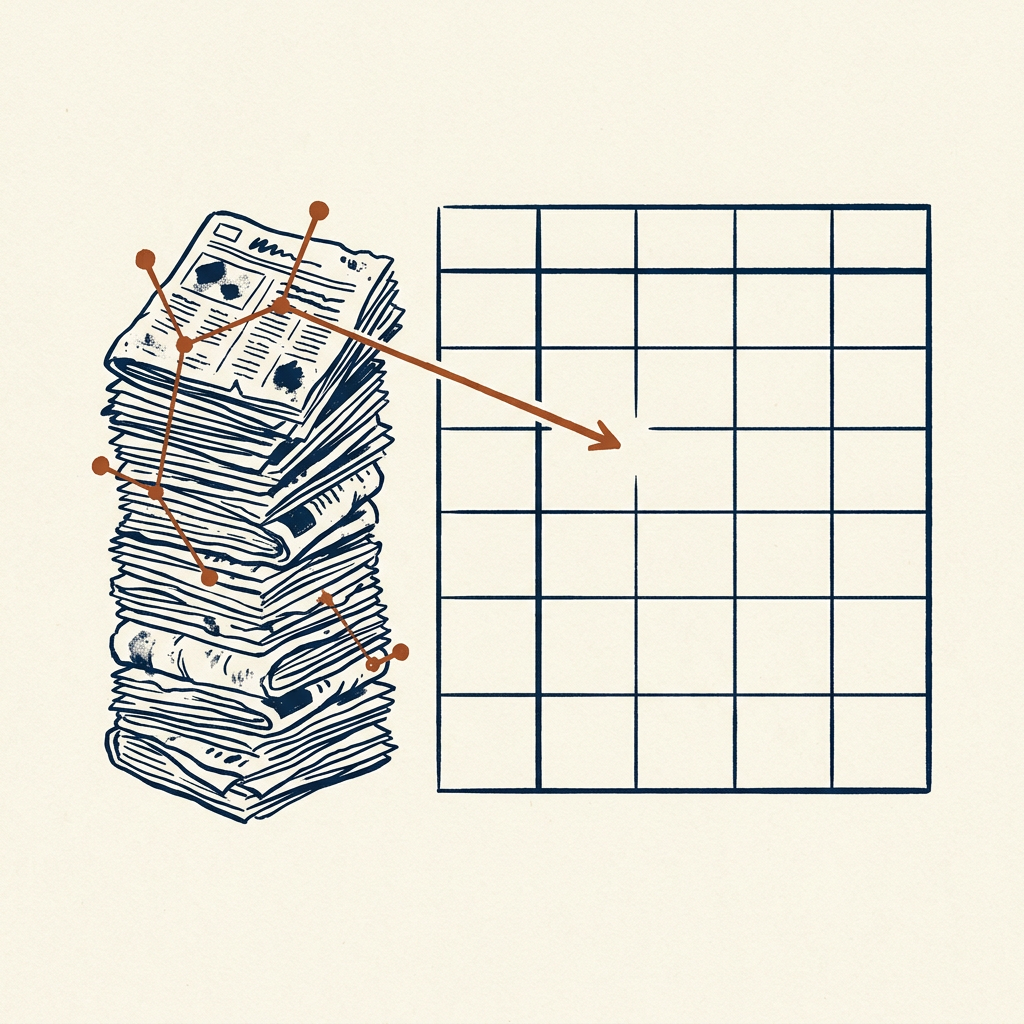
Digitized newspapers and word counts can track when narrative phrases surge, yet proving causation and building clean indices remains far harder than measuring prices.
What we can count
Word-frequency spikes for panic, bubble, new era in digitized archives
What stays fuzzy
Clean causation, belief versus mere mention, and working forecast indices
Shiller points to archives, Ngram-style frequencies, and counts of words like ‘panic,’ ‘new era,’ or ‘bubble’ as early instruments. Spikes sometimes precede or coincide with downturns, offering suggestive leads.
He is careful about the limits. Correlation does not settle which way causation runs. The same news event can both feed a narrative and be produced by forces already under way. Word counts also blur genuine belief with mere media repetition of a topic people may not act on.
The proposal is a research program, not a finished theory: build narrative indices the way price indices are built, then feed them into forecasts. Turning ‘stories mattered here’ into disciplined prediction still needed better text tools than existed when the book appeared.
In practice: Shiller shows phrases such as ‘stock market crash’ rising in print around actual downturns, while warning that the same spike can be both cause and symptom.
Key terms
- Narrative economics Treating popular stories about money and markets as measurable forces that help cause economic events
- SIR model Susceptible-infected-recovered framework borrowed from disease tracking and applied to how ideas spread
- Contagion rate How easily a story jumps from person to person or through media
- Recovery rate How quickly people lose interest or grow immune to a narrative
- Narrative constellation A recurring story template—such as automation fear or frugality—that reappears across eras in new dress
- Frugality narrative The Depression-era plot that cast spending as reckless and saving as virtue, feeding on itself
- Animal spirits Keynes’s earlier, less developed nod to confidence and psychology that Shiller aims to formalize
- Narrative index A proposed measure of story prevalence built like a price index and fed into forecasting models
What to do
- Ask what story is spreading before you react to any market move or headline.
- Track which phrases and slogans are gaining repetition around you this week and compare them with six months ago.
- Write down the narrative motivating your next investment or spending choice, then check the fundamentals on a separate page.
- Treat clear, repeatable, honest public messaging as a real economic tool when you lead or communicate.
- Discount any story that neatly profits the person telling it.
Questions to think with
- When did a story you believed move your spending or investing more than the underlying numbers did?
- Which current economic slogan is an old template wearing new clothes?
- How should a central bank answer a harmful narrative without sounding like propaganda?
- Can word counts ever separate real belief from media noise that nobody acts on?
- Whose interests does the loudest money story this month quietly serve?
The other side
The book diagnoses more convincingly than it predicts. Shiller shows stories correlating with turning points yet rarely pins clean causation—whether narratives drive shifts or merely echo credit, technology, or policy already under way. The recurring constellations are broad enough that almost any event can be fitted after the fact, weakening falsifiability. The epidemic analogy is imperfect because contagion rates are inferred from word counts that mix genuine belief with mere topical chatter. Institutional forces—regulation, wage power, balance-sheet mechanics—are treated as backdrop, which may overstate psychology’s share relative to credit-supply accounts. Practical tools stay thin: readers are told to watch stories, but working narrative indices were still exploratory in 2019. The historical lens stays mostly American and European, and manufactured propaganda is not cleanly separated from organic folklore even though their mechanisms differ.
Who it's for
Investors who watch markets swing on sentiment more than spreadsheets, policymakers and economists tired of models that miss turning points, and any reader who wants a clear map of how rumors, slogans, and folk beliefs help shape real booms and busts.