



Maté links decades of suppressed anger to later autoimmune illness

In 60 seconds
- Maté contends serious illness often follows decades of emotional self-denial rather than pure chance, genes, or habits.
- Patients with autoimmune disease, ALS, and cancer in his practice shared a striking inability to express anger on their own behalf.
- He describes a Type C style—compulsive pleasing, conflict avoidance, rigid 'goodness'—as a learned risk factor, not a sole cause.
- The stress system cannot tell a physical threat from a suppressed conflict, so chronic repression can elevate cortisol and weaken immune regulation.
- The pattern typically begins when childhood affection feels conditional on being agreeable and undemanding.
- He frames recovery as reclaiming the capacity to notice limits and say no beside medical care; the evidence is clinical narrative, not controlled proof.
The big idea
Maté argues that decades of suppressing anger and personal need to preserve relationships are not psychologically free—they leave a measurable trace through stress hormones and immune dysregulation. Autoimmune disease, cancer, and related illness can become the body's late refusal when someone has never been allowed to refuse in words.
The book in brief
Maté opens by rejecting disease as only bad luck, bad genes, or bad habits. He proposes that a lifelong habit of muting feelings that might disrupt relationships leaves a physiological mark through the linked nervous, endocrine, and immune systems. He stresses this is not blame or 'negative thinking causes cancer,' but a narrower claim that sustained self-suppression eventually bills the body. A scleroderma patient who said she had never raised her voice or stated a need stands as the kind of repeating clinical observation that drives the book.
He then builds a recognizable human type: people who look pleasant and competent yet cannot register or act on their own anger even when mistreated. Portraits include a woman with ALS who absorbed her husband's demands without complaint and Lou Gehrig's accommodating 'Iron Horse' reputation read against the disease that took his name. Rheumatoid arthritis and multiple sclerosis patients describe childhoods where showing distress cost parental affection, so they learned to mute it. The claim is not that one emotion causes one disease, but that a general style of emotional processing creates general vulnerability.
That style is named Type C—self-sufficiency, pleasing, difficulty telling one's needs from others' expectations, rigid commitment to being good or strong. Maté treats it as a childhood survival strategy gone automatic, illustrated by a breast-cancer patient who could detail every act of care for a demanding parent yet name almost none received in return. He next grounds psychology in physiology: the hypothalamic-pituitary-adrenal axis releases cortisol under perceived threat; sustained elevation can suppress immunity, impair repair, and disrupt inflammation. An internal conflict between felt and expressed emotion can run the same cascade daily. Caregiver studies showing elevated cortisol and reduced immune markers supply a biological signature for sustained relational strain, even while he admits precise emotion-to-disease chains remain unproven.
Attachment theory explains the origin. Children suppress legitimate anger or need when approval feels conditional, especially with depressed or unavailable parents; adults who never cried before a parent may still feel pride in that muting. Boundary-setting becomes a psychophysiological capacity—the ability to notice a violation signal before relationship needs override it. An inflammatory-bowel patient felt weeks of physical illness in a demeaning job yet named only gut and sleep symptoms until asked. Anger, properly working, is an early-warning system; suppress it and the body registers the breach late as symptom.
Maté extends the argument to population patterns: scleroderma, lupus, and rheumatoid arthritis strike women far more often, partly, he suggests, because caregiving roles demand more self-effacement and offer fewer accepted outlets for anger—one factor beside hormones and environment. He then indicts medicine's split between mind and body: training and short visits favor tests over questions about anger, boundaries, or family dynamics. His fix is additive, not replacement of drugs or surgery. The close argues genuine healing includes practicing needs and limits long suppressed, often in therapy beside medical care—not as guaranteed cure, but so the conscious self can say no before the body must.
Context
Drawing on his oncology and family practice plus stress-physiology research, Maté offered a clinically informed hypothesis rather than a controlled experimental proof. The book mattered because it pushed a widely read popular argument against mainstream medicine's strict separation of mind and body.
The key ideas
1
The body keeps score
Serious illness frequently follows decades of unconscious emotional self-denial rather than striking people at random.
Common story
Disease as bad luck, genes, or habits alone
Maté's claim
Lifelong emotional self-denial leaves a measurable physiological trace
Maté rejects the story that chronic disease is only misfortune, genes, or lifestyle. He holds that a person's emotional style—especially muting anything that might rock a relationship—leaves a physiological trace over years.
He is explicit this is not blame and not a claim that negative thoughts invent tumors. The narrower point is continuity: nervous, endocrine, and immune systems are not sealed off from psychological life, so sustained self-suppression shows up as strain.
He anchors the method in clinical narrative plus physiology research, not a single controlled trial. The pathway he flags is the hypothalamic-pituitary-adrenal axis and its effects on immune regulation—the bill the body eventually presents.
In practice: A woman with scleroderma described a marriage and family in which, by her own account, she had never once raised her voice or stated a need.
2
People who never get angry
Severe autoimmune illness and ALS patients in his practice shared a conspicuous inability to express anger on their own behalf even when it was warranted.
- EElizabethALS patient who absorbed a spouse's demands without complaint
- LLou Gehrig typeThe accommodating 'Iron Horse' reputation read against later neurological disease
- AArthritis and MS patientsChildhoods where showing distress cost affection, so distress was muted
Maté advances the case through patient portraits rather than abstraction. The shared trait is not general sadness; many present as unusually pleasant and competent.
What stands out is a specific incapacity to register or act on anger toward a mistreating spouse or employer—the ordinary protective response. He reads Lou Gehrig's ceaselessly accommodating reputation against the disease later tied to his name.
He admits the material is observational from oncology and family practice, not a randomized study, and correlation in a caseload is not proven cause. Still, repetition across cancer, arthritis, and neurological disease suggests a general vulnerability from a general emotional style.
In practice: Elizabeth, diagnosed with ALS, had spent her marriage absorbing her husband's demands without complaint.
3
The Type C pattern
A learned personality style—not genetic vulnerability alone—helps predict susceptibility to certain diseases as one risk factor among others.
Maté draws on and extends work such as Lydia Temoshok's Type C proposal for cancer patients, set apart from hostile, time-pressured Type A linked to heart disease.
As he describes it, Type C includes compulsive self-sufficiency, a drive to please and avoid conflict, trouble separating one's needs from others' expectations, and rigid commitment to being good or strong at any cost. He treats it less as a fixed trait than as a childhood survival strategy that became automatic.
He notes Type C traits appear in people who never fall ill, which blocks any simple prediction, and he places the pattern beside genetics, toxins, and chance—not as a sufficient cause. The daily asymmetry of giving care without receiving it, repeated for years, is what he says loads chronic physiological stress.
In practice: A breast-cancer patient could recall every instance of caring for a demanding parent yet struggled to name a single instance of that parent caring for her.
4
Stress hormones and immunity
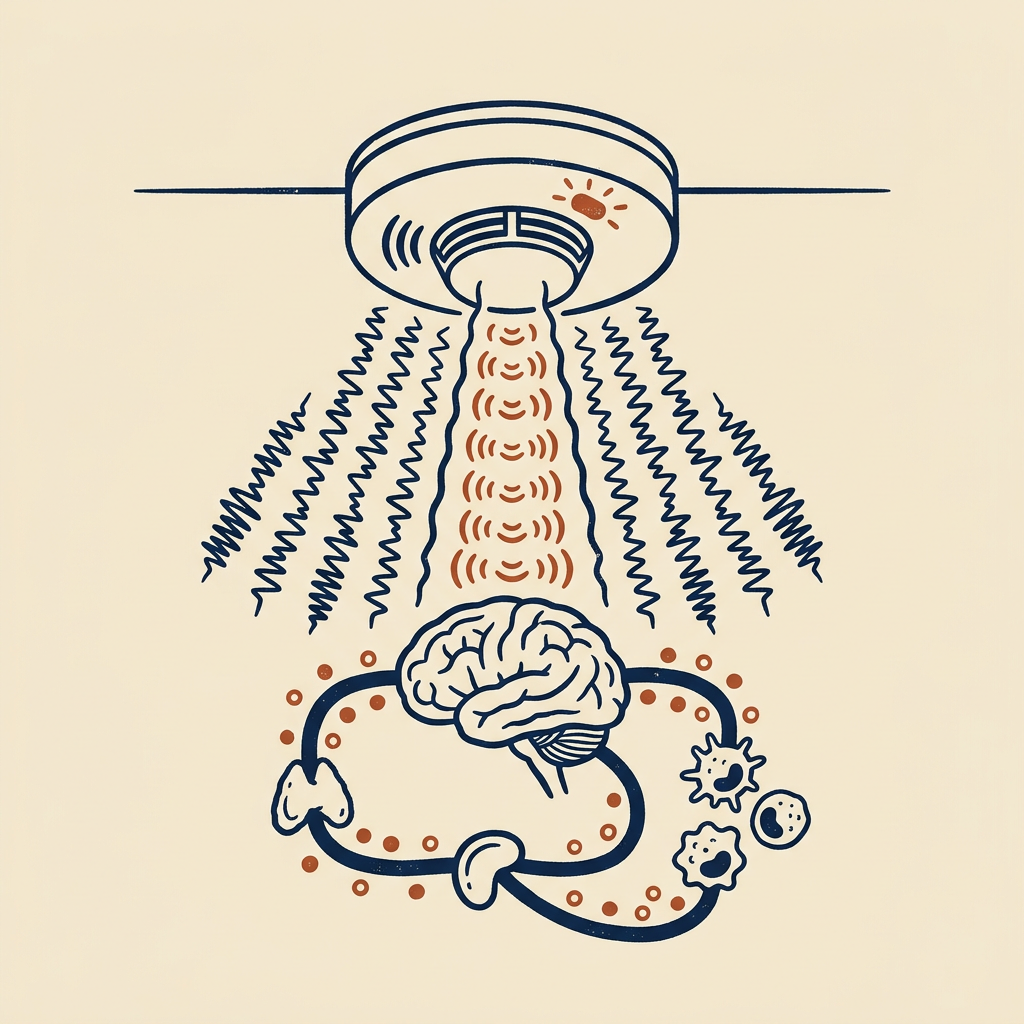
The stress-response machinery cannot distinguish a physical threat from a suppressed emotional conflict, so chronic repression can drive the same hormonal cascade as chronic danger.
Maté explains the hypothalamic-pituitary-adrenal axis that releases cortisol when threat is perceived. Work building on Hans Selye's stress studies shows sustained cortisol elevation can suppress immune function, impair tissue repair, and disrupt inflammation control.
The nervous system does not need a visible external danger; a daily internal clash between what is felt and what is allowed expression can trigger the cascade for years without being labeled 'stress.'
He is candid that psychoneuroimmunology was still young at publication and that a precise chain from one repressed emotion to one disease in one patient outran the evidence. What he says the research supports is weaker but important: chronic stress degrades immune regulation, and emotional repression is an underexamined source of that stress.
In practice: Studies on caregivers of chronically ill relatives showed measurably elevated cortisol and reduced immune markers compared with non-caregivers.
5
Where the pattern begins
Children suppress their own needs when parental affection feels conditional on being agreeable, and that template persists unexamined into adult health.
Maté turns to attachment work, including John Bowlby's, to explain Type C rather than only describe adult symptoms. Infants and children depend so fully on caregiver approval that they will mute legitimate anger or need if it risks that bond.
In homes with a depressed, overwhelmed, or unavailable parent, being undemanding and cheerful can become the price of connection. Decades later, patients may not recall ever crying in front of a parent and may treat that silence as pride rather than loss.
He frames this as usually unintended—family stress passed down without being named. The adult who cannot refuse an employer or spouse is often running a childhood safety strategy long after it stopped being adaptive, which is why information alone rarely undoes it.
In practice: Patients who could not recall ever crying in front of a parent and described that restraint as a point of pride.
6
The biology of saying no
Recognizing and acting on one's limits is one psychophysiological system; people who cannot set boundaries pay a bodily cost for the gap between what they feel and what they allow.
Anger working
Early signal that a limit was crossed; action possible
Anger suppressed
Warning disabled; body registers the breach later as symptom
Boundary-setting, Maté argues, is not merely polite communication. It is the capacity to notice an internal signal of discomfort or violation and act before the need to keep a relationship overrides it.
In patients who repeatedly develop stress-related illness, that felt boundary often arrives late, faintly, or not at all—trained out early. The symptom can substitute for the no that was never spoken.
Anger, when it works, signals and enforces limits. A person who learned to suppress anger has disabled an early-warning system, leaving the body to register chronic violation only as somatic breakdown. He ties this to the prior stress-hormone account without claiming individual-case proof.
In practice: A patient with inflammatory bowel disease felt physically ill for weeks in a demeaning job yet described only gastrointestinal symptoms and sleep disruption until specifically asked about the work.
7
Gender, care, and risk
Cultural expectations that assign women the bulk of nurturing and self-effacing labor partly help explain sex disparities in some autoimmune diseases.
- Population patternHigher rates of certain autoimmune diseases in women
- Social assignmentCaregiving and self-effacing labor disproportionately expected
- Emotional mechanismMore chronic suppression of need and anger under relational strain
- Individual bodiesStress physiology accumulating beside hormones and environment
Maté notes scleroderma, lupus, and rheumatoid arthritis occur far more often in women than men, and he argues biology alone does not exhaust the gap.
The social role of primary emotional caretaker—especially in earlier generations—structurally requires suppressing one's needs and offers fewer accepted outlets for anger than scripts often available to men. He lists this as one factor beside hormonal immune differences and does not call it sufficient alone.
If repression under chronic relational strain is a real risk factor, arrangements that assign more of that strain to one group should show up partly in that group's disease rates. Male patients in his account more often had culturally easier routes to outward anger and different stress-related forms such as cardiovascular disease.
In practice: Composite stories of women who had no language or permission for anger toward husbands or children, set against freer outward-anger scripts Maté saw more often in some male patients.

8
Medicine's blind spot
Conventional medicine's split between psychological and physical causation leads physicians to overlook diagnostic and therapeutic information relevant to chronic illness.
Maté holds that training itself produces the gap. Doctors learn to ask about family disease history, diet, and toxins, yet rarely about emotional history, family dynamics, or the capacity to express anger or set boundaries—data he argues carry weight for chronic and autoimmune conditions.
He describes his own early years treating patients without questions that later revealed patterns he had missed. Causes include the historical split between psychiatry and the rest of medicine and appointment pressures that favor ordering a test over exploring relational history.
He rejects replacing pharmacology or surgery with emotional explanation and calls purely emotional treatments dangerous when they delay needed care. His position is additive: psychological history beside blood work and imaging, and treatment plans that attend to emotional patterns because they affect recovery and relapse.
In practice: Maté's own early practice, in which he treated patients for years without asking about anger, boundaries, or family emotional dynamics he later found revealing.
9
Reclaiming what was repressed
Recovery from stress-related illness requires consciously reclaiming suppressed anger and unmet needs, not only treating the physical symptom.
Because Type C formed in childhood and hardened over decades, Maté argues undoing it takes more than insight. It takes practicing, often for the first time in adulthood, the expression of needs and limits once suppressed for survival.
Patients who added therapy to medical care did not mostly report cure. They reported a changed relation to illness: noticing anger as it arose rather than weeks later as a symptom, and willingness to disappoint others in small ways once forbidden.
He stays modest—no claim that emotional work reverses autoimmune disease or cancer—and repeats that this supplements rather than replaces medical treatment. The larger aim is diagnostic: name the pattern early, ideally before illness. When someone cannot say no in words, the body may say no in symptoms; recovery is learning to speak it first.
In practice: Patients in therapy beside medical treatment who became able to notice anger as it arose and to disappoint others in small ways they had never previously allowed.
Key terms
- Type C pattern A learned style of compulsive pleasing, conflict avoidance, self-sufficiency, and rigid goodness that Maté links to higher vulnerability for some illnesses.
- HPA axis The hypothalamic-pituitary-adrenal stress system that releases cortisol when threat—outer or inner—is perceived.
- Emotional repression Habitually muting feelings, especially anger and need, to keep relationships intact.
- Psychoneuroimmunology The study of how psychological life, the nervous system, and immune function interact; still developing when Maté wrote.
- Boundary capacity The bodily ability to notice a limit being crossed and act before relationship pressure overrides the signal.
- Chronic cortisol load Sustained stress-hormone elevation that can suppress immunity, slow repair, and dysregulate inflammation.
- Attachment survival strategy Childhood muting of need or anger to protect caregiver approval when affection feels conditional.
- Additive care Maté's stance that emotional history and work sit beside—not instead of—drugs, surgery, and standard workups.
What to do
- Pause before answering a request you resent and notice the bodily signal—tightness, fatigue, sink—before you agree.
- Say no once this week to a recurring ask from a boss, relative, or friend, plainly, without over-explaining or double apologies.
- Bring your emotional and family history to your next medical visit as added information, not as a substitute for treatment.
- If even small refusals feel impossible, treat that difficulty as information and consider starting therapy.
- Track one moment daily when anger or a limit appears late as a symptom rather than as a spoken need.
Questions to think with
- Where in your week do you agree first and only later notice resentment or fatigue?
- What childhood rule about being 'good' or 'easy' still decides your nos and yeses?
- If anger is an early-warning system, what warning have you been trained not to hear?
- What would change at your next medical appointment if emotional history sat beside lab work?
- Which small disappointment of someone else feels newly allowable this month?
The other side
The core weakness is method: evidence is mostly Maté's own caseload told as story, open to selection bias, with cited work largely correlational and later psychoneuroimmunology mixed on personality predicting specific outcomes; the book can still load blame onto the ill, underweights genes, toxins, infection, and poverty, generalizes from a Canadian clinical world, and leaves its gender explanation speculative beside stronger hormonal accounts—best read as a hypothesis that opened conversation, not established fact, and never instead of standard medical care.
Who it's for
People living with autoimmune disease or cancer who want a framework beyond purely biomedical stories; therapists, nurses, and physicians curious about emotion-immune links; and adults who recognize themselves as lifelong caretakers who cannot set boundaries or express anger.