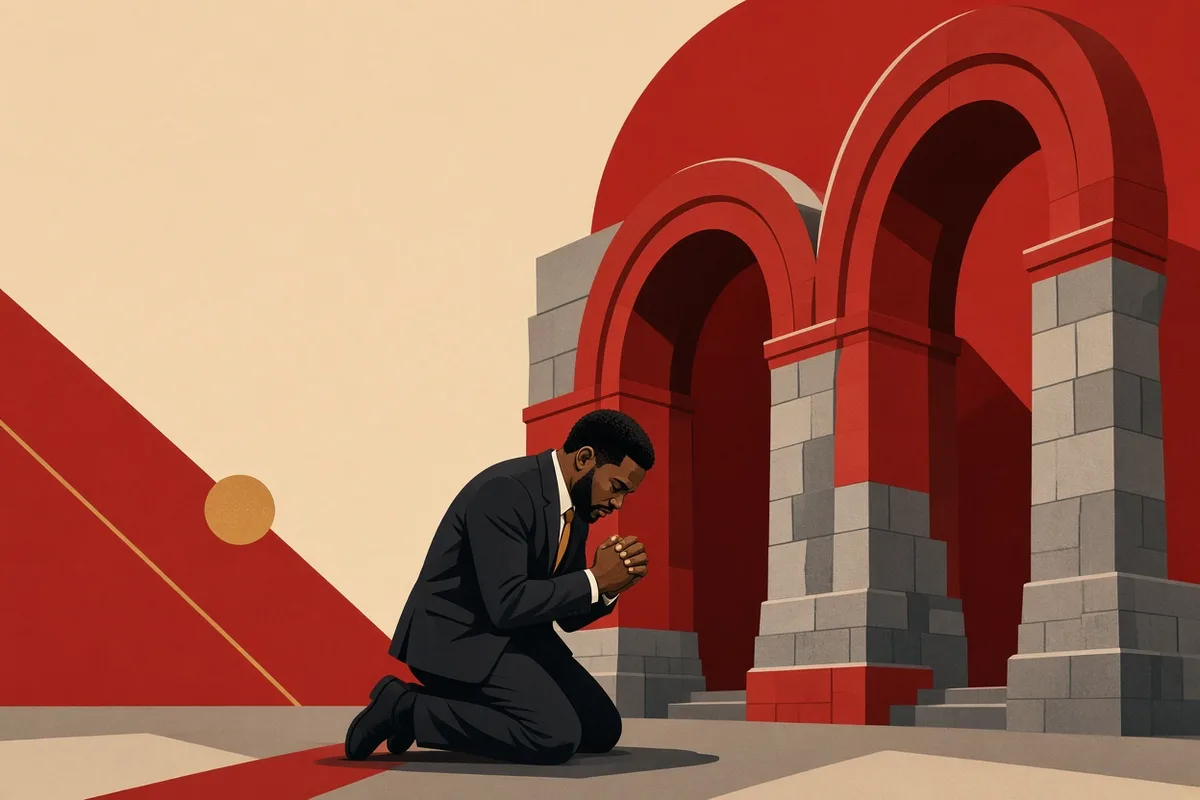



T. S. Eliot Joins Church of England
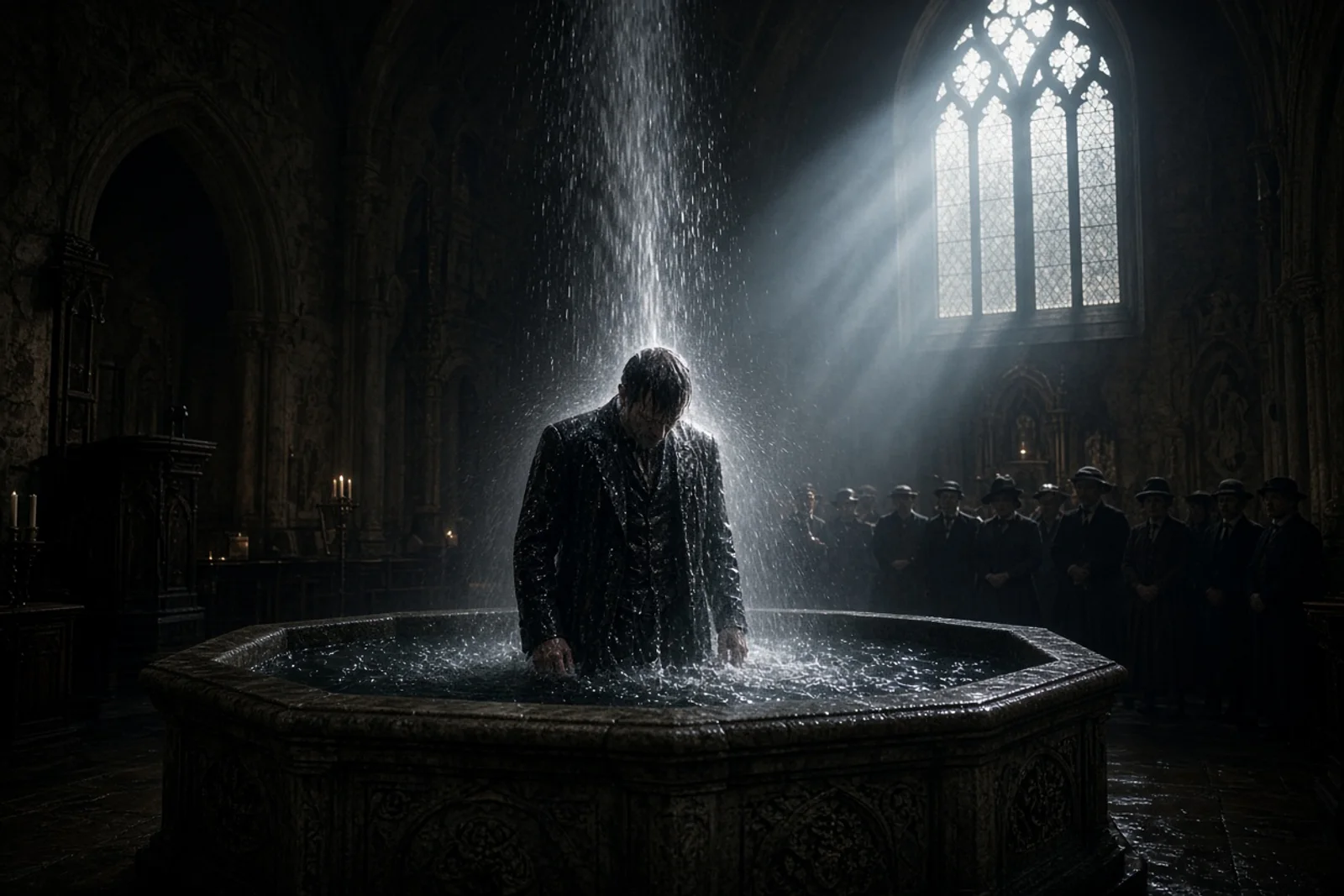
I pulled the collar higher on my coat as the motorcar turned onto the lane toward Finstock. Rain had fallen through the night and the hedgerows still dripped onto the windscreen. The driver cut the engine fifty yards short of the church and sat with his hands on the wheel while I stepped out. The building stood low and grey, its door already shut from inside. A single lamp burned above the porch.
Eliot had arrived earlier with Stead. They had come separately, Eliot by train from London and Stead from his parish duties. No one else waited in the lane. The churchwarden had been asked to keep the key turned until the service ended. I stayed outside because that was the arrangement. From the road I could hear nothing except the wind moving through the yew trees.
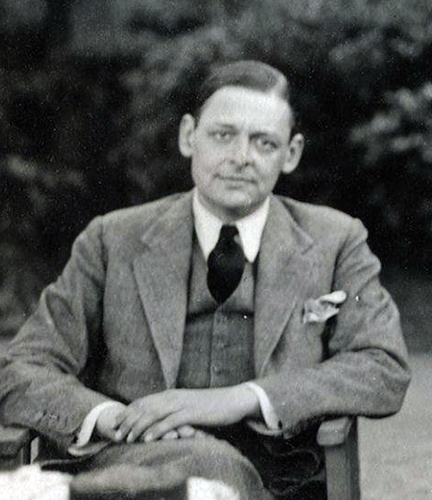
Stead had agreed only after Eliot insisted on absolute privacy. The clergyman disliked any show of feeling in such matters and had given his word that the registers would record the names without further notice. Eliot wanted the same restraint from everyone else present. I had known him since the early days of The Criterion and had seen how he measured every public word. That morning he measured this one as well.
The door opened again after nearly an hour. Eliot came out first, hat in hand, his face still damp from the font. Stead followed and locked the door behind them. They spoke for a moment on the step, then separated. Eliot walked toward the waiting car without looking back at the building. I fell into step beside him. Neither of us mentioned what had just taken place inside.
The next morning we drove the short distance to Cuddesdon. Bishop Strong met us in the chapel there. The confirmation was brief and followed the order set down in the prayer book. Eliot answered the questions in the same low voice he used when reading proofs. Strong laid his hands on him and spoke the appointed words. When it was finished we returned to the motorcar and Eliot asked the driver to take the longer road back to Oxford so he could reach his rooms before midday.
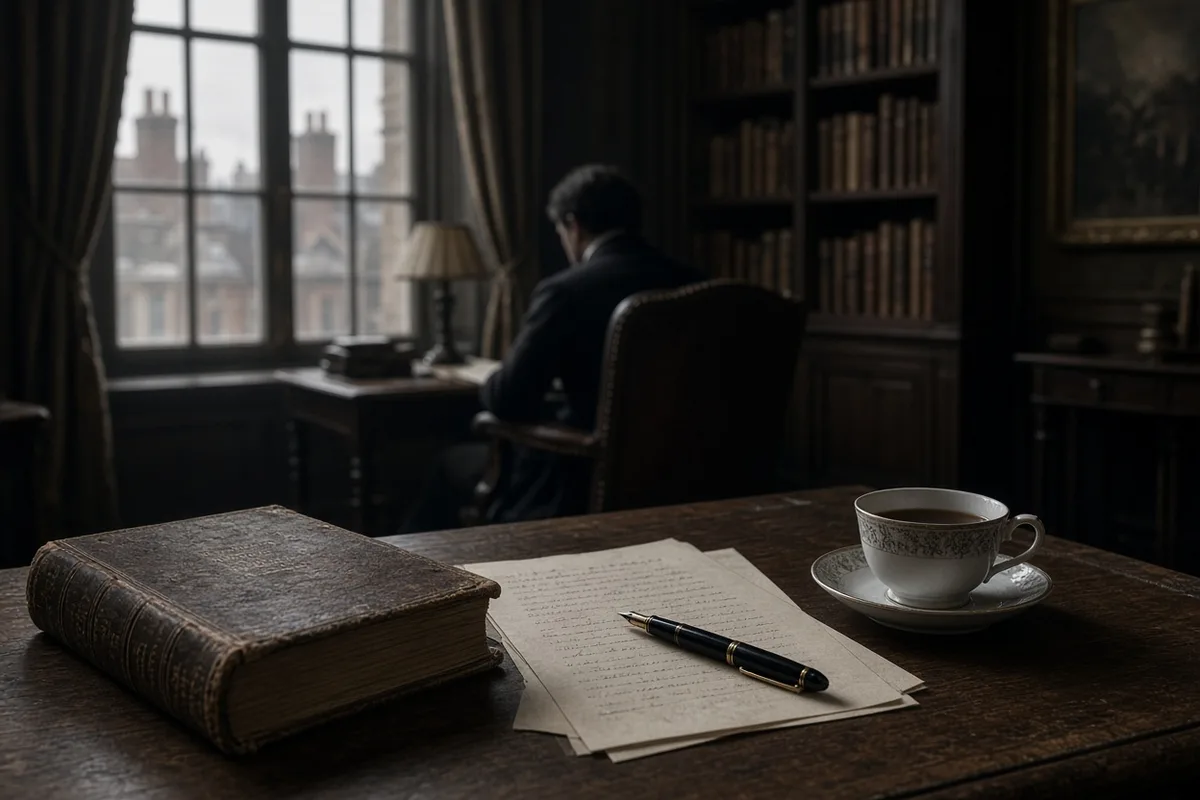
In the months that followed he continued at Lloyds Bank during the week and kept the same hours at his desk. He still edited The Criterion and met contributors in the same rooms. The only change anyone outside a handful of people could notice was that he now attended early services at St Stephen’s, Gloucester Road, on Sundays. He did not speak of it unless asked directly.
Virginia Woolf heard the news through mutual friends and wrote to him at once. She asked whether he now handed round the plate and what he felt when he prayed. Eliot answered her letter in his usual measured sentences and let the matter rest there. He had already told another correspondent that he hated spectacular conversions and would not supply any account of his own.
By the time he wrote the foreword to For Lancelot Andrewes the following year, the fact was public. He stated his position plainly: classicist in literature, royalist in politics, anglo-catholic in religion. Some readers treated the sentence as a sudden turn. Those who had watched him through the years after The Waste Land knew the ground had been prepared longer than any single morning in Finstock.
He left Lloyds Bank in 1925 and joined Faber and Gwyer, later Faber and Faber. The daily work of reading manuscripts and corresponding with authors occupied the same hours the bank had once taken. In the evenings he wrote. Ash-Wednesday appeared in 1930. The lines carried the same attention to rhythm and exact word that had shaped his earlier poems, yet the subject was now the movement of a soul toward order rather than the fragments of a ruined city.
Murder in the Cathedral was first performed in 1935. Eliot attended the early rehearsals in the Chapter House at Canterbury and made small adjustments to the verse when the actors needed clearer stresses. He did not discuss the theology with the company beyond what the text itself required. After the first night he returned to London on the late train and was at his desk the next morning.
The separation from Vivienne had already taken place by then. She remained in the flat they had shared; he took rooms nearby and later moved to a flat of his own. The legal end of the marriage came years afterward. In 1957 he married Valerie Fletcher. She managed his correspondence and guarded the papers that accumulated in the flat. After his death she prepared the volumes of letters for publication, checking every date and name against the originals.
The Four Quartets were written across the war years. Eliot read the sections aloud to small groups when they were finished, testing the cadence against the sound of a human voice in a room. He made no claim that the poems explained his faith; he only said they recorded the attempt to find words for what could not be stated directly.
On the last afternoon I saw him he was sorting papers at the table in his study. A pile of letters lay to one side, already tied with string for the archive. He looked up once when the clock struck and then returned to the work. Outside the window the streetlamps had come on. He reached for the next envelope without hurry, as though the evening still held several hours of useful light.
He remained at the table until the last envelope had been opened and its contents noted in the margin with a small pencil mark. The following week he met with Frank Morley at the Faber offices in Russell Square to discuss the proofs for the American edition of his collected poems, and the two men walked together along Southampton Row to the British Museum reading room where Morley needed to check a reference in the 1623 folio of Donne’s sermons. Eliot’s health had already begun to limit his movements by then, yet he continued to arrive at the office each morning at nine and left only after the evening post had been cleared. In 1948 the Swedish Academy awarded him the Nobel Prize for Literature, and the citation named the “pioneer daring” of his experiments in verse; he sent a brief cable accepting it and asked that the medal be forwarded to his bank rather than presented at a public ceremony in Stockholm.
Valerie Fletcher had joined the firm as his secretary in 1949, and by 1952 she was handling all his appointments and the daily correspondence that arrived from universities and little magazines. They were married on 10 January 1957 at St Barnabas Church in Kensington; the service was performed by Father Thomas Roberts and attended by only six people, including Eliot’s solicitor and Valerie’s sister. After the ceremony they took a short train to Yorkshire, where they stayed three nights at the Spa Hotel in Whitby before returning to the flat at 3 Kensington Court Gardens. In the years that followed she typed the drafts of his later lectures and accompanied him on the annual visits to the Edinburgh Festival, where he served on the drama panel until 1963.
On 4 January 1965 he suffered a heart attack in the flat and was taken by ambulance to the Middlesex Hospital; he died there at six minutes past midnight without regaining consciousness. Valerie arranged for the body to lie overnight at St Stephen’s, Gloucester Road, where Canon John B. B. McDonald read the burial office the next afternoon. The coffin was then driven to Golders Green Crematorium, and the ashes were placed in a sealed urn that remained in her keeping until March, when she carried them herself on the train to Yeovil and onward by motorcar to East Coker. There, on 17 March, the urn was interred in the church floor beneath a plain stone inscribed only with the dates 1888–1965 and the line from East Coker that reads “In my beginning is my end.”
Valerie returned to the flat and began the systematic ordering of his papers, separating the manuscripts into chronological series and placing each year’s letters into acid-free folders. In 1969 she edited the facsimile edition of The Waste Land drafts, reproducing every cancelled line and marginal note from the original typescript that had been given to John Quinn in 1922. She continued this work through the 1970s, answering queries from scholars at Harvard and the Bodleian while refusing all requests for personal reminiscences. The first volume of the Letters appeared in 1988 under Faber’s imprint, containing 734 items from the years 1898 to 1922 and accompanied by a 42-page index of correspondents that included Wyndham Lewis, Ezra Pound, and Harriet Shaw Weaver.
The second volume, covering 1923 to 1925, was published in 2009 after additional letters surfaced in the archives of the New York Public Library and the University of Texas. By that date the T. S. Eliot Society, founded in 1984, held its annual meeting at the Institute of English Studies in London each July, with sessions devoted to the unpublished Clark Lectures of 1926 and the correspondence with Emily Hale that had been opened to researchers in 2020. A blue plaque was fixed to the wall of the former Faber building in 1986, and another marks the Kensington flat where he died; both carry only his name and the dates of residence.
On a weekday morning in 2023 a research student from King’s College London stood at the reading-room desk in the Bodleian and requested the folder containing Eliot’s 1935 letter to Bishop George Bell concerning the final revisions to Murder in the Cathedral. The archivist brought the folder, already opened to the correct page, and the student copied out the sentence in which Eliot wrote that the chorus must remain “the voice of the ordinary man” rather than any liturgical choir. When the copying was finished the folder was returned to its box, the box was replaced on its shelf, and the student walked out through the courtyard where the plane trees were already dropping their first leaves onto the gravel path.
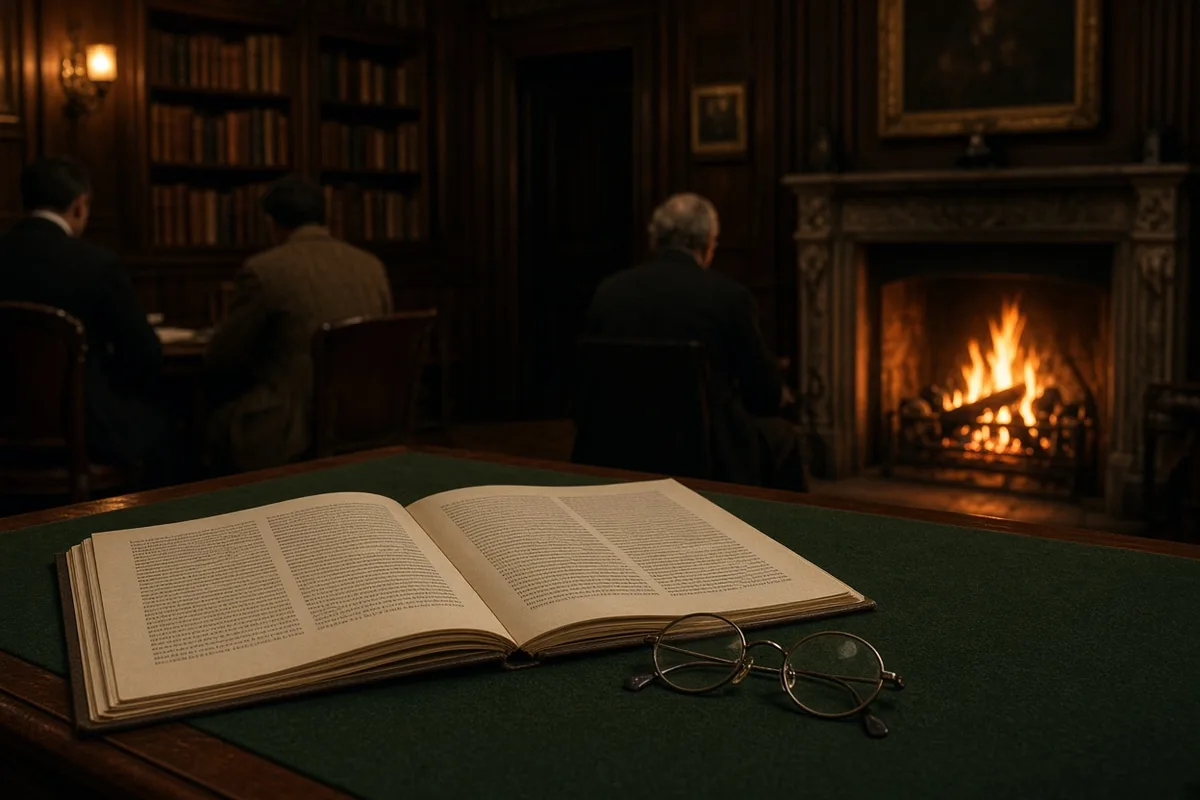
The Bodleian’s reading-room log for that morning recorded the student’s request under the call number MS Eng. lett. d. 432, and the archivist noted the exact time of return as 11:17 a.m. Three days later the same folder was requested again, this time by Professor Ronald Schuchard of Emory University, who checked the marginal note Eliot had added in pencil to the 1935 letter: “Bell suggests ‘ordinary Christian’—prefer the stricter phrasing.” Schuchard copied the sentence into his notebook and then examined the attached carbon of Bishop Bell’s reply dated 12 November 1935, which had been filed with the letter when the papers reached the library in 1978.
In 2024 the T. S. Eliot Estate granted permission for a new facsimile of the 1922 typescript held at the New York Public Library. The edition, prepared by the University of Virginia Press, reproduced every cancelled line from the section originally titled “He Do the Police in Different Voices,” including the 47 lines deleted after Pound’s marginal comments of January 1922. The press run was limited to 750 numbered copies, each bound in quarter-cloth with a tipped-in reproduction of the telegram Eliot sent to Quinn on 19 January 1922 confirming receipt of the $150 payment.
That same spring the Eliot Society’s annual meeting moved from London to the University of York for a three-day session on the Clark Lectures of 1926. Dr. Sarah Kennedy of Cambridge presented a paper that quoted Eliot’s 14 March 1926 letter to John Hayward, in which he described the audience at Trinity College as “thirty-seven persons, most of them asleep after the third lecture.” The paper was followed by a visit to the York Minster library, where participants examined the 1635 edition of Lancelot Andrewes’s XCVI Sermons that Eliot had cited in his 1926 notes.
On 17 March 2025 a small group gathered at East Coker church for the sixtieth anniversary of the interment. The rector, the Reverend Dr. James Butterworth, read the same passage from the burial office that Canon McDonald had used in 1965. Valerie Eliot’s urn remained beneath the stone, and the only addition since the original placement was a second inscription cut in 1996 recording her own dates, 1926–2012, at the foot of the same slab. After the service the group walked the short distance to the village hall, where the parish council displayed the original 1930s Ordnance Survey map that Eliot had consulted when writing the opening lines of East Coker.
The following October the British Library acquired the final portion of Eliot’s working library from the Kensington flat. Among the 1,184 volumes transferred were his annotated copy of the 1928 Prayer Book, with underlinings on pages 237 and 238 marking the confirmation service, and a first edition of The Book of Common Prayer (1662) that carried his ownership signature dated 29 June 1927. The acquisition was catalogued under Additional Manuscripts 89001–89012, and the volumes were placed on open access in the Rare Books and Music reading room beginning in January 2026.
A postgraduate researcher from the University of Leeds visited the British Library on 9 June 2026 to examine the newly catalogued volumes. She requested Eliot’s copy of the 1928 Prayer Book, opened it to the confirmation pages, and transcribed the marginal note he had written in ink beside the rubric for the laying on of hands: “Strong’s hands were steady—unlike the tremor in his voice when he reached the final sentence.” After completing the transcription she returned the volume to the issue desk, collected her coat from the cloakroom, and walked out into the courtyard where the plane trees were already dropping their first leaves onto the gravel path.